Search This Blog

Saturday, 5 January 2013

David Nicholls: The half hour that changed my life


Recently I became confused about my age. For some reason I came to believe that I was 46 years old, instead of 45. The error was pointed out to me, and once I’d got over the embarrassment of forgetting my own age (not the kind of mistake I’d make at 19 or 27 or even 36), I had a brief moment of elation. In some way, hadn’t I gained an extra year, a whole 12 months of time that I’d mislaid? What could I do with my precious 46th year? Take up the violin, train for a marathon, learn carpentry or juggling or Spanish?
What I really wanted to do was read.
I’ve been a compulsive reader for as long as I can remember. For the best part of my childhood I visited the local library three or four times a week, hunching in the stacks on a foam rubber stool and devouring children’s fiction, classics, salacious thrillers, horror and sci-fi, books about cinema and origami and natural history, to the point where my parents encouraged me to read a little less. I loved television and movies, too, but the solitary act of reading was always my greatest pleasure. Books were an obsession – an education, an escape and inspiration.
So why, as an adult, was I reading so little, less than even 10 years ago? Of course the multiple distractions of modern life, the increasing demands of work and a new family all played a part, along with the bleeps and trills of technology, the constant tap on the shoulder that comes from texts, emails, mobile phones, because God forbid that I should call someone back or reply to an email a whole hour later.
If reading is simply the act of consuming text, then in fact I was probably reading more than ever, but for the most part it was nonsense, jabber and jargon. Like most people who work in front of a screen, I’d developed a terrible internet tick, cycling endlessly around the same websites, reading the same urgent “breaking news” 10 times a day, peering pointlessly at film premiere reports, gossip and Twitter feuds, movie trailers, updating iTunes and Adobe Acrobat for the 25th time, habits that devoured hours of my day, the hours that presumably I once gave to reading books. 
I was still buying books, far more than I could ever possibly read, but buying them is not the same as reading them, or loving them. All they did was furnish the room. The piles got higher, the irritation and guilt and regret increased. Reading was like sunbathing – something that I only did for two weeks in August.
About a year ago I decided to do something about all this. Along with the usual vows about exercise and fresh vegetables, caffeine and alcohol, I resolved to set my alarm one half-hour earlier, to sit up straight and read again. Unusually for a resolution, I’m pleased to say that I have stuck to that routine, and now those first 30 minutes of solitary reading are all too often the best part of my day.
I’ve read missing classics and new authors. I’ve finally devoured those writers who’ve been repeatedly recommended to me – Patrick Leigh Fermor, Alice Munro, Elizabeth Taylor, Marilynne Robinson – and, yes, they are wonderful. I’ve managed to reread some of Cheever’s brilliant short stories, and rediscovered writers who’ve unaccountably fallen off the literary map, like the great US writer John Williams or the neglected H E Bates. It’s not just fiction, either – there’s the brilliant journalism of John Jeremiah Sullivan, contrasting histories of cinema by David Thomson and Mark Cousins. Robert Macfarlane’s fascinating mix of geology, mythology and natural history. The unread pile still teeters precariously, but at least I’ve made a start.
Of course, there have been lapses along the way. I’ve slipped back into sleep more than once during The Portrait of a Lady, and there have been one or two hangover-induced lie-ins. Getting up earlier means going to sleep earlier, which isn’t always much fun. And I’ve yet to conquer my shaming addiction to electronics. I still find it absurdly difficult to concentrate on a novel if there’s a phone or computer to hand; I have taken to locking them outside the room like noisy pets. Thirty minutes is also a fairly puny amount of time. I’ve tried to turn off the TV and extend the hours into the evening, but reading a book – even a great book – after 9pm has the same effect on me as a chloroformed handkerchief. Mornings remain the best time, especially in spring or summer when the house is quiet, reading as the sun comes up.
“Just half an hour a day can change your life.” It’s the sort of dubious claim you find in the back of a magazine, and I’m aware of a zealot’s shrillness in all of this. I know that for every reader who has lost the habit or can’t find the time, there are people who’ve never enjoyed reading and question the value of literature, either as entertainment or education, or believe that a love of books, and of fiction in particular, is sentimental or frivolous. Given an extra half-hour a day, I know that some people would much prefer to be jogging or bantering on social networks or simply sleeping some more. “No one reaches the end of their life and wishes they’d spent more time on Twitter” is a claim I’ve heard before, but perhaps that won’t always be the case.
But to allow the zealot his voice again, think of what you might be missing by not finding the time to read. Allowing for a steady pace of a page a minute, you could easily take in a short story by Chekhov or Raymond Carver or Richard Yates every morning of next week.
An Alice Munro might take two days, but it will be worth it. The Great Gatsby could be read in four mornings or, if that’s too obvious, there is always Tender is the Night, a much better book I think. Other novellas – there’s The Good Soldier or The End of the Affair or Franny and Zooey or Goodbye, Columbus. Or something more recent – Denis Johnson’s Train Dreams, a small masterpiece and the best book I read last year. Or something lighter; have you ever read Ian Fleming? Casino Royale ’s a terrifically invigorating book to read before breakfast. Or why not start something more ambitious: Anna Karenina or Bleak House or Les Misèrables might last you into March, but Great Expectations or Persuasion or Madame Bovary will take half that time.
And then there are the Man Booker nominations, and the fine new work that’s coming out of independent presses, and the book of that film you saw, and travel writing before you go away, and poetry and, come to think of it, isn’t now the perfect time to read a really good biography of Napoleon?


Friday, 4 January 2013

How algorithms secretly shape the way we behave


Algorithms, the key ingredients of all significant computer programs, have probably influenced your Christmas shopping and may one day determine how you vote
Srudens
Program or be programmed? Schoolchildren learn to code. Photograph: Alamy
 
Keynes's observation (in his General Theory) that "practical men who believe themselves to be quite exempt from any intellectual influences, are usually the slaves of some defunct economist" needs updating. Replace "economist" with "algorithm". And delete "defunct", because the algorithms that now shape much of our behaviour are anything but defunct. They have probably already influenced your Christmas shopping, for example. They have certainly determined how your pension fund is doing, and whether your application for a mortgage has been successful. And one day they may effectively determine how you vote.

On the face of it, algorithms – "step-by-step procedures for calculations" – seem unlikely candidates for the role of tyrant. Their power comes from the fact that they are the key ingredients of all significant computer programs and the logic embedded in them determines what those programs do. In that sense algorithms are the secret sauce of a computerised world.

And they are secret. Every so often, the veil is lifted when there's a scandal. Last August, for example, a "rogue algorithm" in the computers of a New York stockbroking firm, Knight Capital, embarked on 45 minutes of automated trading that eventually lost its owners $440m before it was stopped.

But, mostly, algorithms do their work quietly in the background. I've just logged on to Amazon to check out a new book on the subject – Automate This: How Algorithms Came to Rule Our World by Christopher Steiner. At the foot of the page Amazon tells me that two other books are "frequently bought together" with Steiner's volume: Nate Silver's The Signal and the Noise and Nassim Nicholas Taleb's Antifragile. This conjunction of interests is the product of an algorithm: no human effort was involved in deciding that someone who is interested in Steiner's book might also be interested in the writings of Silver and Taleb.

But book recommendations are relatively small beer – though I suspect they will have influenced a lot of online shopping at this time of year, as people desperately seek ideas for presents. The most powerful algorithm in the world is PageRank – the one that Google uses to determine the rankings of results from web searches – for the simple reason that, if your site doesn't appear in the first page of results, then effectively it doesn't exist. Not surprisingly, there is a perpetual arms race (euphemistically called search engine optimisation) between Google and people attempting to game PageRank. Periodically, Google tweaks the algorithm and unleashes a wave of nasty surprises across the web as people find that their hitherto modestly successful online niche businesses have suddenly – and unaccountably – disappeared.

PageRank thus gives Google awesome power. And, ever since Lord Acton's time, we know what power does to people – and institutions. So the power of PageRank poses serious regulatory issues for governments. On the one hand, the algorithm is a closely guarded commercial secret – for obvious reasons: if it weren't, then the search engine optimisers would have a field day and all search results would be suspect. On the other hand, because it's secret, we can't be sure that Google isn't skewing results to favour its own commercial interests, as some people allege.

Besides, there's more to power than commercial clout. Many years ago, the sociologist Steven Lukes pointed out that power comes in three varieties: the ability to stop people doing what they want to do; the ability to compel them to do things that they don't want to do: and the ability to shape the way they think. This last is the power that mass media have, which is why the Leveson inquiry was so important.

But, in a way, algorithms also have that power. Take, for example, the one that drives Google News. This was recently subjected to an illuminating analysis by Nick Diakopoulos from the Nieman Journalism Lab. Google claims that its selection of noteworthy news stories is "generated entirely by computer algorithms without human editors. No humans were harmed or even used in the creation of this page."

The implication is that the selection process is somehow more "objective" than a human-mediated one. Diakopoulos takes this cosy assumption apart by examining the way the algorithm works. There's nothing sinister about it, but it highlights the importance of understanding how software works. The choice that faces citizens in a networked world is thus: program or be programmed.

Thursday, 3 January 2013

Martin Sorrell's peculiar vision of corporate social responsibility

Outlook Sir Martin Sorrell has expressed himself on the great corporation tax debate. What firms need to understand, the advertising magnate said today, is the imperative of corporate social responsibility.
"Doing good is good business," he told the likes of corporate black sheep such as Starbucks and Amazon, which have faced obloquy in recent months for paying less than their fair share of profit taxes in the UK. I'm afraid this is richer than the Christmas pudding that your grandmother oversoaked in alcohol. For Sir Martin's record on tax hardly resembles a model of virtuous corporate citizenship.

For several decades the British state has had a system whereby a UK-based multinational is required to pay corporation tax on its worldwide profits. In 2007 the Labour government proposed to move to a system where firms would only pay tax on their UK profits, a so-called territorial regime. This was good news for the multinationals, implying a smaller tax bill. But they didn't trust Labour to deliver.

So they upped sticks in a kind of pre-emptive protest. Pharmaceutical giant Shire shifted its headquarters to the Irish Republic. So did United Business Media. The exhibitions and magazines group Informa scurried off to Switzerland. The office accommodation provider Regus went to Luxembourg. And, making the biggest song and dance of all was Sir Martin, who shuffled his WPP advertising empire to the Emerald Isle.

Faced with this exodus the Labour Chancellor, Alistair Darling, redoubled his efforts to establish a territorial tax regime. And Sir Martin made it his business to seal the deal. He extracted a guarantee from Mr Darling's successor, George Osborne, that the new territorial regime would definitely come into force. And, in return, Sir Martin announced last year that WPP would be returning its HQ to London. The territorial corporation tax regime came into full force this week. And WPP is, as Sir Martin promised, on its way back.

The trouble is the new territorial tax regime looks even more open to corporate tax avoidance. Under the old system HMRC could, in theory, go after tax on profits anywhere in the world. It seldom did this effectively. But now, with its territorial remit in place, it is even less likely to do so. And there is still more room for clever accountants to register profits overseas by registering intellectual property rights in tax havens.

This compounds the advantage of multinationals in relation to smaller, domestic firms. We have long known that income tax tends to be for the little people. It increasingly looks like corporation tax is only for the little companies.

The only solution is harmonised international governmental agreement to prevent multinationals playing off national governments against each other on profit tax rates.

As for Sir Martin, he might like to consider whether quitting the country and promising to return only when a law you dislike is changed can be considered "doing good".

Why do UK rail fares keep rising?

With train companies, Network Rail and the Government involved, the answer is far from simple

Fed up: protesters against a rise in rail fares in King’s Cross Station - Why do our rail fares keep rising?
Fed up: protesters against a rise in rail fares in King’s Cross Station Photo: AFP/Getty Images
Here we go again. It’s a new year but an old story. Commuters are up in arms about rises in rail fares and they’re looking for someone to blame.
Aside from the fact that central London was half empty yesterday and finding a seat on a train would have been no problem for most, they have a good point. This is the 10th successive year of above-inflation fare rises, and there is no sign of any change in policy coming until the next general election at least, and probably well beyond that.

But finding the right target for passenger anger is made difficult by the fact that transparency is not a feature of the rail industry and railway economics remains a dark art. The train companies, the Government, previous governments, and even Network Rail (responsible for the track and infrastructure) are all in the frame for blame. And actually, all of them deserve at least a bit of buckshot, if not a high-velocity bullet.

The railways may have been privatised in the mid-Nineties, but in reality they are a mix of private and state interests, with most of the purse – and other – strings still being pulled by the Government. Forget the notion of a raw capitalistic enterprise with energetic entrepreneurs seeking innovative ways to fleece the public: the train operating companies are pretend capitalists who have very little room for manoeuvre and invest very little. They complain that they make only a 3 per cent profit – or around £250 million annually – yet that is a misleading figure, based not on investment, as with a conventional company, but on turnover.

The train companies will receive a proportion of the extra fare income that yesterday’s rises generate, thanks to an opaque process that began last summer. Once the fare rises (which are based on July’s inflation figures) are known, the Department for Transport (DFT) and train companies begin negotiations over how the spoils should be divided. This is because rising fares will deter some passengers from travelling, and under the franchise agreements the DFT has to compensate the private companies for this loss.

However, given the recent inept performance of the DFT over the West Coast franchise, it would not be reckless to suggest that perhaps the train companies get rather more of this extra dosh than they need to cover any passengers lost as a result of the rises. The projections and the sums of money that follow are, of course, “commercially confidential”, and therefore not released to the great unwashed British public.

There is a real irony here. The legislation to regulate season tickets and off-peak fares was designed, at the outset of privatisation, to protect passengers from greedy private companies exploiting their monopoly position. Originally, the rises for “regulated” fares were set at the RPI measure of inflation minus 1 per cent, as a way of encouraging rail travel. In fact, since 2003 – when the formula was changed by the Labour government to RPI plus 1 per cent – the legislation that supposedly protects consumers has been used against them.

However, the situation with unregulated fares – which represent about half the income of the train companies – is completely different. Train operators are free to set all other fares, which include the very expensive peak fares on intercity and other routes, first class and advanced, and all of the increase will go to them.

For their part, the train operators argue that the extra revenue from unregulated fares is needed in order to meet the financial arrangements that come with the franchise deals – most of the train companies pay an annual premium to the Department for Transport. They say these unregulated fares are set commercially because operators face competition from airlines or the roads. But many people making occasional journeys at peak times have no option but to travel then, and are therefore heavily penalised for their lack of flexibility.

A spokesman for the train operators justifies the situation by saying: “Train companies have to meet tough financial commitments agreed with the Government when franchise agreements are signed.” It is also the case that since 2007 there has been a cross-party policy of increasing the share of the cost of the railways paid by rail users, which is now around two thirds, compared with less than 50 per cent six years ago. Yet this does not negate the fact that the train operators decide the level of unregulated fares and many have gone up far more than regulated fares. A peak return from London to Manchester in standard class, for example, is now a stunning £308.

Provided the DFT gets its sums vaguely right, the Government therefore will receive a substantial proportion of the money from increased fares. Ministers’ explanation for the rises is that this money will be used for investment in the railways – but the relationship between investment and fare rises is a distant one.

In fact, the amount of investment going into the railway for extra capacity such as improved track and better signalling is determined by a complex process of negotiation involving Network Rail, the Office of Rail Regulation and the Department for Transport. Ministers set out an investment programme in five‑year periods – the current one runs out in March 2014 – and allocate funds accordingly, and then the Office of Rail Regulation assesses whether enough money is available to carry out the plans. Network Rail then undertakes the work, primarily through contractors.

New trains are provided through a different, and similarly tenuous, relationship. The Government will determine that there is a need for new trains and build this into franchise contracts. The trains are then leased, with the operators paying for them out of their income from the fare box and any subsidy they receive from the DFT. However, the level of fare rises is not linked to the acquisition of new rolling stock. As one angry rail traveller tweeted yesterday: “Why should I pay more to travel in Lincolnshire when the services and rolling stock are so bad?”

Overall, then, there is very little relationship between yesterday’s fare rises and future investment plans. Indeed, for the past two years, the Government, in the face of public pressure, has backed down from proposed fare increases of RPI plus 3 per cent to the current RPI plus 1 per cent, which has resulted in a reduced income of around £250 million annually – enough to kick-start an investment programme of, say, £2.5 billion. Yet there has been no suggestion from ministers that this cut in fares income will reduce the amount available for investing in the railways.

The position of Network Rail – a state-owned company in all but name – adds to the confusion. It spends around £6 billion a year on maintaining the railways but has been sharply criticised for excessive costs. A report in the spring of 2010 by Sir Roy McNulty, the former chairman of Short Brothers, the airline manufacturer, identified wasted spending amounting to 30 per cent.

Network Rail is therefore being required to cut costs; McNulty reckoned it could save £1.8 billion by 2019. Justine Greening, who was Transport Secretary until the autumn reshuffle, argued that if these reductions were made then fares could, in future, be held steady, but few industry insiders believe that such big cuts could be made without compromising performance or safety.

So the real blame for the fare rises must lie with us, the passengers, and our appetite for rail travel. Ever since the early Nineties, passenger numbers have kept on rising steadily. Remarkably, even the long-term trend of passenger numbers falling during recessions has been reversed, as numbers have continued rising except for 2009-10, and even then the fall was very small.

The one way to ensure that fare rises are lower in the future is for more people to shun the railways and use the alternatives – or simply not travel. While numbers keep rising, even in times of recession, why should either the train companies or their political masters change the policy?

Christian Wolmar is a writer and broadcaster specialising in transport.

Wednesday, 2 January 2013

USA - Congress's manufactured non-solution to its manufactured fiscal cliff crisis


This fiscal cliff deal doesn't stop tax hikes, doesn't reduce the deficit, doesn't avoid spending cuts … and it's not even a deal
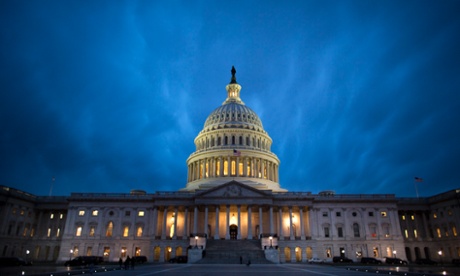
The U.S. Capitol is pictured on the night the U.S. appears set to go over the so-called fiscal cliff in Washington, DC.
The Capitol as the US went over the 'fiscal cliff' in Washington, DC. Photograph: Jim Lo Scalzo/EPA

It is a habit of the United States Congress never to congratulate itself until it has utterly failed to accomplish what it set out to do. Needless to say, the Congress is particularly delighted with its work in leaping over the fiscal cliff last night.

Of course, it will never be put that way. Amid the usual Washington smoke and mirrors, lawmakers will talk about the benefits of the deal: it will cut taxes; it has come in time to avoid the real fiscal cliff; it will reduce the US budget deficit; it will represent a bipartisan agreement to fix America's debt problems.

It does precisely none of those things.

The much-praised deal is as thoughtless and hasty as you would expect from anything cobbled together at the last minute. Lawmakers should regard it not with self-congratulatory glee, but with suitable shame at their failure to think through major issues that impact the American economy. As the humorist Andy Borowitz concisely put it on Twitter this morning:
Taken point by point, the deal looks even less worthy of praise.

Tax cuts – and hikes

While the Senate agreement was designed to protect the middle class by allowing the Bush era tax cuts to rise for people making $450,000 and above, don't believe anyone who tells you that it's a tax cut. In fact, all Americans are going to be paying higher taxes through their paychecks, starting today 1 January, because Congress has allowed the payroll tax cut to lapse. President Obama cut the payroll tax to 4.2% from 6.2% in 2010; now, those taxes are going back up.

The cost is noticeable. It will amount to $1,000 a year out of the pocket of Americans making $50,000pa. That could be a mortgage payment, or nearly a year's cellphone bills, or a vacation.
In addition, the middle-class Bush era tax cuts will be extended for only five more years, so expect more dithering in 2018 about the value of the middle class to the US economy. Luckily, that will only be a year for midterm elections that affect Congress, not another presidential election.

Spending cuts: sequester postponed

Nor does the deal avoid the uncertainty and economic disaster avoided with the fiscal cliff. In fact, it creates an even bigger cliff – really, a fiscal mountain – in March. The Senate refused to come to an agreement on the actual "cliff" part of the fiscal cliff: sweeping government spending cuts that were designed in 2011 to be so stupidly punitive that they would never be passed. Instead of sitting down and thoughtfully coming up with a new set of spending cuts, the Senate has pushed the issue off for two months. That deadline coincides with the moment that the US will hit its debt limit.

The result: the new fiscal cliff will have even higher stakes, as the US could spend the next two months wrestling with even greater potential economic disaster, and a more dire impact on the markets. Now, it's not just some spending cuts that are on the table; it's the full faith and credit of the US government. That was already proven in 2011 to be an ill-judged candidate for congressional toying, but the addiction of the drama and adrenaline appears to be too much to resist for those in Congress.

The deficit and debt: revenues reduced

As for the deficit, that will actually grow under this deal, partly because the tax cuts now don't apply to many of the rich. When the president aimed for $250,000 in income and above for tax hikes, that encompassed about 2% of American taxpayers. But the new $450,000 threshold covers less than 1% of Americans. That means less money to cut the deficit, and more coming in spending cuts – very likely, to important government programs.

A deal far from done

And lastly, the bipartisan nature of the deal is something that is unlikely to last after the House meets to talk about it this New Year's Day. Whatever joy the Senate has with its 89-8 landslide agreement achieved at the ungodly hour of 2.07am, news channels featured an endless stream of Republican lawmakers in the House of Representatives talking about their unlikeliness to vote for the deal. One of them compared his plan to vote against the deal to dying in honor on a battlefield.

The deal is not a complete disaster, although most of what it does well is completely and obviously necessary. The best thing that it does is extend unemployment benefits for millions of Americans – at least, for another year – and revoke an ill-judged $900m automatic pay hike for members of Congress. It also extends tax breaks for research and development and interest on student loans: this is important as student loan debt now exceeds credit card debt in the United States.

So, after a day, and week, and year filled with manufactured drama, the US Senate not only failed its only goal – reducing the US deficit – but also built a mountain range out of the molehill of budget talks. But tell that to lawmakers patting themselves on the back.

"For the first time in years, we will have a major issue settled with a bipartisan vote," Senator Dianne Feinstein crowed. Vice-President Biden, asked what was his selling point to Senate Democrats, modestly declared, "Me." He expanded later on how he did it – not with reasoned arguments about the duty of the Congress and the American economy, but with this folksy negotiation tactic: "I said, 'this is Joe Biden and I'm your buddy.'" Harry Reid graded his fellow failing congressional students on a curve: "It's disappointing that we didn't get the grand bargain … but we tried."

Well, at least they tried, right? Except that won't be good enough for the millions of Americans who have their pensions invested in the stock market and the bond market. We already know that the markets don't care a fig about tax policy; but when it comes to the debt limit, they react disastrously.
Columbia Professor Emanuel Derman depended on a classic quote when he tweeted his reaction to the Senate's last-minute deal for the fiscal cliff:
The worst part, Derman might have added, is that we are only, after all this, at the first act.

Saudi Arabia's riches conceal a growing problem of poverty


In a country with vast oil wealth and lavish royalty, an estimated quarter of Saudis live below the poverty line
Saudi Poverty
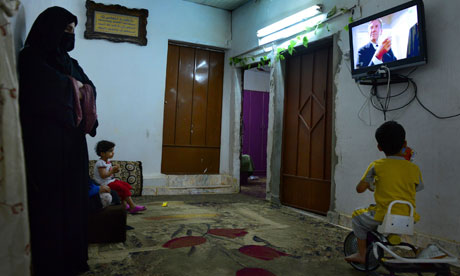
The children of Souad Al-Shamir watch television in their living room in Riyadh, Saudi Arabia. Photograph: Linda Davidson/Washington Post
 
A few kilometres from the blinged-out shopping malls of Saudi Arabia's capital, Souad al-Shamir lives in a concrete house on a trash-strewn alley. She has no job, no money, five children under 14 and an unemployed husband who is laid up with chronic heart problems.

"We are at the bottom," she said, sobbing hard behind a black veil that left only her eyes visible. "My kids are crying and I can't provide for them."

Millions of Saudis struggle on the fringes of one of the world's most powerful economies, where jobs and welfare programmes have failed to keep pace with a population that has soared from 6 million in 1970 to 28 million today.

Under King Abdullah, the Saudi government has spent billions to help the growing numbers of poor, estimated to be as much as a quarter of the native Saudi population. But critics complain that those programmes are inadequate, and that some royals seem more concerned with the country's image than with helping the needy. In 2011, for example, three Saudi video bloggers were jailed for two weeks after they made an online film about poverty in Saudi Arabia.

"The state hides the poor very well," said Rosie Bsheer, a Saudi scholar who has written extensively on development and poverty. "The elite don't see the suffering of the poor. People are hungry."

The Saudi government discloses little official data about its poorest citizens. But press reports and private estimates suggest that between 2 million and 4 million of the country's native Saudis live on less than about $530 a month – about $17 a day – considered the poverty line in Saudi Arabia.

The kingdom has a two-tier economy made up of about 16 million Saudis, with most of the rest foreign workers. The poverty rate among Saudis continues to rise as youth unemployment skyrockets. More than two-thirds of Saudis are under 30, and nearly three-quarters of all unemployed Saudis are in their 20s, according to government statistics.

In just seven decades as a nation, Saudi Arabia has grown from an impoverished backwater of desert nomads to an economic powerhouse with an oil industry that brought in $300bn last year.

Forbes magazine estimates King Abdullah's personal fortune at $18bn, making him the world's third-richest royal, behind the rulers of Thailand and Brunei. He has spent government funds freely on high-profile projects, most recently a nearly $70bn plan to build four "economic cities", where government literature says "up to 5 million residents will live, work and play".

The king last year also announced plans to spend $37bn on housing, wage increases, unemployment benefits and other programmes, which was widely seen as an effort to placate middle-class Saudis and head off any Arab Spring-style discontent. Abdullah and many of the royals are also famous for their extensive charitable giving.

For many years, image-conscious Saudi officials denied the existence of poverty. It was a taboo subject avoided by state-run media until 2002, when Abdullah, then the crown prince, visited a Riyadh slum. News coverage was the first time many Saudis saw poverty in their country.

Prince Sultan bin Salman, a son of Crown Prince Salman, said in an interview that the government has acknowledged the existence of poverty and is working to "meet its obligations to its own people".
Prince Sultan said the Saudi government was "three to five years" away from dramatically reducing poverty through economic development, micro-lending, job training and creation of new jobs for the poor.

The Saudi government spends several billion dollars each year to provide free education and health care to all citizens, as well as a variety of social welfare programmes – even free burials. The government also provides pensions, monthly benefits and payments for food and utility bills to the poor, elderly, disabled, orphans and workers who are injured on the job.

Much of the welfare spending comes from the Islamic system of zakat, a religious requirement that individuals and corporations donate to charity 2.5% of their wealth; the money is paid to the government and distributed to the needy.

"Living in Saudi Arabia is like living in a charitable foundation; it is part and parcel of the way we're made up," Prince Sultan said. "If you are not charitable, you are not a Muslim."

Despite those efforts, poverty and anger over corruption continue to grow. Vast sums of money end up in the pockets of the royal family through a web of nepotism, corruption and cozy government contracts, according to Saudi and US analysts.Bsheer said some Saudi royals enrich themselves through corrupt schemes, such as confiscating land from often-poor private owners, then selling it to the government at exorbitant prices.

At the other end of the spectrum, many of the poorest Saudis are in families headed by women such as Shamir, who are either widowed, divorced or have a husband who cannot work. Under Islamic law, men are required to financially support women and their children. So women who find themselves without a man's income struggle, especially because the kingdom's strict religious and cultural constraints make it hard for women to find jobs.

The situation for many families, including Shamir's, is worse because they are "stateless" and not officially recognised as Saudi citizens, even though they were born in the country.

The UN estimates that there are 70,000 stateless people in Saudi Arabia, most of them descended from nomadic tribes whose traditional territory included parts of several countries. Their legal limbo makes it harder for them to receive government benefits.

Shamir, 35, lives in the shadow of a huge cement factory. The houses and streets are covered in a haze of smoke and dust. Her concrete house is down a narrow alley, where graffiti covers the cracked walls and litter piles up in the street. Her landlord is threatening to kick her out, and a local shop owner has cut off her credit for food and gas for her stove. She lives mainly on charity from wealthy Saudis who show up with food and clothes.

One recent morning, her children ran to the door to help unload food being dropped off by a middle-class Riyadh couple in an SUV. Shamir said donations help her pay for the electricity to run an air conditioner, but she does not have enough to buy school supplies for her children.

While middle-class Saudi youths have all the latest gadgets, Shamir's 14-year-old daughter, Norah, has never sent an email or seen Facebook. Her husband has a second wife who has another 10 children. Most of them are unemployed.

Shamir said her husband earned about $500 a month as a security guard until his health forced him to quit five years ago. She said she has tried in vain to find work as a seamstress or a cleaner.
"I've been patient all these years," Shamir said. "I hope that God will reward me with a better life for my children."

• This story appeared in Guardian Weekly, which incorporates material from the Washington Post

Tuesday, 1 January 2013

We avoided the apocalypse – but 2013 will be no picnic


The world hasn't ended, but global leaders will still have to work hard to manage economic trials and social tensions
Andrzej Krauze 31 December 2012
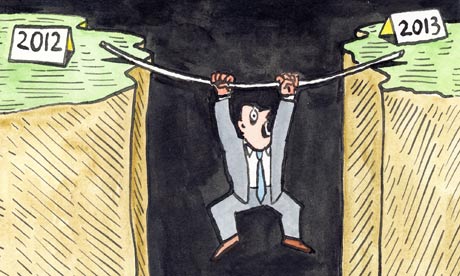
‘The eurozone is entering a make or break year, with the social fabric of the periphery countries stretched to the limit.' Illustration: Andrzej Krauze
 
 
The world did not end this year, as some people thought it would following a Mayan prophecy (well, at least one interpretation of it), but it seems pretty certain that next year is going to be tougher than this one.

We are entering 2013 as the Republican hardliners in the United States Congress does its utmost to weaken the federal government, using an anachronistic law on federal debt ceiling. Until the Republicans started abusing it recently, the law had been defunct in all but name. Since its enactment in 1917, the ceiling has been raised nearly a hundred times, as a ceiling set in nominal monetary terms becomes quickly obsolete in an ever-growing economy with inflation. Had the US stuck to the original ceiling of $11.5bn, its federal debt today would have been equivalent not even to 0.1% of GDP (about $15tn) – the current debt, which is supposed to hit the $16.3tn ceiling today, is about 110% of GDP.

A compromise will be struck in due course (as it was in 2011), but the debt ceiling will keep coming back to haunt the country because it is the best weapon with which the extremists in the Republican party can advance their anti-state ideology. This ideology has such a hold on American politics because it taps into the anxiety of the majority of the white population. Being squeezed from the top by greedy corporate elite and from the bottom by new immigrants, they seek solace in an ideology that harks back to the lost golden age of (idealised) 18th-century America, made up of self-defending (with guns), free-contracting (white) individuals who are independent of the central government. Unless mainstream American politicians can offer these people an alternative vision, backed up by more secure jobs and a better welfare system, they will keep voting for the extremists.

Meanwhile, on the other side of the Atlantic, the eurozone is entering a make or break year, with the social fabric of the periphery countries stretched to the limit. With its GDP 20% lower than in 2008, with 25% unemployment rate and with the wages of most of those still in work down by 40% to 50%, it is a real touch and go whether the current Greek government can survive another round of austerity. Spain and Portugal are not yet where Greece is, but they are hurtling down that way. And even the infinitely patient Irish are beginning to vent their anger against the inequities of the austerity programme that has hit the poorest the hardest. Should any of these countries socially explode, the consequences could be dire, whether they technically stayed in the eurozone or not.

As for the UK, 2013 may become the year when it sets a dubious world record of having an unprecedented "triple-dip recession". Even if that is avoided, with high unemployment, real wages that are at best stagnant and swingeing welfare cuts, many people will struggle to make ends meet. In a letter to the Observer yesterday, the leaders of the city councils of Newcastle, Liverpool and Sheffield, have even warned of a "break-up of civil society", should the austerity programme continue.

European leaders need to work out new economic programmes with a more equitable sharing of the burden of adjustment, both within and between countries. Paradoxically, they can look towards Iceland, the canary that first died in the mine of toxic debt, for a lesson. The country has been recovering rather well, considering the scale of the banking crisis, while making spending cuts in a way that impose the least burden on the poorest: between 2008 and 2010, income of the poorest 10% fell by 9% while that of the richest 10% fell by 38%.

Things look brighter in the Asian countries, with their economies growing much faster and with even Japan ready to make a dash for growth through more relaxed monetary and fiscal policies. However, they – especially the two giants of China and India – have their own shares of social tension to manage.

Growth is slowing down in China. It is estimated to have grown by 7.5% in 2012, well below the usual rate of 9% to 10%. Some forecast that its growth rate will pick up again to above 8% in 2013, but others believe it will fall below 7%. Given the country's heavy reliance on exports to the US and the European Union, the more pessimistic scenario seems likely, as things don't look very good in those economies. With slower economic growth it will become more difficult to manage the social tension that has been bubbling up thanks to runaway inequality and high levels of corruption.

Management of social tension will be an even bigger challenge for India. Its economic growth has significantly slowed down since 2010, and few predict a major reversal of the trend in 2013. Add to this economic difficulty deepening economic, religious and cultural divisions, and you have a heady mixture, as we see in the social unrest following the recent gang rape and death of a young medical student.

If the political leaders of the major economies do not manage these social tensions well, 2013 could be a year in which the world takes a turn for the worse. It is a huge challenge, as it is like trying to fix a car while driving it. However, without fixing the malfunctioning car, we will not get out of the woods, however much extra fuel, like quantitative easing, we pour into the car.

Friday, 14 December 2012

Jacintha Saldanha: Duchess hospital nurse suicide note 'criticised hospital'


A suicide note left by the nurse found dead after the hoax call to the hospital treating the Duchess of Cambridge criticised fellow staff, it emerged tonight. 

The letter was one of three Jacintha Saldanha, 46, wrote before she was found hanging in her room at a nurses’ accommodation block at the King Edward VII Hospital in London last Friday.
Injuries to her wrists were also found, a coroner heard today. Attempts were made to revive the nurse but they were "to no avail".

Mrs Saldanha, from Bristol, had left three suicide notes for her family and had also written emails and made telephone calls that police believe might help shed light on what happened, the court was told.

Tonight, reports claimed that one note specifically addresses her employers and criticism of hospital staff despite officials previously maintaining they were fully supportive of the nurse. 

The Guardian reported that one note also specifically referred to the hoax call made by the two Australian radio presenters while a third detailed wishes for her funeral.
Two notes were found at the scene in central London and the third recovered in the nurse’s belongings.

The mother of two’s family has been given typed copies of the three handwritten notes by the police and has read the contents, the Guardian claimed.

It has been reported that the family did not know about the hoax call until after Mrs Saldanha’s death.
Today, during a five-minute hearing at Westminster Coroner’s Court, Det Chief Insp James Harman said Mrs Saldanha, a night sister, was found by a colleague and a security guard who called the emergency services.

DCI Harman told the court: “At this time there are no suspicious circumstances apparent to me in relation to this death.”

Detectives are talking to witnesses, friends, colleagues and Mrs Saldanha’s telephone contacts, DCI Harman said, in order to establish the circumstances that may have led to, and contributed, to her death.

Referring to the two 2 Day FM presenters who made the prank call, he added: “You will be aware of the wider circumstances in this case and I can expect in the very near future we will be in contact with colleagues in New South Wales to establish the best means of putting the evidence before you.”
Coroner’s officer Lynda Martindill said Mrs Saldanha’s accountant husband Ben Barboza, 49, had identified her body. The coroner opened and adjourned the inquest, with a full hearing listed for March 26 next year.

None of Mrs Saldanha’s family attended the hearing, but one of her colleagues was there. The coroner said: “Can I express my sympathy to you and to the family.”

Mrs Saldanha was a nurse at King Edward VII hospital, West London, where the Duchess of Cambridge was being treated for severe pregnancy sickness.

During the hoax call, the nurse transferred the DJs, believing they were the Queen and Prince of Wales, to a colleague who described in detail the condition of the Duchess of Cambridge during her hospital treatment for severe pregnancy sickness.

The Australian DJs, Mel Greig and Michael Christian, have both issued emotional apologies for her death and have since been moved into “safe houses” and given 24-hour bodyguards after receiving death threats.

It emerged last night that the broadcasters responsible for airing the call are to be officially investigated by the Australian Communications and Media Authority, which regulates radio broadcasting, in line with the Commercial Radio Codes of Practice.

Her family are set to receive more than £320,000 from Southern Cross Austereo, the parent company for whom the presenters work for.

The hearing comes on the day that Southern Cross Austereo (SCA) is to resume advertising on 2 Day FM. All profits from the adverts until the end of the year will be donated to a memorial fund established in aid of her family.

Keith Vaz, the Labour MP who is helping Mr Barboza, daughter Lisha, 14, and son Junal, 16, said a memorial service would be held in Bristol tomorrow, followed by one in Westminster Cathedral on Saturday. The hospital has offered bereavement counselling for the family in Bristol, which they have decided to take up, he added.

He did not attend the hearing but said of the family: “They are grieving in their homes, they are comforting each other and the community is comforting them, that is why they have not come.” Her body was released to her family in order to arrange her funeral in India.

A hospital spokeswoman tonight said no one in senior management knew what the contents of the notes left were but she said officials “were very clear that there were no disciplinary issues in this matter”.

Both the nurses involved had been offered “full support” and “it was made clear they were victims of a cruel journalistic trick,” she added.


Thursday, 13 December 2012

Why England's spinners are better


Monty Panesar celebrates his first wicket with Graeme Swann, Pakistan v England, 2nd Test, Abu Dhabi, 1st Day, January, 25, 2012
Swann and Panesar have been more impressive than the Indian spinners, despite theoretically having had to bowl to batsmen more adept at playing spin © Getty Images
Enlarge

A look at why Panesar and Swann have outbowled Ojha and Ashwin in India

December 13, 2012


There were times in India when the sight of a spinner running in to the crease was intimidating for the batsman. The close-in fielders hovered, standing by to take the catches that would inevitably be produced. Back then Indian spinners sent out strong signals - that they were as lethal as the Caribbean quick bowlers, and no second fiddles. Invariably India's spinners were superior to those from other countries, and the land of Bedi, Chandrashekhar and Prasanna kept producing quality spinners, so much so that some of them didn't even play for India - for these three kept going for years. 

Today, though, even on wilting, dusty turners, Indian spinners don't hold the same threat. For the longest time, dishing out a dustbowl guaranteed success, for India's batsmen would score a mountain of runs and the spinners would bowl the opposition out twice, double quick. But since the retirement of Anil Kumble, things have changed.
The signs of the downward spiral have been there for everyone to see. The lowest ebb has been reached in the ongoing series against England - probably the first time in Indian cricket's history that a visiting team from outside the subcontinent has had the services of better spinners, and the decision to dish out a rank turner has been more likely to backfire on India than guarantee success - as happened in Mumbai.

Why is it that Monty Panesar and Graeme Swann are extracting a lot more out of the tracks than their Indian counterparts? (Remember also that they're bowling against a batting line-up that is known for its proficiency against the turning ball.)

Panesar has been the most impressive bowler in the series, operating at a pace ideally suited to the tracks provided thus far. He bowls at least 10kph quicker than is usually recommended for spinners. While that extra pace goes against him on good batting surfaces - because he doesn't keep the ball in the air long enough to create deception - it's working absolutely fine on slow Indian pitches. The extra pace in the air doesn't allow the batsman the luxury of stepping out or of waiting on the back foot. It is this extra pace that made Panesar unplayable at times in Mumbai, because handling a viciously turning ball at high speeds is extremely difficult.

If it was only about the pace, then why didn't India's spinners crack the code and bowl quicker too? After all, how difficult could it be to increase your pace as a spinner?

That's where the basics are important, for speed can work in your favour only if the ball comes out of the hand properly, with enough revolutions on it. That's precisely where Panesar has scored over Pragyan Ojha.

Panesar's action is that of a classical left-arm spinner, with the bowling arm very close to the ear, which enables him to not only get the wrist position slightly tilted (about 45 degrees) at the point of release but also to extract more bounce off the surface with the higher point of release.

He delivers from the middle of the box, which allows him to bowl a lot straighter. Bowling closer to the stumps makes his arm ball a lot more effective, for it is always pitching and finishing in line with the stumps. Also, his follow-through takes him towards the batsman, which means the body momentum is heading in the direction of the ball; that translates into him getting a fair bit of zip off the surface.

In contrast, Ojha releases the ball from the corner of the box, and his bowling arm is further away from the ear than in Panesar's case. Ojha's position on the crease creates an acute angle, which might give a false impression of the ball drifting in. It also means he needs a lot of assistance from the pitch to generate spin off the surface to compensate for that angle. His wrist position is slightly more tilted than Panesar's at the point of release, which negatively affects not just bounce off the surface but also his chances of turning the ball. Finally, there's no follow-through whatsoever: Ojha stops as soon as he delivers the ball, which indicates that his bowling is a lot about wrist and shoulder instead of being about hips and torso as well.

Swann is technically superior to R Ashwin too. His bowling is all about using every limb to impart more revolutions on the ball. Since he plays most of his cricket on unresponsive English pitches, he has learnt the importance of putting revs on the ball every single time, which creates deception in the air by making the ball dip on the batsman, and also produces bite off the surface.


In Test cricket there needs to be a stock ball that one should bowl, ball after ball. You need to create deception in the air by varying the lines and speeds ever so slightly


Swann doesn't have too many variations; in fact he has got only two deliveries - the one that spins in to the right-hander and the arm ball that goes straight on. Having fewer variations has led him to become more patient, and made him rely on changing the point of release, speed and flight without compromising on length. He has struck a fine balance between being aggressive and being patient.

His lines of operation to right-handed batsmen are slightly outside off, challenging the batsman to play against the spin. Against the left-handers, he bowls a lot closer, cramping them for room. Like with Panesar, Swann's body momentum too takes him towards the batsman.

Ashwin, on the other hand, has a lot of tricks in his bag. He can bowl the traditional offspinner, a doosra and a carrom ball at will, and with a reasonable amount of control. His high-arm action gets him bounce off the surface too. But while having so many options works wonders in the shorter formats, where the batsmen can't line him up, it works against him in Test cricket.

Wickets in Test matches are a result of setting up a dismissal, and for that you need to be patient, almost bordering on being boring and predictable. There needs to be a stock ball that one should bowl, ball after ball. You need to create deception in the air by varying the lines and speeds ever so slightly. The longer you keep the batsman occupied with one kind of delivery, the better your chances of the variation catching him off guard. Ashwin, with all the weapons in his armoury, feels obliged to bring them out at regular intervals. This hampers his consistency with line and length, and results in him offering up boundary balls often.

Technically, while his wrist and arm position are good, like Ojha he too doesn't put his body behind the ball as much as he should; he falls towards the left after delivering the ball, instead of taking the momentum towards the batsman.

The quality of India's spinners was one of the reasons the team became a force to reckon with in Test cricket. The remarkable records at home were all courtesy spin. India may have had a pantheon of quality spinners but the current crop does not seem to have been able to master the craft. There are plenty of former players around who were masters of the skill. Time India got these veterans to guide the youngsters on how to spin a web around teams again.

Google's tax avoidance is called 'Capitalism'

 Google chairman Eric Schmidt has insisted that he is "very proud" of the company's tax structure, and said that measures to lower its payments were just "capitalism". 


Also read Britain could end these tax scams by hitting the big four accountancy firms


Google chairman Eric Schmidt has insisted that he is
Mr Schmidt's comments risk inflaming the row over the amount of tax multinationals pay, after it emerged that Google funnelled $9.8bn of revenues from international subsidiaries into Bermuda last year in order to halve its tax bill. Photo: Bloomberg News
 
Mr Schmidt's comments risk inflaming the row over the amount of tax multinationals pay, after it emerged that Google funnelled $9.8bn (£6.07bn) of revenues from international subsidiaries into Bermuda last year in order to halve its tax bill.
However, Mr Schmidt defended the company's legitimate tax arrangements. “We pay lots of taxes; we pay them in the legally prescribed ways,” he told Bloomberg. “I am very proud of the structure that we set up. We did it based on the incentives that the governments offered us to operate.”
“It’s called capitalism,” he said. “We are proudly capitalistic. I’m not confused about this.”
In Britain Vince Cable was unimpressed by Mr Schmidt’s views. The Business Secretary told The Daily Telegraph: “It may well be [capitalism] but it’s certainly not the job of governments to accommodate it.”
Consumer Watchdog’s director John Simpson called for the Committee to schedule a time for Mr Schmidt and Google’s chief executive could “testify under oath and explain their company’s apparent abuse of the tax code to the detriment of all who play fairly.”

Mr Simpson urged the Senate to work with “other countries’ tax authorities” to “put an end to egregious loopholes that allow cynical exploitation by this generation’s Robber Barons.”

“Governments in Europe, many of which have been targets of Google’s morally bankrupt tax policies, are actively seeking redress,” he wrote. “But this is not a problem that only impacts other countries’ revenues. Google’s tactics strike at the US Treasury as well, forcing the rest of us to make up for the Internet giant’s unwillingness to pay its fair share.”

He added: “What makes Google’s activities so reprehensible is its hypocritical assertion of its corporate motto, 'Don’t Be Evil'.”

Documents filed last month in the Netherlands show that Britain is Google’s second biggest market generating 11pc of its sales, or $4.1bn last year.

But the company paid just £6m in corporation tax. Overall, Google paid a rate of 3.2pc on its overseas earnings, despite generating most of its revenues in high-tax jurdisdictions in Europe.
The company reportedly uses complex tax schemes called the Double Irish and Dutch Sandwich, which take large royalty payments from international subsidiaries and pay tax in low rate regimes.
By channelling its revenues through Bermuda, Google avoided $2bn of global income levies last year.

The tax arrangements add fuel to accusations made by British MPs that Google and other firms including Starbucks and Amazon, have been “immorally” minimising its tax bills.
 
Matt Brittin, Google’s UK boss, said MPs were blaming companies for a system that they had designed. “Google plays by the rules set by politicians,” he said. “The only people who really have choices are politicians who set the tax rates.”

Last week, Starbucks caved into public pressure and promised to pay £20m to the Treasury over the next two years. However the trigger more criticism of “optional” tax payments.

Figuring out the Modi speed machine

Vidya Subrahmaniam

The Hindu

Rural Gujarat is in distress and today more and more people seem willing to speak out against Narendra Modi. Yet even his detractors say he will win
You should go to Gujarat only if you can will yourself to dismiss the contrarian signals: Because in the land of Narendra Modi, anything that mars the big picture, which is Narendra Modi himself, can be a red herring.

So much so, even the grouch with the litany of complaints — oh yes, he exists and his tribe is growing — will say in the end that much as he wishes otherwise, nothing can stop the three-time Chief minister from winning again. Apparently, the only point of curiosity in election 2012 is whether Modi will hold his current tally of 117 of 182 Assembly seats or fall behind it and, if the latter, by how much.

The 2007 scenario

I stepped into the Modi minefield in the 2007 Assembly election when the theoretical odds seemed stacked against the Chief Minister. In September of that year, Saurashtra, accounting for 54 seats, had risen in revolt against Modi; in a spectacle quite at odds with the picture of bounty and happiness that was Gujarat in the publicity brochures, over 5 lakh farmers had gathered in Rajkot, denouncing the Chief Minister for leaving them to rot while he ministered to the business-affluent classes. “We will finish you,” the milling, surging crowds vowed, their war-cry echoing off the power corridors of Gandhinagar.

As elections neared, the underclass, their wretchedness revealed in their tattered clothing and the lines on their faces, turned up in hordes to hear Sonia Gandhi. The numbers, formed by Gujarat’s poor, Dalits, Adivasis and Muslims, seemed ranged on her side. This not counting Modi’s own not inconsiderable problems. The Rashtriya Swayamsevak Sangh, whose cadre worked on the ground to deliver votes to the Bharatiya Janata Party, was deeply discomfited by the growing personality cult around Gujarat’s Chief Minister: The sangh’s once disciplined, devoted foot-soldier was now an icon who inspired hysteria and revelled in it too. An influential local RSS leader told me that Modi had crossed the line on a fundamental sangh belief: vyakti se paksh mahan, paksh se desh mahan (party is greater than person, country is greater than party). Modi as an autonomous power centre also upset sections of the administration, from ministers and bureaucrats to lower level staff, police personnel and teachers. The latter manned the election machinery and conventional wisdom had it that you didn’t win elections by alienating them.

On the other hand, there was Modi’s incredible chemistry with the voters, visible at all his rallies. They wore Modi masks, waved his posters and roared in approval as he made off-colour jokes about Sonia and the Congress. On counting day, the arithmetic came apart. The policeman who had called up a day earlier to tell me “Hitler is losing,” was untraceable. The RSS was numb with shock, and most unbelievably, it was a near clean-sweep for Modi in dissenting Saurashtra. Like Indira Gandhi, Modi had dispensed with party and government — in his case also the sangh — and connected directly with the people. The crowds that attended the Congress chief’s rallies had no one to vote for in the Congress whose local leadership was diminished even more by Modi’s towering presence.
Returning to Gujarat five years later, I’m struck by the far wider rich-poor gulf. Ahmedabad exemplifies Shining Gujarat, with showrooms and shopping plazas to rival the best in Europe. The beautified Sabarmati Riverfront is a captivating sight that is the regime’s newest pride. Happy stories greet the visiting journalist on the mofussil stops along the super highway from the State Capital to Rajkot in Saurashtra. “Narendrabhai, Narendrabhai” chant little children as their parents gush about the rewards of having Modi as Chief Minister: uninterrupted power supply, adequate water, pucca roads, houses, strife and fear-free environment and, above all, a leader who fans the fires of Gujarati asmita (identity) . At Sangani in Chotila, Sarpanch Waghabhai Danabhai describes Modi as a God-send to Gujarat. Next door, Bharatbhai, who is unemployed, gives Modi 130 seats, up 13 from 2007, and insists that after this election, he would be unstoppable on the road to Delhi and Prime Ministership. Bharatbhai is unbothered by his own jobless state.

Off the highway into rural Saurashtra, the narrative changes gradually, yet dramatically — from striking prosperity and raging Modi-mania to poorer habitations and robust Modi-bashing. This is also Keshubhai country. The BJP veteran and now leader of the Gujarat Parivartan Party, had sided with the Congress in 2007 only for his dream to go up in smoke. His Leva Patel community preferred Modi to the Congress. Now his hope is that the GPP will tap into the anger which had no outlet then.
Indeed, in the deeper interiors the shine entirely comes off Gujarat’s magnificent bijli, paani, sadak (power, water, roads) story, told and retold by Modi, and magnified online and offline by his manic fan clubs. Patchy and potholed roads are quite the norm here. The villages here could be from impoverished Uttar Pradesh, judging by the dusty, arid landscape, rundown homes, dark, dank shops, and turbaned men sitting around in groups, their foreheads creased in anxiety over the persistent drought conditions and what that means for their cotton crop. The luckier villages here get water once in three days for 15-odd minutes, others wait up to a week or more. Modi has promised a massive irrigation project for the region but what looms large for now is acute water scarcity made worse by reduced job prospects and runaway prices of essentials.

For Premjibhai, who works as a daily wager on the cotton fields, no water means almost no money to take home. “Vikas (development)? What vikas? Can’t you see the conditions here? Modi speaks for the rich and they speak for him. I hope Keshubhai defeats Modi but it won’t happen because Modi is too clever.”

Industrialised North Gujarat has always boasted a healthy bottom line, and this is reflected in the region’s admiration for Modi. “Sautaka (hundred per cent) he will win,” is a familiar one-liner in these parts. But here too there are strong anti-Modi voices, and as in Saurashtra, he is portrayed as the rich man’s Chief Minister without a care for the poor and the marginalised. At Nugar village in Becharaji, Mehsana, Ganpatbhai, a destitute lower-caste tailor rants against Modi, “Write this down,” he shouts, charging with his fists at the Sarpanch who tries to shut him up, “the darji jaat [tailor caste] doesn’t get plots. Modi is a capitalist surrounded by rich industrialists. And the village headmen are in league with him.” As I leave, Ganpatbhai says grumpily, “I know Modi will win.”

Scary

Why is Modi’s victory treated as a given? Is it because the Congress in Gujarat is in abject surrender? Or is it because people have been conditioned not to see beyond Modi? The magic Modi works on his audience is to be seen to be believed. Modi was scheduled to address an election meeting on October 9 at 7 p.m. in Ahmedabad. He arrived at 10 p.m. to frenzied crowds asking for more — and more. An hour earlier, BJP managers had flung poll memorabilia at them: Modi masks, Modi posters, Modi gloves, Modi T-shirts, bandana, scarves and the works. If the sight of ordinary men turning in an instant into thousands of Modis, waving thousands of Modi posters, was unnerving, the music that pumped them up — relating the gatha (story) of Gujarat and Modi — was infinitely more scary, macho, muscular and intended to induce fear and admiration.

As the crowds grew restive, the organisers pressed other resources into service: high-ranking party functionaries eulogised Modi, a folk singer compared him to Shivaji, Prithviraj Chauhan and Vivekananda. But the masked men would have none of it. “Not you, not you” they cried, as a line-up of partymen competed to paint Modi in hagiographic shades. Modi finally arrived, giving the audience their paisa-wasool moment. He mocked at Sonia and Manmohan Singh, knowing that would elicit the laughs. And he thundered and rallied — “Pradhan Mantriji, don’t you dare trifle with Gujarat” — knowing that would stir the Gujarati pride, his ever-ever formula for success.

India was Indira and Indira was India. But in Gujarat today, every Gujarati is Modi. Or so you are told by Modi himself. His blog, narendramodi.in, says: “In the by lanes of Gujarat’s towns and cities, on the fields of Gujarat, on the coasts of Gujarat, people [are] taking pride in saying one thing — Hoon to Modi No Manas Chu [I am Modi’s person!]” No BJP here. Only Modi.

As in 2007, so in 2012, perhaps more so this time: Saurashtra is angry, the RSS is openly backing Keshubhai, who now has his own party — even a few seats lost in Saurashtra would be a setback for Modi — and there is disaffection within the Gujarat administration. But 58 per cent of Gujarat is urban which is Modi’s strength. The Modi speed machine overrode all obstacles in 2007. What now? Over to December 20, 2012.

Wednesday, 12 December 2012

Why is no one defending teaching at our universities?

Your undergraduate experience depends upon the quality of teaching staff - yet universities continue to put research first, argues Gervas Huxley.

University teaching: it’s time for both Parliament and the public to address the quality of teaching at our universities.
University teaching: it’s time for both Parliament and the public to address the quality of teaching at our universities.  Photo: OJO Images Ltd / Alamy
Much as we wish it weren’t so, Christmas shopping really boils down to one simple rule – the more you spend, the more you end up with under your tree.
The same does not seem to apply to our university system. Students are typically taught in tutorials of 15 or more students these days, whilst their parents (if they went to university) studied in classes less than half this size and of course paid no fee.

How can this be fair? For all the talk about market forces and value for money supposedly reshaping our university system, it doesn’t take an Economics lecturer to see there’s something amiss.

And yet when do we ever hear concerns about the quality of teaching? Rarely, if at all.

As it happens I am an Economics lecturer. More specifically, I am a Teaching Fellow at the University of Bristol. This means I am paid to teach, and only to teach.
I mention this because the status of my profession gives a good insight into the esteem in which teaching is held in academia. As the balance between teaching and research has shifted decisively in favour of research, not just in this country but around the world, the emphasis on research in Russell Group universities means that the role of teaching is increasingly neglected.

And it's not just the universities – almost any academic you’ll find speaking about our university system in the Houses of Parliament or in a national newspaper will be there because of their research.
I’ve been asked to give evidence at the House of Lords this week on the state of higher education teaching – and invited to write this blog – because of a lecture voted for by my students which appeared online last year. But this is highly unusual.

This lack of emphasis on teaching is one of the major problems facing our higher education system. The quality of education received by undergraduates relies increasingly on what teaching staff like myself have to offer, but far too little is known about our role.

Nowhere is this clearer than in the near-total absence of discussion about class size. If increasing class size was the inevitable consequence of falling funding per student for almost two decades from 1979 until 1998 – when students began to pay fees of £1,000 – shouldn’t students be seeing a benefit from the successive increases in the fee since 1998?

So far there’s been no sign of this happening. It’s time for both Parliament and the public to address the quality of teaching at our universities.

And it’s time that those of us in academia whose main concern is teaching began contributing to this debate.

Gervas Huxley is a Teaching Fellow at the University of Bristol and consults on Higher Education policy.

There are no shortcuts


Pritish Nandy in The Times of India

When people run short of ideas, they reach out for other things.

There’s money, the first crutch of all fools. For all those who lack self esteem, the first argument is: If I had enough money, I could have done it. This is untrue. Money can make nothing happen unless you will it. And you can will nothing without a precise premise, a strategy or game plan that you have clearly thought through. In short, an idea. Without the idea, without the intellectual or emotional muscle that goes with that idea, any idle dream based only on the availability of money is always doomed. That’s why angel investors do due diligence. Not only of the idea to invest in but also of the person who will deliver it. Does he or she have the grit, gumption, dedication and leadership? Or the persistence to see the idea through its initial days when all that can go wrong always does, following Murphy’s Law?

The other crutch, very popular in India, is connections. Most people think they can achieve anything if only they had a godfather to see them through. The truth is, much as we may like to believe the opposite, few success stories of modern India have anything to do with godfathers. Except in politics and business, where it has been a tradition to mentor heirs from within the family. So it’s tough to break in. It’s far simpler to go out and make your own road. To do that, the first important step is to stop looking for godfathers. Mentor yourself. The rich uncle will always come to you once you have demonstrated your ability to deliver on your own promise. But if you hang around him hoping he will give you the first break, be sure that he will soon start avoiding you.

The third crutch is fate. We believe so much in it that we spend the best years of our life chasing those who pretend they can predict it. Fortune telling is big business out here and there’s a large contingent of charlatans who make their money telling us how we must live our life, what coloured stones to wear, which God to pray to, and on what days we ought to fast. The same person who is vegetarian five days a week to appease a certain God is also ready to slaughter a hapless animal to please another God on another occasion. We would rather go with what others tell us to do than follow our own heart. We are not ready to think through our own solutions. We need intermediaries to advise us on how to live, how to invest, how to seduce luck. Curiously, the richer people become, the more they depend on fake gurus and fraudulent fortune tellers.

The fourth crutch is new: Technology. We have suddenly found technology as a placebo for everything. Doctors have forgotten how to diagnose. So everyone goes for every stupid test. Robotic surgery is replacing human skill and ingenuity. You can’t make good movies. Go for 3D. Dazzle everyone with SFX and sheer wizardry. Demand a 250 million dollar budget when the greatest films in the world have been made for a pittance. (Pather Panchali was made for Rs 150,000 and Bicycle Thief, $133,000!) We have become so stupid that we can’t even make imaginative porn. So Hugh Hefner now uses 3D to make his centrespread girls look sexy whereas a fully clad Garbo once had the whole world salivating every time she turned around and Mae West, at 83, could get any young man into her pad with a single come hither line.

The purpose of technology, we often forget, is not to replace human ingenuity but to support it. We don’t need a computer to write like Shakespeare. We need to create new Shakespeares. The future lies in technology that can support our skills, not supplant them. Avatar is not the future of movies. Marge Simpson is not the future of sexuality even though she was on the Playboy centrespread. Ever seen Madhubala wet in the rain? Now try it. Rediscover the unforgettable power of sexuality.