Search This Blog

Friday, 4 July 2014

Murali Kartik: How to bowl spin in England

Murali Kartik in Cricinfo
It was my first match for Middlesex and the team's first of the 2007 Championship. We were playing in Taunton against Justin Langer's Somerset. Ed Smith and Richard Pybus, the Middlesex captain and coach, had told me that I would be only filling in for our four seamers with the odd few overs before lunch, tea, and towards the end of the day.
Middlesex had scored 600 for 4 in their first innings. Left-arm spinner Ian Blackwell had taken one wicket. When it was our turn to bowl, Marcus Trescothick smashed our fast bowlers and Somerset racked up 100 for 1 in about ten overs.
Off my first ball I had Trescothick caught bat-pad at short leg. The guy who was told he would bowl only ten overs in the day ended up bowling 50 and finishing with 4 for 168. The seamers picked up six wickets in the drawn match in which more than 1600 runs had been scored.
You need to be big-hearted to bowl in England. It always boils down to your skill and your heart. That is the lesson I learned in my nine years of county cricket, where I played for four different teams.
India will know that since England don't have a specialist spinner anymore - after Graeme Swann's retirement and the disciplinary issues Monty Panesar is struggling with - it's highly unlikely that they will prepare pitches that will spin big even on the fourth day.
So apart from your batsmen putting up enough runs on the board to let you go out and bowl with confidence, the key to succeeding and remaining consistent as a spinner is to not be attacking all the time. I read that R Ashwin said he would like to be a more attacking spinner. That's easier said than done, especially in England, and given the way Alastair Cook and his men played spin in India in the 2012-13 Test series.
 
 
One of my ploys was to push a fielder deep into areas where I expected the batsman to hit. I was telling the batsman: I'm attacking you, so try and take me on
 
In first-class cricket in England you need to understand your role on the first few days. If the pitch is not doing much, you become the stock bowler, play with your flight, set in-out fields, depending on the batsman, and give control to the captain and the team.
The conditions also dictate how you bowl. In England it's important to pitch on the right length; for a spinner that is good length. It is a good defensive and attacking length to stick to, particularly on pitches that can be slow. In overseas series, I have seen Ashwin being cut and pulled a lot. You can't lose your lengths in England; you can, at times, play with your lines.
Another important element to bowling well in England is to put a lot of body behind the ball. As Sanjay Manjrekar has repeatedly pointed out, many Indian spinners use their shoulders and fingers to impart turn, which is why they don't get enough out of unresponsive pitches, unlike Australia's Nathan Lyon, who can generate bounce even on pitches that do not take turn because he uses his body a lot more.
During India's first tour match of the 2011 tour to England, against Somerset, Amit Mishra went for some runs despite having bowled well on the second day. When he asked me how I bowled on such pitches, I told him that he had to realise that spinners will be hit. So you need to play around with the batsman's mind and the field placements.
One of my ploys was to push a fielder deep into areas where I expected the batsman to hit. I would place a deep midwicket to Trescothick, who played the lap shot really well and frequently. People might say it is a defensive mindset but they should understand that I am trying to block the batsman's big shot.
You should not be reacting after a shot has been hit. Instead I was telling the batsman: I'm attacking you. I have close-in fielders but I am also placing a fielder here for the big shot, so try and take me on. Sometimes it plays with his ego but it also brings me comfort and gives me freedom to experiment.
In England it is also a question of mind over matter. It is about sticking to your strengths and doing your job. You know the weather can be cold. You know that sometimes the pitches are going to be really slow and might not take spin. When nothing is going well for you, and this happens to every bowler, you must stay positive and bowl well.
It is not always about thinking of wickets. It is about biding your time. You have to adopt a role: if it is cold, keep lots of hand warmers with you; if the pitch is not taking spin, tell yourself you are going to stick to your lengths; play around with the fields; play with the batsman's mind; stick to your strengths.
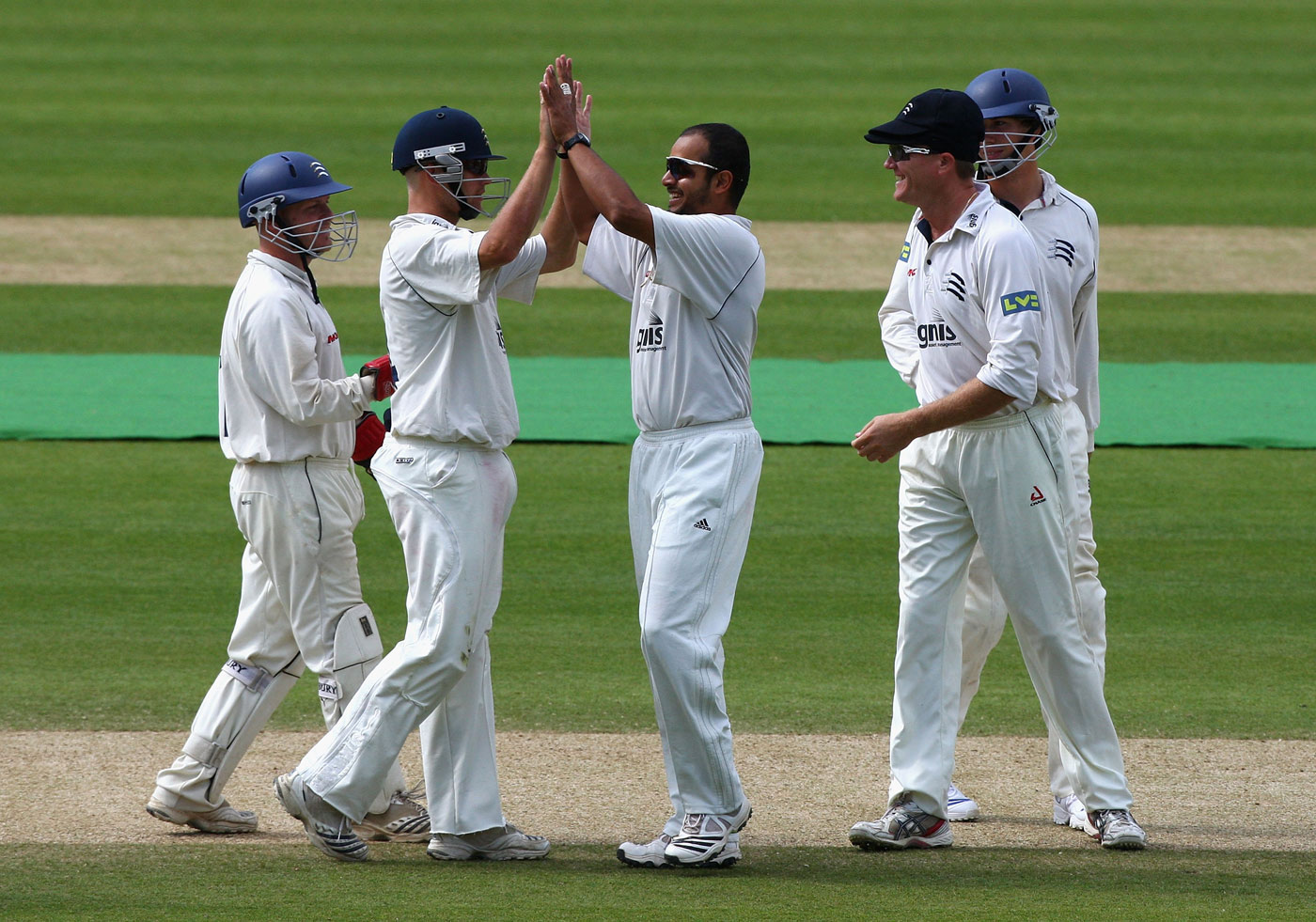
Indian seamers won't find it hard to get used to the Dukes ball in England since it's similar to the SG ball they bowl with at home © Getty Images
John Emburey, the former Middlesex and England offspinner, told me that it was always good to try things. He said that at Lord's, spinners, especially left-arm ones, usually bowl from the Nursery End to take advantage of the slope. Emburey, who was accustomed to bowling from the Pavilion End, would switch sides with former England left-arm spinner Phil Edmonds to bowl from the Nursery End and bowl tighter lines on the off stump to force the outside edge. So it is important to be aware and open to doing things that you will not generally do.
One advantage the Indian spinners have is, they will not find it hard to get used to the Dukes ball, because it is similar to the one they use at home, the SG Test ball, which has a pronounced seam. The Dukes ball stays hard throughout, which is a good thing for a spinner, especially on a dry surface.
At times, more than the pitches, it is the success of the seamers up front that plays a vital role in the spinner being effective. Some of the surfaces in England can be really slow, especially at Lord's and The Oval. There is nothing for spinners at Trent Bridge. The Old Trafford pitch can break up, but at the Rose Bowl it won't.
Overall, the pitches are not going to be conducive to spin, especially in the wake of England's series defeat against Sri Lanka.


Syria/ISIS: UK planned to train and equip 100,000 rebels

 By Nick Hopkins Investigations correspondent, BBC Newsnight

The UK drew up plans to train and equip a 100,000-strong Syrian rebel army to defeat President Bashar al-Assad, BBC Newsnight can reveal.
The secret initiative, put forward two years ago, was the brainchild of the then most senior UK military officer, General Sir David Richards.
It was considered by the PM and the National Security Council, as well as US officials, but was deemed too risky.
The UK government did not respond to a request for comment.
Lord Richards, as he is now, believed his proposal could stem the civilian bloodshed in Syria as rebels fought troops loyal to Mr Assad.
The idea was considered by David Cameron and Dominic Grieve, the attorney general, and sent to the National Security Council, Whitehall sources said.
It was also put to senior figures in Washington, including General Martin Dempsey, the US's most senior military officer.
While it was thought to be too radical at the time, US President Barack Obama said last week he was seeking $500m (£291m) funding to train Syrian rebels - an echo of Lord Richards' plan.
Insiders have told BBC Newsnight that Lord Richards, then chief of the defence staff but since retired from the military, warned Downing Street there were only two ways to end the Syrian civil war quickly - to let President Assad win, or to defeat him.
'Extract, equip, train'

With ministers having pledged not to commit British "boots on the ground", his initiative proposed vetting and training a substantial army of moderate Syrian rebels at bases in Turkey and Jordan.
Mr Cameron was told the "extract, equip, train" plan would involve an international coalition.
It would take a year, but this would buy time for an alternative Syrian government to be formed in exile, the PM was told.
Once the Syrian force was ready, it would march on Damascus, with the cover of fighter jets from the West and Gulf allies.
The plan envisaged a "shock and awe" campaign, similar to the one that routed Saddam's military in 2003, but spearheaded by Syrians.
'Chemical weapons'

Though the plan was put to one side at the time, Mr Cameron was later persuaded to consider military action when evidence emerged of chemical weapons use in Syria.
The US and UK accused the Assad government of being behind the attacks, but Damascus blamed rebel groups.
Monzer Akbik, spokesman for the Syrian National Coalition, an opposition alliance, said: "The international community did not intervene to prevent those crimes and at the same time did not actively support the moderate elements on the ground.
"A huge opportunity was missed and that opportunity could have saved tens of thousands of lives actually and could have saved also a huge humanitarian catastrophe."
'No good options'

Professor Michael Clarke, of the Royal United Services Institute think tank, added: "We have missed the opportunity to train an anti-Assad force that would have real influence in Syria when he is removed, as he will be.
"I think there was an opportunity two or three years ago to have become involved in a reasonably positive way, but it was dangerous and swimming against the broader tide of history… and the costs and the uncertainties were very high."
He said it was now too late for the West to get involved.
"Western policymakers in a sense have got to have the courage to do nothing and to work on what comes after the civil war," he said.
"There are no good options over Syria. It is a slow-motion road accident."
Tens of thousands of people have died and millions more have been displaced in three years of civil war in Syria.

More banking scandals to come, admits Treasury Minister Andrea Leadsom

Andrew Grice in The Independent

More scandals in the financial sector are in the pipeline, the Treasury Minister responsible for the City of London has admitted.

Andrea Leadsom, who previously worked in banking and finance for 25 years, warned that there were more "cringeworthy announcements" to come and that there was "still a lot of baggage" in the financial industry.

Ms Leadsom, who held senior roles at Barclays and Invesco Perpetual before becoming an MP, told the parliamentary magazine The House there was still a long way to go change the City’s culture. Asked whether it is learning the lessons of the financial crisis, she replied: "I would say that at the top echelons of the banks, absolutely. But I think there's quite a long way to go to really change the culture. I think it did become very transaction-oriented and I think it will take time to recover that. I think we are still going to see a lot of cringeworthy announcements."

She admitted that when she heard about the Libor interbank lending rate scandal, she thought: “Well, if Libor is rigged, then what wasn’t rigged?”

Mrs Leadsom said: "We've had a number of issues over bank wrongdoing. There are inquiries going on, there are some pretty serious allegations out there, we've still got PPI going on. There are still things happening and redress under way. So it's quite difficult to just forget about that and move on. There's still a lot of baggage.”

Shortly after she was appointed Treasury Economic Secretary in April, The Independent revealed that she had previously used trusts to reduce her potential tax bill and offshore banking arrangements for her buy-to-let property company.

In the interview, Ms Leadsom declined to say whether she would vote in favour of the HS2 project - even though it is championed by her Treasury boss George Osborne. It would affect her South Northamptonshire constituency and while she is a backbencher, she opposed the Bill paving the way for the scheme. “I’m absolutely firmly committed to getting decent compensation and mitigation for my constituents and I think there’s a long way to go yet,” she said.

She also departed slightly from the party line on Europe, saying that there might be case for leaving the EU. The founder of the Conservative Fresh Start project aimed at getting a better deal for the UK, she said: "Obviously [if there's] a nonsense reform that doesn't achieve anything, then it might be. But at the moment I've spent four years working extremely hard trying to find things that would make it worth staying in."

Ms Leadsom dismissed calls by Tory Eurosceptics for David Cameron to set out his shopping list of demands for the renegotiation of Britain’s membership terms.

Defending the controversial Help to Buy mortgage guarantee scheme, she said: “Overwhelmingly, it's achieving its aspiration of helping people to get their first home. I get many more letters from people saying 'I'm desperate to get a mortgage, why have you done this mortgage market review?' rather than people saying 'oh, you know, property prices are ridiculously high".

Thursday, 3 July 2014

On Cricket Commentary - WHY CONTEXT MATTERS


The idea that we should respond to cricketers in purely cricketing terms is a piety that cripples commentary on the game. Cricket commentary’s organizing conceit — that at every turn in a Test there is a technically optimal choice to be made — produces formalist bromides that explain neither the course of the match nor the performances of its main characters.

A good example of the technicist fallacy was Michael Holding’s criticism of Sri Lankan bowling tactics during the second innings of the second Test at Headingley. The Sri Lankan pacemen were bowling short at Joe Root (picture) who wasn’t comfortable. He was hit on the splice, on his gloves, on the body which encouraged the Sri Lankans to work him over for about half an hour. This provoked Holding into Fast Bowling Piety One: bowling short is all very well but you have to pitch it up to take wickets.

Coming from Holding, one of the great West Indian quartet that unnerved a generation of batsmen with scarily fast and lethally short bowling, this was greeted in the Sky commentary box with general hilarity. Holding insisted that the tales of West Indian bouncer barrages were overstated and offered as proof the number of batsmen who were out lbw or bowled. Botham, from the back of the box offered an explanation: the balls must have ricocheted off their faces on to the stumps.

Nasser Hussain spoke up to make the point that Joe Root seemed to have provoked the Sri Lankans while they were batting, and they, in turn had decided to see if they could sledge and bounce him into submission. Given Root’s visible discomfort, Hussain argued that a short burst of intimidatory bowling was a reasonable tactic.

In response Holding produced his clinching cautionary tale: opposing fast bowlers once peppered Michael Clarke with short balls and he ducked and weaved and got hit but he had the last laugh by scoring more than 150 runs in that innings. Middle-aged desis recalled a very different precedent: the 1976 Test in Sabina Park where the West Indian pace attack led by Holding hospitalized three top order Indian batsmen with a round-the-wicket bouncer barrage and battered Bedi’s hapless team into surrendering a match with five wickets standing because the batsmen who weren’t injured were terrified.

Holding was a member of the West Indian team that ruthlessly ‘blackwashed’ England after Tony Greig stupidly provoked the West Indians by promising to make them grovel. His inability to see that Mathews’s targeting of Root was a symptom of an angry team’s determination not to take a step back was a sign of how completely the conventions of cricket commentary can distract intelligent commentators from the real contest unfolding in front of them.

Sri Lankan teams have long felt slighted by the ECB’s habit of offering them stub series or one-off Tests early in the English season. They have been treated like poor relations and this time round they felt not just patronized but persecuted by the reporting of Sachithra Senanayake’s bowling action during the ODI contests that preceded the two-Test ‘series’. It was this sense of being hard done by, this collective determination to be hard men, not game losers that played a part in Senanayake’s Mankading of Jos Buttler, in Angelo Mathews’s refusal to withdraw Senanayake’s appeal and in the public support that Sangakkara and Jayawardene gave Senanayake when Cook and Co. threw a hissy fit afterwards. And it was this keenness to give as good as they got that spurred the Sri Lankan captain to go after Joe Root who had been noticeably chirpy in the field.

That passage of play, with the Sri Lankans bouncing and sledging Root and Root battling it out, was the series summed up in half a dozen riveting overs. This is not to argue that short pitched bowling is more effective than pitched up bowling when it comes to taking wickets: merely to suggest that producing axiomatic pieties as a commentator without accounting for context is pointless.

If Mathews had persisted with a failed tactic over the best part of the day as Cook did when Mathews and Herath were building their rearguard action, Holding might have had a case. But he didn’t, so Holding’s inability to recognize that this spell of short pitched hostility was a flashpoint in this two Test struggle for superiority is a good example of the way in which orthodox nostrums glide over the action they are meant to illuminate.

It wasn’t just Holding who lost the plot in the Sky commentary box, so did David Lloyd. When Mathews began sledging Root and, in spite of remonstrating umpires, calmly carried on sledging Root, a historically minded commentator might have seen him as a worthy heir to Arjuna Ranatunga, that smiling, pudgy, implacable eyeballer of umpires, winder-upper of oppositions and, by some distance, Sri Lanka’s greatest captain.

But all Bumble saw was a captain who, because he was sledging Root, had lost focus and lost control of the match. So what for the rest of the world was a spell of purposeful hostility with Mathews testing Root’s will to survive, was for Lloyd, a failure by the Sri Lankan captain to focus on his main job, thinking Root out.

Just as Mathews’s sledging was read without context, the larger contest between England and Sri Lanka went unframed. On the one hand there was the English team backed up by a prosperous, hyper-organized cricket board which surrounded its Test team with a support staff so large that journalists joked about it, and on the other there was a Sri Lankan team at war with its board, whose players frequently went unpaid and whose principal spinner, Rangana Herath, had to apply for leave from his day job before going on tour. I learnt more about the Sri Lankan team from one brilliant set of vignettes on Cricinfo (“The Pearl and the Bank Clerk” by Jarrod Kimber) than I did through 10 days of Test match commentary.

Do television commentators do any homework? Are they interested in the individuals in the middle or are the players they describe just interchangeable names on some Platonic team sheet? Virtually every commentator in the world is now a distinguished ex-cricketer; are these retired champions meant to embody totemic authority, to exude experience into a microphone, or should they pull information and insight together to tell us something that we can’t see or don’t know already?

One answer to that leading question might be that ball-by-ball commentary has, by definition, a narrow remit. The answer to that, of course, is that you can’t take a form that originated with radio where the commentator had to literally describe the action in the middle and transfer it to a different medium without redefining it.

Sky Sports’s stab at redefinition consists of more graphical information. We have pitch maps and batting wagon wheels which are useful, but surely the rev counter on the top right hand corner of the screen is an answer looking for a question. Does the fact that Moeen Ali gets more revs on the ball than Rangana Herath does make him the better spinner? Sky’s little dial seems to think so.

The best human insights on the Sri Lankan-England series came from Shane Warne and he wasn’t even in the commentary box. The series cruelly confirmed his criticisms of Alastair Cook’s captaincy: having moaned about Warne’s unfairness and huffed about Buttler’s Mankading, Cook led his team to defeat with all the grit of a passive-aggressive Boy Scout.
In the Sky box, we had Mike Atherton who earned a 2.1 in history at Cambridge but you wouldn’t known it from his commentary: he was as indifferent to time and context as his fellow commentators. Ian Botham was, as always, the Sunil Gavaskar of English commentary while the point of Andrew Strauss’s strangled maunderings escaped foreigners in the absence of subtitles.

The one exception to the tedium of Sky commentary was Nasser Hussain simply because he was alert to the politics of a cricket match, to the personal and collective frictions that makes Test cricket the larger-than-life contest that, at its best, it sometimes is. I like to think that the reason for this is that he’s called Nasser Hussain and has an Indian father and an English mother so he can’t pretend that cricket is a self-contained country.

Pace Holding, the rehearsal of textbook orthodoxy might be a necessary part of cricket commentary, but it ought to be a baseline on which good commentators improvise, rather like the tanpura drone that provides soloists with an anchoring pitch. Too often, though, cricket commentary amounts to just the drone without context, insight or information.

If English commentators are frustratingly literal and narrow, their Indian counterparts make Holding and Co. sound like John Arlott channelling C.L.R. James. Policed by the BCCI, desi commentators are so mindful of their contractual obligations and so formulaic in their utterances that they could be replaced by bots without anyone noticing.

Watching a cricket match glossed by the BCCI’s Own, is unnervingly like playing the FIFA video game with automated commentary, where software produces the appropriate cliché whenever the onscreen action supplies the necessary visual cues.

Readymade words for virtual football are bad enough but canned commentary on real cricket needs a special place in hell. Tracer bullets, kitchen sinks, cliff hangers, pressure cookers, sensible cricket, best played from the non-striker’s end, give the bowler the first half hour, leg-and-leg… it never stops, and its petrifying banality turns live cricket into lead. With five Tests to play, this is going to be a long, hot summer. Welcome to purgatory.

'Terrorism is bad for us but acceptable for others' : The West and Gulf Arabs

Vijay Prashad  in The Hindu


Both the West and the Gulf Arabs suggest that the terrorism that they dislike against themselves is acceptable to others.

Abu Bakr al-Baghdadi welcomed this Ramadan by declaring the formation of the Caliphate, with him as the Caliph — namely the successor of the Prophet Mohammed. It is the first return of a Caliphate since Kemal Atatürk’s Turkish National Assembly abolished it in 1924. Al-Baghdadi, the nom de guerre for the leader of the Islamic State of Iraq and al-Sham (ISIS), has now announced that borders inside the dar al-Islam, the world of Islam, are no longer applicable. He has been able to make this announcement because his fighters have now taken large swathes of territory in northern Syria and in north-central Iraq, breathing down on Baghdad, the capital of the Abbasid Caliphate (750-1258).
Al-Baghdadi’s declaration comes after ISIS threatened to make its presence felt outside the territory it now controls. Bomb blasts in Beirut, Lebanon, hinted at ISIS’ reach. Jordanian authorities hastened to crack down on “sleeper cells” for ISIS as soon as chatter on social media suggested that there would be a push into Zarqa and Ma’an. Private Kuwaiti funding had helped ISIS in its early stages, but now Kuwait hinted that it too is worried that ISIS cells might strike the oil-rich emirate. When ISIS took the Jordan-Syria border posts, Saudi Arabia went into high alert. There is no substantive evidence that ISIS is in touch with al-Qaeda in Yemen, but if such coordination exists (now that al-Baghdadi has fashioned himself as the Caliph) it would mean Saudi Arabia has at least two fronts of concern. “All necessary measures,” says the Kingdom, are being taken to thwart the ISIS advance.
Jihad hub


Several months ago, two intelligence agencies in the Arab region had confirmed that ISIS is a genuine threat, not a manufactured distraction from the war in Syria. Many of those associated with the rebellion in Syria had suggested that ISIS was egged on by the government of Bashar al-Assad to allow his preferred framing of the Syrian war — that his is a war against terrorism and not against a civic rebellion. While it is true that Assad’s government released a number of jihadis in 2011, there is no evidence to suggest that he created ISIS. ISIS is a product of the U.S. war on Iraq, having been formed first as al-Qaeda in Iraq by the Jordanian militant Abu Musab al-Zarqawi. Deeply sectarian politics, namely an anti-Shia agenda, characterised al-Qaeda in this region. Funded by private Gulf Arab money, ISIS entered the Syrian war in 2012 as Jabhat al-Nusra (the Support Front). It certainly turned a civic rebellion into a terrorist war. Political support from the West and logistical support from Turkey and the Gulf Arab states allowed it to thrive in Syria. It became a hub for international jihad, with veterans from Afghanistan and Chechnya now flocking to al-Baghdadi’s band of fellows. By the start of 2014, ISIS held two major Iraqi cities (Ramadi and Fallujah) and two Syrian cities (Raqqa and Deir Ezzor). Their push to Mosul, then Baghdad was on the cards for at least a year.
The West has been consistently naive in its public assessment of events in West Asia. U.S. policy over Syria was befuddled by the belief that the Arab Spring could be understood simply as a fight between freedom and tyranny — concepts adopted from the Cold War. There was a refusal to accept that the civic rebellion of 2011 had morphed quite decisively by late 2012 into a much more dangerous conflict, with the radical jihadis in the ascendancy. It is of course true, as I saw first-hand, that the actual fighters in the jihad groups are a ragtag bunch with no special commitment to this or that ideology. They are anti-Assad, and they joined Jabhat al-Nusra or Ahra¯r ash-Sha¯m because that was the group at hand with arms and logistical means. Nevertheless, the fighters did fight for these groups, giving them the upper hand against the West’s preferred, but anaemic, Free Syrian Army. The Islamic State’s breakthrough in Iraq has inspired some of these men to its formations in Syria. They want to be a part of the excitement.
The West’s backing of the rebellion provided cover for Turkey’s more enthusiastic approach to it. Intoxicated by the possibility of what Turkey’s Foreign Minister Ahmet Davutog˘lu favoured as “neo-Ottomanism,” the Turkish government called for the removal of Assad and the emergence of a pro-Istanbul government in Damascus. Turkey opened its borders to the “rat-line” of international jihad, with planeloads of fighters from Libya and Chechnya flying into Turkey to cross into Syria to fight for ISIS and its offshoots. ISIS spat in Turkey’s salt. ISIS struck Turkey in 2013 with car bombs and abductions, suggesting to Ankara that its policy has endangered its citizens. In March, the Governor of Hatay province, Mehmet Celalettin Lekesiz, called upon the government to create a new policy to “prevent the illegal crossing of militants to Syria.” His report was met with silence.
Blowback


An ISIS billboard in Mosul depicts the flags of the states in the region. All are crossed out as being traitorous regimes. Only the ISIS black flag stands as a sentinel for justice. Among the regimes to be overthrown is the Kingdom of Saudi Arabia. Saudi Arabia has used its vast wealth to influence the region, and to outsource its own problems with extremism. In 1962, the Kingdom created the Muslim World League as an instrument against secular Arab nationalism and Communism. Twenty years later, the war in Afghanistan provided the opportunity for the Kingdom to export its own disaffected youth (including Osama bin Laden) to fight the Afghan Communists rather than their own royal family. The 1979 takeover of the Mecca mosque by jihadists was an indication of the threat of such youth. Saudi policy, however, did not save the Kingdom. Al-Qaeda, the product of this policy, threatened and attacked the Kingdom. But little was learned.
Saudi policy vis-à-vis Syria and Iraq repeats the Afghan story. Funds and political support for jihadisin the region came from the Kingdom and its Gulf allies. Saudi Arabia tried to stop its youth from going to the jihad — a perilous mistake that it had made with Afghanistan. On February 3, the King issued a decree forbidding such transit. But there is no pressure on Saudi Arabia and its Gulf allies to stop their tacit support of ISIS and its cohort. Nor is there pressure on it to stop its financing of the harsh repression in Egypt, sure to fuel more conflict in the near future. The Arab world, flush with hope in 2011, is now drowning in a counter-revolution financed by petrodollars. Saudi Arabia’s response to the rise of ISIS misleads — no intervention to help the Iraqi state. “We are asked what can be done,” wrote its Ambassador to the U.K., Prince Mohammed bin Nawaf bin Abdul Aziz. “At the moment, we wait, we watch and we pray.”
No age-old conflict


The fact is that both the West and the Gulf Arabs are doing more. They continue to finance the jihadi rebels in Syria (all promises of vetting by the U.S. are comical), and they continue to see the Assad government as an obstacle to peace in the region. Both the West and the Gulf Arabs suggest that the terrorism that they dislike against themselves is acceptable to others. The history of their policies also suggests that Western and Gulf Arab intervention leads inexorably to the creation of police states (as in Egypt) and terrorist emirates. A lack of basic commitment to people’s movements — anchored in unions and in civic groups — will always lead to such diabolical outcomes.
Meanwhile, sectarian lines are being hardened in the region. The battle now does not revisit the ancient fight at Karbala. This is not an age-old conflict. It is a modern one, over ideas of republicanism and monarchy, Iranian influence and Saudi influence. Shadows of sectarianism do shroud the battle of ordinary people who are frustrated by the lack of opportunities for them and by the lack of a future for their children. What motivates these fights is less the petty prejudices of sect and more the grander ambitions of regional control. Al-Baghdadi has announced that his vision is much greater than that of the Saudi King or the government in Tehran. He wants to command a religion, not just a region. Of such delusions are great societies and cultures destroyed.

Rowan Williams: how Buddhism helps me pray

John Bingham in The Telegraph

The former Archbishop of Canterbury Lord Williams has disclosed that he spends up to 40 minutes a day squatting and repeating an Eastern Orthodox prayer while performing breathing exercises as part of a routine influenced by Buddhism.
He also spends time pacing slowly and repeatedly prostrating himself as part of an intense early morning ritual of silent meditation and prayer.
The normally private former Archbishop has given a glimpse of his personal devotions in an article for the New Statesman explaining the power of religious ritual in an increasingly secular world.
Lord Williams has spoken in the past about how in his youth he contemplated becoming a monk as well as joining the Orthodox church.
He explained that he draws daily inspiration from the practice, common to both the Greek and Russian orthodox churches, of meditating while repeatedly reciting the “Jesus Prayer”, which says: “Lord Jesus Christ, Son of God, have mercy upon me, a sinner”. 
“Over the years increasing exposure to and engagement with the Buddhist world in particular has made me aware of practices not unlike the ‘Jesus Prayer’ and introduced me to disciplines that further enforce the stillness and physical focus that the prayer entails,” he explained
“Walking meditation, pacing very slowly and coordinating each step with an out-breath, is something I have found increasingly important as a preparation for a longer time of silence.
“So: the regular ritual to begin the day when I’m in the house is a matter of an early rise and a brief walking meditation or sometimes a few slow prostrations, before squatting for 30 or 40 minutes (a low stool to support the thighs and reduce the weight on the lower legs) with the 'Jesus Prayer': repeating (usually silently) the words as I breathe out, leaving a moment between repetitions to notice the beating of the heart, which will slow down steadily over the period.”
Far from it being like a “magical invocation”, he explained that the routine helps him detach himself from “distracted, wandering images and thoughts”, picturing the human body as like a 'cave' through which breath passes.
“If you want to speak theologically about it, it’s a time when you are aware of your body as simply a place where life happens and where, therefore, God ‘happens’: a life lived in you,” he added.
He went on to explain that those who perform such rituals regularly could reach "advanced states" and become aware of an "unbroken inner light".

Wednesday, 2 July 2014

Why we need a Truth on the Clothes Label Act


We know more about the conditions of our battery hens than of our battery textile workers. A year after Rana Plaza, it's time we were given the facts
Daniel Pudles illustration for Clothes Label Act story
'Forcing businesses to admit exactly who is responsible for their economic success, and who reaps the profits, is a good start'. Illustration: Daniel Pudles
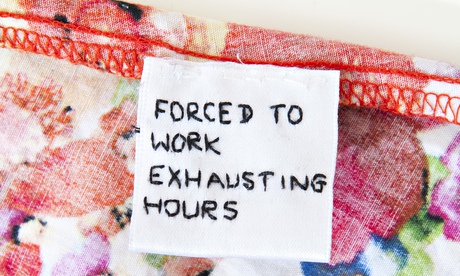
Somewhere in Swansea is a woman whose hand I want to shake. My guess is that she's the one responsible for giving Primark such a stonking headache over the past few days. You probably know her handiwork – at least, you will if you saw the stories about how two Swansea shoppers came back from the local Primark with bargain dresses mysteriously bearing extra labels. One read "'Degrading' sweatshop conditions"; another "Forced to work exhausting hours".
How did they get there? "Cries for help" from a production line in deepest Dhaka, claim the merchants of journalese. But surely no machinist could bunk off their punishing workload to script these complaints in pristine English, stitch them in and whisk them past a pin-sharp inspector. The much-more-likely scenario is an activist, holed up in a south Wales fitting room, hastily darning her protests.
In which case: well-needled, that woman. Not only has she gummed up the Primark publicity machine for days on end and brought back into discussion the costs of cheap fashion, she's also given pause to two shoppers. In the words of one: "I've never really thought much about how the clothes are made … I dread to think that my summer top may be made by some exhausted person toiling away for hours in some sweatshop."
In a mall, such thinking counts as disruptive activity. The lexicon for most retailers runs from impulse buy to splurge to treat; they prefer us to wander the aisles with our eyes wide open and our minds shut tight. The whole point of a shopping environment is to drown out those inconvenient headlines about dead textile workers in Rana Plaza with a bit of Ellie Goulding and a lot of advertising. Which is what makes the Primark protests, or the Tesco shelfie campaign, or the UK Uncut rallies so splendidly aggravating – because they undercut the multimillion-pound marketing with point of sale information about poverty pay for shop staff or high-street tax dodging.
They also underline how little we're told about what we're paying for. Look at the label sewn into your top: the only thing it must tell you under law is which fibres it's made out of – whether it's cotton or acrylic or whatever. Which country your shirt came from, or the accuracy of the sizing – such essentials are in the gift of the retailer. A similarly light-touch regime holds for food: after years of fighting between consumer groups and the (now eviscerated) Food Standards Agency, and big-spending food manufacturers, a new set of traffic-light labels will be introduced. Thanks to heavy industrial lobbying, it will still be completely voluntary.
How much sugar is in your bowl of Frosties: this is a basic fact, yet it remains up to the seller how they present it to you. By law you are entitled to more information about the production of your eggs than your underwear. Under current regulations, we know more about our battery hens than we do about our battery textile workers.

Cry for help label in Primark top A ‘cry for help' label in a top from Primark in Swansea. ‘Big retailers can also display ­prominently how much tax they pay, and what they pay both top staff and shopfloor employees.' Photograph: Matthew Horwood/Wales News Service


Consider: just over a year has passed since the collapse of the Rana Plaza factory, which saw more than 1,100 staff crushed to death and another 2,500 injured, many permanently disabled. Those people and the thousands of others working in similarly precarious and punishing conditions make the garments we wear and the electronic goods we fiddle about with. Yet they rate barely a mention. Outsourcing and globalisation may have brought down the price of our shopping, but it has also enabled retailers to engage in a facade of blame-shifting and plausible deniability: for Apple to pass the buck for suicidal Chinese workers on to Foxconn and duck the questions about how much of a margin it pays suppliers.
So here's a modest proposal: a new law that mandates more, and more relevant information, on the products we buy. Call it the Truth on the Label Act, which will require shops to display where their goods are made, which chemicals were used in production, and whether the factory is unionised. Stick it on the shelves, print it on the clothes tags. Big retailers can also display prominently in each branch how much tax they pay, and what they pay both top staff and shopfloor employees.
That's because while queuing up for the self-service checkout, hungry commuters might want to know that the boss of Tesco's, Philip Clarke, is paid 135 times what his lowest-paid member of staff is. Or that George Weston, chief executive of Primark's parent company, received over £5m last year, while the young women who sew his firm's T-shirts get less than £30 a month.
Such information is not hard for the big retailers to provide. Long before Google was an algorithm in a programmer's eye, Tesco was in the data-collection business. This information in itself won't change an entire economic system. But forcing businesses to admit exactly who is responsible for their economic success, and who reaps the profits, is a good start. Otherwise, we're entirely dependent on activists in changing rooms.