Search This Blog

Monday, 25 June 2012

A degree in life, not just cricket


The MCC university cricket system provides a chance to prepare for life after the game while pursuing a county contract
George Dobell
June 22, 2012


If the last few days have taught us anything, it is that there is far more to life than cricket. So while the outcome of the final of the British Universities and Colleges Cricket (BUCS) competition might not, in itself, seem particularly important in the grand scheme of things, such encounters actually carry much deeper significance. Indeed, you could make a strong case to suggest that the introduction of MCC University cricket (MCCU) is, alongside Chance to Shine, central contracts, four-day cricket and the adoption of promotion and relegation, one of the most positive developments in domestic cricket in the last 20 years.
Professional sport is a seductive beast. It sucks you in with whispered promises of glory and glamour and spits you out with broken dreams and an aching body. For every cricketing career that ends in a raised bat and warm ovation, there are a thousand that end on a physio's treatment table or in an uncomfortable meeting in a director of cricket's office. Many, many more stall well before that level.
And that's where the trouble starts. Young men trained for little other than sport can suddenly find themselves in a world for which they have little training and little preparation. Without status, salary or support, the world can seem an inhospitable place. It is relevant, surely, that the suicide rate of former cricketers is three times the national average.
The Professional Cricketers' Association does sterling work trying to help former players who have fallen on hard times, but prevention must be better than the cure, and a huge step on the road of progress has been taken in the form of the MCCU.
It has had different names along the way but the MCCU scheme was set up in the mid-1990s by former England opening batsman Graeme Fowler. Confronted with a choice between university and full-time cricket when he was 18, Fowler opted for university. It was a decision that provided the foundations for financial stability that extended far beyond his playing days. As Fowler puts it while watching the Durham MCCU team he coaches play Cambridge MCCU in the BUCS final: "Even a cricketer as successful as Alec Stewart had more of his working life to come after he finished playing. And not everyone can be a coach or a commentator."
The fundamental aim of the MCCUs is to allow talented young cricketers to continue their education while also pursuing their dream of playing professional cricket. It is to prevent a situation where they have to choose between the two. It should mean that young players gain the qualifications and skills for a life beyond cricket while still giving themselves every opportunity to progress in the game. Graduates will have enjoyed good-quality facilities and coaching while also maturing as people. It should be no surprise that several counties actively encourage their young players into the scheme as they know they will return, three years later and still in their early 20s, far better prepared for the rigours of professional sport and life beyond it.
It works, too. Just under 25% of England-qualified cricketers currently playing in the county game graduated through the system. Durham MCCU alone has helped develop more than 50 county players, six county captains, three England players and, most obviously, England's Test captain, Andrew Strauss, who credits the initiative as vital to his success. "It was at Durham University that I went through the transition of being a recreational cricketer to one who had the ambition to play the game for a living," he has said. The MCCUs have a mightily impressive record.
And, these days, it costs the ECB nothing. Not a penny. Instead the six MCCUs (Oxford, Cambridge, Durham, Cardiff, Leeds/Bradford and Loughborough) have, since 2005, been funded by the MCC. Each institution receives £80,000 a year and hopes to cobble together enough extra funding from sponsorship and other smaller grants to meet their annual running costs of around £130,000. You might well ask why the ECB - despite its annual income of around £110 million and rising - cannot find some more money for such an admirable scheme.
Indeed, it is interesting to reflect on the roots of the MCCUs. In the mid-1990s, the ECB (or the TCCB as it was known at the time) lost its Lottery funding as the Lottery Commission was concerned that the sport did not possess a complete development programme that incorporated higher education. The board, in panic, embraced Fowler's plans and appointed a couple of dozen regional development officers. Had the Lottery Commission not intervened, it is debatable whether the ECB would have had the foresight to act at all.
 
 
Fowler never actually wanted the games to carry first-class status but worries that if such status is stripped the funding may disappear too. He also worries that the matches against the counties - key factors in the development of his young players - might go
 
There are detractors. When, in April, Durham MCCU were bowled out for 18 by a Durham attack that contained Graham Onions, among others, it provided fresh ammunition for those who say that such games should not hold first-class status.
It is a fair point. Fowler never actually wanted the games to carry first-class status but worries that if such status is stripped, the funding may disappear too. He also worries that the matches against the counties - key factors in the development of his young players - might go. Without those two facets, the system loses its attraction and the safety net disappears. The odd aberration in the first-class record might well prove to be a price worth paying for the benefits of MCCUs.
As it was, Cambridge MCCU, boosted by an innings of 129 by Ben Ackland, defeated Durham MCCU by 24 runs in the BUCS final in the scenic surrounds of Wormsley. Perhaps only four or five of the players on show have realistic hopes of enjoying a career in cricket - Surrey's Zafar Ansari is currently with Cambridge MCCU, though he missed the BUCS game, while Paul Best (Cambridge MCCU and Warwickshire), Chris Jones (Durham MCCU and Somerset) and Freddie van den Bergh (Durham MCCU and Surrey) are among those already affiliated with counties - but it was noticeable that at least one first-class county sent a scout to the match.
"I spent my whole professional playing career on a one- or two-year contract," Chris Scott, the Cambridge MCCU coach, says. "It probably made me a more insecure, selfish cricketer than I should have been. The MCCU scheme provides a safety net for players and helps them grow up and improve as players as people. It helps prepare them for life, whether that is in cricket or not."
"And it's not just about playing," Fowler adds. "Some of our graduates have gone to be coaches or analysts at counties. Some might have become solicitors, but set up junior coaching schemes at their local clubs. There is a cascade effect that people sometimes don't appreciate."
The quality of the head coaches is a vital factor. Scott, for example, is a philosophical fellow well suited to preparing his charges for the inevitable slings and arrows. He has needed to be. As Durham wicketkeeper he was, after all, responsible for the most expensive dropped catch in first-class history. Playing at Edgbaston in 1994, he put down Brian Lara on 18 and moaned to the slip cordon, "I bet he goes on and gets a hundred now." Lara went on to score an unbeaten 501.
Cambridge are the standout side among current MCCUs, and Scott's record in aiding the development of the likes of Chris Wright and Tony Palladino should not be underestimated.
The graduates of Durham MCCU are also lucky to have Fowler. Not just for his playing experience - anyone who scored a Test double-century in India and a Test century against the West Indies of 1984 knows a thing or two about batting - but also his life experience. For his easygoing good humour and mellow wisdom. He enjoyed a long and distinguished career as a player, but the formation of the MCCUs is surely his biggest contribution to the game.
George Dobell is a senior correspondent at ESPNcricinfo

Sunday, 24 June 2012

‘Terrorism Isn’t The Disease; Egregious Injustice Is’


NARENDRA BISHT
INTERVIEW
‘Terrorism Isn’t The Disease; Egregious Injustice Is’
On laws like AFSPA, Unlawful Activities (Prevention) Act, sedition, democracy, terrorism and more
No one individual critic has taken on the Indian State like Arundhati Roy has. In a fight that began with Pokhran, moved to Narmada, and over the years extended to other insurgencies, people’s struggles and the Maoist underground, she has used her pensmanship to challenge India’s government, its elite, corporate giants, and most recently, the entire structure of global finance and capitalism. She was jailed for a day in 2002 for contempt of court, and slapped with sedition charges in November 2010 for an alleged anti-India speech she delivered, along with others, at a seminar in New Delhi on Kashmir, titled ‘Azadi—the only way’. Excerpts from an interview to Panini Anand:
How do you look at laws like sedition and the Unlawful Activities (Prevention) Act, or those like AFSPA, in what is touted as the largest democracy?
I’m glad you used the word touted. It’s a good word to use in connection with India’s democracy. It certainly is a democracy for the middle class. In places like Kashmir or Manipur or Chhattisgarh, democracy is not available. Not even in the black market. Laws like the UAPA, which is just the UPA government’s version of POTA, and the AFSPA are ridiculously authoritarian—they allow the State to detain and even kill people with complete impunity. They simply ought to have no place in a democracy. But as long as they don’t affect the mainstream middle class, as long as they are used against people in Manipur, Nagaland or Kashmir, or against the poor or against Muslim ‘terrorists’ in the ‘mainland’, nobody seems to mind very much.


“India’s democracy is for the middle class; for Kashmir or Manipur, it’s not available. Not even in the black market."
 
 
Are the people waging war against the State or is the State waging war against its people? How do you look at the Emergency of the ’70s, or the minorities who feel targeted, earlier the Sikhs and now the Muslims?
Some people are waging war against the State. The State is waging a war against a majority of its citizens. The Emergency in the ’70s became a problem because Indira Gandhi’s government was foolish enough to target the middle class, foolish enough to lump them with the lower classes and the disenfranchised. Vast parts of the country today are in a much more severe Emergency-like situation. But this contemporary Emergency has gone into the workshop for denting-painting. It’s come out smarter, more streamlined. I’ve said this before: look at the wars the Indian government has waged since India became a sovereign nation; look at the instances when the army has been called out against its ‘own’ people—Nagaland, Assam, Mizoram, Manipur, Kashmir, Telangana, Goa, Bengal, Punjab and (soon to come) Chhattisgarh—it is a State that is constantly at war. And always against minorities—tribal people, Christians, Muslims, Sikhs, never against the middle class, upper-caste Hindus.


How does one curb the cycle of violence if the State takes no action against ultra-left ‘terrorist groups’? Wouldn’t it jeopardise internal security?
I don’t think anybody is advocating that no action should be taken against terrorist groups, not even the ‘terrorists’ themselves. They are not asking for anti-terror laws to be done away with. They are doing what they do, knowing full well what the consequences will be, legally or otherwise. They are expressing fury and fighting for a change in a system that manufactures injustice and inequality. They don’t see themselves as ‘terrorists’. When you say ‘terrorists’ if you are referring to the CPI (Maoist), though I do not subscribe to Maoist ideology, I certainly do not see them as terrorists. Yes they are militant, they are outlaws. But then anybody who resists the corporate-state juggernaut is now labelled a Maoist—whether or not they belong to or even agree with the Maoist ideology. People like Seema Azad are being sentenced to life imprisonment for possessing banned literature. So what is the definition of ‘terrorist’ now, in 2012? It is actually the economic policies that are causing this massive inequality, this hunger, this displacement that is jeopardising internal security—not the people who are protesting against them. Do we want to address the symptoms or the disease? The disease is not terrorism. It’s egregious injustice. Sure, even if we were a reasonably just society, Maoists would still exist. So would other extremist groups who believe in armed resistance or in terrorist attacks. But they would not have the support they have today. As a country, we should be ashamed of ourselves for tolerating this squalor, this misery and the overt as well as covert ethnic and religious bigotry we see all around us. (Narendra Modi for Prime Minister!! Who in their right mind can even imagine that?) We have stopped even pretending that we have a sense of justice. All we’re doing is genuflecting to major corporations and to that sinking ocean-liner known as the United States of America.


Is the State acting like the Orwellian Big Brother, with its tapping of phones, attacks on social networks?
The government has become so brazen about admitting that it is spying on all of us all the time. If it does not see any protest on the horizon, why shouldn’t it? Controlling people is in the nature of all ruling establishments, is it not? While the whole country becomes more and more religious and obscurantist, visiting shrines and temples and masjids and churches in their millions, praying to one god or another to be delivered from their unhappy lives, we are entering the age of robots, where computer-programmed machines will decide everything, will control us entirely—they’ll decide what is ethical and what is not, what collateral damage is acceptable and what is not. Forget religious texts. Computers will decide what’s right and wrong. There are surveillance devices the size of a sandfly that can record our every move. Not in India yet, but coming soon, I’m sure. The UID is another elaborate form of control and surveillance, but people are falling over themselves to get one. The challenge is how to function, how to continue to resist despite this level of mind-games and surveillance.


"Contemporary Emergency has gone to the workshop for denting-painting. It’s come out smarter, and more streamlined.”
 
 
Why do you feel there’s no mass reaction in the polity to the plight of undertrials in jails, people booked under sedition or towards encounter killings? Are these a non-issue manufactured by few rights groups?
Of course, they are not non-issues. This is a huge issue. Thousands of people are in jail, charged with sedition or under the UAPA, broadly they are either accused of being Maoists or Muslim ‘terrorists’. Shockingly, there are no official figures. All we have to go on is a sense you get from visiting places, from individual rights activists collating information in their separate areas. Torture has become completely acceptable to the government and police establishment. The nhrc came up with a report that mentioned 3,000 custodial deaths last year alone. You ask why there is no mass reaction? Well, because everybody who reacts is jailed! Or threatened or terrorised. Also, between the coopting and divisiveness of ngos and the reality of State repression and surveillance, I don’t know whether mass movements have a future. Yes, we keep looking to the Arab ‘spring’, but look a little harder and you see how even there, people are being manipulated and ‘played’. I think subversion will take precedence over mass resistance in the years to come. And unfortunately, terrorism is an extreme form of subversion.


Without the State invoking laws, an active police, intelligence, even armed forces, won’t we have anarchy?
We will end up in a state of—not anarchy, but war—if we do not address the causes of people’s rising fury. When you make laws that serve the rich, that helps them hold onto their wealth, to amass more and more, then dissent and unlawful activity becomes honourable, does it not? Eventually I’m not at all sure that you can continue to impoverish millions of people, steal their land, their livelihoods, push them into cities, then demolish the slums they live in and push them out again and expect that you can simply stub out their anger with the help of the army and the police and prison terms. But perhaps I’m wrong. Maybe you can. Starve them, jail them, kill them. And call it Globalisation with a Human Face.

Friday, 22 June 2012

Tarek Fatah on the Dilemma of Pakistan


Nationalisation: Uruguay's solution to its drug problem


Law allowing state to sell cannabis could be adopted across Latin America in defiance of US

Simeon Tegel in the Independent
Friday, 22 June 2012

Uruguay – in a bid to curb a narcotics-fuelled violent crimewave across the country – has
unveiled plans to nationalise its cannabis market and become the first government in the
world to sell the soft drug to consumers.

The measure is aimed at both reducing the rising power of drug gangs and the growing
number of users of crack and freebase cocaine in what has traditionally been one of Latin
America's most peaceful nations.

"We want to fight two different things: one is the consumption of drugs and the other is the
trafficking of drugs," said the Defence Minister Eleuterio Fernández Huidobro.

"We believe that the prohibition of certain drugs is creating more problems in society than the
drug itself. Homicides have risen as a result of the settling of accounts [between rival drug
gangs] and this is a clear symptom of the appearance of certain phenomena that did not
exist previously in Uruguay." Under the plans, the government would initially grow cannabis
and sell it to registered users. But once the scheme is up and running, it hopes to cash in
and allow private companies to take over the production of the drug.

Possession of small amounts and consumption of marijuana is currently not illegal in Uruguay
but growing and selling it is. The new bill would seek to put the drug dealers out of business
by making it easier, safer and possibly cheaper for users to buy marijuana from official
dispensaries.

President José Mujica, a former leftwing guerrilla, has now sent a bill to the Uruguayan
congress which is widely expected to approve it. The legislation is part of a larger packet of
measures to tackle law and order issues.

Last night, even opposition lawmakers were tweeting in qualified support. One, Luis Lacalle
Pau, of the centre-right National Party, wrote: "I don't believe it would be a good thing to
continue associating marijuana with money." The measure represents a rejection of the
"stepping stone" argument that cannabis is a gateway drug to more damaging substances. Mr
Fernández Huidobro highlighted the government's expectation that it would actually result in
a fall in the use of harder drugs.

It also marks the latest chapter in the region's gathering rebellion against Washington's "war
on drugs", launched in the 1970s by President Nixon. Many Latin Americans resent being
blamed for producing coca – cocaine's key raw ingredient – when impoverished peasant
farmers are largely responding to demand from the US and Europe.

The costs of prohibition to the region have been huge, with Mexico, Honduras, El Salvador
and Guatemala in particular, seeing tens of thousands die as the drug cartels confront law enforcement and battle each other for control of the main cocaine corridor from the Andes
into the US market.

"An erroneous decision by Nixon has been what has caused all these disasters, declaring a
war that has been won by the narco-traffickers," Mr Fernández Huidobro told the Montevideo
newspaper El País.

In the last 12 months , the Mexican President, Felipe Calderon, has called for "market"
alternatives to prohibition to be considered while Colombia's President, Juan Manuel Santos,
has said he would welcome an international debate about legalisation.
Worryingly for Washington, both presidents come from the right of the political spectrum and
have been staunch supporters of the war on drugs.
Uruguay is thought to have around 150,000 regular consumers of cannabis, roughly 5 per
cent of the population, representing an annual market worth around £50m.

Wednesday, 20 June 2012

I am The Markets


I am The Markets and I'm sick of people telling me how I feel

People keep saying I'm 'concerned' and 'confused'. It's not like I'm the one to blame for everything going tits up
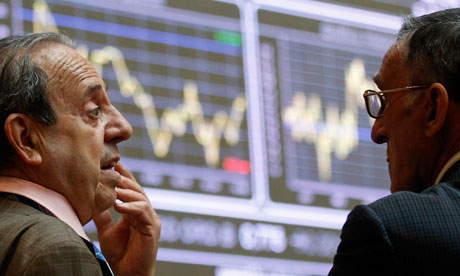
Traders at the stock exchange in Madrid
'I'm not the one who created a whole array of inherently flawed financial instruments that no one properly understood.' Photograph: Andrea Comas/Reuters
Two quotes from yesterday's Guardian got me. "Markets have become increasingly concerned that the austerity programmes in the eurozone are causing a vicious circle of recession", and "Markets were confused by mixed messages from European capitals". I have only one word of reply. Bollocks. Did anyone phone me to ask how I, The Markets, was feeling about these subjects? Did they hell?
So let me get things straight. I am not in the slightest bit concerned about the austerity programmes in the eurozone. I am entirely indifferent to whether Greece and Spain get bailed out, go bankrupt or both. Just as I'm not at all bothered if Germany gets any of its money back.
I existed long before someone invented the eurozone and I will be around long after it has ceased to exist. I'm not in the caring business. I'm a trader. Someone has something they want to sell, someone has something they want to buy. End of. Whether people are flogging something of value or billions of pounds of worthless debt is entirely irrelevant to me. I'm just a mechanism for other people's greed and inefficiency. Neither am I in any way confused. Quite the opposite. I see everything with a steely-eyed clarity. The confusion is all yours.
But while we're on the subject of me, let me tell you how I really am feeling. As you might have gathered, I am pretty damned pissed off. I am sick and tired of everyone making judgments about my emotional state of mind without making any effort to talk to me, think sensibly about me or hack my phone. It's both lazy and insulting, but I've rather got used to it as it goes with the territory. What annoys me most is the way all this talk of me being concerned and confused makes it sounds like I'm implicated in the business of everything going tits up.
I will not be the fall guy. I have done nothing wrong. I am merely the blank canvas for other people's incompetence. I'm not the one who created a whole array of inherently flawed financial instruments that no one properly understood. I'm not the idiot who decided property prices were going to go up for ever and ever and that every country could max out its credit card. I'm not the out-of-my-depth chancellor of the exchequer trying to convince both myself and the country that I have the situation in hand and that I know what I'm doing.
None of that is anything to do with me. If anyone had wanted to set up a more straightforward and fairer market, I would have been OK with that. So, a final word to the wise. Remember who the real culprits are. It's they who are concerned and confused. Though not on your behalf. What they are concerned and confused about is how to get you to pay for the decisions they shouldn't have made in the first place.
As told to John Crace

Wednesday, 13 June 2012

Europe will thrive. But we could be doomed to a life on the fringes

There is a Little England-ism that would have us leave the EU fold. It would be a disaster
Santander Bank - Cambridge branch, Sidney Street Cambridge UK
Santander: familiar on our high streets and part of the Spanish banking system that needs bailing out Photograph: Kumar Sriskandan / Alamy/Alamy

Taxi drivers and eminent commentators are agreed. The euro is an unmitigated disaster. It should never have been launched. Europe's elites over-reached themselves, locking the proud peoples of Europe in a disastrous straitjacket without any democratic mandate or ongoing accountability. This is payback time. Its collapse won't be pleasant, but the sooner the whole experiment is ended and Europe becomes no more than a loose association of free-trading nations with freely floating exchange rates the better. Eurosceptics have been vindicated.

This has become a settled British media and political consensus and now hardly seems the moment to challenge it. After all, Spain needs a massive bailout of its tottering banking system, including Santander, so familiar on every British high street, before the Greek election next Sunday. This appears to have been agreed yesterday. If Greece were to leave the euro before the bailout is complete, the bank run would overwhelm Spain and spread elsewhere. The EU and the IMF have only days to avoid a calamity. Southern Europe would confront run-away inflation and slump.
Nobody knows what will happen. Now Spain has got its bailout, Germany will agree to a fully fledged European banking union before the end of June, in which all eurozone countries guarantee each other's bank deposits and bank debt, agree common banking supervision and joint means to ensure every eurozone bank has sufficient capital. This should cut the poisonous link between the banking crisis and the public debt crisis. I also bet that the next Greek government will cut a deal to allow it to stay in the euro with less austerity.

In addition, a combination of ultra-cheap money and big infrastructure spending, again agreed reluctantly by Germany, across the continent will start to lift the European economy. The EU will have muddled through and the system held, because in the end the costs of break-up or for any one country exiting were just too prohibitive.

But the situation is dangerously volatile and the Germans may be too slow to act. It may be that we face months of bank runs and pandemonium and that the euro is reduced in essence to a north European euro bloc, including France and Germany but not most of southern Europe. But the big point is that one way or another the euro will have survived in some form because the member countries will have pulled together. And what will remain will be immeasurably stronger and more integrated – a euro area with a banking union, common governance of fiscal policy and political structures to match. Not a federal superstate but a new amalgam of nation states within a new international architecture – and with a newly forged European identity.

One of the byproducts of the crisis is that every European has become aware of the continent's interdependence. What happens in Greece, Spain, Ireland, France or Germany affects everyone else. Like it or not, we have to co-exist. In which case, this becomes a moment of existential choice for Britain. Eurozone members are not only fighting for the euro because the costs of collapse are so awesome. Europe must have a monetary order to underpin its ambitions to be a single market.

Devaluation, touted as a panacea across the British economic and political spectrum, certainly works for an individual country if it can devalue against others that hold their currencies stable. But as Keynes argued so effectively, if devaluation becomes the default policy for the entire system – the temptation in a world of floating exchange rates – then the consequence is disaster. It is an invitation for everyone to engage in beggar-my-neighbour economic policies by trying to rig their currency to boost their exports and minimise their imports, just as China has been doing for 30 years. A single market needs an accompanying monetary order – a heartland Keynesian proposition. This is not a doctrine of euro elites. It is how a single market can be made to work for all its peoples.

Which is why post-crisis Europe will be so tough for Britain. The EU that survives with its euro will be the centre of the European order. It will set interest rates and fiscal policy that will become the benchmark for every other European country. It will be the biggest and most desirable market in Europe and it will set the rules for how trade is conducted within its jurisdiction. Already it is happening. Senior ministers and officials have recognised that Britain had to agree to the banking union – with incalculable consequences for the City – but could do little or nothing to shape it. Financial regulation will be organised in Brussels for the benefit of euro member states. If we don't like, we can lump it. It will be across the board, from economics to climate change.

There is general delight that we are not part of this emerging superstate – a language that misrepresents what Europe is becoming. A referendum will cement our detachment or even lead to exit. Sceptics say the model for us to follow is Switzerland. The truth is that we would be a sort of Greater Guernsey, suffering an accelerated economic rundown. We will proudly float the pound, despite evidence that what floating means in practice – for a country with a huge international financial sector such as ours that sucks in capital from abroad – is systemic overvaluation and the evisceration of our traded goods sector: an economic doomsday machine.

Our foreign-owned car industry, dependent upon exports to the EU single market, will gradually migrate back to Europe or low-cost Asia. On a range of key strategic interests – finance, agriculture, fishing, transport, energy, IT and data security – benchmark policy will be made in Brussels, Paris and Berlin. They will have brought the EU through the crisis; their debts will be to each other, not us.

For the British Eurosceptic none of this counts. The vision is of endless austerity, prioritising deficit reduction above all else and evisceration of the social contract at home, and a refusal to recognise interdependence abroad or that there is any need constructively to create rules and an international order, especially in Europe. We should all resolutely tighten our belts and export our unemployment to others in a world of floating exchange rates and nonexistent international rules. It is a doctrine of arid meanness and nationalistic jingoism, an appropriate editorial line for populist centre-right newspapers, but nonsensical for a state with real interests to protect and advance. Britain stood aside from the euro crisis. It will stand even more aside from what follows, leaving us not just economically diminished but culturally shrunken.

Saturday, 9 June 2012

Kerala plants encyclopedia


Minu Ittiype in Outlook India
One would be forgiven for mistaking Hortus Malabaricus to be a treatise on exotic plants from the Garden of Eden instead of the Garden of Malabar. For author Hendrik Adriaan van Rheede tot Drakenstein’s (then governor of Dutch Malabar, 1670-77) prose on his many journeys into the dense forests of Malabar (in present day Kerala) is almost as lush as the vegetation. Indeed, in one section he describes that he saw such a marvellous variety of flora that it was difficult to find two trees of the same kind in the same forest.

In a flourish of similes, he likens a tree adorned with green creepers to a magnificent palace. (Hardly the stuff one expects in a preface to a plant encyclopedia.) What astonished him no less was how the natives would pick up a few leaves, crush them to use as a balm or eat them to relieve themselves of some ailment.

The secrets of the leaves, roots, berries etc and their effects on the human body were common knowledge in Malabar in the 17th century, passed down orally from one generation to the next. Rheede was intent on documenting this vast trove of traditional knowledge for his fellow Europeans and proceeded to oversee the scientific description and paintings of the medicinal uses of 742 species of flora of Malabar. It was a herculean task which took him 30 years to complete. As governor, he employed 25 experts for the project, including physicians, botanists, painters, engravers, translators and a legion of 200 supporting staff to gather the plants. The Raja of Cochin and the Zamorin of Calicut readily lent their support. The period was not without political intrigue and in between Rheede found himself posted to Batavia in the middle of the project. But he remained ardently faithful to it. The 12 volumes of Hortus were published in Amsterdam between 1678 and 1693.
For over 300 years the Hortus volumes remained in relative obscurity due to a linguistic barrier: it was written in Old Latin and there was none well versed both in Old Latin and the plant kingdom to decipher it. In 1968, K.S. Manilal, a botany scholar and taxonomist, finally undertook the arduous task of studying Latin for 12 years, collected over 400 species of the mentioned plants and decoded Hortus. The project took 35 years of his life, but an English translation was published in 2003 (published by Kerala University) with a Malayalam edition coming out in 2008.

A comprehensive analysis of the Hortus also throws up some uncomfortable questions, some of which have already got the state’s intelligentsia talking. Like the case of the Hortus’s main contributor, a hereditary Ezhava vaidyan (physician) named Itty Achuthan, who was at the time forbidden from using the official written form of Malayalam, vattezhuthu, because he was not from the upper caste. His certificate in kolezhuthu, published in the Hortus, is a testament to this though, ironically, he was the chief protagonist in the documentation. So Hortus, besides documenting the flora, is also a subverted commentary on the culture, linguistics and social structure of the period. The record shows that initially three Saraswat Brahmins—Ranga Bhatt, Vinayak Pandit and Appu Bhatt—gymnosophists well versed in the classic medical texts, were initially employed to assist in identifying the plants. But when Van Rheede found that the Brahmins relied on their servants for physical verification of the plants he found Itty Achuthan far more invaluable. (In a sense, through the encyclopaedia he created, for the first time, an unimaginable inter-caste collaboration.) Achuthan, a descendant of Kollatt vaidyans, had inherited certain ancient palm leaf manuscripts which set out in detail the medicinal use of various plants. During his time, he was considered the most knowledgeable man in the field.

Commemorating the 333rd year of the Hortus, historians now believe it is the only authentic source of the ancient ethno-medical knowledge of Kerala, pre-dating even Ayurveda. As Dr B. Ekbal, former Kerala University V-C, puts it, “It was a decentralised medical practice that was Dravidian and predated ayurveda. Almost like an internal colonisation, later Ayurvedic practitioners appropriated this knowledge.” Today’s Ayurveda doctors are not too sure about this theory, saying their system is codified and argue that the medicinal properties described in Hortus are based mostly on folklore. Dr K. Anilkumar, executive director of Kerala Ayurveda Ltd, says, “We need to study Hortus to ascertain its efficacy. Like it’s mentioned that the bark of the coconut tree can be used to cure liver diseases. We’ll need research to see if there’s any truth to it.”

Kerala’s traditional knowledge of the curative powers of plants has eroded over the years but with the translation of Hortus an intangible heritage has once again become accessible. Some of the plants mentioned have become extinct, others unidentifiable. Even the health of the forests has declined, with trees now reduced to pygmies: the biggest kokum or kodampuli tree of today would at most fill a man’s armspan today but the book has instances of a similar tree’s girth “filling the embrace of two men”. Hortus is a repository of medical treasures as well as insights: who knew the oil of the common brinjal taken with opium has the potent effect of poison?

Friday, 8 June 2012

Risk models must be torn up, says Bank of England's Haldane

Financial risk models that underpin market behaviour, economic theory and bank regulation dangerously underestimate the threat to taxpayers and must be completely redrawn to prevent a repeat of the financial crisis, a leading policymaker has warned.
 
The Bank of England's Andrew Haldane has called for economists to re-think what they mean by "normal" 
 
Andrew Haldane, executive director for financial stability at the Bank of England, said the crisis provided compelling proof that “catastrophe risk” has been totally mis-priced. “That was a key fault-line during the crisis and, as recent experience attests, remains a key fault-line today,” he said in a paper at the University of Edinburgh Business School.
If taxpayers are to be protected in future, financial regulators must put “in place robust fail-safes to stop chaos emerging”, such as UK plans to ringfence banks’ retail operations or US proposals to ban casino-like proprietary trading.

Such “structural safeguards on worst-case outcomes” need to be accompanied by a massive increase in the “array of financial data available to regulators” provided by banks, he added. The extra information would allow regulators to build a “systemic risk map” not unlike a weather forecast that could “provide early warnings to enable defensive actions to be taken”.

“In a complex, uncertain environment, the only fail-safe way of protecting against systemic collapse is to act on the structure of the overall system, rather than the behaviour of each individual within it,” he said. “Until then, normal service is unlikely to resume.”

In a wide-ranging piece of research that sourced evidence not just from economics but from physics, biology and even behaviour on Twitter, Mr Haldane argued that the orthodox models used to measure risk overstate “normality” and underestimate the costs and probability of “catastrophe”.
To make the financial system safer, they need to be torn up, he said in the paper, co-authored with Bank economist Benjamin Nelson.

“The economics profession has for much of the 20th century been bewitched by normality. Real business cycle theory in economics and efficient markets theory in finance bear the tell-tale signs of this intellectual infatuation,” he said. “Over the past five years, the real world has behaved in ways which make a monkey of these theories.”

Changing the dangerous consensus “will require a fairly fundamental re-think of the foundations of modern-day economics, finance and econometrics”, Mr Haldane added.

Popular models that underpin banks’ risk management, such as Value-at-Risk (VaR), Black-Scholes and Vasicek, underprepare directors and regulators for a “fat tail”, or catastrophe event.

Citing studies of actuarial models used in insurance, Mr Haldane said “fat tails... would be expected to occur approximately once every 800 years for GDP and once every 64 years for equities”. “In reality, for GDP it appears to occur roughly once every century, for equities once every eight years.”

Regulatory risk measurements using the Vasicek model underestimate capital requirements by between 20pc and 85pc compared with a proper analysis of the past three centuries, he added. He cited JP Morgan’s recent $2bn trading loss as an example of the failure of VaR.

Changing the accepted wisdom on how to calculate risk is more important now than ever before, he added. “As the world becomes increasingly integrated – financially, economically, socially – interactions among the moving parts may make for potentially fatter tails. Catastrophe risk may be on the rise."

Thursday, 7 June 2012

What will happen in the eurozone? Don't ask the experts, they don't have a clue


Simon English: The Independent

Thursday, 7 June 2012
Outlook Shares were up yesterday, theoretically on hope that the eurozone "crisis" will be
resolved. If they are down again today (that's the way to bet) does that mean we are
suddenly back in the mire?

Not really. One thing that happens when economic news gets interesting enough to bother
the front pages is that all sorts of unlikely people, TV presenters for example, suddenly claim
to care about the machinations of this curiosity called markets.

If they've fallen there must be a good reason why – we shall tell people what that reason is.
Sometimes markets are moved by genuine shifts in sentiment or genuine moves in perception
of what the future holds, but it is hard to see that's the case lately. They are moving on
noise and, moreover, on extremely low trading volumes.

The eurozone situation is so hard to call that traders, fund managers, bankers, economists
and the whole rest of the chasing pack of folk pretending they know what's going on from
one day to the next are left floundering even more than usual.
They might like to say "search me, I've no clue", but that could prove to be a seriously
career limiting stance.

Instead, they react to newsflow, rather than relying on the considered analysis on which
their jobs are supposedly based.

That daily tension between greed and fear has always been present and trading on what one
thinks will be in the news is far from a fresh approach, but the trend is lately exacerbated
since the possibilities are so far apart (either we're all doomed to the Third World War, or
we're heading to the end of the banking crisis and a fresh boom in prosperity).

So much so that Matthew Lynn of Strategy Economics argued the following in a paper
yesterday: "Conventional economics is now largely useless in trying to analyse the twists and
turns of the unfolding euro crisis: it has long since left behind any rational calculation of what
is good and bad for the Continent."

If he is right, most economists should pretty much just resign.

By Mr Lynn's telling, the present situation is best understood as a branch of game theory. "The markets take the euro-zone to the brink of collapse. Asset prices plunge. "As they peer over the edge of the abyss, the leaders... take fright and come up with whatever is necessary to keep the system from collapsing," he writes.

This has happened several times already and will keep happening, goes the theory.

He thinks this game of chicken is a trading opportunity, and suggests buying blue-chip
European stocks, French bonds, German property, gold and the Russian stock market. They'll
all go up after the Greek elections and the next big rescue deal, he says, at least for a while.
Even if you aren't in the mood to take such risks, his analysis might be a source of comfort.
His wider point seems to be that, since it is in no one's interests for an entire continent to go
bust, they shall keep figuring out a deal to prevent such a calamity.

Mr Lynn thinks that none of the bailouts can work in the long-term, but he might concede
that until tomorrow comes (it never has yet) we can all live forever, one day at a time.
In the short-term, there are money-making opportunities for those who ignore the gloomy
chat.

So don't look too closely at the stock market. Its daily gyrations really aren't telling you
anything that helpful.

s.english@independent.co.uk

The Bresnan effect


What makes some players talismans, in whose presence their teams play better than they would otherwise?
Ed Smith in Cricinfo
June 6, 2012


Are some players lucky charms? Or do we use luck as lazy short-hand slang to avoid the effort of identifying the set of skills that really sets them apart?
Tim Bresnan, England's bowling allrounder, now has a remarkable record in Test matches: played 13, won 13. So Bresnan will begin his 14th Test match this week yet to feel the pain of defeat in a white England jersey. Is that luck or skill?
Bresnan's role in those 13 consecutive victories has been mostly unflashy. Indeed, for many of those 13 selections, his place in the XI has been the most in jeopardy: the other ten players were picked first, with Bresnan battling it out for the final place. So far, the selectors have been proved right every time.
The unheralded rise of this understated Yorkshireman reminds me of "The No-Stats All-Star", a brilliant New York Times article by the American writer Michael Lewis. Fans of Lewis' iconic book Moneyball should read it immediately. Lewis' starting point is trying to understand how some players have an effect on a team that is not captured in their own statistical performance.
Lewis' subject is Shane Battier, a defensive player for the Houston Rockets. Battier seems to have the ability to make a team win, and yet no one knows quite how he does it. Battier's job is to guard the most talented opponents, shutting down attacking geniuses such as Kobe Bryant. So you would expect Battier to have poor numbers as a shooter and dribbler. Much more interestingly, he doesn't even have outstanding stats using the standard defensive metric of rebounds. Nor is Battier universally highly rated by his peers.
Lewis describes the situation as a basketball mystery. "A player is widely regarded inside the NBA as, at best, a replaceable cog in a machine driven by superstars. And yet every team he has ever played on has acquired some magical ability to win." How quickly we fall back on irrational terminology: the "magic Battier" or the "lucky charm Bresnan". In fact, Lewis goes on to deconstruct the magic in the most logical terms:
"Battier's game is a weird combination of obvious weaknesses and nearly invisible strengths. When he is on the court, his team-mates get better, often a lot better, and his opponents get worse - often a lot worse. He may not grab huge numbers of rebounds, but he has an uncanny ability to improve his team-mates' rebounding. He doesn't shoot much, but when he does, he takes only the most efficient shots. He also has a knack for getting the ball to team-mates who are in a position to do the same, and he commits few turnovers."
One of the coaches at the Rockets calls Battier "lego" because "when he's on the court, all the pieces start to fit together". It is a standard misconception that team selection is about picking the best all-round players and only the best players. In fact, the art of selection is picking the right team, which is an organic entity with its own unique personality. The Houston Rockets are committed to analysing how the five players on any basketball team are far more than the sum of their parts. As Lewis puts it: "The Rockets devote a lot of energy to untangling subtle interactions among the team's elements."
The Rockets' coaches use a statistic called the "plus-minus", which measures what happens to the score when any given player is on the court. There are risks with over-reliance on the plus-minus, of course. In football, the very best players are often rested for easy games - so they miss on easy "pluses". And the plus-minus flatters players who are dragged up by brilliance that surrounds them. A basketball player who finds himself on the same team with the world's four best players, and who plays only when they do, will benefit from an artificially inflated plus-minus.
Analysts need to watch out for these potential pitfalls. But the brilliance of the plus-minus, unlike other statistical measures, is that it asks absolutely the right question - how much does a player really help the team? In basketball, a good player might be a plus three -- that is, his team averages three points more per game than its opponent when he is on the floor. Shane Battier is plus six.
 
 
It is a standard misconception that team selection is about picking the best all-round players and only the best players. In fact, the art of selection is picking the right team, which is an organic entity with its own unique personality
 
There are Battiers in every sport. Arsenal fans will tell you how what a huge difference Mikel Arteta made to their efficiency and effectiveness last season. Arteta does not possess explosive pace or power. Nor does he quite have the ability to play the thrilling eye-catching pass that made his predecessor Cesc Fabregas so exciting to watch. But when Arteta is on the pitch, Arsenal possess shape, structure and - above all - common sense and leadership. Arteta brings class and poise to a team that has often lacked maturity. In the same vein, Chelsea fans can talk into the early hours about how Claude Makelele - the defensive midfielder who masterminded their glory days in the mid-2000s - is the most underrated player in Premiership history.
There are also inverse-Battiers: players who rack up good personal stats while actually damaging the team's win-loss percentage. Every cricketer has personal experience of selfish batsmen in one-day cricket who tend to score their runs when it is easy, and take up more balls than they should while they're doing so. The saddest thing about selfish players is how often weak coaches let them get away with it to the detriment of the team.
In some respects, Bresnan (for the time being, anyway) is not the ideal cricketing example of the Battier phenomenon - because after a stellar personal best at Trent Bridge last month, Bresnan is currently sitting on a very tidy set of personal statistics.
But for much of his career to date, Bresnan's contribution to the team has not been so easy to observe in the old-fashioned statistical measures. Fortunately, England employ the perfect man to explore how the value of some players is observed best in the win-loss column. Nathan Leamon, a former maths teacher and another unsung hero of the England set-up, spends his time developing new statistical tools to explain how cricket matches are won.
I doubt Bresnan is especially interested in obscure statistical analysis. But if his career continues on its current trajectory, he might end up as the accidental standard bearer for a more enlightened approach to selecting teams. How appropriate it would be if a new number - the plus-minus column - was added to every player's personal statistics. Perhaps the cricketing incarnation of the plus-minus metric should be given a special nickname: "the Bresnan".

Flatter, faster, weaker


Most Indian spinners today are content to bowl wicket to wicket rather than attack batsmen with turn and bounce. The IPL is to blame to a large extent
Aakash Chopra in Cricinfo
June 6, 2012


When Chris Gayle hit Rahul Sharma for five consecutive sixes in an IPL match in April, I found myself wondering not about Gayle's brute strength or his ability to hit sixes at will but the spinner's response to the onslaught. Would he slow it down, bowl a googly or try a big spinner?
Sharma changed his lines and lengths, but didn't significantly change his pace or variations. If anything, he bowled a bit quicker. Since he is believed to have modelled his action on the great Anil Kumble, it's worth deliberating how Kumble would have responded to such a situation. My educated guess tells me Kumble may have bowled a couple of googlies, taken the pace off another two, or tried a flipper, bowling it faster and pitching it short of a good length, so it skidded off the surface and forced Gayle to pull. All this may or may not have changed the outcome but the use of spinner's most potent weapon, deception, would definitely have made a contest of it.
Since Sharma is still cutting his teeth at international cricket, it's unfair to compare him to a man who has taken 600 Test wickets. But I like to believe that Kumble got to that milestone because of his desire to try something new each time, and not that he experimented only because he had a pile of wickets to support him. After all, records don't make men great; great men make records.
Let's take a look at how other spinners who have a realistic chance of playing for India in the next few years have responded in similar situations.
In the IPL, every time a left-hand batsman went after his bowling, Pragyan Ojha responded with yorkers aimed at the batsman's toes. Some missed their mark by a few inches, some were deposited into the stands by the likes of Gayle, and others went wide down the leg side.
Even Harbhajan Singh, despite his considerable experience, was guilty of bowling flat or fast yorkers under pressure.
Would Muttiah Muralitharan and Daniel Vettori have responded differently? Having watched them play in the IPL for the last five years, it's fair to say that both have enough tricks in the bag to not have to resort to bowling flat in these situations. Murali rarely bowls a yorker, for his strength lies in extracting spin off the surface and disguising his doosra. Vettori slows it down, keeps the ball hanging in the air for a fraction longer and changes his line to counter the onslaught.
R Ashwin is perhaps the only Indian fingerspinner willing to flight the ball, but unfortunately he too seems to be falling into the trap of bowling only doosras and carrom balls. He has compromised on a spinner's biggest strength, the ability to turn the ball, and his performance in Test cricket is getting affected by it.
 
 
Few try to get drift in the air or put enough revolutions on the ball to extract spin and bounce off the surface. Most spinners are just slow bowlers who break the monotony of seam bowling
 
Not surprisingly, legspinners Piyush Chawla and Amit Mishra refrained from bowling yorkers, because leggies struggle to find the blockhole at will. Mishra bowled variations in the latter part of the tournament, but Chawla wasn't too inclined to turn the ball away from the right-handers.
While it's a given that the best fast bowlers in the IPL will be overseas players, it's a worry if the best spinners are not Indian. But it's not just the IPL; there are no good spinners on India's domestic circuit either. Few try to get drift in the air or put enough revolutions on the ball to extract spin and bounce off the surface. Most spinners are just slow bowlers who break the monotony of seam bowling.
As young batsmen we were told to spend quality time honing our skills to defend against the turning ball. It was imperative to transfer the weight at just the right time, keep the bottom hand loose always, and play close to the body. To succeed in first-class cricket you had to have a solid defence and the ability to hit the turning ball along the ground.
We practised these by playing with a tennis ball from a short distance. Even then, hours of training weren't enough every time, because spinners like Bharati Vij, Venkatapathy Raju, Sunil Joshi, Kanwaljit Singh and others would use the SG Test ball to their advantage and extract both drift and spin. They would rarely bowl flat and fast, because even a batsman's fiercest assault could be countered by deception.
Turning the ball a bit more than expected to get bat-pad dismissals, beating the batsman in the drift and forcing him to edge it to slip, or exploiting poor weight transfer by getting the batsman caught at short cover or midwicket were regular modes of dismissals. As a batsman, it was imperative to look for the shiny side even when facing spinners, for that helped you read the direction of the drift and the arm balls.
Today, even talking about all this makes me feel nostalgic because I can't name a single spinner in the domestic circuit who uses these skills. I also don't see batsmen spending hours to get their forward defence watertight against spin. The only thing a modern batsman does is place the bat in front of the front pad to avoid lbw decisions. Most spinners, not looking to extract any turn, try to bowl wicket to wicket, expecting to get leg-before decisions in case the batsman misses the line. Fielders at short leg and silly point are of ornamental value, except on rank turners. This is a sorry state of affairs for a country that boasted many fine spinners.
The deterioration in the quality of spin started about a decade ago, but the IPL has aggravated it. Anyone willing to practise the traditional craft of spin bowling is routinely overlooked by the IPL talent scouts. The temptation of making it into an IPL team is so huge that compromising flight and spin for accuracy and flatter trajectories seems a small price to pay.
While there were many young left-arm spinners on show this IPL season, not one of them bowled with a high-arm action or looked suitable for the longer version of the game. The moment you bowl with a round-arm action and lower your arm, you cease to get bounce off the surface. It also doesn't allow you to put enough revolutions on the ball to get spin off the surface, which is why such bowlers rely heavily on dusty pitches to spin the ball.
It is a lovely sight to watch batsmen struggling to dig out accurate yorkers, but only if the practitioner operating 22 yards away is a fast bowler, not a spinner.