Friday, 3 February 2012
The case for the legalisation of drugs
Sir Richard Branson is a fascinating figure. His politics are surprisingly convoluted for a billionaire businessman; at times he has resembled a Thatcherite neo-classical and at others he has been a Labour-supporting proponent of humanitarian issues and environmentalism. Last week the Virgin Group boss addressed the home affairs select committee on another issue he has championed down the years, calling on the government to implement a liberalisation of drugs policy. Interestingly, what he had to say made a lot of sense.
Branson began, naturally, with cannabis. He insisted that the decriminalisation, regulation and taxation of the drug libertarians have traditionally seen as a start-point for reform would reap widespread rewards for society as a whole. Responsibility for drugs policy should shift from the Home Office to the Department of Health, he argued, quite compellingly enquiring of his inquisitors whether, upon finding out that their own son or daughter had a drug problem, would they rather seek medical help or be having to deal with the police? Tellingly, they offered no answer. In Portugal, where even heroin addicts are hospitalised rather than arrested, drug use has fallen by 50% as a result of legalisation. Each year some 75,000 young Britons have their futures ruined by receiving criminal records for minor drugs offences. Treating drug users as patients rather than criminals would be an important first step to a more effective drugs policy.
Following decriminalisation, Branson admitted that regulation would inevitably be required. I have previously argued that carefully regulating the legal sale of drugs would do more than anything else to save lives. Last November two young men died after taking a fatally potent form of ecstasy (MDMA) at a London music venue. Due to the covert nature of acquiring drugs they had no way of knowing what they were buying; drug dealers are not thoughtful enough to label their products with an ingredients sticker. At present drug users are clueless about whether they are actually taking what they think they are, the extent to which it has been cut with other noxious substances, or even if they have been given a new and untested form of drug. It doesn’t take a rocket scientist to work out why people are dying. Legalisation and regulation would require sellers – licensed by the state – to only offer a genuine product with clear guidelines for safe usage. It may have saved the lives of the two young men last November, and would save countless more in the future.
If the practical case for a more liberal drugs policy is fairly straightforward, the economic argument is somewhat more complex. Branson convincingly articulated the basics last week. Home Office figures show that £535 million of taxpayers’ money is spent each year on the enforcement of laws relating to the possession or supplying of drugs. Conversely, only 3% of total expenditure on drugs is through health service use, and just 1% on social care. A staggering 20% of all police time is devoted to arresting drug users and sellers. The balance between policing and treatment clearly seems skewed, but in this age of austerity these figures are especially unforgivable. At a time when the Coalition is controversially cutting welfare, why do we accept huge spending on a law and order policy that has failed to reduce the prevalence of drugs in society? As Branson succinctly puts it, the money saved through decriminalisation and taxation would surely be better spent elsewhere: ‘it’s win-win all round’.
Now on to the more technical side of things. While the supply-side economist Milton Friedman is of course celebrated for his writings on neo-liberalism, his less well-known contribution to the debate on drugs was also quite brilliant. Friedman argued that the danger of arrest has incentivised drug producers to grow more potent forms of their products. The creation of crack cocaine and stronger forms of cannabis (and evidently MDMA as shown above) is, he claims, the direct result of criminalisation encouraging producers to strive for a more attractive risk-reward ratio. Moreover, drug prohibition directly causes poverty and violent crime. Supply is suppressed by interdiction and prosecution therefore prices rise. Users are forced by their addictions to pay the going rate, then turn to crime to fund their habit as they are plunged into poverty. Finally, and perversely, the government effectively provides protection for major drug cartels. Producing and selling drugs is a risky and expensive business so only serious organised crime gangs can afford to stay in the game. All the money goes to the top. It is, as Friedman notes, ‘a monopolist’s dream’.
The deleterious and unforeseen economic consequences of criminalisation are, one you get your head round them, pretty persuasive. There is, however, one last point worth considering: the moral perspective. You may hate the idea of drugs, most people do. Yet what right does the state have to tell someone what they can and cannot do in the privacy of their own home? John Stuart Mill, the great liberal philosopher, famously declared that ‘the only purpose for which power can be rightfully exercised over any member of a civilised community, against his will, is to prevent harm to others. His own good, either physical or moral, is not sufficient warrant’. The act of taking drugs is an entirely personal choice that affects no one but the individual himself. Can the state therefore justify impinging upon his personal liberty? Mill would say no. This is a question that deserves serious thought.
Sir Richard Branson is a maverick. A week ago most people would have been against a liberalisation of drugs policy. After listening to what Branson had to say many will have changed their minds.
Tuesday, 31 January 2012
Who came up with the model for excessive pay? No, it wasn't the bankers – it was academics
All the focus has been on bankers' bonuses, yet no one has looked at the economists who argued for rewarding bosses by giving them a bigger financial stake in their companies
Take a big step back. Ignore those sterile debates about how Dave screwed up over Stephen Hester's pay and where this leaves Ed. Instead, ask this: which profession has done most to justify the millions handed over to the boss of RBS, his colleagues and counterparts? Which group has been most influential in making the argument that top people deserve top pay? Not the executives themselves – at least, not directly. Nor the headhunters. Try the economists.
The ground rules for the system by which City bankers, Westminster MPs and ordinary taxpayers live today were set by two US economists just a couple of decades ago. In 1990, Michael Jensen and Kevin Murphy published one of the most famous papers in economics, which first appeared in the Journal of Political Economy and then in the Harvard Business Review. Its argument is well summed up by the latter's title: "CEO Incentives: It's Not How Much You Pay, But How."
The way to get better performance out of bosses, argued the economists, was by giving them a bigger financial stake in their company's performance. You couldn't have asked for a better codification of bonus culture had you stuck a mortar board on Gordon Gekko's head. So popular, so influential was Jensen and Murphy's work that it opened the door to a new corporate culture: one where executives routinely scooped millions in stock options, apparently justified by top research that they were worth it.
The usual criticism of economists is that they missed the crisis: they preferred their models to reality, and those models took no account of the mischief that could be caused by bankers running wild. Of all explanations, this is the most comforting; all academics need to do next time, presumably, is look a little harder – ideally with a grant from the taxpayer.
But economists didn't just fail to spot the financial crisis – they helped create it. They provided the intellectual framework and drew up the policies that helped caused the boom – and the bust. Yet rather than a full-blown investigation, their active involvement in this crisis and their motivations have barely got a look-in. As Philip Mirowski, one of the world's leading historians of economic thought, puts it: "The bankers have got off the hook, and gone back to business as usual – and so too have the economists." It's the same discipline that spoke all that nonsense about markets always being efficient that is now deciding how to reform the economy.
A few weeks ago, I described the current economic system as a bankocracy run by the banks, for the banks. Mainstream economists play the role of a secularised priesthood, explaining to the laity just how and why the markets' will must be done. Why are they doing this? Luigi Zingales, an economist at Chicago, calls it "economists' capture". Much of the blame for the financial crisis has fallen on regulators for being captured by the bankers, and seeing the world from their point of view. The same thing, he believes, has happened to academics. When Zingales looked at the 150 most downloaded academic papers on executive pay he found that those arguing that bosses should get more (à la Jensen and Murphy) were 55% more likely to get published in the top journals.
Anyone who saw the film Inside Job will recall the scene in which leading economists are shown puffing financial deregulation, or the outlook for Icelandic capital markets, or whatever – and then revealed to have taken hundreds of thousands, sometimes millions, from the very interests they are advocating. But this goes wider than direct payment; many academics also believe those arguments about how markets work best when they are left alone. As the economist Steve Keen puts it: "Most economists are deluded."
Maybe, but it also pays to be deluded. Think about the rewards for toeing the mainstream economic line. Publication in prestigious journals. Early professorships at top universities. The conferences, the consultancies at big banks, the speaking fees. And then: the solicitations of the press, the book contracts. On it goes.
Rob Johnson, director of the Institute of New Economic Thinking, quotes a dictum he was once given by a leading west coast economist. "If you got behind Wall Street," he remembers the professor telling him, "you went to Lake Como every summer. If you left finance alone, you took a nice vacation in California. And if you took on the bankers, you drove a secondhand car."
Were this corruption of analytical philosophy, say, this might not matter so much. But economics shapes our policy and our public debates – and it warps both. Yesterday, I listened to a discussion of Hester's bonus (what else?) on the Today programme. Defending Hester, a journalist quoted some American finding that CEO pay had actually halved since 2001.
Chicago economist Steve Kaplan does indeed argue that "CEO pay in 2006 remained below CEO pay in 2000 and 2001". What's missing there is that 2001 was the height of the US dotcom boom, when bosses were getting crazy money. Kaplan also writes papers about how hard it is to be a chief executive. According to his CV, his consulting clients have included Accenture, Goldman Sachs and a bunch of other Wall Street banks. This is the way such arguments are prosecuted: without full disclosure of either evidence or interests. And in such arguments, it's you that loses.
Take a big step back. Ignore those sterile debates about how Dave screwed up over Stephen Hester's pay and where this leaves Ed. Instead, ask this: which profession has done most to justify the millions handed over to the boss of RBS, his colleagues and counterparts? Which group has been most influential in making the argument that top people deserve top pay? Not the executives themselves – at least, not directly. Nor the headhunters. Try the economists.
The ground rules for the system by which City bankers, Westminster MPs and ordinary taxpayers live today were set by two US economists just a couple of decades ago. In 1990, Michael Jensen and Kevin Murphy published one of the most famous papers in economics, which first appeared in the Journal of Political Economy and then in the Harvard Business Review. Its argument is well summed up by the latter's title: "CEO Incentives: It's Not How Much You Pay, But How."
The way to get better performance out of bosses, argued the economists, was by giving them a bigger financial stake in their company's performance. You couldn't have asked for a better codification of bonus culture had you stuck a mortar board on Gordon Gekko's head. So popular, so influential was Jensen and Murphy's work that it opened the door to a new corporate culture: one where executives routinely scooped millions in stock options, apparently justified by top research that they were worth it.
The usual criticism of economists is that they missed the crisis: they preferred their models to reality, and those models took no account of the mischief that could be caused by bankers running wild. Of all explanations, this is the most comforting; all academics need to do next time, presumably, is look a little harder – ideally with a grant from the taxpayer.
But economists didn't just fail to spot the financial crisis – they helped create it. They provided the intellectual framework and drew up the policies that helped caused the boom – and the bust. Yet rather than a full-blown investigation, their active involvement in this crisis and their motivations have barely got a look-in. As Philip Mirowski, one of the world's leading historians of economic thought, puts it: "The bankers have got off the hook, and gone back to business as usual – and so too have the economists." It's the same discipline that spoke all that nonsense about markets always being efficient that is now deciding how to reform the economy.
A few weeks ago, I described the current economic system as a bankocracy run by the banks, for the banks. Mainstream economists play the role of a secularised priesthood, explaining to the laity just how and why the markets' will must be done. Why are they doing this? Luigi Zingales, an economist at Chicago, calls it "economists' capture". Much of the blame for the financial crisis has fallen on regulators for being captured by the bankers, and seeing the world from their point of view. The same thing, he believes, has happened to academics. When Zingales looked at the 150 most downloaded academic papers on executive pay he found that those arguing that bosses should get more (à la Jensen and Murphy) were 55% more likely to get published in the top journals.
Anyone who saw the film Inside Job will recall the scene in which leading economists are shown puffing financial deregulation, or the outlook for Icelandic capital markets, or whatever – and then revealed to have taken hundreds of thousands, sometimes millions, from the very interests they are advocating. But this goes wider than direct payment; many academics also believe those arguments about how markets work best when they are left alone. As the economist Steve Keen puts it: "Most economists are deluded."
Maybe, but it also pays to be deluded. Think about the rewards for toeing the mainstream economic line. Publication in prestigious journals. Early professorships at top universities. The conferences, the consultancies at big banks, the speaking fees. And then: the solicitations of the press, the book contracts. On it goes.
Rob Johnson, director of the Institute of New Economic Thinking, quotes a dictum he was once given by a leading west coast economist. "If you got behind Wall Street," he remembers the professor telling him, "you went to Lake Como every summer. If you left finance alone, you took a nice vacation in California. And if you took on the bankers, you drove a secondhand car."
Were this corruption of analytical philosophy, say, this might not matter so much. But economics shapes our policy and our public debates – and it warps both. Yesterday, I listened to a discussion of Hester's bonus (what else?) on the Today programme. Defending Hester, a journalist quoted some American finding that CEO pay had actually halved since 2001.
Chicago economist Steve Kaplan does indeed argue that "CEO pay in 2006 remained below CEO pay in 2000 and 2001". What's missing there is that 2001 was the height of the US dotcom boom, when bosses were getting crazy money. Kaplan also writes papers about how hard it is to be a chief executive. According to his CV, his consulting clients have included Accenture, Goldman Sachs and a bunch of other Wall Street banks. This is the way such arguments are prosecuted: without full disclosure of either evidence or interests. And in such arguments, it's you that loses.
Monday, 30 January 2012
Old Conservative Values
Norman Tebbit in The Telegraph
It is all too easy for a blogger to respond a bit too much to the headlines of the day, so every now and again I think it useful to stand back and look at some long-term trends.
David Cameron used to speak about Britain's broken society, and even Ed Miliband makes socialist noises about society from time to time. The Lib Dems concede, too, that there are some deep-rooted problems facing any government which could not be solved by handing everything over to Brussels.
I know well enough that as a man of eighty years, if I say that many things were better in our society when I was young, those who never knew those years will condemn me as an addled old fool living in the past. Should I suggest that if a new way of organising things is clearly not working, and we might revert to the old way which did, some of the “all change is for the better” brigade will denounce me as a mindless reactionary incapable of progressive thought.
Yet the essence of Darwinism is not just that the new shall replace the old. The species that makes the wrong change in response to a changed environment suffers the same fate as that which does not change at all. For all that, there are a good many successful species which have scarcely changed at all for many millions of years.
In our human case the right approach must be the classical conservative approach. That is, when it is not necessary to change, it is necessary not to change. In recent years we have had too much gratuitous change, which has relentlessly divorced the consequences of actions from those actions themselves.
This has happened at all levels of human conduct.
Being fat used generally to be caused by eating too much. Nowadays obesity is generally a medical condition or an “epidemic”. Stealing from shops used to be theft. These days it is at worst shoplifting or a civil offence, or “a cry for help”. Sometimes no doubt it is a cry for help… but not all the time.
As we saw last summer, a crowd smashing into a shop, taking the stock and setting fire to the building may these days no longer be breaking and entering, conspiring to commit theft, violent disorder and arson so much as making “a political statement”.
Despite a rising level of expenditure on education we face a rising tide of illiteracy, innumeracy, and ignorance of science and history amongst school-leavers. Could it be that the cult of child-centred education is a failure? When bright pupils are held back less, the slow ones will follow – because they won't want to be left far behind. More to the point, if we're not stretching bright pupils in the classroom, they'll find some extracurricular activity (perhaps gang leadership) at which to excel anyway.
Why, we might well ask (as Duncan Smith has done), do we have these days hereditary unemployment in families where for two or three generations no one has ever been gainfully and legally employed?
Is it possible that we have constructed a world full of perverse incentives in which it is often the case that immediate gratification, even if not long-term benefit, is most easily achieved by anti-social behaviour? If so, might it not be a good idea to think about reverting to past ways of dealing with such things. After all, was a classroom in which corporal punishment was available, but in my experience seldom used, better or worse than one in which teachers may be physically attacked and teaching takes second place to just keeping a semblance of order?
Nor are such thoughts confined to the behaviour of the financially or socially disadvantaged. The excesses of bankers might have been more quickly changed for the better had rather more of them faced the criminal justice system. Nor can politicians escape their responsibility for creating a belief that the answer to the question, “should I do this?” is no more than “yes, if I can I get away with it”.
Perhaps my views are shaped not just by growing up in rather hard times, but by my profession as a pilot. We aviators learned the inexorable laws of aerodynamics and of the frequently fatal consequences of the pretence that they could be scoffed at, ignored, or changed. And we learned to pay heed to those who had survived longer than us in that unforgiving environment.
It is all too easy for a blogger to respond a bit too much to the headlines of the day, so every now and again I think it useful to stand back and look at some long-term trends.
David Cameron used to speak about Britain's broken society, and even Ed Miliband makes socialist noises about society from time to time. The Lib Dems concede, too, that there are some deep-rooted problems facing any government which could not be solved by handing everything over to Brussels.
I know well enough that as a man of eighty years, if I say that many things were better in our society when I was young, those who never knew those years will condemn me as an addled old fool living in the past. Should I suggest that if a new way of organising things is clearly not working, and we might revert to the old way which did, some of the “all change is for the better” brigade will denounce me as a mindless reactionary incapable of progressive thought.
Yet the essence of Darwinism is not just that the new shall replace the old. The species that makes the wrong change in response to a changed environment suffers the same fate as that which does not change at all. For all that, there are a good many successful species which have scarcely changed at all for many millions of years.
In our human case the right approach must be the classical conservative approach. That is, when it is not necessary to change, it is necessary not to change. In recent years we have had too much gratuitous change, which has relentlessly divorced the consequences of actions from those actions themselves.
This has happened at all levels of human conduct.
Being fat used generally to be caused by eating too much. Nowadays obesity is generally a medical condition or an “epidemic”. Stealing from shops used to be theft. These days it is at worst shoplifting or a civil offence, or “a cry for help”. Sometimes no doubt it is a cry for help… but not all the time.
As we saw last summer, a crowd smashing into a shop, taking the stock and setting fire to the building may these days no longer be breaking and entering, conspiring to commit theft, violent disorder and arson so much as making “a political statement”.
Despite a rising level of expenditure on education we face a rising tide of illiteracy, innumeracy, and ignorance of science and history amongst school-leavers. Could it be that the cult of child-centred education is a failure? When bright pupils are held back less, the slow ones will follow – because they won't want to be left far behind. More to the point, if we're not stretching bright pupils in the classroom, they'll find some extracurricular activity (perhaps gang leadership) at which to excel anyway.
Why, we might well ask (as Duncan Smith has done), do we have these days hereditary unemployment in families where for two or three generations no one has ever been gainfully and legally employed?
Is it possible that we have constructed a world full of perverse incentives in which it is often the case that immediate gratification, even if not long-term benefit, is most easily achieved by anti-social behaviour? If so, might it not be a good idea to think about reverting to past ways of dealing with such things. After all, was a classroom in which corporal punishment was available, but in my experience seldom used, better or worse than one in which teachers may be physically attacked and teaching takes second place to just keeping a semblance of order?
Nor are such thoughts confined to the behaviour of the financially or socially disadvantaged. The excesses of bankers might have been more quickly changed for the better had rather more of them faced the criminal justice system. Nor can politicians escape their responsibility for creating a belief that the answer to the question, “should I do this?” is no more than “yes, if I can I get away with it”.
Perhaps my views are shaped not just by growing up in rather hard times, but by my profession as a pilot. We aviators learned the inexorable laws of aerodynamics and of the frequently fatal consequences of the pretence that they could be scoffed at, ignored, or changed. And we learned to pay heed to those who had survived longer than us in that unforgiving environment.
Wednesday, 25 January 2012
The demise of the dollar
In a graphic illustration of the new world order, Arab states have
launched secret moves with China, Russia and France to stop using the US
currency for oil trading
Tuesday, 6 October 2009
In the most profound financial change in recent Middle East history, Gulf Arabs are planning – along with China, Russia, Japan and France – to end dollar dealings for oil, moving instead to a basket of currencies including the Japanese yen and Chinese yuan, the euro, gold and a new, unified currency planned for nations in the Gulf Co-operation Council, including Saudi Arabia, Abu Dhabi, Kuwait and Qatar.
The plans, confirmed to The Independent by both Gulf Arab and Chinese banking sources in Hong Kong, may help to explain the sudden rise in gold prices, but it also augurs an extraordinary transition from dollar markets within nine years.
The Americans, who are aware the meetings have taken place – although they have not discovered the details – are sure to fight this international cabal which will include hitherto loyal allies Japan and the Gulf Arabs. Against the background to these currency meetings, Sun Bigan, China's former special envoy to the Middle East, has warned there is a risk of deepening divisions between China and the US over influence and oil in the Middle East. "Bilateral quarrels and clashes are unavoidable," he told the Asia and Africa Review. "We cannot lower vigilance against hostility in the Middle East over energy interests and security."
This sounds like a dangerous prediction of a future economic war between the US and China over Middle East oil – yet again turning the region's conflicts into a battle for great power supremacy. China uses more oil incrementally than the US because its growth is less energy efficient. The transitional currency in the move away from dollars, according to Chinese banking sources, may well be gold. An indication of the huge amounts involved can be gained from the wealth of Abu Dhabi, Saudi Arabia, Kuwait and Qatar who together hold an estimated $2.1 trillion in dollar reserves.
The decline of American economic power linked to the current global recession was implicitly acknowledged by the World Bank president Robert Zoellick. "One of the legacies of this crisis may be a recognition of changed economic power relations," he said in Istanbul ahead of meetings this week of the IMF and World Bank. But it is China's extraordinary new financial power – along with past anger among oil-producing and oil-consuming nations at America's power to interfere in the international financial system – which has prompted the latest discussions involving the Gulf states.
Brazil has shown interest in collaborating in non-dollar oil payments, along with India. Indeed, China appears to be the most enthusiastic of all the financial powers involved, not least because of its enormous trade with the Middle East.
China imports 60 per cent of its oil, much of it from the Middle East and Russia. The Chinese have oil production concessions in Iraq – blocked by the US until this year – and since 2008 have held an $8bn agreement with Iran to develop refining capacity and gas resources. China has oil deals in Sudan (where it has substituted for US interests) and has been negotiating for oil concessions with Libya, where all such contracts are joint ventures.
Furthermore, Chinese exports to the region now account for no fewer than 10 per cent of the imports of every country in the Middle East, including a huge range of products from cars to weapon systems, food, clothes, even dolls. In a clear sign of China's growing financial muscle, the president of the European Central Bank, Jean-Claude Trichet, yesterday pleaded with Beijing to let the yuan appreciate against a sliding dollar and, by extension, loosen China's reliance on US monetary policy, to help rebalance the world economy and ease upward pressure on the euro.
Ever since the Bretton Woods agreements – the accords after the Second World War which bequeathed the architecture for the modern international financial system – America's trading partners have been left to cope with the impact of Washington's control and, in more recent years, the hegemony of the dollar as the dominant global reserve currency.
The Chinese believe, for example, that the Americans persuaded Britain to stay out of the euro in order to prevent an earlier move away from the dollar. But Chinese banking sources say their discussions have gone too far to be blocked now. "The Russians will eventually bring in the rouble to the basket of currencies," a prominent Hong Kong broker told The Independent. "The Brits are stuck in the middle and will come into the euro. They have no choice because they won't be able to use the US dollar."
Chinese financial sources believe President Barack Obama is too busy fixing the US economy to concentrate on the extraordinary implications of the transition from the dollar in nine years' time. The current deadline for the currency transition is 2018.
The US discussed the trend briefly at the G20 summit in Pittsburgh; the Chinese Central Bank governor and other officials have been worrying aloud about the dollar for years. Their problem is that much of their national wealth is tied up in dollar assets.
"These plans will change the face of international financial transactions," one Chinese banker said. "America and Britain must be very worried. You will know how worried by the thunder of denials this news will generate."
Iran announced late last month that its foreign currency reserves would henceforth be held in euros rather than dollars. Bankers remember, of course, what happened to the last Middle East oil producer to sell its oil in euros rather than dollars. A few months after Saddam Hussein trumpeted his decision, the Americans and British invaded Iraq.
Should we give the doosra a little leeway?
What if spinners were allowed to flex their arms 20 degrees while bowling?
January 25, 2012


One midwinter English Sunday, two arresting sporting headlines -
neither, pluckily, having anything whatsoever to do with f**tball.
Tucked away in the bottom left corner at the front of the latest Sunday Times
sports section, beneath the acres given over to "Kenny Blasts Reds" and
"Dalglish threatens clear-out of 'unprofessional' players", lurked
"Robinson attacks 'arrogant' England" - the Robinson in question being
neither Nottinghamshire's Tim nor Sussex's Mark but Andy, the
English-born coach of Scotland's rugby union side. In the top left
corner, opposite "Magical Murray - Briton Storms Into Last 16 At The
Aussie Open", lurked "Fanning The Flames - Trott Voices New Suspicion
Over Pakistan Spinner".
As a snapshot of Blighty's sporting fancies it was nothing if not
symbolic. Team games before individual, f**tball before all. As a
reflection of the lengths sportsfolk will go to secure an advantage, it
was just as telling.
Robinson's "attack" came a fortnight before Scotland meet - you guessed
it - England in the opening match of the Six Nations championship, that
annual scrap to prove who's the best in Europe but still a distant
second on the planet; Trott's "suspicion" during preparations for the
second Test against Pakistan. In both instances, not unnaturally, the
agitators were smarting from a humbling: Scotland's last encounter with
England, in October, had seen them beaten in the World Cup
quarter-finals; Trott and England had just been drubbed in Dubai.
Both headlines were broadly accurate; both, as is the way of the media
world, masked thin but provocative stories, stories where the headline
is the story. Robinson's allegation about the arrogance of those
accursed English ruckers was entirely unspecific. He used the word, yes,
but resolutely declined to go a zillimetre further. Trott's "suspicion"
(which wasn't exactly "new") proved to be little more than a sliver of a
scintilla of a hint, albeit a politically correct one: "From what the
guys are hearing… and are talking about, we can't make any accusations
before the guy has been tested. The ICC have got their job to do and we
trust they will be able to do it." Then he covered his tracks a bit
more: "There is going to be speculation around his action… [but] it
would be foolish for us every time we face him to think he's suspect."
All of which ran somewhat counter to Graeme Swann's assertion in his Saturday morning column for the Sun, to wit: "Some people are talking about [Saeed] Ajmal's
action but it's not a topic of conversation in our dressing room." He
has tried to bowl a doosra himself, Swann related, but couldn't do so
"without bending my elbow". Meanwhile, Andy Flower was adding his
ha'pworth: "I've got my own private views and talking about them here
and now isn't going to help the situation."
Everyone, in other words, was steering that narrow course between libel
action and the inalienable right of sportsfolk to play mind games,
however ineptly. Call it the Doosra Dance. Call it the game within the
game within the game. Boxing, which has always had one foot in the sham
of showbiz, led the way. Stirring the pot has been part and parcel of
the pre-match ritual for time almost immemorial, but as the stakes rose,
so the press became more brazen; and as radio, television, internet and
social media multiplied the megaphones, so the vigour and wattage rose.
The philosophy became part Machiavelli, part Malcolm X: get under the
opposition's skin by any means necessary. The lawyers quietened things
down but the sound of sniping still reverberates. It's in the script.
Greg Chappell characterised this inner-inner game with typical
succinctness long ago. On the eve of the final Test of the 1982-83 Ashes
series in Sydney, where victory for the outclassed tourists would have
kept the urn in English hands, captain Bob Willis, happy to kindle
memories of Australia's gobsmacking collapses at Headingley and
Edgbaston 18 months earlier, said he would rather Australia bat last,
obviously. The riposte from his opposite number was as firm and straight
and true as one of Chappell's on-drives: "That's just propaganda."
The difference in Ajmal's case is that Flower, Swann and Trott (and Matt
Prior for that matter) had two other factors to contend with as they
contemplated airing their views. First, they would be accusing a fellow
professional of cheating, still widely considered the most dastardly of
sporting crimes, even among those horrified by match-fixing. Second, by
questioning Ajmal's action, or even alluding to any dubiousness, they
ran the risk of being seen as whingeing Poms, whether of the
Northamptonian or southern African variety. They also knew a swift but
polite "no comment" would have sufficed. Swann, presumably, has some
control over what goes out under his name, so he could have ignored the
matter altogether. The Sun's sports editor might not have liked
it but he'd have had to lump it. Instead, all three chose to fan the
flames behind a veil of respectability, the better to unsettle.
WHICH LEADS US, INEVITABLY, to the bigger question. Not whether
all is fair in love, war and ballgames, but whether bending the elbow
beyond the permissible 15 degrees might actually be more acceptable in a
spinner. To propose this, of course, should in no way be seen as a
desire to see a new generation of Tony Locks wreck stumps and wreak
havoc with 80mph "faster" balls, prompting victims to surmise - as Doug
Insole did so volubly after being castled by the Surrey southpaw - that
they could only have been run out.
In June 2009, a batch of eminent Australian spinners, including Shane
Warne, Stuart MacGill, Ashley Mallett and the late Terry Jenner,
gathered in Brisbane for a grandiloquently dubbed "Spin Summit". All
condemned the doosra. "There was unanimous agreement that [it] should
not be coached in Australia," wrote Mallett in the Adelaide Review.
"I have never seen anyone actually bowl the doosra. It has to be a
chuck. Until such time as the ICC declares that all manner of chucking
is legal in the game of cricket I refuse to coach the doosra. All at the
Spin Summit agreed." Principle was surely the cause; the only other
interpretation is that they didn't want their records broken.
A couple of months earlier, by way of context, Ajmal had been reported
by the umpires following an ODI against Australia in Dubai. An expert
in biomechanics, however, gave his doosra the all-clear, and, so far as
we know, the charge has never been repeated. Muttiah Muralitharan and
Harbhajan Singh were both reported before the degree of flexibility was
justly raised from 10 degrees - on the basis that just about every ball
ever recorded on film would otherwise have been illegal - but not
thereafter. To my knowledge no official aspersions were ever cast about
the doosra wielded so wickedly by its inventor, Saqlain Mushtaq.
| Should the regulations distinguish between spinners and quicks? Given that there is an appreciable gap between the intent and potential physical ramifications of a 95mph "chuck" and a 60mph one, this does not seem unreasonable | |||
All of which would suggest: a) half a dozen degrees of flex are
indiscernible to the naked eye, and b) there are oodles of people, many
of them umpires, who believe not only that it is entirely possible to
bowl such a ball legitimately but that it is done so with considerable
regularity. In their refusal to coach it (not, one imagines, that they
could so without a scary amount of homework, seldom something that comes
naturally to retired luminaries), Warne et al are almost certainly
doing their heirs a grave disservice.
But let's just say, strictly for the sake of argument, that Ajmal's
right arm does stray fractionally beyond that prescribed limit. Should
the regulations, in this respect, distinguish between spinners and
quicks? Given that there is an appreciable gap between the intent and
potential physical ramifications of a 95mph "chuck" and a 60mph one,
this does not seem unreasonable. Why not a 15-degree leeway for one and
20 for the other? It was only a few years back, after all, that the ICC
deemed such a differential - five degrees for pacemen, ten for twirlers -
right and proper. Offspinners, of course, are entitled to raise another
point: why, unlike their wrist-flexing brothers-in-arms and charms,
should they be denied the right to bowl a wrong'un?
The sentiments of Bernard Bosanquet, proud parent of the wrong'un, ring
down the ages with a deafening echo. "Poor old googly!" he lamented in
the 1925 Wisden. "It has been subjected to ridicule, abuse,
contempt, incredulity, and survived them all. Nowadays one cannot read
an article on cricket without finding that any deficiencies […] are
attributed to the influence of the googly. If the standard of bowling
falls off, it is because too many cricketers devote their time to trying
to master it [...] If batsmen display a marked inability to hit the
ball on the offside, or anywhere in front of the wicket, and stand in
apologetic attitudes before their wicket, it is said that the googly has
made it impossible for them to adopt the old aggressive attitude and
make the old scoring strokes. But, after all, what is the googly? It is
merely a ball with an ordinary break produced by an extra-ordinary
method."
So it all boils down, in essence, to the Googly Question: would you
prefer the game to remain rigid and obstinate, clinging fast to
traditional notions of what is far and unfair, and hence stagnate, or
encourage the expansion of horizons? In other words, would we be better
off with or without the doosra? You don't have to be a fully qualified
Luddite to reply in the negative, but it helps.
Rob Steen is a sportswriter and senior lecturer in sports journalism at the University of Brighton
Tuesday, 24 January 2012
The secret to an enduring sex life - cups of tea
Tuesday, 24 January 2012
Sex life a bit lacking? Take heart: the answer lies not in scary-sounding toys or tantric techniques, but a nice cup of tea. That's the comforting view of leading marital therapist Andrew G Marshall. He explains how it works: "If you stop in the middle of love-making to have tea and talk to each other, it shows how desire comes and goes – that sex isn't just a race to the end. It allows you time to be intimate with each other. Sex which used to last 15 minutes suddenly lasts an hour and a half. Sex doesn't have to involve going out of your comfort zone – although challenging yourself is good."
Marshall is on a mission to reclaim monogamous sex for couples who
are puzzling out how to feel sexy with the partner who shares the
frankly unsexy business of domestic life and bringing up children. As a
marital therapist with practices in London and Sussex, Marshall has
enjoyed a rare insight into the love lives of ordinary people over the
past 25 years. His latest book is, How to Make Love Like a Prairie Vole:
Six Steps to Passionate, Plentiful and Monogamous Sex (Bloomsbury,
£12.99), published both as a book and an app.
In his view, too many couples resign themselves to little or no sex after the first few years and pretend they don't mind while secretly yearning for better sex – or resorting to an affair. "Too often people leave a relationship at just the point when sex has the potential to get much better," Marshall says.
"One myth I particularly want to challenge is that after the first few years it's downhill all the way and once you get past 40 that's about it – you've got one last chance and you'd better grab it quickly. That encourages all sorts of stupid affairs.
"However, if couples make love rarely it leaves the relationship pretty vulnerable, because we don't lose our need for sex. It's a wonderful way of feeding a relationship. It's not just about orgasms: what's particularly restorative is that afterglow, where you hold each other and feel cared for. But if you don't feed your relationship it dies, or someone else comes along and feeds your partner. I don't think people get divorced because they have a bad sex life, but I certainly think it's a contributing factor."
Marshall encourages couples to reinvent their sex lives every few years. It's not about spicing things up superficially with new techniques and toys but about building confidence and openness. If couples can pull this off – in the face of undeniable pressures like kids and careers – sex gets better and better. Yet the very glue that binds long-term relationships can hamper progress, because individuals are naturally wary of suggesting changes for fear of rocking the emotional boat and as time goes on there's so much more at stake. And while it's all very well for sexperts to bang on about the importance of communication, most couples haven't got a clue where to begin.
Too often sex has become the elephant in the room; a subject far too scary to bring up because it feels like criticism. So much easier to bite your tongue and put up with things the way they are.
Marshall's advice is to avoid bringing up problems, which will make your partner feel defensive. Instead start by talking about what you like about your sex life and remembering what was wonderful in the past. That should to break the ice for further discussions about how to bring more good stuff into the relationship now.
Marshall is also keen to bust the myths about sex which hold couples back: that it has to be spontaneous and that both partners have to be equally turned on at the same time. "That puts people under extreme pressure," he says. "What's needed is a bit of give and take and accepting that sometimes one person is in the spotlight, sometimes the other. If you wait until you both feel in the mood you'd probably only have sex once a year, on holiday. That's not to say you can't have spontaneous sex, just that you can't rely on it. The rest of the time you need to plan."
And he urges couples to treat sex as a priority, rather than the last thing on the minds of two exhausted individuals. Parents, whether their children are teenagers or toddlers, should take note: "If anything is causing problems in our sex lives, it's the sense that we have to be super-parents who are available to our children 24/7," he says.
"I can't tell you how difficult it is to persuade couples to put a lock on their bedroom door, although they wouldn't dream of barging into their kids' bedrooms! If your kids hear you making love, Hurrah! It says you are sexual creatures and I think that's incredibly reassuring because it gives children the message that their parents love each other – and that is a wonderful bedrock for them to have."
SEXUAL HEALING
* Take the pressure off by having a break from sex for a few weeks. Focus on touching instead.
* Develop habits that give you a head start, such as going to bed at the same time as your partner and keeping distractions such as computers and phones away from the bedroom.
* Simple communication also helps: if you're going to bed, then make a point of telling your partner, so they know you haven't just gone for a bath or whatever.
* If you've got children, put a lock on your bedroom door. If you're worred about being overheard, play music.
* Don't wait to be in the mood. Sex doesn't always have to be spontaneous. Plan sex.
* Communicate. Bringing up the subject of sex can easily be taken as a criticism. Don't focus on problems but talk about what's good about your sex life and what you enjoyed in the past.
In his view, too many couples resign themselves to little or no sex after the first few years and pretend they don't mind while secretly yearning for better sex – or resorting to an affair. "Too often people leave a relationship at just the point when sex has the potential to get much better," Marshall says.
"One myth I particularly want to challenge is that after the first few years it's downhill all the way and once you get past 40 that's about it – you've got one last chance and you'd better grab it quickly. That encourages all sorts of stupid affairs.
"However, if couples make love rarely it leaves the relationship pretty vulnerable, because we don't lose our need for sex. It's a wonderful way of feeding a relationship. It's not just about orgasms: what's particularly restorative is that afterglow, where you hold each other and feel cared for. But if you don't feed your relationship it dies, or someone else comes along and feeds your partner. I don't think people get divorced because they have a bad sex life, but I certainly think it's a contributing factor."
Marshall encourages couples to reinvent their sex lives every few years. It's not about spicing things up superficially with new techniques and toys but about building confidence and openness. If couples can pull this off – in the face of undeniable pressures like kids and careers – sex gets better and better. Yet the very glue that binds long-term relationships can hamper progress, because individuals are naturally wary of suggesting changes for fear of rocking the emotional boat and as time goes on there's so much more at stake. And while it's all very well for sexperts to bang on about the importance of communication, most couples haven't got a clue where to begin.
Too often sex has become the elephant in the room; a subject far too scary to bring up because it feels like criticism. So much easier to bite your tongue and put up with things the way they are.
Marshall's advice is to avoid bringing up problems, which will make your partner feel defensive. Instead start by talking about what you like about your sex life and remembering what was wonderful in the past. That should to break the ice for further discussions about how to bring more good stuff into the relationship now.
Marshall is also keen to bust the myths about sex which hold couples back: that it has to be spontaneous and that both partners have to be equally turned on at the same time. "That puts people under extreme pressure," he says. "What's needed is a bit of give and take and accepting that sometimes one person is in the spotlight, sometimes the other. If you wait until you both feel in the mood you'd probably only have sex once a year, on holiday. That's not to say you can't have spontaneous sex, just that you can't rely on it. The rest of the time you need to plan."
And he urges couples to treat sex as a priority, rather than the last thing on the minds of two exhausted individuals. Parents, whether their children are teenagers or toddlers, should take note: "If anything is causing problems in our sex lives, it's the sense that we have to be super-parents who are available to our children 24/7," he says.
"I can't tell you how difficult it is to persuade couples to put a lock on their bedroom door, although they wouldn't dream of barging into their kids' bedrooms! If your kids hear you making love, Hurrah! It says you are sexual creatures and I think that's incredibly reassuring because it gives children the message that their parents love each other – and that is a wonderful bedrock for them to have."
SEXUAL HEALING
* Take the pressure off by having a break from sex for a few weeks. Focus on touching instead.
* Develop habits that give you a head start, such as going to bed at the same time as your partner and keeping distractions such as computers and phones away from the bedroom.
* Simple communication also helps: if you're going to bed, then make a point of telling your partner, so they know you haven't just gone for a bath or whatever.
* If you've got children, put a lock on your bedroom door. If you're worred about being overheard, play music.
* Don't wait to be in the mood. Sex doesn't always have to be spontaneous. Plan sex.
* Communicate. Bringing up the subject of sex can easily be taken as a criticism. Don't focus on problems but talk about what's good about your sex life and what you enjoyed in the past.
Only a maximum wage can end the great corporate pay robbery
Corporate wealth is being siphoned off by a kleptocratic class that has neither earned nor generated it



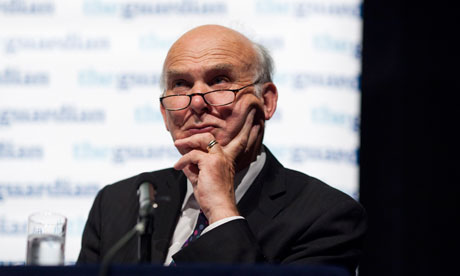
The business secretary, Vince Cable. Photograph: Martin Argles for the Guardian
The income of corporate executives, which the business secretary Vince Cable has just failed to address, is a form of institutionalised theft, arranged by a kleptocratic class for the benefit of its members. The wealth that was once spread more evenly among the staff of a company, or distributed as lower prices or higher taxes, is now siphoned off by people who have neither earned nor generated it.
Over the past 10 years, chief executives' pay has risen nine times faster than that of the median earner. Some bosses (British Gas, Xstrata and Barclays for example) are now being paid over 1,000 times the national median wage. The share of national income captured by the top 0.1% rose from 1.3% in 1979 to 6.5% by 2007.
These rewards bear no relationship to risk. The bosses of big companies, though they call themselves risk-takers, are 13 times less likely to be sacked than the lowest paid workers. Even if they lose their jobs and never work again, they will have invested so much and secured such generous pensions and severance packages that they'll live in luxury for the rest of their lives. The risks are carried by other people.
The problem of executive pay is characterised by Cable and many others as a gap between reward and performance. But it runs deeper than that, for three reasons. As the writer Dan Pink has shown, it's not just that there is currently no visible link between performance and pay; but high pay actually reduces performance. Material rewards incentivise simple mechanistic jobs: working on an assembly line, for example. But they lead to the poorer execution of tasks which require problem-solving and cognitive skills. As studies for the US Federal Reserve and other such bolsheviks show, cash incentives narrow people's focus and restrict the range of their thinking. By contrast, intrinsic motivators — such as a sense of autonomy, of enhancing your skills and pursuing a higher purpose — tend to improve performance.
Even the 0.1% concede that money is not what drives them. Bernie Ecclestone says: "I doubt if any successful business person works for money … money is a by-product of success. It's not the main aim." Jeroen van der Veer, formerly the chief executive of Shell, recalls, "if I had been paid 50% more, I would not have done it better. If I had been paid 50% less, then I would not have done it worse". High pay is both counterproductive and unnecessary.
The second reason is that, as the psychologist Daniel Kahneman has shown, performance in the financial sector is random, and the belief of traders and fund managers that they are using skill to beat the market is a cognitive illusion. A link between pay and results is a reward for blind luck.
Most importantly, the wider consequences of grotesque inequality bear no relationship to entitlement. Obscene rewards for success are as socially corrosive as obscene rewards for failure. They reduce social mobility, enhance plutocratic power and allow the elite to inflict astonishing levels of damage on the environment. They create resentment and reduce the motivation of other workers, who see the greedy bosses as the personification of the company.
Cable has announced four main policies: more transparency, a requirement that companies should "report" on boardroom diversity, a mechanism for clawing back pay settlements not justified by the company's performance, and granting shareholders binding powers to block excessive rewards. They are likely to be almost useless – or worse. Pay transparency, while of general interest, can create the perverse result that executives discover how much their rivals are getting, and use the information to demand more. The clawback mechanism will be inserted into the corporate governance code. This is voluntary, and its existing provisions are widely ignored.
Shareholder power is likely to be illusory. As Prem Sikka has shown, the proportion of stock owned by individuals fell from 47% in 1969 to 10% in 2008, while the percentage in foreign hands has risen from 7% to 42%. Why should oil sheikhs care about social justice in the UK? And most traders hold shares too briefly to take an interest in the inner workings of a company. As Rob Taylor, formerly the chief executive of Kleinwort Benson, points out, if shareholders don't like the way a company is run, they don't hang around to change it; they sell up and move on.
Labour's policies seem designed to sound tough but change little. Like Cable, its spokesman Chuka Umunna talks of transparency and simplicity (which are both worthy aims) but not of holding down pay. Labour has based its policy on the findings of the High Pay Commission, which have been widely hailed as revolutionary. I've read the commission's final report, and can find no justification for this description. Its recommendations are, to be frank, pathetic. With the possible exception of employee representation on pay committees, the 12 measures it proposes are likely to make only a marginal difference. Nowhere does it suggest anything resembling the obvious means of capping executive pay: namely, er, capping executive pay.
So what should be done? The UK government imposes a minimum wage, and even the neoliberal coalition appears to accept that this is a necessary intervention in the market. So why should it not impose a maximum wage?
I'm not talking about ratios or relative earnings. Various bodies have proposed that there should be a fixed ratio of the top earnings within a company to either the median or lowest salaries. But as a report on this issue by the New Economics Foundation shows, the first measurement quickly becomes complex and opaque, the second creates an incentive to contract out the lowest paid work. I'm talking about an absolute maximum, applied nationwide.
Let's say £500,000 a year, a figure that includes bonuses, share options, pensions and benefits. It will rise with inflation, but no faster than that. If you want to make more, you can invest in a risky venture of your own or someone else's. If you want to make more money as a salaried worker – in other words while other people carry the risks – you can go abroad, and good riddance to you. Another country, incautious enough to set no cap, can deal with the consequences of your destructive greed.
The feeble measures proposed by the government will do nothing to prevent the great pay robbery. If Vince Cable intended to limit executive pay, he would limit it. But he knows who his masters are, and the policies he has announced are intended to create only a semblance of action.
Subscribe to:
Posts (Atom)