Thursday, 19 April 2012
How Pakistan makes US pay for Afghan war
By Dilip Hiro
The following ingredients should go a long way to produce a political thriller. Mr M, a jihadi in an Asian state, has emerged as the mastermind of a terrorist attack in a neighboring country, which killed six Americans. After sifting through a vast cache of intelligence and obtaining a legal clearance, the State Department announces a $10 million bounty for information leading to his arrest and conviction. Mr M promptly appears at a press conference and says, "I am here. America should give that reward money to me."
A State Department spokesperson explains lamely that the reward is meant for incriminating evidence against Mr M that would stand up in court. The prime minister of M's home state condemns foreign interference in his country's internal affairs. In the midst of this imbroglio, the US decides to release $1.18 billion in aid to the cash-strapped government of the defiant prime minister to persuade him to reopen supply lines for US and North Atlantic Treaty Organization (NATO) forces bogged down in the hapless neighboring Islamic Republic of Afghanistan.
Alarmingly, this is anything but fiction or a plot for an upcoming international sitcom. It is a brief summary of the latest development in the fraught relations between the US and Pakistan, two countries locked into an uneasy embrace since September 12, 2001.
Mr M is Hafiz Muhammad Saeed, a 62-year-old former academic with a tapering, hennaed beard, and the founder of the Lashkar-e Taiba (the Army of the Pure, or LeT), widely linked to several outrageously audacious terrorist attacks in India.
The LeT was formed in 1987 as the military wing of the Jammat-ud Dawa religious organization (Society of the Islamic Call, or JuD) at the instigation of the Pakistani army's formidable intelligence agency, Inter-Services Intelligence (ISI). The JuD owes its existence to the efforts of Saeed, who founded it in 1985 following his return to his native Lahore after two years of advanced Islamic studies in Riyadh, Saudi Arabia, under the guidance of that country's grand mufti, Shaikh Abdul Aziz bin Baz.
On its formation, the LeT joined the seven-year-old anti-Soviet jihad in Afghanistan, an armed insurgency directed and supervised by the ISI with funds and arms supplied by the Central Intelligence Agency (CIA) and the Saudis. Once the Soviets withdrew from Afghanistan in 1989, the Army of the Pure turned its attention to a recently launched anti-Indian jihad in Indian-administered Kashmir and beyond.
The terrorist attacks attributed to it range from the devastating multiple assaults in Mumbai in November 2008, which resulted in 166 deaths, including those six Americans, to a foiled attack on the Indian parliament in New Delhi in December 2001, and a successful January 2010 attack on the airport in Kashmir's capital Srinagar.
In January 2002, in the wake of Washington's launching of the "war on terror", Pakistan formally banned the LeT, but in reality did little to curb its violent cross-border activities. Saeed remains its final authority. In a confession, offered as part of a plea bargain after his arrest in October 2009 in Chicago, David Coleman Headley, a Pakistani-American operative of LeT involved in planning the Mumbai carnage, said: "Hafiz Saeed had full knowledge of the Mumbai attacks and they were launched only after his approval."
In December 2008, the United Nations Security Council declared the JuD a front organization for the banned LeT. The provincial Punjab government then placed Saeed under house arrest using the Maintenance of Public Order law. But six months later, the Lahore High Court declared his confinement unconstitutional.
In August 2009, Interpol issued a Red Corner Notice, essentially an international arrest warrant, against Saeed in response to Indian requests for his extradition. Saeed was again put under house arrest but in October the Lahore High Court quashed all charges against him due to lack of evidence.
It is common knowledge that Pakistani judges, fearing for their lives, generally refrain from convicting high-profile jihadis with political connections. When, in the face of compelling evidence, a judge has no option but to order the sentence enjoined by the law, he must either live under guard afterwards or leave the country.
Such was the case with Judge Pervez Ali Shah who tried Mumtaz Qadri, the jihadi bodyguard who murdered Punjab's governor Salman Taseer for backing an amendment to the indiscriminately applied blasphemy law. Soon after sentencing Qadri to capital punishment last October, Shah received several death threats and was forced into self-exile.
Aware of the failures of the Pakistani authorities to convict Saeed, US agencies seemed to have checked and cross-checked the authenticity of the evidence they had collected on him before the State Department announced, on April 2, its reward for his arrest. This was nothing less than an implied declaration of Washington's lack of confidence in the executive and judicial organs of Pakistan.
Little wonder that Pakistani Prime Minister Yousaf Raza Gilani took umbrage, describing the US bounty as blatant interference in his country's domestic affairs. Actually, this is nothing new. It is an open secret that, in the ongoing tussle between Pakistani President Asif Ali Zardari and his bete noire, army chief of staff General Ashfaq Parvez Kiani, the Barack Obama administration has always backed the civilian head of state. That, in turn, has been a significant factor in Gilani's stay in office since March 2008, longer than any other prime minister in Pakistan's history.
How to trump a superpower
Given such strong cards, diplomatic and legal, why then did the Obama administration commit itself to releasing more than $1 billion to a government that has challenged its attempt to bring to justice an alleged mastermind of cross-border terrorism?
The answer lies in what happened at two Pakistani border posts about two kilometers from the Afghan frontier in the early hours of November 26, 2011. NATO fighter aircraft and helicopters based in Afghanistan carried out a two-hour-long raid on these posts, killing 24 soldiers.
Enraged, Pakistan's government shut the two border crossings through which the US and NATO had until then sent a significant portion of their war supplies into Afghanistan. Its officials also forced the US to vacate Shamsi air base, which was being used by the CIA as a staging area for its drone air war in Pakistan's tribal areas along the Afghan border. The drone strikes are exceedingly unpopular - one poll found 97% of respondents viewed them negatively - and they are vehemently condemned by a large section of the Pakistani public and its politicians.
Furthermore, the government ordered a comprehensive review of all programs, activities and cooperation arrangements with the US and NATO. It also instructed the country's two-tier parliament to conduct a thorough review of Islamabad's relations with Washington. Having taken the moral high ground, the Pakistani government pressed its demands on the Obama administration.
An appointed Parliamentary Committee on National Security (PCNS) then deliberately moved at a snail's pace to perform the task on hand, while the Pentagon explored alternative ways of ferrying goods into Afghanistan via other countries to sustain its war there.
By contrast, a vociferous campaign against the reopening of the Pakistani supply lines led by the Difa-e Pakistan Council (Defense of Pakistan), representing 40 religious and political groups, headed by Hafiz Saeed, took off. Its leaders have addressed huge rallies in major Pakistani cities. It was quick to condemn Washington's bounty on Saeed, describing it as "a nefarious attempt" to undermine the council's drive to protect the country's sovereignty.
Meanwhile, the loss of the daily traffic of 500 trucks worth of food, fuel and weapons from the Pakistani port of Karachi through the Torkham and Chaman border crossings into Afghanistan, though little publicized in US media, has undermined the fighting capability of US and NATO forces.
"If we can't negotiate or successfully renegotiate the reopening of ground lines of communication with Pakistan, we have to default and rely on India and the Northern Distribution Network (NDN)," said a worried Lieutenant General Frank Panter to the Readiness Subcommittee of the Armed Services Committee of the US House of Representatives on March 30. "Both are expensive propositions and it increases the deployment or redeployment."
The main part of the NDN is a 3,220-mile (5,100 kilometer) rail network for transporting supplies between the Latvian port of Riga and the Uzbek town of Termez (connected by a bridge over the Oxus River to the Afghan settlement of Hairatan). According to the Pentagon, it costs nearly $17,000 per container to go through the NDN compared to $7,000 through the Pakistani border crossings.
Moreover, US and NATO are allowed to transport only "non-lethal goods" through the NDN.
Other military officials have warned that the failure to reopen the Pakistani routes could even delay the schedule for withdrawing American "combat troops" from Afghanistan by 2014. That would be bad news for the Obama White House with the latest Washington Post/NBC News poll showing that, for the first time, even a majority of Republicans believe the Afghan war "has not been worth fighting". A CBS News/New York Times survey indicated that support for the war was at a record low of 23%, with 69% of respondents saying that now was the time to withdraw troops.
In the Pakistani capital, Islamabad, the PCNS finally published a list of preconditions that the US must meet for the reopening of supply lines. These included an unqualified apology for the air strikes last November, an end to drone attacks, no more "hot pursuit" by US or NATO troops inside Pakistan, and the taxing of supplies shipped through Pakistan.
Much to the discomfiture of the Obama administration, a joint session of the National Assembly and the senate called to debate the PCNS report took more than two weeks to reach a conclusion.
On April 12, parliament finally unanimously approved the demands and added that no foreign arms and ammunition should be transported through Pakistan. The Obama administration is spinning this development not as an ultimatum but as a document for launching talks between the two governments.
Even so, it has strengthened Gilani's hand as never before. Furthermore, he has to take into account the popular support the Saeed-led Difa-e Pakistan Council is building for keeping the Pakistani border crossings permanently closed to NATO traffic. Thus, Saeed, a jihadi with a US bounty on his head, has emerged as an important factor in the complex Islamabad-Washington relationship.
Squeezing Washington: The pattern
There is, in fact, nothing new in the way Islamabad has been squeezing Washington lately. It has a long record of getting the better of US officials by identifying areas of American weakness and exploiting them successfully to further its agenda.
When the Soviet bloc posed a serious challenge to the US, the Pakistanis obtained what they wanted from Washington by being even more anti-Soviet than America. Afghanistan in the 1980s is the classic example.
Following the Soviet military intervention there in December 1979, the Pakistani dictator General Muhammad Zia ul-Haq volunteered to join Washington's Cold War against the Kremlin - but strictly on his terms. He wanted sole control over the billions of dollars in cash and arms to be supplied by the US and its ally Saudi Arabia to the Afghan mujahideen (holy warriors) to expel the Soviets from Afghanistan. He got it.
That enabled his commanders to channel a third of the new weapons to their own arsenals for future battle against their archenemy, India. Another third were sold to private arms dealers on profitable terms. When pilfered US weapons began appearing in arms bazaars of the Afghan-Pakistan border towns (as has happened again in recent years), the Pentagon decided to dispatch an audit team to Pakistan.
On the eve of its arrival in April 1988, the Ojhiri arms depot complex, containing 10,000 tons of munitions, mysteriously went up in flames, with rockets, missiles and artillery shells raining down on Islamabad, killing more than 100 people.
By playing on Ronald Reagan's view of the Soviet Union as "the evil empire", Zia also ensured that the American president would turn a blind eye on Pakistan's frantic, clandestine efforts to build an atom bomb. Even when the CIA, the National Security Agency and the State Department determined that a nuclear weapon assembled by Pakistan had been tested at Lop Nor in China in early 1984, Reagan continued to certify to congress that Islamabad was not pursuing a nuclear weapons program in order to abide by a law which prohibited US aid to a country doing so.
Today, there are an estimated 120 nuclear bombs in the arsenal of a nation that has more Islamist jihadis per million people than any other country in the world. From October 2007 to October 2009, there were at least four attacks by extremists on Pakistani army bases known to be storing nuclear weapons.
In the post-9/11 years, Pakistan's ruler General Pervez Musharraf managed to repeat the process in the context of a new Afghan war. He promptly joined president George W Bush in his "war on terror", and then went on to distinguish between "bad terrorists" with a global agenda (al-Qaeda), and "good terrorists" with a pro-Pakistani agenda (the Afghan Taliban).
Musharraf's ISI then proceeded to protect and foster the Afghan Taliban, while periodically handing over al-Qaeda militants to Washington. In this way, Musharraf played on Bush's soft spot - his intense loathing of al-Qaeda - and exploited it to further Pakistan's regional agenda.
Emulating the policies of Zia and Musharraf, the post-Musharraf civilian government has found ways of diverting US funds and equipment meant for fighting al-Qaeda and the Taliban to bolster their defenses against India. By inflating the costs of fuel, ammunition and transport used by Pakistan's 100,000 troops posted in the Afghan-Pakistan border region, Islamabad received more money from the Pentagon's Coalition Support Fund (CSF) than it spent. It then used the excess to buy weapons suitable for fighting India.
When the New York Times revealed this in December 2007, the Musharraf government dismissed its report as "nonsense". But after resigning as president and moving to London, Musharraf told Pakistan's Express News television channel in September 2009 that the funds had indeed been spent on weapons for use against India.
Now, the widely expected release of the latest round of funds from the Pentagon's CSF will raise total US military aid to Islamabad since 9/11 to $14.2 billion, two-and-a-half times the Pakistani military's annual budget.
There is a distinct, if little discussed, downside to being a superpower and acting as the self-appointed global policeman with a multitude of targets. An arrogance feeding on a feeling of invincibility and an obsession with winning every battle blind you to your own impact and even to what might be to your long-term benefit. In this situation, as your planet-wide activities become ever more diverse, frenzied, and even contradictory, you expose yourself to exploitation by lesser powers otherwise seemingly tied to your apron strings.
Pakistan, twice during America's 33-year-long involvement in Afghanistan made a frontline state, is a classic example of that. Current policymakers in Washington should take note: it's a strategy for disaster.
Dilip Hiro, a TomDispatch regular, is the author of 33 books, the most recent being the just-published Apocalyptic Realm: Jihadists in South Asia (Yale University Press, New Haven and London).
(Copyright 2012 Dilip Hiro.)
Wednesday, 18 April 2012
Argentina Re-Nationalises an Oil Company
Standard & Poor's puts Argentina on 'negative watch' over YPF nationalisation plan
Standard & Poor's has put a "negative watch" on Argentina's credit rating, citing "rising restrictions to international trade" and "steps to nationalise oil company YPF" as reasons for the move.

Women walk past a poster that reads "CFK - YPF. They're ours, they're Argentine" in Buenos Aires last week. Photo: Reuters

11:03PM BST 23 Apr 2012
 41 Comments
Despite affirming its "B" credit rating, S&P added that the South American
country's recent actions "could exacerbate existing weaknesses in the
economy", pointing to high inflation and increasingly rigid government
expenditure.
The news came after Spain’s Repsol threatened legal action against any company that attempts to invest in YPF following its expropriation by Argentina last week, as the government expressed determination to “pay nothing at all” in compensation to the Spanish oil company.
The move would discourage external partners from providing the investment YPF needs to exploit vast shale oil deposits discovered within the Latin American country and is the latest attempt by Repsol to fight back against the illegal seizure of its subsidiary.
“We reserve the right to take legal action against any party investing in the YPF and its assets following the unlawful expropriation of the company,” Kristian Rix, a spokesman for Repsol in Madrid, told the Daily Telegraph on Monday.
The Spanish energy company believes billions of dollars are required to develop Argentina’s prospects including at least €25bn a year over the next decade to exploit the Vaca Muerta shale discovery made last year.
Julio De Vido, Argentina’s Planning Minister has already approached Brazil's state-run oil company Pertobras over investment in YPF and plans to contact other foreign oil companies including Exxon, Chevron and ConocoPhilips.
The development comes amid yet more rhetoric from Argentina as government sources insisted the offer of compensation would be “zero pesos”.
Shares in Repsol and Spanish builder Sacyr Vallehermoso, which owns a 10pc stake in the company, fell by 4.7pc and 10.7pc respectively on Monday after government sources quoted in Argentina’s daily newspaper La Nacion said the government was “determined to pay nothing at all to Repsol”.
Antonio Brufau, CEO of Repsol has argued that its YPF stake had a value of $10.5bn.
“They are looking into and finding out everything on the management of Repsol: irregularities, lack of investment, defective technical plans, financial and accounting issues. There is a debt of $9bn,” an unnamed official told the newspaper.
The government is assuming that any legal action processed through international tribunals could take five or six years, confided the source.
Meanwhile, details of the aggressive tactics employed by the government of Cristina Fernandez de Kirchner towards Spanish executives at YPF during the takeover emerged in a briefing issued by Spain’s foreign office to all its embassies fermenting hostilities between the two countries.
Mr de Vido and Axel Kicillof, the deputy economy minister, arrived at company headquarters with armed security guards who used “physical violence and threats” to force Spanish YPF employees from the building giving them five minutes to collect their personal belongings, the internal memo said.
Spanish YPF executives were then “hunted down” for “harsh interrogation” and they and their families sought refuge at the home of a senior executive awaiting repatriation to Spain.
In addition, eyebrows were raised over the state appointment of one of new managers of YPF. Exequiel Espinosa, the head of state oil company Enarsa, was once embroiled in a corruption scandal that threatened to derail Mrs Kirchner’s campaign for presidency in 2007.
Mr Espinosa was one of the Argentine officials on board a plane carrying Guido Antonini, a Venezuelan businessman who was caught landing in Buenos Aires with a suitcase of $800,000 allegedly destined for Mrs Kirchner’s campaign.
The matter forced the resignation of Claudio Uberti, an Argentine government official involved in trade and investment deals with Venezuela and cost Diego Uzcategui, president of Venezuela oil company PDVSA as both were on board the plane.
But Mr Espinosa, who was also one of the eight passengers on the private jet hired by Enarsa, survived the association unscathed.
“He’s a complete Kichnerista crony and now he’s in charge of exploration and production at YPF,” said a source connected to the Latin American energy industry.
Repsol may fight a move by the Eskenazi family to buy back shares in YPF citing a “force majeure” argument to declare the agreement void.
The company could argue that the agreement to buy back Eskenazi shares in the event that Repsol was to lose its majority stake was not applicable in the context of expropriation.
It also emerged on Monday that Argentine officials had searched a property used by Mr Braufau in Buenos Aires, seizing computers and documents apparently without an official court order.
----------------
Argentina's oil grab is timely retort to rampaging capitalism
Cristina Fernández's actions, however clumsy, are part of a worldwide reaction to exploitation by business and the rich


Cristina Fernández's move was populist and clumsy, but perfectly understandable. Photograph: Daniel Garcia/AFP/Getty Images
Suppose the British government knew that a key shareholder in
Centrica, our last great British energy company and owner of British
Gas, was to sell its stake to Gazprom, so making Russian state ownership
inevitable. I hope that, in this scenario, the government would expand
the provision of the Enterprise Act
that allows Britain to block takeovers that are against the national
interest to include gas and nuclear power. (The act is currently
confined to defence, financial services and the media.) I'm pretty
certain that Centrica chairman Sir Roger Carr,
also president of the CBI, shares the same view. No country can be
indifferent to the ownership of strategic assets and thus the use to
which they might be put. Its first obligation is to the well-being of
its citizens.
The Argentinian government was faced with just this dilemma last week. YPF is its national oil and gas company, which it sold to the Spanish oil company Repsol for $15bn in 1999 as part of its privatisation drive. It has not been a great deal for either party. Argentinian oil and gas production has slumped, exploration for new reserves has been run down and this oil-rich country is now an oil importer, with Repsol accused of looting the company and betraying its obligations.
Repsol's excuse is that Argentinian price controls are absurdly tough. It has wanted to sell its holding for some time and last July finally found a potential buyer: the Chinese state oil company Sinopec. On Monday, fearing that the deal was about to be done, the Argentinian government seized the lion's share of Repsol's stake to get majority control. Better that YPF is owned by the Argentinian government than the Chinese Communist party is their reasoning.
Many governments would have done the same. Ownership matters. Yet Argentina has been roundly condemned – the EU, Spain, Mexico and even Britain have all weighed in. The Economist thunders that President Cristina Fernández's antics must not go unpunished; nationalisation is a sin beyond redemption. The inference is that Repsol should have been allowed freely to dispose of its shares to whichever buyer and at the best price it could achieve. Argentina and its citizens have no right to intervene.
Ms Fernández was certainly high-handed and very arbitrary. She only seized enough shares from Repsol to secure 51% control and has yet to say what the state will pay in compensation; the other shareholders are hapless bystanders with their investment shredded. There is more than a whiff of shameless populism to her actions. But to portray Repsol as an injured innocent whose natural rights have been unfairly suborned is to traduce economic and political reality.
For too long, companies and the rich worldwide, egged on by American Republicans and British Tories, have shamelessly exploited the proposition that there is only one proper relationship between them and society: they do what they want on their own terms. And society must accept this because it is the sole route to "wealth generation". Capital exists above state and society.
Fernández's actions, however clumsy and unfair in their execution, are part of a growing worldwide reaction to the excesses that this proposition has brought. Repsol does not, and did not, have a God-given right to sell control in YPF to whomever it pleases while Argentina's interests can go hang. It exists in a symbiotic relationship with the society in which it trades. The right to trade and to own are privileges that come with reciprocal obligations as the Ownership Commission, which I chaired, argued earlier this year. They cannot exist in a vacuum because companies' actions have profound effects.
Moreover, companies, especially energy companies, need public agencies to help mitigate the risk of undertaking huge investments in a world where the future is unknowable. Across the globe, business and the rich insist on denying these elementary truths. Now they are reaping the whirlwind as a hostile reaction gathers pace worldwide. Capitalism's self-appointed custodians have become its worst enemies.
It is the driving force behind the Occupy Movement. It is why Jean Luc Melénchon, the hard left French presidential candidate, has had such a successful election campaign. It is why so many governments are co-ordinating their investigation into Amazon, the company paying negligible tax on its worldwide profits. It is why President Obama has adopted the Buffet tax on millionaires as a popular part of his re-election campaign. It is why George Osborne felt he had to balance his high-risk reduction in the top rate of income tax to 45%with a passionate declaration of war on the rich evading tax.
The reaction is long overdue and is producing some long-needed corrections. For example, in the last fortnight alone, Goldman Sachs' Lloyd Blankfein, Barclays' Bob Diamond and Citibank's Vikram Pandit have all faced angry shareholders, responding to the new mood, protesting about the extravagance of their bonuses compared to their institutions' paltry performance. They are being forced to accept less. Proportionality in top pay is beginning to be restored, if still a long way off.
But the mood needs to be channelled. Argentina may have done everyone a service by forcibly reminding global business that there are unpleasant consequences for neglecting economic and social responsibilities, but summary nationalisation without compensation is hardly a solid template for the future. It is a harbinger of Chinese-style arbitrary government; a move from crony capitalism to crony statism. It is time to reassert that while capitalism may be a proven route to prosperity, it only works in a complex interdependence with the state and society. There have to be rules at home and abroad to make a desirable world of open borders, free trade and free business work. Taxes have to be paid rather than evaded. Pay has to be proportional to contribution. Labour leader Ed Miliband was roundly and universally criticised as a leftist innocent just seven months ago when he differentiated between good and bad capitalism; now he looks extraordinarily prescient.
If more of his party – especially the shadow cabinet – would rally to his cause, there is a phenomenal political opportunity. The mood is changing. It needs to be channelled: the creation of a new and different compact with business, finance and the rich. It is what electorates across the world want to see. President Fernández, in her gauche way, has tapped into a global mood.
The Argentinian government was faced with just this dilemma last week. YPF is its national oil and gas company, which it sold to the Spanish oil company Repsol for $15bn in 1999 as part of its privatisation drive. It has not been a great deal for either party. Argentinian oil and gas production has slumped, exploration for new reserves has been run down and this oil-rich country is now an oil importer, with Repsol accused of looting the company and betraying its obligations.
Repsol's excuse is that Argentinian price controls are absurdly tough. It has wanted to sell its holding for some time and last July finally found a potential buyer: the Chinese state oil company Sinopec. On Monday, fearing that the deal was about to be done, the Argentinian government seized the lion's share of Repsol's stake to get majority control. Better that YPF is owned by the Argentinian government than the Chinese Communist party is their reasoning.
Many governments would have done the same. Ownership matters. Yet Argentina has been roundly condemned – the EU, Spain, Mexico and even Britain have all weighed in. The Economist thunders that President Cristina Fernández's antics must not go unpunished; nationalisation is a sin beyond redemption. The inference is that Repsol should have been allowed freely to dispose of its shares to whichever buyer and at the best price it could achieve. Argentina and its citizens have no right to intervene.
Ms Fernández was certainly high-handed and very arbitrary. She only seized enough shares from Repsol to secure 51% control and has yet to say what the state will pay in compensation; the other shareholders are hapless bystanders with their investment shredded. There is more than a whiff of shameless populism to her actions. But to portray Repsol as an injured innocent whose natural rights have been unfairly suborned is to traduce economic and political reality.
For too long, companies and the rich worldwide, egged on by American Republicans and British Tories, have shamelessly exploited the proposition that there is only one proper relationship between them and society: they do what they want on their own terms. And society must accept this because it is the sole route to "wealth generation". Capital exists above state and society.
Fernández's actions, however clumsy and unfair in their execution, are part of a growing worldwide reaction to the excesses that this proposition has brought. Repsol does not, and did not, have a God-given right to sell control in YPF to whomever it pleases while Argentina's interests can go hang. It exists in a symbiotic relationship with the society in which it trades. The right to trade and to own are privileges that come with reciprocal obligations as the Ownership Commission, which I chaired, argued earlier this year. They cannot exist in a vacuum because companies' actions have profound effects.
Moreover, companies, especially energy companies, need public agencies to help mitigate the risk of undertaking huge investments in a world where the future is unknowable. Across the globe, business and the rich insist on denying these elementary truths. Now they are reaping the whirlwind as a hostile reaction gathers pace worldwide. Capitalism's self-appointed custodians have become its worst enemies.
It is the driving force behind the Occupy Movement. It is why Jean Luc Melénchon, the hard left French presidential candidate, has had such a successful election campaign. It is why so many governments are co-ordinating their investigation into Amazon, the company paying negligible tax on its worldwide profits. It is why President Obama has adopted the Buffet tax on millionaires as a popular part of his re-election campaign. It is why George Osborne felt he had to balance his high-risk reduction in the top rate of income tax to 45%with a passionate declaration of war on the rich evading tax.
The reaction is long overdue and is producing some long-needed corrections. For example, in the last fortnight alone, Goldman Sachs' Lloyd Blankfein, Barclays' Bob Diamond and Citibank's Vikram Pandit have all faced angry shareholders, responding to the new mood, protesting about the extravagance of their bonuses compared to their institutions' paltry performance. They are being forced to accept less. Proportionality in top pay is beginning to be restored, if still a long way off.
But the mood needs to be channelled. Argentina may have done everyone a service by forcibly reminding global business that there are unpleasant consequences for neglecting economic and social responsibilities, but summary nationalisation without compensation is hardly a solid template for the future. It is a harbinger of Chinese-style arbitrary government; a move from crony capitalism to crony statism. It is time to reassert that while capitalism may be a proven route to prosperity, it only works in a complex interdependence with the state and society. There have to be rules at home and abroad to make a desirable world of open borders, free trade and free business work. Taxes have to be paid rather than evaded. Pay has to be proportional to contribution. Labour leader Ed Miliband was roundly and universally criticised as a leftist innocent just seven months ago when he differentiated between good and bad capitalism; now he looks extraordinarily prescient.
If more of his party – especially the shadow cabinet – would rally to his cause, there is a phenomenal political opportunity. The mood is changing. It needs to be channelled: the creation of a new and different compact with business, finance and the rich. It is what electorates across the world want to see. President Fernández, in her gauche way, has tapped into a global mood.
--------------
Argentina's critics are wrong again about renationalising oil
In taking back oil and gas company YPF, Argentina's state is reversing past mistakes. Europe is in no position to be outraged

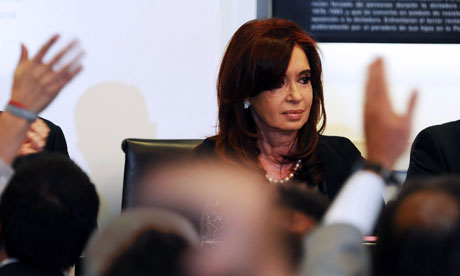
Argentinia's president, Cristina
Kirchner, announces that the oil company YPF is subject to
expropriation. Photograph: Daniel Garcia/AFP/Getty Images
The Argentinian government's decision to renationalise
the oil and gas company YPF has been greeted with howls of outrage,
threats, forecasts of rage and ruin, and a rude bit of name-calling in
the international press. We have heard all this before.
When the government defaulted on its debt at the end of 2001 and then devalued its currency a few weeks later, it was all doom-mongering in the media. The devaluation would cause inflation to spin out of control, the country would face balance of payments crises from not being able to borrow, the economy would spiral downward into deeper recession. Then, between 2002 and 2011, Argentina's real GDP grew by about 90%, the fastest in the hemisphere. Employment is now at record levels, and both poverty and extreme poverty have been reduced by two-thirds. Social spending, adjusted for inflation, has nearly tripled. All this is probably why Cristina Kirchner was re-elected last October in a landslide victory.
Of course this success story is rarely told, mostly because it involved reversing many of the failed neoliberal policies – that were backed by Washington and its International Monetary Fund – that brought the country to ruin in its worst recession of 1998-2002. Now the government is reversing another failed neoliberal policy of the 1990s: the privatisation of its oil and gas industry, which should never have happened in the first place.
There are sound reasons for this move, and the government will most likely be proved right once again. Repsol, the Spanish oil company that currently owns 57% of Argentina's YPF, hasn't produced enough to keep up with Argentina's rapidly growing economy. From 2004 to 2011, Argentina's oil production has actually declined by almost 20% and gas by 13%, with YPF accounting for much of this. And the company's proven reserves of oil and gas have also fallen substantially over the past few years.
The lagging production is not only a problem for meeting the needs of consumers and businesses, it is also a serious macroeconomic problem. The shortfall in oil and gas production has led to a rapid rise in imports. In 2011 these doubled from the previous year to $9.4bn, thus cancelling out a large part of Argentina's trade surplus. A favourable balance of trade has been very important to Argentina since its default in 2001. Because the government is mostly shut out of borrowing from international financial markets, it needs to be careful about having enough foreign exchange to avoid a balance of payments crisis. This is another reason that it can no longer afford to leave energy production and management to the private sector.
So why the outrage against Argentina's decision to take – through a forced purchase – a controlling interest in what for most of the enterprise's history was the national oil company? Mexico nationalised its oil in 1938, and, like a number of Opec countries, doesn't even allow foreign investment in oil. Most of the world's oil and gas producers, from Saudi Arabia to Norway, have state-owned companies. The privatisations of oil and gas in the 1990s were an aberration; neoliberalism gone wild. Even when Brazil privatised $100bn of state enterprises in the 1990s, the government kept majority control over energy corporation Petrobras.
As Latin America has achieved its "second independence" over the past decade-and-a-half, sovereign control over energy resources has been an important part of the region's economic comeback. Bolivia renationalised its hydrocarbons industry in 2006, and increased hydrocarbon revenue from less than 10% to more than 20% of GDP (the difference would be about two-thirds of current government revenue in the US). Ecuador under Rafael Correa greatly increased its control over oil and its share of private companies' production.
So Argentina is catching up with its neighbours and the world, and reversing past mistakes in this area. As for their detractors, they are in a weak position to be throwing stones. The ratings agencies threatening to downgrade Argentina – should anyone take them seriously after they gave AAA ratings to worthless mortgage-backed junk during the housing bubble, and then pretended that the US government could actually default? And as for the threats from the European Union and the rightwing government of Spain – what have they done right lately, with Europe caught in its second recession in three years, nearly halfway through a lost decade, and with 24% unemployment in Spain?
It is interesting that Argentina has had such remarkable economic success over the past nine years while receiving very little foreign direct investment, and being mostly shunned by international financial markets. According to most of the business press, these are the two most important constituencies that any government should make sure to please. But the Argentinian government has had other priorities. Maybe that's another reason why Argentina gets so much flak.
When the government defaulted on its debt at the end of 2001 and then devalued its currency a few weeks later, it was all doom-mongering in the media. The devaluation would cause inflation to spin out of control, the country would face balance of payments crises from not being able to borrow, the economy would spiral downward into deeper recession. Then, between 2002 and 2011, Argentina's real GDP grew by about 90%, the fastest in the hemisphere. Employment is now at record levels, and both poverty and extreme poverty have been reduced by two-thirds. Social spending, adjusted for inflation, has nearly tripled. All this is probably why Cristina Kirchner was re-elected last October in a landslide victory.
Of course this success story is rarely told, mostly because it involved reversing many of the failed neoliberal policies – that were backed by Washington and its International Monetary Fund – that brought the country to ruin in its worst recession of 1998-2002. Now the government is reversing another failed neoliberal policy of the 1990s: the privatisation of its oil and gas industry, which should never have happened in the first place.
There are sound reasons for this move, and the government will most likely be proved right once again. Repsol, the Spanish oil company that currently owns 57% of Argentina's YPF, hasn't produced enough to keep up with Argentina's rapidly growing economy. From 2004 to 2011, Argentina's oil production has actually declined by almost 20% and gas by 13%, with YPF accounting for much of this. And the company's proven reserves of oil and gas have also fallen substantially over the past few years.
The lagging production is not only a problem for meeting the needs of consumers and businesses, it is also a serious macroeconomic problem. The shortfall in oil and gas production has led to a rapid rise in imports. In 2011 these doubled from the previous year to $9.4bn, thus cancelling out a large part of Argentina's trade surplus. A favourable balance of trade has been very important to Argentina since its default in 2001. Because the government is mostly shut out of borrowing from international financial markets, it needs to be careful about having enough foreign exchange to avoid a balance of payments crisis. This is another reason that it can no longer afford to leave energy production and management to the private sector.
So why the outrage against Argentina's decision to take – through a forced purchase – a controlling interest in what for most of the enterprise's history was the national oil company? Mexico nationalised its oil in 1938, and, like a number of Opec countries, doesn't even allow foreign investment in oil. Most of the world's oil and gas producers, from Saudi Arabia to Norway, have state-owned companies. The privatisations of oil and gas in the 1990s were an aberration; neoliberalism gone wild. Even when Brazil privatised $100bn of state enterprises in the 1990s, the government kept majority control over energy corporation Petrobras.
As Latin America has achieved its "second independence" over the past decade-and-a-half, sovereign control over energy resources has been an important part of the region's economic comeback. Bolivia renationalised its hydrocarbons industry in 2006, and increased hydrocarbon revenue from less than 10% to more than 20% of GDP (the difference would be about two-thirds of current government revenue in the US). Ecuador under Rafael Correa greatly increased its control over oil and its share of private companies' production.
So Argentina is catching up with its neighbours and the world, and reversing past mistakes in this area. As for their detractors, they are in a weak position to be throwing stones. The ratings agencies threatening to downgrade Argentina – should anyone take them seriously after they gave AAA ratings to worthless mortgage-backed junk during the housing bubble, and then pretended that the US government could actually default? And as for the threats from the European Union and the rightwing government of Spain – what have they done right lately, with Europe caught in its second recession in three years, nearly halfway through a lost decade, and with 24% unemployment in Spain?
It is interesting that Argentina has had such remarkable economic success over the past nine years while receiving very little foreign direct investment, and being mostly shunned by international financial markets. According to most of the business press, these are the two most important constituencies that any government should make sure to please. But the Argentinian government has had other priorities. Maybe that's another reason why Argentina gets so much flak.
Tuesday, 17 April 2012
Total Football - Barcelona style
Be it the 2-3-5, the 4-3-3, the 4-2-4, or the 4-4-2, Barcelona have consigned
mathematical rigidity in football to irrelevance. They have done the same
with the ancient and venerable notion that centre halves, or centre
forwards, should be tall and strapping. Also torn to shreds is the article
of faith that dictates all teams need a “stopper”, a specialist in defensive
destruction, in midfield.
What’s more, Barcelona have signalled a democratic revolution in the sport.
They have shown, through their success, that the qualities a football player
requires to prosper are technical skill and intelligence on the ball. Size
doesn’t matter; neither does the position of each player on the pitch.
The seed of it all was the “total football” of Ajax Amsterdam, patented by one
of the sport’s philosophers, Rinus Michels. His favourite disciple, Johan
Cruyff, brought it to Barcelona, first as a player and then as manager. From
there the Barcelona “Dream Team” of the early Nineties emerged.
What we are witnessing today is the perfected version of that model, a purified distillation of the ideology of Michels. What the “Pep Team” delivers is more than total football; it is absolute football.
What we are witnessing today is the perfected version of that model, a purified distillation of the ideology of Michels. What the “Pep Team” delivers is more than total football; it is absolute football.
Michels led the great revolution of modern football. He bequeathed a legacy
that included three consecutive European Cup triumphs for Ajax, from 1971 to
1973, and that took Holland’s “clockwork orange” team, with Johan Cruyff as
standard-bearer, to the World Cup final in 1974 and 1978.
The system was based not on the manner players were distributed on the field – by a clear division between defenders, midfielders and forwards – but by a change in attitude that led the entire team to perform, and think, in a different way. The defender was no longer a mere stopper, he had to be capable of distributing the ball as adeptly as a midfielder. Possession was the indispensable prerequisite.
A player in a Michels team had to be comfortable with the ball at his feet, whatever his position. When he recovered possession, he would lift his head, find a team-mate and initiate another attack. The game was suddenly being played at an entirely different rhythm. Ajax and Holland appeared to play with more speed than any other team in history. They gave this impression because it was true.
Michels carried the orange torch to Barcelona, where he was coach for two spells in the 1970s, failing each time to make his model gel. He did, though, leave his mark, not least by his decision to sign Cruyff, even if they were unable to break the dominance of Real Madrid.
The turning point came when Cruyff took over the team’s reins in 1988. Suddenly the coach was king; his philosophy would now become the key to success. Cruyff’s first season at the helm was, however, a disaster. Had it not been for his legendary name, and if he had not believed so stubbornly in his own abilities, Barcelona would have sacked him. Cruyff convinced the president of the club, Josep Lluís Nuñez, to forget about the short term and think strategically, allowing time for the concept of total football that had captivated the world 15 years previously to permeate the club. This was the path to adhere to, this was the cause for which it was worth fighting.
In a private conversation back then, on a particular evening long on Heineken consumption, Cruyff confided to one of his drinking companions, “I am going to change the world of football.” How? “My defenders will be midfielders; I will play with two wingers and no centre forward.” Cruyff’s interlocutor wondered if that might have been the beers talking. It wasn’t.
Without a centre forward to preoccupy them rival centre halves would be left bewildered, unemployed; with two wingers the available space opened up enormously and from such a tactical platform a team whose players were all masters on the ball were free to play expansively.
Cruyff’s Barcelona never defined themselves in terms of European triumphs accumulated, like Real Madrid or Ajax, but his trophy haul was not inconsiderable: four consecutive Spanish Liga titles, a King’s Cup, a Cup-Winners’ Cup, European and Spanish Super Cups and that one, coveted first European Cup, at Wembley, courtesy of a goal from Ronald Koeman, total football made flesh. The Cruyff blueprint became emedded in the club’s DNA.
The seductiveness of the Cruyff playing style captivated the fans, the Catalan press and the youth players, none more so than the most intelligent and receptive of them all, Pep Guardiola, who rose to the first-team captaincy under Cruyff, where he remained after the Dutchman’s departure in 1996. Two Dutch coaches, Louis van Gaal and Frank Rijkaard, perpetuated the club ethos, with varying success but unwavering fidelity.
When Guardiola, Cruyff’s protégé, ascended to the first team bench, he coincided with the emergence of a group of players who had been immersed in the in-house philosophy from adolescence, among them Xavi Hernández, Víctor Valdés, Gerard Piqué, Andrés Iniesta and Lionel Messi.
What they had been taught, as their chief article of faith, was that the ball was sovereign; possession the primary — practically the only — priority.
The striking thng about Guardiola’s team is that, while tactical discipline is strict, one is never sure exactly what position on the pitch at least three quarters of the players are supposed to occupy.
The images showing the nominal formation of the starting 11 flash up on the television screens at the start of each match but when the whistle is blown the Barca players pop up everywhere, defying the game’s ancient orthodoxies. Dani Alves is listed as a right back but he often plays more an attacking midfielder or a winger; it has never been made clear whether Andres Iniesta is a right or left winger, or whether his natural position is in the centre of midfield. Alexis Sánchez is a centre forward — the smallest target man in the history of the sport — but disguises himself as a winger. Messi is a “false nine”, occupying a deeper position than a traditional centre-forward, and much more.
As for Cesc Fàbregas, the former Arsenal captain defies all analysis of the position on the field he is supposed to occupy. It is his superior football brain, and his years in the Barcelona youth teams, that have allowed him to impose order, under Guardiola’s watchful guidance, on the apparent chaos of his role.
Xavi Hernández is, of course, the conductor of the midfield orchestra, but he tackles back. Messi also wins back possession; if it were ever necessary he could perform perfectly ably as a full-back. Valdés, the goalkeeper, passes the ball more often than he stops shots.
Guardiola requires his players to pass the ball, even in defensive extremis, because the cardinal sin is to play a random long ball, to reduce football to an anarchic game of chance.
It is the dream that Cruyff aspired to and Guardiola finally transformed into hard, trophy-winning reality. Possession is the sacred principle, as much in defence as in attack, because if the opposition is deprived of the ball, there is no need to defend.
The team’s forward movement operates on the principle of a wave in the sea, gathering momentum until it breaks on the shore of the opposition penalty area. Even if a goal is not the outcome, even if the ball is lost, the rival team recover control so deep in their own half that they have a long and winding road ahead before they can mount an effective threat on the Barca goal. The opposition are obliged not only to cover the entire length of the field to mount a threat, along the way they have to thread a way through a team under orders to chase the ball like a pack of rabid dogs. Barca are artisans, but workers too.
What Barcelona have done is to invent a new language, or what Fábregas, since his arrival from Arsenal this season, has described as the Guardiola “software”. It is hard to assimilate for those who have not been raised from an early age at the club’s La Masia academy.
Some, such as Eric Abidal and Javier Mascherano, have managed to pick it up. But it is a measure of how tough the challenge is that two such reputed superstars as Thierry Henry and Zlatan Ibrahimovic failed to adapt, each ending up as awkward misfits, only fitfully effective, in the Nou Camp ballet.
Barca have imprinted an instantly identifiable picture on football’s global consciousness. Physicality and athleticism have bowed to refinement and technique, the warrior spirit remains but has been leavened by intelligence and the killer grace of the champion swordsman, or the matador. It does not matter if a player is tall or short, wide or thin, so long as he knows how to caress the ball.
Will Barcelona’s triumphant run last? Who knows? Guardiola may leave the club; Messi might suffer a career-diminishing injury, or simply run out of steam; a rival coach might come up with the antidote. It is possible, if highly unlikely, that Barca won’t add to the 13 out of 16 trophies they have won in the past three seasons. But whatever the future may hold, they have left an indelible mark on the game and its history. Nothing will ever be the same again.
From The Telegraph
Economics has failed us: but where are the fresh voices?
Mainstream economic
models have been discredited. But why aren't political scientists and
sociologists offering an alternative view?

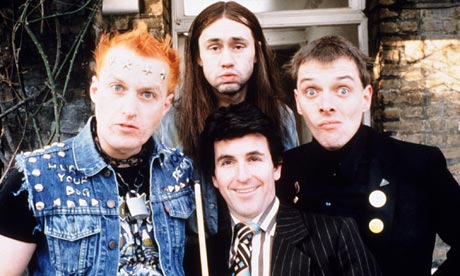
Actually do some meaningful work? Us? Top academics, The Young Ones Photograph: image.net
When the history of how a good crisis went to waste gets written up, it will surely contain a big chapter on the failure of our academic elites. Because just like the politicians, the taxpayer-funded intellectuals at our universities have missed the historic opportunities gifted to them by the financial collapse. And it will be the rest of us who pay the price.
At the start of the banking crisis, the air was thick with the sound of lachrymose economists. How did they miss the biggest crash since 1929? Professors at the LSE were asked that very question by the Queen – and were too tongue-tied to reply. A better answer came from Alan Greenspan, until recently the most powerful economist on the planet, who went to Capitol Hill and confessed to a "flaw" in his model of the world. Clearly, the economic crisis was also a crisis of economics.
With the all-powerful dismal-ists temporarily discredited, an opportunity opened up for the sociologists, the political scientists and the rest to charge in, have their say – and change the way public policy is shaped.
If all that sounds like a battle of the -ologies to you, then consider: no discipline has so profoundly shaped Britain or America over the past 30 years as mainstream economics, with its almost unshakeable faith in markets, and its insistence on taking politics out of the public sphere. Displace that narrow, straitened form of economics from its position as the orthodoxy on modern capitalism, and you have a shot at changing capitalism itself.
So have the non-economists grasped their moment? Have they hell. Look at the academic conferences held over the past few weeks, at which the latest and most promising research in each discipline is presented, and it's as if Lehman Brothers never fell over.
Britain's top political scientists met in Belfast a couple of weeks ago, and you'd have thought there'd be plenty in the crisis for them to discuss, from the technocrat governments installed in southern Europe to the paralysis of British politicians in the face of the banks. But no: over the course of three days, they held exactly one discussion of Britain's political economy. There was more prominence given to a session on how academic research could advance dons' careers.
Perhaps you have more faith in the sociologists. Take a peek at the website for the British Sociological Association. Scroll through the press-released research, and you will not come across anything that deals with the banking crash. Instead in April 2010, amid the biggest sociological event in decades, the BSA put out a notice titled: "Older bodybuilders can change young people's view of the over-60s, research says."
Or why not do the experiment I tried this weekend: go to three of the main academic journals in sociology, where the most noteworthy research is collected, and search the abstracts for the terms "finance" or "economy" or "markets" since the start of the last decade.
Comb through the results for articles dealing with the financial crisis in even the most tangential sense. I found nine in the American Sociological Review, three in Sociology ("the UK's premier sociology journal"), and one in the British Journal of Sociology. Look at those numbers, and remember that the BSA has 2,500 members – yet this is the best they could do.
Sociologists are reliably good at analysing the fallout from crises: the recessions, the cuts, the dispossessed, the repossessed. I'd expect them to be in for a busy few years. But on the upstream stuff, the causes of this crisis, they are practically silent. At Oxford, Donald MacKenzie has pulled off remarkable close-up studies of financiers in action but without context or politics: the view is all cogs and no car. Indeed, leave aside three remarkable books from Karen Ho, David Graeber and Alexandra Ouroussoff, all of whom are anthropologists (and all discussed here previously), and the bigger picture is still in the hands of those formerly shamefaced, but now rather assertive, economists. One promising initiative has just begun on the Open Democracy website called Uneconomics, where non-economists do chip in on the upstream causes of the crisis. But that's it: a cheap and cheerful internet forum. The Second International it ain't.
It wasn't always like this. One way of characterising what has happened in America and Britain over the past three decades is that people at the top have skimmed off increasing amounts of the money made by their corporations and societies. That's a phenomenon well covered by earlier generations of sociologists, whether it's Marx with his study of primitive accumulation, or the American C Wright Mills and his classic The Power Elite, or France's Pierre Bourdieu.
But those sociologists were public academics, unafraid to stray outside their disciplines. Compare that with the picture of today's teacher in a modern degree-factory, forever churning out publications for their discipline's top-rated journals. Not much scope there to try out a speculative research project that might not fly, or to collaborate with specialists in other subjects.
Nor is there much encouragement to engage with public life. Because that's what's really missing from the other social sciences. When an entire discipline does what the sociologists did at their conference last week and devotes as much time to discussing the holistic massage industry ("using a Foucauldian lens") as to analysing financiers, they're never going to challenge the dominance of mainstream economics. And it's hard to believe they really want to.
Daughter, my generation is squandering your birthright
When my second child reaches my age I fear the NHS, along with the tiger and rhino, will be part of a mythologised arcadia

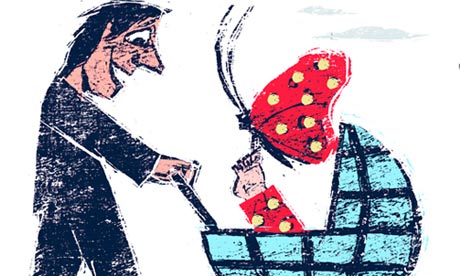
Illustration by Daniel Pudles
Already it feels like years since I saw you, my second daughter, in the scan, your segmented skeleton revealed like an ancient beast uncovered by geologists, buried in the rock of ages. Already I have begun to entertain the hopes and fears to which every parent has succumbed, perhaps since early hominids laid down the prints which show that the human spark had been struck.
Let me begin at the beginning, with the organisation to which you might owe your life. When I was born, almost 50 years ago, in the bitter winter of 1963, the National Health Service was just 15 years old. It must still have been hard for people to believe that – for the first time in the history of these islands – they could fall ill without risking financial ruin, that nobody need die for want of funds. I see this system as the summit of civilisation, one of the wonders of the world.
Now it is so much a part of our lives that it is just as hard to believe that we might lose it. But I fear that, when you have reached my age, free universal healthcare will be a distant fantasy, a mythologised arcadia as far removed from the experience of your children's generation as the Blitz was from mine. One of the lessons you will learn, painfully and reluctantly, is that nothing of public value exists which has not been fought for.
The growth of this system was one of the remarkable features of the first half of the period through which I have lived. Then, wealth was widely shared and the power of those who had monopolised it was shaken. Taxation was used without embarrassment as a means of redistributing the commonwealth of humanity. This great social progress is also being rolled back, and, though perhaps I am getting ahead of myself, I fear for your later years. My generation appears to be squandering your birthright.
This destruction echoes our treatment of the natural world. In my childhood it would never have occurred to me that birds as common as the cuckoo, the sparrow and the starling could suffer so rapid a decline that I would live to see them classed as endangered in this country. I remember the astonishing variety of moths that clustered on the windows on warm summer nights, the eels, dense as wickerwork, moving downriver every autumn, field mushrooms nosing through grassy meadows in their thousands. These are sights that you might never see. By the time your children are born, the tiger, the rhino, the bluefin tuna and many of the other animals that have so enthralled me could be nothing but a cause of regret.
We now have a better understanding than we did when I was born – a year after Silent Spring was published – of the natural limits within which we live. The new science of planetary boundaries has begun to establish the points beyond which the natural resources which make our lives viable can no longer be sustained. Already, this tells us, we may have trespassed across three of the nine boundaries set out by researchers, and we are pushing towards three others.
You may live to see the extremes of climate change I have spent much of my life hoping we can avert, accompanied by further ecological disasters, such as the acidification of the oceans, the loss of most of the world's remaining forests, its wetlands and fossil water reserves, its large predators, fish and coral reefs. If so, you will doubtless boggle at the stupidity and short-sightedness of those who preceded you. No one can claim that we were not warned.
There is another possible route, which I have spent the past two years researching and to which I have decided to devote much of the rest of my working life. This is a positive environmentalism, which envisages the rewilding – the ecological restoration – of large tracts of unproductive land and over-exploited sea. It recognises nature's remarkable capacity to recover, to re-establish the complex web of ecological relationships through which, so far, we have crudely blundered. Rather than fighting only to arrest destruction, it proposes a better, richer world, a place in which, I hope, you would delight to live.
There is one respect at least in which this country and many others have already become better places. I believe that family life, contrary to the assertions of politicians and newspapers, is now better than it has been for centuries, as the old, cold model of detached parenting and the damage – psychological, neurological and (some research suggests) epigenetic – that it appears to have caused finally begins to disappear.
Perhaps the greatest source of hope and social progress arises from our rediscovery of the animal needs of babies and young children: the basic requirements of comfort, contact and attachment. Yes, attached parenting is taxing (now you are beginning to writhe and rumble and I fear that your mother, exhausted from a night of almost constant feeding, will soon have to wake again), but it is, I believe, the one sure foundation of a better world. Knowing what we now know, we have an opportunity to avert the damage, the unrequited needs that have caused so many social ills, which lie perhaps at the root of war, of destructive greed, of the need to dominate.
So this is where hope lies: right at the beginning, with the recognition that you, like all of us, arose from and belong to the natural world.
Monday, 16 April 2012
Compelling case for Iraq war crime tribunal
The Age of Deception: Nuclear Diplomacy in Treacherous Times by Mohamed ElBaradei
Reviewed by Kaveh L Afrasiabi
This book, eloquently written by a former director-general of the International Atomic Energy Agency (IAEA), is a must read, both for the wealth of information it provides on the contentious issues of global nuclear diplomacy as well as for the passionate and compelling case that it presents for a war crime tribunal to
In blunt yet sincere language steeped in international law, ElBaradei writes that in light of the US's complete "disdain for international norms" in its invasion of Iraq, the United Nations should request an opinion from the International Court of Justice (ICJ) as to the legality of the Iraq war.
 Convinced
that the overwhelming weight of evidence favors a
negative verdict if the ICJ ever braved such an
initiative, ElBaradei then makes a case for the
International Criminal Tribunal to "investigate
whether this constitutes a war crime". (pg 87)
Convinced
that the overwhelming weight of evidence favors a
negative verdict if the ICJ ever braved such an
initiative, ElBaradei then makes a case for the
International Criminal Tribunal to "investigate
whether this constitutes a war crime". (pg 87)
Irrespective, ElBaradei is so morally outraged by the blatant pulverization of a sovereign Middle East country by a Western superpower and its allies that he also advises the Iraqis to demand war reparations - that is sure to amount to tens of billions of dollars.
If for nothing else, this book's value - in putting self-righteous Western powers on the defensive and depicting them as essentially rogue states that have caused a new global anarchy by their willful exercise of power without much regard for the rights of others - is indispensable.
Divided into 12 chapters with a useful conclusion on the future of nuclear diplomacy, the book covers nearly three decades of the author's involvement with various cases, ie, Iraq, North Korea, Libya and Iran, the notorious "nuclear bazaar of Abdul Qadeer Khan" in Pakistan, as well as nuclear asymmetry and the hypocrisy and double standard, not to mention outright deceptions, marking the behavior of US and other Western countries (along the familiar North-South divide).
In the chapters on Iraq, ElBaradei defends the cherished record of his agency in refusing to act as a sounding board for post 9/11 warmongering US policies, which earned him the occasional venom of US media that questioned his integrity. In fact, ElBaradei is equally critical of the compliant Western media that often act as indirect apparatuses of state despite their wild claims of neutrality and objectivity.
Although much of what ElBaradei writes about the US-British deceptions to go to war in Iraq is already well-known, it is instructive to revisit those "grotesque distortions" - as he puts it - from a reputable source who for years was caught in the maelstrom of contesting politics of non-proliferation.
With respect to the British role under premier Tony Blair, whom he accuses of a false alarm on Iraq's chemical weapon capability, ElBaradei actually underestimates the degree to which London influenced Washington on Iraq, characterizing this instead as a "one-way street" with the British "acting as apologists for US". (pg 67).
But, ElBaradei is not a foreign policy expert and his shortcoming, in detecting the American foreign policy elite's vulnerability with respect to British political influence, is forgivable. This is a minor defect in a solid contribution that sheds much light on how the US manipulated the UN atomic agency as "bit players" in its scheme to invade Iraq.
It shows the Pandora's box opened by the IAEA when it agreed to receive foreign intelligence from member states spying on others, thus opening the door to calibrated disinformation often beyond the ability of the agency and its meager resources to authenticate.
As a result, today the IAEA has turned into a de facto ''nuclear detective agency" that constantly receives tips from Western clients targeting specific countries. Sooner or later, either this unhealthy situation is rectified or we must expect more gaping holes in the agency's credibility.
With respect to North Korea, which has exited the nuclear Non-Proliferation Treaty (NPT) and proliferated nuclear weapons without much international backlash, ElBaradei blames the US's failure to live up to its agreed commitment and the fallacy of "attempts to contain proliferation ambitions through confrontation, sanctions, and isolation". (Pg 109)
He also writes about Libya's voluntary disarmament in 2004, a decision that the late Muammar Gaddafi now regrets in his grave, given the likelihood that the North Atlantic Treaty Organization (NATO) would have thought twice about attacking Libya under the guise of "responsibility to protect", thus making a mockery of the UN, if Tripoli had retained a nuclear shield.
For sure, this issue must loom large on the mind of many developing nations that have clashing interests with the (increasingly bullying) Western powers.
ElBaradei has devoted a whole chapter to the subject of nuclear double standards that discusses, for instance, how South Korea's clear evidence of non-compliance was shoved under the rug by the US in 2004 simply because it is a US allay.
The US and other privileged nuclear-have nations have been derelict in their NPT obligations to move toward nuclear disarmament, some, like France and Britain, modernizing their arsenals, while at the same time having the audacity of taking the moral high ground against countries suspected of clandestine proliferation.
ElBaradei writes that in the Middle East, "The greatest source of frustration and anxiety was the regional asymmetry of military power symbolized by Israel's arsenal." (pg 223) And yet, Israel, which since its bombardment of Iraq's nuclear facility in 1981 has been mandated by the UN Security Council to place its nuclear facilities under the IAEA inspections, has evaded this obligation with impunity.
Regarding Iran, extensively dealt with in four chapters, ElBaradei seeks to present a balanced account that pinpoints the chronology of events, interactions and negotiations that are still ongoing as of this date, thus making the book an indispensable tool for those who follow the developments in the Iran nuclear crisis.
Since his retirement from the IAEA, ElBaradei has repeatedly gone on record to state that during his tenure at the agency he never saw any evidence that Iran was proliferating nuclear weapons.
What is more, he informs readers that after the 2007 US intelligence report that confirmed that Iran's program had been peaceful since 2003, "I received a follow-up briefing by US intelligence. They did not show the supposed evidence that had let them to confirm the existence of a past Iranian nuclear weapon program, other than to refer to the same unverified set of allegations about weaponization studies that had already been discussed with the agency." (pg 269)
He also writes, "The Americans did acknowledge - as in most previous intelligence briefings - that there was no indication that Iran had undeclared nuclear material." (pg 262) Indeed, this is important information, given that in more than a dozen reports on Iran the IAEA has repeatedly confirmed the absence of any evidence of military diversion of "declared nuclear material".
In Chapter 11, on the "squandered opportunities" with Iran, the author writes about Iran-IAEA cooperation through a workplan that resulted in the successful resolution of the "six outstanding" issues that had led to the IAEA's referral of Iran's file to the UN Security Council.
Missing in this book is any mention of that workplan's concluding paragraph that stipulated the agency's treatment of Iran's nuclear file as "routine" once those issues were resolved. That this did not, and as of today has not, happened is solely due to the US-led disinformation campaign that burdened the IAEA with new data coming from a stolen Iranian lap top, even though ElBaradei readily admits that "the problem was, no one knew if any of these was real". (pg 281).
He discretely blames his deputy, Ollie Heinnonen, now turned into a valuable US asset from his recruitment by Harvard University, of buying "into the US accusations" (pg 281), and laments the fact that on a number of occasions the US scuttled meaningful negotiation with Iran by "refusing to take yes for an answer".
Questioning the US's negotiation strategy toward Iran, in a memorable passage that rings relevant to today's context of new multilateral talks with Iran, ElBaradei writes: "It was naive to ask Iran to give up everything before the start of the talks and expect a positive response. But the problem was familiar, nothing would satisfy, short of Iran coming to the table completely undressed." (pg 313)
In a clue to the direct relevance of this book to the Iran nuclear talks this weekend in Istanbul, where the US has put its foot down by demanding Iran's suspension of its 20% uranium enrichment, ElBaradei readily admits that under the NPT, Iran has the right to possess a nuclear fuel cycle, like "roughly a dozen countries" around the world. Moreover, he reminds us of the absence of a legal basis for the US's demand, in light of the fact that "many research reactors worldwide also use 90% enriched uranium fuel for peaceful purposes, such as to produce medial radioisotopes". (pg 14)
As he puts it in the final chapter, on the quest for human security, this cannot be a selective, or rather elitist, process that benefits some while depriving others. In today's increasingly interdependent world, the idea that the threat of nuclear proliferation can be contained while the asymmetrical nuclear-have nations hold onto their prized possessions and even use them to threaten the non-nuclear nations, is simply a chimerical dream that has a decent chance of turning into a nightmare. This is the core message of ElBaradei's timely book that cannot be possibly ignored.
The Age of Deception: Nuclear Diplomacy in Treacherous Times by Mohamed ElBaradei. Metropolitan Books, Henry Holt and Company, New York, 2011. ISBN-10: 0805093508. Price US$27, 322 pages with index 340 pages.
Kaveh L Afrasiabi, PhD, is the author of After Khomeini: New Directions in Iran's Foreign Policy (Westview Press) . For his Wikipedia entry, click here. He is author of Reading In Iran Foreign Policy After September 11 (BookSurge Publishing , October 23, 2008) and Looking for rights at Harvard. His latest book is UN Management Reform: Selected Articles and Interviews on United Nations CreateSpace (November 12, 2011).
(Copyright 2012 Asia Times Online (Holdings) Ltd. All rights reserved. Please contact us about sales, syndication and republishing.)
Civil Aviation in India
India mulls over 49% overseas share in airlinesBy Raja Murthy
MUMBAI - The Indian government on April 12 postponed to this week an eagerly awaited decision to allow foreign airlines own up to 49% stake in Indian carriers. But overseas funding alone is unlikely to rescue India’s struggling US$12 billion civil aviation industry.
It's more a case of mismanaged potential that has caused five out of the six Indian carriers, except Indigo, to have accumulated losses of nearly $2 billion in the past two years. India, the world's ninth largest civil aviation market, had passenger traffic doubling
India aims to be among the world's top three aviation markets within a decade. In between are mountains to climb and some strange oddities to correct - such as building multi-billion dollar luxury airports in an industry dominated by low-cost airlines.
The foreign direct investment (FDI) move, if it materializes as part of the mountain climbing process, could give desperately needed survival cash and breathing time to nearly dead flying companies like Kingfisher Airlines. The Vijay Mallya-promoted carrier is drowning in a debt of $1.3 billion, with no new loans forthcoming, with over 60% of its aircraft fleet grounded and its employees receiving salaries for December 2011 only on April 9.
The state-owned carrier Air India has similar mismanagement woes, but continues to receive public money to bankroll it. On April 12, the government approved 300 billion rupees (US$5.7 billion) as bailout and part of a revival plan for Air India across the next eight years. This after Civil Aviation minister Ajit Singh informed parliament that Air India incurs losses of $1.9 million every day, or over $700 million annually.
Whether Air India would fare better without government ownership is as moot a question as whether more funding, including FDI, could only be more investment down the drain. Waiting to be surgically treated are roots of the problem such as unviable operating costs for airlines.
Unfairly high taxes on aviation fuel have long been a major complaint for India's airline industry. Aviation Turbine Fuel (ATF) continues to be over 50% costlier in India than in Singapore and Malaysia. Fuel costs contribute about 45% of the operational costs of India's airlines.
Yet India's state-owned oil companies sell jet fuel cheaper to international airlines than for domestic flights in Indian airports. Indian Oil, for instance, sells jet fuel at $1,010 per kilo liter for international airlines in Mumbai (March 1, 2012 prices), while domestic airlines pay a pre-tax cost of $1,316.77. International airlines are free from sales tax on aviation fuel, while domestic airlines pay an additional 26% sales tax that local state governments levy.
Instead of the obvious step of reducing aviation fuel taxes to reasonable levels - or to only at least 25% above international levels - the Indian government earlier this year allowed domestic airlines to directly import aviation fuel. That seems as bizarre as asking an impoverished dying patient to go overseas to buy medicine available down the street.
Even more peculiar is that India exports nearly half its production of aviation fuel. According to Ministry of Petroleum data, India exported 4.478 million tonnes of aviation fuel in 2010-2011, out of total aviation fuel production of 9.570 million tonnes,
Fuel costs are only part of the problem. Aviation infrastructure growth appears heading in a direction different from requirements for industry growth. Privatization of metropolitan airports, for instance, resulted in multi-billion dollar upgrades for the Mumbai and Delhi airports, and new airports for Bangalore and Hyderabad. The impressive new airports though are driving up operational costs for a budget airline industry that critically needs low-cost infrastructure.
The spectacular new Terminal 3 of New Delhi's is itself both solution and problem. Built and operated by the Delhi International Airport (P) Ltd (DIAL) - a joint venture consortium of global infrastructure company GMR Group, Airports Authority of India, Fraport and Malaysia Airports Holdings Berhad - Terminal 3 makes Indira Gandhi International Airport (IGI) one of Asia's largest public buildings and the world's second-largest integrated airport, after Beijing Capital International Airport.
The $6 billion Terminal 3, spread along 4 kilometers and with a roof area of 45 acres (18.2 hectares), serves as future investment for Delhi having the world's fastest growing airport passenger traffic. According to the Montreal-based Airport Councils International, Delhi registered passenger traffic growth of 21.77%, faster than Jakarta's 19.2% and Bangkok's 12% growth. This compares impressively to the 1.8% air passenger traffic growth in North America.
But India's airlines and passengers are being asked to pay more airport fees and taxes to recover the multi-billion dollar costs for the new airports. Both Air India and Kingfisher Airlines alone owe the Delhi airport $100.4 million in airport fees. So airport employees are also suffering salary delays.
International carriers are too feeling the pinch. Malaysia's Air Asia, the continent's leading budget airline, announced termination of its flights out of the Delhi and Mumbai airports from March 24 this year, citing excessively high airport and handling fees and aviation fuel costs at these airports. Air Asia continues to fly from five other cities in South India.
The Airports Economic Regulatory Authority has proposed a 280% increase in landing and parking charges at Delhi airport, while the airport operator DIAL wants a 700% increase. Not just low-cost airlines, but Lufthansa, Air France, KLM and British Airways have announced putting on hold expansion plans in India due to the huge hike in operational fees at IGI Terminal 3.
Such headaches were not quite anticipated when an Air Deccan 48-seater ATR turbo-prop aircraft took off from Hyderabad to Vijayawada on September 26, 2003, to unofficially launch low-cost airlines in India. Since then, a heavily loss-making Air Deccan was bought by Kingfisher in 2007, and now a heavily loss-making Kingfisher is looking to sell itself to a foreign carrier.
The pending 49% FDI decision on the governmental anvil is actually a throwback to over six decades ago. In 1951, the government bought a 49% stake in Air India, founded and owned by the Tata Group. The government retained an option to buy another 2% stake and became owner. It did so under the Air Corporations Act of 25 August 1953 that nationalized all private airlines.
Air travel was booming in India in the 1950s, with cheaply available World War II surplus aircraft and India having bountiful skilled air pilots and maintenance crews after the war. The 26-page "Official Airline Guide" of July 1952, published by the Air Transport Association of India, lists schedules for about nine domestic airlines: Air India Ltd (also called The Tata Airline), the Air Services of India (also called the Scindia Airline), Airways (India) Ltd, Bharat Airways (also called the Birla Airline), Deccan Airways, Himalayan Aviation, the Indian National Airways, Kalinga Airlines and Air India International.
In 1953, India had over 20 private airlines, with unstructured growth without proper infrastructure creating market problems similar to the current woes of some domestic airlines. JRD Tata (1904-1993), called the father of civil aviation in the subcontinent, predicated an industry disaster. One of the reasons why the government nationalized the entire airline industry in 1953 was apparently to ward off many private airlines going bankrupt.
Now with Air India saved from bankruptcy with a $5.7 billion gift of public money, the government may as well consider re-privatizing Air India, and selling 49% of the stock back to its original owners the Tata Group.
The $5.7 billion bailout and the 49% FDI decision for overseas investors have better chances of working only if the government ensures there being low-cost operational costs to support low-cost air travel.
(Copyright 2012 Asia Times Online (Holdings) Ltd. All rights reserved. Please contact us about sales, syndication and republishing.)
Subscribe to:
Posts (Atom)