Search This Blog

Friday, 23 August 2013

At last, a politician has been arrested


Mark Steel in The Independent
At last, a politician has been arrested.
The one they’ve taken in is Caroline Lucas, the Green MP, because of all the lousy things you can remember politicians doing in recent years, have any been as filthy as what she did this week, standing in a field with a placard?
Some MPs, such as Stephen Byers and others, were filmed promising to use their status to offer access to ministers, if you paid them between £3,000 and £5,000 a day. That could be seen, if you were picky about morals, as abusing your position slightly, but he only needed a mild caution, because at least he didn’t bring the good name of Parliament into disrepute by standing in front of a tree protesting about fracking.
If Caroline Lucas had any decency, instead of writing a slogan about protecting the environment on that placard, she’d have sold the space for advertising. She could still have had “Stop Climate Change” in one corner, but the rest of it would have been sold for £3,000 to £5,000 to someone reputable such as British Aerospace, and say something like “There’ll be sod-all to frack after our bombs attack”, and the reputation of our government would be intact.
Countless MPs seem to be involved in the process of lobbying, so much that it’s now an industry in which companies employ specialists to butter up politicians to influence policy, or secure the odd million-pound contract. But Caroline Lucas has taken it too far, using her position to meet a bloke with dreadlocks who lives up trees.
When Tony Blair was Prime Minister he used his post only to meet people of vital importance to the nation, like Cliff Richard and President Assad of Syria, but that Lucas woman has spent her time hobnobbing with an angry farmer and a couple who haven’t worn shoes since 1973.
Then there were all those MPs who seemed to be competing with each other to file the most imaginative claim for expenses. One of them must have thought he’d won when it was revealed he’d claimed public money to have his moat cleaned, but then must have been horrified and yelled, “Oh no, some bastard’s trumped me by claiming for a duck island.”
One or two of these were arrested, but most of them weren’t, including those who claimed tens of thousands for unnecessary second homes. Because, as they all pointed out, they weren’t breaking any rules, not like Caroline Lucas who stood only a few hundred yards from a giant drilling machine, intimidating it so much it now needs counselling at a specialist therapy unit for bullied industrial equipment.
And none of the MPs who were caught claiming all this money could possibly have been doing it for personal gain. But protesting in a Sussex village opens up so many business opportunities, lucrative sponsorship deals and chat show appearances it’s only right such selfish behaviour is what the authorities crack down on.
It could also be argued that telling a blatant lie in order to get elected could be a breach of the electoral system. To pick an example at random, if you, let’s say, won votes by pledging to abolish tuition fees but once you were elected you trebled them instead, that may bring democracy mildly into disrepute. But no one gets arrested for that, because it’s a trifle compared to the deception of Caroline Lucas, who stood for the Green Party, and then betrayed all those who voted for her by protesting in defence of the environment, a policy no one could be expected to be associated with the Green Party in any way.
Or imagine if you’d insisted, throughout an election campaign, that you would absolutely not under any circumstances raise VAT to 20 per cent, and then a week after the election you raised VAT to 20 per cent. Could that, if you were to examine it carefully, be seen to contain a hidden mistruth? Maybe, but not as much as someone who pledges to oppose fracking, and then once elected opposes fracking. Such behaviour makes a mockery of our constitution; is it any wonder politicians aren’t trusted?
Another issue that might have resulted in a small arrest could have been the politicians who led the country into a war on a premise that turned out to be a pile of nonsense. As this is a week for locking people up if they’ve jeopardised our national security, maybe that jeopardised it a bit, as it appears to have angered some people in the Middle East. But across that region the local population will be yelling, “Thank God the British have finally arrested one of their politicians. Because the one who ruined everything was that Green Party woman from Brighton. Every time she waved that placard it caused another of our buildings to collapse. Now she is arrested at last we may sleep in peace.”
Her arrest, along with the other protesters, according to a police spokesman, was due to the fact she was “disrupting the life of the village”. So now they’ll be able to carry on with their tranquil lives, enjoying the sweet morning coo of a 25-ton boring drill clacking into the earth to extract gas in a process likely to cause underground tremors, without it being spoilt by the racket of a Sussex MP standing in the mud.

British Rail - Should it be renationalised?


satoshi train

Privatising the railways was a disaster. It's time to renationalise

Passengers are paying a fortune to travel in overcrowded trains, so Labour, like the Greens, should seize the initiative
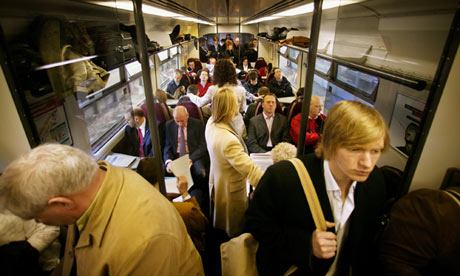
Commuters on a crowded train
'The solution the Green party is proposing is for our railways to be brought back into public hands, with passengers having a greater say in the development of the system.' Photograph: Bruno Vincent/Getty Images
"No direction", "dithering", "rudderless". Ed Miliband isn't the first opposition leader to hear this kind of language as an election looms, so perhaps we shouldn't be surprised that his MPs are queuing up to offer him friendly encouragement to fill the policy vacuum.
Clearly, it's not easy being in opposition, knowing that every policy announcement can and will be used against you by the government and a hostile media. But that's why politics requires courage.
Labour now has some fantastic opportunities to get behind progressive policies that would resonate with its traditional support and with voters. One in particular is about to pull into the station. With the dreadful news last week that rail fares will go up by an average of 4.1% next year (and sincere sympathies to you if you're one of the many passengers who will be hit much harder than that), it's surely time for Labour to accept that privatisation of the railways was a disastrous failure that it should have reversed when it had the chance.
With the prime minister's former speechwriter, Ian Birrell, leaping to the defence of privatised services and talking about record levels of passenger satisfaction, surely now is the time for Miliband's team to sign up to a policy that would genuinely distinguish him from the coalition. The shadow transport secretary, Maria Eagle, sounds as if she wants to head in that direction. She recently criticised the government's determination to re-privatise the East Coast service, calling it "bizarre and dogmatic". East Coast, she noted, makes one of the highest payments to the public purse, receives the least subsidy and is the only route on which all profits are reinvested in services. So why doesn't Labour go the whole way?
The Rebuilding Rail report, published last year by Transport for Quality of Life, offers a superb analysis of the mess Britain's railways are in. It finds that the private sector has not delivered the innovation and investment that were once promised, that the costs of back-room staff have massively increased, and that the costs of train travel rose by 17% between 1997 and 2010 (while the costs of travelling by car fell). It conservatively estimates that £1.2bn is being lost each year as a result of fragmentation and privatisation. The irony is that some of the biggest profiters are the state-owned rail companies of our neighbours: Deutsche Bahn, for example, owns three UK franchises.
Birrell seeks to paint opponents of privatisation as dewy-eyed nostalgists. But the modern, efficient, clean, affordable services enjoyed in other parts of Europe offer a much better blueprint than our own past. The solution the Green party is proposing is for our railways to be brought back into public hands, with passengers having a greater say in the development of the system. The government would take back individual franchises when they expire, or when companies fail to meet their conditions. The enormous savings generated could and should then be reinvested in rail infrastructure, and to reduce the soaring cost of fares.
My private member's bill sets out the process to make this happen, and is due to have its second reading in October. I've written to Maria Eagle asking if Labour will get behind it. As a policy for Labour, it's unlikely to play well in the Mail and the Telegraph. But I suspect many of their readers – particularly those reading their papers while jammed up against a fellow commuter on an overcrowded, overpriced train – might be more receptive. And certainly there are many rank and file Labour MPs, many of whom are already backing the bill, who are desperate to see their leader prove himself as theconviction politician he says he is.

--------

Forget the nostalgia for British Rail – our trains are better than ever

Passengers may be grumbling about the planned fare increases, but on balance rail privatisation has been a huge success

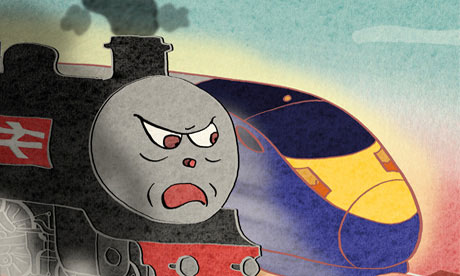
'For all the defects of a rushed privatisation, rail has evolved into a ­privately run public transport system playing a critical and successful role in the economy.' Illustration by Satoshi Kambayashi
There is a weary predictability to the political choreography. Once again, it's revealed,commuter rail fares are rising above the rate of inflation, squeezing the cost of living still further for hard-pressed families. Ministers claim they checked bigger increases; the opposition pretends it would have done differently; passenger groups scream in pain; and the unions demand a return to state ownership.
This is one area where union conservatism strikes a chord with the British public, long sceptical over the supposed benefits of rail privatisation. Many regular users see it as little more than a modern-day train robbery, with fat cat bosses cramming passengers into carriages and creaming off vast profits from creaking services. Surveys show two-thirds of voters would happily see the railways renationalised, an idea being considered by Labour.
As so often, conventional wisdom is wrong. For all the defects of a rushed privatisation, rail has evolved into a privately run public transport system playing a critical and successful role in the economy. The reality could hardly be more different to perception: passenger numbers booming, productivity rising, the number of services soaring, and customer satisfaction at near-record highs. Even those hated fare rises are not all they seem.
Modern vision is clouded by misty-eyed nostalgia for lovely old trains that once trundled around our tracks. As we hurtle along in slick modern trains with Wi-Fi and friendly service, it is easy to forget the poor punctuality and filthy carriages in the dismal days of British Rail. It was crippled by decades of under-investment, driving up fares and driving away freight – but even Margaret Thatcher saw the sale of the railways as a step too far. It was left to her successor, who forced it through too fast with civil servants told to privatise "as soon as practicable" and ensure the process was irreversible.
As one former rail boss said, the plan was half-hearted and half-baked; it was so unloved even Lord Whitelaw, Thatcher's long-suffering deputy, opposed the idea. The result in political and financial terms was a disaster, symbolised by executives of three rolling-stock firms handed the most obscene profits on a plate. The architecture of privatisation was flawed – an attempt to impose models from other industries on a complex transport system – but the ambition to introduce competition and private capital was sound.
Two decades later, some – although far from all – of the kinks have been ironed out. There remain, for example, issues over inflated hidden subsidies handed to the train operating companies. And while public spending on the railways has soared, Network Rail remains wasteful and guilty of inadequate management yet its bosses take big bonuses. The transport secretary, Patrick McLoughlin, should have slammed their greed rather than supported them earlier this week.
But focus on the facts. When I travel from London to watch my football team, Everton, play at home, the average journey time to Liverpool is now 37 minutes quicker than when rail was privatised. This makes a difference on a trip that is now little more than two hours. There are also more options available for travel; on some major routes, more than twice as many trains are running. Britain has an additional 4,000 services a day, a rise of one-fifth that ensures the most frequent services among eight European nations tested by a consumer group. And we have the safest railways on the continent.
The ultimate test of any market is its popularity. Here again, rail can claim success despite intense competition from bus companies and budget airlines, which only took off in this country after rail privatisation. When the plan was first promoted, Britons took on average 11 train trips a year; now we take twice that number. Since the turn of the century freight traffic has risen substantially and passenger numbers have soared by 49% – far more than under those admired state-run services in France, Germany and the Netherlands. This means the level of subsidies per passenger has fallen while revenues to Whitehall have risen by more than £1bn.
Passengers grumble with justification over a maze-like ticketing system, yet these price variations have ensured rail companies can compete on longer journeys with rivals in the air and on the roads. So yes, the cost of some fares is now ridiculous; with travellers often stung by hideous sums for peak-time travel – but away from the headlines and cries of outrage, many fares and season tickets have fallen in real terms. One test on a price comparison website found journeys in Britain mostly cheaper than similar-length jaunts in France and Germany. Overall, the average price per passenger mile has risen only 4% in real terms over the past 15 years.
More investment, more competition and more pressure on the corporate fat cats are needed. But our focus should be on improved regulation, not a reversion to failed models; indeed, in many ways rail demonstrates the potential of a part-privatised public service at a time when such policies are causing concern in other sectors. Britain should, as with other national institutions, stop being dazzled by nostalgia, ignore the groans of vested interests and focus on keeping an unlikely success story on track.

Furniture stores used fake prices, says OFT


Six High Street furniture and carpet retailers have been accused of misleading their customers with fake prices.
The Office of Fair Trading (OFT) said the stores had all advertised price cuts which were not genuine.
In particular, they advertised reductions from previously higher prices, which tricked customers into thinking they were getting a bargain.
So far, none of the retailers involved has been named officially.
During its inquiries, the OFT said it found systematic examples of inflated "reference pricing".
That is where a retailer claims the price "was" £500, for example, and is "now" £300.
But the OFT said that in some cases, the stores under investigation had not sold a single product at the previous higher price.
On average, it found that 95% of sales were at the lower, or "now" price, suggesting the original prices were not genuine.
It also said the problem was "endemic" within the industry.
Fines

The OFT's investigation revealed that high reference prices can persuade people to buy goods when otherwise they would not.
"Reference pricing can mislead consumers into thinking the item they have bought is of higher value and quality," said Gaucho Rasmussen of the OFT.
It also puts consumers under pressure to buy immediately, and stops them hunting for better deals elsewhere.
"Buying an item immediately means they do not get the chance to search the market for the real best deals," said Mr Rasmussen.
The OFT has ordered the six to stop the practice of misleading pricing.
If they continue the habit, the OFT has the power to fine them up to 30% of their relevant turnover.
Consumers shopping this coming weekend are being advised to ask the shops how long reference prices were used for and what percentage of sales were achieved at the higher price.
'Genuine prices'

Earlier this week, Tesco was fined £300,000 for misleading customers over what it claimed were "half-price" strawberries.
The higher prices that the offer referred to, the "reference prices", had been available for just two weeks.
However, the lower price was available over several months.
Under the pricing practices guide, administered by the Department of Business, Innovation and Skills, the length of the new lower price sale should not be longer than the old higher price was available for.
The same guidelines also stipulate that "a previous price used as a reference price to make a price comparison should be a genuine retail price".
Under the Consumer Protection from Unfair Trading Regulations (CPRs) 2008, it is illegal to indulge in misleading or aggressive advertising.

Wednesday, 21 August 2013

Do nasty guys finish first?

Michael Jeh in Cricinfo

Surliness wouldn't change the scoreline for Clarke, would it?  © Getty Images
Enlarge

I wonder which Michael Clarke we'll see at The Oval. If he's been reading any of the press from both sides of the world, he might be confused as to which persona to adopt as Australia try hard to avoid a 4-0 scoreline that won't really do justice to their fighting spirit and to his excellent leadership under duress.
Wayne Smith, writing in the Australian, was eloquent and informed in his analysis of Clarke's captaincy. Most good judges of cricket have applauded his attacking instincts in the field, clever bowling changes and innovative field placements. At the end of the day, though, two relatively evenly matched teams have contrived to produce a scoreline that reads 3-0, despite Clarke's captaincy, not because of it. The difference has been that when Australia have played poorly, they have done so badly enough to virtually surrender a game in a session. England's poor patches have been limited by some effective damage control to the extent where they haven't allowed the slide to become terminal. They have shown a bit more resolve in not allowing a mini-collapse or wayward bowling to spiral to the point where the game is irretrievable from that point on. 
The Times' Alan Lee took a different tack in his post-match analysis after the fourth Test. His view was that Clarke (and by association, Australia) needed to cultivate more mongrel and stop being such a "nice guy". The basic tenet of his piece was that Clarke was smiling too much and was not putting on enough of the Mr Nasty act. Clarke's apparent cheerfulness, perceived by many as a sign of dignity and good grace, was now being written up as possibly a reason why those Tests were compromised. Lee cited Ian Chappell's truculence and Allan Border's grumpiness as prime examples of Australian captains who were successful because they were curmudgeonly.
In my opinion this sort of simplistic analysis misses a few obvious truths that have everything to do with cricketing ability and very little to do with boorishness. The winning and losing of Test matches (any sporting contest for that matter) is primarily down to the superior ability of one team/individual in comparison to their opponents. Occasionally luck, weather, key injuries and umpiring decisions can change that destiny, but in the main it's usually down to who has the better cattle on the day. In this Ashes series, England started as deserved favourites and despite Australia's admirable tenacity (at times), the results have echoed that slight edge in the quality of the cricketers. No amount of cussing and frowning would necessarily have changed that.
Even the Chappell brothers, Rod Marsh and Dennis Lillee, renowned for being gristly opponents, couldn't do much when their teams were regularly overwhelmed by the West Indies of the late 1970s and early 1980s, including in World Series Cricket. That period was described by many as the emergence of the Ugly Australian (in a cricketing sense) as the history books portrayed them (although I was too young myself to tell if that tag was warranted or not), but that counted for very little when those fearsome West Indian fast bowlers were at their throats or when Viv Richards, Clive Lloyd, Gordon Greenidge et al were collaring formidable bowling attacks spearheaded by the Lillee Thomson and Pascoe. I can't see how being any nastier could have won them any more games. More runs and wickets might have helped, and that's what it boils down to.
Likewise Border. His prolific run-scoring feats, much of them accomplished with his back to the wall, was a function of his immense mental strength and no little amount of pure skill. Some of those brave innings against the likes of Michael Holding, Joel Garner and Malcolm Marshall were because he was supremely talented as a batsman, not because of the so-called Captain Grumpy tablets. Being grumpy didn't do much to change Australia's success in the early years of his captaincy. It was only in 1989, when Mark Taylor, Geoff Marsh, Steve Waugh and Terry Alderman all clicked together that he won back the Ashes. He was probably just as cantankerous in 1986-87 and fat lot of good that did him when Fat Gatt's tourists took Australia to the cleaners on the back of Chris Broad's purple patch.
I've been watching bits of the Caribbean Premier League recently and Kieron Pollard's ridiculous on-field antics are a prime case in point. In two recent matches, he has deliberately instigated aggro with two of his West Indian team-mates (Lendl Simmons and Marlon Samuels) to the point where it is clear that his infractions with other players over the years cannot be written off as temporary moments of poor manners. Yet, in both those CPL games, he was comprehensively clean-bowled for nought. So much for the theory that aggressive behaviour drives superior performance. All the trash-talking and sledging that he initiated could not change the fact that on those two occasions, despite being Captain Obnoxious, his team lost both games, and his sum contribution was zero from three balls. His team did not benefit from that style of captaincy but they might have appreciated some runs and wickets instead.
If you look back to the deliveries that Clarke received in the first innings at Trent Bridge and the second innings in Durham, it wouldn't have mattered if he was the grumpiest bloke on the planet or not - those balls were almost unplayable. Well, actually, they were unplayable. Stuart Broad's mojo moments in Durhamwere out of Clarke's control. An impersonation of Chappelli or AB at their curmudgeonly best could not have altered that. Great bowling, some indifferent shots, and one team playing better than the other - that's what decides Test matches, not some rubbish theories about standing at first slip and smiling too much. It's an insult to these guys, hardened professional cricketers who are giving 100% at all times, to suggest that it's as easy as turning on the "nasty tap" and winning becomes a whole lot easier.
Cricketers are made different. Andre Nel looked like he might have been born snarling at the midwife, and that's the way he played his cricket too. His behaviour rarely changed, even when Ricky Ponting was giving him a touch-upat the SCG in 2006. He went for 6.5 runs per over in the second innings but never changed his abrasive manner. If it was as easy as just getting angrier or nastier to get wickets, why wasn't he a world-beater?
I'm mates with Gladstone Small and you couldn't meet a nicer bloke if you walked to the ends of the earth. Both Small and Nel averaged about 33 with the ball in Test cricket (Small's batting average was six runs higher) and you couldn't think of two blokes with similar records who could be any more different in terms of bile and invective hurled at batsmen. So what does that prove about the connection between success and savage intent?
The funny thing about even those players who swear (literally) by their tactic of being deliberately obnoxious as a strategy is that if you ask them if they have ever been put off by someone acting aggressively towards them, they laugh it off disdainfully. It's as if they truly believe that only their sledging, only their body language and only their dark moods, have the power to put others off their game. They don't admit to being affected by such things themselves. Talk about living in fool's paradise. Try sledging Jacques Kallis and see if that works - the guy bats as if he is hypnotised.
You can't manufacture nastiness where it doesn't exist. Clarke's just not one of those personality types. Simply getting him to stop smiling ruefully and keeping life in perspective ain't gonna change a thing. When this team gets a bit more experience and has a bit of luck, he might win a game or two. I sincerely doubt if, as Mr Lee puts it, "he stopped smiling and developed some nastiness" whether that would make the slightest difference. Until he has a winning team at his disposal, his options are limited, so he may as well show some grace under fire without fear of being labelled soft by any of his more hard-bitten predecessors. As Lee concedes, "He has led his vanquished men with dignity and inventiveness." That's not something to be ashamed of.

So the innocent have nothing to fear?

After David Miranda we now know where this leads

The destructive power of state snooping is on display for all to see. The press must not yield to this intimidation
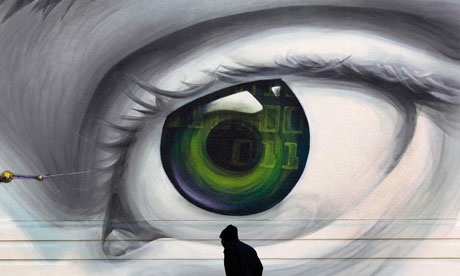
Eye graffiti
'But it remains worrying that many otherwise liberal-minded Britons seem reluctant to take seriously the abuses revealed in the nature and growth of state surveillance.' Photograph: Yannis Behrakis/Reuters
You've had your fun: now we want the stuff back. With these words the British government embarked on the most bizarre act of state censorship of the internet age. In a Guardian basement, officials from GCHQ gazed with satisfaction on a pile of mangled hard drives like so many book burners sent by the Spanish Inquisition. They were unmoved by the fact that copies of the drives were lodged round the globe. They wanted their symbolic auto-da-fe. Had the Guardian refused this ritual they said they would have obtained a search and destroy order from a compliant British court.
Two great forces are now in fierce but unresolved contention. The material revealed by Edward Snowden through the Guardian and the Washington Post is of a wholly different order from WikiLeaks and other recent whistle-blowing incidents. It indicates not just that the modern state is gathering, storing and processing for its own ends electronic communication from around the world; far more serious, it reveals that this power has so corrupted those wielding it as to put them beyond effective democratic control. It was not the scope of NSA surveillance that led to Snowden's defection. It was hearing his boss lie to Congress about it for hours on end.
Last week in Washington, Congressional investigators discovered that the America's foreign intelligence surveillance court, a body set up specifically to oversee the NSA, had itself been defied by the agency "thousands of times". It was victim to "a culture of misinformation" as orders to destroy intercepts, emails and files were simply disregarded; an intelligence community that seems neither intelligent nor a community commanding a global empire that could suborn the world's largest corporations, draw up targets for drone assassination, blackmail US Muslims into becoming spies and haul passengers off planes.
Yet like all empires, this one has bred its own antibodies. The American (or Anglo-American?) surveillance industry has grown so big by exploiting laws to combat terrorism that it is as impossible to manage internally as it is to control externally. It cannot sustain its own security. Some two million people were reported to have had access to the WikiLeaks material disseminated by Bradley Manning from his Baghdad cell. Snowden himself was a mere employee of a subcontractor to the NSA, yet had full access to its data. The thousands, millions, billions of messages now being devoured daily by US data storage centres may be beyond the dreams of Space Odyssey's HAL 9000. But even HAL proved vulnerable to human morality. Manning and Snowden cannot have been the only US officials to have pondered blowing a whistle on data abuse. There must be hundreds more waiting in the wings – and always will be.
There is clearly a case for prior censorship of some matters of national security. A state secret once revealed cannot be later rectified by a mere denial. Yet the parliamentary and legal institutions for deciding these secrets are plainly no longer fit for purpose. They are treated by the services they supposedly supervise with falsehoods and contempt. In America, the constitution protects the press from pre-publication censorship, leaving those who reveal state secrets to the mercy of the courts and the judgment of public debate – hence the Putinesque treatment of Manning and Snowden. But at least Congress has put the US director of national intelligence, James Clapper, under severe pressure. Even President Barack Obama has welcomed the debate and accepted that the Patriot Act may need revision.
In Britain, there has been no such response. GCHQ could boast to its American counterpart of its "light oversight regime compared to the US". Parliamentary and legal control is a charade, a patsy of the secrecy lobby. The press, normally robust in its treatment of politicians, seems cowed by a regime of informal notification of "defence sensitivity". This D-Notice system used to be confined to cases where the police felt lives to be at risk in current operations. In the case of Snowden the D-Notice has been used to warn editors off publishing material potentially embarrassing to politicians and the security services under the spurious claim that it "might give comfort to terrorists".
Most of the British press (though not the BBC, to its credit) has clearly felt inhibited. As with the "deterrent" smashing of Guardian hard drives and the harassing of David Miranda at Heathrow, a regime of prior restraint has been instigated in Britain whose apparent purpose seems to be simply to show off the security services as macho to their American friends.
Those who question the primacy of the "mainstream" media in the digital age should note that it has been two traditional newspapers, in London and Washington, that have researched, co-ordinated and edited the Snowden revelations. They have even held back material that the NSA and GCHQ had proved unable to protect. No blog, Twitter or Facebook campaign has the resources or the clout to confront the power of the state.
There is no conceivable way copies of the Snowden revelations seized this week at Heathrow could aid terrorism or "threaten the security of the British state" – as charged today by Mark Pritchard, an MP on the parliamentary committee on national security strategy. When the supposed monitors of the secret services merely parrot their jargon against press freedom, we should know this regime is not up to its job.
The war between state power and those holding it to account needs constant refreshment. As Snowden shows, the whistleblowers and hacktivists can win the occasional skirmish. But it remains worrying that many otherwise liberal-minded Britons seem reluctant to take seriously the abuses revealed in the nature and growth of state surveillance. The arrogance of this abuse is now widespread. The same police force that harassed Miranda for nine hours at Heathrow is the one recently revealed as using surveillance to blackmail Lawrence family supporters and draw up lists of trouble-makers to hand over to private contractors. We can see where this leads.
I hesitate to draw parallels with history, but I wonder how those now running the surveillance state – and their appeasers – would have behaved under the totalitarian regimes of the 20th century. We hear today so many phrases we have heard before. The innocent have nothing to fear. Our critics merely comfort the enemy. You cannot be too safe. Loyalty is all. As one official said in wielding his legal stick over the Guardian: "You have had your debate. There's no need to write any more."
Yes, there bloody well is.

Tuesday, 20 August 2013

The Top 10 Funniest Jokes from the Edinburgh Fringe Festival 2013

  1. Rob Auton “I heard a rumour that Cadbury is bringing out an oriental chocolate bar. Could be a Chinese Wispa.”

  1. Alex Horne “I used to work in a shoe-recycling shop.  It was sole-destroying.”

  1. Alfie Moore - “I’m in a same-sex marriage… the sex is always the same.”

  1. Tim Vine - “My friend told me he was going to a fancy dress party as an Italian island, I said to him ‘Don’t be Sicily.’”

  1. Gary Delaney - “I can give you the cause of anaphylactic shock in a nutshell.”

  1. Phil Wang “The Pope is a lot like Doctor Who. He never dies, just keeps being replaced by white men.”

  1. Marcus Brigstocke “You know you are fat when you hug a child and it gets lost.”

  1. Liam Williams “The universe implodes. No matter.”

  1. Bobby Mair “I was adopted at birth and have never met my mum. That makes it very difficult to enjoy any lapdance.”

  1. Chris Coltrane - “The good thing about lending someone your time machine is that you basically get it back immediately.”

Islam's ability to empower is a magnet to black British youths


When I was younger it was Islam's sense of brotherhood that my life needed, not the passivity of Christian doctrine
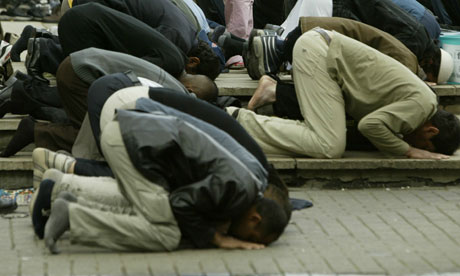
Muslims pray at the Central London mosque
'Islam's monotheistic foundation made sense to me and was easy to comprehend.' Photograph: Dan Chung for the Guardian
A seminar was hosted last month by Christians Together in England to consider ways to "stem the flight of black British youths to Islam and radicalisation". In an unprecedented move, Muslims were invited to attend – and they did. Together, both faith groups discussed the reasons why a growing number of young black people are choosing Islam in preference to Christianity. According to this morning's BBC Radio 4's Today programme, one in nine black Christian men are converting to Islam.
Following in my father's footsteps, I was raised as a Roman Catholic and attended Sunday mass regularly as a child. I also attended a Roman Catholic secondary school – initially a cultural shock as I found myself the only black student among a predominantly white class. The religious focus of the school was, however, a refreshing contrast to my urban, street background. Teachers and students were more serious about God than at my previous schools. A student was not considered "nerdy" or "odd" due to their religiosity. I was therefore able to excel in religious studies and was successful in my final O-level exam.
During these lessons, the more we learned about religion, the more we questioned and challenged particular concepts, particularly relating to Christianity. Questions about the concept of the trinity – the Godhead being three in one – caused many debates as some of us; myself and others did not find this logical or feasible. Our religious studies teacher became exasperated by persistent questions on this topic, and arranged for the local priest to attend and address the question. His explanations did little to remove our doubts in this very fundamental and important area of faith.
I recall one particular lesson where we were doing Bible studies and I queried why we, as Christians, failed to prostrate in the same manner that Jesus had in the garden of Gethsemane prior to his arrest. I was unable to identify any relationship between Jesus's prayer and ours as his Christian followers. However, the Muslim prayer most closely resembled Jesus's.
After leaving school, I lost contact with most of my school friends. I also abandoned many aspects of Christianity and instead submerged myself into the urban street culture of my local friends and community – we would make our own religion based on the ethics and beliefs that made sense to us.
The passivity that Christianity promotes is perceived as alien and disconnected to black youths growing up in often violent and challenging urban environments in Britain today. "Turning the other cheek" invites potential ridicule and abuse whereas resilience, strength and self-dignity evokes respect and, in some cases, fear from unwanted attention.
I converted to Islam after learning about the religion's monotheistic foundation; there being only one God – Allah who does not share his divinity with anything. This made sense and was easy to comprehend. My conversion was further strengthened by learning that Islam recognised and revered the prophets mentioned in Judaism and Christianity. My new faith was, as its holy book the Qur'an declares, a natural and final progression of these earlier religions. Additionally, with my newfound faith, there existed religious guidelines that provided spiritual and behavioural codes of conduct. Role models such as Malcolm X only helped to reinforce the perception that Islam enabled the empowerment of one's masculinity coupled with righteous and virtuous conduct as a strength, not a weakness.
My personal experiences are supported by academic research on the same topic: Richard Reddie, who is himself a Christian, conducted research on black British converts to Islam. My own studies revealed that the majority of young people I interviewed converted from Christianity to Islam for similar reasons to me.
Islam's way of life and sense of brotherhood were attractive to 50% of interviewees, whereas another 30% and 10% respectively converted because of the religion's monotheistic foundations and the fact that, holistically, the religion "made sense" and there were "no contradictions".
My research examined whether such converts were more susceptible to violent radicalisation or more effective at countering it. The overwhelming conclusion points to the latter – provided there are avenues to channel these individuals' newly discovered sense of empowerment and identity towards constructive participation in society, as opposed to a destructive insularity which can be exploited by extremists.
Many Muslim converts – not just black British ones – will confirm the sense of empowerment Islam provides, both spiritually and mentally. It also provides a context within which such individuals are able to rise above the social, cultural and often economic challenges that tend to thwart their progress in today's society. Turning the other cheek therefore is never an option.