Search This Blog

Tuesday, 8 December 2015

Opec bid to kill off US shale sends oil price down to 2009 low

Larry Elliott in The Guardian

Oil falls by $2 a barrel with energy shares as Opec refusal to stop flooding the market with cheap oil and likely US rate hike sends Brent crude tumbling


 
Oil rigs in western North Dakota, US. Opec plans not to cut output aims to kill off the threat from US shale oil by making it deeply unprofitable. Photograph: Matthew Brown/AP


Oil prices have slumped by 5% after the latest attempt by Saudi Arabia to kill off the threat from the US shale industry sent crude to its lowest level since the depths of the global recession almost seven years ago.

Signs of disarray in the Opec oil cartel prompted fears of a global glut of oil, wiping $2 off the price of a barrel of crude on Monday and leading to speculation that energy costs could continue tumbling over the coming weeks.

Shares in energy companies lost ground as the impact of the drop in oil prices rippled through European stock markets. Prices of other commodities also weakened following disappointment among traders that Opec had decided late last week to keep flooding the global market with cheap oil.

Iron ore continued its steady fall and finished the latest session at $38.90 per tonne, squeezing profit margins to the bone at even large producers such as Rio Tinto and BHP Billiton, whose shares fell sharply on the Australian stock market on Tuesday.

The consultancy Capital Economics tweeted: “#Oil sell-off after #OPEC makes even ECB look good. Better to have announced something, even if less than hoped for, than nothing at all...”

A barrel of benchmark Brent crude was changing hands for less than $41 a barrel in New York on Monday night after Opec – heavily influenced by Saudi Arabia – did nothing about a market already seen as saturated.

US light crude, which tends to trade at slightly lower levels than Brent, recorded similar falls, dropping from just over $40 a barrel to less than $38 a barrel.

Both Brent and US light crude were at levels not seen since early 2009, when the collapse of US investment bank Lehman Brothers triggered the most severe recession since the 1930s.

As recently as August 2014, Brent stood at $115 a barrel, but in 16 months its price has been more than halved in response to a slowdown in China and other emerging market economies, and the end of oil sanctions against Iran.

Global supply of oil is currently thought to be up to 2m barrels per day higher than demand, with traders fearing that Opec’s refusal to cut production despite the financial pain it is causing its members’ economies will lead to a still greater glut of crude. Venezuela, in particular, is thought to be suffering badly as a result of the drop in oil 
prices.
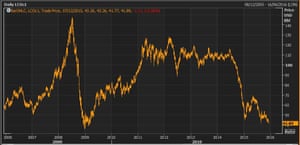

  Brent crude, from 2005-2015. Photograph: Thomson Reuters

The fall, if sustained, will lead to lower inflation in oil-consuming nations through the knock-on effects on petrol, diesel, domestic energy prices and the cost of running businesses.

Lower crude prices may also delay or limit increases in interest rates. The Bank of England has already accepted that inflation – which stands at -0.1% – has stayed lower for longer this year than it anticipated.


Analysts believe the slide in oil prices has come too late to persuade the US Federal Reserve, America’s central bank, to delay an increase in the cost of borrowing later this month, adding that the prospect of the first tightening of policy from the Fed since 2006 was an added factor in crude’s decline.

The prospect of higher US interest rates has led to the value of the US dollar rising on foreign exchanges; since oil is priced in dollars that has led to a fall in the cost of crude.

Markets had been expecting Opec to announce a new ceiling on production after last Friday’s meeting, but analysts at Barclays said the lack of any curbs in its announcement was a sign of discord.

“Past communiques have at least included statements to adhere, strictly adhere, or maintain output in line with the production target. This one glaringly did not,” they said.

Saudi Arabia needs oil prices of $100 a barrel to balance its budget, but as the world’s biggest exporter of crude it is gambling that the low price will knock out the threat posed by so-called unconventional supplies, such as shale.

The chief executive of Saudi Aramco, Amin Nasser, said at a conference in Doha on Monday that he hoped to see oil prices adjust at the beginning of next year as unconventional oil supplies start to decline.

In a sign that US production could dip, Baker Hughes’ November data showed US rig count numbers down month-by-month by 31 to 760 rigs.

The fall in oil prices helped wipe almost 1% off share prices in New York. Wall Street’s Dow Jones industrial average was down more than 160 points in early trading, with Chevron and Exxon both losing around 3% of their value.

In London, Shell’s share price was down 4.5% while BP lost 3.4% of its value as early gains in the FTSE 100 were wiped out. The Index closed 15 points lower at 6223.
Sunday, 6 December 2015

The India that says no

Tunku Varadarajan in the Indian Express

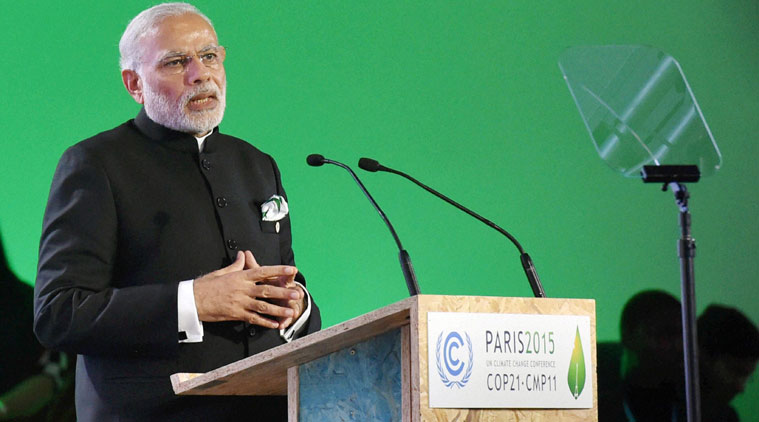
 PM Narendra Modi, Modi in Paris, world climate conference, Indian cricket, Virat Kohli, India-Sout Africa, indian cricket team, indian politics, indian cricket, express opinion, indian express Prime Minister Narendra Modi addressing during the International Solar Alliance in Paris on Monday. (PTI Photo)

These last days have seen a fascinating demonstration of righteous assertiveness by Indians. In Paris, Narendra Modi was at the world climate conference defending India’s right to burn coal, it being the cheapest and most profuse of the country’s present sources of energy, entirely mined at home (unlike oil, imported from the world’s volatile hell-holes, and over whose price India has little positive control).

Back in smoggy India, another leader, India’s Test cricket captain Virat Kohli, was defending the country’s repeated resort to slow, turning pitches in the series against South Africa, this type of pitch being the most reliable source of victory at home for the spin-focused Indian cricket team.

In both cases, what we were seeing was a species of indignant, nationalist pushback against standards set by the West, and Western expectations of “fair play” that work to India’s apparent disadvantage.

Modi was blunt and eloquent. Having “powered their way to prosperity on fossil fuel when humanity was unaware of its impact”, he wrote in an op-ed in the Financial Times, it was “morally wrong” of the industrialised West to deny India the right to use the same sources of energy today to pull its people out of poverty. “Justice demands that, with what little carbon we can still safely burn, developing countries are allowed to grow.”

The message embedded here was that the West is guilty of double-standards in seeking to deny India access to the very fuels that had served the occident so well for centuries — and for doing so just as India is primed for a Great Leap Forward.  In response to his assertion of India’s transitional developmental rights, Modi earned patronising lectures from the usual suspects, including the tirelessly sanctimonious The New York Times.

Double-standards were also the theme of the Indian cricket complaint. Responding to the barrage of English and Australian criticisms of the Nagpur pitch — where South Africa were spin-dried in just three days — the captain, manager and players of the Indian team took a leaf out of Modi’s book. Why are your standards the norm, they said to Western critics, and our standards — Indian standards — the aberration?

At issue is the belief, rife in English and Australian cricket circles, that green pitches that seam and bounce are fair and manly, the proper surfaces on which to play a game of cricket. These are the pitches one encounters in England and Australia because they are the natural products of local conditions. They also suit the style of play of teams from these countries, while cramping the style of visiting Indian players.

In contrast, Indian pitches are bereft of grass and turn early in a Test match. They are described by foreign cricket writers — often the loudest promoters of the too-much-spin-is-immoral school of thought — as Dust Bowls, conjuring images of famine, and of hardscrabble conditions unsuited to civilised cricket.

As foreign pundits took aim at India, the director of the Indian cricket team was quick to shoot back. “Which rule tells me the ball can’t turn on Day One?” said a mouthy Ravi Shastri. “Where does it tell me in the rulebook it can only swing and seam?” India has to sink or swim when playing abroad, so touring teams should expect no different in India.
As with cricket, so with carbon. “The lifestyles of a few must not crowd out the opportunities for many,” said Modi in Paris. Hands off our coal. And hands off our pitches. This is the India that can say No. 

If half of Britain are ‘terrorist sympathisers’ for opposing air strikes, then Isis will win the next election

Mark Steel in The Independent

Everyone agrees the debate on whether to bomb showed our democracy at its finest. To start with, David Cameron called on all his command of history, Etonian diplomacy and wit to call his opponents “terrorist sympathisers”. Then, if anyone objected, he replied: “Look, we must move on.” This is debating at the highest level, and it would be marvellous to see Cameron try this method in pubs on the council estates of Peckham.

Opinion polls suggest that half of the population opposes the bombing, so the situation is worse than we thought, with around 30 million terrorist sympathisers – which is quite a worry as it means that Isis could win a general election, as long as its leader didn’t spoil his chances by saying something daft in the TV debates.

Then there were the Labour MPs supporting the bombing, who all assured us: “I have given this matter a great deal of thought and not taken this decision lightly.” This was highly considerate of them. Not one of them said: “I’ve given this no thought as I couldn’t give a monkey’s wank. So I made my decision by putting two slugs on a beermat and the one on the left reached the end first, so I’m with Corbyn.”

Then came the speech by Hilary Benn, which was so powerful that it persuaded MPs such as Stella Creasy to vote with Cameron. She said afterwards: “Benn persuaded me fascism should be defeated.”
Presumably then, until his speech, she thought fascism was worth a try. When she makes a full statement, it will say: “I always thought I might try fascism as a hobby when I retire, but Hilary explained the negative aspects very well so, on balance, I decided it’s best to defeat it.”

Benn has been praised for being “impassioned”. That was certainly true of the longest part of his speech, which went something like: “These people hate us. They hate our values, they hate our democracy, they hate our way of life. They hate our food, they hate our pets, they hate our weather, they have utter contempt for our garden centres, they despise Adele’s new album, they hate Cornwall, they hate Football Focus – and hated it even when it was presented by Des Lynam – and they can’t stand our flora and fauna, including our bluebells.”

Dozens of MPs were keen to remind us how much Isis hates us, which would be a reasonable point, if people opposed to bombing were saying: “Oh, I don’t think they mind us all that much. We’ve just got off on the wrong foot. Maybe if we invite them to a barbecue we’ll find out we’ve got more in common that we realise.”

It’s a shame that Benn didn’t have longer to speak, as he could have been impassioned about one more aspect of the rise of Isis, which is that most people agree this was caused – at least in part – by the disastrous invasion of Iraq, which Hilary Benn also voted for. You would think that might crop up, but instead we should just accept that the obvious solution to any disaster is to get the people who caused it to put it right by doing exactly what caused it in the first place. That’s why, if an electrician sets your house on fire, you insist on getting the same one to repair it, and on no account take any notice of the idiot who kept shouting: “Don’t do that, you’ll set the house on fire.” 

Some Labour MPs have assured us that the debate was different from the one before the invasion of Iraq because this time Cameron’s assessment and intelligence was “convincing”. But at the time Tony Blair was trying to convince people, and he sounded convincing as well. He didn’t turn up to the Iraq debate wearing a chicken costume, then swallow a balloon full of helium before screaming “Saddam can attack us in 45 minutes” in a squeaky voice and blowing bubbles at John Prescott.

Blair told us, with a solemn gaze, that to take no action in Iraq would be lethal, that we couldn’t stand aside, that there was a plan for what to do after the invasion, and he knew for a fact there were weapons of mass destruction. Now we are told that to take no action in Syria would be lethal, there is a plan for what to do after air strikes, we can’t stand aside and Cameron knows for a fact there are 70,000 moderates waiting for us to help out.


Few military experts believe this; Max Hastings says it is “bonkers”. But most MPs would believe Cameron if he said: “I have also been informed that there is a moderate, giant, two-headed bulldog, allied neither to Daesh nor to Assad, who will chew Isis to death once our brave pilots have bombed the region.”

Similarly, they believe the Defence Secretary Philip Hammond’s claim that there is a plan to introduce “free and fair elections” in Syria within 18 months, and this plan is “backed by Saudi Arabia”. That makes sense: if Saudi Arabia is known for one thing, it’s putting on elections. It’s just elections, elections, elections in Saudi. It’s a wonder they get anything else done.

We will all get excited over the next few days, when we see blurred film of something going up in smoke in a desert, and we are told this is a precision bomb blowing up an Isis factory where they manufacture evil.

The only other development we can so easily predict is that, in 10 years’ time, lots of politicians will say: “Of course, in retrospect, it’s easy to see that the bombing of Syria was a catastrophe.
But this is different, so it’s essential we bomb Finland. They hate us.”

The art of profitable giving - PhilanthroCapitalism

G Sampath in The Hindu


Not too long ago, public opinion was against philanthropy. A new book explains how attitudes have changed, and why we must scrutinise them.


Once upon a time there was charity. The haves gave some to the have-nots, and that was that. Sometimes the giving impulse was religious, sometimes guilt-induced. But charity was more about the soul of the giver than the welfare or rights or dignity of the receiver. This is why there can be no charity between equals. Or between friends. For all these reasons, charity had for long remained an activity rooted in the personal-private, quasi-religious sphere.

Then came philanthropy. Jeremy Beer, in his The Philanthropic Revolution: An Alternative History of American Charity, argues that the displacement of charity by philanthropy was “the result of a reconceptualisation of voluntary giving as primarily a tool for social change.” It also marks, according to Beer, a shift from a theological to a secular framework for giving, bringing with it all the baggage that secularisation entails – blind faith in the technological mastery of the social world, centralisation, and the bureaucratization of personal relations.”

And today we have ‘philanthrocapitalism’. The term gained currency after The Economist carried a report in 2006 on ‘The birth of philanthrocapitalism’. Noting that “the need for philanthropy to become more like the for-profit capital markets is a common theme among the new philanthropists,” the article explains why philanthropists “need to behave more like investors.”

Two years later came the book that today’s biggest philanthropists swear by: Philanthrocapitalism: How the Rich can Save the World by Matthew Bishop (a senior business editor from The Economist) and Michael Green. The title is not intended to be ironic. It is an earnest argument: in a world of rich men and poor states, who better to save the poor than the rich themselves?

The advent of philanthrocapitalism may have finally brought to the fore what is tacitly understood but rarely made explicit -- the symbiotic relationship between capitalist excess and philanthropic redress.


When philanthropy was shunned


It is no accident that the first great philanthropists were also the greatest capitalists of their age. Nor is it a coincidence that many of these men, remembered today by their philanthropic legacies – John D Rockefeller, Andrew Carnegie, Andrew Mellon, Leland Stanford, James Buchanan Duke – also figure in Wikipedia’s list of “businessmen who were labelled robber barons”.

If one is to make sense of the recent surge in the quantum of philanthropic funds sloshing around looking for worthy causes – the Bain & Co. Indian Philanthropy Report 2015 notes that foreign philanthropic funding in India more than doubled from 2004 to 2009, jumping from $0.8 billion in FY‘04 to $1.9 billion in FY’09 – then one needs to go beyond the numbers and look at the economic underpinnings of corporate philanthropic initiatives. This is precisely what sociologist Linsey McGoey sets out to do in No Such Thing as a Free Gift: The Gates Foundation and the Price of Philanthropy, which released last month.

No Such Thing… kicks off with a quick reminder of the shady origins of philanthropy. How many of us know, for instance, that not too long ago public opinion (and government opinion) was against philanthropy in general, and corporate philanthropy in particular?

In the early 20th century, philanthropic foundations were “viewed as mere outposts of profit-seeking empires, only cosmetically different from the corporations that had spawned them, a convenient way for business magnates to extend their reach over domestic and foreign populaces.” McGoey quotes US Attorney General George Wickersham, who had observed that they were “a scheme for perpetuating vast wealth” and “entirely inconsistent with the public interest.”

Yet what was common sense in 1910 would sound blasphemous in 2015. While no self-respecting economist today can deny the obscene economic inequality that characterises our age, not many would willingly acknowledge the connection between concentration of wealth and philanthropy. That is to say, an equitable society would suffer neither a club of the super-rich that seeks self-expression through philanthropy, nor a class of the super-poor that is dependant on philanthropic charity for survival. McGoey makes this point simply with a quote from the economic historian RH Tawney: “What thoughtful rich people call the problem of poverty, thoughtful poor people call with equal justice the problem of riches.”

If philanthropy is thriving in this age of extreme inequality, it is because it serves a dual purpose: one, to make inequality more acceptable ideologically and morally; and two, to define poverty as a problem of scarcity rather than of inequality. Hence the ultimate argument in favour of philanthropy, deployed when all else fails, is the one based on scarcity: ‘something (from a foundation) is better than nothing (from the government)’.

Philanthropy is the palliative that makes the pain of capitalism bearable for those fated to endure it. Philanthrocapitalism, on the other hand, is about transcending this palliative function to represent capitalism itself as a philanthropic enterprise.

In Bishop and Green’s formulation, such a philanthropic capitalism – also known as ‘venture philanthropy’, ‘social entrepreneurship’, ‘impact investing’ – would drive innovation in a way that “tends to benefit everyone, sooner or later, through new products, higher quality and lower prices.”

As McGoey reveals in her book (and Bishop and Green attest in theirs), no one does philanthrocapitalism better, or bigger, than Bill Gates, who helms the world’s largest philanthropic foundation, the Bill and Melinda Gates Foundation (henceforth Gates Foundation), with an endowment of $42.3 billion. For this very reason, the Gates Foundation is an ideal case study for understanding the social impact of philanthropic foundations.


Problems with philanthrocapitalism


McGoey enumerates three obvious problems with philanthrocapitalism, illustrating each with reference to the Gates Foundation.

First is the lack of accountability and transparency. McGoey points out that the Gates Foundation is the single largest donor to the World Health Organisation (WHO), donating more than even the US government. While the WHO is accountable to the member governments, the Gates Foundation is accountable only to its three trustees – Bill, Melinda, and Warren Buffet. It is not unreasonable to wonder if the WHO’s independence would not be compromised when 10% of its funding comes from a single private entity “with the power to stipulate exactly where and how the UN institution spends its money.”

Secondly, “philanthropy, by channelling private funds towards public services, erodes support for governmental spending on health and education.” With governments everywhere slashing their budgets for public goods such as education and healthcare, the resultant funding gap is sought to be filled by philanthropic money channelled through NGOs. But with one crucial difference: while the citizen has a rights-based claim on government-funded social security, she can do nothing if a philanthropic donor decides to stop funding a given welfare project – as has happened time and again in many parts of the world.

At the same time, even as it facilitates government withdrawal from provision of social goods, philanthropy paves the way for entry of private players into the same space. McGoey details how the Gates Foundation orchestrated this brilliantly in the American education sector, where it helped create a whole new market for private investment: secondary and primary schools run on a for-profit basis.

Third, the same businessmen who made their money through unhealthy practices that worsened economic inequalities are now, in their philanthropic avatar, purporting to remedy the very inequalities they helped create. In the case of the Gates Foundation, Microsoft’s illegal business practices are well documented in the US Department of Justice anti-trust case against the company. As McGoey puts it, the fortune now being administered through the Gates Foundation “was accumulated in some measure through ill-gotten means.”

Of course, none of this should detract from the undeniably good work that philanthropic bodies have done. The Gates Foundation has saved countless lives, especially in Africa, through its funding of immunisation programmes and outreach projects. Its several achievements, therefore, have been deservedly celebrated. Nonetheless, critical scrutiny lags far behind the lavish accolades.

Even the three issues discussed above barely scratch the surface. McGoey goes on to raise several more.

She asks, for instance, asks how the Gates Foundation’s interventions in global health tally with Bill Gates’ violent opposition to any dilution of the patent regime. The Gates Foundation was the largest private donor to the Global Fund to Fight AIDS, Tuberculosis and Malaria. At the same time, it “has continually lobbied against price reductions of HIV drugs and other medicines”, infuriating activists who “want a more equitable global patent regime” and “do not want charity handouts.”

She examines the Gates Foundation’s partnerships with Coca-Cola, not exactly popular among those who value public health. In the context of the Foundation’s work to help combat global hunger, she reveals how its financial ties with Monsanto and investments in Goldman Sachs “may be compounding food insecurity rather than mitigating it”.

She interrogates its skewed research portfolio. Of the 659 grants made by the Gates Foundation in the field of global health, 560 went to organisations in high-income countries, even though the problems being targeted were in low-income countries. How does excluding local scientists and programme managers who are best placed to understand the problems help the cause, asks McGoey.

While it is generally taken for granted that a philanthropic foundation would make grants only to non-profits, McGoey draws attention to the Gates Foundation’s non-repayable grant of $4.8 million to Vodacom, a subsidiary of Vodafone. In 2014, the Gates Foundation also announced a grant of $11 million to Mastercard for a “financial inclusion” project in Nairobi. Interesting how philanthropy has evolved to such an extent that in a world wracked by hunger, disease, war, and malnutrition, two entities found to be most in need include a multinational credit card network and a multinational mobile service provider.
Finally, not to be forgotten are the tax breaks that philanthropic foundations enjoy. Critics have pointed out that nearly half of the billions of dollars in funds that philanthropic foundations hold actually belong to the public, as it is money foregone by the state through tax exemptions. History has shown that progressive taxation is the most efficacious route to redistribution. But a strong case for philanthropy is another way of making a strong case for lower taxation of the rich – after all, it’ll leave them with more money to spend on uplifting the poor. Small wonder then that philanthropy’s biggest enthusiasts are political conservatives.

The Economist report on philanthrocapitalism cited above also quotes a young Indian philanthropist, Uday Khemka, who predicts that “philanthropy will increasingly come to resemble the capitalist economy.” That was in 2006. Nine years later, the publication of McGoey’s No Such Thing As a Free Gift marks the first systematic attempt to document this phenomenon.


sampath.g@thehindu.co.in

The tyranny of ‘Comrade Bala’


Parvathi Menon in The Hindu


ReutersAravindan Balakrishnan, who has been found guilty of offences, including cruelty to a child, false imprisonment and rape and indecent assault.


The details of the story Aravindan Balakrishnan – the 73 year old leader of a bizzare Maoist cult who was yesterday sentenced to life imprisonment for rape, sexual assaults, cruelty to a child, and false imprisonment – are being unraveled in the British media after two members of his collective broke the silence and secrecy that bound them for the last several decades.

The first is his 30-year old daughter, with the pseudonym “Fran” who was born into captivity ; and the second is Josephine Herival, the woman who helped his daughter escape but still insists that Mr. Balakrishnan is innocent.

In the time between his arrival in the United Kingdom in the 1970s as a young student from Malaysia come to study at the London School of Economics – a handsome young bespectacled man in his photograph – to the wizened old man shuffling to the courts accompanied by his wife, as TV images show him today, Mr. Balakrishnan created an alternate world for a group of people who came under his tyrannical control.

The Brixton-based Workers’ Institute of Marxism-Leninism Mao Zedong Thought established by Mr. Balakrishnan, was one of the many splinter groups that emerged in the radicalism of the late 1960s and 1970s in Britain. The bright, charismatic and articulate revolutionary attracted followers, including Sian Davies, Fran’s mother. The group set up office in Brixton, and in 1978 it was raided by the police in search of drugs that were not found. Several of them were arrested, including Mr. Balakrishnan. After this a number of people left and a remaining core slowly shut themselves out from the outside world and retreated into a small cult that revolved around a single leader who became increasingly crazed and despotic, Comrade Bala.

For these people, all women, the leader apparently imposed stringent rules about what they could and could not do or say. Comrade Bala frequently invoked the wrath of a universe-controlling machine called Jackie that would wreak hell and damnation on them if they fell out of step. In 1983, Comrade Bala and Ms. Davies had a daughter, but never revealed the fact to her. In unclear circumstances, in 1996 Ms. Davies fell from the bathroom window of a commune house after apparently becoming mentally ill.

Fran was 13 at the time. She had never been sent to school and was taught to read and write at home, becoming as she grew up a keen diarist. Much of what is known about life in the commune is documented in it. She described herself as a “fly caught in a web” and a “bird in a cage with clipped wings” in an interview to the BBC, in which her face was not shown. Her father used to regularly abuse and beat her and the other women, and tell the little girl who longed to go out and play on the swings with other children, that lightning would strike her dead, or she would spontaneously combust.

Fran made an unsuccessful attempt to escape when she was 22. It was in October 2013 that an opportunity presented itself again. Learning of a charity that rescued women, Fran, who believed she was desperately ill with diabetes, and another commune inmate, Josephine Herival, called the charity, which rescued her. The lid on the commune and its activities was lifted.

Clearly, however, Comrade Bala’s hold continues. Speaking to Channel 4 on Friday, Josephine Herival, insisted he was innocent. “I know Aravindan Balakrishnan…he is such a good person. Anyone who knows him will say the same thing.” She says that the evidence given against him in the court are “outrageous allegations.”

Fran is integrated herself into society well, according to her carers, starting formal studies and even becoming a member of the Labour Party – living life that was denied her for 30 years.

Who only sport know


For Marqusee, sport was always a part of the wider world© Mark Ray


Letter from... Washington DC
DAVE ZIRIN in Cricinfo

Dear Cricket Monthly,

The late, great writer Mike Marqusee accomplished something for me that my younger self would not have considered remotely possible: he made cricket fascinating. I first read Marqusee, who passed away in January following a long battle with cancer, in his seminal book Redemption Song, about the political life of Muhammad Ali. I was so overwhelmed by the way Marqusee made the outside world come as alive as the electricity Ali conjured inside the ring, I mined his other works. Many of his columns and books were about this sport, unfamiliar to me, known as cricket. Titles included War Minus the Shooting, which was a deep look at the 1996 World Cup, and Anyone But England.

I did not understand the rules, the references or even the basic language of this newly discovered, globally adored section of the sports world. (For a cricket novice, hearing that someone is "the next Viv Richards" doesn't exactly pack a big punch.) But just as someone who knows nothing of boxing would immediately find Redemption Song riveting, these were books I could not put down. The reason was simple: unlike in the United States, where every conceivable effort is made to bleach the politics out of our games, the political alliances in cricket beg to be understood. In Marqusee, we had a writer not only willing but eager to explain the various colonial roots of the sport and the tensions that manifest and mushroom when a one-time coloniser faces off on the pitch against their one-time colonial ward.

In this regard, Marqusee was our successor to the legendary West Indian socialist CLR James. In a writing life that included numberless Marxist pamphlets and articles, and a masterwork on the Haitian Revolution - The Black Jacobins - James also wrote what Sports Illustrated honoured as one of the 100 greatest sports books of all time: Beyond a Boundary. This 1963 classic, which I read after picking up the works of Marqusee, is like the blueprint for all political sports books that would come in the decades since. James uses cricket as a lens to not only understand colonial relationships in the West Indies but to comprehend what it is that makes the sport so remarkable, so intoxicating and so - heaven forfend - fun in its own right.

Marqusee has sometimes been accused of being doctrinaire - in other words, slathering all of sport in a red political gloss to match an unmoving ideology - but I disagree. I believe it to be far more doctrinaire to pretend that sports somehow operate in a space independent of the outside world. That works for the business of sport, but it fails if we truly want to understand the context of the games we live and love.

This methodology is something that I apply to my own writing. When I was writing from Brazil about the 2014 World Cup, I told the stories of the families that were displaced in the name of sports facilities. I interviewed victims of the police-military build-up in the favelas. I spoke about the social cost I witnessed. Yet I also spoke about the joy of seeing Lionel Messi play in person. I spoke about the electricity in the crowd. If you don't tell this side of sports, it is impossible to explain the other. Similarly, when I have reported on the construction boom of new sports stadiums in the United States, I have found it's impossible to tell that story without looking at it through a political lens. You need to understand the deindustrialisation of US cities and how taxpayer-funded arenas have become a substitute for anything resembling an urban policy in this country.

James and Marqusee are willing to embrace what is beautiful about the games we love while not removing them from their social context. Cricket is in so many ways uniquely suitable for this kind of analysis, but it is also not exclusively able to shoulder that burden. Through any sport we can gain insight into the world. The question in 2015 is more about the courage of the sports journalist to make that leap.

Mike Marqusee and CLR James exemplify that courage. Their greatest lesson for me is not merely that they made cricket matter. It is that they showed how sports matter as well. This is critical especially if we hope to understand just what is happening in the world off the field.

Sincerely,
Dave Zirin