Search This Blog

Monday, 14 January 2013

Britain's first state-certified sex coach

Unlike conventional sex therapists - who talk to clients having sexual problems and give them advice on how to overcome them - sex coaching can take place in the bedroom

Jane walked up and down the street outside what looked like a nondescript house in north London three times before she summoned up the courage to ring the doorbell. The 51-year-old was about to have her first session with Britain's - and indeed one of the world's - first state-certified sex coaches. She was overwhelmed with nerves.
Unlike conventional sex therapists - who talk to clients having sexual problems and give them advice on how to overcome them in their own homes - sex coaching can take place in the bedroom. Its benefits can include anything from achieving better orgasms to simply feeling more comfortable naked with a partner. They can use a range of techniques: talk, role-play or intimate physical approaches like touching or massage.

Until now, this sector has been largely unregulated, and understandably scepticism has run high. But experts talk of a "booming industry" that is moving out of the shadows and into the mainstream. California has become the first state worldwide to certify sex coaches, but it is Britons who are its very first graduates. Jane's instructor, Mike Lousada, is so committed to the regulation of the sector that he is launching the first professional body for the industry across Europe later this year.

Lousada, 45, moved from the corporate world into sex coaching as a way do something "more meaningful" in his life. With his own hang-ups and "shame around the body," he became trained as a counsellor, and graduated from the Advanced Study of Human Sexuality last month as a sex coach. He now charges £80 an hour for talking therapy, and £120 for physical work, which includes genital massage, but can include having intercourse with a client. This would be in very rare cases; say to overcome a situation where a woman wanted, but wasn't able to, have penetrative sex.

Lousada calls his work "sex positive," differing from sex therapy which "arises from the point of view that something's wrong that needs to be fixed." He insists his services, often used by women who have been abused in some way in the past, is "boundaried" and run with a "strict code of ethics." He added: "'I'm showing people how to connect their bodies with someone else's. We are taught at school about pregnancy and sexual disease, but not about pleasure."

There are no recorded figures for the number of sex coaches in Britain, but one of the world's pioneering sex coaches, Dr Patti Britton, found there are at least 80 worldwide, when she conducted the first international survey last year.

Namita Caen, 46, from London, is another state-certified sex coach, working in California. She says interest in her services, which focus on talk, are on the increase as they become "legitimised": "Attitudes are totally changing; People are dying to share what's happening in their relationship".

Jane agrees. She had been living an asexual life for almost thirty years when she decided to take up sessions with Lousada. She said she chose to see a sex coach over a sex therapist, because her "issues were around discovering who [she] was as a sexual woman - in relationship to another." Engaging in talk sessions and intimate massage with Lousada, she said she is now "more comfortable with men" and able to "look in the mirror and see a sexy woman" again.

She added: "I find it fascinating that in the UK 'sex coaches' generally have the unfounded reputation of being some sort of prostitutes by another name - exploiting men and women who are either bored and rich or vulnerable and stupid. Mike's work provided me with a safe supportive environment where I could explore my sexuality as a woman and address the issues and hurts of the past."

The Department of Health advises that "people visit their GP if they are experiencing a sexual health problem" and some therapists have voiced suspicion of coaches lacking their accreditation. But Lousada hopes to change this. His professional body will be launched in the next few months: "Sex coaching is becoming a new profession. We need to have a code of ethics, a disciplinary code, and standards, in order to do this work safely."

Jane's name has been changed

Sunday, 13 January 2013

The US and UK remain wedded to Quantitative Easing to stifle a debate on fiscal policy

Has quantitative easing had its day?

QE's failure to power recovery is clear, but the US and UK remain wedded to the policy to stifle debate about fiscal policy
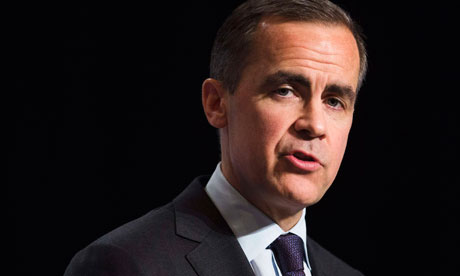
Mark Carney
Mark Carney, governor-elect of the Bank of England, wants to retain QE as the chief policy instrument for engineering recovery. Photograph: Mark Blinch/Reuters
 
Last autumn the chairman of the US Federal Reserve, Ben Bernanke, ended months of speculation about whether there would be another round of quantitative easing – the policy of buying up securities from banks so that more money is injected into the financial system. The idea has been that this will get them lending more and powering a recovery. Since the first two rounds had patently failed to generate recovery, he now announced a QE3 with a difference: not only did he announce QE3, its sheer scale and boundlessness made it a veritable QE infinity. The Fed would continue buying up mortgage-backed securities to the tune of $40bn a month until the labour market improved and would keep interest rates to their current near-zero levels until unemployment fell below 6.5%.

Having targeted inflation to please the holders of capital for almost two decades, even when the resulting high interest rates stifled investment and kept unemployment high, the Fed's concern about employment was certainly novel. To be sure, it is mandated to keep both inflation and unemployment low, but until now it had succeeded in finessing this mandate and concentrating more or less exclusively on keeping the former alone in check.

Meanwhile, the UK's new central banker in waiting, Mark Carney, proposed his own innovation in monetary policy: the Bank of England's two-decade-old policy of targeting inflation should be dropped in favour of targeting nominal GDP growth. This would keep up liquidity injections into the financial system until targeted nominal growth materialised. He did not say what he would do if the nominal growth target yielded more inflation than growth. Discussion centred on whether the Bank of England's mandate would be revised. Both David Cameron and Vince Cable appeared open to the concept.

Bernanke and Carey's new and improved monetary policies are designed to retain QE as the chief policy instrument for engineering recovery despite its failure so far. Given that its most vocal opponents are the economic neanderthals of the US Tea Party right, it is usually assumed that QE is progressive, if not, so far at least, very effective.

In reality, QE has served, first and foremost, to socialise the losses of the financial systems of the two countries at the centre of the financial crisis, the US and the UK. In contrast to the publicly fought over Troubled Asset Relief Program (TARP), QE contributed far more to achieving that objective and did so without the fuss and melodrama of Treasury secretaries going on bended knee before House speakers to beg its passage.

Some find consolation in the thought that at the very least QE prevented the economies of these two countries from falling into outright depression. In reality, two other things accomplished this. First, unlike in the 1930s, the "automatic stabilisers" – government spending and transfers – formed a floor beneath which the economy could not fall. Second, there were mild fiscal stimuli. But their end now threatens to send economic activity south again in both economies.

Indeed, insofar as QE was part of a wider set of policy choices that focused on relieving financial institutions of their irresponsibly extended loans but not the households and firms, QE ensured that a highly leveraged private sector would be unable to borrow, whether to invest or consume. It would also ensure that the resulting demand conditions would deter even the comparatively unleveraged from borrowing to invest.

So we shouldn't assume that QE will power a recovery. It probably won't. As Keynes pointed out, under certain conditions (such as those today: rock-bottom interest rates, poor demand outlook, heavily leveraged firms and households) credit easing would amount to little more than "pushing on a string". So why are Bernanke and Carney seeking to tie recovery even tighter to monetary policy with their innovations in QE precisely when its failure to power recovery is clearer than ever?

It's because without some action on their part, public discussion is bound to turn towards the alternative: a vigorously expansionary fiscal policy, with massively increased state investment in the economy. This option lies just below the surface of public discourse: the neoliberal triumph of recent decades was never able to entirely eradicate it from public discourse and memory. But as long as the public can be kept believing that monetary policy will achieve some semblance of growth, later if not sooner, that the economy's managers are busy refining monetary policy tools to accomplish that, fiscal policy can be that much more effectively kept out of the picture.

In effect the public in both these countries is being told that they cannot get recovery unless the banks give it to them. And keeping recovery hostage to the financial system is tied up with something very fundamental. Announcing the failure of monetary policy is to displace that holy of holies – the private sector – from its current centrality in our understanding of the economy and admitting that government action and expenditure, probably on a large and unprecedented scale, is necessary for recovery.

Wall Street thanks you for your service, Tim Geithner

First the treasury secretary propped up the big banks with public spending. Then he backed their agenda: cuts to public spending
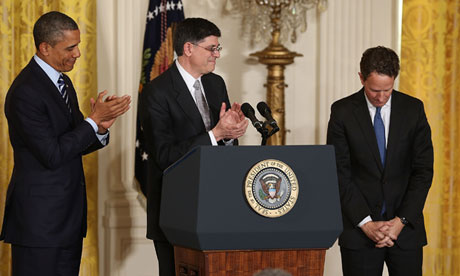
Tim Geithner is congratulated by Barack Obama and Jack Lew
Departing Treasury Secretary Timothy Geithner is congratulated by President Barack Obama and his next nominee, Jack Lew. Photograph: Mark Wilson/Getty Images
Treasury Secretary Timothy Geithner's departure from the Obama administration invites comparisons with Klemens von Metternich. Metternich was the foreign minister of the Austrian empire who engineered the restoration of the old order and the suppression of democracy across Europe after the defeat of Napoleon.

This was an impressive diplomatic feat – given the widespread popular contempt for Europe's monarchical regimes. In the same vein, protecting Wall Street from the financial and economic havoc they brought upon themselves and the country was an enormous accomplishment.

During his tenure as head of the New York Fed and then as treasury secretary, most, if not all, of the major Wall Street banks would have collapsed if the government had not intervened to save them. This process began with the collapse of Bear Stearns, which was bought up by JP Morgan in a deal involving huge subsidies from the Fed.

The collapse of Lehman Brothers, a second major investment bank, started a run on the three remaining investment banks that would have led to the collapse of Merrill Lynch, Morgan Stanley, and Goldman Sachs if the Fed, FDIC, and treasury had not taken extraordinary measures to save them. Citigroup and Bank of America both needed emergency facilities established by the Fed and treasury explicitly for their support, in addition to all the below market-rate loans they received from the government at the time. Without this massive government support, there can be no doubt that both of them would currently be operating under the supervision of a bankruptcy judge.

Of the six banks that dominate the US banking system, only Wells Fargo and JP Morgan could conceivably have survived without hoards of cash rained down on them by the federal government. Even these two are questionmarks, since both helped themselves to trillions of dollars of below market-rate loans, in addition to indirectly benefiting from the bailout of the other banks that protected many of their assets.

Had it not been for Geithner and his sidekicks, therefore, we would have been permanently rid of an incredibly bloated financial sector that haunts the economy like a horrible albatross.

Along with the salvation of the Wall Street banks, Geithner also managed to restore their agenda of deficit reduction. Even though the economy is still down more than 9 million jobs from its full employment level, none of the important people in Washington is talking about measures that would hasten job creation.

Instead, the focus is exclusively on deficit reduction, a process that is already slowing growth and putting even more people out of work. While lives are being ruined today by the weak economy, Geithner helped create a policy agenda where the focus of debate is the budget projections for 2022.
These projections are hugely inaccurate. Furthermore, the actual budget for 2022 is largely out of the control of any politicians currently in power, since the Congresses elected in 2016, 2016, 2018, and 2022, along with the presidents elected in 2016 and 2020, may have some different ideas.
Nonetheless, the path laid out by Geithner's team virtually ensures that these distant budget targets will serve as a distraction from doing anything to help the economy now.

There are two important points that should be quashed quickly in order to destroy any possible defense of Timothy Geithner.

It is often asserted that we were lucky to escape a second Great Depression. This is nonsense.
The first Great Depression was not simply the result of bad decisions made in the initial financial crisis. It was the result of ten years of failed policy. There is zero, nothing, nada that would have prevented the sort of massive stimulus that was eventually provided by the second world war from occurring in 1931, instead of 1941. We know how to recover from a financial collapse: the issue of whether we do so simply boils down to political will.

This is demonstrated clearly by the case of Argentina, which had a full-fledged collapse in December of 2001. After three months of freefall, its economy stabilized in the second quarter of 2002. It came roaring back in the second half of the year and had made up all of the lost ground by the middle of 2003. Its economy continued to grow strongly until the 2009, when the world economic crisis brought it to a standstill. There is no reason to believe that our policymakers are less competent than those in Argentina: the threat of a second Great Depression was nonsense.

Finally, the claim that we made money on the bailouts is equally absurd. We lent money at interest rates that were far below what the market would have demanded. Most of this money, plus interest, was paid back. But claiming that we thus made a profit would be like saying the government could make a profit by issuing 30-year mortgages at 1% interest. Sure, most of the loans would be repaid, with interest, but everyone would understand that this was an enormous subsidy to homeowners.

In short, the Geithner agenda was to allow the Wall Street banks to feed at the public trough until they were returned to their prior strength. Like Metternich, he largely succeeded.

Of course, democracy did eventually triumph in Europe. Let's hope that it doesn't take quite as long for that to happen here.

The beautiful game embodies everything that's bad about Britain

Unlike Germany's thriving Bundesliga, the Premier League is run for the super-rich, not fans
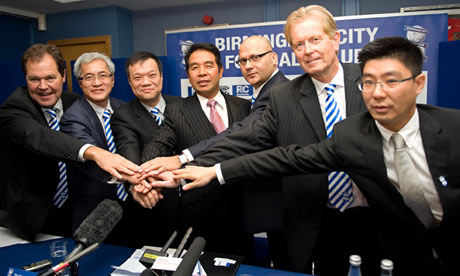
Carson Yeung, Hutton
Carson Yeung (fourth from left) poses with Birmingham's board of directors after acquiring the club in 2009. Photograph: Leon Neal/AFP/Getty Images
Birmingham City FC fans are in revolt. Their once proud club has not been well managed – to put it mildly – by "businessman" Carson Yeung, currently awaiting trial in his native Hong Kong, for an alleged £59m-worth of money laundering, and the process is not over yet. It is the degeneracy of British economy and society in a football microcosm – nothing to stop Cayman Island ownership, strange "sponsorships" and lush, anonymous director fees.

In Britain, there are no legal or governance structures that put football or the fans at the centre of a club owner's concerns. Rather, in keeping with the wider culture, football is "open for business". Market forces are deified as the only value worth celebrating and a business – even a football club – is no more than its owner's private plaything. The result is a moral and economic disaster – in football as in the wider economy.

Economists call this "rent-seeking" and those who don't know what the term means need only spend a few seconds surveying the history of the club since Mr Yeung, his son and third director Peter Pannu took it over in 2009. The club is owned by a holding company based in the Cayman Islands, but burdened by vast debts used by Yeung to buy it, now facing financial problems following the problems with Yeung's business affairs.

Their sole interest is selling off assets, chiefly good footballers in the transfer market, and now the club, to get their money back into the Cayman Islands – while paying large director fees for unnamed services. What they want is economic rent: a surplus created for doing nothing of value.

Britain is a rent-seeker's paradise, as many more football clubs other than Birmingham City can testify. We have created a looters' charter, with football as a playpen, within which the super-rich can do what they want. A recent flash point is the price visiting fans are charged for their tickets. (Manchester City fans protested at the £62 they were asked to pay for today's game at Arsenal.) If the price of admission, along with travel, is prohibitive, then the game is played to only one set of supporters in the stadium with one set of chants. The experience of a game shrivels.

For the rent-seeker, this is emotional sentimentality. Everybody now knows that market forces are both best and irresistible, a perfect justification for putting up ticket prices to whatever the market will bear. Christian Siefert, CEO of the German Bundesliga, told the Observer recently that football is one of the last areas where people are brought together: "We want to have our whole society as part of our football, in our stadiums", explaining why the owners of football clubs forgo the highest possible ticket prices. It is not a sentiment that Mr Yeung, or the many other foreign owners of British clubs, would share. Why worry about British society? We exist to be looted and privately mocked for our connivance in our own destruction.

Flexible and free markets, we have had drummed into us for 30 years, are the reason why Britain is now the world-beating economy that it has become and Germany and the European Union are in the doldrums. The Premier League, slavishly following these principles, is self-evidently, or so runs the line, the best football league in Europe. Pity the poor Germans and the daffy Herr Siefert, who worry about who owns their companies and football clubs, care about fan culture and invest in their young talent.

They don't welcome "wealth creators" such as Carson Yeung with no questions asked, and because German clubs reserve parts of their grounds for standing room only cheap tickets, they don't maximise the economic value of their sporting assets. Down that road lies ruin – or so a bevy of economic commentators and Eurosceptic Conservative MPs will rush to tell us.

But the German approach to football, as with their wider economy and society, is beginning to win admirers, not least among football supporters. There are three German sides in the last 16 of the Champions League this year and fuddy-duddy Dortmund played Manchester City, exemplar of British-style market forces, off the park. What's more, they care about their fans. It is a great club rather than a sheikh's passing whim. The Premier League is now considering something very German: capping the prices that clubs can charge visiting supporters. Football as a sport might just, in one tiny step, challenge the law of the market.

British football needs to go much further. German football clubs require that a majority of votes are exercised by fans. There can't be Carson Yeungs because they would be outvoted. German clubs invest in homegrown talent. Sixty per cent of Bundesliga players are homegrown compared with 39% of Premier League players.

The lessons go wider still. Eighteen years ago, I argued in The State We're In that it was obvious that Germany would outperform Britain economically, just as it is obvious that it will do the same – unless we reform ourselves wholesale – over the next 18. What is so depressing about today's economy is not just that we stand on the verge of a triple dip recession, but that, like our football clubs, so much of our economic base is organised around rent-seeking.

Nor do we seem to have learned much. There should be a vibrant debate about how to reproduce in Britain what evidently works in Germany. We need companies organised around long-term business purpose and to create a whole network of public and private institutions, law and practice that buttresses them. Yet the heart of the Eurosceptic, anti-EU case is that, instead, we need to leave to reinforce the market "flexibilities" and "freedoms" that have created such fantastic British success. Let the looting get more intense.

We are far gone. There is no majority in the Premier League for serious reform. Foreign owners are not going to vote to qualify their autonomy, allow more supporter voice or limit their capacity to compete by offering sky-high player wages. On the other hand, there is a growing argument for change – witness the possible concession on ticket prices.

It's the same with wider economic reform. The average size of a British manufacturing firm is 14 people: the majority of large firms and factories are foreign-owned. We have constructed an economy in which the rent-seekers and Carson Yeungs are the majority. It is very clear what needs to be done. The signs are confusing, but, as in football, maybe the grip of the looters is weakening as the evidence mounts of their vandalism. Here's hoping.

Saturday, 12 January 2013

Lead Poisoning - The Grime Behind The Crime?

Could an astonishing explanation for the rise and fall of violent crime be correct? 
 It seemed, at first, preposterous. The hypothesis was so exotic that I laughed. The rise and fall of violent crime during the second half of the 20th century and first years of the 21st were caused, it proposed, not by changes in policing or imprisonment, single parenthood, recession, crack cocaine or the legalisation of abortion, but mainly by … lead.

I don’t mean bullets. The crime waves that afflicted many parts of the world and then, against all predictions, collapsed, were ascribed, in an article published by Mother Jones last week, to the rise and fall in the use of lead-based paint and leaded petrol (1).

It’s ridiculous – until you see the evidence. Studies between cities, states and nations show that the rise and fall in crime follows, with a roughly 20-year lag, the rise and fall in the exposure of infants to trace quantities of lead (2,3,4). But all that gives us is correlation: an association that could be coincidental. The Mother Jones article, based on several scientific papers, claimed causation.

I began by reading the papers. Do they say what the article claims? They do. Then I looked up the citations: the discussion of those papers in the scientific literature. The three whose citations I checked have been mentioned, between them, 301 times (5). I went through all these papers (except the handful in foreign languages), as well as dozens of others. To my astonishment, I could find just one study attacking the thesis (6), and this was sponsored by the Ethyl Corporation, which happens to have been a major manufacturer of the petrol additive tetraethyl lead. I found many more supporting it. Crazy as this seems, it really does look as if lead poisoning could be the major cause of the rise and fall of violent crime.

The curve is much the same in all the countries these papers have studied. Lead was withdrawn first from paint and then from petrol at different times in different places (beginning in the 1970s in the US in the case of petrol and the 1990s in many parts of Europe), yet, despite these different times and different circumstances, the pattern is the same: violent crime peaks around 20 years after lead pollution peaks (7,8,9). The crime rates in big and small cities in the US, once wildly different, have now converged, also some 20 years after the phase-out (10).


Nothing else seems to explain these trends. The researchers have taken great pains to correct for the obvious complicating variables: social, economic and legal factors. One paper found, after 15 variables had been taken into account, a four-fold increase in homicides in US counties with the highest lead pollution (11). Another discovered that lead levels appeared to explain 90% of the difference in rates of aggravated assault between US cities (12).

A study in Cincinnati finds that young people prosecuted for delinquency are four times more likely than the general population to have high levels of lead in their bones (13). A meta-analysis (a study of studies) of 19 papers found no evidence that other factors could explain the correlation between exposure to lead and conduct problems among young people (14).

Is it really so surprising that a highly potent nerve toxin causes behavioural change? The devastating and permanent impacts of even very low levels of lead on IQ have been known for many decades. Behavioural effects were first documented in 1943: infants who had tragically chewed the leaded paint off the railings of their cots were found, years after they had recovered from acute poisoning, to be highly disposed to aggression and violence (15).

Lead poisoning in infancy, even at very low levels, impairs the development of those parts of the brain (the anterior cingulate cortex and prefrontal cortex) which regulate behaviour and mood (16). The effect is stronger in boys than in girls. Lead poisoning is associated with attention deficit disorder (17,18), impulsiveness, aggression and, according to one paper, psychopathy (19). Lead is so toxic that it is unsafe at any level (21, 22).

Because they were more likely to live in inner cities, in unrenovated housing whose lead paint was peeling and beside busy roads, African Americans have been subjected to higher average levels of lead poisoning than white Americans. One study, published in 1986, found that 18% of white children but 52% of black children in the US had over 20 milligrammes per decilitre of lead in their blood (23); another that, between 1976 and 1980, black infants were eight times more likely to be carrying the horrendous load of 40mg/dl (24). This, two papers propose, could explain much of the difference in crime rates between black and white Americans (25), and the supposed difference in IQ trumpeted by the book The Bell Curve (26).

There is only one remaining manufacturer of tetraethyl lead on earth. It’s based in Ellesmere Port in Britain, and it’s called Innospec. The product has long been banned from general sale in the UK, but the company admits on its website that it’s still selling this poison to other countries ( 27). Innospec refuses to talk to me, but other reports claim that tetraethyl lead is being exported to Afghanistan, Algeria, Burma, Iraq, North Korea, Sierra Leone and Yemen (28,29), countries afflicted either by chaos or by governments who don’t give a damn about their people.

In 2010 the company admitted that, under the name Associated Octel, it had paid millions of dollars in bribes to officials in Iraq and Indonesia to be allowed to continue, at immense profit, selling tetratethyl lead (30). Through an agreement with the British and US courts, Innospec was let off so lightly that Lord Justice Thomas complained that “no such arrangement should be made again.” (31) God knows how many lives this firm has ruined.

The UK government tells me that because tetraethyl lead is not on the European list of controlled exports, there is nothing to prevent Innospec from selling to whoever it wants (32). There’s a term for this: environmental racism.

If it is true that lead pollution, whose wider impacts have been recognised for decades, has driven the rise and fall of violence, then there lies, behind the crimes that have destroyed so many lives and filled so many prisons, a much greater crime.

First published in the Guardian. Courtesy: www.monbiot.com
References:
1. http://www.motherjones.com/environment/2013/01/lead-crime-link-gasoline
2. Rick Nevin, May 2000. How Lead Exposure Relates to Temporal Changes in IQ, Violent Crime, and Unwed Pregnancy. Environmental Research, Vol.83, Issue 1, pp1–22. http://dx.doi.org/10.1006/enrs.1999.4045
3. Rick Nevin, 2007. Understanding international crime trends: the legacy of preschool lead exposure. Environmental Research Vol. 104, pp315–336.
doi:10.1016/j.envres.2007.02.008
4. Jessica Wolpaw Reyes, May 2007. Environmental Policy as Social Policy? The Impact of Childhood Lead Exposure on Crime. National Bureau of Economic Research Working Paper 13097. http://www.nber.org/papers/w13097
5. The three papers whose citations I checked were Rick Nevin, May 2000, as above;
Rick Nevin, 2007, as above and Jessica Wolpaw Reyes, May 2007, as above.
6. Patricia L. McCalla and Kenneth C. Land, 2004. Trends in environmental lead exposure and troubled youth, 1960–1995: an age-period-cohort-characteristic analysis. Social Science Research Vol.33, pp339–359.
7. PB Stretesky and MJ Lynch, May 2001. The relationship between lead exposure and homicide. Archives of Pediatrics and Adolescent Medicine, vol.155, no.5, pp579-82.
8. Paul B. Stretesky and Michael J. Lynch, June 2004. The Relationship between Lead and Crime.Journal of Health and Social Behavior, Vol.45, no.2, pp214-229. doi: 10.1177/002214650404500207
9. Howard W. Mielke and Sammy Zahran, 2012. The urban rise and fall of air lead (Pb) and the latent surge and retreat of societal violence. Environment International Vol. 43, pp 48–55. doi:10.1016/j.envint.2012.03.005
10. Bureau of Justice, no date given. Homicide Trends in the U.S. http://bjs.ojp.usdoj.gov/content/homicide/city.cfm
11. PB Stretesky and MJ Lynch, May 2001, as above.
12. Howard W. Mielke and Sammy Zahran, 2012, as above.
13. Herbert L. Needleman et al, 2002. Bone lead levels in adjudicated delinquents: a case control study. Neurotoxicology and Teratology, Vol. 24, pp711 –717.
14. David K. Marcus, Jessica J. Fulton and Erin J. Clarke, 2010. Lead and Conduct Problems: a Meta-Analysis. Journal of Clinical Child and Adolescent Psychology, vol.39, no.2, pp234-241. http://dx.doi.org/10.1080/15374411003591455
15. R.K. Byers and E.E. Lord, 1943. Late effects of lead poisoning on mental development, American Journal of Diseases of Children, Vol. 66, pp. 471– 483.
16. Kim M Cecil et al, 2008. Decreased Brain Volume in Adults with Childhood Lead Exposure. Decreased Brain Volume in Adults with Childhood Lead Exposure. PLoS Medicine, vol. 5, no. 5. doi:10.1371/journal.pmed.0050112
17. Joel T. Nigg et al, January 2010. Confirmation and Extension of Association of Blood Lead with Attention-Deficit/Hyperactivity Disorder (ADHD) and ADHD
Symptom Domains at Population-Typical Exposure Levels. J Child Psychol Psychiatry. Vol. 51, no.1, pp.58–65. doi:10.1111/j.1469-7610.2009.02135.x.
18. Joe M. Braun et al, 2006. Exposures to Environmental Toxicants and Attention Deficit Hyperactivity Disorder in U.S. Children. Environmental Health Perspectives vol. 114, pp.1904–1909. doi:10.1289/ehp.9478
19. John Paul Wright, Danielle Boisvert and Jamie Vaske. July 2009. Blood Lead Levels in Early Childhood Predict Adulthood Psychopathy. Youth Violence and Juvenile Justice, vol.7, no.3, pp.208-222. doi: 10.1177/1541204009333827
20. Rick Nevin, 2007, as above, reports that “there is no lower blood lead threshold for IQ losses”.
21. David Bellinger concludes that “No level of lead exposure appears to be ‘safe’ and even the current ‘low’ levels of exposure in children are associated with neurodevelopmental deficits.”. April 2008. Very low lead exposures and children’s neurodevelopment. Current Opinion in Pediatrics, Vol.20, no.2, pp172-177. doi: 10.1097/MOP.0b013e3282f4f97b
23. Royal Society of Canada, 1986. Lead in the Canadian Environment. Science and Regulation. Cited by Rick Nevin, 2007, as above.
24. Agency for Toxic Substances and Disease Registry, 1988. The Nature and Extent of Lead Poisoning in Children in the United States. US Department of Health and Human Services. Cited by Rick Nevin, 2007, as above.
25. Rick Nevin, 2007, as above.
26. Rick Nevin, February 2012. Lead Poisoning and The Bell Curve. Munich Personal RePEc Archive MPRA Paper No. 36569. http://mpra.ub.uni-muenchen.de/36569/
27. http://www.innospecinc.com/octane-additives.html
28. http://www.economist.com/news/21566385-lead-tantalisingly-close-death-2013-world-meant-stop-using-leaded-petrol-toxin
29. Anne Roberts and Elizabeth O’Brien, 2011. Supply Chain for the Lead in Leaded Petrol. LEAD Action News, vol.11, no.4.
30. http://www.guardian.co.uk/uk/2010/mar/18/firm-bribes-banned-chemical-tetraethyl
31. http://www.guardian.co.uk/business/2010/jun/30/octel-petrol-iraq-lead
32. I was passed by Defra to the Department for Transport, then by the DfT to the Department for Business, which told me it was all down to the European list. It was clear that none of them were remotely interested in the issue, or had considered it before.

The secrets of success against spin bowlers

Dean Jones

NOW that Australia has finished its Test cricket for the summer, the Australian batsmen have to have a good think on how they will play in India next month.

This series is massive to a lot of players and could be a great tour for the Australians if they bat well against the Indian spinners. India is not in good shape and if Australia can get a win early, we might win the series. But a lot of work needs to be done.

India will no doubt prepare turning pitches or ''Bunsen burners'' as we like to call them. The Australian batsmen must start preparing now by practising on substandard practice pitches. These will find your weakness very quickly and will really make you watch the ball.

When you play against fast bowling you need to have physical courage to get behind the ball. The top half of your body is always under pressure, ducking and weaving short-pitched deliveries. 

When you play against quality spinners, you must have mental courage to be successful. And your footwork, or bottom half of your body, must be supple and nimble to move quickly to get to the pitch of the ball.

Playing against great spinners was always fun for me. I was fortunate enough to meet the great Lindsay Hassett, who was widely regarded as the greatest batsman to play spin.

Don Bradman just loved the way Hassett played havoc against great spinners. I asked Lindsay why he was so successful at playing spinners. ''Deano, watch their ball release, watch the rotation of the seam, and try to get down the track and hit the ball on the full. If you can't get to the pitch of the ball, then play them off the back foot. It's easy!''

Neil Harvey played the same way. Harvey was known to run at the spinners once the spinner started his run-up! That's how keen he was to use his feet.

So I thought I would play the same way. I quickly realised that spinners don't like you running at them. They say they do, but in reality they don't. I measured how far I could dance down the pitch. It was 2.8 metres. I even did something a bit naughty without the umpires and opposition knowing. I used to place marks on the side of the pitch to help me see how far I could get down the pitch. It also helped me commit to get to the pitch of the ball. I also learnt that I must always make my first stride to the ball a big one. No half-steps. Mark Waugh was awesome at this. Graham Yallop, Allan Border, Brian Lara and Michael Clarke are no different.

Using your feet to the spinners can be very taxing on your body, so you need to be very fit. I often think batting against spinners is a bit like playing chess. If you are worried about bat-pad fieldsmen catching you out, then you must strike up a plan to remove them. It might be a lofted shot over mid-off, which might get rid of the bat-pad on the offside. And a few sweep shots might get rid of the silly mid-on and he might be placed at backward square or short fine leg.

It is just about playing a few shots early to get the fieldsmen where you want them, and then just pick them off with singles for the rest of the day.

So here is where the mental courage comes in. You must practice the lofted shot. You must have the courage to play it early, so you can get the bat-padders away. I must confess I loved hitting bat-pad fieldsmen in the shins. It always gave me a giggle. Sorry, that was just me.

When spinners have really got you under pressure, you must have a shot or plan that you can use to get off strike. Mine was running at the spinners and running a single to mid-off or mid-on. Border, Matty Hayden and Mark Taylor swept when under pressure. David Boon used to walk across his stumps and work the ball behind square leg. You need to find a shot that you can play blindfolded to get off strike.

Tactically, spinners love bowling maidens. So you must look to hurt them early in their over. Don't allow them to bowl when they want. Control the momentum and tempo of the game and let them bowl to you when you are ready. You are the boss and let them know that.

I always asked my playing partner to back up very close to the stumps. If I did hit a ball straight, I wanted my batting partner to get in his way. In other words, he can only field on his side of the pitch.

Basically, every batsman has to learn what works for him and what doesn't. If you are hitting the ball to the field a lot, just change your guard or play everything off the back foot.

I had some wonderful battles with Shane Warne at practice. We would bet $50 for every dismissal. I wanted to bat against him on the worst practice pitches and it was the best fun. Yes, Warnie won a lot of money off me, but I was ready for anyone who bowled spin to me. A trick I learnt was to not go with the spin if it kicks or spits at you. Just hold your original line with your bat and not follow the ball. You will get caught bat-pad very quickly if you go with the spin.

I also practised a lot by playing everything off the back foot. It is just great fun.
Just for anyone asking who were the best spinners I played against. The best off-spinner I faced was Saqlain Mushtaq. The best left-arm orthodox was Maninder Singh. The best leggie was Warne. Mind you, Abdul Qadir was pretty good in Pakistan, with no DRS and local umpires. 

India on track to becoming a failed state


INDIA ranks 78th in the Failed States Index 2012, which measures adversarial social, economic and political pressures faced by nations. Finland scores least risk at 177 and Somalia worst at 1.
India has fallen steeply from 110 in 2007.
Anecdotal evidence based on recent corruption and mal-governance-ridden domestic scams suggests it at 45-55 next year in company with the likes of Colombia, Angola and Kyrgyzstan.
India passes muster on just two of the 12 indicators that comprise the index -- intellectual capital and international behaviour.
It scores abysmally on other crucial indicators, including demographic pressures (malnutrition, water scarcity); group grievances (ethnic & communal tensions, powerlessness); state legitimacy (corruption, protests); public services (crime, social services); uneven economic development (income inequalities) and on political elite behaviour (factionalised and constantly in a gridlock over a quest for political power).
Digital Pass $1 for first 28 Days
Is India on a slow track to a failing state? A pointer to what might be in store for India comes from the book by Daron Acemoglu and James Robinson, Why Nations Fail.
After a comprehensive survey of the rise and fall of nations from the Roman Empire to the Soviet Union to (new) African states, they contend that nation-states do not fail because of culture, weather, geography or ignorance of what policies are right. Nations collapse because "extractive" economic institutions fostered by local elites come to rule them.
Abetted by self-seeking functionaries, these institutions exist for the benefit of elites, who gain from extraction of valuable minerals, land, water, labour or from protected monopolies.
They conclude that the key to sustained progress is in "combining political centralisation with inclusive economic institutions". Absolutist states have strong centres, but power wielders fashion an economic framework to enrich themselves.
In democratic states, power rests with a plurality of groups and inclusive institutions arise.
But if there is no strong political centre to provide direction and to control or sanction, power accrues to the elite(s). Extractive institutions then arise. In both scenarios, internal contradictions pile up -- indicators for the Failed States Index provide a measure -- and the exploitative structure inevitably fails, bringing down the entire corrupt system with it.
The relevance of this analysis to India today is inescapable.
The centre is not holding. In the era of coalitions, power has been seeping from the Delhi sultanate to islands of political elites. And the relatively inclusive institutions midwifed by a superbly crafted constitution have been suborned by national and regional establishments into extractive tools for personal gain.
Indian legislatures are no longer forums for informed debate. Instead, under the guise of "seeking a consensus", they are now nodal points for crass political horse-trading. Or for obstructionist mobocracy.
Cutting across party affiliations, regional and social loyalties, the objective of the political class is to acquire power, not sound governance or advancing national interests. It has mauled the ideology of democracy into the sole objective of winning elections. Its parasitic behaviour is focused on extracting perks from public and private sectors; on status and symbols; competitive populism and casteism; dynasticitis; protecting each other from greater accountability; and on blatantly exercising discretion-based powers, which the Brits used for disbursing patronage to divide and rule, and which now serve as founts for extortion in cahoots with bureaucrats and crony capitalists.
Prime Minister Manmohan Singh's indecisive leadership relies largely on confetti of populist schemes for electoral advantage. His own personal integrity is unquestionable, but he's led the most corrupt federal government since independence, benignly neglecting massive sleaze in ministerial fiefdoms under his watch.
Meanwhile bureaucracy, the famed steel frame of yesteryears, is rusting. With officials appointed and removed at whims of elected kleptocrats, the anointed favourites' humiliating task is to extract swill from troughs of discretionary powers for political snouts to sip. As for the defence establishment, it is now mired in scandals from land grabbing, procurement frauds to generals expropriating a share of largesse meant for war widows.
Worse, the army chief dragging the government to the courts on a personal issue has opened a chink to armed forces' potential politicisation.
The Indian judiciary is doing its best to fill the vacuum in the wake of a somnolent executive and paralysed legislatures.
But this activism has a major downside.
Handing out pronouncements daily on relatively trivial subjects, its higher reaches are becoming part of the political process, compromising their role as chambers of dispassionate reflection on issues of constitutional significance. It is also tainted by corruption and dispensing too little justice, too late. The legal system can no longer cope with the demands of a litigious citizenry increasingly aware of its rights.
The concerted attempts by the three constitutional pillars to undermine the media's role as auditors of their accountability is another insidious trend. India is turning increasingly censorious on books, arts, cinema, the internet and reporting.
Freedom is lost in small steps. Calls for protests to the American government over an article critical of Singh in the Washington Post betrays a disturbing mindset; it implicitly assumes that a government should control media content.
The debilitating shenanigans of the unholy, well-knit trinity of politicians, bureaucrats and their private sector cronies are now eroding confidence at home.
The tarnished economy is treading towards a 4-5 per cent GDP growth rate.
This self-inflicted, reform-resistant decline is evident in India's ranking at 111 in the latest Economic Freedom of the World Index (2010 data). It gauges the extent to which the policies and institutions in a country support economic activity for poverty reduction, etc. India is closer to Burundi (144) than to Hong Kong (1). Notably, it was 76th in 2007. This BRIC "angel" can only fall further in 2012.
The international euphoria that lauded India's recent "rise" from stultified economic depths is fading. Pessimism about its capabilities on regional and geopolitical fronts is seeping. The fluffy souffle of arrogant pretensions to a superpower status has fallen flat. India is a half-baked power.
Arguably, India's very antecedents are partly responsible for the fast-diminishing political and administrative authority of the central government. Post-Independence India was always an artificial construct. Fashioning it from 550-odd distinct entities was a landmark achievement.
But, to paraphrase Mark Twain, it was only a bundle of countries. It began to unravel with linguistic divisions. Sixty-five years later, values and practices associated with a genuine democracy have still not coalesced into good governance for the common good in (purportedly) a one nation-state.
Instead, demands and counter-demands and protests on endless issues have accelerated. Impulses more in line with a confederation than with a federation are emerging.
Interestingly, the government's acknowledgement that some economic reforms need not apply nationwide because of local opposition suggests a subliminal acceptance of a co-federalist model.
And yet the Indian political class continues to smugly showcase the country as an example of "unity in diversity".
A million mutinies thus confront India today. But the cadaverous gerontocracy across its political board remains preoccupied with fiddling for power post-2014 elections, while relegating policies to meet the aspirations of an expanding cohort of new, upwardly mobile stakeholders to the back burner.
India has depreciated from a "functioning anarchy" to a dysfunctional democracy.
If the idea of India (secularism, democracy) is to survive, the good among the ugly will have to cross their political and social divides and forsake the "me" culture to renovate the constitution and abolish feudal powers of patronage before darkness falls at noon on one of the most misgoverned nations on the globe.
Rakesh Ahuja heads Axessindia Consultancy Group, Canberra, and was the former Australian Deputy High Commissioner to India.