Search This Blog

Saturday, 17 August 2013

Osborne economics is not an invincible force of nature


Although many appear resigned to life under this dysfunctional capitalism, there is a way to make the system less inhuman

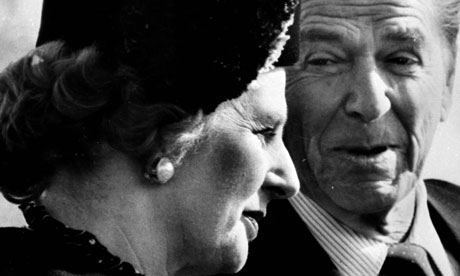
Ronald Reagan and Margaret Thatcher
'As the followers of Thatcher and Reagan intended, everything has become individualised.' Photograph: AP
Britain is on the move, says George Osborne, from "rescue to recovery". But not if you're young: this week's unemployment figures showed joblessness among the 16-24s rising to 973,000. Not if you're the north-east, the north-west or Wales, where the out-of-work numbers have also risen. And if you've been on the dole for more than two years, heaven help you: despite the millions blown on the work programme and Osborne's alleged green shoots, the numbers of people suffering long-term unemployment jumped by 10,000 to 474,000, the highest figure in 16 years.
Some recovery, then. At the same time there are even more signs of the ongoing pinch affecting those people once thought to be safe, in the aspirational middle. In the Economist this week there is a very incisive graph plotting median real earnings and the retail price index. It shows the former keeping pace with the latter until 2005, when they began to split. From 2009, moreover, the earnings line began to drop, while prices carried on rising: the UK, we now know, has one of the worst recent records on real wages of any country in Europe (worse even than Spain, which is saying something).
"The plate tectonics of the labour market offer the best explanation for this," said the accompanying text. "With a declining industrial base, the British economy needs fewer mid-level skilled workers. Most new posts are low- or high-paying ones … Many in the middle lack the skills to move up and are pushed towards the low-wage end of the economy. Machinists and tradesmen become cashiers and call-centre workers." They do, and when that happens, they are ushered into that fragile part of the labour force we now know as the Precariat, where zero-hours contracts are becoming the norm, and a return visit to the jobcentre is never far away.
Meanwhile, the cost of living continues to soar, not least in the parts of the country held up to be the recovery's heartlands. In the last year, food prices have risen four times as fast as average pay. There are now plans to make water meters compulsory for people served by nine of the UK's water companies, which could lead to some family bills doubling. This week also brought news of more increases to train fares, some of which could go up by as much as 9%.
And who will that hit? Among others, commuters who have often fled from London's impossible house prices – which, according to this week's headlines, have lately risen by 8.1%, the biggest jump in two-and-a-half years. Entirely unsurprisingly, the share of Londoners renting on the private market is up from 18% in 2011 to 25% today. And an increase in demand colliding with flatlining supply means only one thing: the average share of income devoted to rental costs is now a jaw-dropping 27%, up from 21% a decade ago.
This is what a completely dysfunctional version of capitalism looks like. The crudest, most stupid, completely self-destructive formula for maximising profits – cutting wages while pushing up prices – is extended over the entire economy. An ever-increasing dependence on the service sector drives out skilled jobs in the middle, and offers no hope to those places which are still a byword for the end of heavy industry and manufacturing. The nation's capital becomes the playground of the people at the very top, serviced by young people who can live cheaply(ish), and people from overseas who are just about able to cope, on the basis that they might eventually go home. Housing, surely any worker's most basic need, is in permanent crisis. And for a lot of people trying to keep pace with forces that are out of anyone's control, there is only one option: residence in what the economist Ann Pettifor this week called Wongaland, where people borrow unsustainably while saving absolutely nothing (see right).
And so to an interesting question: what are the politics of all this? On my office shelves, there are two books whose titles – both of which include the word "great"– neatly encapsulate the most important developments of the last 30 years. One, titled The Great Divestiture, is by Italian economist Massimo Florio. It chronicles the revolution that took industries and services once delivered by the state into the private sector, and thereby relieved politicians of accountability for their machinations, not least when the monopoly capitalists in charge started to endlessly push up prices. The other is The Great Risk Shift, by US academic Jacob S Hacker, a very prescient look at how employers, with the complicity of governments, have spent the past few decades shoveling responsibilities on to the narrow shoulders of their workers.
From the perspective of the individual the consequences look bleak. The government cannot much help people; and the companies and corporations that depend on their employees' labour offer increasingly little in return. As the followers of Thatcher and Reagan intended, everything has become individualised, to the point that even the pump-priming of a dormant economy is now a matter of debt-driven consumption, as the summer's unexpected surge in spending suggests. Political discourse has inevitably shrunk: we mostly hear politicians talking about "welfare" and immigration not just because of the political dividends they are said to produce, but because they represent some of the only things related to economic wellbeing that they think they can actually affect (and in the case of immigration, that's a fantasy anyway). Talk to the young people who are at the sharp end of the modern economy, and where we might be headed becomes clear: to a lot of them, the most basic features of the economy are like the weather: thoroughly depoliticised, and to be fatalistically accepted.
Yet perhaps something is stirring. This week's big thing has been the carpeting – and egging – of Ed Miliband. Certainly, Labour should be doing much better. But its people have been talking for quite a while about a cost of living crisis. Their proposed solutions still look flimsy, but that is perhaps down to the fact that when faced with a hegemonic economic model – one, moreover, in which they have long acquiesced – most Labour people understandably do not even know where to start. Not that long ago, it looked like their leader might: he was at least talking about the squeezed middle, responsible capitalism and Hacker's ideas about "pre-distribution". If it's not too late, they are themes worth reprising – though whether people might be perplexed by the spectacle of a politician taking issue with things they see as invincible forces of nature is a very interesting question.
As we move into the succession of zombie jamborees that is conference season, one other thought occurs. Humankind long ago invented things that could at least retilt the balance between capital and labour, and ease some of modern life's most inhuman aspects. We called them trade unions. Most Tories would rather they did not exist: now, even people in the Labour party want to push them even further to the margins. If they do, they will be adding to the problem, when the increasingly poor, huddled masses they represent could really do with some solutions. To turn Osborne on his head, recovery alone is not the issue: rescue is what people need.


Friday, 16 August 2013

Debunking the myths of your employment contract


Employment lawyer Philip Landau looks at some of the more common misconceptions about workers' contractual rights
Man holds head in his hands
Staff who familiarise themselves with their contract early on can avoid any nasty surprises further down the line. Photograph: Getty Images
Many workers are not aware of their contractual rights. Their written contract of employment (assuming they have one) is often only read in passing and they are consequently surprised – whether positively or negatively – when they have to rely on it. Here are several things that workers commonly believe, but are not actually true:

All the terms of my employment are set out in writing in my contract

A contract of employment is not necessarily one document; it can incorporate terms from a number of different sources, and can be written or verbal.
Express terms are those that are explicitly agreed between the parties (written or verbal), such as your hours of work, job description, notice, wages and sick pay. These terms could be found in a number of different documents such as a written statement of employment particulars, staff handbook, the job advertisement, payslips or, of course, the written employment contract itself.
Certain terms and conditions can also be implied into a contract of employment by common law or custom and practice. For example, both employer and employee have duty, trust and confidence implied into every relationship. If that fundamental trust is breached, a right of action could follow (in an employee's case, this would be a constructive dismissal claim). Other examples of an implied term can include an employer's decision to pay a bonus every year, or an enhanced redundancy pay, which could give rise to a custom and practice to receive such benefits.

My employer can't force me to relocate against my wishes

Yes, it can if you have a "mobility clause" written into your contract of employment. This would entitle it to move you to another location within the limits set out in the contract (unless your employer is acting unreasonably).
If you refuse to move, your employer may be able to avoid paying you redundancy.
If you do not have a mobility clause in your contract, you can generally refuse to move and still be entitled to receive redundancy payment. However, if the relocation is just a short distance (say a few miles) you could still lose this if you are seen to have unreasonably refused this suitable alternative employment.

My employer cannot vary the terms of my contract without my consent

Your consent may, in fact, have already been given when you entered into your contract of employment as there may be an express right reserved for your employer to make the required changes (a flexibility clause). This could apply, for example, to a change in job role or hours of work.
Such clauses are construed narrowly by the courts and your employer must act reasonably, but an employer will be in a far stronger position if the contract allows them to make this change. You may also have "impliedly" given your consent, especially if the imposed change is of immediate practical effect (such as a pay cut or change in commission structure) and you have continued to work without objection after the change. In these circumstances, there is unlikely to be a breach of contract by your employer.

My employer has to pay my outstanding bonus when I leave

If there is a clause in your contract of employment (which there often is) stating that you must be employed and not under notice "as at the bonus payment date", you may lose your bonus entitlement when you leave. Many are caught out when they resign and not aware of this clause.
Some employers purposefully choose to fast-track you out of the business to avoid you being employed at the bonus payment date – even if you have worked the full preceding year. They can do this by placing you on notice or making a payment under "pay in lieu of notice clause" in your contract. This is especially the case with bankers' bonuses, even where the announcement to make the bonus payments had been made many months beforehand.

I can work my notice when I leave my job

Once you resign or are given notice, you may think you would usually work that notice period. But assuming your employer has reserved the right in your contract, you could also be paid in lieu of your notice or put on garden leave.
Many individuals want to work for as long as possible as they consider prospective employers have more of a preference for candidates that are still employed. But employers will often want to cut ties early once a termination is on the cards – and pay in lieu of notice. You can't object.
If your employer elects to put you on garden leave, you are not required to attend work for the period of your notice, but are still contractually bound to your employer so cannot start a new job either. This is likely to have a greater impact, of course, if you have a longer period of notice.
It is always good to familiarise yourself with your employment contract so you can make the dealings with your employer work to your advantage when you need to. Or even better, try and negotiate more favourable terms before you sign it, as it will invariably be too late otherwise.
Are you familiar with the terms of your contract of employment? Have you ever regretted agreeing to certain terms or been surprised about what it contained?

There is still time to side with those committed to democracy in Egypt


The irony for some is that the Muslim Brotherhood and its supporters remain the upholders of the ballot box's legitimacy
Protesters in Egypt
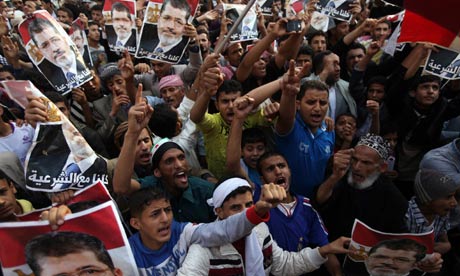
Supporters of Mohamed Morsi: 'The security apparatus is taking revenge for the last two years when it felt threatened by the possibility of any new order.' Photograph: Mohamed Al-Sayaghi/Reuters
The military and police state has returned in full force to Egypt. A country that for a brief period after 60 years of dictatorship was on a path of democratic transition saw a reversal of that process with the coup on 3 July against Egypt's first freely elected president. The coup was justified on the basis of a mass popular outpouring on the streets, although it is generally accepted now that the numbers were a fraction of those claimed by the military and its supporters.
Those calling for a return to the days that preceded the 25 January revolution in 2011, which brought about the fall of Hosni Mubarak, were not only the military high command, the interior ministry, the security services and the police, but critically the judiciary and the state media. These coteries of power actively worked together to block the smooth functioning of the state.
This went hand-in-hand with a vicious campaign to vilify and demonise the party in power, namely the Muslim Brotherhood. Propaganda campaigns against them had been a feature of Egypt's dictatorships from Nasser to Mubarak in an attempt to weaken the main challenge to the regime. But the secular and liberal opposition, having failed to win enough votes themselves, played spoilers rather than engage in the political process, accept the results and campaign for the next elections.
And so the military and this opposition to Mohamed Morsi were to come together in an alliance of convenience with at least a nod from the US and UK to bring down the elected government through unconstitutional means. The street would have to be the way out if the ballot box was not delivering desired results. The method was a well-choreographed campaign that, despite genuine popular support, was essentially directed by the interior ministry and military.
As we examine the debris of Wednesday's massacre (where mounting casualty numbers are suggesting more than 1,000 deaths), there are two parties in today's power struggle. On one side is the ancien regime and its liberal allies – that small core of revolutionaries opposed to the Brotherhood and the politicking Salafi parties. On the other side is the Muslim Brotherhood and its supporters, including pro-legitimacy liberals who refused to broker the idea that votes suddenly counted for nothing. The irony for some is that it is the Islamist side that is upholding the legitimacy of the ballot box and the commitment to a civil state.
During the elected government's year-long term some said that the ballot box was not enough and that Morsi was not inclusive enough, but the fact remains that the ballot box is an essential part of the democratic process. Politically, what Egypt lacked during its experiment in democracy was a loyal opposition. Instead, the opposition that came together under the umbrella of the National Salvation Front decided to back a military coup.
The public is told through the state-controlled media that the sit-ins that have filled Egypt's squares were hijacked by terrorists bent on destroying state institutions. The west is told that part of the roadmap that General Sisi has sanctioned includes a limited number of cabinet posts for the Muslim Brotherhood. Notwithstanding such blatant distortion of electoral will, the vast majority of the Brotherhood's rank-and-file are determined that its opposition to the military coup be peaceful and its leadership categorically reject violence.
What Egypt has experienced since the coup has been the systematic return of the military and police state through arbitrary arrests, media clampdown and the shooting of protesters. Egypt's state institutions, as in most dictatorships, are corrupt and fearful of change. The security apparatus is taking revenge for the last two years when it felt threatened by the possibility of any new order that would eventually hold it accountable. Since the coup began it feels it has taken control again and is ready to strike hard at anyone who challenges it, whatever their ideology.
The civilian facade to this regime is no guarantee against human rights abuses. On the contrary, it provides them with greater shelter. Egyptians are divided today between those who long for security and economic stability, and those who know that although the price is high, the country is at a crossroads of military dictatorship and the possibility of a civil society.
There is still a window of opportunity to side with those committed to democracy in Egypt, and to put pressure on the military by cutting off aid from the United States and by ensuring that it has to be held accountable for any crimes against humanity.

Wednesday, 14 August 2013

Gibraltar and the Falklands deny the logic of history


These relics of empire pay hardly any UK tax – but when the neighbours cut up nasty, they demand the British protect them
People queue with their vehicles in La Linea at the Spanish border to enter Gibraltar
La Linea. ‘People living in the colonies have a right to be considered, but this has never overridden political reality. Photograph: Oli Scarff/Getty
Nothing beats a gunboat. HMS Illustrious glided out of Portsmouth on Monday, past HMS Victory and cheering crowds of patriots. Within a week it will be off Gibraltar, a mere cannon shot from Cape Trafalgar. The nation's breast heaves, the tears prick. The Olympic spirit is off to singe the king of Spain's beard. How dare they keep honest British citizens waiting six hours at Spanish border control? Have they forgotten the Armada?
The British empire had much to be said for it, but it is over – dead, deceased, struck off, no more. The idea of a British warship supposedly menacing Spain is ludicrous. Is it meant to bomb Cadiz? Will its guns lift a rush-hour tailback in a colony that most Britons regard as awash with tax dodgers, drug dealers and right-wing whingers? The Gibraltarians have rights, but why British taxpayers should send warships to enforce them, even if just "on exercise", is a mystery.
Any study of Britain's currently contentious colonies, Gibraltar and the Falklands, can reach only two conclusions. One is that Britain's claim to them in international law is wholly sound, the other is that it is nowadays wholly daft.
Twenty-first century nation states will no longer tolerate even the mild humiliation of hosting the detritus of 18th- and 19th-century empires. Most European empires were born of the realpolitik of power, mostly the treaties of Utrecht (1713) and Paris (1763). The same realpolitik now ordains their dismantling. An early purpose of the United Nations was to bring this about.
Of course those living in these colonies have a right to be considered, but such rights have never overridden political reality. Nor has Britain claimed so, at least when circumstance dictated. The residents of Hong Kong and Diego Garcia were not consulted, let alone granted "self-determination", when Britain wanted to dump them in the dustbin of history. Hong Kong was handed to China in 1997 when the New Territories lease ended. Diego Garcia was demanded by and handed to the Pentagon in 1973. The Hong Kong British were denied passports, and the Diego Garcians were summarily evicted to Mauritius and the Seychelles.
Britain's security does not need these places. It does not depend on coaling stations in the Atlantic. France survives without any longer owning Senegal and Pondicherry, and Portugal without São Tomé and Goa. When the Indians seized Goa in 1961, the world did not object. Indeed the Argentinian invasion plan for the Falklands in 1982 was called Operation Goa, as Buenos Aires assumed it would likewise be seen as a post-imperial clear-up.
Relics of the British empire now mostly survive in the interstices of the global economy. They are the major winners from the fiscal haemorrhage that has resulted from financial globalisation. Many have become synonymous with sleaze. American tax authorities wax furious over Bermuda. George Osborne is out to get the tax dodgers of the Caymans and British Virgin Islands.
Spain has long held grievances over Gibraltar's role in aiding people smuggling, money laundering and offshore gambling beyond its own regulatory reach. This culminated in a 2007  IMF report on shortcomings in the colony's financial regulation. Gibraltar's status as a tax haven has brought it surging wealth, fuelling Spain's rage at so much money pouring untaxed through what it regards as its own territory.
Such colonies claim to be "more British than the British", except that they pay no UK tax and act as tax havens for funds from Britain. Gibraltar has made a particular specialism of internet gambling. Colonies claim allegiance to the crown, but not to its exchequer, or its financial police. They are Churchillian theme parks of red pillar boxes, fish and chips and warm beer. But they want the smooth without the rough. When the neighbours cut up nasty, they demand that those whose taxes protect them should send soldiers, diplomats and lawyers to their aid.
The legal argument between Britain and Spain is in Britain's favour. Though Britain failed to join the Schengen area with free border crossings, all EU states supposedly ease the movement of their citizens. Spain's proposed £43 admission charge is excessive. It might seem ironic for Tory ministers to plead their cause before the hated European courts, but that is the right place to go. Law-law is better than play-acting at war-war.
That said, it is beyond belief that an honest broker could not resolve this centuries-old dispute. Britain has, on several occasions, sought a compromise deal on Gibraltar's sovereignty. Thatcher initiated talks in 1984, after successfully settling both Rhodesia and Hong Kong. The Spaniards offered Gibraltar fully devolved status, like the Basques and Catalans, respecting language, culture and a degree of fiscal autonomy. As Hong Kong has shown, sovereignty transfer does not mean political absorption.
The curse has been Spanish ineptitude feeding Gibraltarian intransigence. Border hold-ups are counterproductive to winning hearts and minds, as were blundering Argentinian landings on the outer Falklands. Spain demanded sovereignty now – despite itself having colonies in north Africa. This pushed British governments to the wall and made them vulnerable to colonial lobbyists wielding the demand for self-determination. A 2002 Gibraltar referendum gave 98% support for continued colonial status – a Falklands vote gave a similar result. It's a far cry from Thatcher's readiness to surrender Hong Kong and accept "sovereignty with leaseback" from both Madrid and Buenos Aires.
The truth is that Britain's tax-haven colonies feel more secure than ever, blessed by history with British protection and free to skim the dark side of the global economy for cash. This has bred a tribe of gilded "Britons" who live in a perpetual other-world. When I asked a Gibraltarian who claimed to be "150% British" why he should not at least pay 100% British taxes, he replied: "Why should I pay for people thousands of miles away?"
While they deny the logic of history and geography, neither Gibraltar nor the Falklands will ever be truly "safe". One day these hangovers will somehow merge into their hinterlands and cease to be grit in the shoe of international relations. This day will be hastened if world governments take action to end tax havens.
Meanwhile, the inhabitants of Gibraltar can go on voting "to stay British" as long as they like. But if they do not accept the taxes and disciplines most Europeans accept, while sucking business from Europe's financial centres, they can hardly expect one EU state to protect them from another. An occasional six-hour queue at La Linea is a small price to pay for declining to join the real world.
• This article was amended on 14 August 2013. It originally stated that the US department of state had called Gibraltar "a major European centre of money laundering". In fact, it was referring to Spain. This has now been corrected.

Salt: chefs are still laying it on thick


Government advice is that you should use just half a pinch of salt a day. But the only people who appear to pay any attention to this are those with cooking shows on TV
salt cellar
Salt has been used throughout history to preserve food, but it is also linked to many health problems. Photograph: Alamy
Cooking telly is full of frauds. Sit and watch with anyone who's worn chef's whites and they will spot a host of lazy fictions guaranteed to make them snort and pshaw. A popular one is that on TV no one puts their fingers in the food: in a working kitchen, the digits are the most used tool of all. Another is the salt thing.
On television you will hardly see a shake of the white powder. But in real kitchens, they lay it on thick: "Correct seasoning to a chef is as much salt as you can put in without it tasting too salty," Bocca di Lupo's Jacob Kennedy says. "That's why we all die young."
In his last book, Cooked, the American eco-food guru Michael Pollan gets busy preparing a piece of meat for grilling. A chef tells him to lay on the salt. "Use at least three times as much as you think you should." Shocked, Pollan consulted another pro. He agreed, but "upped the factor to five". Science explains why: long-chain carbohydrates in cooked food neutralise natural salt by binding in the sodium ions. For taste, it needs replacing.
So it's no great shock when survey after survey finds higher levels of salt from high-street restaurants – Domino's, Wetherspoon's, Carluccio's and Jamie's Italian were all putting more salt in single dishes than adults are supposed to eat in a whole day.
But what we're supposed to eat is ridiculously, you may even think unfeasibly, little. The NHS recommends just 4g of salt a day for a child (a small teaspoonful) and 6g for an adult (a large teaspoonful). But the NHS also says that up to 90% of the salt we eat comes already present in our food, so we should only be using adding 0.6g or half a pinch. My mother uses half a teaspoon of salt or more every time she sits down to eat, usually before she has tasted the food. (At nearly 80, she admits to being well preserved.)
As with so many ingredients, there's good and bad when it comes to salt.

The bad

It hardens your arteries and drives up blood pressure, leading to heart attacks and strokes. The latest medical charge against it is that it may be acting as a secret agent, "driving our immune systems to rebel against us". It may also play a leading role in multiple sclerosis. Nonetheless, wicked salt dealers are working to persuade you to eat even more. The Department of Health has said that reducing salt intake by just 1g a day – just a pinch – would save 4,147 preventable deaths and £288m.

The good

For 6,000 years it has been preserving fish and meat to keep humans alive in hard times and produce such glories as jamon serrano and brandade of salt cod. Salt is instantly vivid; it puts a shoulder to a shy taste and shoves it on to the stage. Try salting a boiled egg, or a slice of avocado, to watch something bland come alive - try it on everything, actually.
Also, get it while you can. With transfats gone and sugar under attack, salt may be the next ingredient to come under the pitiless eye of the law. Legislators in New York have already made one attempt to get salt banned in restaurants. According to Time magazine, federal legislation on salt content in packaged and restaurant food is under consideration.

What to do?

Manufactured food tends to use a lot of salt, especially if it claims to be "healthy", because salt fills in for taste when fat or sugar is removed to lower calories. But lots of basic foods we use are high in salt: bread, cheese, sun-dried tomatoes, pickles and so on. And – hold on to your seats – crisps and bacon. Not to mention those damnable salty caramel-flavoured sweets.
Clearly, avoiding ready meals and processed food is one way to allow yourself more salt in your cooking. Or you could just ignore the advice, and carry on salting. Anthony Bourdain – the chef who first lifted a lid off the seamy truths of the professional kitchen, has no time for the salt police. "It's what makes food taste good," he told Time magazine. "Traditional, intelligent and skilled used of salt has become confused in the minds of nanny-state nitwits with the sneaking of salt into processed convenience foods. Nothing else encapsulates the mission of the food ideologues better than this latest intrusion: they desire a world without flavor."
So, could you cook with half a pinch a day?

Thursday, 8 August 2013

A Possible solution to the DRS Imbroglio


by Girish Menon

The DRS debate, definitely on the netosphere and to some extent on TV and print media, appears to be a conversation of the deaf. These warriors appear to have wrapped themselves in national colours with scorn and ridicule being the weapons used. Does this win over their opponents? I doubt it, because both groups are dominated by users of terms like 'Luddites' and '100 % foolproof' which instead of persuading the dissenter actually antagonises them. In this piece I will attempt to try to mediate this debate and attempt a possible solution to the imbroglio.

It is a principle of rhetoric that the side demanding a change from the status quo must provide the burden of proof. To that extent I will agree that the pro DRS lobby have already proven that DRS does reduce the number of umpiring errors in a cricket match. I'm sure that BCCI will admit this point. However the ICC's claim that DRS improves decisions by 93 % is in the realm of statistics and it is possible to find methodological grey areas that will challenge this number. So for purposes of this argument I'm willing to discount ICC's claim and willing to start on the premise that DRS does reduce errors by at least 70 %. The debate should actually be more concerned with the next question i.e. 'at what price does one obtain this 70% increase in decision accuracy and is it worthwhile?' This question is ignored by net warriors and media pundits alike and I wonder why?

Before I proceed further I wish to remind readers of the MMR scare scandal, not many years ago, that prompted a mass scare in the UK about a triple jab vaccine and its links with autism. Some may recall Andrew Wakefield, an expert, on TV exhorting viewers to avoid the vaccine. The saga ended with Wakefield being discredited and found to have multiple undeclared conflicts of interest in propagating the scare.

-------
Also Read

Cricket and DRS - The Best is not the Enemy of the Good


------

To avoid a similar hijacking of the DRS debate I suggest that all protagonists declare their interests in the matter. I for one have no truck with any cricketing body or media organisation or a technology provider or a provider of a competing technology. Also, I'd like a reduction in umpiring errors at a price that will sustain and grow cricket all over the world.

Similarly it is incumbent on the likes of Michael Vaughan to declare their links with the purveyors of such technologies so that the cricket loving public know that their views are without any profit or personal motive.

While the reliability and validity of DRS technologies has been well debated, the monopoly profits that derive to these suppliers has been largely ignored. I suspect this is the real issue where the BCCI is at loggerheads with the others. As an outsider, I think national cricket boards have their own technology suppliers which they wish to back. They may even have an investment in them which may expose their reluctance to adopt alternative and cheaper solutions to a problem. Jagmohan Dalmiya's argument against the esoteric Duckworth-Lewis method is a case in point.

It is a truism that in the market for technologies, unfortunately, the best technology does not always win.  Economics students will be aware that Dvorak keyboards have never made much headway against their QWERTY rivals and  Betamax became a cropper to VHS. So just like the well ensconced Duckworth Lewis method, Hot Spot  and Hawk Eye hope to become monopoly providers of technology services to the ICC. This will enable them protection from cheaper alternative service providers and will guarantee their promoters life long rents.

There is another dimension to this issue viz. 'Cost'. In 1976 the FIH (International Federation for Hockey) replaced natural turf with astroturf to improve the game. Today, while the game looks good on TV and is fast etc it provides no competition to cricket in countries playing both sports. One possible cause is the decline of the sport in India and Pakistan, the two nations who did not have the financial resources to create adequate 'astroturf based' infrastructure among the lovers of the sport. Along similar lines, the prohibitively expensive DRS technology may bankrupt the smaller cricket boards of the world. I'm sure no warrior on either side of this debate wants a reduction in the numerical diversity of cricket lovers.

I suppose as a way out of this imbroglio would be for the ICC to take ownership of the current technologies and make the technology 'open source'. Allow competitive bidding for DRS services instead of paying monopoly rents to the patent owning suppliers. I'm sure this will reduce the costs for DRS and even the BCCI will be keen to support such a venture.  

Towards a radical new theory of Anglo-American slavery, and vindication of free markets


New evidence coming to light in the National Archives and the Bodleian Library may soon change our entire view of the British slave trade, and the roots of institutional plantation slavery in the Americas.


AMISTAD
The Caribbean states, CARICOM, are filing a lawsuit against Britain, Spain, France, Holland and Portugal for slavery reparations Photo: Film Stills
With luck it will help to vindicate the fathers of liberal government and the free market in the 17th and 18th Centuries, falsely accused until now of abetting - or promoting - the great crime of race-based African slavery.
For academic orthodoxy holds that John Locke and the great Whig thinkers of the Glorious Revolution (1688) helped to design and foster the economic system of hereditary slavery that shaped Atlantic capitalism for a century and a half.
From that it is but a step to dismiss the moral claims of liberalism as so much humbug, to write off all the talk of justice, natural rights, inviolable contracts and government by consent as the self-interested catechism of oppressors. As Samuel Johnson said acidly: "How is it we hear the loudest yelps for liberty among the drivers of negroes?"
Except that this established version of events is not true. It is a near complete inversion of what happened, and this matters in all kinds of ways since the debate over slavery refuses to subside, even though the trade was abolished in 1808 and Empire slaves were freed in 1833.
Indeed, it is coming to the boil again. The Caribbean states, CARICOM, are filing a lawsuit against Britain, Spain, France, Holland and Portugal for slavery reparations. Apologies are not enough, says Ralph Gonsalves, premier of Saint Vincent. "We have to have appropriate recompense." 
It matters too because liberal democracy has been on the back foot in large parts of the world for a decade. China is bidding for global leadership with radically different claims - with allies in Moscow, and followers from Bangkok to Caracas. It seizes eagerly on anything that punctures the moral claims of the West.
Joshua Kurlantzick says in Democracy in Retreat that the "Washington Consensus" we have known for so long is losing ground to an ascendant "Beijing Consensus", the greatest challenge to Western Liberal values since fascism and communism in the 1920s and 1930s.
The banking crash of 2008-2009 has tempted some in China's Politburo to conclude that Leninist planning is superior to Anglo-Saxon markets, and prompted many in Europe to ask whether Capitalisme Sauvage is worth saving at all. They misread events of course. It was governments that caused the crisis: the West by fixing the price of credit too low, the East by amassing reserves and flooding the world with excess capital. But that is not the narrative of the web, or political discourse.
So let us start to set the record straight on one point at least. The archives demonstrate that the Stuart monarchs Charles II and James II systematically drew up laws to enforce and spread hereditary slavery, mimicking the Spanish practice of the day and the "divine right" absolutism of the Habsburg empire.
They did so with relentless focus, stacking the courts to ensure favourable rulings, and carrying out police state sedition trials against opponents, not least because revenues from tobacco and sugar plantations became the chief source of wealth for the crown.
Professor Holly Brewer from the University of Maryland says Charles II was so enamoured with the Royal African Company that he engraved its symbols of elephant and castle on one side of his golden Guinea. "The Stuarts envisaged monarchy and slavery as, literally, two sides of the same coin," she said.
Slavery had not been hereditary in British possessions before. There were African slaves, just as there were indentured white workers, but it was fluid, in a legal grey zone, and judges could not be counted on to enforce the recapture of runaways.
Prof Brewer said the findings she has uncovered in the archives show that Locke fought tooth and nail to reverse this new hereditary structure while on the Board of Trade in the 1690s under William of Orange.
Locke sought the stop linking land grants to the number of imported slaves - 50 acres per head - a "strangely perverted "practice, in his words, intended to ensure a plantation aristocracy built on slaves. He urged that the children of blacks should be "baptized, catechized and bred Christians" so that they could not be denied their civil liberties so lightly.
Locke had been compromised earlier in the 1660s as a young man working for the Stuarts but later became an exile and rebel in Holland. "When he had a position of real power, he tried to undercut the development of slavery in comprehensive ways," she said.
His was the outlook of most liberal thinkers who shaped the American Revolution. It was the view too of Adam Smith, the free market theorist writing later in the 18th Century, also accused of promoting slavery. Smith, in fact, argued that slaverly stifled economic growth and innovation. “It appears from the experience of all ages and nations, I believe, that the work done by freemen comes cheaper in the end than that performed by slaves," he wrote in Wealth of Nations. William Wilberforce cited Smith approvingly to buttress the abolition case.
Locke's efforts to undo Stuart damage came too late. Vested interests were too powerful. Hereditary slavery had become embedded in the economic system of the American and Caribbean colonies. Britain would acquire the notorious "Asiento" at the Treaty of Utrecht in 1713, giving the South Sea Company the contract to supply the Spanish Empire with slaves. The cancer then metastasized.
In my view, the British are a little too cavalier about this saga, thinking the nation absolved because the practice was far away and not on island soil.
We tend not to be aware that King George III actively perpetuated the slave trade in the late 18th Century, vetoing laws by Virginia and other states trying to deter the inflow by raising import taxes on slaves. It is why Thomas Jefferson's original draft of the US Declaration of Independence contained a clause saying the king "has waged cruel war against human nature itself, violating its most sacred rights of life and liberty in the persons of a distant people who never offended him, captivating and carrying them into slavery in another hemisphere or to incur miserable death in their transportation thither. Determined to keep open a market where men should be bought and sold, he has prostituted his negative for suppressing every legislative attempt to prohibit or restrain this execrable commerce. And that this assemblage of horrors might want no fact of distinguished die, he is now exciting those very people to rise in arms among us."
And no, Jefferson was not a hyprocrite because he owned slaves. They were mortgaged, due to his family's crushing debts left from monetary deflation after the Seven Years War. They could not legally be freed.
America puts its own gloss on events. Simon Scharma argues in Rough Crossing that "theirs was a revolution, first and foremost, mobilized to protect slavery". His point is that the "Somerset" ruling of 1772 in England - "the state of slavery is so odious, that nothing can be suffered to support it: the black must be discharged" - set off ferment in the colonies, and the Dunsmore Proclamation in 1775 offering freedom to slaves who fought on the British side rallied planters to the revolution. Yet this can be pushed too far. The intellectual leaders of the American Revolution were Lockeans through and through, almost all tormented by slavery.
As Britain prepares to defend itself against the Caricom suit - so soon after settling torture claims from Mao Mao victims in Kenya - it is scarcely helps perhaps to argue that the slave system was built by monarchical tyranny, rather than by private citizens beyond control, as we like to think. It is worse, in some ways, if it was a state endeavour.
Yet it should be some comfort that Parliament and liberal government may be absolved, at least in part. Slavery was excresence of absolutism, not free commerce. We cannot hold our own in the world's bare-knuckled battle of ideas if we concede this cardinal point of history.