Search This Blog

Friday, 11 January 2013

For Indian women in America, a sea of broken dreams


By Narayan Lakshman in the Hindu

When Pavitra’s Delta Air Lines flight flew into Atlanta’s Hartsfield-Jackson International Airport on a crisp blue July morning back in 2008, her heart pounded with excitement. Though it was a dangerous time economically and few companies were hiring, her husband landed a good job with a major IT firm and was assigned to projects across the U.S.
Pavitra, who had a bachelor’s degree from India and some work experience, had made a careful plan to embark on a course of higher studies — permitted under her current H-4 visa — and then seek employment. It was all coming together for her, it seemed. But she was in for a rude shock.
Within months of her settling down in a strange new land, she found out that not only were higher studies a financially draining option, given the lack of funding for spouses of H1-B visa-holders, she was also unable to pursue a graduate programme because with her three-year Indian undergraduate degree she was not considered eligible for graduate enrolment in the U.S.
With a paucity of viable alternatives, she turned her attention to the job market, an effort that proved even more futile. “I tried applying for a job but as soon as the recruiters came to know of my H-4 visa status, they would say they do not sponsor H1-B,” Pavitra said.
Matters then took a turn for the worse. Trapped in a labyrinth of visa-related restrictions, she began to feel she had no purpose in life. “I started going through depression, loss of enthusiasm and self-esteem. I started having chronic migraines every day,” she said. As migraine attacks went, hers were so severe that she could not even open her eyes, often threw up, and had chills.
“I had to call my husband every day at work, saying I am ill and he used to come home running. Life for him was very difficult, juggling between work commitments and my doctor visits,” she said. He was unable to look for better work opportunities since he was worried and wanted to look after her.
Now in the midst of a mind-numbing routine of hobbies, she asks herself: “Where am I in my life today? Still a dependent, still need to start my career fresh at this age.” And her future looks cloudy too, as it is a shaky prospect to start and raise a family on a single income, and whenever she tries to get back in the job market, “getting back my self-confidence, independence, self-esteem... [is] going to be a struggle for me.”
If Pavitra’s situation were an idiosyncratic case of misery in the wilderness of American suburbia, it may not be a collective concern. Yet that is not the case and, to be specific, 1,00,000 to 1,50,000 people, mostly women, from India, other parts of Asia and the rest of the world are stuck in this deadening reality of joblessness and social isolation, rapid erosion of self-esteem, and attendant toxic malfunctions in their personal lives.
Let’s step back and consider the facts and numbers in question.
The issue of H-4’s debilitating impact on its holders is not a new one. In fact, writing on cases of abuse of H-4 women by their H1-B husbands in The Hindu in 2008, Shivali Shah, a New York-based lawyer, explained that the U.S. Customs and Immigration Service does not provide H-4 spouses with work authorisation until well into the green card process.
There is no prospect of working on the H-4 visa per se. The State Department’s guidance on a range of non-immigrant visas notes: “A person who has received a visa as the spouse or child of a temporary worker may not accept employment in the U.S. with the exception of spouses of L-1 visa-holders.”
“Therefore, these women are financially dependent on their husbands for anywhere from two to nine years,” Ms. Shah pointed out, adding “H-4 women are middle-class and have status in the U.S., but immigration laws can make them indigent and undocumented at the whims of their husbands.”
So how many individuals are affected by this law? Since around 2004, the USCIS has set the annual cap for H1 visas issued at approximately 65,000. Even if one were to conservatively assume that 50 per cent of these visa-holders were married, it suggests close to 32,500 spouses or partners on H-4 visas a year.
Given that the H-4 visa is often of six-year validity, it would not be far off the mark to assume that there are well over 1,00,000 individuals stuck with this visa, possibly over 1,50,000. Further, the most recent USCIS data quoted in a study by the Brookings Institution suggest that 58 per cent of the H-1B visas are granted to Indians. This means that well over 50,000 Indians are in this position.
This includes only H-1 spouses. There is a host of other visa-types, for example, I-visas for journalists, all of which are subject to the USCIS work ban for their spouses — except L-1s, usually issued for senior executives who are on intra-company transfers from other nations. If the spouses of visa-holders in these categories were also counted, the number of frustrated, but often talented, individuals unable to work would perhaps grow exponentially.
To truly come to grips with the intensity of the problem faced by individuals trapped in the H-4 visa quagmire, a glimpse into the corrosive nature of the visa’s work restrictions is useful.
Rashi Bhatnagar, a H-4 visa-holder in the U.S. who was willing to have her real name used in this story — all others have been changed to respect privacy concerns — set up a Facebook group called ‘H-4 visa, a curse,’ after facing the deadening reality of joblessness, having enjoyed years of a successful career in India. Though she had a master’s degree from India, she had numerous doors of opportunity slammed on her in the U.S. after she had to relocate to this country to join her IT-worker husband.
However, Rashi counts herself among the fortunate few, whose spouses have a senior role, some leverage with their employer and hence some hope for flexibility, such as an early or expedited green card application. For most other “H-4s,” the mathematics of the waiting time for the right to work is debilitating, killing off their most productive work years from their late twenties to late thirties.
In the EB2 category of temporary, non-immigrant workers, a H-4 visa spouse would typically wait for six years before a green card application is made and then potentially another six years for the issuance of the green card. This makes a total of around 12 years, time spent languishing in the aisles of Walmart, making small-talk with vendors on street corners, engaged in the soul-destroying household chores and the limited joys of child-rearing.
In the EB3 category, the six-year wait for the green card process initiation is compounded by an even longer eight-12 year wait for the green card itself, requiring the H-4 visa-holders to hold their life in suspended animation for a staggering 14-18 years. Over the passage of such a length of time, all hope of resuscitating one’s passion to pursue a meaningful career is likely to be extinguished, with only a sense of lonely desperation left in its wake.

Part 2


To better understand the impact of the U.S.’ H-4 visa, the non-working visa given to the spouse of a work-authorised H-1B visa holder, The Hindu conducted a limited survey via a Facebook page that is a portal for H-4 visa holders. Along with the administrator of that page, Rashi Bhatnagar, who is herself on an H-4 visa, respondents were asked about the circumstances they found themselves in after they arrived in the U.S.
The responses not only hinted at a wide range of personal and health setbacks for female Indian H-4 visa holders but also testified to this visa’s impact on those from other nations, grown children of H-4 visa holders and, in some rare cases, male H-4 visa holders.
Take the case of Kathy, who used to be Senior Principal at a firm in the United Kingdom. After she and her children moved to the U.S. to join her husband, they had to put their oldest daughter through college with absolutely no access to financial aid because they were not permanent citizens of the U.S.
To make matters worse, when her daughter finished college she found herself, like her mother, stuck at home and unable to earn a living using the skills acquired at university. “She sits in her room all day, on her own,” Kathy worried, adding that her daughter had few friends and got very depressed.
Kathy herself fared poorly and it took a drastic toll on her health. Initially she and her daughters had private health insurance, but after she was diagnosed with a pineocytoma, or non-malignant brain tumour, she was dropped from her insurance. Apart from the compelling case that such instances make for reform of the H-4 visa restrictions, they underscore the need for the sort of health insurance reform that President Barack Obama has pushed through. As for Kathy, she and her daughter have no health insurance, no prospect of working and face a daily routine of social isolation and despondence.
Another striking case that the survey revealed was of Rahul, a male H-4 visa holder who followed his IT-professional wife to the U.S. For him, too, the stark reality of U.S. employers’ unwillingness to sponsor an H-1B struck home after many months of a frustrating job search. Cut off from friends and family and no longer the sociable, buoyant person he used to be, Rahul turned to alcohol — at a heavy cost. Caught in a downward spiral of depression, he attempted suicide several times. “I hurt myself very badly during one of these attempts and had to be hospitalised after calling 911,” he said. However, he showed resilience and tried to bounce back from that low point. He returned to India to change his field from sales and marketing and gain a greater IT focus. He even found work in a U.S. firm’s India office in the hope that the firm would apply for a work visa for him.
“Unfortunately the recession hit in 2008 and the company did not do well,” said Rahul. He had to resign himself to the prospect of staying on in India and battling the spectre of alcoholism that had arisen once again, not to mention thoughts of depression and suicide. Meanwhile, his wife and three-year-old child live out their lives in the U.S. without him.
Among most respondents to the Facebook survey, health issues arising from depression and a sense of hopelessness appeared to be common. One respondent, Joyita, said she was constantly visiting neurologists and physical therapists for treatments related to psychological turmoil “which have their roots in H-4 visa’s work restrictions”.
Even where physical symptoms were absent a sense of utter despair replaced the initial optimism that these spouses of H-1B workers had felt. Shauravi, for example, felt that she could not afford an MBA or other professional degree given the lack of funding opportunities. But the alternative, to “be at home for whole day without working and be very dependent to my husband ... has made me very weak just thinking about it”.
Another respondent, Ketaki, worried that the only degree she could afford was of no interest to her and lack of friends and complete dependence on her husband in a new environment had made her lose her self-confidence. Similarly Lavanya, who left a senior post in the Indian government, found herself struggling to keep up her self-esteem when she could not find any job, not even one that required far lower skill levels than those she possessed.
For several survey respondents their vulnerability had led to abuse within the marriage, in some cases resulting in complete familial breakdown. Priya told The Hindu that after suffering numerous beatings by her husband, she managed to file a police complaint and had him arrested. However, because as an H-4 spouse she had no access to bank accounts and other paperwork — all of which were controlled by her husband — she was unable to afford an attorney to fight the case. She was left praying for a denial of visa renewal for her husband for she had no other means to reach out to her family back in India.
A similar case was Poorvi who, despite overcoming financial hurdles and completing a U.S. academic degree, faced marital trouble, loneliness and spousal abuse that ultimately led to divorce.
The severity of personal problems faced by individuals in this position begs the question of why the spouses of H-1B, I, and a range of other visa holders have been denied the right to work, while L-1 visa holders’ spouses were granted the right some time ago,
Sheela Murthy, an expert on immigration law, told The Hindu that there had occasionally been talk in official circles about granting H-4 visa holders the right to work, but “that was before the economy tanked”. Apart from the sheer political pressure that any government would face if it tries to push through such a reform, it could also lead to some uncomfortable questions as to why the spouses of other visa holders — including the A, B, C, D, G, and F visas — could not similarly be given the right to work .
The H-4 case may be a “strong but not a winning argument”, said Ms. Murthy, noting that another fact pertinent to this case was that India ranks among the top 10 nationalities of illegal immigrants in the U.S.
On lobbying the White House and Capitol Hill for relaxing the work restrictions, she said: “I do not think we have been able to make the case clearly and strongly, with statistics and numbers, and have a very limited and strong message, to take up the drumbeat that gets both Houses of Congress on board.” There was still something missing in the strategy and articulation, she suggested.
In the end there is a complex argument to be made that must consider all of the difficult questions relating to the politics of post-recession unemployment, the plight of spouses of other visa holders, and the broader context of comprehensive immigration reform and illegal immigration.
Yet even as the weight of these unanswered questions stalls progress on H-4 visa reform, thousands of individuals in this category will continue to live with their broken dreams.
(Concluded)



Wednesday, 9 January 2013

Just because something has value doesn't mean it has a price


If every last shred of incidental online value is given a price tag, we'll never harvest the full fruits of our ingenuity
Google
Google is a case-study in harvesting positive externalities. Photograph: Britta Pedersen/EPA
 
When future economists look back on the dawn of the internet era, they will marvel that an age of such technological marvel was attended by a widespread, infantile mania for preventing positive externalities.

"Externalities" are the economist's catchall term for the spillover effects experienced by the people who are affected by others' activities. Most of the 20th century was spent locked in battle with the corporate vice of externalising negative costs. Companies are beholden to their shareholders, and so they are meant to save every penny they can, even when saving that penny might cost the rest of society several pounds. The classic example is toxic waste: processing industrial waste before it leaves the factory is a costly proposition, and so, whenever it is possible to do so, companies have defaulted to dumping their waste into the wider world. This is a much cheaper option — for the company.

For the world, it's vastly more costly. After all, when the offensive sludge is all neatly gathered at the effluent pipe's head-end, it is concentrated and handy, and can be gathered and fed into whatever decontamination or sequestration system is appropriate.

But once the sludge has exited the pipe and is out in the world, it has to be gathered up before it can be dealt with. Contaminated coolant can be sealed in barrels at the factory and sent for secure burial. Once it's dumped in a stream, you have to figure out how to get it out of the stream before you can clean it up – this is notoriously difficult.

What's more, streams feed into rivers, and rivers into oceans, and people drink from them and swim in them and eat the animals that swim in them and rely on them. What started as a waste-containment problem has become a public health emergency and an environmental catastrophe – the company's savings are the world's loss.

So policy wonks have spent a century thinking about creating the carrots and sticks necessary to minimise this externalising behaviour. The idea is to work out a system of fines and punishments that make it economically irrational to dump sludge, because the savings from doing so are offset by the penalties for getting caught. Getting this number right is notoriously hard, because you have to factor in some kind of multiplier of the penalty that accounts for the discount that rational – albeit psychopathically immoral – companies will apply based on the likelihood that they will not get caught.

Virtuous circles

But what about positive externalities? Historically, these have been a lot less contentious, and it's easy to see why. A positive externality arises when you do something you want to do that also makes life better for someone else. For example, if you drive your car slowly and carefully to avoid a wreck, a positive externality is that other users of the road have a safer time of it, too. If you keep up your front garden because it pleases you, your neighbours get the positive externality of slightly buoyed-up property values from living on a nicely kept street.

Positive externalities — virtuous cycles — are all around us. Your kid learns to speak because of all the people around her who carry on conversations and because of the TV shows and radio programmes where speaking occurs (as do immigrants like my grandmother, whose English fluency owes much to daytime TV after she came to Canada from Russia).

My flat – on the top floor, above a commercial building – gets some of the rising heat from the building below, capturing our downstairs neighbour's exhaust heat (on the other hand, we provide a positive externality to them by insulating their roof with our home).

The net is the natural home of positive externalities. Start with the "network effect" – the way that adding people to the network creates more value for existing users of the network (one fax machine is useless, two fax machines are slightly useful, a billion fax machines are indispensable, at least, until the web makes them obsolete). Every website that came along increased the likelihood that new users would find some reason to join the internet. Every new user that came along increased the likelihood that someone would make a website that tried to reach that user.

This is a kind of anti-entropic magic trick, using the exhaust from one process to create fuel for the next one. The most famous example is Google's PageRank algorithm, which began when the company's founders realised that every time a web creator added a link from one site to another, there was a kind of implied vote for the linked-to site – when I link to you, I'm implicitly saying that you have something I think others should see. This citation analysis (a common practice in academia, where journals who are widely cited are considered more valuable than less-cited journals; and where journal-articles that are more widely cited are considered more valuable as well) was wildly successful, and it showed that there was, latent on the web, an invisible mesh of authority that could be made visible with the right kind of analysis.

Google is a case-study in harvesting positive externalities. It offered a free, voice-based directory assistance number, and used the interactions users had with its software to build a corpus of common phrases, expressed in multiple accents and under a wide range of field conditions. Then it used this to train the voice-recognition software that powers its Android-based phone-search. Likewise, it mined all the publicly available translations on the web – EU documents that appeared in multiple languages, fan-based translations for subtitles on cult cartoons, and everything else it could find – and used this to train its automated translation engine, providing it with the context that it needed to figure out the nuance and sense of ambiguous phrases.

There are other companies that do well by harvesting these positive externalities. Facebook provides its users with a handy platform for socialising, and then – notoriously – mines their social graph to figure out how to sell things to them.

However, there's a wide difference between the two companies: much of Google's business revolves around capturing externalities from things you were going to make anyway. In many cases, the resources Google mines are public and remain in place even after Google's finished with them (for example, anyone can index the web and do the same citation analysis as Google).

Both Facebook and Google also try to entice the world into activities that generate externalities. Facebook is a giant behaviourist experiment designed to tempt you into systematically undervaluing your privacy, and it uses game-like mechanics to extract more personal data and more social-graph enumeration from its users. Google's a little less obvious about its enticements, but clearly, offering services such as YouTube and Blogger are mostly about figuring out how to earn money from the exhaust-stream from individual and corporate creativity. Facebook, and to a lesser extent, Google, try to claim ownership over your externalities by locking them up in proprietary walled gardens.

Taking a cut

But back to our era's defining mania: resentment over positive externalities. Many people and companies have concluded that if someone, somewhere, is getting value from their labour, that they should get a cut of that value. Irish newspapers are paying solicitors to demand money from websites that link to them, on the grounds that a website is improved if it contains a reference to the news, and that improvement needs to be paid for. Many people have accused Google of "ripping off" the public by indexing content, or analysing it, or both. Jaron Lanier recently accused Google of misappropriating translators' labour by using online translated documents as a training set for its machine-translation engine – an extreme version of many labour-oriented critiques of online business.

And take DRM – digital rights management – which is used to restrict the way you use the media you buy, such as ebooks, videos, and games.

DRM systems have been deployed to stop people from selling used games, to stop them lending their ebooks, to stop them from taking DVDs from one country to another. This is pure positive-externality resentment.

The reasoning for DRM goes like this: "I sold you this [ebook/game/video] for the following uses. If you figure out a way to get any more value out of it, it belongs to me, and you can't have it, until and unless I decide to sell it to you."

In the pre-digital world, this would have been laughable. "I sold you that book: if you want to use it to keep the table from wobbling, you'll have to pay me extra." Or: "I sold you that game to play in your house. How dare you bring it on holiday with you?! You owe me!" Or: "That TV was sold to you for the purposes of watching programmes, not to be used as a white-noise machine to lull your newborn to sleep, and certainly not to support a pile of knick-knacks!"

Of course, removing positive externalities also removes value. Cars are worth more because of the used-car market. University textbooks command a higher price because of the market for used textbooks. If either sector managed to kill those externalities, it would be selling goods that its customers valued less (and would likely find that they demanded lower prices for them, too).

I was at a TV DRM meeting once where a representative from the US-led Motion Picture Association proposed that broadcasters should be able to selectively block the use of wireless retransmitters – the sort of thing that lets you have a receiver in the sitting-room that fed a TV set in your bedroom – because "watching TV in a room other than the one the show is being received in has value, and if it has value, we need to be able to charge money for it".

That's the crux of this irrational fear of positive externalities: "If something I do has value, I deserve a cut." It's one thing to say that someone who hires you to do a job, or purchases your product, should pay you money. But positive externalities are the waste-product of something we were already going to do. They're things that you have thrown away, that you have thrown off, that you have generated in the process of enjoying yourself and living your life.

The mania to internalise your positive externalities is the essence of cutting off your nose to spite your face. I walk down the street whistling a jaunty tune because I'm in a good mood — but stop as soon as I see someone smiling and enjoying the music. I keep my porchlight on to read by on a warm night, but if I catch you using the light to read your map, I switch it off, because those are my photons — I paid for 'em!

Worse still: the infectious idea of internalising externalities turns its victims into grasping, would-be rentiers. You translate a document because you need it in two languages. I come along and use those translations to teach a computer something about context. You tell me I owe you a slice of all the revenue my software generates. That's just crazy. It's like saying that someone who figures out how to recycle the rubbish you set out at the kerb should give you a piece of their earnings. Harvesting positive externalities involves collecting billions of minute shreds of residual value – snippets of discarded string –and balling them up into something big and useful.

If every shred needs to be accounted for and paid for, then the harvest won't happen. Paying for every link you make, or every link you count, or every document you analyse is a losing game. Forget payment: the process of figuring out who to pay and how much is owed would totally swamp the expected return from whatever it is you're planning on making out of all those unloved scraps.

In other words, if all latent value from our activity has a price-tag attached to it, it won't get us all paid – instead, it will just stop other people from making cool, useful, interesting and valuable things out of our waste-product.

Anglo - EU Translation Guide

Cheating isn’t cheating if you don’t think it is


Luis Suárez's handball: Cheating isn’t cheating if you don’t think it is

Football is only a reflection of that society - and that doesn't say much about us


Mark Steel in The Independent

Luis Suárez should be given a job in the Cabinet. He’s the footballer who’s been called a cheat, after he handled the ball just before scoring a goal for Liverpool in the FA Cup, and experts are undecided as to how he should be dealt with. And you can see the difficulty, because with such a brazen attitude towards cheating, he ought to be running one of our major institutions.

Suárez appears to have grasped how society’s rules have changed. Under the old system, if you cheated you hoped you weren’t caught. Now you don’t mind getting caught, you just announce that cheating isn’t really breaking any rules, and carry on. Football is only a reflection of that society.

So in his next match, Suárez could place the ball in a Sherman tank and drive it through the goal, flanked by marines who assassinate the opposing goalkeeper. His manager would say, “I can’t comment as I didn’t see the incident, but his first touch was astounding”. Match of the Day would debate whether the commandos were interfering with play. And after he’d scored 60 goals this way, the Football Association would set up an inquiry, in which Suárez would say he couldn’t recall ever playing football in his life. The inquiry would propose a limit on the number of tanks in each half but this wouldn’t be implemented as Suárez would be outraged at the restrictions on his freedom.

Or he could learn from the Deputy Prime Minister, by pledging to abolish handball at all times in every way, including by the goalkeeper, with fines for anyone who even carries the ball to the ground. And then spend the next match throwing balls in the goal, before announcing: “I’m really, really sorry to have made such a foolish promise. I’m sure you’ll understand that from now on I’m going to do this in every match.”

Maybe the first part of each footballer’s training now is to study the banks. The coach says: “This lot were caught bringing the whole economic system down, but did they bother looking sheepish? No, they insisted on an extra bonus as it would be even harder clearing up the mess than it was causing it. If they can do that after causing a global recession, you can do it after diving in the box.”

As the attitude towards cheating is so similar in different fields, football pundits should be regular guests on the news. So Alan Shearer could say: “You can see from this angle, the police have definitely falsified 116 documents, but the ref hasn’t blown the whistle so they’ve got away with it.”

Some commentators suggested that Suárez should have owned up to his foul, but with the modern rules, even if he’d announced on the Tannoy, “I punched that ball in the goal ha ha ha”, the referee would have let it stand, but suggested at some point in the future someone should set up a self-regulating body made up of prominent figures from the handballing community.

Chav-bashing – a bad joke turning into bilious policy

It started as snobbery, but this week the idea that the poor are to blame for their plight may well become law
Homeless man
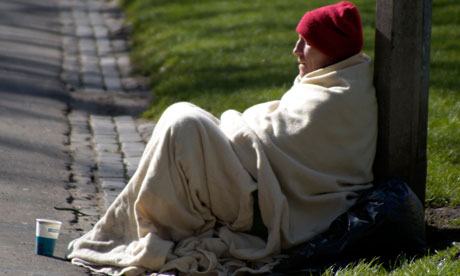
'In almost everything we now hear about economic disadvantage, to be one of the economy's losers isn't about being a vicitm of forces beyond your control, but character failings'. Photograph: ALIKI SAPOUNTZI / aliki image li/Alamy


Six years ago, I wrote a piece for the Guardian about a phenomenon that had been bubbling away for a few years, and had started to become inescapable. It all seems rather quaint now: Prince William allegedly taking part in a "chav-themed fancy dress party" at Sandhurst; Oxford colleges hosting "chav bops"; the privately educated creators of Little Britain entertaining their devotees with comedic representations of the so-called underclass. But there it was: to be living on an estate, and in receipt of benefits, and possibly out of work, was to not just to be fair game for Oxford undergraduates, the future king and a certain kind of TV comedian, but the butt of a huge national joke. Some of us wondered where exactly what was briefly known as "The New Snobbery" was headed.

We now know. Its cultural aspects were merely the tip of the iceberg – as the Labour party engaged in the rebranding of social security as "welfare" and its ministers raged against "benefit cheats", something poisonous was being embedded at the core of our national life. While the Conservative party grimaced through a fleeting modernisation, it sat there, ready to be picked up by a Tory-led administration and taken to its logical conclusion.

Tuesday sees the Commons vote on the welfare uprating bill, via which the government wants to cap increases in working-age benefits at 1% and in the process portray Labour as – to quote the Observer's Andrew Rawnsleythe party of "skiving fat slobs". Throughout the coming year, the grim provisions of the Welfare Reform Act will be upon us, snatching away money from hundreds of thousands of people, and commencing the uncertain era of universal credit. It is a token of the government's agenda that in moving in on just about anyone who receives state help (apart from those electorally vital pensioners), they are simultaneously lionising hard-working families while snatching money off them – which is the basis of Labour's creditable opposition to the bill, though that does not quite let them off the hook. Most of the opposition seem incapable of challenging the "strivers v skivers" dichotomy, and are therefore leaving one modern shibboleth unchallenged: that even with swaths of the country economically dead, to be on out-of-work benefits is to be degenerate, and unable to grasp the soul-cleansing wonders of toil, however low paid.

Meanwhile, the same people who rage against the nanny state have become its loudest advocates. Last week, in partnership with a thinktank called the Local Government Information Unit, Westminster council came up with a report that was seemingly based on a neo-Hogarthian caricature of people on limited incomes – again, many of them actually in work. The text said this: "The increasing use of smart cards for access to leisure facilities, for instance, provides councils with a significant amount of data on usage patterns. Where an exercise package is prescribed to a resident, housing and council tax benefit payments could be varied to reward or incentivise residents." To translate: they should be able to pack anyone who is obese and on benefits off to the gym, on pain of having their money cut.

Just before Christmas, the Tory backbench MP Alec Shelbrooke issued a private member's bill proposing that all benefits aside from pensions and those covering disability be delivered via a "welfare cash card" that would only cover "priority purchases" and outlaw "luxury goods such as cigarettes, alcohol, Sky television and gambling". He was echoing noises made by people at the top of government: in June 2012, in a speech on future welfare reform, David Cameron floated the idea of paying benefits "in kind". Iain Duncan Smith is working on the same idea for "problem families". This is nothing to do with practical policy: it is about grandstanding on the basis of crass stereotypes, and the Victorian idea that only the affluent should be allowed pleasure – not to mention a weird definition of "luxury".

Last week came my favourite outburst so far. Free-market oracle John Redwood said in response to news that bookmakers are situating the majority of their addictive fixed-odds gambling machines in areas where most people don't have much money: "I put it down to the fact that poor people believe there's one shot to get rich. They put getting rich down to luck and think they can take a gamble. They also have time on their hands. My voters" – he's the MP for Wokingham, in Berkshire – "are too busy working hard to make a reasonable income." Note that distinction between people who are poor, and those who are "too busy working hard", as if he has not bothered to think about who it is who empties his office bin.

In almost everything we now hear about economic disadvantage, there is the same belief, embodied in such government schemes as the Work Programme, that 40-plus years of deindustrialisation matters not, and to be one of the economy's losers isn't about being a victim of forces beyond your control, but character failings.

This, it's often said, is what the majority of the public believe, but perhaps things are more complicated. Last week, the TUC put out the results of a survey by YouGov. On average, people apparently think 41% of the social security budget goes to those who are unemployed, and 27% is spent on fraudulent claims, whereas the true figures are 3% and 0.7% respectively. However, while 48% of people support the welfare uprating bill, 63% think benefits should go up in line with wages, prices or both. In other words, many people are confused, and their answers depend on how you phrase the questions. Funny, that.

You will not turn this unprecedented tide of nastiness and bigotry by using statistics. If it can be stopped, that will happen via arguments built on emotion, and a conversation about exactly what kind of country we ought to be. A shame, perhaps, that Rowan Williams has left Lambeth Palace: he did a pretty good job of opposing a lot of what the government was doing to the benefits system, and apparently brought most of his church with him. A pity, too, that whereas past attacks on the welfare state sparked revolts that were expressed culturally just as much as politically, people who write TV dramas, plays, songs and novels seem to have little interest in what's happening.

Over the next 12 months, some of the fundamentals of Britain's future will become clear. In the meantime, consider the words of writer and artist John Berger, written 20 or so years ago, but pertinent today: "The poverty of our century is unlike that of any other. It is not, as poverty was before, the result of natural scarcity, but of a set of priorities imposed upon the rest of the world by the rich. Consequently, the modern poor are not pitied but written off as trash."

There is a problem with welfare, but it's not 'shirkers'

This economic model isn't delivering jobs or decent wages. The real scroungers are greedy landlords and employers
Falinge Estate, Rochdale
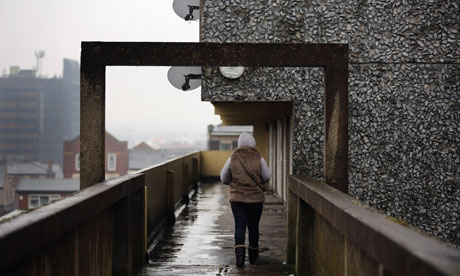
‘The costs of systemic failure have ­ballooned: long-term ­unemployment has ­increased by 146% since 2010.' Photograph: Christopher Furlong/Getty Images
The glee and class contempt with which Britain's Tory leaders have set about this week's onslaught on welfare has been an object lesson in the cynical venom at the heart of David Cameron's coalition. To force through cuts in the living standards of the poorest people in the country, demonisation and division have been the order of the day.

The Conservatives back workers not shirkers, the prime minister declared, as George Osborne pictured an honest shift worker passing the closed blinds of a skiver "sleeping off a life on benefits". Tory MP John Redwood insisted betting firms target deprived areas because the poor have too much "time on their hands".

Having softened up their audience with a press campaign of tales of "scroungers" and fraudsters, the Tories couldn't have been clearer about their purpose: to turn the low paid against the unemployed, just as they've tried to set private sector against public sector workers – and the Victorians separated the deserving from the undeserving poor.

Having drawn their toxic dividing line, the game has then been to put Labour on the wrong side, in the scroungers' camp. Hence the Conservative poster campaign in advance of yesterday's Commons vote on the coalition plan to make the first general real terms benefit cuts since the 1930s, declaring: "Today Labour are voting to increase benefits by more than workers' wages."

But the signs are that the skivers versus strivers talk has been backfiring. Even Cameron's dog-whistle spinman, Lynton Crosby, has been getting worried about the tone. So no wonder Nick Clegg, who claims to be on a journey to "the centre ground", wants to dissociate his Lib Dems from the nakedly nasty party.

As the impact of this year's benefit squeeze hits home, the backlash is likely to grow. Far from targeting "shirkers", the three-year benefit and tax credit cap doesn't even mainly target the unemployed. More than 60% of those who will lose out are in work.

Among the "scroungers" Cameron will be clamping down on are 300,000 nurses, 150,000 teachers and 40,000 soldiers. The real terms cut will hit the poorest, lone parents, the disabled and women hardest, according to the government's own assessment. It will increase inequality and help tip hundreds of thousands of children into poverty.

Just as 8,000 millionaires are about to get an average tax cut of over £107,000 and food banks are booming, the coalition is driving through a benefit squeeze that swamps the rise in tax allowances and targets the most vulnerable – already subject to a string of other cuts and new charges, from disability allowances to council tax.

Ministers claim the end of child benefit for the better-off in some way balances the attack on means-tested benefits. But not only is child benefit set apart in being paid overwhelmingly to women: like all universal benefits it helps to create a common social interest, can be offset with progressive taxation and becomes far easier to hack away at once restricted to the lower paid.

Of course, these cuts are being made in the name of deficit reduction. In reality, even if the logic of the coalition's austerity programme is accepted, there are plenty of other ways to find the savings made from capping benefit and tax credits (even the Blairite prince over the water, David Miliband, today denounced the cap and floated lower rate pension tax relief instead).

But austerity is failing and the underlying deficit growing. Even the IMF has now admitted it underestimated the disastrous impact of austerity programmes on growth and jobs. And cuts in the incomes of the poorest in any economy will only depress demand when the opposite is urgently needed – including to shrink the deficit.

The Tories feel safe attacking social security because a long-running media campaign has fostered a wildly inaccurate welfare mythology. On average, people think 27% of the welfare budget is claimed fraudulently, when the government's own estimate is 0.7% – or around £1bn, compared to an estimated £70bn worth of tax evasion. Most payments go to pensioners, and, far from soaring ahead of wages, unemployment benefit has fallen to 11% of average earnings, compared with 22% in 1979.

That's not to say there isn't a problem with welfare. It just isn't the one the political class and media mostly claim it is. Central to the sharp increase in social security costs over the past generation have been rising joblessness and stagnating wages. Since 1980, unemployment has averaged more than three times the postwar rate, while the proportion of those in low-paid jobs has doubled to over 20%.

In other words, welfare has become a prop for the failure of neoliberal capitalism to deliver jobs or decent wages. In Britain, the prop has partly taken the form of subsidising poverty pay through New Labour's tax credits, and exorbitant private rents through a massively expanded housing benefit bill.

That model has now crashed and the costs of systemic failure have ballooned: long-term unemployment has increased by 146% since 2010. What Cameron and Osborne are doing is to kick away props, not from bad employers and greedy landlords – the real welfare scroungers – but from the most deprived when they're needed most.

Labour is right to oppose real benefit cuts and support publicly backed work programmes, but wrong to endorse real terms cuts in public sector pay and private minimum wage schemes. If politicians are serious about cutting the welfare bill – instead of driving claimants deeper into poverty – there are obvious alternatives.

A crash council housebuilding programme, backed with northern European-style rent control, would slash the £21bn a year from the housing benefit bill. A living wage across the economy, combined with strengthened workplace rights, would cut the tax credit and other benefit bills. And both, combined with a public bank-driven national investment programme, would boost growth and shrink the dole bill.

Since this government will be doing nothing of the kind, expect instead the social unrest predicted by northern council leaders in response to plans for 30% cuts in local authority budgets. Polling suggests public opposition to the benefit squeeze will also spread as people find out more about who will bear the brunt. Even the Tories may come to regret their war on the poor.

An Obituary to The Welfare State, 1942-2013.

After decades of public illness, Beveridge's most famous offspring has died
For much of its short but celebrated life, the Welfare State was cherished by Britons. Instant public affection greeted its birth and even as it passed away peacefully yesterday morning, government ministers swore they would do all they could to keep it alive.

The Welfare State's huge appeal lay in its combination of simplicity and assurance. A safety net to catch those fallen on hard times, come rain or shine, boom or bust, it would be there for all those who had paid in.

Such universality allowed people to project on to it whatever they wished. Welfare State's father, the Liberal William Beveridge, described his offspring as "an attack on Want", one of the five evil giants that had to be slain in postwar Britain. But for future Labour prime minister Clement Attlee, "Social security to us can only mean socialism".

Yet there were critics. Indeed, it is thought that as late as yesterday, an unnamed twentysomething PPE graduate at Policy Exchange was revising a document entitled "What's Wrong with Welfare?" In the end, however, it was not a rightwing think tank that killed Welfare. The proximate cause of death was a change in child benefit from being available to all to a means-tested entitlement. That marked the end of one of the last remaining universal benefits, in turn causing a fatal injury to Welfare.
It is a testimony to Welfare's powerful charm that few immediately accepted its passing. Hours after its official death, bloggers continued to talk as if it were still alive, albeit under grave threat from the perfidious Tories.

But analysts later confirmed that the change to child benefit did indeed mark the death of the Welfare State as originally envisaged by Beveridge: a "contributory" system, where those who paid in during their working lives could count on financial help from the government when in need.

It expired peacefully on Monday, 7 January, just weeks after marking its 70th birthday.
The system had suffered many attacks over the years, from politicians talking of a "welfare trap", government means-testing, and frothy-mouthed journalists reporting isolated cases of benefit fraud.
For many would-be claimants, Welfare had become a ragged system where, however deserving or needy, they weren't poor enough to qualify for benefits, or the cash involved was too small to bother claiming.

Though David Cameron spoke of a "something for nothing" culture, the opposite was closer to the truth: Welfare had become a "nothing for something" system where taxpayers chipped in but got very little back.

This was very different from the scenes that greeted Welfare's birth in 1942. Then, the BBC broadcast in 22 different languages the details of Beveridge's social insurance scheme and the Manchester Guardian repeatedly acclaimed it as a "great plan" and a "big and fine thing". The public was enthusiastic, buying more than 635,000 copies of what was formally titled the "Report of the Inter-Departmental Committee on Social Insurance and Allied Services".

Yet the golden period of Welfare really came in the 60s and 70s as, thanks to the work of Barbara Castle, Jeff Rooker, Audrey Wise and others, pensions and allowances were made more generous and tied to typical earnings.

"If you were poor, you were far less behind than at any other time in contemporary British history," according to Richard Exell, a senior policy officer at the TUC and a campaigner on welfare issues for more than 30 years. "It produced a Britain that was one of the most equal societies in western Europe."

Just before Margaret Thatcher came to power, a single person out of work would get unemployment benefit worth almost 21% of average earnings; last year, jobseeker's allowance was nearly half that, amounting to just over 11%.

Welfare's big decline came in the 1980s, as the Conservatives moved more benefits from available to all to on offer only to the poor. This was justified as making public spending more efficient.

But, according to a famous and much quoted study by Walter Korpi and Joakim Palme, such means-testing is far less effective and more expensive than universal benefits. In a study of 18 rich countries, the academics found that targetting benefits at the poorest usually generated resentment among those just above – and led to smaller entitlements.

This "paradox of redistribution" was certainly observable in Britain, where Welfare retained its status as one of the 20th century's most exalted creations, even while those claiming benefits were treated with ever greater contempt.

"If you look at unemployment and sickness benefit as a proportion of average earnings, then Britain has one of the meanest welfare systems in Europe," says Palme. "Worse than Greece, Bulgaria or Romania."

Some of that same meanness can be seen in the way Welfare was discussed as it moved into its sixth and seventh decades. It was no longer about social security but benefits. Those who received them were no longer unfortunate but "slackers", as Iain Duncan Smith referred to them. A recent study by Declan Gaffney, Ben Baumberg and Kate Bell of 6,600 national newspaper articles on Welfare published between 1995 and 2011 found 29% referred to benefit fraud. The government's own estimate of fraud is that it is less than 1% across all benefit cases.

The death of Welfare does not mean an end to all benefit spending. Instead, it is outlived by its predecessor, Poor Relief, in which only the very poorest will receive government cash. Analysts are unsure about the repercussions.

"I'm not aware of any country that's ever had a combination of Victorian-style poor laws and parliamentary democracy," says Gaffney.

Instead of a book of condolences, there will be a special edition of the Guardian's letters page. In separate tributes, BBC4 will air some respectful but little-watched documentaries; there will also be a truly unbearable edition of The Moral Maze.

Monday, 7 January 2013

Google shows China the white flag of surrender


By   Last updated: January 7th, 2013 

Google's message to Beijing

Six months ago, Google loudly trumpeted a brave stand against censorship in China. Now it's quietly committed an act of cowardice. In May 2012, it announced an anti-censorship feature – under the pretext of improving search quality – with a public blog post. In December, it got rid of the measure which notified Chinese users when keywords they were searching for would trigger the country's Great Firewall content blocking system – without telling its users. The switch-off only came to light thanks to the vigilance of Greatfire.org, a not-for-profit organisation that monitors censorship in China. The group called the move "self-censorship" but it's worse than that – it's a white flag of surrender.

From the moment Google introduced the feature, the Chinese internet censors fought back. But the ingenuity of Google's engineers got round each block until they finally embedded the entire function in HTML on Google's start page. That meant to block the notifications, China would have to block Google altogether. Inevitably, the search engine did end up blocked in its entirety more than once before the feature been activated. Gmail was also subject to blocks and a noticeable slowdown in performance. In the stand-off, Google blinked first. At a time when the Chinese government is strengthening its internet censorship measures, the firm has effectively admitted it just can't beat them and is no longer willing to try.

Though Google's share of search in China is under five per cent, that still amounts to more than 25 million users, and despite moving its services to Hong Kong in 2010, it won't abandon that market. Reports in recent weeks have suggested that it's on the cusp of a partnership with local search company, Qihoo 360, to take on the dominant player, Baidu. With that in mind, it seems like a remarkable coincidence that it has now decided to throw in the towel and drop the notifications. The company's unofficial mantra – "don't be evil" – becomes more threadbare with ever year.

While it's arguable that notifying users when they were about to be censored was a small thing, it put Google on the right side of the fight for free expression. By ceasing to indicate when its results are interfered with by the Great Firewall, Google has made itself complicit in the process. The company's desire to maintain a foothold in the Chinese market outweighs its highfalutin' rhetoric on the openness of the web and freedom of speech. China's censors must be delighted that Google has silenced itself.

Sunday, 6 January 2013

Needed: An exit policy for bad businessmen

S A Aiyer

Vijay Mallya has not paid employees of Kingfisher Airlines for months, and has defaulted on thousands of crores due to suppliers and creditors. Yet he has just donated three kilos of gold, worth almost one crore, to the Tirupathi temple. In August, he offered 80-kilo gold plated doors to the Kukke Subramanya temple in Karnataka. Possibly he believes that the gods can be bought off in ways that employees and creditors cannot.

How can a man who owes enormous sums to employees and creditors be free to throw gold around like small change? If there were any justice, surely the gold and golden doors should be seized from the temples and handed over to the employees and creditors. Surely they should have first right to Mallya’s assets.

After two decades of economic reform , we have not yet evolved rules that facilitate the exit of poor managements before they ruin a company beyond redemption. Kingfisher Airlines has been ground to the dust by Mallya, a liquor baron who should never have entered this space.

A free-market economy is not just a device giving owners the freedom to sack employees. It is one where creditors and employees have the right to seize a company defaulting on dues, and sack the management. The managing shareholder or promoter is only one of many stakeholders. If he cannot meet his obligations to other stakeholders , they should oust him in a true free market economy. In India, alas, our unreformed regulations and procedures leave promoters in control no matter how big a mess they make.

In the US, creditors can quickly seize a company that defaults on dues, and reorganize or sell it to a new owner . The owner can get temporary protection from creditors through Chapter 11 proceedings. In this, a judge determines whether the company is so far gone that it must be liquidated, or whether it can be saved through mutual sacrifices by creditors, employees and owners. In the process, the judge can change the owner. So, often workers survive bankruptcy proceedings , but the owner does not. That is what we should aim for in India too: an exit policy for incompetent, defaulting owners.

Kingfisher Airlines never made a profit, not even in the boom years when its rival airlines were profitable. Creditors should have moved in years ago when it became clear that the skills of a liquor baron were irrelevant for an airline. But in India creditors cannot quickly seize a company, least of all when the owner has political clout (as in Mallya’s case).

In the old licence permit raj, banks and financial institutions had to support existing managements and keep rescuing them. This has not changed despite the 1991 reforms. Banks have to keep throwing good money after bad.

Today Kingfisher is so worthless that it no longer makes sense to seize it and find a buyer. SBI Chairman Pratip Chaudhuri estimates that rehabilitating Kingfisher will cost a billion dollars. Nobody will do so — a new airline can be started for maybe just $100 million. Kingfisher has just lost its flying licence. Mallya’s hopes of being rescued by Etihad Airways of Abu Dhabi look like pure fantasy.

Even if it makes no sense to seize the airline today, why not seize his liquor business? Why not seize his prize luxury possessions, ranging from paintings to yachts or jets? Why not take over his cricket team, Royal Challengers ? Why not take over his football team Mohun Bagan, and his Formula 1 racing team Force India? Why is he allowed to keep all these, along with gold that he donates to temples, when he says he doesn’t have enough to pay employees or suppliers? He has given personal guarantees to banks: why are these not being enforced?

Mallya can be congratulated on one thing. Service was top-class in Kingfisher , and the airline gained a good reputation for quality. Had the airline been seized early on, it could definitely have been sold to a new owner. However , its reputation has steadily fallen with its continuing financial crisis, leading to cancelled flights and official grounding.

I constantly hear that India has gone in for neo-liberal policies. That’s pure rubbish. Neo-liberalism would have given employees and creditors the right to quickly seize and sell a company that cannot meet its obligations. The problem is not liberalism but the continuing old illiberalism that keeps promoters in charge, forcing other stakeholders to take a hit. Temples and religious trusts can keep enormous donations from defaulters instead of handing them over to others who, in all justice, should have the first right to such money or gold. This area desperately needs reform.

Saturday, 5 January 2013

Barack Obama and the 'empathy deficit'


The US president claims the 'empathy deficit' is a more pressing problem than the federal deficit, but empathy may be merely a product of changing scientific fashions
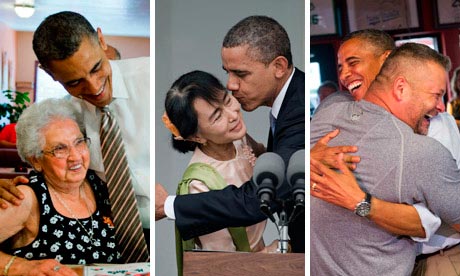
Barack Obama hugs composite
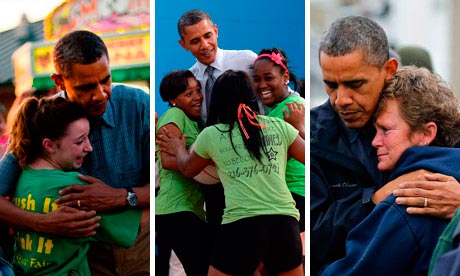
Barack Obama at the Iowa state fair; meeting girls from the Boys and Girls Club of Cleveland; and with North Point Marina owner Donna Vanzant after Hurricane Sandy. Photograph: Jim Watson/Jewel Samad/Larry Downing/AFP/Getty/Reuters
In 2011, researchers at the University of Chicago conducted a simple experiment to ascertain whether a rat would release another rat from a cage without being given a reward. The answer was yes. After several sessions, the rats learned intentionally and quickly to open the restrainer and release the caged rats. The rats also repeated the behaviour even when they were denied the reward of reunion. Even more astonishing, when the rats were presented with two cages, one containing a rat, the other chocolate, they chose to open both cages and "typically shared the chocolate".
For the researchers, the conclusion was inescapable: the rats were displaying empathy. Announcing the results in Science, the lead researcher, Peggy Mason, explained: "There is nothing in it except whatever feeling they get from helping another individual."
Neuroscientists are not the only ones to see empathy – or its absence – everywhere these days. According to Barack Obama, the "empathy deficit" is a more pressing political problem for America than the federal deficit and holds the key to the success of his second term as he seeks to build bridges with Republicans and tackle the wave of horrific shootings that last year disfigured American communities from Colorado to Connecticut. On this side of the Atlantic, meanwhile, George Osborne's enthusiasm for welfare cuts is explained by the coalition cabinet's "lack of empathy" for the poor.
But can the solution to violence, cruelty and the divide between liberals and conservatives really be a matter of promoting a trait that we appear to share with rats? And are scientists and politicians talking about the same thing when they invoke empathy in these different experimental and social contexts?
One of the problems with using the same word to describe the pro-social behaviour of rats and similar behaviour observed in humans is that people are infinitely more complex and reflective than rodents. It also confuses the different psychological and philosophical meanings of empathy.
Thus modern-day neuroscientists and social psychologists, drawing on the Scottish Enlightenment philosopher Adam Smith's notion of a "moral sentiment", have come to regard empathy as intrinsically pro-social. When we empathise, they argue, we mirror the distress of an "other" and, unless our brains are damaged or we are developmentally abnormal, we are moved to alleviate their suffering.
The result is that, like other modern moral sentiments such as trust and altruism, empathy is increasingly seen as a "social glue" and the evolutionary basis of human co-operation. But what if this notion reflects nothing more than the current vogue for connectedness that permeates the post-Darwinian sciences and our internet-obsessed times? What if, instead of empathy being the basis of modern social life, it is merely a product of changing scientific fashions?
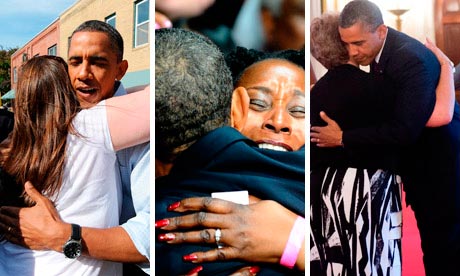
Obama hugs composite Barack Obama in Boone, North Carolina; at a campaign event in Chicago; and with Rose Mary Sabo-Brown, who received a medal of honour for her late husband, US army specialist Leslie H Sabo, Jr. Photograph: Jewel Samad/Saul Loeb/AFP/Getty
Although empathy has become something of a political buzzword, it is surprisingly difficult to define. Moreover, a survey of the scientific and historical literature reveals that its meaning has shifted significantly over time.
The word first appeared, misspelled as enpathy, in a 1909 lecture by the Cornell psychologist Edward B Titchener, and in a translation credited to the Cambridge philosopher and psychologist James Ward the same year. Inspired by the German aesthetic term Einfühlung, meaning "feeling into", Titchener compared empathy to an enlivening process whereby an art object evoked actual or incipient bodily movements and accompanying emotions in the viewer.
This made it very different from the far older term sympathy, or Victorian notions of the "sympathetic imagination", which novelists such as George Eliot considered a cognitive act in which readers learned to extend themselves into the experiences, motives and emotions of fictional characters.
For empathy to become more like sympathy, it first had to transit from aesthetics to interpersonal psychology and the new brain sciences. The key shift came in 1992 when a group of Italian researchers observed neurons in macaque monkeys that fired both when they picked up a raisin and when they saw a person pick up a raisin. A few years later, similar "mirror neurons" were identified in humans.
Since then, neuroscience has greatly expanded our understanding of the "empathy circuit". The key brain regions appear to be the amygdala, which is involved in the regulation of emotional learning and the reading of emotional expressions, and the anterior cingulate cortex (ACC), which activates when people experience their own pain or observe others in pain. Another important area is the anterior insula (AI), which lights up in response both to one's own pain and a loved one's pain, as well as to other emotional elicitors, such as disgusting tastes and images.
But perhaps the most important region of all is the medial prefrontal cortex (MPC), also known as the prefrontal lobe. A "hub" for social information processing, the MPC modulates self-awareness and our awareness of other people's thoughts and feelings. It also appears to play an important role in "marking" certain emotional experiences so as to provide us with emotional shortcuts to actions that are positive and therefore likely to be rewarding.
The neuroscientists Antonio and Hanna Damasio have shown that patients with damage to the ventromedial part of the MPC – the section closely associated with self-awareness – typically have great trouble learning from previous emotional experiences or making decisions, seeing equal merit in every course of action. Such patients also show less of a change in their heartbeat and other autonomic responses when shown distressing images. In this respect, their response mirrors that of sociopaths who may have suffered no medical trauma.
For some writers, these discoveries show that empathy is hard-wired and that we are primed for morality, hence the writer Jeremy Rifkin's claim that these circuits are the source of humanity's desire for "intimate participation and companionship".
However, as Simon Baron-Cohen, an expert on autism spectrum disorders, has shown, this is frequently not the case. Psychopaths, for instance, tend to be very good at reading other people's emotions while remaining emotionally unmoved themselves. Adolescents with a history of violence and diagnoses of "conduct disorder" exhibit similar traits.
By contrast, people with autism and Asperger's syndrome are very poor at reading non-verbal emotional signals and other social clues, but, once they become aware of how others are feeling, they are capable of sharing those emotions intensely. The result is that, while both psychopaths and people with Asperger's could both be characterised as having "zero degrees of empathy, only psychopaths are capable of extreme cruelty.
Where Baron-Cohen and others run into difficulty is in accounting for emotions such as schadenfreude. Far from being a form of counter-empathy, schadenfreude appears to involve empathically mirroring another person's distress and taking pleasure in that distress at the same time. Indeed, in role-playing games involving "altruistic punishment", brain researchers have found that both the ACC and the dorsal striatum – the brain's pleasure/reward centre – are activated.
Neuroscientific approaches also tend to give too little weight to the cognitive dimensions of empathy. A horrific illustration of this was the cold-blooded shooting of 69 Norwegian Labour activists by Anders Behring Breivik in 2011. At his trial, Breivik argued that he was fully capable of empathy but had used a "meditation technique" to override his feelings. "If you are going to be capable of executing such a bloody and horrendous operation you need to work on your mind, your psyche, for years," he explained.
As the German historian of emotions Ute Frevert puts it: "The fact that human beings are naturally equipped to feel what others feel does not mean that they always do so. They might just turn away and act indifferent."
So how can we make it less likely that people such as Breivik or Adam Lanza, the 20-year-old responsible for the horrific shooting in December in Newtown, Connecticut, commit acts of mass murder in future?
Barack Obama hugs composite Barack Obama at a cafe in Pueblo, Colorado; with Aung San Suu Kyi at her residence in Yangon; and with Scott Van Duzer, owner of Big Apple Pizza in Florida. Photograph: Jim Watson/Nicolas Asfouri/Saul Loeb/AFP/Getty Images
The most common answer is by fostering greater perspective-taking. Decades of scientific research show that people are kinder to those they view as human beings. The reason is that, when we make the imaginative effort to step into the shoes of another person and see things from their perspective, we become less capable of ignoring their suffering. Indeed,brain imaging studies of Buddhists who use meditation exercises to contemplate compassion on a daily basis show increased activation of the amygdala and other parts of the brain's empathy circuit.
Novels, television and the internet can also foster greater empathy by exposing us to the perspectives of people whose lives we would not otherwise consider. This is particularly the case when empathy is married with "humanitarian reason" – the force that Harvard psychologist Steven Pinker credits for the steady decline in levels of societal violence since the Enlightenment.
However, as the response last year to Invisible Children's video about the Ugandan warlord Joseph Kony showed, this sort of empathy can be short-lived. Yes, nearly 100 million people shared Invisible Children's video on YouTube, but the outcry against Kony was temporary and people quickly found new objects for their indignation.
Moreover, far from being a guide to what is right, empathy often leads us astray, as when judges go easier on white-collar criminals who share their social background, which is why we frequently invoke other values and principles to balance such tendencies. This is precisely the argument made by Jonathan Haidt in his book The Righteous Mind: Why Good People Are Divided by Politics and Religion. Haidt maintains that empathy, or what he labels the "harm/care" module, is just one of several emotional dispositions that undergird our moral outlook, the others being fairness, liberty, loyalty, authority and purity/sanctity. The difference between Democrats and Republicans is that, while liberals focus almost entirely on care and fairness, conservatives tend to give equal weight to all six dispositions.
In theory, this should be good news for Osborne as he seeks to counter perceptions that his austerity measures are "uncaring", and even better news for Republicans, especially as something like 42% of the American electorate self-identify as conservative. However, asObama's response to Mitt Romney's unfortunate remarks about the "47%" underlined, the perceived absence of empathy is a powerful weapon with which to browbeat a political opponent. Perhaps this is why, rather than defending his comments about the 47% on traditional conservative grounds, Romney spent the closing weeks of last year's campaign desperately trying to persuade voters that he was just as compassionate as Obama.
Even before hurricane Sandy upset the candidates' campaign plans, however, that was not an argument that carried much weight with the undecideds and, following the pictures ofObama embracing the victims of the storm damage in New Jersey, it was pretty much game, set and match to the incumbent.
Indeed, if there is a lesson to be drawn from the 2012 presidential election, it is that empathy is here to stay and that where candidates once talked about "the economy, stupid" they would now be well-advised to use a different E-word.

Altruistic punishers: when it feels good to act cruelly

Empathy is not the only "moral emotion" that is enjoying a renaissance thanks to social neuroscience. Scientists have also been probing the biological processes involved in trust and altruism.
One theory is that when we empathise oxytocin and other chemicals flood the brain's pleasure centres, resulting in a "warm glow" effect. Similar surges occur when people are asked to play economic exchange games designed to elicit trust.
According to neuroeconomists such as Paul Zak, this suggests that empathy and trust are two sides of the same adaptive response – the idea being that our brains have evolved so that it literally feels good to empathise and to trust people.
Primatologists such as Frans de Waal believe that altruism may be the result of similar selection pressures. Spontaneous assistance has long been observed in apes, hence the adoption of orphans by wild male chimpanzees who may devote years of costly care to unrelated juveniles. And, as the Chicago experiment illustrates, rats also exhibit similar altruistic behaviour without their altruism being repaid.
In the case of humans, altruism is more complicated as over the course of a lifetime we will co-operate with thousands of genetically unrelated strangers with whom we are unlikely to interact again. In such societies, the advantages of forming a good reputation are minimal. At the same time, it is easy for unscrupulous individuals, known as "free-riders", to exploit the "trusting" instincts of the majority.
To explains this, neuroeconomists posit that a unique form of co-operation has evolved in human societies in which social norms are learned, co-operators are altruistically rewarded and free-riders are altruistically punished.
This theory is supported by studies of economic role-playing games in which punishment is used to motivate two players to co-operate and a failure to show and reciprocate altruism leaves both players worse off.
However, such games also pose a problem for the notion that humans are hard-wired for pro-sociality and morality as brain scans of altruisitic punishers show that they both empathise with the free-rider and take an active pleasure in his or her punishment. In other words, as anyone who has experienced schadenfreude knows, sometimes it feels good to act cruelly.