Search This Blog

Wednesday, 7 June 2023

Externalities and Taxes - What to do when the interests of the individual and society do not coincide?

 From The Economist

LOUD conversation in a train carriage that makes concentration impossible for fellow-passengers. A farmer spraying weedkiller that destroys his neighbour’s crop. Motorists whose idling cars spew fumes into the air, polluting the atmosphere for everyone. Such behaviour might be considered thoughtless, anti-social or even immoral. For economists these spillovers are a problem to be solved.

Markets are supposed to organise activity in a way that leaves everyone better off. But the interests of those directly involved, and of wider society, do not always coincide. Left to their own devices, boors may ignore travellers’ desire for peace and quiet; farmers the impact of weedkiller on the crops of others; motorists the effect of their emissions. In all of these cases, the active parties are doing well, but bystanders are not. Market prices—of rail tickets, weedkiller or petrol—do not take these wider costs, or “externalities”, into account.

The examples so far are the negative sort of externality. Others are positive. Melodious music could improve everyone’s commute, for example; a new road may benefit communities by more than a private investor would take into account. Still others are more properly known as “internalities”. These are the overlooked costs people inflict on their future selves, such as when they smoke, or scoff so many sugary snacks that their health suffers.

The first to lay out the idea of externalities was Alfred Marshall, a British economist. But it was one of his students at Cambridge University who became famous for his work on the problem. Born in 1877 on the Isle of Wight, Arthur Pigou cut a scruffy figure on campus. He was uncomfortable with strangers, but intellectually brilliant. Marshall championed him and with the older man’s support, Pigou succeeded him to become head of the economics faculty when he was just 30 years old.

In 1920 Pigou published “The Economics of Welfare”, a dense book that outlined his vision of economics as a toolkit for improving the lives of the poor. Externalities, where “self-interest will not…tend to make the national dividend a maximum”, were central to his theme.

Although Pigou sprinkled his analysis with examples that would have appealed to posh students, such as his concern for those whose land might be overrun by rabbits from a neighbouring field, others reflected graver problems. He claimed that chimney smoke in London meant that there was only 12% as much sunlight as was astronomically possible. Such pollution imposed huge “uncharged” costs on communities, in the form of dirty clothes and vegetables, and the need for expensive artificial light. If markets worked properly, people would invest more in smoke-prevention devices, he thought.

Pigou was open to different ways of tackling externalities. Some things should be regulated—he scoffed at the idea that the invisible hand could guide property speculators towards creating a well-planned town. Other activities ought simply to be banned. No amount of “deceptive activity”—adulterating food, for example—could generate economic benefits, he reckoned.

But he saw the most obvious forms of intervention as “bounties and taxes”. These measures would use prices to restore market perfection and avoid strangling people with red tape. Seeing that producers and sellers of “intoxicants” did not have to pay for the prisons and policemen associated with the rowdiness they caused, for example, he recommended a tax on booze. Pricier kegs should deter some drinkers; the others will pay towards the social costs they inflict.

This type of intervention is now known as a Pigouvian tax. The idea is not just ubiquitous in economics courses; it is also a favourite of policymakers. The world is littered with apparently externality-busting taxes. The French government imposes a noise tax on aircraft at its nine busiest airports. Levies on drivers to counterbalance the externalities of congestion and pollution are common in the Western world. Taxes to fix internalities, like those on tobacco, are pervasive, too. Britain will join other governments in imposing a levy on unhealthy sugary drinks starting next year.

Pigouvian taxes are also a big part of the policy debate over global warming. Finland and Denmark have had a carbon tax since the early 1990s; British Columbia, a Canadian province, since 2008; and Chile and Mexico since 2014. By using prices as signals, a tax should encourage people and companies to lower their carbon emissions more efficiently than a regulator could by diktat. If everyone faces the same tax, those who find it easiest to lower their emissions ought to lower them the most.

Such measures do change behaviour. A tax on plastic bags in Ireland, for example, cut their use by over 90% (with some unfortunate side-effects of its own, as thefts of baskets and trolleys rose). Three years after a charge was introduced on driving in central London, congestion inside the zone had fallen by a quarter. British Columbia’s carbon tax reduced fuel consumption and greenhouse-gas emissions by an estimated 5-15%. And experience with tobacco taxes suggests that they discourage smoking, as long as they are high and smuggled substitutes are hard to find.

Champions of Pigouvian taxes say that they generate a “double dividend”. As well as creating social benefits by pricing in harm, they raise revenues that can be used to lower taxes elsewhere. The Finnish carbon tax was part of a move away from taxes on labour, for example; if taxes must discourage something, better that it be pollution than work. In Denmark the tax partly funds pension contributions.

Pigou flies

Even as policymakers have embraced Pigou’s idea, however, its flaws, both theoretical and practical, have been scrutinised. Economists have picked holes in the theory. One major objection is the incompleteness of the framework, since it holds everything else in the economy fixed. The impact of a Pigouvian tax will depend on the level of competition in the market it is affecting, for example. If a monopoly is already using its power to reduce supply of its products, a new tax may not do any extra good. And if a dominant drinks firm absorbs the cost of an alcohol tax rather than passes it on, then it may not influence the rowdy. (A similar criticism applies to the idea of the double dividend: taxes on labour could cause people to work less than they otherwise might, but if an environmental tax raises the cost of things people spend their income on it might also have the effect of deterring work.)

Another assault on Pigou’s idea came from Ronald Coase, an economist at the University of Chicago (whose theory of the firm was the subject of the first brief in this series). Coase considered externalities as a problem of ill-defined property rights. If it were feasible to assign such rights properly, people could be left to bargain their way to a good solution without the need for a heavy-handed tax. Coase used the example of a confectioner, disturbing a quiet doctor working next door with his noisy machinery. Solving the conflict with a tax would make less sense than the two neighbours bargaining their way to a solution. The law could assign the right to be noisy to the sweet-maker, and if worthwhile, the doctor could pay him to be quiet.

In most cases, the sheer hassle of haggling would render this unrealistic, a problem that Coase was the first to admit. But his deeper point stands. Before charging in with a corrective tax, first think about which institutions and laws currently in place could fix things. Coase pointed out that laws against nuisance could help fix the problem of rabbits ravaging the land; quiet carriages today assign passengers to places according to their noise preferences.

Others reject Pigou’s approach on moral grounds. Michael Sandel, a political philosopher at Harvard University, has worried that relying on prices and markets to fix the world’s problems can end up legitimising bad behaviour. When in 1998 one school in Haifa tried to encourage parents to pick their children up on time by fining them, tardy pickups increased. It turned out that parental guilt was a more effective deterrent than cash; making payments seems to have assuaged the guilt.

Besides these more theoretical qualms about Pigouvian taxes, policymakers encounter all manner of practical ones. Pigou himself admitted that his prescriptions were vague; in “The Economics of Welfare”, though he believed taxes on damaging industries could benefit society, he did not say which ones. Nor did he spell out in much detail how to set the level of the tax.

Prices in the real world are no help; their failure to incorporate social costs is the problem that needs to be solved. Getting people to reveal the precise cost to them of something like clogged roads is asking a lot. In areas like these, policymakers have had to settle on a mixture of pragmatism and public acceptability. London’s initial £5 ($8) fee for driving into its city centre was suspiciously round for a sum meant to reflect the social cost of a trip.

Inevitably, a desire to raise revenue also plays a role. It would be nice to believe that politicians set Pigouvian taxes merely in order to price in an externality, but the evidence, and common sense, suggests otherwise. Research may have guided the initial level of a British landfill tax, at £7 a tonne in 1996. But other considerations may have boosted it to £40 a tonne in 2009, and thence to £80 a tonne in 2014.

Things become even harder when it comes to divining the social cost of carbon emissions. Economists have diligently poked gigantic models of the global economy to calculate the relationship between temperature and GDP. But such exercises inevitably rely on heroic assumptions. And putting a dollar number on environmental Armageddon is an ethical question, as well as a technical one, relying as it does on such judgments as how to value unborn generations. The span of estimates of the economic loss to humanity from carbon emissions is unhelpfully wide as a result, ranging from around $30 to $400 a tonne.

It’s the politics, stupid

The question of where Pigouvian taxes fall is also tricky. A common gripe is that they are regressive, punishing poorer people, who, for example, smoke more and are less able to cope with rises in heating costs. An economist might shrug: the whole point is to raise the price for whoever is generating the externality. A politician cannot afford to be so hard-hearted. When Australia introduced a version of a carbon tax in 2012, more than half of the money ended up being given back to pensioners and poorer households to help with energy costs. The tax still sharpened incentives, the handouts softened the pain.

A tax is also hard to direct very precisely at the worst offenders. Binge-drinking accounts for 77% of the costs of excessive alcohol use, as measured by lost workplace productivity and extra health-care costs, for example, but less than a fifth of Americans report drinking to excess in any one month. Economists might like to charge someone’s 12th pint of beer at a higher rate than their first, but implementing that would be a nightmare.

Globalisation piles on complications. A domestic carbon tax could encourage people to switch towards imports, or hurt the competitiveness of companies’ exports, possibly even encouraging them to relocate. One solution would be to apply a tax on the carbon content of imports and refund the tax to companies on their exports, as the European Union is doing for cement. But this would be fiendishly complicated to implement across the economy. A global harmonised tax on carbon is the stuff of economists’ dreams, and set to remain so.

So, Pigou handed economists a problem and a solution, elegant in theory but tricky in practice. Politics and policymaking are both harder than the blackboard scribblings of theoreticians. He was sure, however, that the effort was worthwhile. Economics, he said, was an instrument “for the bettering of human life.”

Governments can borrow more than was once believed

 From The Economist


If people know one thing about the thinking of John Maynard Keynes, who more or less founded macroeconomics, it is that he was in favour of governments borrowing lots of money, at least under some circumstances. The “New Keynesian” orthodoxy that evolved from his work in the second half of the 20th century was much less liberal in this regard. It put less faith in borrowing’s purported benefits, and had greater concerns about its dangers.

The 2010s saw the pendulum swinging back. In large part because they feel bereft of other options, many governments have borrowed heavily—and as yet they have paid no dreadful price. Can this go on?

Keynes’s ideas about borrowing reflected his view of recessions—and in particular, the Depression of the 1930s, during which he wrote “The General Theory of Employment, Interest and Money”—as vicious circles. Recessions come about when the economy is hit by a sudden rise in the desire to save money; such desires lead to lower spending, which leads to more unemployment, which leads to yet less spending, and so on. If the government borrows enough to offset lower private spending with increased spending of its own the circle can be broken—or stopped from getting going.

Most early Keynesians assumed that the deficits caused by borrowing to stimulate the economy would be temporary; after borrowing more than they raised in taxes in order to provide a fiscal stimulus, governments would be able to raise more in taxes, and thus pay off their debts, in the good times that followed. Some, though, suspected that the structure of the advanced economies of the 1930s might mean they were low on demand even in the good times, and that a permanent deficit might be necessary to keep the economy going at a rate that minimised unemployment.

Debates about the proper role of fiscal stimulus became less urgent in the decades after the second world war, as robust economic growth eased worries that demobilisation might bring a return of Depression-like conditions. Faith in Keynesian orthodoxy was further shaken by the economic developments of the 1970s and 1980s. Some economists began to argue that the public would eventually adjust to stimulus measures in ways that weakened their impact. Robert Barro, a leading proponent of this “rational expectations” approach, argued that a fiscal stimulus paid for by borrowing would see households spend less and save more, because they would know that tax rises were coming. This decreased private spending would then offset the increased public spending.

Linked to, but broader than, such academic questions was the fact that, by the 1970s, the ways in which Keynesian governments had been running their economies seemed to have failed. A trifecta of slowing growth, soaring inflation and high unemployment brought the idea of governments being able to avoid recessions through stimulus into disrepute.

The new orthodoxy was that governments should instead rely on monetary policy. When the economy slowed, monetary policy would loosen, making it cheaper to borrow, thus encouraging people to spend. Government borrowing, for its part, should be kept on a short leash. If governments pushed up their debt-to-gdp ratio, markets would become unwilling to lend to them, forcing up interest rates willy-nilly. The usefulness of monetary policy demanded a sober approach to fiscal policy.

The 2000s, however, saw a problem with this approach beginning to become plain. From the 1980s, interest rates had been in a long, steady decline. By the 2000s they had reached historical lows. Low rates made it harder for central banks to stimulate economies by cutting them further: there was not room to do so. The global financial crisis pushed rates around the world to near zero.

Governments experimented with more radical monetary policy, such as the form of money printing known as “quantitative easing”. Their economies continued to underperform. There seemed to be room for new thinking, and a revamped Keynesianism sought to provide it. In 2012 Larry Summers, a former American treasury secretary, and Brad DeLong, an economist, suggested a large Keynesian stimulus based on borrowing. Thanks to low interest rates, the gains it would provide by boosting the growth rate of gdp might outstrip the cost of financing the debt taken on.

In the following year Mr Summers followed some 1930s Keynesians, notably Alvin Hansen, in suggesting that borrowing in order to stimulate might be needed not just as an occasional pick-me-up, but as a permanent part of the economy. Hansen had argued that an ageing population and a low rate of technological innovation produced a long-term lack of demand which he called “secular stagnation”. Mr Summers took an updated but similar view. Part of his backing for this idea was that the long-term decline of interest rates showed a persistent lack of demand.

Way down we go

Sceptics insisted that such borrowing would drive interest rates up. But as the years went by and interest rates remained stubbornly low, the notion of borrowing for fiscal stimulus started to seem more tenable, even attractive. Very low interest rates mean that economies can grow faster than debt repayments do. Negative interest rates, which have been seen in some countries over recent years, mean that the amount to repay will actually be less than the amount borrowed.

Adherents of “Modern Monetary Theory” (mmt) went further than this, arguing that governments should borrow as much as was needed to achieve full employment while central banks focused simply on keeping interest rates low—a course of action which orthodox economics would expect to promptly drive up inflation. Currently mmt remains on the fringes of academic economics. But it has been embraced by some left-wing politicians; Senator Bernie Sanders, the candidate beaten by Joe Biden for the Democratic nomination, counted an mmt enthusiast, Stephanie Kelton of Stony Brook University, among his chief advisers.

The shift in mainstream thinking on debt helps explain why the huge amounts of government borrowing with which the world has responded to the pandemic has not worried economists. But now that governments have, if only for want of an alternative, become more willing to take on debt, what should be their limit? For an empirical answer, it is tempting to consider Japan, where the ratio of net public debt to gdp stood at 154% prior to the pandemic.

If Japan can continue to borrow with that level of debt, it might seem that countries with lower levels should also be fine. But this ignores the fact that if interest rates stagger back from the floor, burdens a lot smaller than Japan’s might become perilously unstable. There is no immediate account for why this might be likely. But that does not mean it will not happen. And governments need to remember that debt taken on at one interest rate may, if market sentiment changes, need to be rolled over at a much higher one in times to come.

Given this background risk, governments ideally ought to make sure that new borrowing is doing things that will provide a lasting good, greater than the final cost of the borrowing. If money is very cheap and likely to remain so, this will look like a fairly low bar. But there are opportunity costs to consider. If private borrowing has a high return and public borrowing crowds it out, then the public borrowing either needs to show a similarly high return or it needs to be cut back.

At the moment private returns remain well above the cost of new borrowing in most places: in America, for instance, the earnings of corporations are generally high relative to the replacement cost of their capital. This makes it conceivable that resources used by the government would generate a greater level of welfare if they were instead mobilised by private firms.

But it does not currently look as though they would be. Despite the seemingly high returns to new capital, private investment in America is quite low. This suggests either that there are other obstacles to new investment, or that the high returns on investment reflect an insufficient level of competition rather than highly productive companies.

Both possibilities call for government remedy: either action aimed at identifying and dismantling the obstacles to investment, or at increasing competition. And until such actions produce greater investment or lower returns, the case for government borrowing remains quite strong. This is even more the case for public investments which might in themselves encourage the private sector to match them—“crowding in”, as opposed to crowding out. Investment in a much better electricity grid, for example, could increase investment in zero-carbon generation.

In the long run, the way to avoid having to borrow to the hilt is to implement structural changes which will revive what does seem to be chronically weak demand. Unfortunately, there is no consensus over why demand is weak. Is technological progress, outside the realm of computers and communications, not what it was? Is inequality putting money into the hands of the rich, who are less likely to spend their next dollar, rather than the poor, who are more likely? Are volatile financial markets encouraging precautionary saving both by firms and governments? Is the ageing of the population at the root of it all?

Making people younger is not a viable policy option. But the volatility of markets might be addressed by regulation, and a lack of competition by antitrust actions. If inequality is at the root, redistribution (or its jargony cousin, predistribution) could perk up demand. Dealing with the structural problems constraining demand would probably push up interest rates, creating difficulties for those governments which have already accumulated large debt piles. But stronger underlying growth would subsequently reduce the need for further government borrowing, raise gdp and boost tax revenues. In principle that would make it easier for governments in such situations to pay down their increased debt.

The new consensus that government borrowing and spending is indeed an important part of stabilising an economy, and that interest rates are generally low enough to allow governments to manage this task at minimal cost, represents progress. Government borrowing is badly needed to deal with many of the world’s current woes. But this consensus should ideally include two additional planks: that the quality of deficit-spending still matters, and that governments should prepare for the possibility of an eventual change in the global interest-rate environment—much as 2020 has shown that you should prepare for any low-probability disaster. 

Thursday, 1 June 2023

The backlash: how slavery research came under fire

More and more institutions are commissioning investigations into their historical links to slavery – but the fallout at one Cambridge college suggests these projects are meeting growing resistance writes  Samira Shackle in The Guardian 

When the historian Nicolas Bell-Romero started a job researching Cambridge University’s past links to transatlantic slavery three years ago, he did not expect to be pilloried in the national press by anonymous dons as “a ‘woke activist’ with an agenda”. Before his work was even published, it would spark a bitter conflict at the university – with accusations of bullying and censorship that were quickly picked up by rightwing papers as a warning about “fanatical” scholars tarnishing Britain’s history.

Bell-Romero, originally from Australia, had recently finished a PhD at Cambridge. He was at the start of his academic career and eager to prove himself. This was the ideal post-doctoral position: a chance to dig into the university’s archives to explore faculty and alumni links to slavery, and whether these links had translated into profit for Cambridge. It was the kind of work that, Bell-Romero said, “seems boring to the layperson” – spending days immersed in dusty archives and logbooks, exploring 18th- and 19th-century financial records. But as a historian, it was thrilling. It offered a chance to make a genuinely fresh contribution to burgeoning research about Britain’s relationship to slavery.

In the spring of 2020, Bell-Romero and another post-doctoral researcher, Sabine Cadeau, began work on the legacies of enslavement inquiry. Cadeau and Bell-Romero had a wide-ranging brief: to examine how the university gained from slavery, through specific financial bequests and gifts, but also to investigate how its scholarship might have reinforced, validated or challenged race-based thinking. 

Cambridge was never a centre of industry like Manchester, Liverpool or Bristol, cities in which historic links to slavery are deep and obviously apparent – but as one of the oldest and wealthiest institutions in the country, the university makes an interesting case study for how intimately profits from slavery were entwined with British life. Given how many wealthy people in Britain in the 17th, 18th and 19th centuries were slaveholders, or invested in the slave economy, it was a reasonable expectation that both faculty and alumni may have benefited financially, and that this may have translated into donations to the university.

In the past decade, universities in the UK and US have commissioned similar research. Top US universities such as Harvard and Georgetown found they had enslaved people and benefited from donations connected to slavery. The first major research effort in the UK, at the University of Glasgow, began in 2018, but soon similar projects launched at Bristol, Edinburgh, Oxford, Manchester and Nottingham. Stephen Mullen, co-author of the Glasgow report, told me that he was surprised not only by the extent of the university’s financial ties to slavery, but by how much that wealth is still funding these institutions.

In their report, Mullen and his co-author Simon Newman established a methodology for working out the difficult question of how the financial value of historic donations and investments might translate into modern money, which produces a range of estimates rather than a single number: in the case of Glasgow, between £16.7m and £198m. In response to the research, the University of Glasgow initiated a “reparative justice” programme, including a £20m partnership with the University of the West Indies and a new centre for slavery studies.

All of this marks a dramatic change in how Britain thinks about slavery, and especially the idea of reparations. For the most part, when Britain has engaged with this history, the tendency has been to focus on the successful campaign for abolition; historians of slavery like to repeat the famous quip that Britain invented the slave trade solely to abolish it.

This wider trend is reflected in Cambridge. As far as the story of slavery and the University of Cambridge goes, perhaps the most well-known fact is that some of Britain’s key abolitionists – William Wilberforce, Thomas Clarkson – were educated there. But British celebration of the abolition of slavery in the 1800s has tended to elide the awkward question of who the abolitionists were fighting against, and the point that the wealth and economic power generated by slavery did not disappear when the Abolition Act was passed.

“It was interesting to me that there weren’t so many questions about the other side – were slaveholders educated here? Did slaveholders give benefactions? Did students invest in the different slave-trading companies?” Bell-Romero said. “It’s not about smashing what came before, it’s about contributing and building on histories.”

Cambridge consists of the central university and 31 constituent colleges, each of which has its own administration, decision-making powers and budgets. Most of the university’s wealth is situated within colleges, and from the outset, the legacies of enslavement inquiry relied to an extent on colleges granting Bell-Romero and Cadeau access to their archives. This wasn’t always easy. “The entire research experience, even now, remains a constant struggle for archival access, an ongoing political tug of war,” Cadeau told me in late 2022. “There was financial support for the research from the central university, but mixed feelings and outright opposition were both widespread.”

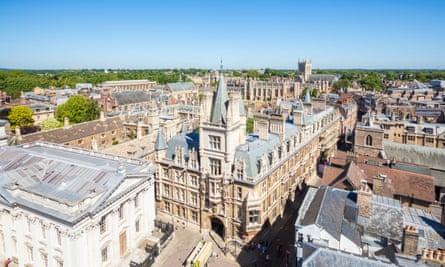
Gonville and Caius college (centre) at Cambridge University. Photograph: eye35/Alamy


So when Bell-Romero was approached by Gonville and Caius, the college where he had recently completed his PhD, to conduct a separate piece of research into the college’s links to slavery, he was delighted. Caius, as it is commonly known (it’s pronounced “Keys”), was founded in 1348. One of the oldest and wealthiest colleges in Cambridge, it is also seen as one of the most conservative and traditional. The college offered him a year’s contract, working one day a week, meaning he had about 50 days to do the archival research and write the report – a very short time for a broad brief.

As with the university inquiry, the idea was to look at all possible links to slavery. Alongside investigating whether the college held investments in slave-trading entities such as the East India, South Sea and Royal African Companies, he was asked to explore any connections to slavery among alumni, students and faculty. Not only would this be interesting in its own right, but hugely useful for the wider project. He said yes. “I just thought – this is wonderful, unrestricted access to the archive,” he said. “That’s a dream for a historian. It’s as good as it gets.”

But it was at Gonville and Caius that the problems would begin. The reaction to Bell-Romero’s draft report caused a rift among faculty at the college – with some pushing to prevent its publication entirely. According to the critics, the work suggested all white people “carry the taint of original sin” and that it was motivated by an “agenda” to “implicate” the college in slavery.

What happened at the college demonstrates the collision between two different worldviews: one that sees research into the history of slavery as a routine, but vital, academic exercise; and another that sees it as an overtly biased undertaking and a threat to the way historical knowledge is produced. The intensity of this clash sheds some light on why it has proved so difficult to reappraise Britain’s past.

When the Cambridge vice-chancellor Stephen Toope first announced the legacies of enslavement inquiry, he said he wanted the university to “acknowledge its role during that dark phase of human history”, adding: “We cannot change the past, but nor should we seek to hide from it.”

Momentum was building around institutions looking into their links to slavery. Historians working on this area see this as a valuable addition to historic knowledge and a way to understand how the profits of slavery shaped Britain. Many of the richest people in 18th- and 19th-century Britain were involved in the slave trade and the plantation economy. The trade and distribution of goods produced by enslaved people helped fuel Britain’s development.

While enslaved people were mostly overseas, in colonies, out of sight, slavery funded British wealth and institutions from the Bank of England to the Royal Mail. The extent to which modern Britain was shaped by the profits of the transatlantic slave economy was made even clearer with the launch in 2013 of the Legacies of British Slave-ownership project at University College London. It digitised the records of tens of thousands of people who claimed compensation from the government when colonial slavery was abolished in 1833, making it far easier to see how the wealth created by slavery spread throughout Britain after abolition. “Slave-ownership,” the researchers concluded, “permeated the British elites of the early 19th century and helped form the elites of the 20th century.” (Among others, it showed that David Cameron’s ancestors, and the founders of the Greene King pub chain, had enslaved people.)

But as Bell-Romero would write in his report on Caius, “the legacies of enslavement encompassed far more than the ownership of plantations and investments in the slave trade”. Scholars undertaking this kind of archival research typically look at the myriad ways in which individuals linked to an institution might have profited from slavery – ranging from direct involvement in the trade of enslaved people or the goods they produced, to one-step-removed financial interests such as holding shares in slave-trading entities such as the South Sea or East India Companies.

Bronwen Everill, an expert in the history of slavery and a fellow at Caius, points out “how widespread and mundane all of this was”. Mapping these connections, she says, simply “makes it much harder to hold the belief that Britain suddenly rose to power through its innate qualities; actually, this great wealth is linked to a very specific moment of wealth creation through the dramatic exploitation of African labour.” 

This academic interest in forensically quantifying British institutions’ involvement in slavery has been steadily growing for several decades. But in recent years, this has been accompanied by calls for Britain to re-evaluate its imperial history, starting with the Rhodes Must Fall campaign in 2015. The Black Lives Matter protests of 2020 turbo-charged the debate, and in response, more institutions in the UK commissioned research on their historic links to slavery – including the Bank of England, Lloyd’s, the National Trust, the Joseph Rowntree Foundation and the Guardian.

But as public interest in exploring and quantifying Britain’s historic links to slavery exploded in 2020, so too did a conservative backlash against “wokery”. Critics argue that the whole enterprise of examining historic links to slavery is an exercise in denigrating Britain and seeking out evidence for a foregone conclusion. Debate quickly ceases to be about the research itself – and becomes a proxy for questions of national pride. “What seems to make people really angry is the suggestion of change [in response to this sort of research], or the removal of specific things – statues, names – which is taken as a suggestion that people today should be guilty,” said Natalie Zacek, an academic at the University of Manchester who is writing a book on English universities and slavery. “I’ve never quite gotten to the bottom of that – no one is saying you, today, are a terrible person because you’re white. We’re simply saying there is another story here.”

For the critics of this work, campaigns to remove statues, revise university curricula, or investigate how institutions may have benefited from slavery are all attempts to censure the past. While this debate often plays out in public with emotive articles about “cancellation” and “doing Britain down”, conservative historians emphasise the danger of imposing value judgments on historical events or people. David Abulafia is a life fellow at Caius, and an influential figure in the college. Best known for his acclaimed history of the medieval Mediterranean, in recent years he has become a prominent conservative commentator. (Some of his eye-catching Telegraph columns have argued that “Cambridge is succumbing to the woke virus” and that the British Museum “might as well shut” if it “surrenders the Rosetta Stone”.) When I spoke to Abulafia, he struck a less strident tone. “What worries me is that modern politics is intruding into the way we interpret the past,” he said. “One has somehow to be able to chronicle the past without getting caught up with moralising about the current state of the world.”

Yet the historians working on studies of slavery or imperialism are often bemused by this concern, pointing out that all history is a product of the time in which it is written. “The job of a historian is to uncover the past and try to work out what happened, why it did, and what consequences and effects that had,” said Michael Taylor, a historian of colonial slavery and the British empire. “We’re allowed to focus on and celebrate abolition, but the previous 200 years of slavery are apparently taboo. That doesn’t make any sense.”

Every historian of slavery I spoke to emphasised that their research primarily involves archives and financial records. In their view, the work of many institutions mapping their own historic links to slavery helps to build up a more detailed picture of how Britain was shaped by its relationship with slavery and the slave trade.

Abulafia agreed that history is about “the accumulation of evidence, in as accurate and careful a way as possible”, but argued that “there is a danger of manipulating the past in the interest of current political concerns, one of which might be the idea that the ascendancy of the west has been achieved through a systematic policy of racism”. He questioned the point of tracing “profits from the slave trade that alumni might then have converted into benefactions” since, in the 18th century, using your wealth to fund scholarship might have been seen as virtuous. “It’s that challenge of trying to get one’s head around values, which are so remote from our own,” he said.

Historians of slavery argue that simply establishing these flows of money does not equate to moral judgment. As Taylor says: “This research simply helps us piece together a picture of what Britain was like when slave-trading and slave-holding was legal, which would otherwise not be there.” But critics do not accept this.

On 17 June 2020, as Black Lives Matter protests raged across the country, activists in Cambridge spraypainted the heavy wooden medieval gate that separates Caius from the busy high street it sits on: “Eugenics is genocide. Fisher must fall.” The graffiti referred to a stained-glass window installed in the Caius dining hall in 1989, commemorating the statistician RA Fisher. The window was an abstract design; squares of coloured glass arranged in a Latin Square, an image from the cover of Fisher’s influential 1935 book The Design of Experiments.

Commonly thought of as the most important figure in 20th-century statistics, Fisher was also a prominent eugenicist. He helped to found the Cambridge University Eugenics Society and, after the second world war, wrote letters in support of a Nazi scientist who had worked under Josef Mengele. The window had been controversial for years: a substantial number of students – and some faculty – wanted it to be taken down. The debate was reignited by the graffiti. A Caius student launched an online petition, writing: “Caius students and Fellows eat, converse and celebrate in space that also acts as a commemoration of our racist history.” It gained more than 1,400 signatures.

But there was pushback. Cambridge colleges are like universities within a university; faculty usually work both for their university department, where they deliver lectures, and for their college, where they provide tutorials. Students live at the college for at least part of their degree and typically have much of their teaching there. Despite a wide range of specialisms and political views among the faculty, and a proactive student body, Caius is broadly seen as one of Cambridge’s most conservative colleges, largely due to its vociferous community of life fellows. Someone becomes a life fellow after teaching at Caius for 20 years. Life fellows – who make up about 25% of the total fellowship, similar to the number of female fellows – occupy a strange position in college life; most do not teach any more, but have a room at the college and can eat at the dining hall. One former Caius student described the college as “the most luxurious nursing home in the country”.


Graffiti reading ‘Eugenics is genocide … Fisher must fall’ being cleaned off Gonville and Caius College in Cambridge University in 2020. Photograph: PA Images/Alamy


Many Cambridge colleges have some form of life fellowship for retired professors, but Caius is unusual in that they have full voting rights and can sit on the college council, a small executive body on which staff serve rotating terms. This means they have as much of a say in the running of the college as current faculty. “They functionally run the place,” said Everill. Michael Taylor, the historian, went to Caius as an undergraduate in 2007 and stayed until he finished his PhD in 2014. When he sat as a student representative on the college council, he was struck by the dysfunction of this system. “The sheer indifference to the experience of students was shocking,” he told me. “A few good people were – and are – trying to reform the college, but it’s basically a form of feudal governance.” This has often led to a situation where faculty at Caius are pulling in different directions; one primarily concerned with the preservation of tradition and the good name of the college, and another with student experience and other day-to-day concerns of a modern academic institution.

A number of life fellows had been taught by Fisher and felt that his pioneering work on statistics stood separately to his other views. “It really sparked all hell,” said Vic Gatrell, a historian and life fellow at Caius. Gatrell, in common with many of the working faculty and the students, thought the window should come down. This marked him out among the life fellows, most of whom wanted the window to stay. Gatrell is in his 80s and has worked at Caius since the 1970s. In that time there had been disagreements – “the admission of women was very divisive,” he recalls – but in those 50 years, nothing had provoked such strong emotions. “In all these years, we never inquired into each other’s politics,” he told me. But now, colleagues he’d lived and worked with for decades walked past in the corridor without saying hello, or sat separately in the dining hall. “It was a microcosm of what’s happening in the nation at large,” he said.

In late June 2020, Caius removed the Fisher window. But the dividing lines were there to stay. In a long article for the Critic titled Cancelled by his college, the eminent geneticist, life fellow Anthony Edwards – who had been mentored by Fisher, and had proposed the installation of the window – rejected the allegation that Fisher was racist, or even a leading eugenicist. He decried the fact that “now the college Fisher loved has turned its back on him”. Within college, life fellows spoke of Fisher being cancelled, dishonoured and targeted unfairly by BLM protesters. “The removal of the Fisher window opened a wound that still continues in various ways,” said one research fellow.

It was against this backdrop that Bell-Romero got to work in the Caius archives in the autumn of 2020. The Fisher window had been removed, but bad blood remained. Still, Bell-Romero – who was not based fulltime at the college – was blissfully unaware. He had a specific brief: to examine whether students, alumni, staff or benefactors had links to slavery. Once a week, he went into the archive, housed in a grand 19th-century building next to the lush green lawn of Caius Court. The archive spans the full eight centuries of the college’s life, from medieval estate records to the personal papers of modern alumni and faculty. The research was a low-key pursuit – just Bell-Romero and the college archivist, going through paper records. 

As per his brief, he looked widely: “It’s not just about people owning plantations – it’s about small pots of money, small investments people had,” he said. Gradually, he traced a number of connections to slavery, through former students and staff who had investments in slave-holding companies. Previous histories of Caius had identified two sizeable donations to the Society for the Abolition of the Slave Trade in the late 18th century. But in the archives, Bell-Romero found that the financial benefits from enslavement outweighed the college’s contribution to abolition.

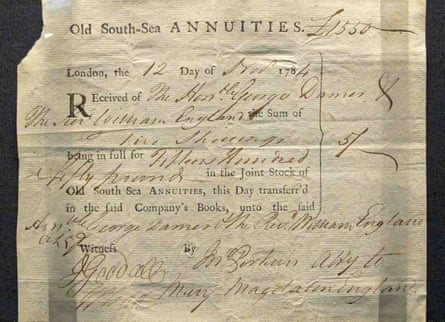
His draft report was a modest document of about 50 pages. His key finding was that the college once had financial interests in the South Sea Company, an organisation that “sent 64,780 enslaved persons to the Spanish Americas”. These were in the form of annuities and stocks, gained through donations left to the college by alumni. He wrote that through these benefactions “the College’s fate – like so many other educational institutions in Great Britain – became intertwined with the imperial commercial economy, with slavery being one of its most profitable ventures”. Mapping this out, along with details of students from slave-owning families educated at Caius, Bell-Romero concluded that this story was “not singular, but indicative of the longstanding ties of British institutions and individuals to chattel slavery and coerced labour”.

These findings didn’t surprise Bell-Romero. “It was what you’d expect for a rich college that has existed for many hundreds of years,” he said. When he submitted the draft in the autumn of 2021, he did not realise how contentious it would be.

Bronwen Everill was head of the Caius working group on the legacies of enslavement project. Bell-Romero’s report was a draft – it needed editing – but Everill thought it was a solid piece of work with uncontroversial conclusions. “Basically, the finding of this report was – like almost all these institutions – Caius had a little bit of a hand in slavery, but it was not fundamentally based on financing from the slave trade,” she told me. Bell-Romero’s report only included archival research. But Everill and her three colleagues on the working group were expected to come up with suggestions for next steps.

Part of the remit of the Cambridge University inquiry was to consider how these legacies are reflected in the modern day. The most prominent example of this work – at Glasgow University – had led to a substantial reparative package. That project had passed without controversy. But in the intervening years, the political climate had changed. (“Any study now is being scrutinised from the outset, and the credibility and objectivity of academic historians is being questioned by some critics,” Mullen, the Glasgow researcher, told me.)

There are various mechanisms for working out how much historical sums are worth in today’s currency. For his report, Bell-Romero used an academic database called Measuring Worth, created by a group of economic historians to calculate estimates of the “present value” of past assets – which the Glasgow report had also employed. Bell-Romero wrote that “the calculation of historical value is not an exact science – indeed, these figures are at best a rough estimate.” On the basis of the report, the working group proposed that Caius offer funding to two Black Mphil students.

Typically, a drafted piece of research might be assessed and edited by other experts in the field; historians with some knowledge of its particular time period and geography. But the quirks of college life meant that the process at Caius was different. The report was being published on behalf of the college, so in December, the draft report was circulated for feedback to all fellows and life fellows, regardless of their expertise.

In January 2022, responses rolled in. Some highlighted mistakes: confusion over the name of a historical figure, and minor spelling errors. Others questioned the entire motivation for the project. In a lengthy response, Abulafia said that people in the past may have been involved in many things that today seem unsavoury, and asked: “If British people carry the taint of original sin by all those who are white supposedly being complicit in the slave trade, how much more are we complicit in all these activities that still go on around us?” He concluded that the report must “stand back from the past and not make it into a canvas they can slather with the moral wisdom of a particular fashionable ideology”.


A share certificate for the South Sea Company, in which Gonville and Caius College was found to have had financial interests. Photograph: Universal History Archive/Universal Images Group/Getty


Prof Joe Herbert, a life fellow in medicine, wrote that the report “clearly has an agenda: to implicate Caius as much as possible in supporting and benefiting [from] slavery”. He questioned the logic of funding Black MPhil students: “There is an undoubted shortfall of black applicants (not other ethnic groups); but this is not a direct result of slavery 200 years ago, and we absolve ourselves from our responsibility by thinking it is, and offering a solution which is no solution.”

Everill was surprised by the tenor of the responses, and particularly by the fact that the most strident criticism had come from life fellows who were not scholars of Britain or empire. To her, it felt like a fundamental misunderstanding of the project and a recycling of culture-war talking points. (Abulafia suggested the report was “infused with the ideas of critical race theory”.) Many of the people most affronted by the report were the same who had been most defensive of the Fisher window. “There’s a lot of people who read about the culture wars and think they are personally under attack by a woke mob,” Everill said a few months later.

A number of responses queried – in strong terms – the mechanism for working out historical inflation, which the critics argued had produced an implausibly wide range of estimated values, and the reparative suggestion. “They seemed to think we were saying we, today, should be guilty – rather than that the institution made this money, and so the institution should think about distributing this money,” said Everill.

Bell-Romero was frustrated that some of the notes appeared to be responding to points he hadn’t made. “It had nothing to do with what I found; it was just about the political bent of what they thought the research was about,” he said. “The point was never to denigrate the college.”

The college council told the working group they had to respond in particular to Abulafia’s criticisms, because of his high standing as a historian. Together, they drafted a 5,000-word response, accepting some criticisms and disputing others. They wrote: “The report is not admonishing past Caians, or saying that ‘Caians should not have’ done something … The very point is the banality … The report is recording the connections to a system that was widespread throughout British economic life. We are not asking for people to judge the people of the past. We are simply presenting a more complete picture so that we, today, can think about what we want to do with that information.”

Rather than defend the report in front of the college council, Everill thought it would be more productive to hold an open meeting, in the hope of encouraging a discussion rather than a debate. It took place in early March, an opportunity for anyone to ask questions of Bell-Romero and the working group. Bell-Romero expected a big turnout. But only one person turned up: Joe Herbert. According to others present at the meeting, he walked into the room and declared: “This is a terrible report.” That set the tone. Members of the working group said that Herbert, who declined to be interviewed for this story, called history a “crap discipline” and suggested that the low admission rates for Black students at Cambridge were not connected to the history of slavery.

Everill was appalled. At one point, she said, she stood up and said: “No, absolutely not, I will not put up with that kind of tone.” Herbert responded: “Sit down, woman,” adding, “You’re not in charge here.” In a later email to Everill, he acknowledged this, saying: “I told you to shut up because you were shrieking at me. You weren’t attempting to say anything.” (Contacted before publication, Herbert said that “inappropriate language” used at the meeting “was not limited to me”, but denied saying history was a “crap discipline”.)

After the open meeting, Everill was copied on an email thread in which this group of three life fellows continued to attack the report. They did not acknowledge the 5,000-word response, writing: “You never tried to explain anything.” In the emails, another life fellow, the philosopher Jimmy Altham, suggested that Everill may be “dyslexic” because of some typos; Herbert said that “the important thing is that this disastrous report is not published in the college’s name”; and Abulafia replied “I 100% agree”. Everill made a formal complaint of harassment against Altham and Herbert. The complaint against Herbert was upheld; but not against Altham. Herbert was encouraged to apologise, but he did not. 

The scholars engaged in the research had fulfilled a narrow brief to examine the college’s financial links to slavery and come up with a proposal for action. But the life fellows who objected seemed to be responding to something larger; the idea that the legacies of slavery might still be shaping our present.

When I spoke with Abulafia, he didn’t want to discuss the specifics of events at Caius, which he described as “a source of division and contention”, but he did talk more broadly about this area of research. “It started with one or two Oxbridge colleges conducting these investigations and by and large, not much came out of it,” he said. “Why are they looking into it? It’s become a sort of fad, if you like. If we want to look at issues to do with the way human beings were being badly oppressed in the early 19th century, we might also want to look at children down the mines in this country. There are horrific stories. I just wish we could recognise that sort of unholy behaviour, which certainly took place in the slave trade, is also taking place on our own soil between white people – if we’re going to make it about a given colour, which I hate doing, actually.” Citing other examples of historic exclusion and oppression, such as child labour, he said: “Let’s tell those stories and not put so many resources into the legacies of slavery. I think we’ve got the basic idea on that now.”

Soon after the disastrous open meeting, the college council suggested that Bell-Romero redraft his report in collaboration with a life fellow in history who was not one of the primary critics – saying he would “know the fellowship tone”. But Bell-Romero was affronted. “It’s censorship, being babysat to write your own piece,” he said. “That’s where I drew the line.” He declined. With no clear plan of action, he thought the report might never be published. He continued with the Cambridge inquiry and tried to forget about it. But that would not be so easy.

In late May, as the Easter term edged towards its end, Tommy Castellani, a second-year languages undergraduate, was sitting in the Caius dining hall when a friend mentioned that his history tutor had been tweeting about a dispute. Castellani had recently started writing news stories for Varsity, the Cambridge student paper, and he wanted to know more. His friend pulled up Everill’s Twitter account. “It is literally my favourite thing, waking up on a lovely bank holiday Sunday to a whole string of emails from angry *life fellows* calling me names. The best.” (She was referring to the “dyslexic” comment.) Castellani started to dig into it.

“I realised this was going to be a big story,” he said. “There’s a culture war in college, and you can see it in the council papers – people feel divided.” He got hold of emails, spoke to Everill and interviewed Bell-Romero, who asked not to be named in the story. In June, Varsity published Castellani’s account of the fallout, including quotes from the life fellows’ emails and details of what was said at the open meeting. Castellani had approached the college for comment on the “racist and sexist” undertones of comments at the open meeting.

But when the Telegraph picked up on the Caius dispute three weeks later, the story had a very different slant. Incorrectly stating that the Caius research had been initiated “in the wake of the Black Lives Matter movement” (the college had actually started the process of researching its links to slavery in spring 2019, a year before the protests), the story claimed the report included “incorrect monetary conversions”.

The paper identified Bell-Romero by name as a “woke activist” who had produced “shambolic” work that caused the crisis. Bell-Romero couldn’t access the article at first because of the paywall. When he did, his first response was horror. His second was to laugh. “I’d been struggling to explain to my friends what this had been like, and now I could point to the Telegraph article and say – that’s the tenor of the feedback we received.”

Although the reporter had clearly been briefed by at least one life fellow, the critics remained anonymous, even when quoted at length saying that these “attempts to rewrite history fall at the first hurdle”. Meanwhile Bell-Romero – a precariously employed early-career academic (wrongly described in the article as a “student”) – was named, and his professionalism questioned. A few days later, the Telegraph story was picked up by the Times, which has devoted increasing attention to campus conflicts in recent years.

The work of looking into legacies of slavery or related topics is typically done by early-career researchers. There is a growing concern about the risk of backlash for young academics working on histories of empire or slavery who are singled out in the press. They are left highly exposed, while their critics often have established positions and job security. Charlotte Riley, a lecturer in history at the University of Southampton, described a conversation with a new PhD student looking at empire and railways. “We had to sit him down and say: ‘The Daily Mail might come for you.’”

After the stories came out, Bell-Romero was contacted by a number of other researchers working on topics related to decolonisation and slavery who had been the subject of hit-jobs in the rightwing press. Time and again, researchers I interviewed for this story insisted on answering questions by email rather than speaking on the phone or in person, citing the fear of being misrepresented. “I do worry about a chilling effect,” says Everill. “There are a bunch of these postdocs available at the moment, and people who don’t want to be named and shamed in the national media might decide not to apply.”


The conflict at Caius seemed to be part of a wider faltering of legacies of slavery research – through overt backlash, or institutions announcing projects with great fanfare but not following through with support and funding. Hilary Beckles, the vice-chancellor of the University of the West Indies and the author of Britain’s Black Debt, calls this pattern “research and run” – where universities do the archival work, then say a quick sorry and run from the implications of the findings, leaving the researchers exposed.

The historian Olivette Otele, a scholar of slavery and historical memory who was the first Black woman to be appointed a professor of history in the UK, joined the University of Bristol in 2020, and worked on the university’s own research into its deep connections to the slave trade. When she left just two years later, a colleague in another department tweeted that the university had used Otele “as a human shield to deflect legitimate criticism”. Announcing her departure, Otele wrote on Twitter: “The workload became insane and not compensated by financial reward. I actually burnt out,” adding that colleagues had been “sabotaging my reputation inside and outside the uni.”

As far as anyone could see, Caius had backed away from publishing Bell-Romero’s report after the controversy; Everill, head of the working group, was not sure it would ever be published. But in July, a newspaper submitted a freedom of information request about it. (Newspapers increasingly submit FoIs about academic research on subjects like slavery and empire as universities have become the frontline in the culture war; a controversial Times front page in August claimed that universities were changing syllabuses, even though their own data did not bear this out. Riley recalled one absurd example, where a journalist sent an FoI requesting all emails from academics using the word “woke”. “There were none, because we don’t actually sit there writing ‘I’m a woke historian’. That is insane.”)

The following month, the Caius report was published online, with the proposal for MPhil funding removed. It was not covered anywhere. “Probably because it turns out that wasn’t actually that inflammatory,” Everill said. In a statement to the Guardian, the master of the college, Prof Pippa Rogerson, said: “The report makes uncomfortable reading for all those affiliated to Caius. The College is 675 years old and it is important we acknowledge our complex past.”

In September, Bell-Romero and Cadeau’s much larger Cambridge University legacies of enslavement project was published. It found that Cambridge fellows had been involved in the East India Company and other slave-trading entities, and that the university had directly invested in the South Sea Company. They wrote: “Such financial involvement both helped to facilitate the slave trade and brought very significant financial benefits to Cambridge.” The report was covered by major news outlets, but did not provoke a particularly strong response.

The conflict over the Caius research suggests that these disputes often have little to do with the archival research itself, or its conclusions. In the view of the critics, the research is discredited by its intention to correct past wrongs. Even when the researchers insist that they are not trying to assign blame or guilt, the critics insist in return – not without some justification – that whether or not this is the intention, it is almost always the effect. This is presumably why they disapprove of doing the research to begin with.

Seen this way, it is a standoff that has no hope of resolution. When I spoke to Abulafia, he questioned the point of the research: “Cambridge University and its role in slavery is not, to my mind, as big a question as all sorts of other questions one could argue about the slave trade,” he said. But scholars working on the area argue that this is precisely the point; to understand institutions’ relationships to slavery, whether small or large, and through this to build a fuller picture of the past. “When we do this research, we’re just adding another layer, another perspective,” said Bell-Romero. The critics, of course, see this empirical modesty as disingenuous. But the archival work carries on, all over the country, and the diametrically opposing views on the very premise will inevitably lead to more conflicts.

In late September, Cadeau and Bell-Romero organised an academic conference about reparations, held at the Møller Institute, a starkly modern building west of Cambridge city centre. A few days before, it was covered in the Telegraph, which quoted anonymous sources describing it as “propagandist” and “fanatical” and Abulafia saying: “It’s that sense that it’s going to be one-sided that concerns me.” Cadeau, who is now a lecturer of diaspora history at Soas in London, was unfazed. “What I am most concerned about are legacies of racism. I am concerned with how little this country knows about slavery, even leading historians,” she told me. “I have been more concerned about the implications of how we treat the history of slavery, and whether or not our societies will address the legacies of slavery and racism, and much less concerned about the press.”


In his opening remarks to the conference, the historian Prof Nicholas Guyatt acknowledged the negative coverage, saying: “We’ve had some media attention already and that’s great, I welcome all views and am pleased everyone is here to listen to our fantastic speakers.” Bell-Romero presented a paper on the profits of slavery at Oxbridge. Cadeau spoke about her research into South Sea Company annuities at Cambridge, saying that it was hard to find an older college in Cambridge that doesn’t have links to this funding. No news story about the conference emerged – perhaps because in practice this was a fairly routine academic exercise. People presented papers on their niche areas of research, ran over time and debated.

On the final day of the conference, I sat with Bell-Romero in the lunch hall. He told me that he felt the launch of the Cambridge project had been handled better than the Caius report; the draft had gone to expert readers and the university backed the research it had commissioned. While the academics waited for the next talk to begin, Bell-Romero and a few other scholars working on slavery and reparations discussed the growing backlash to their work in an incredulous and frustrated tone. One British academic said he receives death threats every time he speaks about the case for reparations. After a few minutes of weary commiseration, they stood up from their empty plates and walked back into the lecture theatre.

“If you take pride in the past,” a Latin American researcher said with quiet exasperation before leaving, “then you have to take responsibility, too.”