Search This Blog

Friday, 27 March 2015

Cook rice in a way that dramatically cuts the calories

Roberto A Ferdman in The Independent

Rice, the lifeblood of so many nations' cuisines, is perhaps the most ubiquitous food in the world. In Asia, where an estimated 90 percent of all rice is consumed, the pillowy grains are part of almost every meal. In the Caribbean, where the starch is often mixed with beans, it's a staple too. Even here in the United States, where people eat a comparatively modest amount of rice, plenty is still consumed.

Rice is popular because it's malleable—it pairs well with a lot of different kinds of food—and it's relatively cheap. But like other starch-heavy foods, it has one central flaw: it isn't that good for you. White rice consumption, in particular, has been linked to a higher risk of diabetes. A cup of the cooked grain carries with it roughly 200 calories, most of which comes in the form of starch, which turns into sugar, and often thereafter body fat.

But what if there were a simple way to tweak rice ever so slightly to make it much healthier?

An undergraduate student at the College of Chemical Sciences in Sri Lanka and his mentor have been tinkering with a new way to cook rice that can reduce its calories by as much as 50 percent and even offer a few other added health benefits. The ingenious method, which at its core is just a simple manipulation of chemistry, involves only a couple easy steps in practice.

"What we did is cook the rice as you normally do, but when the water is boiling, before adding the raw rice, we added coconut oil—about 3 percent of the weight of the rice you're going to cook," said Sudhair James, who presented his preliminary research at National Meeting & Exposition of the American Chemical Society (ACS) on Monday. "After it was ready, we let it cool in the refrigerator for about 12 hours. That's it."

How does it work?

To understand what's going on, you need to understand a bit of food chemistry.

Not all starches, as it happens, are created equal. Some, known as digestible starches, take only a little time to digest, are quickly turned into glucose, and then later glycogen. Excess glycogen ends up adding to the size of our guts if we don't expend enough energy to burn it off. Other starches, meanwhile, called resistant starches, take a long time for the body to process, aren't converted into glucose or glycogen because we lack the ability to digest them, and add up to fewer calories.

A growing body of research, however, has shown that it might be possible to change the types of starches found in foods by modifying how they are prepared. At the very least, we know that there are observable changes when certain foods are cooked different ways.

Potatoes, for instance, go from having the right kind of starch to the less healthful kind when they are cooked or mashed (sigh, I know). The process of heating and cooling certain vegetables, like peas and sweet potatoes, can also alter the amount of resistant (see: good) starches, according to a 2009 study. And rice, depending on the method of preparation, undergoes observable chemical changes. Most notably, fried rice and pilaf style rice have a greater proportion of resistant starch than the most commonly eaten type, steamed rice, as strange as that might seem.

"If you can reduce the digestible starch in something like steamed rice, you can reduce the calories," said Dr. Pushparajah Thavarajah, a professor who is supervising the research. "The impact could be huge."

Understanding this, James and Thavarajva tested eight different recipes on 38 different kinds of rice found in Sri Lanka. What they found is that by adding a lipid (coconut oil in this case, because it's widely used in Sri Lanka) ahead of cooking the rice, and then cooling the rice immediately after it was done, they were able to drastically change its composition—and for the better.

"The oil interacts with the starch in rice and changes its architecture," said James. "Chilling the rice then helps foster the conversion of starches. The result is a healthier serving, even when you heat it back up."

So far they have only measured the chemical outcome of the most effective cooking method for the least healthful of the 38 varieties. But that variety still produced a 10 to 12 percent reduction in calories. "With the better kind, we expect to reduce the calories by as much as 50 to 60 percent," said James.

Cooking that can change the world

The prospect of lower calorie rice is a big deal. Obesity rates are rising around the world, particularly in the developing world, where people rely more heavily on cheaper food staples. China and India, which are already seeing rising obesity problems, are huge consumers of rice. Rice, of course, is not the sole cause of weight gain. But reducing the amount of calories in a cup of rice by even as little as 10 percent could have an enormous impact for future generations.

"Obesity has been a problem in the United States for some time," said Thavarajah. "But it's becoming a problem in Asia, too. People are eating larger and larger portions of rice, which isn't good."

The researchers still have to test the remaining varieties of rice, including Suduru Samba, which they believe will produce the largest calorie reduction. They also plan to experiment with oils other than coconut oil, like sunflower oil.

A world where commercially sold rice comes pre-cooked and with much fewer calories might not be that far off. People should already be able to replicate the process at home, although James warns the results might vary depending on the type of rice used. And there's good reason to believe the chemistry could be applied to many other popular but less-than-healthy foods.

"It's about more than rice," said Thavarajah. "I mean, can we do the same thing for bread? That's the real question here."


Copyright: The Washington Post

Welcome Transitions in Pakistan Tehreek - i - Insaaf

Tarek Fatah chats about his four-months visit to Hindustan - Bilatakalluf with Tahir Gora Ep10


Najam Sethi in The Friday Times

Welcome Transitions


The PTI Election Tribunal (ET) headed by Justice (r) Wajihuddin Ahmed has reported that the PTI intra-party elections held in 2013 were “fraudulent”.

The 60-page report points out core problems in the whole exercise. Tickets were badly distributed to poor candidates because of corrupt practices by central party leaders; millions of voters registered through the given phone numbers were not included in voter lists because of incompetence and inefficiency in the PTI’s Central Office; the central command of the party did not obey the guidelines for regional, provincial and central parliamentary boards to be set up to process and decide the names of party’s nominees for tickets for the general elections, preferring instead to direct party ticket aspirants to file their nominations with the Central Office directly; the UC-level election was manipulated by aspirants of district and provincial posts, assisted by aspirants of party tickets for general elections; the process of candidates’ assessment and allocation of tickets was carried out by a couple of groups in a ‘hush hush’ manner; people who became party members through telephone help lines were disenfranchised during intra-party polls; the top posts of the party in the provinces and center are all nominated; that Jehangir Tareen’s role was highly objectionable; and so on. The ET has ordered Imran Khan to dissolve all posts and hold new elections.

This is in sharp contrast to Mr Khan’s earlier claim that these party elections were “unprecedented and historical”. He is furious that the Report was leaked and shows the squabbling party leadership in bad light. He has reacted by replacing Justice ® Wajihudidn’s tribunal with a new one led by Tasneem Noorani.

The error of his self-righteous ways is dawning on Mr Khan. After the failure of the longest “dharna” in history last year to try and dislodge the government, with a wink and nod from sections of the military establishment, Imran Khan has finally agreed to an unprecedented compromise with the PMLN on the matter of the judicial commission to determine the fairness of the last general elections. He has desperately backpedalled from his position that the elections were deliberately and premeditatedly stolen from the PTI by a gang of powerful conspirators. That has prompted the PMLN to put a clause into the TORs to exactly that effect: if this specially “designed and systematic” conspiracy is not proved, then, despite any irregularities, the election wasn’t stolen, and there is no compulsion to dissolve the assemblies and hold mid-term polls.

Imran’s about-turns are getting to be predictable. Earlier, he insisted that the Pakistani Taliban were simply “misguided Muslims” provoked by US drones who should be talked to; now he admits they are brutal terrorists who should be stamped out militarily. Before long the PTI will doubtless take back its resignations and return to the National Assembly.

But this is not necessarily a sign of weakness or opportunism. Recognition of ground realities and necessary adjustment can also be a sign of political maturity. Consider.

Indeed, Imran’s attempt to focus on the elections in AJK, provincial local bodies and the developing political vacuum in Karachi instead of trying to compel regime change are steps in the right direction. Hopefully, he will also acknowledge the harm done to his party by “lotas” and “electables” and oversee a new and transparent intra-party election that brings genuinely new and untainted PTI supporters from grass roots to positions of responsibility so that they can help the party positively impact the next general elections in 2018. He also needs to get cracking in running a good government in Khyber-Pakhtunkhwa so that he has an enviable track record to flaunt before cynical voters.

Imran Khan is not the only one having second thoughts. Nawaz Sharif is also working hand in hand on core national security issues with the very military establishment with whom he has expressed bitter grievances in the past. His obsession with the trial of General Pervez Musharraf has also ended. All this augurs well for the stability of the country.

The most important development, however, is a radical change in the strategic perspective of the military establishment regarding both internal and external affairs. This is entirely due to the new army chief Gen Raheel Sharif and a crop of new corps commanders who are in the process of re-evaluating security doctrines and responding to new realities.

The MQM is the only political player that is still resisting the broad based transitions in the country. It is crying foul against the clean-up operation in Karachi when this military-led operation has the support of all of Pakistan much like that against the Taliban. The sooner the MQM comes to accept the fact that its fearful blackmailing hegemony in Karachi is untenable from a national security viewpoint and won’t be tolerated, the better.

These multi-faceted military and political transitions in Pakistan are most welcome and should be supported. We need to put our house in order rather than constantly blaming others for our woes.

Thursday, 26 March 2015

Why Hawk-Eye still cannot be trusted

Russell Jackson in Cricinfo

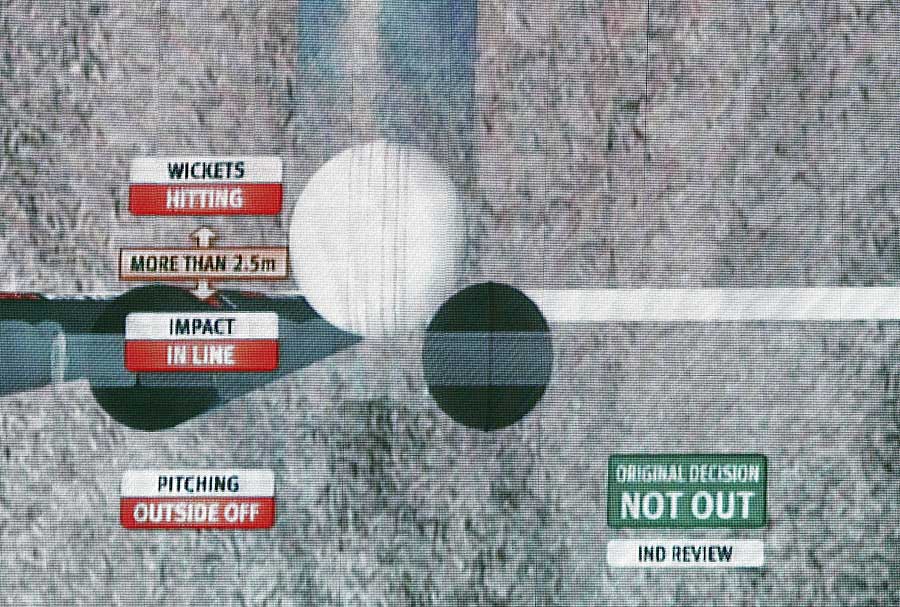
Imran Tahir's appeal against Martin Guptill looked straightforward but Hawk-Eye differed © AFP
Enlarge
I don't trust the data. Don't worry, this isn't another Peter Moores thinkpiece. It's Hawk-Eye or ball-tracker or whatever you want to call it. I don't trust it. I don't trust the readings it gives.
This isn't a flat-earth theory, though flat earth does come into it, I suppose. How on earth can six cameras really predict the movement of a ball (a non-perfect sphere prone to going out of shape at that) on a surface that is neither flat nor stable? A ball that's imparted with constantly changing amounts of torque, grip, flight, speed and spin, not to mention moisture.
----- Also Read
------
When Hawk-Eye, a prediction system with a known and well-publicised propensity for minor error (2.2 millimetres is the most recent publicly available figure) shows a fraction less than a half of the ball clipping leg stump after an lbw appeal, can we take that information on face value and make a decision based upon it?
During Tuesday's World Cup semi-final, my long-held conspiracy theory bubbled over. How, I wondered, could the ball that Imran Tahir bowled to Martin Guptill in the sixth over - the turned-down lbw shout from which the bowler called for a review - have passed as far above the stumps as the TV ball-tracker indicated? To the naked eye it looked wrong. The predicted bounce on the Hawk-Eye reading looked far too extravagant.
Worse, why upon seeing that projection did every single person in the pub I was in "ooh" and "aah" as though what they were seeing was as definitive and irrefutable an event as a ball sticking in a fieldsman's hands, or the literal rattle of ball on stumps? Have we just completely stopped questioning the authority of the technology and the data?
Later I checked the ball-by-ball commentary on ESPNcricinfo. Here's what it said: "This is a flighted legbreak, he looks to sweep it, and is beaten. Umpire Rod Tucker thinks it might be turning past the off stump. This has pitched leg, turned past the bat, hit him in front of middle, but is bouncing over, according to the Hawkeye. That has surprised everybody. That height has come into play here. It stays not-out."

Why don't we question the authority of a technology that has a well-publicised margin of error?  © Getty Images
Enlarge

It surprised me, but did it surprise everybody? Probably not. More TV viewers seemed to accept the call than question it. When you've watched enough cricket though, some things just look a little off. To me this one didn't add up. Guptill made another 28 runs, not a trifling matter in the context of the game.
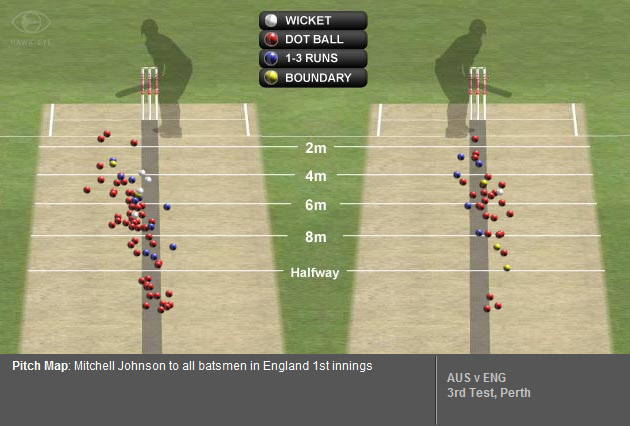
A disclaimer: though I distrust it for lbw decisions, I'm not saying that Hawk-Eye is all bad. It's great for "grouping" maps to show you where certain bowlers are pitching the ball, because tracking where a ball lands is simple. What happens next I'm not so sure on, particularly when the spinners are bowling.
To be fair, Hawk-Eye's inventor Paul Hawkins was a true pioneer and has arguably made a greater contribution to the entertainment factor of watching cricket on TV than many actual players manage. That's the thing though: it's entertainment. In 2001, barely two years after Hawkins had developed the idea it had won a BAFTA for its use in Channel 4's Ashes coverage that year. It wasn't until 2008 - seven years later - that it was added as a component of the Decision Review System. Quite a lag, that.
On their website, admittedly not the place to look for frank and fearless appraisal of the technology, Hawk-Eye (now owned by Sony) claim that the fact TV viewers now expect a reading on every lbw shout is "a testimony to Hawk-Eye's reputation for accuracy and reliability". But it's not, is it? All that it really tells us is that we are lemmings who have been conditioned to accept the reading as irrefutable fact upon which an umpiring decision can be made. But it's a prediction.
Not even Hawk-Eye themselves would call it a faultless system. Last December the company admitted they had got a reading completely wrongwhen Pakistan's Shan Masood was dismissed by Trent Boult during the Dubai Test. In this instance, the use of only four cameras at the ground (Hawk-Eye requires six) resulted in the operator making an input error. Why it was even being used under those conditions is more a question for the ICC, I suppose.

It's not all bad: Hawke-Eye gives great insight into where bowlers are pitching their deliveries  © Hawk-Eye
Enlarge

The Masood debacle highlights an interesting issue with regards to the cameras though. Understandably given the pay cheques at stake and that Hawk-Eye is a valuable component of their coverage, TV commentators rarely question the readings even in cases as puzzling as the Masood verdict. Mike Haysman is one who stuck his neck out in a 2011 Supersport article. Firstly, Haysman echoed my earlier thought: "The entertainment factor was the exact reason they were originally introduced. Precise decision-making was not part of the initial creative masterplan." The technology has doubtless improved since, but the point remains.
More worryingly though, Haysman shone a light on the issue with the cameras upon which Hawk-Eye depends. At that point an Ashes Test, for instance, might have had bestowed upon it a battalion of deluxe 250 frame-per-second cameras, whereas a so-called lesser fixture might use ones that captured as few as 25 frames-per-second. Remember: the higher the frame rate the more accurate the reading. Put plainly, for the past five years the production budget of the rights holder for any given game, as well as that game's level of perceived importance, has had an impact on the reliability of Hawk-Eye readings. Absurd.
As a general rule, the more you research the technology used in DRS calls, the more you worry. In one 2013 interview about his new goal-line technology for football, Paul Hawkins decried the lack of testing the ICC had done to verify the accuracy of DRS technologies. "What cricket hasn't done as much as other sports is test anything," he started. "This [football's Goal Decision System] has been very, very heavily tested whereas cricket's hasn't really undergone any testing." Any? Then this: "It's almost like it has tested it in live conditions so they are inheriting broadcast technology rather than developing officiating technology." Does that fill you with confidence?
Hawkins and science-minded cricket fans might bray at the suggestion that Hawk-Eye can't be taken as law, but in lieu of any explanation of its formulas, machinations and the way it's operated (also known as proprietary information) it's hard for some of us to shake the doubt that what we're seeing with our eyes differs significantly from the reading of a computer.

Wednesday, 25 March 2015

Why Bank of England employees are reading my A-level economics textbook

Alain Anderton in The Guardian

A Freedom of Information request by the Times, showed that Economics, my A-level textbook and the “bible for those seeking a handle on basic economics”, was the most issued book from the library of the Bank of England. Since it was first published in 1991, the book has been the bestselling text in the A-level economics market. Generations of economists have learned their basic economics from studying it. However, it isn’t the economists at the Bank of England who are borrowing the book now. The bank has helpfully explained that it provides development for secretaries, graduates and school leavers. Panic over – the Bank of England is not being run by economists consulting a school textbook.

What is good about this news is that it means the Bank of England is serious about education and professional development. In Economics, you will find out that these are essential for the growth of the economy. They raise productivity levels of workers and contribute to our national wellbeing. Other topical points raised in the book include the fact that increasing the supply of oil on to world markets will lead to a fall in the price of oil; if you cut government spending, at least in the short term, aggregate demand will fall and so will GDP; that global warming is the result of market failure; and that directors and managers of companies might be more concerned with maximising their own benefits than the benefits of the shareholders of the company.

It is also good news that people want to find out about economics. Since the financial crisis of 2008, the numbers of people studying A-level economics have more than doubled, suggesting that these uncertain times have sparked the curiosity of 16- to 18-year-olds about the world in which they live.

Economics at A-level is fundamentally about studying models: ways of looking at the world and making sense of it. But it is also about evaluating the world around us. Was there an alternative for the UK to fiscal austerity in 2010? Does it matter that the UK persistently runs a current account deficit on the balance of payments? Should we regulate banks more? Would a significant rise in the minimum wage be good or bad and for whom? In A-level exams, only candidates who can show they understand basic economic models and appreciate that there are many sides to each issue will get top marks.

Should our politicians be studying some basic economics? The answer to that is obviously yes. What is particularly disheartening about much current political discourse is the failure of politicians to admit that there will be costs and disadvantages to their policies. Our adversarial system means that any such admission is seized upon by the media and blown up out of all proportion. The simple fact is that almost any economic decision has its costs and benefits.

The first concept an A-level student may well learn is the principle of opportunity cost. If you buy a car, you lose the benefits of what you could otherwise have bought with that money. If the government cuts taxes, what are the benefits that are going to be lost as a result of that decision, benefits like higher government spending or a lower national debt? However, to some extent we get the politicians we deserve. Too many people seem to think that there are simple answers to complex problems; we don’t want to pay for the choices we make. For example, we want high-quality public services but we don’t want to pay for them in taxes.

Our grasp of economics would be more mature if the acceptance of costs and benefits that are being acknowledged in classrooms were also being acknowledged at our dinner tables, in our local council chambers and in parliament.

Tuesday, 24 March 2015

Inflation falls to 0%: what does it mean for the UK economy?

With average earnings growing by just under 2%, living standards should rise and interest rates should remain low but it’s not all good news

Larry Elliott in The Guardian

Britain is within a month of a period of deflation. When the figures for March come out next month lower energy bills mean that the cost of living will be lower than it was a year earlier.

These are uncharted waters for the UK, at least in the modern era. There have been times when inflation has turned negative but they have been few and far between since the second world war, and there have been none since the move to the consumer prices index as the preferred yardstick.

The general assumption is that this is good news, for two reasons. The first is that the fall in inflation boosts living standards, because wages are rising faster than prices. Wages have risen extremely slowly since the recession of 2008-09 and even against a backdrop of falling unemployment are currently only going up by 1.6% a year.

But the sharp drop in oil prices in the second half of 2014 has pushed inflation lower and meant those modest wage increases now stretch further. This is clearly welcome news for the government, eager to fend off Labour’s accusation that the coalition has presided over a cost-of-living crisis. The opposition will say that the recent increase in living standards does not make up for the earlier falls.

The second boost to consumers comes from the outlook for interest rates. It will come as no surprise to the Bank of England that inflation now stands at zero, and the Bank’s governor, Mark Carney, has said it would be “foolish” to cut the cost of borrowing in response to what is thought to be a temporary fall in commodity prices.

That said, the Bank is not going to be in a hurry to raise rates either. All nine members of the Bank’s monetary policy committee are in favour of official interest rates remaining at 0.5%, which is where they have been since early 2009. They look like remaining there for the rest of this year, and one MPC member – Andy Haldane, the Bank’s chief economist – says he can contemplate voting to cut borrowing costs.

That’s because there’s a potential dark side to the fall in inflation, namely the risk that it becomes a permanent feature of the economic landscape. The reason the majority of economists view February’s zero inflation as benign is because they think lower unemployment will put upward pressure on wage settlements. Higher pay deals will start to push up inflation at a time when last year’s drop in oil prices starts to unwind. There is, on this view, little prospect of deflation becoming embedded, as it did in Japan.

This, though, assumes that wage settlements are not dragged lower by the drop in inflation. The fact that average earnings are growing at an annual rate of below 2% even after two years of a relatively robust period of growth is indicative of a labour market where employers are able to secure workers cheaply. They may be tempted to be even less generous once inflation goes negative.

Saudi Arabia and Iran - The real enemies of Islam


Monday, 23 March 2015

The Coming Chinese Crackup

The endgame of communist rule in China has begun, and Xi Jinping’s ruthless measures are only bringing the country closer to a breaking point


Chinese President Xi Jinping, front center, and other Chinese leaders attend the opening meeting on Thursday of the third session of the National People’s Congress at the Great Hall of the People in Beijing. PHOTO: XINHUA/ZUMA PRESS
By DAVID SHAMBAUGH in The Wall Street Journal March 6, 2015 11:26 a.m. ET


On Thursday, the National People’s Congress convened in Beijing in what has become a familiar annual ritual. Some 3,000 “elected” delegates from all over the country—ranging from colorfully clad ethnic minorities to urbane billionaires—will meet for a week to discuss the state of the nation and to engage in the pretense of political participation.

Some see this impressive gathering as a sign of the strength of the Chinese political system—but it masks serious weaknesses. Chinese politics has always had a theatrical veneer, with staged events like the congress intended to project the power and stability of the Chinese Communist Party, or CCP. Officials and citizens alike know that they are supposed to conform to these rituals, participating cheerfully and parroting back official slogans. This behavior is known in Chinese as biaotai, “declaring where one stands,” but it is little more than an act of symbolic compliance.

Despite appearances, China’s political system is badly broken, and nobody knows it better than the Communist Party itself. China’s strongman leader, Xi Jinping, is hoping that a crackdown on dissent and corruption will shore up the party’s rule. He is determined to avoid becoming the Mikhail Gorbachev of China, presiding over the party’s collapse. But instead of being the antithesis of Mr. Gorbachev, Mr. Xi may well wind up having the same effect. His despotism is severely stressing China’s system and society—and bringing it closer to a breaking point.

Predicting the demise of authoritarian regimes is a risky business. Few Western experts forecast the collapse of the Soviet Union before it occurred in 1991; the CIA missed it entirely. The downfall of Eastern Europe’s communist states two years earlier was similarly scorned as the wishful thinking of anticommunists—until it happened. The post-Soviet “color revolutions” in Georgia, Ukraine and Kyrgyzstan from 2003 to 2005, as well as the 2011 Arab Spring uprisings, all burst forth unanticipated.


The Gate of Heavenly Peace in Beijing’s Tiananmen Square, the site of pro-democracy demonstrations in 1989. PHOTO: NATIONAL GEOGRAPHIC/GETTY IMAGES

China-watchers have been on high alert for telltale signs of regime decay and decline ever since the regime’s near-death experience in Tiananmen Square in 1989. Since then, several seasoned Sinologists have risked their professional reputations by asserting that the collapse of CCP rule was inevitable. Others were more cautious—myself included. But times change in China, and so must our analyses.

The endgame of Chinese communist rule has now begun, I believe, and it has progressed further than many think. We don’t know what the pathway from now until the end will look like, of course. It will probably be highly unstable and unsettled. But until the system begins to unravel in some obvious way, those inside of it will play along—thus contributing to the facade of stability.

Communist rule in China is unlikely to end quietly. A single event is unlikely to trigger a peaceful implosion of the regime. Its demise is likely to be protracted, messy and violent. I wouldn’t rule out the possibility that Mr. Xi will be deposed in a power struggle or coup d’état. With his aggressive anticorruption campaign—a focus of this week’s National People’s Congress—he is overplaying a weak hand and deeply aggravating key party, state, military and commercial constituencies.

The Chinese have a proverb, waiying, neiruan—hard on the outside, soft on the inside. Mr. Xi is a genuinely tough ruler. He exudes conviction and personal confidence. But this hard personality belies a party and political system that is extremely fragile on the inside.

Consider five telling indications of the regime’s vulnerability and the party’s systemic weaknesses.


A military band conductor during the opening session of the National People’s Congress on Thursday at the Great Hall of the People in Beijing. PHOTO: ASSOCIATED PRESS

First, China’s economic elites have one foot out the door, and they are ready to flee en masse if the system really begins to crumble. In 2014, Shanghai’s Hurun Research Institute, which studies China’s wealthy, found that 64% of the “high net worth individuals” whom it polled—393 millionaires and billionaires—were either emigrating or planning to do so. Rich Chinese are sending their children to study abroad in record numbers (in itself, an indictment of the quality of the Chinese higher-education system).

Just this week, the Journal reported, federal agents searched several Southern California locations that U.S. authorities allege are linked to “multimillion-dollar birth-tourism businesses that enabled thousands of Chinese women to travel here and return home with infants born as U.S. citizens.” Wealthy Chinese are also buying property abroad at record levels and prices, and they are parking their financial assets overseas, often in well-shielded tax havens and shell companies.

Meanwhile, Beijing is trying to extradite back to China a large number of alleged financial fugitives living abroad. When a country’s elites—many of them party members—flee in such large numbers, it is a telling sign of lack of confidence in the regime and the country’s future.

Second, since taking office in 2012, Mr. Xi has greatly intensified the political repression that has blanketed China since 2009. The targets include the press, social media, film, arts and literature, religious groups, the Internet, intellectuals, Tibetans and Uighurs, dissidents, lawyers, NGOs, university students and textbooks. The Central Committee sent a draconian order known as Document No. 9 down through the party hierarchy in 2013, ordering all units to ferret out any seeming endorsement of the West’s “universal values”—including constitutional democracy, civil society, a free press and neoliberal economics.

A more secure and confident government would not institute such a severe crackdown. It is a symptom of the party leadership’s deep anxiety and insecurity.


A protester is pushed to the ground by a paramilitary policeman March 5, 2014, in Beijing before the opening of the National People’s Congress nearby. PHOTO: ASSOCIATED PRESS

Third, even many regime loyalists are just going through the motions. It is hard to miss the theater of false pretense that has permeated the Chinese body politic for the past few years. Last summer, I was one of a handful of foreigners (and the only American) who attended a conference about the “China Dream,” Mr. Xi’s signature concept, at a party-affiliated think tank in Beijing. We sat through two days of mind-numbing, nonstop presentations by two dozen party scholars—but their faces were frozen, their body language was wooden, and their boredom was palpable. They feigned compliance with the party and their leader’s latest mantra. But it was evident that the propaganda had lost its power, and the emperor had no clothes.

In December, I was back in Beijing for a conference at the Central Party School, the party’s highest institution of doctrinal instruction, and once again, the country’s top officials and foreign policy experts recited their stock slogans verbatim. During lunch one day, I went to the campus bookstore—always an important stop so that I can update myself on what China’s leading cadres are being taught. Tomes on the store’s shelves ranged from Lenin’s “Selected Works” to Condoleezza Rice’s memoirs, and a table at the entrance was piled high with copies of a pamphlet by Mr. Xi on his campaign to promote the “mass line”—that is, the party’s connection to the masses. “How is this selling?” I asked the clerk. “Oh, it’s not,” she replied. “We give it away.” The size of the stack suggested it was hardly a hot item.

Fourth, the corruption that riddles the party-state and the military also pervades Chinese society as a whole. Mr. Xi’s anticorruption campaign is more sustained and severe than any previous one, but no campaign can eliminate the problem. It is stubbornly rooted in the single-party system, patron-client networks, an economy utterly lacking in transparency, a state-controlled media and the absence of the rule of law.

Moreover, Mr. Xi’s campaign is turning out to be at least as much a selective purge as an antigraft campaign. Many of its targets to date have been political clients and allies of former Chinese leader Jiang Zemin. Now 88, Mr. Jiang is still the godfather figure of Chinese politics. Going after Mr. Jiang’s patronage network while he is still alive is highly risky for Mr. Xi, particularly since Mr. Xi doesn’t seem to have brought along his own coterie of loyal clients to promote into positions of power. Another problem: Mr. Xi, a child of China’s first-generation revolutionary elites, is one of the party’s “princelings,” and his political ties largely extend to other princelings. This silver-spoon generation is widely reviled in Chinese society at large.


Mr. Xi at the Schloss Bellevue presidential residency during his visit to fellow export powerhouse Germany in Berlin on March 28, 2014. PHOTO: AGENCE FRANCE-PRESSE/GETTY IMAGES

Finally, China’s economy—for all the Western views of it as an unstoppable juggernaut—is stuck in a series of systemic traps from which there is no easy exit. In November 2013, Mr. Xi presided over the party’s Third Plenum, which unveiled a huge package of proposed economic reforms, but so far, they are sputtering on the launchpad. Yes, consumer spending has been rising, red tape has been reduced, and some fiscal reforms have been introduced, but overall, Mr. Xi’s ambitious goals have been stillborn. The reform package challenges powerful, deeply entrenched interest groups—such as state-owned enterprises and local party cadres—and they are plainly blocking its implementation.

These five increasingly evident cracks in the regime’s control can be fixed only through political reform. Until and unless China relaxes its draconian political controls, it will never become an innovative society and a “knowledge economy”—a main goal of the Third Plenum reforms. The political system has become the primary impediment to China’s needed social and economic reforms. If Mr. Xi and party leaders don’t relax their grip, they may be summoning precisely the fate they hope to avoid.

In the decades since the collapse of the Soviet Union, the upper reaches of China’s leadership have been obsessed with the fall of its fellow communist giant. Hundreds of Chinese postmortem analyses have dissected the causes of the Soviet disintegration.

Mr. Xi’s real “China Dream” has been to avoid the Soviet nightmare. Just a few months into his tenure, he gave a telling internal speech ruing the Soviet Union’s demise and bemoaning Mr. Gorbachev’s betrayals, arguing that Moscow had lacked a “real man” to stand up to its reformist last leader. Mr. Xi’s wave of repression today is meant to be the opposite of Mr. Gorbachev’s perestroika and glasnost. Instead of opening up, Mr. Xi is doubling down on controls over dissenters, the economy and even rivals within the party.

But reaction and repression aren’t Mr. Xi’s only option. His predecessors, Jiang Zemin and Hu Jintao, drew very different lessons from the Soviet collapse. From 2000 to 2008, they instituted policies intended to open up the system with carefully limited political reforms.

They strengthened local party committees and experimented with voting for multicandidate party secretaries. They recruited more businesspeople and intellectuals into the party. They expanded party consultation with nonparty groups and made the Politburo’s proceedings more transparent. They improved feedback mechanisms within the party, implemented more meritocratic criteria for evaluation and promotion, and created a system of mandatory midcareer training for all 45 million state and party cadres. They enforced retirement requirements and rotated officials and military officers between job assignments every couple of years.

In effect, for a while Mr. Jiang and Mr. Hu sought to manage change, not to resist it. But Mr. Xi wants none of this. Since 2009 (when even the heretofore open-minded Mr. Hu changed course and started to clamp down), an increasingly anxious regime has rolled back every single one of these political reforms (with the exception of the cadre-training system). These reforms were masterminded by Mr. Jiang’s political acolyte and former vice president, Zeng Qinghong, who retired in 2008 and is now under suspicion in Mr. Xi’s anticorruption campaign—another symbol of Mr. Xi’s hostility to the measures that might ease the ills of a crumbling system.

Some experts think that Mr. Xi’s harsh tactics may actually presage a more open and reformist direction later in his term. I don’t buy it. This leader and regime see politics in zero-sum terms: Relaxing control, in their view, is a sure step toward the demise of the system and their own downfall. They also take the conspiratorial view that the U.S. is actively working to subvert Communist Party rule. None of this suggests that sweeping reforms are just around the corner.

We cannot predict when Chinese communism will collapse, but it is hard not to conclude that we are witnessing its final phase. The CCP is the world’s second-longest ruling regime (behind only North Korea), and no party can rule forever.

Looking ahead, China-watchers should keep their eyes on the regime’s instruments of control and on those assigned to use those instruments. Large numbers of citizens and party members alike are already voting with their feet and leaving the country or displaying their insincerity by pretending to comply with party dictates.

We should watch for the day when the regime’s propaganda agents and its internal security apparatus start becoming lax in enforcing the party’s writ—or when they begin to identify with dissidents, like the East German Stasi agent in the film “The Lives of Others” who came to sympathize with the targets of his spying. When human empathy starts to win out over ossified authority, the endgame of Chinese communism will really have begun.

Dr. Shambaugh is a professor of international affairs and the director of the China Policy Program at George Washington University and a nonresident senior fellow at the Brookings Institution. His books include “China’s Communist Party: Atrophy and Adaptation” and, most recently, “China Goes Global: The Partial Power.”