Search This Blog

Thursday, 4 August 2011

What's luck got to do with injury?

When a player walks off the field injured, we tend to sympathise. We need to pause to think if he is culpable
Sanjay Manjrekar in Cricinfo
August 4, 2011

Over the last few days MS Dhoni has been fending off questions about his team's fitness about as frequently as some of his young batsmen have had to fend bouncers in England.

I'm certain Dhoni has his own views on fitness, and I would love to hear them one day, for he is one of the fittest men in international cricket, but as captain - well, he has to say the right things, doesn't he? His patent response to questions about injuries to his key players has been that they are unfortunate and there is nothing one can do. I agree with him that injuries are indeed unfortunate, but I hope he does not really mean it when he says there is nothing one can do about them. There is plenty you can do about injuries, and there is a very good, logical explanation for why some cricketers suffer more of them than others.

When a player gets injured, it is often termed unlucky, and he is generally spared criticism, on the assumption that it was beyond the poor cricketer's control. I have seen, during my playing career, cricketers take advantage of this mindset of the fans and media to tackle their insecurities as players: you would often find a short period of poor form quickly followed by an injury absence.

Except in obvious cases, like where fingers are broken while batting or fielding - like with Yuvraj Singh at Trent Bridge - I really think most injuries should be held against players, as you would a poor performance on the field. Injuries too largely happen because of poor performance - off the field. A player who does not forget that he is a top-level international cricketer, even when he is not playing matches, simply does not get injured often.

Kapil Dev, the great Indian allrounder, who I had the privilege of playing with, was one of the fittest Indian cricketers there has been, and there is no better role model of a fit Indian cricketer than him. Was Kapil lucky that he could play 131 Test matches as a fast-medium bowling allrounder, missing only one Test in between, when he was dropped for playing a wild slog at a delicate stage in a match? No, he wasn't. There was a good reason for why he was so durable.

Kapil's greatest asset was that he was an outstanding athlete. Unathletic cricketers tend to suffer more injuries than athletic ones, and there are numerous examples in Indian cricket of fast bowlers who were talented but not good athletes. Should the lack of athleticism of a player not be held against him? Wouldn't the lack of a natural flair for numbers be held against a chartered accountant who keeps bungling up balance sheets?

Kapil was a superb athlete, and admirably, it was an advantage he never took for granted. He may not have given you the impression of being a thinking batsman, but when it came to his bowling, fielding and general approach to fitness, there was no one quite as sharp. He knew his body well and he made sure that he never pushed it beyond a certain limit, but he was also careful to not keep it in cold storage for too long.

During fielding drills, even before matches, Kapil would always throw the ball back to the keeper with real pace, while most fast bowlers I saw, would want to rest their bowling shoulders. Kapil thought different. He made sure his shoulder was always ready and never surprised - in case he had to throw hard for a run-out first ball of a match, for instance. Damage to a body often happens due to such sudden acts, resulting in the player missing games because of an "unfortunate" injury. Mind you, Kapil was not injury-free through his long career, but he planned the rehabilitation well, so he was always ready and raring to go for the next Test. Playing for India meant a lot to him.

Kapil did not let anyone influence him into changing his natural bowling action - though it had the potential threat of creating lower-back problems. He believed that if his body was allowing him to bowl without discomfort, it had to be the right action for him. I wonder, when I watch some of our Indian seamers who keep breaking down, whether they have strayed from their natural actions so much that their bodies have started protesting.

Rest to the body, as we know, is as critical as physical training, for a long, relatively injury-free career, and that is the big challenge for modern-day players: to get time off to rest their tired bodies. But it is also true that a cricketer opting out of an international series is not as big a deal as it used to be; players are usually given their time off without it being held against them. There is always a tour of West Indies or Bangladesh to take a break from, as we have seen.

I saw a couple of Indian players come into the England Test series off a period of relaxation, with chubby faces and bulging midriffs. That's not something you'd ever see with Rahul Dravid. The only international cricket he plays these days is Test cricket, and he often has to come into the team off long periods of "inactivity", but each time he turns up, he looks lean and mean. Dravid is another player with an excellent record of long-term fitness in Indian cricket, and he does not even have great natural athleticism to thank for it. What he has plenty of, though, as we all know, is discipline. He is the perfect example of that cricketer I mentioned earlier, who even when he is not playing reminds himself every day when he wakes up that he is still an active international player, only waiting for his next international assignment.

Players who are willing to make sacrifices, I have found, sustain fewer injuries than others, so the next time we see a cricketer suffer yet another pulled muscle, let's pause for a moment more before saying, "That's unlucky."

Wednesday, 3 August 2011

India's reinstatement of Ian Bell was a testament to their sportsmanship, not to cricket's supposed moral superiority

The oldest cricket cliche of them all


Ian Bell

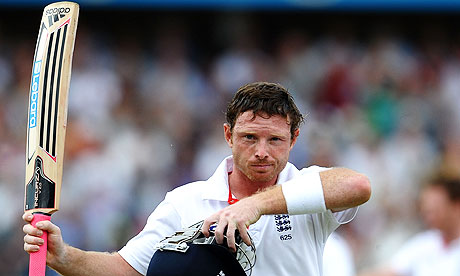
Ian Bell acknowedges the crowd after his second stint at the crease following his reinstatement against India. Illustration: Laurence Griffiths/Getty Images

A question: what connects the increase in 1923 of the cost of brewing licences, the British Army's use of dum dum bullets in the Boer War, modern Toryism, Arthur Balfour's opinions on Tariff reform, the lack of bilingual librettos in modern opera, the refusal of Lancashire mill owners to limit the working hours of their employees, and the theft, in 1921, of 1,000 cigars and a consignment of Trilby hats by the theatrical agent Marmaduke Miller?

The answer is that they were all, according to the Guardian "not cricket".

Unsurprisingly enough given its overuse, the cliche eventually lost its currency. But the myth persists that cricket adheres to a stricter set of ideals than other sports. There are a set of stumps pitched permanently on the moral high ground. And so, when MS Dhoni recalled Ian Bell to the crease last Sunday, the phrase "not cricket" was dragged out and dusted down by a couple of the commentators on Test Match Special.

My friend and colleague Rob Smyth wrote a good little book trying to fathom exactly what the spirit of cricket is. But one of the most telling definitions I've seen recently came from Steve James. "I was captain of Glamorgan for two full seasons and in both we won the MCC's Spirit of Cricket award," he wrote last Sunday. "But I've no idea what we did or what it was for." The spirit, Steve rightly points out, is a morass of contradictions. It is permissible for a batsman to stand his ground if he knows he has touched the ball, but it is a sin for a fielder to claim a catch that has touched the ground. It is against the spirit to "dispute an umpire's decision by word, action or gesture," but the DRS now encourages players to do exactly that.

As the Guardian has proven, it is often easier to point out what the spirit of cricket is not than what it is.
And what it is not has, over the years, encompassed just about everything. One of the earliest appearances of "not cricket" was in the Guardian, back in 1888, in a report of the opening match of the county season between Nottinghamshire and Sussex. "The Notts Committee agreed with the Marylebone Club in their endeavour to put down leg play," we are told. "It was not cricket, said Mr Oates, and people would not come to see play of that kind." Leg play! Perish the thought.

In England cricket first flourished as a game played by blackguards, rogues and gamblers, matches were played outside village inns for vast wagers, and results were bought and sold. It was the Victorians who recast it as an altogether more upright activity. "Not cricket" next crops up in the Guardian in a report of a sermon given by the Venerable Archdeacon Wilson at Rochdale Parish Church on 4 February 1894. "Cricket encourages a love of fair play," he told what we can only assume was an enthralled audience. "It is a moral training that operates far outside the cricket field." As for football, well, "the dishonourableness and ill-temper of its controversies is best described as 'not cricket'."

And yet anyone with even the most cursory knowledge of the way the Grace brothers played the game will know that they committed sins against "the spirit" that went way beyond playing the ball to the leg side.
Back in 1864, for instance, "not cricket" makes its very first appearance in these pages in a report of an incident in a game between Surrey and '18 gentlemen', one of whom was WG's elder brother, Edward. "Finding Jupp holding his ground at the wicket in defiance of the most insidious and trying balls," Grace "resorted to the expedient" of bowling a series of three "full pitch deliveries which culminated at 30 foot high and descended on the wicket at an angle unprovided for in the practice of the game."

Jupp, assuming it was an errant delivery, hit the first of them to leg (gasp!) for two. But then "turned sulkily" away from the next two deliveries and allowed them to take their course. The third of them landed flush on the undefended wicket. "There were bursts of hisses from the spectators, who did not conceal their disapprobation for Mr Grace's bowling. They stigmatised him as an 'old woman' and his bowling as 'no cricket'. "The Sporting Papers took up the question, and numerous correspondents angrily support either side," the report continues. "The main accusation against Mr Grace's new trick is that it is "not cricket". That it is quite legal we may assume, as the umpire did not decide against it."

And there's the rub. To this day there is a tension between the letter and the spirit of the laws. What a team is allowed to do and what we think it ought to do can be two quite different things, and when it comes to winning matches players often prefer to give the first precedence over the second, while the press do the reverse.

When Rob's publisher designed the cover for his book, they chose to use one of the most iconic photographs in the history of cricket: Andrew Flintoff with his arm around Brett Lee in the moments after England's victory at Edgbaston in 2005. And understandably so – for many people it seemed to capture the essence of the spirit of the game.

And yet there are people who worked alongside Flintoff in the England team – who insist on staying off the record – who argue that this was the moment that spoiled him as a cricketer. From that point on, they have told me, he became too obsessed with the public perception of him as 'good old Freddy', the guy who always plays the game in the right spirit. When he was appointed captain for the 2006-07 Ashes, he was too friendly with the opposition, too keen to have a laugh during the game and a beer after it. England even brought in a sports psychologist before the third Test at Perth to try and toughen him up. Flintoff himself hinted at this when he wrote, in the forward to Matthew Hayden's autobiography, that the friendships he developed with the Australians changed the dynamic, bringing "a respectful edge to the proceedings" in the middle.

And so to Trent Bridge last Sunday. Some will always argue that MS Dhoni's decision – prompted, reportedly, by the insistence of Sachin Tendulkar – to recall Bell showed weakness in his team's will to win. Others, myself among them, would say that it was simply an impressive piece of sportsmanship, albeit no more so than Paolo Di Canio's refusal to score in an open net when the former Everton keeper Paul Gerrard was down injured, or Andy Roddick arguing that the line judge was wrong to call Fernando Vedasco on a double fault when he was down match point in the 2005 Rome Masters.

The credit is India's alone. The decision was a testament to their character and sportsmanship, not to the moral superiority of the sport they play. The prattle about other sports learning from India's example seems insufferably pompous coming from a game whose history has been as riddled with controversy as cricket's has.

India Against Corruption - The Second Freedom Struggle

Beware of the Government Lokpal Bill


My dear friend,

I reviewed the Government.s Lokpal bill in great detail. I am deeply concerned and not to mention alarmed with what I learned from it. Government has completely ignored the wishes of the common man and made a mockery of our hard fought struggle for strong anti-corruption laws. I have summarized the most troubling aspects of the government version here and suggested possible steps that everyone of you can take to help in this movement.

We had been demanding that an institution called Lokpal should be set up for central government and a Lokayukta should be set up for each state government through the same Bill. Lokpal would receive and investigate corruption complaints against central government employees and politicians. Lokayukta would do that job in respective states. However, the Cabinet has rejected our demand. Only a few senior-most officers in central government have been brought within the jurisdiction of Lokpal. All officials and politicians in state governments have been left out.

What does that mean?
  • It means that rampant corruption in Panchayat works would continue as it is. Through the use of RTI Act, many people across the country have revealed how payments are routinely made for ghost works. Check dams exist only on paper. List of beneficiaries of various government schemes contain bogus names. Wages of poorest people are denied and siphoned off under NREGA. Social audits in several states have exposed corruption running into thousands of crores in NREGA. Medicines are routinely diverted to black market from government hospitals. Teachers do not turn up in government schools. They pay a part of their salaries to Basic Shiksha Adhikari to mark their attendance. 80% of Rs 30,000 crores of ration subsidy is siphoned off. People living below poverty line are turned away by ration shopkeepers because their rations are diverted to black market. Much of this money reaches the party coffers or the senior-most politicians. All this will continue even after the enactment of government.s Lokpal Bill because all of this is outside its jurisdiction.
  • In cities, roads would continue to break after a few months of being constructed. Flyovers would continue to collapse. Streetlights will still not light up. Parks would continue to remain dilapidated. The builders would continue to fleece ordinary consumers. You would still need to pay bribes to get your passport or income tax refund. Building plan will not be passed without a bribe. Government.s Lokpal Bill does not cover any of this.
  • Adarsh Housing scam is not covered under Government.s Lokpal. Reddy brothers will continue to loot our mines and minerals. Commonwealth Games, Fodder scam, Taj Corridor Scam, Yamuna Expressway scam, Jharkhand Mukti Morcha scam, Cash for vote scam . none of these scams are covered under Government.s Lokpal Bill.
  • Members of Parliament and MLAs would continue to take bribes to ask questions or vote in Parliament and legislative assemblies because Lokpal would not have the powers to investigate them.
  • Prime Minister, Chief Ministers, MPs, MLAs, municipal councilors, sarpanches, judges, all state government employees, all Group B, Group C and group D employees of the central government . all are out of the jurisdiction of Government.s Lokpal Bill.
  • Interestingly, if any citizen makes a complaint of corruption against any official to Lokpal and if it lacks adequate evidence, then as per government.s bill, the citizen would face two years of minimum imprisonment. And the government would provide a free advocate to the corrupt official to file a case against the citizen. But if the citizen is able to prove that the official has indeed indulged in corruption, there is just six months of minimum imprisonment. Therefore, rather than the corrupt and corruption, the government bill is targeted against those who dare raise their voice against corruption. In short, it discourages people from reporting acts of corruption!
  • 13 people, who had dared to raise their voice against corruption, were murdered in the last one year. We had demanded that Lokpal should have the powers and duty to provide protection to such people. Government Bill does not have any such provision.
  • Government has retained its control over CBI. So, CBI would continue to avoid taking action against a future Raja until Supreme Court admonished them. Accounts of Quattrochis would continue to be defrozen in secrecy against national interests. CBI would continue to be used to arm twist Mayawatis, Laloo Yadavs, Jayalalithas and Mulayam Singhs into submission. Corruption money would continue to be siphoned off to Swiss accounts.
  • Government.s Lokpal Bill is also unconstitutional. Prime Minister does not enjoy any immunity from investigations under the constitution. Exclusion of Prime Minister from Lokpal Bill is unconstitutional.
  • Selection and removal of Lokpal members will be completely in the control of the government. Out of 9 member selection committee, five will be from ruling establishment, thus effectively giving powers in the hands of the government to appoint the most corrupt, pliable and politically loyal people as Lokpal members.
  • High Courts and Supreme Court would continue to take more than 20 years to dispose appeals in corruption cases because our plea to set up special benches to hear such appeals has also been turned down.
Government says that there are 1.25 crore government employees in the country. Government refuses to bring them under Lokpal Bill because it would need large number of anti-corruption staff to keep a check on them. Isn.t that an absurd excuse? India is a huge country. Obviously, it has large number of employees. Can the government leave them unchecked and allow them to loot the people and the country? Under law, corruption is a crime . as heinous as murder or rape. If tomorrow, the incidence of murders or rapes increases as much as we have corruption now, would the government turn around and say that this country has 120 crore population and since they would need large number of policemen to check crime, they would not do it?
The country seems to be in the clutches of highly corrupt people. It has been reported that in the Cabinet Meeting, the Prime Minister, including some of his other Cabinet colleagues, kept pleading that PM be included within the Lokpal Bill. However, the corrupt within the Cabinet had the last say. The Prime Minister was rendered helpless, though one wonders the reasons for his helplessness.

What are our options? Some people feel that Anna is unreasonable. They say that an indefinite fast is a brahmastra and should be used as a last resort. Haven.t we already reached the end of the road?
Friends, I must confess that the road ahead is extremely challenging. Government is on a path to try and crush the movement at any cost. We need the active participation of every single Indian in order to fight back. If the Government.s bill becomes law we are literally gifting our country to the corrupt people to further plunder our resources.

Like I have said before its now or never.

Let every citizen in this country take one week.s off from his normal work from 16th August, the day Anna starts his indefinite fast, and take to the streets . in front of his house or at the crossings or in parks . with a tricolor in his hands shouting slogans against corruption. Let students take off from their schools and colleges. Let everyone take to streets. If this happens, we will achieve our goal within a week. Government can crush one Anna but it cannot crush 120 crore Annas. Government can impose section 144 on one jantar mantar. But it cannot impose a curfew on the whole country.

Can we count on you support to participate in one final attempt to save our country from the corrupt?

Arvind Kejriwal

Tuesday, 2 August 2011

The relentless pursuit of productivity is socially divisive, environmentally destructive and doesn't make us any happier

Happiness: the price of economic growth


  • Family cycling along heathland tracks in Dorset
    Family and friends ranked highest in a survey of what mattered most to people. Photograph: Alamy
    Last week, on the same day that we learned economic growth in the UK was running at a miserly 0.2%, the Office for National Statistics launched a new programme of work on measuring human well-being. The latter was the result of a month-long survey in which the public were asked what mattered to them. To barely disguised yawns, the answers that came back were, "family, friends, health, financial security, equality and fairness in determining well-being", according to national statistician Jill Matheson. So we were caught on one hand between a low-grade, generalised fear that people weren't buying enough stuff to keep the economy going, and being told on the other hand something we already knew deep down: that a better quality of life stems not from consuming more, but from a range of mostly immaterial things. Crucially, in a society like the UK, enjoyment of these does not correlate in any positive, straightforward manner with economic growth. On the contrary, some policies used to promote growth can directly undermine a range of the factors that do contribute to well-being, such as the time we need to spend with family, health, equality and fairness. Depending on how it is pursued, economic growth can be jobless, socially divisive and environmentally destructive. It can, in other words, be "uneconomic growth". In a quite extraordinary intervention, as part of the government's desire to cut spending on public services, Oliver Letwin, the coalition's policy minister, recently suggested that "fear" of losing your job should be used to increase the productivity of workers. This approach appears to be wrong on so many levels that I first thought it had to be a spoof. It will do nothing for growth; it chronically misunderstands how to get the best out of people; it contradicts the prime minister's own public conversion to the importance of well-being at work and, perhaps most importantly, it misunderstands real productivity. In professions like health and education, if you drive out costs (ie people) you get a worse service. Quality of care and nurturing depends to a huge degree on attentive human contact in a convivial context. Subject people to old-fashioned Taylorist production-line management, coupled with the intimidation of a threatened job loss, and nobody wins. It is wrong, also, because buried in this conundrum, may also be the secret of how, in the long term, we align our livelihoods and lifestyles with the limited planet on which we depend. This is about designing an economy of better, not more. And that suggests fundamentally rethinking what we mean by efficiency and productivity. An economy that is more based on services, and in which we are sharing, repairing, recycling, reusing, learning, collaborating and coproducing services (that's the jargon, at any rate – it just means give and take) is one in which, ultimately, we may have more people doing fewer things in formal paid employment. In that context, we might have more time for "family, friends, health", and all the things that do add to our well-being. The big objection is that growth is needed for jobs, and that these are what we need for financial security. On one level, yes, of course. However, financial security is also a function of equality and fairness, and given other economic problems (such as that many of the jobs created in a push for growth alone do not deliver financial security) as well as environmental constraints, there may be more reliable paths to find security. Inequality both creates insecurity and raises a society's costs in relation to health problems, crime and almost everything else. Redistribution of income and access to employment, therefore, compared with generalised, unequal and resource-hungry growth, can be quicker, less destructive and a more effective way of delivering security. A sensible approach to enhance economic activity in a way that met many needs would be to take Vince Cable's suggestion of another round of quantitative easing, but instead of just spraying a general injection of cash via the banks (who take a cut) into the economy, to channel it into the productive low-carbon economy – a sort of green easing. Sadly, that doesn't look likely to happen any time soon. For now the captain of this ship insists we're all heading south, when there are all kind of indicators telling us that our real needs can only be met by going north.

The debt deal will hurt the poorest Americans, convinced by Fox and the Tea Party to act against their own welfare

Debt deal: anger and deceit has led the US into a billionaires' coup


  • Daniel Pudles
    Illustration by Daniel Pudles
    There are two ways of cutting a deficit: raising taxes or reducing spending. Raising taxes means taking money from the rich. Cutting spending means taking money from the poor. Not in all cases of course: some taxation is regressive; some state spending takes money from ordinary citizens and gives it to banks, arms companies, oil barons and farmers. But in most cases the state transfers wealth from rich to poor, while tax cuts shift it from poor to rich. So the rich, in a nominal democracy, have a struggle on their hands. Somehow they must persuade the other 99% to vote against their own interests: to shrink the state, supporting spending cuts rather than tax rises. In the US they appear to be succeeding. Partly as a result of the Bush tax cuts of 2001, 2003 and 2005 (shamefully extended by Barack Obama), taxation of the wealthy, in Obama's words, "is at its lowest level in half a century". The consequence of such regressive policies is a level of inequality unknown in other developed nations. As the Nobel laureate Joseph Stiglitz points out, in the past 10 years the income of the top 1% has risen by 18%, while that of blue-collar male workers has fallen by 12%. The deal being thrashed out in Congress as this article goes to press seeks only to cut state spending. As the former Republican senator Alan Simpson says: "The little guy is going to be cremated." That means more economic decline, which means a bigger deficit. It's insane. But how did it happen? The immediate reason is that Republican members of Congress supported by the Tea Party movement won't budge. But this explains nothing. The Tea Party movement mostly consists of people who have been harmed by tax cuts for the rich and spending cuts for the poor and middle. Why would they mobilise against their own welfare? You can understand what is happening in Washington only if you remember what everyone seems to have forgotten: how this movement began. On Sunday the Observer claimed that "the Tea Party rose out of anger over the scale of federal spending, and in particular in bailing out the banks". This is what its members claim. It's nonsense. The movement started with Rick Santelli's call on CNBC for a tea party of city traders to dump securities in Lake Michigan, in protest at Obama's plan to "subsidise the losers". In other words, it was a demand for a financiers' mobilisation against the bailout of their victims: people losing their homes. On the same day, a group called Americans for Prosperity (AFP) set up a Tea Party Facebook page and started organising Tea Party events. The movement, whose programme is still lavishly supported by AFP, took off from there. So who or what is Americans for Prosperity? It was founded and is funded by Charles and David Koch. They run what they call "the biggest company you've never heard of", and between them they are worth $43bn. Koch Industries is a massive oil, gas, minerals, timber and chemicals company. In the past 15 years the brothers have poured at least $85m into lobby groups arguing for lower taxes for the rich and weaker regulations for industry. The groups and politicians the Kochs fund also lobby to destroy collective bargaining, to stop laws reducing carbon emissions, to stymie healthcare reform and to hobble attempts to control the banks. During the 2010 election cycle, AFP spent $45m supporting its favoured candidates. But the Kochs' greatest political triumph is the creation of the Tea Party movement. Taki Oldham's film (Astro)Turf Wars shows Tea Party organisers reporting back to David Koch at their 2009 Defending the Dream summit, explaining the events and protests they've started with AFP help. "Five years ago," he tells them, "my brother Charles and I provided the funds to start Americans for Prosperity. It's beyond my wildest dreams how AFP has grown into this enormous organisation." AFP mobilised the anger of people who found their conditions of life declining, and channelled it into a campaign to make them worse. Tea Party campaigners take to the streets to demand less tax for billionaires and worse health, education and social insurance for themselves. Are they stupid? No. They have been misled by another instrument of corporate power: the media. The movement has been relentlessly promoted by Fox News, which belongs to a more familiar billionaire. Like the Kochs, Rupert Murdoch aims to misrepresent the democratic choices we face, in order to persuade us to vote against our own interests and in favour of his. What's taking place in Congress right now is a kind of political coup. A handful of billionaires have shoved a spanner into the legislative process. Through the candidates they have bought and the movement that supports them, they are now breaking and reshaping the system to serve their interests. We knew this once, but now we've forgotten. What hope do we have of resisting a force we won't even see? • A fully referenced version of this article can be found on George Monbiot's website. On Twitter: @GeorgeMonbiot

Why do political leaders stride into the same trap, even having witnessed the fate of those who went before them?

Steve Richards: History repeats itself in Libya


Tuesday, 2 August 2011 in The Independent
 
Some of the best thrillers depend on the audience knowing in advance that a deadly outcome is unavoidable. We sit, watch and wait, gripped with fear as the inevitable end looms. And often the characters suspect they are making the wrong moves but cannot stop themselves from doing so.

The same pattern applies in politics. Governments tend to make the same colossal mistakes as their predecessors. Leading figures recognise the errors when they were committed the first time around but then proceed to make a similar set of misjudgements. It's as if they are trapped by dark forces beyond their control.

This is what has happened with David Cameron's response to the crisis in Libya. He watched the first time around, recognised the mistakes and repeated them. The invasion of Iraq was on a much bigger scale and conducted without the support of the UN. Nonetheless, there are precise parallels with Libya. George Bush and Tony Blair invaded Iraq without having a clear outcome in mind. Their official war aims as far as they were specified did not include the removal of Saddam, although that was the outcome they hoped for.

Both leaders assumed that Iraqis would welcome them as liberators and that democracy would follow. As with the earlier war in Afghanistan, Blair declared that financial costs would be relatively low. In the build-up to Iraq, most newspapers hailed Blair for his political courage, even though he was siding with the most powerful military force in the world against an ageing tyrant. We know what followed.

More importantly, David Cameron knew what followed. Friends of Cameron insist he had deep doubts about the war in Iraq at the time, although he voted for it. Later, as Leader of the Opposition, he made one of his best speeches, during which he argued that a lesson of Iraq was that countries could not be bombed into democracy. With Cameron it is not always easy to judge whether he meant what he said or was seeking crudely to widen his party's appeal by belatedly marking distance for Iraq. Still, that was what Cameron argued, in an extensively briefed speech. I recall talking to him at length about it at the time. We must presume he recognised complexity and nuance as the calamity of Iraq unfolded.

Yet earlier this year Cameron rushed to the Commons to make an emergency statement. He supported a no-fly zone over Libya and had taken the lead in securing it. The aim was to protect the Libyans but he hoped the outcome would be the removal of Gaddafi, although this was not an objective. The cost would be a few million pounds. In large parts of the media Cameron was hailed for his leadership and courage.

A few months later and we are in another familiar phase of the pattern. The dictator is still there. The alternative might well be as unsavoury. Questions are being asked about why military action is taken in Libya, but not in Syria.

Here the Defence Select Committee estimates the costs of the campaign have exceeded early predictions and have already risen to beyond £200m. There is no end to the conflict in sight, so that figure will continue to rise. The same committee calculates that the cost of Afghanistan to the UK Government has been at least £18bn and it is probably a lot more than that.

Cameron and George Osborne argue that spending went out of control in the early years of this century. They may have a case, but in terms of the specifics they supported all the areas where expenditure rose. One of them was the cost of fighting major wars. Here we go again.

Why do political leaders stride into the same trap, having resolved not to do so when witnessing the fate of those that went before them? Cameron is not the first to do so. On the domestic front in the 1970s there was a similar eerie pattern. Ted Heath got into fatal difficulties as he attempted to impose a pay policy. His opponent, Harold Wilson, was scathing until he won an election. Shortly afterwards, he also imposed one. Jim Callaghan was also sceptical but succumbed in the same way and was brought down by it. In the end, all three Prime Ministers followed the same deadly route having resolved not to do so. They could see no alternative. They were too scared of breaking with corporatist orthodoxy. Having been brought up politically in the 1930s, they feared the social and economic consequence of high unemployment.

On Libya Cameron could see no alternative. He feared a slaughter. He is the heir to Blair and as he contemplated what to do about Libya, he reflected on his hero and what he would have done. Cameron was brought up politically at a time when Britain deployed military force without asking too many awkward questions. Now he is trapped, just as the leaders in the 1970s were in relation to their economic policies.

I make no prescription as to what outsiders can do to tame selected tyrants but we know from recent conflicts what does not work. Or do we? We are about to do so. Orthodoxies change and leaders learn, but after knowing the risks involved, they still make the same miscalculations as those who preceded them.

Saturday, 30 July 2011

Indian win even though they fail at Tebbit's cricket test

Norman Tebbit's cricket test means nothing when you're winning

Combined with its team's prowess on the field, India's economic clout has turned the tables on the old colonial master
  • cricket india england lords
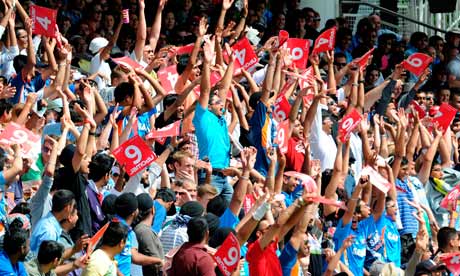
    The incredible atmosphere at Lord's on Monday was due in part to thousands of British Indians cheering the India cricket team. Photograph: Anthony Devlin/PA
    The game of cricket should be thankful that so many British Asians continue to fail Norman Tebbit's "cricket test". In one of his less helpful contributions to social harmony, the old polecat suggested in 1990 that the side that ethnic minorities cheer for – England or their country of origin – should be a barometer of whether they are truly British. But what swells the gates and gives the current Test series against India an atmosphere that rivals the Ashes is the presence, particularly at Lord's on Monday, of thousands of British-based Indians cheering Sachin Tendulkar, Rahul Dravid, VVS Laxman, MS Dhoni and other stars of the visiting team. Significantly, Tebbit directed his barb at Asians, not at Britons of Caribbean descent. The latter presumably pass his test, most having long ago lost interest in cricket and, like everybody else, become obsessed with those unimpeachably English institutions (not), Manchester United and Chelsea. Black people are now hardly seen at English cricket grounds and the West Indies team, once the game's biggest draw and a source of pride and inspiration to African-Caribbean people, is regarded as poor box-office material, usually invited to play here before sparse crowds on rainswept days in May. It is not, however, just memories of Tebbit that give this series its political edge. India is currently the master of the game. On the field, it stands at the top of the world rankings, though England hope, in a few weeks, to have usurped that position. More importantly, India increasingly controls how the game is governed and organised. It generates 70% of world cricket revenues and doesn't hesitate to exercise the power and influence that brings. Though the Dubai-based International Cricket Council (ICC) is nominally in charge, it rarely defies Indian wishes, just as it didn't defy the wishes of the English, as expressed through the Marylebone Cricket Club (MCC), in the days when it was based at Lord's and called itself the Imperial Cricket Conference. It has declined, for example, to rule that ball-tracking technology should be used in all Test matches to review umpires' decisions. The Indians, for obscure reasons, don't like it and that, as far as the ICC is concerned, is that. India's power is most evident through the Indian Premier League, a Twenty20 competition between city-based teams with names such as Delhi Daredevils and Royal Challengers Bangalore, which, for a few weeks annually, attracts nearly all the world's best players by offering previously unimaginable sums of money. Some players no longer bother with longer forms of the game such as Test matches, and concentrate entirely on lucrative IPL contracts. The titled gentlemen of Lord's – who invented Twenty20 to entice English proletarians into cricket grounds and thus rescue ailing county clubs – think this a desecration of cricket's true, Corinthian spirit. But the millions of Mumbai and Chennai, who now rarely turn up to watch Tests, have fallen in love with Twenty20 and, much as the purists may object, that and other short forms of cricket will probably dominate in future. So, the tables have turned. Just as the English once used cricket to assert the ideology of empire – to play the game honourably, said Lord Harris, governor general of Bombay and a former captain of Kent, "is a moral lesson in itself" – so Indians now use it to assert the brash, go-getting, commercial values of the new, upwardly mobile India. It is not, it must be admitted, a particularly pretty sight, but then nor was the period of English hegemony. When the Australians were getting uppity in the 1930s, cheekily putting tariffs on British cricket balls and other goods, the English establishment concocted bodyline bowling to teach them a lesson. The Australians responded with accusations of "unsportsmanlike" behaviour – a judgment which, in the MCC's view, it alone was qualified to make – and threats to leave the empire. Without admitting its own culpability, the MCC settled the matter by blaming it all on Harold Larwood, the Nottinghamshire miner who carried out the instruction to bowl fast at Australian bodies. He was driven from the game and ultimately into exile (in Australia, ironically). Even worse was the MCC's record not only of playing all-white South African teams – cricket being racially segregated even before the advent of official apartheid – but of contriving to omit anyone with a non-white skin from English touring teams there. As the recently released film Fire in Babylon recalls, West Indians once used cricket for black self-assertion. In a Britain that seemed to regard West Indians as nothing but "a problem", recalled the black writer Caryl Phillips, "the West Indies team … appeared as a resolute army, with power and creative genius in equal measure". For 15 years, the West Indies dominated world cricket. But those poor islands lacked the economic muscle to carry their dominance into cricket's corridors of power. India's success, on and off the field, is the most palpable evidence of its rising global status. Whatever the outcome of the present series, India, unlike the West Indies, will continue to matter. No wonder British Indians don't care about Tebbit's test. They are backing winners.