Search This Blog

Thursday, 5 June 2014

The Indian Pharmaceutical Sector


By Jill E. Sackman, PhD,Michael Kuchenreuther

Biopharma companies should not overlook India's growing market.

ABHIJITMORE/ROOM/GETTY IMAGES
Recognizing that emerging markets continue to play a significant role in terms of future growth, most major pharmaceutical companies have accelerated efforts to strengthen their presence within these markets through R&D investment, licensing deals, acquisitions, or other partnerships. However, with global markets facing dynamic demographic and disease trends, changing market demands, and evolving regulatory requirements, it has been hard for manufacturers to devise the strategies needed for success in each of these areas.


India, a member of the BRIC nations (Brazil, Russia, India, and China), is much more comparable to the United States in terms of market size and must be included in this list of promising potential markets for global pharmaceutical manufacturers. Recent changes in India’s population and economy have contributed to a shift in the country’s epidemiological profile towards ‘lifestyle’ diseases that are more prevalent in Western markets. Such changes have increased the demand for better healthcare and for medications that address chronic diseases. Furthermore, India’s own pharmaceutical industry, a recognized world leader in the production of generic drugs, offers manufacturing expertise to organizations looking to outsource or create networks of collaboration and discovery. However, a more granular assessment of India’s pharmaceutical market reveals growing concerns over patent protection, price capping, quality, and safety. Understanding this country’s complex market dynamics will be crucial for manufacturers exploring new opportunities for growth in India.

India health and pharmaceutical market overview

India is the second most populous country in the world with about 1.27 billion people, and is projected to surpass China by 2028 (1). As the Indian population has continued to grow in recent years, so too has the country’s economy. Over the past decade, India’s economy grew above the Organization for Economic Co-operation and Development (OECD) average, which can be attributed to rising average income levels, an expanding middle class, and a drive toward urbanization (2). These socio-economic changes are contributing to a significant shift in India’s epidemiological profile. With working-age adults accounting for the majority of the overall population and more people becoming affluent and living longer, Indian health service users are facing increasing challenges associated with the prevention and treatment of chronic diseases such as obesity, heart disease, stroke, cancer, and diabetes (3).

At the same time, India continues to be challenged by a range of infectious disorders. Despite economic advancements, significant income inequality still exists throughout the country. In fact, per capita gross national income in India was only $3,391 in 2012 when adjusted by purchasing power parity (compared to $50,000 in US) (4).  In rural areas, where two-thirds of the nation’s citizens are located, hundreds of millions of people are still living in severe poverty, and vaccination coverage for children remains poor.


RELATED CONTENT


Global Instability Affects the Pharma Market in Brazil1

The Affordable Care Act's Impact on Innovation in Biopharma2

More Global Report Topics3
Taken together, this high incidence of infectious and chronic disease and the large number of disadvantaged communities have created an even greater need for patient access to quality healthcare delivery as well as new and innovative therapeutic products. Historically, India has had one of the world’s lowest levels of health spending as a proportion of gross domestic product (GDP). In 2011, India’s total health expenditure was 3.9% of GDP (public expenditure was only 1.2% of GDP) compared to 10.1% of GDP, an average across all G-5 countries (4). The lack of government funding in healthcare has led to significant gaps in the quality and availability of public facilities and has pushed an increasing proportion of Indian patients to use private healthcare facilities that are associated with high costs. Where other countries have a well-established insurance sector that seeks to reduce this economic burden, health insurance in India is still in its infancy.

Approximately 243 million people are covered by different forms of government-sponsored insurance schemes while approximately 55 million rely on commercial insurers (5). With the vast majority of people in India uninsured, out-of-pocket payments are among the highest in the world. According to the World Health Organization (WHO), 70% of Indians are spending their entire out-of-pocket income on medicines and healthcare services (6). On top of this, most insurance plans only provide coverage for inpatient healthcare services and do not include coverage for outpatient treatments, including prescription medicines. Thus, it is no surprise that approximately 90% of India’s pharmaceutical market is currently made up of branded generic drugs (7).

Against this backdrop, India’s Ministry of Health has been focused on improving access to healthcare facilities, increasing population coverage by way of healthcare insurance, and creating initiatives for the prevention and early stage management of chronic diseases. In 2012, as part of the country’s 12th Five-Year Plan, the government proposed to double its public expenditure on healthcare to 2-3% of GDP in an effort to boost local access and affordability to quality healthcare. In light of these efforts, the Indian healthcare industry as a whole is expected to reach $158 billion by 2017 (8).
India’s pharmaceutical market accounts for about 10% of the global pharmaceutical industry in terms of volume and represents a major component of growth for the country’s healthcare industry (9). The Indian pharmaceutical market was estimated at $18.4 billion in 2012 and is expected to almost double by 2016. Although India’s market is currently dominated by generic drugs, rising incomes, enhanced medical infrastructure, and insurance coverage could provide a valuable opportunity for manufacturers’ higher-priced branded healthcare products moving forward.  

Key market challenges and considerations

Regulatory. Similar to many other countries, India’s medical regulatory structure is divided between national and state authorities. The Drug Controller General of India (DCGI) is the national authority responsible for the regulation of pharmaceuticals. The DCGI registers all imported drugs, new drugs, and biologicals in selected categories and has responsibility for approving clinical trials and quality standards in the country. Recently, these standards have come under question by FDA, citing quality-control problems ranging from data manipulation to sanitation. While FDA and regulatory bodies in other countries step up inspections of Indian plants in response to these developments, global manufacturers have had to reassess their contracted relations with these plants and give careful consideration to developing new strategic partnerships in this country moving forward (10).  

Concerns over quality and data integrity have also impacted manufacturers’ perception of India’s clinical trials system. India’s large and diverse patient pool and low drug trial costs have made the country an attractive destination for multinational pharmaceutical clinical trials. However, India has recently seen the number of clinical trials fall dramatically among allegations that protocols were not being conducted properly and that companies were taking advantage of disadvantaged patients (11). In response to these developments, manufacturers have been forced to either shift their trials to another country or encounter significant delays in clinical trial approval--both of which are holding their organizations back.

Market access and pricing. The high prevalence of self-pay generic drugs throughout the country has created little incentive for the development of certain market access disciplines such as health economics and outcome research (HEOR) and reimbursement. Government affairs and pricing functions, on the other hand, play an important role and have been broadly cited as the most crucial challenges global manufacturers face in the Indian marketplace.

India’s National Pharmaceutical Pricing Authority (NPPA) controls product pricing throughout the country. In 2013, the NPPA expanded the National List of Essential Medicines (NLEM) to include 652 drugs, a substantial increase over the 74 drugs previously listed. These products will now be subject to price controls that are projected to reduce prices by more than 20% for half the drugs (12). As if this did not challenge manufacturers enough, the Indian government recently decided to revise the NLEM later this year in response to complaints that the list should include all dosages, strengths, delivery mechanisms, and combinations of these previously identified drugs (13). The NPPA is also allowed to control prices of patented drugs that lie outside this list, and last month the government began exploring the possibility of using a reference pricing system for these products (14).  With intense generic competition already driving down drug prices in India, these additional controls pose a significant threat to international manufacturers’ ability to generate revenue.

Intellectual property. Aside from pricing, patent protection has also come under the microscope as of late. In an effort to ensure greater accessibility to higher-cost, branded drugs, India, as well as other BRIC countries, has begun to allow generic-drug manufacturers to market these drugs at dramatically reduced costs without consequence through compulsory licenses.  While only one compulsory license has been approved by India’s government to date (Bayer’s Nexavar), other manufacturers have recently had their patents weakened, revoked, or rejected. While appeals to some of these rulings are still in process, precedents have been set, leading manufacturers to question their future investment in India.

Implications for successful market entry 

Despite the aforementioned challenges, major pharmaceutical companies recognize the long-term prospects of this market and continue launching new patented drugs and pursuing unique business opportunities in India. To encourage future investment, the government has made tax breaks available to the pharmaceutical sector, including a weighted tax deduction of 150% for any R&D expenditure incurred. In addition, the government recently declared that all drugs that offer some form of innovation would be exempt from price regulation for the first five years following approval. Here, innovation refers to drugs or drug delivery systems that arise from native R&D efforts or existing drugs that are improved upon by an Indian company. This measure is aimed to spur growth in the domestic pharmaceutical market and to ensure that pricing regulations do not turn global manufacturers away from India. Thus, companies that develop strategic partnerships with local businesses and outsource some of their R&D and manufacturing activities will be well-positioned to maximize revenue by avoiding steep price cuts. This opportunity for manufacturers will only apply, however, for those products that offer true innovation by providing economic and/or clinical value.

Uncertainty over patent security and obstacles to clinical trials are discouraging Western companies from conducting drug research in India. With that said, the government has already initiated clinical research reform efforts through new amendments and regulations that could quickly restore the growth of clinical trials throughout the country.  At the same time, there is speculation that a transfer of power in India’s upcoming election could dampen fears of additional compulsory licenses (15). Manufacturers should closely monitor these internal developments and react accordingly.

Moving forward

A growing middle class that is projected to see a significant rise in noncommunicable diseases provides an excellent opportunity for global companies to launch their premium products and expand their market share. India’s underdeveloped insurance industry and high poverty rates, however, require that manufacturers first develop a careful pricing strategy. Pricing products appropriately can go a long way towards ensuring future growth as well as avoiding disputes over patent protection and licensing agreements.  In a country that holds about one-fifth of the world’s population, India’s market is too big for pharmaceutical companies to shy away from, despite all of the hurdles placed in front of them.  
I feel for Sachitra Senanayake

by Girish Menon

When the English mob and commentators unleashed their self righteous 'spirit of cricket' indignation on Sachitra Senanayake I felt the need to find out more about this unheard of cricketer who has caused a minor tempest in England's favourite brew container.

So, I looked up his career stats to find out that Sachitra is 29 and had already played 1 Test, 34 ODIs and 17 T20Is. I also learnt that prior to his 'Mankadding' of Buttler, in earlier ODIs of the current series he had been reported for a faulty action and asked to report to Perth for a bio-mechanical examination about the degree of flex in his action.

I happened to listen to Test Match Special (TMS) at the time of Sachitra's Mankadding incident and at the time the commentators were insistent that Sachitra had not warned Buttler earlier before running him out.  The commentators also alleged that English bowlers, unlike Sachitra and Murali before him, were unable to bowl the doosra since it would be ironed out by coaches at the junior stages itself.

Personally, I feel any bowling action which does not threaten the life of a batsman should be permitted. This will balance the equation between bat and ball and make for interesting cricket.  

In his book Lila, Robert Pirsig describes the English reaction when the first stuffed platypus was shipped there. At first, the traditionalists were aghast that nature had betrayed their classification. Also, they denied that platypi could lay eggs and then suckle their young. The traditionalists also tried to ban the platypus out of existence since it did not meet their classification code. It was only much later that the traditionalists accommodated  the platypus in the field of biology. 

At 29, Sachitra may feel like the stuffed platypus on its arrival in England. After investing so much time and effort in developing his skill, he is now being told that if he does not obtain a clearance from an Australian he will not be allowed to ply his trade.  England may or may not have had a role in the reporting of Senanayake, but surely this could have been done discreetly at the end of the series so that the Sri Lankan team would not be compromised in the middle of the tour. Isn't this a case of giving the home team an unfair advantage?

Yet, when Sachitra legitimately runs out Buttler after warning him twice against cheating, the umpires had the audacity to ask the Sri Lankan captain whether he wished to withdraw the appeal. The crowds aroused by a partisan TMS commentariat then boo the Sri Lankans and Sachitra in particular.


So, Sachitra you are not alone. I empathise with your situation. I also hope that you have an alternative career mapped out for I am not aware of any cricketer who has retained his wicket taking skills after his action has been re-modelled. So power to you.

Where is the cheapest place to buy citizenship?

 By Kim Gittleson


It is a cliche used from Bond to Bourne: the classic spy image of a suitcase filled with cash and multiple passports for a quick getaway. But increasingly it is not spies that are looking for a second passport, but a growing number of "economic citizens".
Henley and Partners citizenship expert Christian Kalin, who helps to advise clients on the best place to spend their money, estimates that every year, several thousand people spend a collective $2bn (£1.2bn; 1.5bn euros) to add a second, or even third, passport to their collection.
"Just like you diversify an investment portfolio, you want to diversify your passport portfolio," he says. The option has proven popular with Chinese and Russian citizens, as well as those from the Middle East.
Cash-strapped countries have taken notice. In the past year alone, new programmes have been introduced in Antigua and Barbuda, Grenada, Malta, the Netherlands and Spain that either allow direct citizenship by investment or offer routes to citizenship for wealthy investors.
However, concerns have been raised about transparency and accountability.
In January, Viviane Reding, vice-president of the European Commission, said in a speech: "Citizenship must not be up for sale."
But for now, at least, it seems that those with money to spare are in luck, with half a dozen countries offering a direct citizenship-by-investment route with no residency requirements.
Essentially, citizenship that is very much for sale.
Dominica
By far the cheapest deal for citizenship is on the tiny Caribbean island of Dominica.
For an investment of $100,000 plus various fees, as well as an in-person interview on the island, citizenship can be bought.
However, experts caution that because the interview committee meets only once a month, actually getting a Dominican passport can take anywhere from five to 14 months.
Since Dominica is a Commonwealth nation, citizens get special privileges in the UK, and citizens can also travel to 50 countries, including Switzerland, without a visa.
St Kitts and Nevis
The Caribbean islands of St Kitts and Nevis have the longest running citizenship-by-investment programme (CIP) in the world, which was founded in 1984.
There are two methods to obtain citizenship, with the cheapest option being a $250,000 non-refundable donation to the St Kitts and Nevis Sugar Industry Diversification Foundation, a public charity. A second option involves a minimum $400,000 investment in real estate in the country.
The programme has recently been singled out by the US Treasury, which cautioned that Iranian nationals could be obtaining passports and then use them to travel to the US or make investments, which could violate US sanctions. (St Kitts closed its programme to Iranians in December 2011.)
However, Mr Kalin of Henley and Partners, which helped to set up the programme, says that while the programme has its issues, "St Kitts is relatively well run - it's in a way a model."
He adds that Caribbean locations are good for interim passports for "global citizens" who are looking to eventually establish themselves via investments in other "economic citizenship" programmes like those in Portugal or Singapore.
Antigua and Barbuda
Antigua and Barbuda introduced its CIP in late 2013, with similar parameters to the St Kitts model: a $400,000 real estate investment or a $200,000 donation to a charity.
In a speech announcing the programme, Prime Minister Baldwin Spencer cited a common reason that countries have increasingly introduced CIPs: an economic slowdown and "the virtual disappearance of traditional funding sources".
He cited both the St Kitts example as well as the United States, which allows foreigners to obtain a green card under the EB-5 visa if they invest $500,000 in a "targeted employment area" and create 10 jobs. (Since 1990, foreigners have invested more than $6.8bn and the US has given out 29,000 visas through the EB-5 programme, although there is a yearly cap of 10,000.)
However, Mr Spencer also said: "The Antigua and Barbuda Citizenship by Investment Programme is not an open-sesame for all and sundry."
Malta
"Citizenship-by-investment programmes are certainly on the rise, especially in Europe," says University of Toronto law professor Ayelet Shachar.
The tiny nation of Malta recently came under fire when it announced plans to allow wealthy foreigners to obtain a passport for a 650,000 euro investment with no residency requirement, which would have made it the cheapest European Union (EU) nation in which to purchase citizenship.
Prime Minister Joseph Muscat estimated about 45 people would apply in the first year, resulting in 30m euros (£24m; $41m) in revenues.
After pressure from EU officials, officials changed the rule to require potential passport holders to reside in Malta for a year and raised the investment to 1.15m euros.
The uproar exposed rising tensions over the definition of citizenship, according to Prof Shacher.
"At stake is the most important and sensitive decision that any political community faces: how to define who belongs, or ought to belong, within its circle of members," she says.
"The heft of the applicant's wallet is the new answer, according to citizenship by investment programmes. This is in breach of our standard naturalisation and citizenship requirements that focus on establishing a genuine link between the individual and the new home country."
Cyprus
Cyprus is the other EU nation to offer a direct citizenship-by-investment route.
The cost of the programme was slashed to 2m euros in March, partially in an effort to placate mostly Russian investors who lost money when Cyprus was forced to accept a strict European Union bailout.
(The 2m euro figure applies when one invests as part of a larger group whose collective investments total more than 12.5m euros; an investment of 5m euros in real estate or banks is still required for an individual.)
But Mr Kalin cautions against a Cypriot investment, noting that the programme initially cost 28m euros, then 10m euros, then 5m euros.
"It's a good example of how not to do it - you bring a product to market and totally misprice it and it gets cheaper every six months. It is ridiculous," he says.

Wednesday, 4 June 2014

Meritocracy is a myth

James Bloodworth in The Independent

What do you want to be when you grow up? I remember a careers advisor asking me just that question shortly before my sixteenth birthday. Like most of my peers I had very little idea as to what I wanted to do with my life when the seemingly endless horizon of school came to an end. Drink beer, smoke cigarettes and chase girls was about the sum of it.
Looking back, though, the question was a strange one. We insist on asking children what they want to do with their lives when most of the time it’s set in stone when they pull on their first school uniform. If they are born poor they will almost certainly stay poor; if their parents have money then it’s likely that they will too. The more unequal a society is the truer this statement becomes. 
Yes we insist on telling children that they can be ‘whatever they want to be’, knowing full well that crushing disappointment lies further in their future. Every nation relies to some extent on fairy tales. In Britain we cling to the idea that you can be or do anything in life so long as you put your mind to it. In the process we hand our politicians the one thing they can use to justify the obscene privileges at the top and the revolting squalor at the bottom: the indomitable myth of meritocracy.
Meritocracy is what’s politely called a dead duck. A child from a ‘modest’ background can only go from rags to riches in the sense that a human being can take off if they flap their arms around wildly enough. A disadvantaged child will nearly always and everywhere become a disadvantaged adult, and if you ignore the right-wing rhetoric and look at the data you might be a little less keen on hearing the 'M' word in future.
The children of wealthier parents are more likely to go to the best schools (houses in desirable catchment areas cost on average 42 per cent more), eat the best food, have access to ‘high culture’ and have a quiet place to do homework when they get home from school. As a result, poor but bright children get overtaken by their less intelligent classmates from wealthier backgrounds in the very first years of schooling, according to a 2007 study. 
As children become teenagers these inequalities are entrenched further. Around 10 per cent of young people at the bottom rung of the social ladder go to university compared with over 80 per cent of those from professional or managerial backgrounds. A student from a private school is 55 times more likely to go to Oxford or Cambridge University than a state school student on free school meals. And as universities minister David Willetts likes to point out, graduates will earn around £100,000 more over a lifetime than non-graduates.
Thomas Piketty’s ground-breaking book Capital in the 21st Century looks at how wealth concentrates when the returns on capital are higher than economic growth. Or in plain English, how it’s easier for a person who already has lots of money to make more of it. But it isn’t only wealth that concentrates; opportunity does too. Or as Picketty’s predecessor Karl Marx put it, “men make their own history, but they do not make it as they please; they make it…under circumstances…given and transmitted from the past”.
Take a look at political life in Britain today and the truth of that statement becomes self-evident. When Margaret Thatcher came to power in 1979 around 40 per cent of Labour MPs had done some form of manual or clerical work before they entered parliament. By 2010 that figure had plummeted to just 9 per cent. The shape of the labour market undoubtedly accounts for some of the change, but the extent to which parliament is rapidly becoming the talking shop of the middle classes is evident in other ways too. An astonishing 91 per cent of the 2010 intake of MPs were university graduates and 35 per cent were privately-educated. This is a rise on previous elections and, in the case of the latter, compares to just 7 per cent of the school age population as a whole.
If nothing else, the fact that a tweed-suited former stockbroker can pose as just an ordinary bloke when contrasted with other politicians should set the alarm bells ringing. The ossification of politics is made worse by a media which increasingly resembles the establishment talking to itself.
The unpalatable truth that no politician will dare acknowledge is this: meritocracy can only exist if the rich have a little less and the poor a little more. Countless studies show that social mobility improves in more equal societies. Norway has the greatest level of social mobility, followed by Denmark, Sweden and Finland. Britain and the US are the most unequal western societies on earth in terms of income distribution and, surprise surprise, have much lower rates of social mobility than their more equal Scandinavian counterparts.
Despite the well-intentioned rhetoric of Ed Miliband, we are not ‘one nation’, and the first step in creating a genuine meritocracy would be an admission that the interests of the banker are not the same as those of the nurse or the refuse collector. While huge inequalities exist there can be no serious talk of social mobility or meritocracy, and careers advisors up and down the country will have to keep on lying to our children.

Tuesday, 3 June 2014

The Indian miracle-buster stuck in Finland

 By Samanthi Dissanayake

BBC News, Helsinki

An Indian man who made his name exposing the "miraculous" feats of holy men as tricks has fled the country after being accused of blasphemy. Now in self-imposed exile in Finland, he fears jail - or even assassination - if he returns.
When a Hindu fakir declared on live television that he could kill anybody with tantric chanting, Sanal Edamaruku simply had to take him up on the challenge.
As both were guests in the studio, the fakir was put to the test immediately.
The channel cancelled all subsequent programming and he began chanting on the spot. But as the hours passed a note of desperation crept into his raspy mantras. For his part, Edamaruku, president of the Indian Rationalist Association, showed no sign of discomfort, let alone death. He merely chortled his way through this unconventional (and unsuccessful) attempt on his life.
He has spent his life as a prominent member of India's small band of miracle-busters, men who dedicate their life to traversing the country demystifying certain beliefs.
It's a nation often associated with profound spirituality, but rationalists see their country as a breeding ground for superstition.
In the 1990s Edamaruku visited hundreds of villages replicating the apparently fabulous feats some self-proclaimed holy men became renowned for - the materialisations of watches or "holy" ash - exposing them as mere sleight of hand.
As a campaigner determined to drill home his point, sometimes with an air of goading bemusement, he has attracted critics.
He readily admits he took advantage of the explosion in Indian television channels which discovered an audience fascinated with tales of the extraordinary.
"I was campaigning in villages for so long before the television came," he says. "But some people do not like me to be going on television and reaching out to millions of people."
But in 2012, four years after his televised encounter with the fakir, a steady drip of water from the toe of a statue of Christ genuinely did, he believes, put his life in danger.
Immediately hailed as a miracle, hundreds of Catholic devotees and other curious residents flocked to the shrine in a nondescript Mumbai suburb to watch the hypnotic drip. Some even drank the droplets.
Edamaruku was challenged to investigate and so he went to the site with an engineer friend and traced the source of the drip backwards. Moisture on the wall the statue was mounted on seemed to come from an overflowing drain, which was in turn fed by a pipe that issued from a nearby toilet.
The "miracle" was simply bad plumbing, he said.
It was then that the situation turned ugly.
He presented his case in a febrile live television debate with representatives of Catholic lobby groups, while outside the studio a threatening crowd bearing sticks had gathered. He claims they were hired thugs.
For some Catholics the veracity of the miracle is no longer the point. Edamaruku, they say, insulted the Catholic church, by alleging the church manufactured the miracle to make money, by claiming the church was anti-science and even casting doubt over the miracle that ensured Mother Theresa's sainthood.
In the following weeks, three police stations in Mumbai took up blasphemy cases filed against him by Catholic groups under the notorious Section 295a of India's colonial-era penal code.
Section 295a was enacted in 1927 to curb hate speech in a restless colony bristling with religious and communal tensions. It makes "deliberate and malicious" speech insulting to religion punishable with up to three years in prison and a fine. However, some say it is frequently abused to suppress free speech.
"Under this law a policeman can simply arrest me even though there has been no investigation... they can just arrest me without a warrant and keep me in prison for a long time… That risk I do not want to take," says Edamaruku.
He applied for anticipatory bail, which would prevent police taking him into custody before any investigation - but this was rejected. At the same time, he says, he was getting threatening phone calls from policemen proclaiming their intention to arrest him and telling him that unless he apologised the complaint would never be withdrawn.
Threatening comments were posted on an online forum, he says, and contacts in Mumbai told him they had heard talk of somebody being hired to beat him in jail. Catholic groups say they aren't behind any threats Mr Edamaruku may have received.
He decided to leave early for a European lecture tour. Finland was the first country to give him a visa and he had friends on the Finnish humanist scene willing to help.
He arrived in Helsinki on a summer afternoon two years ago, the endless hours of sunlight saturating both day and night. He thought he would only stay for a couple of weeks until the furore he left behind in India had died down.
But the furore has not died down - the Catholic Secular Form (CSF), one of the groups that made the initial complaint, still insists it will press for prosecution should he ever return.
Two years on, he is angry, bitter and defiant. Living in a small flat on the eastern edge of Helsinki, he has forced himself to adjust to an alien landscape. After the crowded hustle of Delhi, more than 3,000 miles away, he can now walk mile upon lonely mile without seeing a single person.
His closest friend here - the founder of the Finnish humanist society Pekka Elo - died late last year.
"I miss a lot of people… That I cannot meet them is something that saddens me," he says.
Since he left India, his daughter has had a child, and his mother has died.
He conducts board meetings of the Indian Rationalist Association by Skype and every morning colleagues update him on the latest tales of the supernatural and fraudulent holy men. He plots their downfall. This routine is crucial to him.
Cardinal Oswald Gracias of Mumbai tried to broker a solution by calling upon Edamaruku to apologise and on Catholic groups to drop their case in return.
But Edamaruku staunchly refuses to compromise on what he sees as his freedom of expression.
"I don't regret anything I said," he says. "I feel that I have full right to express my views... I am open for discussion and correction but I am not willing to accept anybody's bullying, change my views or submit to their pressure to apologise."
Some legal analysts think he could risk returning. The courts recognise that Section 295a is regularly misused, they point out. Writers, activists and others have been arrested and imprisoned even before charge - but most were released on bail.
But Edamaruku fears for his safety, pointing to the fate of his friend, anti-black-magic campaigner Narendra Dabholkar.
"Narendra Dabholkar… suggested that if I come to Mumbai he and his friends would be able to protect me. I was considering his proposal," Edamaruku recalls, referring to a conversation last summer.
But four days later he was murdered, a crime which many believe was linked to his campaign against magic.
So Edamaruku spends his time trudging the arresting, bleak forests of Helsinki, sometimes remembering his unconventional childhood in Kerala.
His father, born a Christian, grew up to become a rebel who was excommunicated. His mother gave birth to him in the pouring rain having fled her in-laws' Christian home because they pressured her to convert. But the family always managed to reconcile its differences. The bishops and Hindu priests among his relatives could be found sitting around one dinner table laughing at their own beliefs.
He insists he has no regrets.
"I would do it again. Because any miracle which has enormous clout at one moment, is simply gone once explained. It's like a bubble. You prick it and it is finished."
The statue still stands in that sleepy suburb of Mumbai, but it no longer drips.

Monday, 2 June 2014

On Playing Spin - Watch, move, and play late


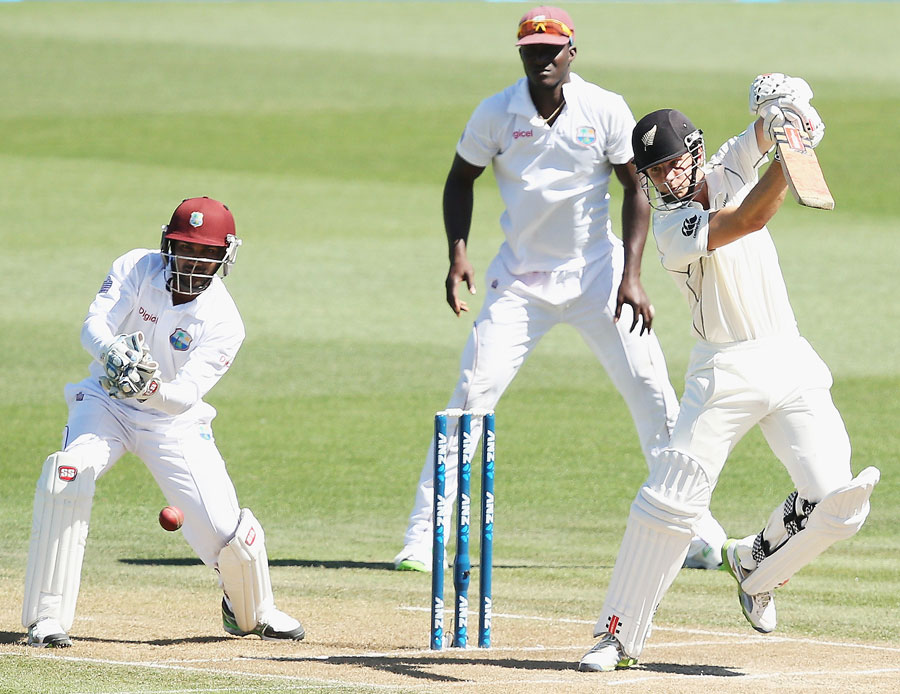
Kane Williamson: the key to New Zealand's chances against West Indies' spinners © Getty Images

Martin Crowe in Cricinfo

As New Zealand tour the West Indies in what will be a close fight, it is likely it will come down to who spins their wheels the best. Years back, when touring the Caribbean, there was a queue every second day to get an X-ray for a possible broken bone, but not now. These days it is slow spin that will determine the outcome, and cause the pain.
Mystery spin would normally be West Indies' trump, via Sunil Narine and Shane Shillingford, while rookies Ish Sodhi and Mark Craig carry the responsibility on the other side of the trenches. But shockingly, Narine hasdecided to turn his back on his country to play a domestic T20 game over a vitally important Test series. I will say no more, until the end of this piece, except to say : in my heart it doesn't wash.
Instead, let me speak of what the secrets are to playing quality spin, even the mysterious kind.
To assess the virtues of what it takes to play spin well, I will refer to two great specialist players of spin, rather than just go to the obvious list of greats who dominated the game against all bowling. The two specialists were Pakistan's finest, Javed Miandad, and John Reid, the left-hander for New Zealand during the '80s.
Both were different in method. Javed was the busier of the two, John the more poised and composed. What they both possessed was an open stance to see all possible lines, and an acutely watchful eye to fend off any last-second danger. In essence, they were attracted to the slow, spinning nature of the ball, far more than the split-second flurry of pace.
They also, as did the greats, did not ever fret over picking the mystery ball, or what approach to take. They simply saw the ball at its earliest release, and with a clear mind, zeroed in on the detail of the delivery. This gave them the information as to what was happening and what was the correct response, even at the very last moment.
These days many players feel a need to analyse, to delve into what the mystery is. This is the worst approach. To fill the head with theory and second-guessing will not only confuse the mind and create doubt, it will inevitably block the ability to see what is real, the ball spinning in mid-air and seeing it for what it is. The crux is in the over-analysing and subsequent confusion.
 
 
Most important of all is the need to not overthink the situation or challenge. Far better to just practise it, absorb it, find trust in what you have, to counter spin
 
Narine, for example, is unique with his finger-flicking technique. It's cool to watch. And it is challenging also, for he is deadly accurate and bowls a nagging length. That he spins it a bit both ways makes him a truly effective international bowler. But he is no Qadir, Warne or Murali. And so the approach should be respectful and simple.
The key is clearing the mind. To not think. A good routine will assist this. What is needed is to turn off from the last ball and to wait 30 seconds before turning on a fierce focus to the next ball. And then the focus becomes the ball, and watching it, gathering the information as you witness the delivery unfolding, curving and spinning through the air.
With the use of good, agile footwork and a steady blade, the ball should be countered and measured surely enough, given the time involved. If the mind is pre-empting what might happen, or trying to make a snap decision as to which way it will spin once arriving, then the chances of playing it correctly are limited.
Too often young players and coaches will believe they need a plan. They don't. As with Reid and Miandad, they just need simplicity and trust. Trusting what they see will be enough, in which their sure feet and hand-eye feel for the ball's twists and turns will be ready at the right time. Reid and Miandad grew up with a natural background of playing on surfaces that spun. This gave them their natural instinctive trust.
When you play in a foreign land on unfamiliar surfaces, it's vital you spend as much time as possible getting exposed to what will be served up come Test time.
Most important of all is the need to not overthink the situation or challenge. Far better to just practise it, absorb it, find trust in what you have, to counter it. Don't spend that practice time going over the various theories undoubtedly on offer. Avoid them at all costs. Simply clear the mind and watch, move and play late.
Kane Williamson will hold a key to his team's fortunes. He is a terrific player, reminding me of Reid himself. With his open stance, bat down, softly held, and fast, trustworthy feet at his disposal, he can anchor the innings. Why he still feels the need to double-pump his bat held high to the quicks is puzzling and self-defeating, especially when he provides a perfect set-up to the spinners. However, if he gets past the quicks and settles in as he can against spin, he will allow Taylor and McCullum to also get in and go big. These three hold the secret to keeping it simple for the rest.
It's a big series this one, for both teams. West Indies have a new captain in Denesh Ramdin, a rapidly slowing Chris Gayle, and many other factors to decipher, which means the local team has a few issues to sort. Yet they can't afford to let this series get away from them, especially after smashing the same opponents two years earlier in the same conditions. Back then Narine dominated majorly, but this time around he won't show. It's his decision, and he isn't the only one to have done this, but under Richard Pybus and a new "West Indies First" mandate, it's a crucial blow for a once-great team to climb the ladder again.
Narine's decision shows we have a problem running too deep for comfort, and I am not looking forward to the spin that will follow.

Sunday, 1 June 2014

Britain is still feasting on credit – and the next crunch will hit in 2016


Interest rates won't stay low for much longer. When the cheap loans end the result will be red-letter bills and repossessions
shoppers women oxford street
‘This time the credit crunch will primarily affect ordinary consumers, rather than banks or businesses.’ Photograph: Dominic Lipinski/PA
Come with me into the near future, just two years from now. In spring 2016 things look much the same: another coalition government has been installed; the spending cuts first outlined at the beginning of the decade have begun again; and somewhere on the continent a newspaper is publishing grainy close-ups of Kate Middleton's elbow. Business as usual.
Except for one big difference. By early 2016, the era of record-low interest rates is over. Borrowing is getting steadily more expensive. And the result is starting to destabilise our entire economic model.
Such a vista is clearly visible from our vantage point today. Over the past couple of weeks, senior officials at the Bank of England have dropped hint after hint that it is simply a matter of time before interest rates go up. Few expect the Bank governor, Mark Carney, to lob anything as inconvenient as a rate rise at Chancellor George Osborne this side of a general election – but some of his colleagues are growing impatient. On the front of Thursday's FT, rate setter Martin Weale asked: "The question is: how close are we getting to 'soon'? Of course we can never be sure, but the economy has sustained fairly rapid growth in demand." Which sounds like the monetary-policy equivalent of the backseat child grumping, "Are we there yet?"
You can see why Weale is getting twitchy. House prices in London are rising at an annual rate of 17%. The unemployment rate has dropped below 7% – the point at which Carney initially committed himself to lifting the key rate off its 300-year low.
This narrow range of indicators doesn't amount to a recovery. Yet – and here's one oddity of Britain's economic situation – it does add up to a case for rate hikes. Rather than suddenly rocketing from 0.5%, rates are likely to go up in what the Bank's outgoing deputy head, Charlie Bean, recently described as "baby steps". He might as well have used the metaphor of a frog immersed in water that is slowly brought to the boil.
Which is what makes spring 2016 so important, because while likely to be still early in the slow uphill march of rates, that's the point identified by economist Matthew Whittaker as being "crunch time" for Britain's indebted households.
As chief economist at the well-regarded Resolution Foundation, Whittaker has probably spent more time than anyone else in the country analysing what higher borrowing costs could mean for Britons. His predictions are frightening. Should the key rate hit 3% in 2018, as the market and the Bank's Bean predicts, then about one in three of all mortgaged households will find themselves dangerously stretched.
Within that group, Whittaker identifies 770,000 "mortgage prisoners" – households who, perhaps because they're self-employed or have low equity in their homes, will find it very hard to remortgage on to a cheaper deal.
What he's describing is a second credit crunch – this time primarily affecting ordinary consumers, rather than banks or businesses, and kicking-in in just two years' time. The Resolution Foundation avoids sketching out what the human implications of this consumer credit crunch might be, but they're not hard to infer: red-letter bills, forced sales of homes, and a rise in repossessions. All this at a time when the bulk of Osborne's austerity programme will be pushed towards completion.
In its Financial Stability report last November, the Bank of England noted that 16% of mortgage debt is owed by households with less than £200 left over each month after paying their essential bills and groceries. Imagine such a household has a £100,000 mortgage on a 3.6% variable rate. As the rate goes up in line with the base rate, their monthly mortgage bills will rise from £506 to £644. Between now and Christmas 2018, they'll have paid something like an additional £4,400 solely on home loans. All that before you look at any other debts or financial mishaps they might have.
Looking at these figures, some might say this is the fault of the feckless, of those who wanted newly built flats, German kitchens and exotic holidays during the boom but couldn't afford them. That ain't necessarily so, for three main reasons.
First, as estate agents say, location matters. Look at Northern Ireland, where Whittaker thinks around 70,000 households face mortgage imprisonment. A lot of those people will have taken out perfectly prudent home loans in 2005, 2006 or 2007 – it's just that their properties have halved in value from their pre-Northern Rock peak. A London couple could have borrowed to the hilt in the boom – but they will have been kept afloat by the bubble in the capital.
Second, for each heedless debtor, there will have been a predatory lender. Even at the end of 2007, well after the credit crunch had begun, just under half of all mortgages were given without any proof being demanded of the borrower's income. This was a no-questions-asked market, and both lenders and politicians liked it that way.
Finally, your average cash-strapped Britons, with their wages lagging far behind rising prices, don't have the space to sort out their finances. The story of British households is simply told: we went into the crash with historic levels of debt; we cut back a bit, but are still burdened with debts worth about 140% of our income – higher than the eurozone and even credit-happy America. In cash terms, household debt is way above that racked up by the government – even though the right only bangs on about the latter.
Step back and the big picture isn't even of three-quarters of a million British households unable to pay their way, but an entire country unable to do so. As research from the TUC and others shows, Britons built up so much debt during the boom because they weren't getting paid enough. National income grew, sure enough, but it largely went to those at the top. For the rest of the country, the model was simple: let them eat credit. The result is summed up by former head of the Financial Services Authority Adair Turner in a speech this March: "We seem to need credit growth faster than GDP growth to achieve an optimally growing economy, but that leads inevitably to crisis and post-crisis recession."
During the long bust, the problem wasn't fixed – it was simply shoved under the carpet of ultra-low rates. The existential question facing post-crash Britain is this: if we now rely on cheap debt and tax credits to keep our heads above water, what happens in an era when neither loans nor benefits are so easy to come by?

Friday, 30 May 2014

'In cricket, if you allow yourself to relax, you'll be swept away' Saeed Ajmal

Umar Farooq's interview with Saeed Ajmal in Cricinfo

Everyone in Pakistan either wants to be a fast bowler or a batsman. How did you end up a spinner?
I was a fast bowler until 15. I used to play mostly with a tennis ball covered in vinyl electrical tape. My school captain Maqsood Ahmed encouraged me to try off spin. He felt I might be more successful as a spinner. He probably noticed that my height and build weren't good for fast bowling. It was a breakthrough. So here I am.
What does cricket mean to you?
Cricket is a tough game. I would say 90% of the time it makes you cry, but the 10% that forms the good parts is truly worth it. The key to success, I think, is to bear the bad days with a smile. If you can do that, the good days become more and more frequent.
You made a relatively late entry into international cricket, playing your first Test when nearly 32. How come?
I cannot tell why I took so long and who and what were the forces that delayed my entry into international cricket. I'd rather focus on my present and future rather than cursing my past. God has given me this personal quality of shrugging off failure quickly and not taking disappointments to heart. That's just the way I am and this approach has helped me greatly in life. I simply refuse to be disappointed.
How did you master the doosra?
I learned to bowl the doosra by watching video footage of Saqlain Mushtaq's bowling during my days in England playing league cricket. I never got any direct tips from him but I closely studied him bowling the doosra on video.
But way before that, Aqeel Ahmed, who played for Faisalabad, could bowl a pretty good one. Variation is a key weapon for any spinner. I used to watch Aqeel take wicket after wicket with his doosra and I wanted to do the same. I felt confident that if he can do it I could too.
Is it still a problem for you to bowl to left-handers?
During the early phase of my career it was. It had almost become a mental block. Left-handers are supposed to be fearful of offspinners, but I could see that I wasn't making them afraid. It became very frustrating for me and I knew I had to do something about it. I thought to myself, I have this ball in my hand, that's my biggest weapon; why am I not able to use this weapon effectively against left-handers? I worked hard at the problem, going to the nets and bowling at left-handed batsmen for long periods. Allah was kind and I was able to work out my deficiencies. Over the last year and a half to two years, it has ceased to be a problem. I came at the problem with a positive mental attitude. I fine-tuned my doosra for left-hand batsmen.
Do you fear that overusing the doosra might make you predictable?
I don't think I overuse it. When I look at the left-handers I've dismissed over the last two years, 70% have fallen to the doosra. I use it because it works. To me, that's effective use, not overuse. If I find that a batsman is uncomfortable against the doosra, I'll bowl exactly that to him, even if I end up bowling ten doosras in a row.
We heard you were offered the Pakistan captaincy.
I don't want to put myself forward for captaincy. I think I am better as a team player. I do think about being captain of Pakistan, but I am reluctant too. Captaincy in Pakistan is not easy. The captain ends up being blamed for anything that goes wrong. Just look at Mohammad Hafeez. He resigned after our exit from this year's World T20. Why? It's because all the blame was being dumped on him. I have been approached for captaincy but I declined. I want to be relaxed about my cricket. God has blessed me with a sunny disposition and I want to keep it that way.
Misbah-ul-Haq has been outstanding in this role. In fact, when you consider the circumstances in which he has performed his job, I would say his services as captain are greater than even Imran Khan's. Yet he doesn't always receive his due. He's been a tremendous leader during an extremely difficult time for Pakistan and he's been our leading run getter. Yet each time we lose a match, people forget about his magnificent contributions. They start demanding that he be dropped. I really fail to understand this. Even as a batsman, people complain he's too slow, that he blocks a lot, does a lot of tuk-tuk. This is not fair to Misbah. He is a watchful batsman and becomes extra-watchful if the team is losing wickets from the other end, which often happens with us. His approach is appropriate and serves the interests of the team. I can tell you as a bowler that it pleases me greatly to see Misbah standing at the crease. If he is batting, it gives me heart that I will have runs to bowl at.
 
 
"As a bowler that it pleases me greatly to see Misbah standing at the crease. If he is batting, it gives me heart that I will have runs to bowl at"
 
Don't you think Misbah is over-reliant on you and that this keeps you under pressure all the time?
I agree that they rely heavily on me. This is a responsibility I accept with a sense of honour and humility. I am there to be used as and when my captain needs. I am never sure which overs I'm going to bowl, when I'm going to get called upon. I remain alert all the time, ready to serve. All I know is that whenever my captain calls on me, I have to give it everything. There was a time when I used to feel anxious that I could get called upon unpredictably, but I no longer feel any pressure about it.
Cricket is a team game, so you obviously can't get five or ten wickets all the time. Others too have to respond to contribute.
Whether it's the first over or the last, whether the boundary is short or long, whether the batsman is new or well-set, I always answer the call of my captain. I would never say, hey, that's a short boundary over there, I don't want to bowl from this end. That's just not me. I have a sense of duty about it. Whenever I'm called upon, my answer always is, come on, give me the ball.
You can never relax in cricket. You have to keep working at the game all the time, keep trying and learning new things. If you allow yourself to relax, you'll be swept away. It's an unpredictable game. You can never be sure of what's going to happen next. It can also be a cruel game. It can give you a lot of heartache.
You have never played Test cricket in your country. How does that feel?
It is perhaps the greatest misfortune of my career that I have been forced to play nearly all my international matches outside Pakistan. I have played over 200 international matches by now and only three have been in Pakistan. None of my 33 Tests has been in Pakistan.
I grew up watching many Tests at Iqbal Stadium, in my home town of Faisalabad, and used to dream of one day playing there myself. That has yet to happen. I can't say if it ever will. I am extremely keen to play in front of my own people. Few things would give me greater joy. I keep praying for the quick return of international cricket to Pakistan. If it happens after my retirement, it will leave me very sad indeed. I do agree that our team has nicely managed to adopt the UAE as a second home, but my heart still aches with the desire to play at home. I want to see the intensity of support I am able to attract here. That is something I would like to experience. We have played our so-called home matches in a number of locations, including the UAE, England, Sri Lanka, and even New Zealand. These locations have all been welcoming and provided top-notch facilities, but they aren't home. It's different when I come to Pakistan. Just breathing the air here makes me feel better.
As one of the world's top spinners, do you miss playing in the IPL?
No doubt it would be better for us if we could be included in the IPL. But the loss is only financial. We're all playing a good deal of cricket as it is, so we're not losing out on that count. But yes, Pakistani players fully deserve to be included in the IPL. I can understand why they might want to exclude us from matches inside India, but the IPL has now been exported to South Africa and the UAE. There should be no hesitation in including us when the games are being played outside India. I would even ask the IPL organisers to host matches in Pakistan. Why not? It would be good for the fans and our players would benefit. It will reveal the close bond and mutual affection that exists between Indians and Pakistanis. That is what should be allowed to truly define the relationship between our countries.
There has lately been some talk about reviving bilateral series between India and Pakistan. I would love to see that. I dearly hope it happens.
You predicted you'd take a ten-wicket haul in Cape Town last year before the start of the match. How did you feel it coming?
The first thing I do whenever I arrive at any ground is to go look at the pitch. At the start of the Cape Town Test, a commentator and a TV cameraman were standing there doing a pitch report. When I saw the surface I couldn't help rubbing my hands in glee. The camera managed to get a shot of me rubbing my hands together. It appeared to be a pitch tailor-made for me. I can't explain it in words and I can't tell you what I saw in that pitch that made me feel this way, but I sensed I would be taking wickets.
It was just this realisation that arose from somewhere deep inside. It just happens that way sometimes in cricket. If you're a batsman, there are days when you'll play your first scoring shot and right away you can sense you'll be making a hundred today. That's the kind of feeling that Cape Town pitch gave me. I took ten wickets in that game, so it proved correct.
Did you lose faith in technology in cricket after Sachin Tendulkar was not given out off your bowling in the 2011 World Cup?
I was left dumbfounded when Hawk-Eye gave Tendulkar not out in the semi-final in Mohali. As I understand it, the way the system was set up back then, it was controlled by a producer who could influence the images. Now it has been improved and the technical people are required to present all the available angles to the third umpire without editing.
I am telling you: Sachin was 100% out. He was lbw. As far as I am concerned, it did not reflect the truth of the event. In fact, this is not just my view, it is what the entire cricket world thinks. But we move on and so does the technology. I believe it is evolving and learning from its mistakes. I am fine with it.
What encouraged you to start a cricket academy in Faisalabad?
Pakistan has immense cricketing talent but we lack proper facilities. This is where the PCB should place its energies and focus. My effort to establish a properly equipped and organised cricket academy is also motivated by this concern. I am eager to get it done while I am still active internationally. I know nobody will give me the time of day after I retire. So time is short and I need to be efficient and take advantage of the opportunity. The Faisalabad authorities and the leadership of the Agricultural University have been most helpful. I am extremely grateful to them.

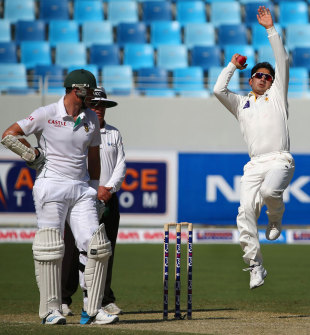
Saeed Ajmal in his delivery stride, Pakistan v South Africa, 2nd Test, 1st day, Dubai, October 23, 2013
"If I find that a batsman is uncomfortable against the doosra, I'll bowl exactly that to him, even if I end up bowling ten doosras in a row" © AFP 
Enlarge
The country used to be known for its fast bowlers but your success might change that.
I would agree that the quality of seam bowlers from Pakistan has declined somewhat. I think the reason is that we have started making green and bowler-friendly wickets in domestic matches. In the old days, the wickets were dead and bowlers had to try hard to succeed. They were forced to learn tricks and skills. After all this toil they would come into the international arena and find helpful wickets and they would be able to dominate easily. Now the situation is reversed. Our bowlers are being raised on seaming surfaces. They perform adequately on green pitches, but if they come across a batting wicket they are unable to adjust and end up getting badly punished. I would advise the PCB to favour batting surfaces in our domestic set-up. It will certainly be good for the bowlers - both spinners and seamers - and I am sure it will produce a few great batsmen too.
What have been the highs and lows of your career so far?
The best moment of my career, I will say, is the 3-0 Test whitewash over England in the UAE in early 2012.
There have, of course, been a number of bad moments too. Losing last year's Cape Town Test against South Africa, despite my ten wickets, was a terrible blow. There is the ODI against South Africa in Sharjah last year, where I took four wickets and we had a modest target to chase, but we had an awful collapse, losing the last six batsmen for only 16 or 17.
And of course, there is the last over I bowled to Michael Hussey in the 2010 World T20 semi-final.
But I would say the absolute worst match of my career was a Test against West Indies in the summer of 2011. I took 11 wickets in that game. Despite conceding a first-innings lead, we had a reasonably modest fourth-innings target and we still lost. That hurt deeply. It still hurts when I think about it. I had this bagful of wickets but it gave me no real sense of achievement.
How do you expect Pakistan to do in the 2015 World Cup?
The next World Cup remains less than a year away. I have a feeling its location in Australia and New Zealand is going to suit us. My prediction is we are going to do well. Our batsmen have a flair for playing shots on bouncy wickets. They love to cut, for example. The Akmal brothers Umar and Kamran, opener Ahmad Shehzad, even Hafeez, and the newcomer Sohaib Maqsood - they are all happy on bouncy tracks. They all love it when the ball comes quickly onto the bat.