Search This Blog

Friday, 1 April 2016

"You Don't Deserve a Bailout - You are NEITHER a Banker NOR Chinese"


If librarians and steelworkers wanted state bail-outs, they should have done something 
useful - like bankers

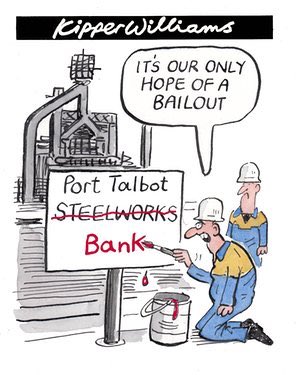
In any case the bankers deserved to be bailed out, as they couldn’t possibly anticipate that if they kept taking money it might eventually run out, whereas steelworkers have caused their own downfall by not being Chinese.

Mark Steel in The Independent


The main thing to realise with the current steel industry crisis is that the government has been clear and decisive. They’ve stated firmly, “We’re not ruling out anything at all, though we are ruling out nationalising anything as that doesn’t count as anything, but we will do anything we possibly can that won’t make a difference such as drawing a pretty picture of a caterpillar, and we’re doing all we can because as we keep saying there’s nothing we can do, but we do feel desperately sorry for anyone who loses their job which is why any steelworkers who become redundant will immediately be called in to the job centre for an interview and told they won’t get any benefits if their answer to ‘Why have you let yourself be put of work?’ is ‘There was nothing I could do’.”


---Also read

Steel v banks: Why they're different when it comes to a government bail-out


------

Some people have pointed out that other industries were bailed out by governments in the past - but this has only been if they’ve produced essential goods, such as hedge funds and executive bonuses, not frivolities like the stuff that makes ships and teaspoons.

In any case the bankers deserved to be bailed out, as they couldn’t possibly anticipate that if they kept taking money it might eventually run out, whereas steelworkers have caused their own downfall by not being Chinese.


Luckily this sound economics is understood across the country, including by the sensible wing of the Labour Party such as those in charge of Lambeth Council, who are closing half the borough’s libraries and turning them into gyms.


This is the sort of can-do attitude people want from Labour. Hopefully it will spark off other schemes, such as turning social services departments into sushi bars, or converting disabled people’s wheelchairs into drones so they can be rented out to the RAF.

There’s no point in complaining about this; it’s the way the free market works. And if the Chinese are flooding South London with cheap Agatha Christies, we just have to accept it, and ask the elderly people who rely on going to libraries as their only point of contact with the community to spend all morning performing 200 reps of 40 kilograms per calf on a multi-gym body-solid squat machine instead.

One of these libraries, the Tate, has been assessed as receiving an average of 600 visits per day. This may seem successful, but where the library has let itself down is forgetting to charge any of them money for borrowing books and bringing kids into reading classes.

Maybe the library service should learn from gyms, and only let them in if they pay £40 a month on a minimum two-year contract. They could even offer them special courses in which an instructor screams, “Right, everyone, let’s all read this week’s Economist - you CAN do it - let’s drive ourselves to the limit - GO – ‘the Yen faces unexpected slow down’ - come on Eileen pick it up, PUSH everyone!”

The council insists they will preserve the essence of the libraries, because each of the gyms will include a “lounge with a limited supply of books”. Obviously they won’t have all those unnecessary books you see in old-fashioned libraries, but surely no one’s so fussy they insist on any specific book, as most books are pretty much the same.

The council also agreed that “under-18s may not be allowed in these lounges”, which will surely improve the service as rooms with books aren’t a suitable environment for the young.

Surprisingly, the local population appears shamefully ignorant about economics - so there have been daily protests against the closures, in which thousands have taken part. It seems these people don’t understand that it may have been all right to build and maintain free libraries back in the 1930s, but you can’t expect us to keep funding the luxuries we could afford back then.

So the council demanded a banner was taken down at one library, which was changed each day to tell people how many days were left until it was closed. Maybe the council hoped that if people weren’t reminded of the closure, they just wouldn’t notice. Then eventually they’d all tell stories of success and improvement to each other, such as: “I asked for a reference book on growing cucumbers and was sent into the corner. After three weeks I didn’t feel I was making any progress with my gardening, but then someone told me I’d spent the whole time benching 140 kilograms and now I’m the all-Hertfordshire Over-60s Bodybuilding champion.”

Nevertheless, the protests continue. But the libraries have probably been lending the wrong assets if they want state intervention. Instead of irresponsibly lending books to people who live round the corner so they can read and study and educate and entertain themselves and their kids, they should have lent billions of dollars to anyone who asked for it, without even suggesting a 40p fine if they kept it a week too long.

Then, once they’d succeeded in ruining the world economy, they’d have had a very reasonable case for being bailed out - unlike these people who want to fund steelworks and libraries because they don’t understand the world economy.


@@@@@@

------- The China Tariff matter


Steel tariff row explained


Steel v banks: Why they're different when it comes to a government bail-out

Jay Cockburn BBC Money

The British steel industry is in a perilous position right now.
Tata Steel is looking to pull out of the UK; they own most of Britain's steelworks.
It's led to mutterings of government intervention, after all they put up the cash to bail out the banks in 2008.
Why shouldn't they do the same for the steel industry?
The thing is, they're totally different situations. 
Some of the banks were unable to balance their books with the Bank of England, and some ATMs ran out cash.
The government stepped in and first saved Northern Rock.
Customers queue to take their cash out from Northern Rock
Image captionCustomers queue to take their cash out from Northern Rock
Then it was Bradford and Bingley, closely followed by taking stakes in RBS, Lloyds TSB, HBOS.
The reasons behind the global financial crisis were complex, countless films and documentaries have been made in an attempt to explain why it happened.
Everyone involved in the bailout assumed the banks would recover, and they did (even if it feels like it took forever).

The economy can survive without British steel

The UK is a global centre for banking. Without banks there is nobody to lend money to people to start businesses, or buy homes.
A lot depends on our banks, not just in the UK but around the world.
That's clearly not the same for steel.
One of the problems is the UK industry has been shrinking for a long time. Employment has fallen from around 50,000 in 1990 to under 20,000 today.
Canary Wharf at night
Image captionCanary Wharf in London is one of the world's major financial centres
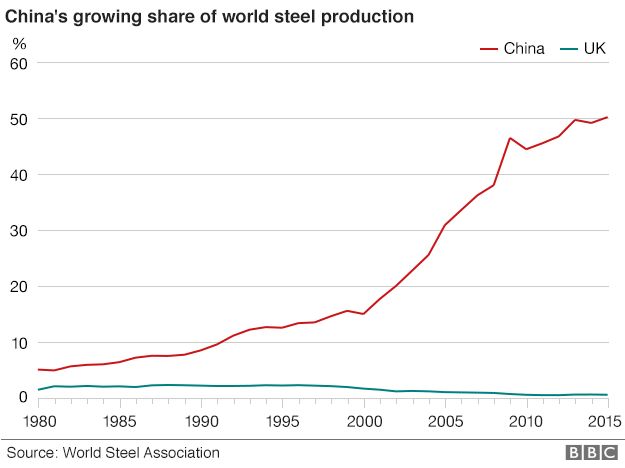
Other countries, such as China, make steel, and they do it for cheaper than we do. The people in the steel industry and the towns like Port Talbot depend on the steel industry, but the rest of the economy will cope without it.
Globally we are a major player in the financial market but our steel output is actually fairly insignificant. We currently put out around 12 million tonnes a year; China's output is 822 million tonnes - although the British industry does tend to specialise in high quality, high value steel.
Chart showing Chinese steel production

Does it make financial sense?

The government will be weighing up the financial cost of making thousands of people unemployed.
One think-tank, the Institute for Public Policy Research, estimates that as many as 40,000 jobs depend on the sector.
The steel plant at Redcar which closed last year leading to 1700 job losses
Image captionThe steel plant at Redcar which closed last year leading to 1700 job losses
During the financial crisis UK unemployment peaked at 2.7 million - a little over 8% of the total workforce. If we hadn't bailed out the banks it's likely that figure would have been even higher, costing the government huge amounts of money in benefits and lost tax revenue.
In the UK we have a workforce of around 31 million. 40,000 is just 0.12% of that workforce. When Port Talbot steelworks is thought to be losing around £1 million a day the government may find that number a little more palatable.

The government can't legally buy the plants

The Prime Minister himself, David Cameron has indicated that they're unwilling to buy the plants: "I don't believe nationalisation is the right answer".
Whether they are willing or not might be irrelevant though, because the UK is a member of the European Union.
By law EU member states cannot rescue failing companies in the steel sector.
These are rules that were agreed on by every member of the EU, including the UK.
Exceptions to those rules on bailing out companies exist, but governments have to prove their economy is in danger - that's why they allowed the banks to be rescued.
But the EU has decided that allowing failing steel companies to go bust is good for the union as a whole.

But...

Unlikely as it may be the EU does still have the final say so it's not entirely impossible for the government to step in.
The decisions on state aid are often highly political though, but ultimately the Commission can decide to approve it.
But if any of the 28 member states don't agree they can challenge the decision - and that can take lots more time.

Thursday, 31 March 2016

The Tata's failure - Another nail for Indian corporate power?

Jayati Ghose in The Guardian

Thousands of steelworkers’ jobs are threatened as Indian company Tata threatens to walk away from its loss-making business in the UK. The move is causing shockwaves over the health of Britain’s manufacturing industry; but it is also a strong indicator of changing political and economic winds in India.

When Tata Steel acquired the steel giant Corus in 2007, it generated some cheers in India, but also raised eyebrows. The cheers were loudest among those who saw this as a macho declaration of Indian corporate arrival on the global scene. The purchase by Tata Steel of a company that was four times larger than itself made it at a stroke the fifth largest steel producer in the world and the first Fortune 500 multinational company from India.

But there were concerns over both the timing and the price at which the purchase was made. To fend off a Brazilian rival, Tata had to pay a 70% premium over the stock price. This was hefty for a company already in financial trouble with a large debt burden. And Tata paid only $4bn (£2.8bn) of the estimated $14bn final price out of its own funds – the rest was borrowed, mainly from Indian public sector banks.

Why were taxpayer-funded banks so willing to lend to a big conglomerate to buy up an overpriced European company, even as they denied loans to Indian farmers and small-scale producers? The sense of reversal of colonial roles might well have played a role. The deal was lauded by politicians as a sign that Indian industry had come of age as a global player, and so prudent considerations were simply cast aside.

Repayment of those loans was supposed to be made out of the profits of Tata Steel Europe. But those profits never came. At the time of acquisition Corus made an annual profit of about $800m, but since then the company has shown only losses – despite numerous rounds of restructuring, job cuts, asset sales and “modernisation”. In the past six months the company has shed around 3,500 jobs in the UK, but the financial indicators look worse than ever. This could result from incompetent management, but it also reflects worsening global conditions.

In Europe steel demand has been falling continuously over recent years, and there is fierce competition as Chinese exporters lower prices to cope with their own massive over-capacity. No one in the world really expects much dynamism from the European economy in the coming years.

By contrast, Indian steel demand is still increasing, if slowly, and the Indian operations still make profits. Tata Steel is now hugely weighed down by the UK business, which also accounts for around a third of its total debt. The charm of owning a big British company may no longer be enough to compensate. Instead, the urge is to cut losses and move out of an area that does not look likely to generate profits anytime soon.

Maybe the company also hopes the mere threat of exit will make the British government react by providing more subsidies – a technique that has worked in the past in India and elsewhere.


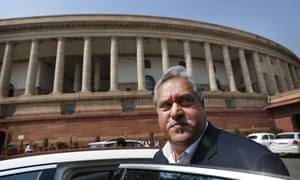
 ‘The Indian businessman Vijay Mallya fled to the UK and is now ensconced in his mansion in a London suburb.’ Photograph: Saurabh Das/AP

But this episode could also reflect collateral damage from another corporate scandal currently enthralling India. The flashy liquor baron Vijay Mallya, whose company Kingfisher Airlines (named after the beer his other company produces) collapsed, was also a major beneficiary of largesse from Indian banks. He now has unpaid debts of about £730m that he’s failed to pay for several years. Since he is also an elected member of the upper house of parliament, voted in by the ruling Bharatiya Janata party, this has caused a political outcry.

When the supreme court of India indicted him for abuse of law and ordered him to pay up or face the consequences, Mallya fled to the UK and is now ensconced in his mansion in a London suburb. He has offered to pay just over half of what he owes in six months’ time, an offer yet to be accepted. But his story must have raised concerns within Tata and among other large Indian businesses with huge debt – that even if the government spares them, the Indian courts may not.

So for now, Indian corporate chiefs planning to invest in the UK are more likely to be looking at real estate, rather than at multinational businesses.

Wednesday, 30 March 2016

Poetry or property punts: what's driving China's love affair with Cambridge?

David Cox in The Guardian


On the edge of Scholar’s Piece, the strip of farmland just behind King’s College, lies a granite stone which has become arguably Cambridge’s most coveted tourist attraction.

For the many students who amble past it every day, it’s easily missed; placed rather innocuously next to the bridge that joins Scholar’s Piece to the rest of the college. But for the thousands of Chinese tourists who travel to Cambridge every year, it is this, rather than the city’s grand 15th-century chapel, meticulously manicured lawns or historical statues, that they’ve come to see.

Carved into the stone are the first and last lines of a poem that has gone down in Chinese folklore. Titled Farewell to Cambridge, it was written in 1928 by Xu Zhimo, a 31-year-old poet and writer who was revisiting King’s after studying there in the early 20s.

Zhimo died three years later in a plane crash, but he would go down as a cult figure in modern Chinese history, immortalised through his premature and tragic end, illicit love affairs and success in introducing western forms into Chinese literature.


The ‘Farewell to Cambridge’ stone. Photograph:Historyworks/Flickr


And while Zhimo spent most of his life in China, Farewell to Cambridge has become his legacy. It is now part of China’s national curriculum, taught to all schoolchildren as an example of the modern poetry movement in the early 20th century.

“The poem is something we’ve all heard of,” says Pei-Ling Lau from Beijing, who is visiting King’s and seeing Zhimo’s stone for the first time. She studied his poem as a compulsory exam text when she was 15: “It’s been adapted into many pop songs too. It paints such a lovely picture of punting in Cambridge, but it wasn’t until I came here that I realised how beautifully it describes the river. It’s special for Chinese people as the life and story of Xu Zhimo is well known, and this was his city. We want to come here and experience that.”

And come they do. Numbers of Chinese tourists visiting the UK have soared in recent years from 115,000 in 2009 to 336,000 in 2014, following the relaxation ofvisa restrictions to Chinese nationals in 2013. With further amendments in the pipeline to boost this lucrative tourist trade, these figures are only set to increase.

But the Chinese are not just interested in Cambridge as a holiday location; they also view it as a key region for property investment. Cambridge’s house prices are soaring, with new figures revealing they have increased by 50% since 2010, driven in large part by the ongoing biotech boom in science parks around the city. And wealthy Chinese appear keen to cash in: the estate agents Savills estimate that in the past year, one in 20 new-build homes across the city and surrounding villages have been bought by Chinese owners.


Looking to invest? … Tourists enjoy a punt tour along the river. Photograph: Chris Radburn/PA

“There is undoubtedly interest in Cambridge as a place to live from Chinese buyers,” says Ed Meyer, head of residential at Savills Cambridge. “But as well as an investment, the major driver for this is education. The majority of Chinese buyers are coming here with younger children, to try and integrate them into Cambridge society and the schools round here, with the view that they will hopefully go to the university in future. And Xu Zhimo’s legacy definitely seems to be ingrained in their psyche. At some point they always explain, ‘Oh, and we know about Cambridge because we learnt about it in the poem at school.’”

Cambridge’s academic reputation is instilled into virtually all Chinese children at a young age. While domestic universities such as Peking and Tsinghua are respected, those who can afford it are increasingly opting to put their money into sending their children abroad for schooling, with the hope of gaining them an edge in a hyper-competitive job market when they return home. Such are the employability benefits associated with a Cambridge education that increasing numbers are sending their children to the various “feeder schools” around the city to boost their chances of a successful application.


Cambridge PhD student Zongyin Yang. Photograph: David Cox

“The reputations of the great universities are passed down from parents to children,” says Zongyin Yang, a PhD student at Cambridge who grew up in Wenzhou. “There’s a respect and curiosity which is instilled at a young age. It’s why Chinese families bring their toddlers to see the campuses. Most children grow up hearing about these ‘dream places’.”

According to China’s Ministry of Education, 459,800 students enrolled at overseas universities in 2014, an increase of 11.1% on the previous year. Of these, 423,000 were entirely funded by their families. And at the top of their list is Cambridge: Chinese students make up the largest ethnic population at the university, with a total of around 900 enrolled for the current academic year.

“A Cambridge degree is definitely perceived to be superior in the recruitment process due to the strength of the brand name,” says Zheng Yao, who studied at Cambridge before returning to Beijing. “There’s a widespread perception that your earning potential in China will be much greater – but the reality is quite different. Pay for new graduates is in fact very limited, no matter where you’ve studied.”

Volatile market

Buying property in Cambridge also makes financial sense for Chinese families looking to invest their money outside of the increasingly volatile market back home. “Chinese parents would rather their children pay rent to them than to another landowner, keeping the money in the family,” explains Keri Wong, a Cambridge student from Guangzhou. “And while the Chinese middle classes have a lot of savings, the market at home is regarded as really unstable. UK property is an attractive divestment. Plus property investment presents the option of being able to eventually gain UK residency status.”


We don’t want our housing market going through a boom-or-bust cycle based on the Chinese economyDuncan Stott

But not everyone is welcoming the new residents. “At some point the world economy will shift and overseas investors will decide that they’re better placing their money elsewhere,” says Duncan Stott, of the local campaign groupPricedOut. “But we don’t want our housing market going through a boom-or-bust cycle based on the Chinese economy. We need a more stable housing market so prices aren’t going to be going up faster than people can earn, before plunging and dropping people into negative equity.”

Stott and many others are especially unhappy about the trend of overseas buyers purchasing homes entirely for investment purposes and leaving them empty for several years, before selling them at a profit. While council taxes are raised on empty properties, the inflation in their price means this does not prove a deterrent. Kevin Price, Cambridge’s executive councillor for housing, says there are currently 240 homes in the city sitting empty.

Is it fair to blame this on the interest from China in particular? “Houses are a safe, strong investment which appeals to people both overseas and those already living here,” says David Bentley, of estate agent Bidwells. “Cambridge is a global brand, so it’s not just the Chinese looking to invest here. We’ve seen a big influx of Russian money too. And the Chinese are typically buying not just as an investment, but for their children, sometimes even before they’ve reached school age.”

The link between Cambridge and China goes back to the 19th century, when the university reformed itself based on the Chinese imperial examination system, before launching the UK’s first professorship of Chinese in 1888.

Two centuries on, the link only looks set to strengthen. With the Home Office launching a new visa system that allowsChinese tourists to make multiple visits over a two-year period, and school and university applications rising every year, the distinct Chinese presence in the city is surely only going to grow.

And for local residents already worried that Cambridge’s housing supply isn’t keeping up with demand, the potential impact of such interest remains a concern – even if, as Bentley points out, the percentage of purchases from overseas buyers is still relatively small.

“It’s a difficult problem to do anything about, but having such strong interest from Chinese buyers just puts even more pressure on an already strained housing market,” Stott adds. “It simply makes it more and more difficult for people who already live here to be able to own their own homes.”