Search This Blog

Tuesday, 9 June 2015

Dying at 22 is too steep a price for being ‘the best’

Shobhaa De in The Times of India
My heart broke while reading the tragic account written by a devastated father on hearing about his 22-year-old son’s sudden death in a San Francisco parking lot some weeks ago. Sarvshreshth Gupta had done all the ‘right things’ ambitious Indian parents expect from their children. He was supposed to be living the Great American Dream, after graduating from the University of Pennsylvania, interning with Credit Suisse and Deutsche Bank, before landing a job as a financial analyst with Goldman Sachs in San Francisco. His young life followed the golden script written for — and sometimes by — aspiring desi students. Those who toil hard to get into the best business schools in the US, achieve great grades, repay huge loans, make their folks proud, bag high-paying jobs, work harder still… and then collapse! Like young Sarvshreshth did. The unreasonable pressure of a system that expects young people to sweat blood so as to make other people rich, finally got to the analyst — perhaps, had he listened to his father and walked out of his job a few hours earlier, he would have been alive. Fired, perhaps. But alive.
Sarvshreshth’s exchanges with his sensitive, understanding father tell their own story. And it’s a pretty common one. He writes of being severely sleep deprived, working for 20 hours a day, spending nights in an empty office, completing presentations while prepping for a client meeting early the next morning… all the while putting up with the tyranny of a senior VP breathing down his neck — pushing, pushing, pushing. Whenever his father advised him to take it easy and look after his health, Sarvshreshth would bravely reply, “Come on, Papa. I am young and strong. Investment banking is hard work.” As it turns out, the young man was not as strong as he imagined. And yes, the hard work as an investment banker is precisely what killed him.
When I came across the grieving father’s poignant online essay, ‘A Son Never Dies’, I thought about several parents and their children in similar situations. I thought about my own children and their friends… what a scary world they occupy. Look around and you will find many other Sarvshreshths — young men who are literally killing themselves in jobs that pay big bucks, but extract a gigantic price. Yes, Indians today can lay claim to being the best-educated, highest paid ethnic group in America. But, at what cost?
Right now, hundreds of over-wrought parents are undertaking pricey campus tours of various universities abroad. They believe this is their ‘duty’ since they want their kids to ‘get the best’. Is this what they mean by ‘the best’ ? We have equally good universities in India. What sort of absurd pressure is this that forces parents and students to go overseas in the hope of ‘bettering prospects’? Why not have confidence in your child’s ability to shine in India, without going through the sort of trauma Sarvshreshth suffered? Yes, we have ragging in our colleges, and no, some of our academic laurels are not as prestigious in global job markets as Ivy League degrees. So what? If you’ve got it, you will make it. Anywhere!
Just a short while before Sarvshreshth’s body was found (cause of death not officially declared so far), his father had told him to take 15 days’ leave and come home. The fatigued son’s forlorn response was, “They will not allow”. Hours later, he was dead. This sad story should act as a wake-up call for both over-ambitious parents and over-achieving children. Not everybody can take the almost inhuman pressure of the rat race. This young man was missing home-cooked food, the comfort of family and an emotionally reassuring environment. If only he’d had the courage to say, ‘To hell with it…’ and come home, his devastated father would not be writing that pathos-filled essay today.
It’s time we took a fresh look at our craze for ‘foreign degrees’ and ‘foreign jobs’. Today there are over 100,000 Indian students on US campuses. Most will think of this time as the best years of their lives. Some will stay on and be successful there. Others will return and pursue successful careers back home. But a few will crack, crumble and succumb under pressure. The system sees all kinds. But this is not about the survivors. This is about the vulnerable. Every parent wants a child to succeed. But not at the cost of their life.
I wish Sarvshreshth’s father Sunil Gupta would take this important message to many more parents still debating about their child’s future. Earning a degree and bagging a great job are fine goals. But living a wholesome life with people who love and respect you is infinitely more rewarding in the long run.
Irony. This was the worst thing to happen to a young man whose name means ‘The Best’.

We don’t live to work, we work to live. Why don’t we say so?

Zoe Williams in The Guardian


‘It appears that you need to be in the bull-headed world of high finance before you can make this simple assertion: I’m don’t have to justify scaling back my work on the basis that I’m swapping one role (‘hardworker') for another (‘mother'). Photograph: Loop Images/ Alamy


“Hardworking” is the ubiquitous political denominator of our age, source of morality, citizenship, respect and status. It slips inanely into even the blandest legislative literature: the psychoactive substances bill, for instance, vowed to “protect hardworking citizens from the risks posed by untested … drugs”. The precise meaning of the phrase is rarely explicitly spelt out (except in the context of benefits and universal credit, where the working week that qualifies as “hard” is endlessly recalibrated by the Department for Work and Pensions). How many hours constitutes hard work? Can you even count it in hours? Does working hard to care for someone count? What about pets? Is there any room in this formulation for work that you find hard – poetry, aerobics – which doesn’t bring in any money? Or is it really a measure of economic productivity, turned by hazy phrasing and sleight of hand into a badge of honour?

This picture jars, rather, with the priorities of the people who are actually doing all this work, as described in the Flexible Jobs Index, out this week. It is compiled by Timewise, a recruitment organisation that also studies cultural attitudes to the workplace. “If you put together the people who work part-time who choose to, plus the people who are working full-time when they would rather work part-time, because they have no choice: that’s half the population,” says Karen Mattison of Timewise. This tells quite a different story to the one we’ve come to accept, of an insecure and underemployed workforce who would like more hours. About 14.1 million people want to work flexibly. One in 10 British workers – or three million people – don’t have enough hours, rising to one in five in so-called elementary or low-skilled occupations. But professionals tend to have more hours than they want.

We could ascribe this to a fundamental difference in outlook between one class and another, with energy levels and can-do attitudes peaking at the lowest pay grades then tailing off among higher earners. But it seems more likely, to me at least, that all these figures point to the same conclusion: people work extremely hard when they can’t live any other way, and steadily less hard – or wish they could work less hard – when they can afford to.

Hard work does not seem to be valued for its own sake, as a marker of identity or bestower of meaning. Work is part of a greater entity known as “life”, and even the fabled “work-life balance” is a bit last-century; given the choice, we see work as a subset of life, and not its rival.

This is already reflected in the reality of work – 95% of companies already offer flexibility – but it’s completely absent from the way people talk about work. In the language of recruitment, ambition and fealty remain inseparable – the truly committed employee thinks only of the job. “The research is saying,” Mattison concludes, “that we have to stop talking about flexible working and start talking about flexible hiring.” From a distance, it is a complicated distinction, but up close, obvious: there is no language in the process of getting a job that allows you to say you want it but only for 60% of the time. Just imagining this crushing awkwardness – when do you even bring it up? – is enough to trap many people in existing jobs they’re overqualified for because the hours work. It’s very wasteful, for them and for employers, who could often get someone much better than they could afford if they were only prepared to have them for fewer hours.

This is one of the critical modern taboos: the way we really feel about work – that it’s OK in its place but cannot be the wellspring of all fulfilment – nor occupy all our hours; versus the role of work in the sociopolitical narrative, in which the solidity of your citizenship is built on the foundations of your fervent industriousness. Partly this is because everyone insists on framing it as a conversation about work versus children; which in turn makes it a women’s issue, which in turn leads people to dismiss flexibility as a signal that ambition has receded, leaving only maturity and reliability in its stead. Going part time is the cultural equivalent of shifting from Cos to Boden.

Furthermore, the new consensus about hardworking people, hardworking families, human units defined by the intensity of their effort, actually sounds, when you decouple it from whichever smooth voice whence it came, a bit Soviet. It calls to mind those glory years of post-revolutionary propaganda in which to work – particularly with your top off – was to wrest back dignity from the capital forces that had tried to steal it from you. And yet we are meant to exist in this era of self-interest, in which our sense of identity is created not by work but by consumption. It’s a totally contradictory trope: of course it couldn’t brook challenge or nuance or an honest account of what work actually means to people. It would disintegrate.

“This is a work-life thing. That life isn’t just children. That life is life,” says Clare Turnbull, who has worked in the famously inflexible world of asset management and hasn’t done a five-day week since 2001. I’d asked her if she would go full time once her children left home. It appears that you need to be in the bull-headed world of high finance before you can make this simple assertion that we should all be able to make: I don’t have to justify scaling back my work on the basis that I’m swapping one duty for another, one role (“hardworker”) for another (“mother”). I don’t have to justify it at all. This life is life.

Monday, 8 June 2015

The Muslim Ummah have abandoned the Rohingyas

by Girish Menon

While the Rohingyas starve, live in fenced in camps or are on boats in high seas with no country willing to accommodate them the Islamic organisations are loudly quiet in their response while western human rights organisations as well as Jewish holocaust survivors espouse their cause. So what happened to the universal brotherhood of Islam? Why don't they offer refuge to their fellow brethren?

The Rohingyas were used by the British during the second world war as a fifth column to defeat the Japanese in Burma. Towards this end they were resettled in the Arakan area of Burma, given arms, money and training by the Allied forces. After the British withdrew from the area and new countries like East Pakistan was created, the Arakan province was to become a part of Burma. At this time the Rohingyas started a jihad against the Burmese government to get their territories to be a part of Jinnah's East Pakistan. Many Islamist organisations were active in this jihad.

----Also watch

-----

At the time the Rohingyas used the 'dar-ul-harb' concept to refuse to integrate with the Burmese population where they were in a minority. Like their Muslim brethren in the northern plains of India they did not wish to live in a country where they were in a minority. They were actively supported in this jihad by Islamic organisations in Pakistan.

The Burmese, unlike the Indians, when they defined their citizenship laws were unwilling to accommodate this group with a separatist and jihadist motive and the Rohingyas were deemed stateless. So, from then on the only way out for the Rohingyas was to pay smugglers to get them out of the Arakan province into countries where they could lead a decent life.


So why are the Islamist countries not going the extra mile to help their brethren? Why is Pakistan (The holy land for the pure) not inviting these Rohingyas to resettle them in their lands? Why is the Islamic State not taking them to Iraq or Syria nor the al Qaeda making attempts to rescue them? Can we say that NIMBY (Not In My Backyard) supersedes the Islamic Brotherhood?

Why Virat Kohli has to rid Indian cricket of bad habits

Suresh Menon on BBC website

In cricket, as in any sport, there are two kinds of mistakes.
The bad mistake arises out of confused thinking, lack of focus and a poor understanding of tactics. The good mistake, on the other hand, implies a well-thought out plan gone wrong or an attempt to force the issue backfiring.
Increasingly as his captaincy progressed, India's most experienced and successful Test captain Mahendra Singh Dhoni kept making bad mistakes. Giving his bowlers one-over spells, for instance. Or wasting a fielder at leg gully.
Good fortune and hunches can take you only so far - every captain in the game's history has taken chances with an inexplicable bowling change or an illogical batting line-up and surprised everybody by winning. But that cannot be the basis for captaincy.

Positive attitude

Virat Kohli, at 26, younger than Dhoni by seven years, is not yet tactically sound but has two important things going for him: a positive attitude and enormous self-belief.
Not since Tiger Pataudi has an Indian captain been willing to risk defeat in the pursuit of victory like Kohli in the December 2014 Adelaide Test against Australia.
The essential difference between the past and future of Indian cricket is that while Dhoni was clearly on his way down, Kohli can only improve.
He will face many of the problems Dhoni did - a poor bowling attack, especially abroad, the pressures of being on the field for beyond 50 overs or a single day, the hope that victories in the shorter format will make up for their absence in Tests.
India had caved in without a fight in 13 of 17 Tests abroad before the last Australian tour. They lost the 14th in Adelaide, where Kohli led for the first time, but the texture of the defeat was different. The Anna Karenina Principle applied. "All happy families are alike," wrote Tolstoy in his novel, "each unhappy family is unhappy in its own way."
Similarly, all victories are alike but defeats are wildly different.
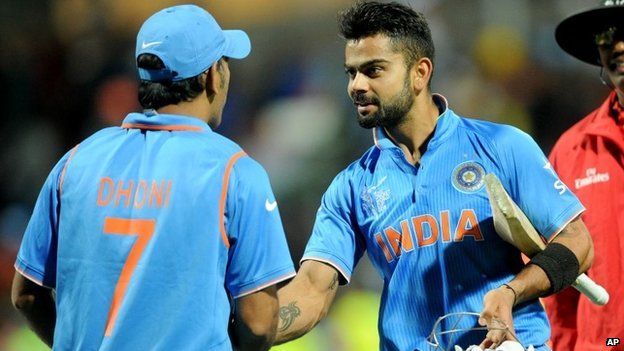
India's Virat Kohli, right, is congratulated by his captain MS Dhoni after they defeated Ireland by eight wickets in their Cricket World Cup Pool B match in Hamilton, New Zealand, Tuesday, March 10, 2015.
Kohli is younger than Dhoni by seven years

India went down in a blaze of glory, attempting to make 364 runs in a day and coming startlingly close.
Playing for a draw was never an option, said Kohli, perhaps aware that India had the batting to win the Test, but not to draw it. Still, there was promise of a change in the standard narrative. Optimism is infectious, and it is easy to catch it off a captain who is full of it.
Kohli projected that optimism and spirit right from the days when he led India to the Under-19 World Cup win. He was marked out as future captain.
The IPL has a lot to answer for. But in Kohli's case, it actually helped.

Finding a balance

After initially tasting its many enticements, Kohli settled down. In his corner was his team Royal Challengers Bangalore coach Ray Jennings, who told him that the Under-19 triumph would soon be forgotten, and that he would be judged as an adult cricketer. Anil Kumble helped to channelise and focus all that energy. And he was made captain in anticipation of the bigger job to come.
While Kohli's captaincy in the one-day format has been aggressive and focused on winning, in Tests he will have to learn - as his bowlers too will - the virtues of patience and long-term planning.
Indian cricket will have to find a balance between Dhoni's tendency to let things drift and Kohli's impatience with uneventful overs and sessions. There is an element of fishing in the longer format. You put out your bait and wait. Kohli will have to learn the waiting game.
Whether it is a reflection of the times, a consequence of playing too many matches in the shorter formats of the game or a question of temperament, India's cricket is currently characterised by an impatience that makes them perform well below potential.
Bowlers are in a hurry to take wickets or simply run through their overs, batsmen seem to have forgotten how to play session-to-session. Kohli will have to rid the team of bad habits.
While many believe that a captain is only as good as his team, the best ones have inspired their teams to play above themselves. Pataudi for one, Mike Brearley or another.
Kohli's advantage is that he is the best batsman in the side, and there are no immediate candidates for his job. In other words, he will be left alone to develop his full potential as captain, unhampered by the need to constantly watch his back - an occupational hazard with Indian captains of the past.
He has it in him to stamp his name on an era.