(Editor's Note: This article was received by email and unable to verify journal of publication. But the points raised are important.)
by Mark Tully
Sir William "Mark" Tully, OBE. He worked for BBC for a period of 30
years before resigning in July 1994. He held the position of Chief of
Bureau, BBC, Delhi for 20 years Padma Shree, KBE, Padma Bhushan, one
of the most respected journalists in the world, writes on Indian
Politics: An eye opener account, not known to most of the Indians.
"I can say without the shadow of a doubt that when history will be
written, the period over which she (Sonia Gandhi) presided, both over
the Congress and India, will be seen as an era of darkness, of immense
corruption and of a democracy verging towards autocracy, if not
disguised dictatorship, in the hands of a single person, a non-Indian
and a Christian like me. Truth will also come out about her being the
main recipient for kickbacks from Bofors to 2G, which she uses to buy
votes."
The sun has already set; darkness is just about to start. Do you blame
it on bankruptcy/blindness of Congress or country's misfortune. It is
both. Now read the complete analysis, which follows. THE TRUTH & THE
HIDDEN FACTS. I was surprised when the Congress party gave me a Padma
Shri – I am the only foreign journalist to ever get it. For, in my
forty years of political reporting in India, I have always been a
vocal critic of the Nehru dynasty. Someone even called me recently: “a
vitriolic British journalist, who in his old age chose to live back in
the land he never approved”.
It started with Operation Blue Star. I was one of the few western
correspondents who criticized Indira. As I have said since then
numerous times, the attack on the Golden Temple and the atrocities
that followed the army operations, produced in all sections of the
Sikhs a sense of outrage that is hard today to alleviate. I believed
then that the large majority of Hindu India, even if politically
hostile to Indira Gandhi, openly identified with – and exulted in –
her will to overwhelmingly humble a recalcitrant minority.
As everybody knows, Indira Gandhi helped my fame grow even more, by
wanting to imprison me during the Emergency she clamped and finally
throwing me out of India for a short while. But the result was that
the whole of India tuned in, then and thereafter, to my radio’s
broadcasts, ‘The Voice of India’, to hear what they thought was
‘accurate’ coverage of events.
When Rajiv Gandhi came to power, I first believed that he was
sincerely trying to change the political system, but he quickly
gave-up when the old guard would not budge. I criticized him for his
foolish adventure in Sri Lanka, although I felt sorry for him when he
was blown to pieces by Dhanu, the Tamil Tiger.
It is in Kashmir, though that I fought most viciously against his Govt
and subsequent Congress ones for its human right abuses on theKashmiri Muslims of the Valley. The Congress Governments tried indeed
several times to censor me and the army even took prisoner my Kashmiri
stringer, whom I had to rescue by the skin of his teeth. I am also
proud that I was the first one to point out then, that the Indian
Government had at that time no proof of the Pakistani involvement in
the freedom movement in Kashmir.
Thus I always made it a point to start my broadcasts by proclaiming
that the Indian Government accuses Pakistan of fostering terrorism»,
or that “elections are being held in Indian-controlled Kashmir”…As I
was so popular, all the other foreign journalists used the same
parlance to cover Kashmir and they always spoke of the plight of the
Muslims, never of the 400.000 Hindus, who after all were chased out of
their ancestral land by sheer terror (I also kept mum about it).
As for Sonia Gandhi, I did not mind her, when she was Rajiv Gandhi’s
wife, but after his death, I watched with dismay as she started
stamping her authority on the Congress, which made me say in a series
of broadcasts on the Nehru Dynasty: “It’s sad that the Indian National
Congress should be completely dependent on one family; the total
surrender of a national party to one person is deplorable. You have to
ask the question: what claims does Sonia Gandhi have to justify her
candidature for prime-ministership? Running a country is far more
complicated than running a company. Apprenticeship is required in any
profession — more so in politics”.
I heard that Sonia Gandhi was unhappy about this broadcast. Then,
after President APJ Abdul Kalam called her to the Raj Bhavan and told
her what some of us already knew, namely that for a long time, she had
kept both her Italian and Indian passports, which disqualified her to
become the Prime Minister of India, she nevertheless became the
Supreme leader of India behind the scenes. It is then that I
exclaimed: “the moribund and leaderless Congress party has latched
onto Sonia Gandhi, who is Italian by birth and Roman Catholic by
baptism”.
She never forgave me for that. Yet, today I can say without the shadow
of a doubt that when history will be written, the period over which
she presided, both over the Congress and India, will be seen as an era
of darkness, of immense corruption and of a democracy verging towards
autocracy, if not disguised dictatorship, in the hands of a single
person, a non Indian and a Christian like me.Truth will also come out
about her being the main recipient for kickbacks from Bofors to 2G,
which she uses to buy votes, as the Wikileaks have just shown.
Finally, I am sometimes flabbergasted at the fact that Indians –
Hindus, sorry, as most of this country’s intelligentsia is Hindu –
seem to love me so much, considering the fact that in my heydays, I
considerably ran down the 850 million Hindus of this country, one
billion worldwide. I have repented today: I do profoundly believe that
India needs to be able to say with pride, “Yes, our civilization has a
Hindu base to it.” The genius of Hinduism, the very reason it has
survived so long, is that it does not stand up and fight. It changes
and adapts and modernizes and absorbs – that is the scientific and
proper way of going about it.
I believe that Hinduism may actually prove to be the religion of this
millennium, because it can adapt itself to change. Hindus are still
slaves to MUSLIMS and CHRISTIANS On the name of secularism, lots of
facilities and cash incentives are given to Muslims and Christians.
Haj subsidy is given to Muslims for Haj yatra, wages of Muslim
teachers and Imams are given to Muslims are given by looting the Hindu
temples. No such subsidy is given to Hindus for going to Hindu
religious places or any wages to Hindu religious priests or Hindu
teachers. In fact congress secular government creates many obstacles
for Hindus for going to Amarnath Yatra.
Even after 65 years of independence reservation is given on religious
grounds while it should have been abolished by this time. If at all
reservation or subsidy is needed, then it should be purely on economic
grounds rather on the grounds of minorities. Such reservations affect
the quality of work. Congress party giving various kinds of
allurements to minorities to buy their votes with Hindu money. In the
government, many people are with Hindu names but in fact many are
Muslims and Christians with Hindu names to fool Hindus and to
show in the government, majority people are Hindus.
Friday, 13 September 2013
Wednesday, 11 September 2013
The Psychological Price of Entrepreneurship

No one said building a company was easy. But it's time to be honest about how brutal it really is--and the price so many founders secretly pay.
By all counts and measures, Bradley Smith is an unequivocal business success. He's CEO of Rescue One Financial, an Irvine, California-based financial services company that had sales of nearly $32 million last year. Smith's company has grown some 1,400 percent in the last three years, landing it at No. 310 on this year's Inc. 500. So you might never guess that just five years ago, Smith was on the brink of financial ruin--and mental collapse.
Back in 2008, Smith was working long hours counseling nervous clients about getting out of debt. But his calm demeanor masked a secret: He shared their fears. Like them, Smith was sinking deeper and deeper into debt. He had driven himself far into the red starting--of all things--a debt-settlement company. "I was hearing how depressed and strung out my clients were, but in the back of my mind I was thinking to myself, I've got twice as much debt as you do," Smith recalls.
He had cashed in his 401(k) and maxed out a $60,000 line of credit. He had sold the Rolex he bought with his first-ever paycheck during an earlier career as a stockbroker. And he had humbled himself before his father--the man who raised him on maxims such as "money doesn't grow on trees" and "never do business with family"--by asking for $10,000, which he received at 5 percent interest after signing a promissory note.
Smith projected optimism to his co-founders and 10 employees, but his nerves were shot. "My wife and I would share a bottle of $5 wine for dinner and just kind of look at each other," Smith says. "We knew we were close to the edge." Then the pressure got worse: The couple learned they were expecting their first child. "There were sleepless nights, staring at the ceiling," Smith recalls. "I'd wake up at 4 in the morning with my mind racing, thinking about this and that, not being able to shut it off, wondering, When is this thing going to turn?" After eight months of constant anxiety, Smith's company finally began making money.
Successful entrepreneurs achieve hero status in our culture. We idolize the Mark Zuckerbergs and the Elon Musks. And we celebrate the blazingly fast growth of the Inc. 500 companies. But many of those entrepreneurs, like Smith, harbor secret demons: Before they made it big, they struggled through moments of near-debilitating anxiety and despair--times when it seemed everything might crumble.

"It's like a man riding a lion. People think, 'This guy's brave.' And he's thinking, 'How the hell did I get on a lion, and how do I keep from getting eaten?"
Until recently, admitting such sentiments was taboo. Rather than showing vulnerability, business leaders have practiced what social psychiatrists call impression management--also known as "fake it till you make it." Toby Thomas, CEO of EnSite Solutions (No. 188 on the Inc. 500), explains the phenomenon with his favorite analogy: a man riding a lion. "People look at him and think, This guy's really got it together! He's brave!" says Thomas. "And the man riding the lion is thinking, How the hell did I get on a lion, and how do I keep from getting eaten?"
Not everyone who walks through darkness makes it out. In January, well-known founder Jody Sherman, 47, of the e-commerce site Ecomom took his own life. His death shook the start-up community. It also reignited a discussion about entrepreneurship and mental health that began two years earlier after the suicide of Ilya Zhitomirskiy, the 22-year-old co-founder of Diaspora, a social networking site.
Lately, more entrepreneurs have begun speaking out about their internal struggles in an attempt to combat the stigma on depression and anxiety that makes it hard for sufferers to seek help. In a deeply personal post called "When Death Feels Like a Good Option," Ben Huh, the CEO of the Cheezburger Network humor websites, wrote about his suicidal thoughts following a failed start-up in 2001. Sean Percival, a former MySpace vice president and co-founder of the children's clothing start-up Wittlebee, penned a piece called "When It's Not All Good, Ask for Help" on his website. "I was to the edge and back a few times this past year with my business and own depression," he wrote. "If you're about to lose it, please contact me."
Brad Feld, a managing director of the Foundry Group, started blogging in October about his latest episode of depression. The problem wasn't new--the prominent venture capitalist had struggled with mood disorders throughout his adult life--and he didn't expect much of a response. But then came the emails. Hundreds of them. Many were from entrepreneurs who had also wrestled with anxiety and despair. (For more of Feld's thoughts on depression, see his column, "Surviving the Dark Nights of the Soul," in Inc.'s July/August issue.)"If you saw the list of names, it would surprise you a great deal," says Feld. "They are very successful people, very visible, very charismatic-;yet they've struggled with this silently. There's a sense that they can't talk about it, that it's a weakness or a shame or something. They feel like they're hiding, which makes the whole thing worse."
If you run a business, that probably all sounds familiar. It's a stressful job that can create emotional turbulence. For starters, there's the high risk of failure. Three out of four venture-backed start-ups fail, according to research by Shikhar Ghosh, a Harvard Business School lecturer. Ghosh also found that more than 95 percent of start-ups fall short of their initial projections.
Entrepreneurs often juggle many roles and face countless setbacks--lost customers, disputes with partners, increased competition, staffing problems--all while struggling to make payroll. "There are traumatic events all the way along the line," says psychiatrist and former entrepreneur Michael A. Freeman, who is researching mental health and entrepreneurship.
Complicating matters, new entrepreneurs often make themselves less resilient by neglecting their health. They eat too much or too little. They don't get enough sleep. They fail to exercise. "You can get into a start-up mode, where you push yourself and abuse your body," Freeman says. "That can trigger mood vulnerability."
So it should come as little surprise that entrepreneurs experience more anxiety than employees. In the latest Gallup-Healthways Well-Being Index, 34 percent of entrepreneurs--4 percentage points more than other workers--reported they were worried. And 45 percent of entrepreneurs said they were stressed, 3 percentage points more than other workers.
But it may be more than a stressful job that pushes some founders over the edge. According to researchers, many entrepreneurs share innate character traits that make them more vulnerable to mood swings. "People who are on the energetic, motivated, and creative side are both more likely to be entrepreneurial and more likely to have strong emotional states," says Freeman. Those states may include depression, despair, hopelessness, worthlessness, loss of motivation, and suicidal thinking.

Call it the downside of being up. The same passionate dispositions that drive founders heedlessly toward success can sometimes consume them. Business owners are "vulnerable to the dark side of obsession," suggest researchers from the Swinburne University of Technology in Melbourne, Australia. They conducted interviews with founders for a study about entrepreneurial passion. The researchers found that many subjects displayed signs of clinical obsession, including strong feelings of distress and anxiety, which have "the potential to lead to impaired functioning," they wrote in a paper published in the Entrepreneurship Research Journal in April.
Reinforcing that message is John Gartner, a practicing psychologist who teaches at Johns Hopkins University Medical School. In his book The Hypomanic Edge: The Link Between (a Little) Craziness and (a Lot of) Success in America, Gartner argues that an often-overlooked temperament--hypomania--may be responsible for some entrepreneurs' strengths as well as their flaws.
A milder version of mania, hypomania often occurs in the relatives of manic-depressives and affects an estimated 5 percent to 10 percent of Americans. "If you're manic, you think you're Jesus," says Gartner. "If you're hypomanic, you think you're God's gift to technology investing. We're talking about different levels of grandiosity but the same symptoms."
Gartner theorizes that there are so many hypomanics--and so many entrepreneurs--in the U.S. because our country's national character rose on waves of immigration. "We're a self-selected population," he says. "Immigrants have unusual ambition, energy, drive, and risk tolerance, which lets them take a chance on moving for a better opportunity. These are biologically based temperament traits. If you seed an entire continent with them, you're going to get a nation of entrepreneurs."
Though driven and innovative, hypomanics are at much higher risk for depression than the general population, notes Gartner. Failure can spark these depressive episodes, of course, but so can anything that slows a hypomanic's momentum. "They're like border collies--they have to run," says Gartner. "If you keep them inside, they chew up the furniture. They go crazy; they just pace around. That's what hypomanics do. They need to be busy, active, overworking."
"Entrepreneurs have struggled silently. There's a sense that they can't talk about it, that it's a weakness."
No matter what your psychological makeup, big setbacks in your business can knock you flat. Even experienced entrepreneurs have had the rug pulled out from under them. Mark Woeppel launched Pinnacle Strategies, a management consulting firm, in 1992. In 2009, his phone stopped ringing.
Caught in the global financial crisis, his customers were suddenly more concerned with survival than with boosting their output. Sales plummeted 75 percent. Woeppel laid off his half-dozen employees. Before long, he had exhausted his assets: cars, jewelry, anything that could go. His supply of confidence was dwindling, too. "As CEO, you have this self-image--you're the master of the universe," he says. "Then all of a sudden, you are not."
Woeppel stopped leaving his house. Anxious and low on self-esteem, he started eating too much--and put on 50 pounds. Sometimes he sought temporary relief in an old addiction: playing the guitar. Locked in a room, he practiced solos by Stevie Ray Vaughan and Chet Atkins. "It was something I could do just for the love of doing it," he recalls. "Then there was nothing but me, the guitar, and the peace."
Through it all, he kept working to develop new services. He just hoped his company would hang on long enough to sell them. In 2010, customers started to return. Pinnacle scored its biggest-ever contract, with an aerospace manufacturer, on the basis of a white paper Woeppel had written during the downturn. Last year, Pinnacle's revenue hit $7 million. Sales are up more than 5,000 percent since 2009, earning the company a spot at No. 57 on this year's Inc. 500.
Woeppel says he's more resilient now, tempered by tough times. "I used to be like, 'My work is me,' " he says. "Then you fail. And you find out that your kids still love you. Your wife still loves you. Your dog still loves you."

But for many entrepreneurs, the battle wounds never fully heal. That was the case for John Pope, CEO of WellDog, a Laramie, Wyoming-based energy technology firm. On Dec. 11, 2002, Pope had exactly $8.42 in the bank. He was 90 days late on his car payment. He was 75 days behind on the mortgage. The IRS had filed a lien against him. His home phone, cell phone, and cable TV had all been turned off. In less than a week, the natural-gas company was scheduled to suspend service to the house he shared with his wife and daughters. Then there would be no heat. His company was expecting a wire transfer from the oil company Shell, a strategic investor, after months of negotiations had ended with a signed 380-page contract. So Pope waited.
The wire arrived the next day. Pope--along with his company--was saved. Afterward, he made a list of all the ways in which he had financially overreached. "I'm going to remember this," he recalls thinking. "It's the farthest I'm willing to go."
Since then, WellDog has taken off: In the past three years, sales grew more than 3,700 percent, to $8 million, making the company No. 89 on the Inc. 500. But emotional residue from the years of tumult still lingers. "There's always that feeling of being overextended, of never being able to relax," says Pope. "You end up with a serious confidence problem. You feel like every time you build up security, something happens to take it away."
Pope sometimes catches himself emotionally overreacting to small things. It's a behavior pattern that reminds him of posttraumatic stress disorder. "Something happens, and you freak out about it," he says. "But the scale of the problem is a lot less than the scale of your emotional reaction. That just comes with the scar tissue of going through these things."
"If you're manic, you think you're Jesus. If you're hypomanic, you think you're God's gift to technology investing."John Gartner
Though launching a company will always be a wild ride, full of ups and downs, there are things entrepreneurs can do to help keep their lives from spiraling out of control, say experts. Most important, make time for your loved ones, suggests Freeman. "Don't let your business squeeze out your connections with human beings," he says. When it comes to fighting off depression, relationships with friends and family can be powerful weapons. And don't be afraid to ask for help--see a mental health professional if you are experiencing symptoms of significant anxiety, posttraumatic stress disorder, or depression.
Freeman also advises that entrepreneurs limit their financial exposure. When it comes to assessing risk, entrepreneurs' blind spots are often big enough to drive a Mack truck through, he says. The consequences can rock not only your bank account but also your stress levels. So set a limit for how much of your own money you're prepared to invest. And don't let friends and family kick in more than they can afford to lose.
Cardiovascular exercise, a healthful diet, and adequate sleep all help, too. So does cultivating an identity apart from your company. "Build a life centered on the belief that self-worth is not the same as net worth," says Freeman. "Other dimensions of your life should be part of your identity." Whether you're raising a family, sitting on the board of a local charity, building model rockets in the backyard, or going swing dancing on weekends, it's important to feel successful in areas unrelated to work.
The ability to reframe failure and loss can also help leaders maintain good mental health. "Instead of telling yourself, 'I failed, the business failed, I'm a loser,' " says Freeman, "look at the data from a different perspective: Nothing ventured, nothing gained. Life is a constant process of trial and error. Don't exaggerate the experience."
Last, be open about your feelings--don't mask your emotions, even at the office, suggests Brad Feld. When you are willing to be emotionally honest, he says, you can connect more deeply with the people around you. "When you deny yourself and you deny what you're about, people can see through that," says Feld. "Willingness to be vulnerable is very powerful for a leader."
The right to Offend
Pritish Nandy in The Times of India
Implicit in the freedoms we cherish in our democracy is our right to offend. (Editor - Is this so?) That is the cornerstone of all free thought and its expression. In a country as beautiful and complex as ours, it is our inalienable right to offend that makes us the nation we are. Of course I also recognise the fact that this right attaches to itself many risks, including the risk of being targeted. But as long as these risks are within reasonable, well defined limits, most people will take them in their stride. I am ready to defend my right to offend in any debate or a court of law. But it’s not fine when mobs come to lynch you. It’s not right, when they vandalise your home or burn your books or art or stop you from showing your film or, what’s becoming more frequent, hire thugs to kill you. Authors, journalists, painters, and now even activists and rationalists are being openly attacked and murdered.
It’s a constant challenge to walk the tightrope; to know exactly where to draw the line when you write, paint, speak.(Editor - Isn't this contradictory to the implicit right to offend statement at the introduction?) The funny thing is truth has no limits, no frontiers. When you want to say something you strongly believe in, there is no point where you can stop. The truth is always whole. When you draw a line, as discretion suggests, you encourage half truths and falsehoods being foisted on others, you subvert your conscience. In some cases it’s not even possible to draw a line. A campaigner against corruption can never stop midway through his campaign even though he knows exactly at which point the truth invites danger, extreme danger. Yet India is a brave nation and there are many common people, ordinary citizens with hardly any resources and no one to protect them who are ready to go out on a limb and say it as it is. They are the ones who keep our democracy burning bright.
Every few days you read about a journalist killed. About RTI activists murdered for exposing what is in the public interest. You read about people campaigning for a cause (like Narendra Dabholkar, who fought against superstitions, human sacrifices, babas and tantriks) being gunned down in cold blood. Even before the police can start investigations, the crime is invariably politicised. Issues of religion, caste, community, political affiliation are dragged in only to complicate (read obfuscate) the crime and, before you know it, the story dies because some other, even more ugly crime is committed somewhere else and draws away the headlines and your attention. And when that happens, criminals get away. We are today an attention deficit nation because there’s so much happening everywhere, all pretty awful stuff, that it’s impossible for anyone to stay focused.
Even fame and success can’t protect you. Dr Dabholkar was a renowned rationalist, a man of immaculate credentials. Yet he was gunned down by fanatics who thought he was endangering their trade in cheating poor and gullible people. Husain was our greatest living painter. He was forced into exile in his 80s because zealots refused to let him live and work in peace here. They vandalised his art; hunted down his shows, ransacked them. Yet Husain, as I knew him, was as ardent a Hindu as anyone else. His paintings on the Mahabharata are the stuff legends are made of. A pusillanimous Government lacked the will to intervene.
Another bunch of jerks made it impossible for Salman Rushdie to attend a litfest in Jaipur. Or go to Kolkata because Mamata Banerjee wanted to appease a certain section of her vote bank. For the same reason Taslima Nasreen was thrown out of Kolkata in 2007 by the CPM Government. Even local cartoonists in the state are today terrified to exercise their right to offend simply because Mamata has no sense of humour. Remember the young college girl on a TV show who asked her an inconvenient question? Remember how she reacted?
When we deny ourselves the right to offend, we deny ourselves the possibility of change. That’s how societies become brutal, moribund, disgustingly boring. Is this what you want? If the answer is No and you want to stay a free citizen, insist on your right to offend. If enough people do that, change is not just inevitable. It's assured. And change is what defines a living culture.
Implicit in the freedoms we cherish in our democracy is our right to offend. (Editor - Is this so?) That is the cornerstone of all free thought and its expression. In a country as beautiful and complex as ours, it is our inalienable right to offend that makes us the nation we are. Of course I also recognise the fact that this right attaches to itself many risks, including the risk of being targeted. But as long as these risks are within reasonable, well defined limits, most people will take them in their stride. I am ready to defend my right to offend in any debate or a court of law. But it’s not fine when mobs come to lynch you. It’s not right, when they vandalise your home or burn your books or art or stop you from showing your film or, what’s becoming more frequent, hire thugs to kill you. Authors, journalists, painters, and now even activists and rationalists are being openly attacked and murdered.
It’s a constant challenge to walk the tightrope; to know exactly where to draw the line when you write, paint, speak.(Editor - Isn't this contradictory to the implicit right to offend statement at the introduction?) The funny thing is truth has no limits, no frontiers. When you want to say something you strongly believe in, there is no point where you can stop. The truth is always whole. When you draw a line, as discretion suggests, you encourage half truths and falsehoods being foisted on others, you subvert your conscience. In some cases it’s not even possible to draw a line. A campaigner against corruption can never stop midway through his campaign even though he knows exactly at which point the truth invites danger, extreme danger. Yet India is a brave nation and there are many common people, ordinary citizens with hardly any resources and no one to protect them who are ready to go out on a limb and say it as it is. They are the ones who keep our democracy burning bright.
Every few days you read about a journalist killed. About RTI activists murdered for exposing what is in the public interest. You read about people campaigning for a cause (like Narendra Dabholkar, who fought against superstitions, human sacrifices, babas and tantriks) being gunned down in cold blood. Even before the police can start investigations, the crime is invariably politicised. Issues of religion, caste, community, political affiliation are dragged in only to complicate (read obfuscate) the crime and, before you know it, the story dies because some other, even more ugly crime is committed somewhere else and draws away the headlines and your attention. And when that happens, criminals get away. We are today an attention deficit nation because there’s so much happening everywhere, all pretty awful stuff, that it’s impossible for anyone to stay focused.
Even fame and success can’t protect you. Dr Dabholkar was a renowned rationalist, a man of immaculate credentials. Yet he was gunned down by fanatics who thought he was endangering their trade in cheating poor and gullible people. Husain was our greatest living painter. He was forced into exile in his 80s because zealots refused to let him live and work in peace here. They vandalised his art; hunted down his shows, ransacked them. Yet Husain, as I knew him, was as ardent a Hindu as anyone else. His paintings on the Mahabharata are the stuff legends are made of. A pusillanimous Government lacked the will to intervene.
Another bunch of jerks made it impossible for Salman Rushdie to attend a litfest in Jaipur. Or go to Kolkata because Mamata Banerjee wanted to appease a certain section of her vote bank. For the same reason Taslima Nasreen was thrown out of Kolkata in 2007 by the CPM Government. Even local cartoonists in the state are today terrified to exercise their right to offend simply because Mamata has no sense of humour. Remember the young college girl on a TV show who asked her an inconvenient question? Remember how she reacted?
When we deny ourselves the right to offend, we deny ourselves the possibility of change. That’s how societies become brutal, moribund, disgustingly boring. Is this what you want? If the answer is No and you want to stay a free citizen, insist on your right to offend. If enough people do that, change is not just inevitable. It's assured. And change is what defines a living culture.
The NSA's next move: silencing university professors?
A Johns Hopkins computer science professor blogs on the NSA and is asked to take it down. I fear for academic freedom

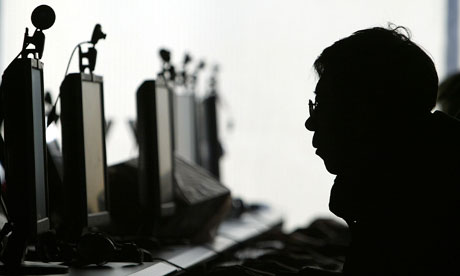
On 9 September, Johns Hopkins University asked one of its professors to take down a blog post on the NSA. Photograph: AP
This actually happened yesterday:
A professor in the computer science department at Johns Hopkins, a leading American university, had written a post on his blog, hosted on the university's servers, focused on his area of expertise, which is cryptography. The post was highly critical of the government, specifically the National Security Agency, whose reckless behavior in attacking online security astonished him.
Professor Matthew Green wrote on 5 September:
I was totally unprepared for today's bombshell revelations describing the NSA's efforts to defeat encryption. Not only does the worst possible hypothetical I discussed appear to be true, but it's true on a scale I couldn't even imagine.
The post was widely circulated online because it is about the sense of betrayal within a community of technical people who had often collaborated with the government. (I linked to it myself.)
On Monday, he gets a note from the acting dean of the engineering school asking him to take the post down and stop using the NSA logo as clip art in his posts. The email also informs him that if he resists he will need a lawyer. The professor runs two versions of the same site: one hosted on the university's servers, one on Google's blogger.com service. He tells the dean that he will take down the site mirrored on the university's system but not the one on blogger.com. He also removes the NSA logo from the post. Then, he takes to Twitter.
The professor says he was told that someone at the Applied Physics Laboratory, a research institute with longstanding ties to the Department of Defense and the National Security Agency, determined that his blog post was hosting or linking to classified material, and sounded the alarm, which led to the takedown request from the dean. He says he thought Johns Hopkins University, his employer, had come down "on the wrong side of common sense and academic freedom", particularly since the only classified material he had linked to was from news reports in the Guardian, the New York Times and ProPublica.org – information available to the public.
Word gets around, and by late afternoon, the press starts asking questions. Now, Johns Hopkins is worried about how it looks in the media. The university bureaucracy scrambles the jets and comes up with a statement:
The university received information this morning that Matthew Green's blog contained a link or links to classified material and also used the NSA logo. For that reason, we asked professor Green to remove the Johns Hopkins-hosted mirror site for his blog Upon further review, we note that the NSA logo has been removed and that he appears to link to material that has been published in the news media. Interim Dean Andrew Douglas has informed professor Green that the mirror site may be restored.
So the university backs down, leaving many unanswered questions. Possibly, they will be addressed today. Here are some on my list:
Who was it in the Applied Physics Laboratory, with its close ties to the NSA, that raised the alarm about what a (very effective) critic of the NSA was writing ... and why?
Did that person hear first from the government and then contact the Johns Hopkins officials?
Why would an academic dean cave under pressure and send the takedown request without careful review, which would have easily discovered, for example, that the classified documents to which the blog post linked were widely available in the public domain?
Why is Johns Hopkins simultaneously saying that the event was internal to the university (that the request didn't come from the government) and that it doesn't know how the whole thing began? The dean of the engineering school doesn't know who contacted him about a professor's blog post? Really? The press office doesn't know how to get in touch with the dean? Seems unlikely. Johns Hopkins spokesman Dennis O'Shea told me this morning that university officials "were still trying to trace" the events back to their source. Clearly, there's a lot more to the story.
Matthew Green said the original request to take down his post could have referred to his Blogger.com site and the site hosted on Johns Hopkins servers. Since a request to unpublish your thoughts is one of the most extreme and threatening that any university can make of a faculty member, what kind of deliberation went into it? That Johns Hopkins backtracked so quickly after the press started asking questions suggests that the reasoning was pretty thin. But the request was momentous. These things don't fit together. What gives?
Dennis O'Shea told me the original concern was that Matthew Green's post might be "illegally linking to classified information". I asked him what law he was referring to. "I'm not saying that there was a great deal of legal analysis done," he replied. Obviously. But again: given the severity of the remedy – unpublishing an expert's post critical of theNSA – careful legal analysis was called for. Why was it missing?
In commenting critically on a subject he is expert in, and taking an independent stance that asks hard questions and puts the responsibility where it belongs, Matthew Green is doing exactly what a university faculty member is supposed to be doing. By putting his thoughts in a blog post that anyone can read and link to, he is contributing to a vital public debate, which is exactly what universities need to be doing more often. Instead of trying to get Matthew Green's blog off their servers, the deans should be trying to get more faculty into blogging and into the public arena. Who at Johns Hopkins is speaking up for these priorities? And why isn't the Johns Hopkins faculty roaring about this issue? (I teach at New York University, and I'm furious.)
Notice: Matthew Green didn't get any takedown request from Google. Only from Johns Hopkins. Think about what that means for the school. He's "their" professor, yet his work is safer on the servers of a private company than his own university. The institution failed in the clutch. That it rectified it later in the day is welcome news, but I won't be cheering until we have answers that befit a great institution like Johns Hopkins, where graduate education was founded on these shores.
And another thing: America's system of research universities is the best in the world. No one argues with that. It's one of biggest advantages this nation has. If it becomes captive to government and handmaiden to the surveillance state, that would be an economic and cultural crime of monstrous proportions. What happened to Matthew Green's blog post yesterday is no small matter.
The red badge of courage
There are several reasons for sporting success but it's possible that bravery exerts the foremost influence
Rob Steen in Cricinfo
September 11, 2013
| |||
Half a century ago, Willie Mays was baseball's Garry Sobers. He ran like the wind, possessed a bone-chilling throw, maintained a sturdy batting average, and biffed home runs by the truckload. A superb centre-fielder, he also claimed the game's most celebrated catch, an over-the-shoulder number in the 1954 World Series that still inspires awe for its athleticism, spatial awareness and geometric precision.
Almost without exception, white New York sportswriters said he was gifted: the inference many drew was that this man, this black man, had succeeded not through hard work but because he had been granted a God-given head start. Even if you somehow manage not to classify this as racism, it remains deeply insulting.
"Gifted" is still shorthand for unfeasibly and unreasonably talented. We use it all the time in all sorts of contexts, mostly enviously. Wittingly or not, the implication is that the giftee has no right to fail. Hence the ludicrous situation wherein David Gower aroused far more scorn than Graham Gooch yet wound up with more Ashes centuries and a higher Test average.
Nature v nurture: has there ever been a more contentious or damaging sociological debate? Its eternal capacity to polarise was borne out last week when the Times devoted a hefty chunk of space to the views of two sporting achievers turned searching sportswriters, Matthew Syed and Ed Smith. Here was a fascinating clash of perspectives, not least since both have recently written books whose titles attest to the not inconsiderable role played by chance: Syed's Bounce and Smith's Luck.
In the red corner sits Syed, a two-time Olympian at table tennis. Referencing the original findings of the cognitive scientist Herbert Simon, winner of the 1978 Nobel Prize, he supported the theory espoused by Malcolm Gladwell, who argued in his recent book Outliers that success in any field only comes about through expertise, which means being willing to put in a minimum of 10,000 hours' practice.
Smith, the former England batsman and Middlesex captain who writes so thoughtfully and eloquently for this site, takes his cue from The Sports Gene: What Makes the Perfect Athlete, a new book by the American journalist and former athlete David Epstein, who takes issue with Gladwell.
Genetic make-up, Epstein concludes, is crucial. Usain Bolt, as he stresses, is freakishly tall for a sprinter. He also cites the example of Donald Thomas, who won the high jump title at the 2007 World Athletics Championships just eight months after taking his first serious leap. The key was an uncommonly long Achilles tendon, which doubled as a giant springboard. Subsequent practice, however, failed to generate any improvement. But if we insist, simplistically, that athletic talent is a gift of nature, counters Syed, echoing academic research, this can wreck resilience. "After all, if you are struggling with an activity, doesn't that mean you lack talent? Shouldn't you give up and try something else?"
The debate is rendered all the more complex, of course, by its prickliest subtext. Having conducted a globetrotting survey of attitudes, one "eye-opener" for Epstein was the reluctance of scientists to publish research on racial differences. Fear of the backlash continues to trump the need for understanding.
| Sport is uniquely taxing because it asks young bodies to do the work of seasoned minds | |||
These delicate issues and stark divergences of opinion, though, mask a deeper, more pertinent and resonant truth. To give nature all the credit is to deny the capacity for change; to plump for nurture is to ignore the inherent unfairness of genetics. Isn't it a matter of nurturing nature? Besides, surely success is more about application. Possessing gallons of ability is no guarantee if, like Chris Lewis, who promised so much for England in the 1990s and delivered conspicuously less, you lack the wherewithal to take full advantage. And if skill was the sole prerequisite, how did Steve Waugh become the game's most indomitable force?
Where would Waugh have been without determination? The same could be asked of the game's two most powerful current captains, MS Dhoni and Michael Clarke. Without that inner drive, would Dhoni have emerged from his Ranchi backwater? Would Clarke have risen from working-class boy to metrosexual man? Ah, but is determination innate or learnt? Cue a cascade of further questions. How telling is environment - social, economic and geographic? Does it have more impact during childhood or adulthood? Is temperament natural or nurtured? Can will be developed? Is confidence instinctive or acquired? I haven't the foggiest. All I can say with any vestige of certainty is that, when preparing a recipe for success, limiting ourselves to a single ingredient seems extraordinarily daft and utterly self-defeating.
So here's another thought. Given that, for the vast majority, achieving sporting success invariably involves battling against at least a couple of odds, surely courage has something to do with it: the courage to overcome prejudice, disadvantage or fear of failure. The courage to perform when thousands are urging you to fail - or, worse, succeed. The courage to take on the bigger man, the better-trained man, to stand your ground, put bones at risk, resist defeatism. The courage not just to be different but act different. The courage not to play the percentages. The courage not to be cautious. The courage to try the unorthodox, the outrageous. The courage to risk humiliation. And the courage, after suffering it, to risk it again.
| |||
The older we get, theoretically at least, the safer we feel and the less courage we need. The less courage I need, the more I admire it in others, hence the growing conviction that bravery exerts the foremost influence on a sportsman's fate, as critical on the field as in the ring or on chicane. In team sports, it is even more imperative: sure, the load can be shared, but it still takes a special type of courage, of nerve, to satisfy the selfish gene - i.e. express yourself - while serving the collective good.
What makes this even more complicated is that when sportsfolk most need courage - between the ages of, say, 14 and 40 - few have fully matured as human beings. How many of the most powerful business leaders or successful lawyers or respected doctors are under 50? How many of the most eminent actors, musicians, authors or chat-show hosts? Sport is uniquely taxing because it asks young bodies to do the work of seasoned minds.
In cricket, the first test of courage comes early. Of all the factors that dissuade wide-eyed schoolboys from pursuing the game professionally, none quite matches the fear of leather and cork. Even for those at the summit, it remains a fear to be acknowledged, tolerated and respected. As Ian Bell recently highlighted when discussing the delights of fielding at short leg, conquest is impossible.
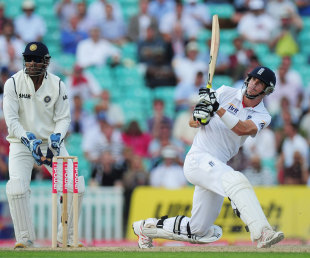
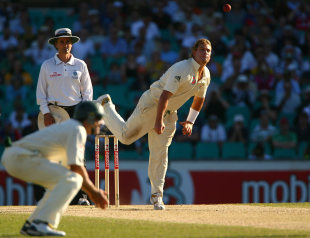
Where the air is rarest and the stakes highest, spiritual courage is even more vital. "I was an outsider. I still am. I didn't do what they wanted." Lou Reed's words they may be, but they could just as easily be the reflections of another couple of performers happy to walk on the wild side, Kevin Pietersen and Shane Warne. That these brothers-in-fitful-charms happen to be 21st-century cricket's foremost salesmen seems far from accidental.
Both are victories for nurture. Both practise(d) with ardour and diligence, mastering their craft, continually honing and refining, then building on it, then honing and refining some more. Both studied opponents assiduously, the better to parry, outwit and confound. Both became inventors, devising daring drives and dastardly deliveries. Yet nature, too, has played a significant role. Both are enthusiasts and positive thinkers. Both radiate self-belief and superiority. Both boast heavenly hand-eye co-ordination. Above all, nonetheless, both aspire(d) to something loftier than mere excellence. Both craved not just to be the best, nor even to dominate, but to astound. To do that takes another very special brand of courage.
For Warne, this meant having the courage to give up one sport and pursue one for which he seemed, physically and temperamentally, far less suited. For Pietersen, it meant having the courage to leave his homeland and to be reviled as both intruder and traitor. Neither, moreover, could completely suppress nature, so they remained true to their gambling instincts and innate showmanship. Without the mental strength to achieve the right balance, such an intricate juggling act would have been beyond them. Perhaps that's what courage really is: the strength to stick to your own path.
Don't take it from me; listen to Bolt: "I'd seen so many people mess up their careers because people had told them what to do and what not to do, almost from the moment their lives had become successful, if not before. The joy had been taken from them. To compensate, they felt the need to take drugs, get drunk every night, or go wild. I realised I had to enjoy myself to stay sane."
Nature versus nurture. Mind versus matter. Means versus ends. Turn those antagonists into protagonists and we might get somewhere. First, though, there must be acceptance: compiling an idiot-proof guide to success is akin to tackling a vat of soup with miniature chopsticks. Besides, if it were easy, there would be more winners than losers. In sport, where success means nothing if nobody fails, that might present a particularly prickly problem.
The best advice? Try Laura Nyro's rallying-cry:
Oh-h, but I'm still mixed up like a teenager
Goin' like the 4th of July
For the sweet sky
Oh-h, but I'm still mixed up like a teenager
Goin' like the 4th of July
For the sweet sky
The silent military coup that took over Washington
This time it's Syria, last time it was Iraq. Obama chose to accept the entire Pentagon of the Bush era: its wars and war crimes

Children, many of whose deformities are believed to be the results of the chemical dioxin that the US used in the Vietnam war, play outside a hospital in Ho Chi Minh City. Photograph: Paula Bronstein/Getty Images
On my wall is the Daily Express front page of September 5 1945 and the words: "I write this as a warning to the world." So began Wilfred Burchett's report from Hiroshima. It was the scoop of the century. For his lone, perilous journey that defied the US occupation authorities, Burchett was pilloried, not least by his embedded colleagues. He warned that an act of premeditated mass murder on an epic scale had launched a new era of terror.
Almost every day now, he is vindicated. The intrinsic criminality of the atomic bombing is borne out in the US National Archives and by the subsequent decades of militarism camouflaged as democracy. The Syria psychodrama exemplifies this. Yet again we are held hostage by the prospect of a terrorism whose nature and history even the most liberal critics still deny. The great unmentionable is that humanity's most dangerous enemy resides across the Atlantic.
John Kerry's farce and Barack Obama's pirouettes are temporary. Russia's peace deal over chemical weapons will, in time, be treated with the contempt that all militarists reserve for diplomacy. With al-Qaida now among its allies, and US-armed coupmasters secure in Cairo, the US intends to crush the last independent states in the Middle East: Syria first, then Iran. "This operation [in Syria]," said the former French foreign minister Roland Dumas in June, "goes way back. It was prepared, pre-conceived and planned."
When the public is "psychologically scarred", as the Channel 4 reporter Jonathan Rugman described the British people's overwhelming hostility to an attack on Syria, suppressing the truth is made urgent. Whether or not Bashar al-Assad or the "rebels"used gas in the suburbs of Damascus, it is the US, not Syria, that is the world's most prolific user of these terrible weapons.
In 1970 the Senate reported: "The US has dumped on Vietnam a quantity of toxic chemical (dioxin) amounting to six pounds per head of population." This was Operation Hades, later renamed the friendlier Operation Ranch Hand – the source of what Vietnamese doctors call a "cycle of foetal catastrophe". I have seen generations of children with their familiar, monstrous deformities. John Kerry, with his own blood-soaked war record, will remember them. I have seen them in Iraq too, where the US used depleted uranium and white phosphorus, as did the Israelis in Gaza. No Obama "red line" for them. No showdown psychodrama for them.
The sterile repetitive debate about whether "we" should "take action" against selected dictators (ie cheer on the US and its acolytes in yet another aerial killing spree) is part of our brainwashing. Richard Falk, professor emeritus of international law and UN special rapporteur on Palestine, describes it as "a self-righteous, one-way, legal/moral screen [with] positive images of western values and innocence portrayed as threatened, validating a campaign of unrestricted political violence". This "is so widely accepted as to be virtually unchallengeable".
It is the biggest lie: the product of "liberal realists" in Anglo-American politics, scholarship and media who ordain themselves as the world's crisis managers, rather than the cause of a crisis. Stripping humanity from the study of nations and congealing it with jargon that serves western power designs, they mark "failed", "rogue" or "evil" states for "humanitarian intervention".
An attack on Syria or Iran or any other US "demon" would draw on a fashionable variant, "Responsibility to Protect", or R2P – whose lectern-trotting zealot is the former Australian foreign minister Gareth Evans, co-chair of a "global centre" based in New York. Evans and his generously funded lobbyists play a vital propaganda role in urging the "international community" to attack countries where "the security council rejects a proposal or fails to deal with it in a reasonable time".
Evans has form. He appeared in my 1994 film Death of a Nation, which revealed the scale of genocide in East Timor. Canberra's smiling man is raising his champagne glass in a toast to his Indonesian equivalent as they fly over East Timor in an Australian aircraft, having signed a treaty to pirate the oil and gas of the stricken country where the tyrant Suharto killed or starved a third of the population.
Under the "weak" Obama, militarism has risen perhaps as never before. With not a single tank on the White House lawn, a military coup has taken place in Washington. In 2008, while his liberal devotees dried their eyes, Obama accepted the entire Pentagon of his predecessor, George Bush: its wars and war crimes. As the constitution is replaced by an emerging police state, those who destroyed Iraq with shock and awe, piled up the rubble in Afghanistan and reduced Libya to a Hobbesian nightmare, are ascendant across the US administration. Behind their beribboned facade, more former US soldiers are killing themselves than are dying on battlefields. Last year 6,500 veterans took their own lives. Put out more flags.
The historian Norman Pollack calls this "liberal fascism": "For goose-steppers substitute the seemingly more innocuous militarisation of the total culture. And for the bombastic leader, we have the reformer manqué, blithely at work, planning and executing assassination, smiling all the while." Every Tuesday the "humanitarian" Obama personally oversees a worldwide terror network of drones that "bugsplat" people, their rescuers and mourners. In the west's comfort zones, the first black leader of the land of slavery still feels good, as if his very existence represents a social advance, regardless of his trail of blood. This obeisance to a symbol has all but destroyed the US anti-war movement – Obama's singular achievement.
In Britain, the distractions of the fakery of image and identity politics have not quite succeeded. A stirring has begun, though people of conscience should hurry. The judges at Nuremberg were succinct: "Individual citizens have the duty to violate domestic laws to prevent crimes against peace and humanity." The ordinary people of Syria, and countless others, and our own self-respect, deserve nothing less now.
Tuesday, 10 September 2013
Reliance Energy Pricing - Selling the dream for a song

The Hindu
The government has spared no effort to convince the public that its gas pricing formula, skewed in favour of Reliance, will be the solution to India's energy needs
Politicians worldwide are dream merchants. They sell dreams. Indian politicians are, of course, second to none in this business and have indeed perfected this art form. Their success in selling pipe dreams is perhaps a measure of the depth of our despair as a nation. Can any Indian, my age, forget the euphoria that the dream of “Garibi Hatao” created in the 1970s? Some 40 plus years later, the same Congress party is telling the nation that 70 per cent of people now need food subsidy to survive. Of course, its minions in the Planning Commission are running out of newly sharpened pencils convincing the nation that poverty has reduced significantly. They see no contradiction between the claimed lowering of poverty and the proposed food security bill that has its foundation in the fact that 70 per cent of Indians cannot even buy sufficient food to survive today.
Rangarajan formula
Veerappa Moily, an old Congress satrap, is a highly decorated warrior of many election battles. As an experienced dream merchant, he is selling the Rangarajan formula for pricing gas as the panacea to India’s energy security woes. No one has answered any of the direct questions that I have asked in my four articles in The Hindu since the Rangarajan Committee report surfaced. However, deceptive claims have kept appearing in the press about the wisdom of pricing natural gas as proposed by Dr. Rangarajan. And since no one was buying their arguments, the powers-that-be took out their most lethal weapon — the pen of the Honourable Minister himself to destroy non-believers like myself. Unfortunately, some of the statements in Mr. Moily’s op-ed of August 7, 2013 in the Times of India come straight out of a recent Annual Report of Reliance.
My issue is with our dream merchants and not with Reliance for it, like any private enterprise, responds efficiently and effectively to shape the prevailing environment and maximise profits. So let me cut short the song and dance and pose some straight questions to the Honourable Minister.
1. Can the Honourable Minister list the $100 billion that Indian companies have invested or committed to date for oil and gas assets overseas? The actual investment to date is under $25 billion and I honestly wish it was four times higher as claimed by the Honourable Minister. Although there are huge cans of worms under some of the overseas acquisitions we have made, the truth is that for every dollar invested overseas we have accrued more oil and gas reserves than for the same dollar invested in the Indian sedimentary basin. Large and serious global investors in oil and gas go where the prospects are the best. I am proud that despite a few questionable deals, the Indian public sector (primarily OVL) took the lead in this while the domestic private sector concentrated on India — an environment it could efficiently and effectively manage for much higher monetary gains (not resource accretion).
2. Can the Honourable Minister name any country in the world that offered investors from India or elsewhere a formula such as that proposed by the Rangarajan Committee or, for that matter, a formula such as the one currently in use in India to lure exploration and production investments in conventional natural gas or oil?
3. Despite the price reforms in Brazil and China cited by the Honourable Minister, do either of these countries or for that matter any country in the world provide the kind of guaranteed well head price for conventional natural gas that we have been paying under the current formula or promising to pay under the Rangarajan formula from April 2014? Can the Honourable Minister name a single well head in the world that is currently receiving $8.40/MMBTU or anywhere close to it for conventional natural gas?
Doubtful claims
4. The Honourable Minister gives several numbers about potentially higher domestic productions that could have been realised by end-2013 and by 2014-15 from KG-D6 and the likely savings in LNG imports. The Honourable Minster blames his own government for failure to give timely approvals to Reliance to achieve these outputs. The validity of these claims, especially the basis for estimating avoided LNG imports, remains in doubt but, more importantly, is the Honourable Minister trashing the various findings of the CAG and the Parliamentary Committee on KG-D6? Is the Honourable Minister trashing the findings of his predecessor and the reports of his own Ministry and the DGH?
5. The Honourable Minister promises an additional production of 40 MMSCMD of gas annually “starting” 2016-17 and savings of $65 billion in LNG imports. This outcome, the Honourable Minister informs, is the direct result of the changes he has instituted in the way his Ministry had been operating and the use of the Rangarajan formula for pricing conventional natural gas at the well head. Again, leaving aside the dubiousness of the estimated savings on LNG imports, let me ask the Honourable Minster if he can guarantee the promised additional output. Will this additional output come from the existing fields or new fields with new investments? Will the additional output result from RIL belatedly fulfilling its long unmet commitments under the addendum to the agreed initial development plan as detailed by the CAG? Finally, will this additional production come from acreage that should have been relinquished years ago as pointed out by the CAG?
In closing, the Honourable Minister lets fly a “conservative” pipe dream of 100 tcf of gas unlocking “$1 trillion in value” — never mind the details or the basis. At IIM-Ahmedabad, one of my very famous professors always said that a policymaker must have her/his head in the clouds but the feet must remain firmly on the ground. Since my infancy, my mother always told me that thieves have no feet. Neither that famous professor nor my illiterate mother is alive today for me to ask them if dream merchants with heads in the clouds too have no feet!
Subscribe to:
Posts (Atom)