Search This Blog

Wednesday, 7 August 2013

The US frequently refuses extradition requests - On Obama's cancellation of summit with Putin and extradition


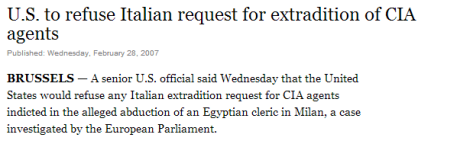
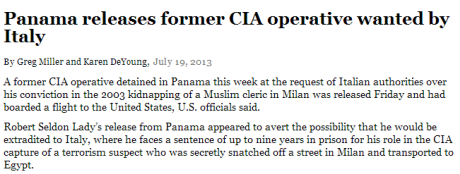
The US frequently refuses extradition requests where, unlike with Snowden, it involves serious crimes and there is an extradition treaty
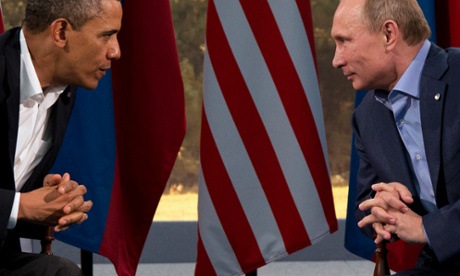
President Barack Obama meets with Russian President Vladimir Putin in Enniskillen, Northern Ireland.  Obama and Putin discussed the ongoing conflict in Syria during their bilateral meeting.
President Barack Obama today canceled a meeting with Russian President Vladimir Putin. Photograph: Evan Vucci/AP
President Obama today canceled a long-scheduled summit with Russian PresidentVladimir Putin in part because the US president is upset that Russia defied his personal directive to hand over Edward Snowden despite the lack of an extradition treaty between the two nations. That means that US media outlets will spend the next 24 hours or so channeling the government's views (excuse the redundancy) by denouncing the Russian evil of refusing extradition. When doing so, very few, if any, establishment media accounts will mention any of these cases:
NYT WashPost Guardian
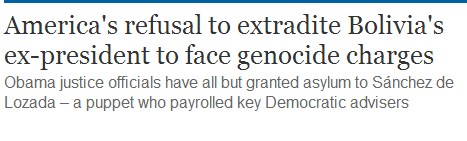
[US refuses Bolivia's request to extradite its former CIA-supported president, Gonzalo Sánchez de Lozada, to stand trial on charges of genocide and other war crimes after de Lozada hires Democratic lobbyists to represent him]
El Paso
The US constantly refuses requests to extradite - even where (unlike Russia) they have an extradition treaty with the requesting country and even where (unlike Snowden) the request involves actual, serious crimes, such as genocide, kidnapping, and terrorism. Maybe those facts should be part of whatever media commentary there is on Putin's refusal to extradite Snowden and Obama's rather extreme reaction to it.

Other matters

Former Bush-era CIA and NSA director Michael Hayden appeared on CNN this week and confirmed that our reporting on the NSA's X-Keyscore program was accurate, telling the nation that we should all be grateful for those capabilities.
NYU journalism professor Jay Rosen has a superb essay on the behavior of the US media in NSA stories.
Foreign Policy CEO and Editor David Rothkopf becomes the latest establishment figure to recognize, as he puts it in a quite good column: "I have myself been too slow to recognize that the benefits we have derived from Snowden's revelations substantially outweigh the costs associated with the breach."

Ashes 2013: England's spin king Graeme Swann makes all the difference


Transpose the seamers and the story would probably be the same. Do so with the spinners and Australia might well be in the ascendant – Graeme Swann is that influential
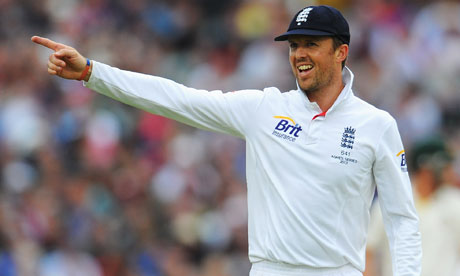
England's Graeme Swann
Graeme Swann is on track to be not just England’s, but one of the game’s, greatest ever spin bowlers. Photograph: Stu Forster/Getty Images
Spin them how you like, twist them until they look like a DNA double helix but in the end statistics can tell a story. In this series, after three Tests, they are revealing both similarities and differences between the sides.
Ian Bell, for instance, stands head and shoulders above any other batsman, with the possible exception of Michael Clarke, and is unmatched for consistency. Closest for England is Joe Root and 180 of his 242 runs have come in a single knock, while Stuart Broad has more runs than Alastair Cook and Jonathan Trott, and averages more than any other England batsman beyond Bell and Root.
Of the seam bowlers, Ryan Harris and Peter Siddle have outbowled their England counterparts significantly. Harris, brilliant, has 11 wickets from two Tests at 18 runs apiece and Siddle, an industry all on his own, has 16 at 21.68. Only Jimmy Anderson comes close for England, with 15 wickets at 26, but he had one of his least productive games for England at Old Trafford, where both Australian seamers excelled.
England's three other seamers in this series – Steve Finn, Tim Bresnan, and Broad – have only as many wickets as Anderson between them, and at a cost that might put them on the shelves in Harrods rather than Lidl. There has been a great deal of mediocrity from both sides in this series.
If England have the upper hand in any area, though, it is with their use of and success with spin. Here the differential is huge.
Australia's spinners have taken seven wickets for 442 runs, four of those going to the occasional legspinner Steve Smith who got lucky once. It means that the two front-line spinners, Ashton Agar and Nathan Lyon, have three wickets between them, costing 111 runs each.
On the same pitches Graeme Swann and, briefly, Root have managed 22 at 23.4 each, 19 of them to Swann.
Only in the maiden-overs column, where the Australia spinners have sent down 30 to England's 29, and from 43 fewer overs, do they have the upper hand – and that most likely is a function of the fields that have been set. Swann is the single player who is making a difference. Transpose the seamers and the story would be the same, probably more so. Do so with the spinners and Australia might well be in the ascendent – he is that influential.
Perhaps it is unfair to compare his figures with those of a teenager elevated to the heights with the rapidity of an ejector seat (although Dan Vettori, for example, managed well enough) or someone whose perceived weakness, despite a perfectly credible career, meant that no Australian had played as many Tests as Lyon had before Old Trafford without one against England. But Swann has moved beyond the stage of being merely a phenomenon and is on track to be not only England's greatest spin bowler, but one of the game's greatest.
At the moment he has 241 wickets from 55 matches, which places him 11th in a list of wicket-taking spinners, headed of course by Muttiah Muralitharan, with 800, then Shane Warne, 708, and Anil Kumble (619).
These are players surely out of reach for all time and perhaps, for Swann, Harbhajan Singh, 413, too. But the rest – from Vettori (360) down to Bhagwat Chandrasekhar (242), are within range. More pertinently, he is closing in on Derek Underwood's England record of 297 wickets as a spinner.
What is surprising is that of those 10 spinners with more wickets than he, his career average of 28.41 is bettered only by Murali (22.72), Warne (25.41) and Underwood (25.83), and this playing half his cricket on generally seam-orientated English pitches.
Indeed sometimes it is hard to understand quite what it is that elevates Swann above other bowlers. There is no mystery to him, no doosra or carrom ball. He is an orthodox finger spinner, not back of the hand like Warne, Kumble, Danish Kaneria or Chandra; or a double-jointed physical freak of nature as Murali has been.
He spins the ball hugely for a finger spinner – about 2,500 revs, according to the TV spinometer – but then Lyon gets close to that, too.
With the spin comes drift away from the direction of turn (physicists can explain that one) and thus he can beat the outside of the bat as well as inside. This, despite his late entry into the Test arena (which given what has happened is as baffling as anything else about him) is a thoroughly modern DRS savvy bowler, whose enviable record against left-handers owes as much to him hitting the pads as beating or taking the outside edge.
Yet even this aspect seems to have tailed off, with batsmen now making sure they keep their pads out of the way.
In the end, it must simply come down to nous. He has supreme confidence in his ability, is unflappable under fire (an interesting contrast to how Lyon reacted when first Pietersen and then Bell got stuck into him in a calculated manner in England's first innings at Old Trafford), can pick holes in a batsman's technique, and varies his pace and trajectory according to conditions and circumstance. There is a tantalising line that he bowls to right-handers too. England offspinners of yore, helped by a lack of fielding restrictions on the leg-side, tended to bowl a straighter line than their overseas counterparts but Swann operates outside the off-stump, inviting the drive through that side. No off-spinner likes being hit through extra cover off the front foot but none mind seeing a batsman try.
Perhaps Swann does have a little magic to him. When, from round the wicket, he proceeded to bowl the left-hander Usman Khawaja behind his legs with an off-break that turned significantly, he celebrated with the sort of joy that only comes when something is pre-planned, or at least signalled beforehand as an act of bravado.
It looked for all the world as if he meant it: he probably did.

Tuesday, 6 August 2013

How Much Land Does a Man Need?

"How Much Land Does a Man Require?" (Russian: Много ли человеку земли нужно?, Mnogo li cheloveku zemli nuzhno) is an 1886 short story by Leo Tolstoy about a man who, in his lust for land, forfeits everything.


Synopsis

The protagonist of the story is a peasant named Pakhom, whose wife at the beginning can be heard complaining that they do not own enough land to satisfy them. He states that "if I had plenty of land, I shouldn't fear the Devil himself!". Unbeknownst to him, Satan is present sitting behind the stove and listening. Satan abruptly accepts his challenge and also tells that he would give Pakhom more land and then snatch everything from him. A short amount of time later, a landlady in the village decides to sell her estate, and the peasants of the village buy as much of that land as they can. Pakhom himself purchases some land, and by working off the extra land is able to repay his debts and live a more comfortable life. 

However, Pakhóm then becomes very possessive of his land, and this causes arguments with his neighbours. "Threats to burn his building began to be uttered." Later, he moves to a larger area of land at another Commune. Here, he can grow even more crops and amass a small fortune, but he has to grow the crops on rented land, which irritates him. Finally, after buying and selling a lot of fertile and good land, he is introduced to the Bashkirs, and is told that they are simple-minded people who own a huge amount of land. Pakhóm goes to them to take as much of their land for as low a price as he can negotiate. Their offer is very unusual: for a sum of one thousand rubles, Pakhóm can walk around as large an area as he wants, starting at daybreak, marking his route with a spade along the way. If he reaches his starting point by sunset that day, the entire area of land his route encloses will be his, but if he does not reach his starting point he will lose his money and receive no land. He is delighted as he believes that he can cover a great distance and has chanced upon the bargain of a lifetime. That night, Pakhóm experiences a surreal dream in which he sees himself lying dead by the feet of the Devil, who is laughing.

He stays out as late as possible, marking out land until just before the sun sets. Toward the end, he realizes he is far from the starting point and runs back as fast as he can to the waiting Bashkirs. He finally arrives at the starting point just as the sun sets. The Bashkirs cheer his good fortune, but exhausted from the run, Pakhóm drops dead. His servant buries him in an ordinary grave only six feet long, thus ironically answering the question posed in the title of the story.


Seeing is unbelieving: DRS in a pickle

Vedam Jaishankar in Times News Network 6/8/13


For some time now the BCCI has been cast as a demon by ICC's former veto-power countries' media. Snide remarks and leaks to the English and Australian media by influential voices in those countries and even within ICC made it seem that the BCCI was responsible for all the ills dogging cricket. 

The malicious plethora of blame ranged from BCCI's position on the Decision Review System to IPL to television money to cricket schedule to pitches to every other issue related to the game. 

How ironic then that with the BCCI far removed from the scene, it is the two Ashes combatants who are smarting under a string of goof-ups, almost all of their making. Tragically for them there is no big, bad wolf to blame for what must already go down as one of the touchiest of series. 

DRS, which was hailed as the greatest invention since sliced bread, is in a veritable pickle. The joke though was when the inventor of the so-called Hot Spot admitted that batsmen were confusing the gizmo by using metallic stickers on their bats. He insisted that the Hot Spot be used with an enhanced snick-o-meter as a back-up. As seen in the Ashes series that is no cure either, as third umpires are also confused by the snicks; not sure whether these are triggered by the sound of bat hitting ground or ball brushing the pad. 

-------
Also read

Cricket and DRS - The Best is not the Enemy of the Good

On Walking - Advice for a Fifteen Year Old


------


The benefit of doubt, which traditionally went to the batsman, now tended to go in favour of the Snick-o-meter and Hot Spot! When the mistakes became too glaring to ignore, vested interests, much in the fashion of the American Gun Lobby who claimed "guns don't kill people; people do" stated that it was the umpires who goofed up on interpretation and not their 'hallowed' gizmos. 

But DRS was not the only sore point. Bad light became an issue in the Ashes Tests much like Tests in the past. These two Ashes nations which attempted to make other countries play Tests under lights did not want to use similar floodlights to dispel darkness. Yes, the lights were switched on, but were not good enough to support Test cricket! 

This was the last straw for Australia who believed they have borne the brunt of the many errors. Their skipper Michael Clarke was seen vehemently arguing with the umpires on live television. At the end of the day's play David Warner revealed that Clarke thought the light was good enough but the umpires thought otherwise. 

Did Clarke bring the game into dispute by arguing publicly on the field of play? Most cricket-loving viewers would have thought so. But did the ICC's match referee too see it that way? Time will tell. That brings us to the cricket pitches. Were they ideal for batting? 

Not really. Not when the ball turns square in the midst of the match, or the odd delivery leaps off a length. Had this been an Indian pitch we would not have heard the last of it. But Australia and England, they have their own rules and they'd be happy if everybody (read as BCCI) too plays to those rules.

Monday, 5 August 2013

The Government’s shameful scapegoating of immigrants

by Yasmin Alibhai Brown in The Independent

The Home Office is on a mission to intimidate Kipling’s “fluttered folk and wild” abroad and in the UK.
It is proud to be institutionally racist, very proud indeed. It has figures to show just how many bloody foreigners have been dealt with and what awaits the others. In June a new £3,000 bond was imposed on visitors from “high risk” nations in Asia and Africa; overseas students from those continents are actively discouraged from coming to our universities. Blatantly discriminatory rules have been instituted; international treaties and human rights legislation are neglected. The nation is dishonoured again by its keepers.
On Friday, on BBC News, Home Office bully boys were shown rounding up dark-skinned folk in specially targeted multiracial localities. In Southall in  west London, outraged Asian women defied them and objected volubly. Some were from Southall Black Sisters, a collective which, for years, has defended gender and minority rights. I recognised some  – grey-haired now, but still full of indignation and passion. In previous decades they demonstrated against virginity tests for Asian women, carried out to check if they were really brides-to-be. And again against the law which denied foreign-born wives legal status for years. And again when the National Front marched through Southall.
The scenes on TV reminded me of South Africa’s pass laws. I broke down and cried inconsolably. Before this latest official  persecution, Home Office vans were spotted in inner-city areas with nasty signs telling illegal migrants to go home. The messages subliminally warned all people of colour not to get too comfortable, to assume we were safe. We who came to stay jumped through hoops of fire to gain some acceptance. But now we know it can be withdrawn. Nasty vans were not sent to areas where Australians and white South Africans hang out. The  barrister  Geoffrey Robertson, his novelist wife Kathy Lette or MP Peter Hain were not made to feel uninvited and unwanted. When will our governments stop pissing on non-white migrants? Will they ever? My kids look like me – I fear for them too.
Ukip’s Nigel Farage, now presenting himself as Mr Nice Guy, has criticised these Home Office initiatives. More bizarrely still, the Tory strategist, Australian Lynton Crosby, has privately expressed his own doubts about the vans. This is the controversial political operator who, in his own country, and the UK has used immigration as an election doodlebug. I told him at a party how much I detested these campaigns and he listened, unmoved, blasé. So why the reservations now about the hardline Home Office tactics? Is it part of Crosby’s cunning plan to disable Ukip? Or have even these unreconstructed men sensed that a line has been crossed?
London has just tried to relive the glorious multiracial Olympics. Oh how our PM and his mates loved all that colour and pizzazz. And all the while his Government forces landlords, medical staff and schools to check passports and exclude those who can’t prove they belong. Immigration detention centres, run by private companies, treat inmates like vermin. Not many white faces in there. Western Europeans have always migrated and still do, as if that is their birthright. But the movement of people from elsewhere is a threat, a menace, even when millions are dispossessed by Western geopolitical games and economic interests.
In our times, we are not permitted to call racism by its name when debating immigration. That discourse is strictly regulated. Immigration is now allegedly completely decoupled from prejudices. Furthermore, it is claimed that Britons are not “allowed” to talk about immigration for fear of being branded “racist”. When did we not talk about the “problems of immigration”? Has there been a single year when known public individuals did not express “brave” views against migration or express xenophobia? Today neo-Powellite nationalists like David Goodhart are lauded as messiahs and the twinned Frank Field and Nicholas Soames regurgitate the messages of anti-immigration lobbyists with enviable access to the media. Britons who are fair and open-minded are appalled by the ceaseless hostility towards incomers. They daren’t speak out because of the overpowering pressure to follow the populist line. Trolls are out to get us too.
The Tories always use the race/immigration card. They don’t even pretend inclusion any more. Shawn Bailey, the Tory black “street” mascot in Downing Street has been dumped; Sayeeda Warsi is back in the ghetto. Meanwhile New Labour, even while encouraging immigration, did not defend it and instead assuaged small island protectionists. But the most culpable are the black and Asian MPs and peers, an unprecedented number now in power, soon to be joined by Doreen Lawrence. So far hardly any have spoken out about the Home Office travesties. Those Southall women had more guts. They could form a cross-party faction and expose the racist immigration policies. Together they would be strong enough to make an impact. But the MPs and peers sit tight, treacherously let the state repeat and exceed the iniquities of the past suffered by their own people, families, possibly themselves. I think I am going to cry again.

Sunday, 4 August 2013

On Walking - Advice for a Fifteen Year Old

  
By Girish Menon


Only the other day at the Bedford cricket festival, Om, our fifteen year old cricket playing son, asked me for advice on what he should do if he nicked the ball and the umpire failed to detect it. Apparently, another player whose father had told him to walk had failed to do so and was afraid of the consequences if his father became aware of this code violation. At the time I told Om that it was his decision and I did not have any clear position in this matter. Hence this piece aims to provide Om with the various nuances involved in this matter. Unfortunately it may not act as a commandment, 'Thou shall always walk', but it may enable him to appreciate the diverse viewpoints on this matter.

In some quarters, particularly English, the act of playing cricket, like doing ethical business, has connotations with a moral code of behaviour. Every time a batsman, the most recent being Broad, fails to walk the moralists create a crescendo of condemnation and ridicule. In my opinion this morality is as fake as Niall Ferguson's claims on 'benevolent and enlightened imperialism'. Historically, the game of cricket has been played by scoundrels and saints alike and cheating at cricket has been rife since the time of the first batting superstar W G Grace.
Another theory suggests that the moral code for cricket was invented after World War II by English amateurs to differentiate them from the professionals who played the game for a living. This period also featured different dressing rooms for amateurs and professionals, there may also have been a third dressing room for coloured players. One could therefore surmise that 'walking' was a code of behaviour for white upper class amateurs who played the game for pleasure and did not have to bother about their livelihood.

This then raises the question should a professional cricketer walk?

Honore de Balzac once wrote, 'Behind every great fortune there is a crime'. Though I am not familiar of the context in which Balzac penned these words, I assume that he may have referred to the great wealth accumulated by the businessmen of his times. As a student and a teacher of economics I am of the conviction that at some stage in their evolution even the most ethical of businesses and governments may have done things that was not considered 'cricket'. The British during the empire building period was not ethical nor have been the Ambanis or Richard Branson.

So if I am the professional batsman, with no other tradable skill in a market economy with no welfare protection, travelling in a last chance saloon provided by a whimsical selection committee what would I do? I would definitely not walk, I'd think it was a divine intervention and try to play a career saving knock.

As you will see I am a sceptic whenever any government or business claims that it is always ethical just as much as the claims of walking by a Gilchrist or a Cowdrey.

I am more sympathetic to the Australian position that it is the umpire's job to decide if a batsman is out. Since dissent against umpiring decisions is not tolerated and there is no DRS at the lower echelons of cricket it does not make sense to walk at all. As for the old chestnut, 'It evens out in the end',  trotted out by wizened greats of the game I'd like to counter with an ancient Roman story about drowned worshippers narrated by NN Taleb in his book The Black Swan.

One Diagoras, a non believer in the gods, was shown painted tablets bearing the portraits of some worshippers who prayed, then survived a subsequent ship wreck. The implication was that praying protects you from drowning. Diagoras asked, 'Where were the pictures of those who prayed, then drowned?"

In a similar vein I wish to ask, 'Where are the batters who walked and found themselves out of the team?' The problem with the quote, 'It evens out in the end' is that it is used only by batters who survived. The views of those batters with good skills but who were not blessed with good fortune is ignored by this 'half-truth'.

So, Om, to help you make up your mind I think Kipling's IF says it best:

If you can trust yourself when all men doubt you

If you can meet with Triumph and Disaster
And treat those two impostors just the same

If you can make one heap of all your winnings
And risk it on one turn of pitch and toss
And lose, and start again at your beginnings

Then, you may WALK, my son! WALK!


There is another advantage, if you can create in the public eye an 'image' of an honest and upright cricketer. Unlike ordinary mortals, you will find it easier, in your post cricket life, to garner support as a politician or as an entrepreneur. The gullible public, who make decisions based on media created images, will cling to your past image as an honest cricketer and will back you with their votes and money. Then what you do with it is really up to you. Just watch Imran Khan and his crusade for religion and morality!

The writer plays for CamKerala CC in the Cambs league.

Friday, 2 August 2013

Selfish traits not favoured by evolution, study shows


Evolution does not favour selfish people, according to new research.
This challenges a previous theory which suggested it was preferable to put yourself first.
Instead, it pays to be co-operative, shown in a model of "the prisoner's dilemma", a scenario of game theory - the study of strategic decision-making.
Published in Nature Communications, the team says their work shows that exhibiting only selfish traits would have made us go extinct.
Game theory involves devising "games" to simulate situations of conflict or co-operation. It allows researchers to unravel complex decision-making strategies and to establish why certain types of behaviour among individuals emerge.
Freedom or prison

A team from Michigan State University used a model of the prisoner's dilemma game, where two suspects who are interrogated in separate prison cells must decide whether or not to inform on each other.
In the model, each person is offered a deal for freedom if they inform on the other, putting their opponent in jail for six months. However, this scenario will only be played out if the opponent chooses not to inform.
If both "prisoners" choose to inform (defection) they will both get three months in prison, but if they both stay silent (co-operation) they will both only get a jail term of one month.
The eminent mathematician John Nash showed that the optimum strategy was not to co-operate in the prisoner's dilemma game.
"For many years, people have asked that if he [Nash] is right, then why do we see co-operation in the animal kingdom, in the microbial world and in humans," said lead author Christoph Adami of Michigan State University.
Mean extinction

The answer, he explained, was that communication was not previously taken into account.
"The two prisoners that are interrogated are not allowed to talk to each other. If they did they would make a pact and be free within a month. But if they were not talking to each other, the temptation would be to rat the other out.
"Being mean can give you an advantage on a short timescale but certainly not in the long run - you would go extinct."
These latest findings contradict a 2012 study where it was found that selfish people could get ahead of more co-operative partners, which would create a world full of selfish beings.
This was dubbed a "mean and selfish" strategy and depended on a participant knowing their opponent's previous decision and adapting their strategy accordingly.
Crucially, in an evolutionary environment, knowing your opponent's decision would not be advantageous for long because your opponent would evolve the same recognition mechanism to also know you, Dr Adami explained.
This is exactly what his team found, that any advantage from defecting was short-lived. They used a powerful computer model to run hundreds of thousands of games, simulating a simple exchange of actions that took previous communication into account.
"What we modelled in the computer were very general things, namely decisions between two different behaviours. We call them co-operation and defection. But in the animal world there are all kinds of behaviours that are binary, for example to flee or to fight," Dr Adami told BBC News.
"It's almost like what we had in the cold war, an arms race - but these arms races occur all the time in evolutionary biology."
Social insects

Prof Andrew Coleman of Leicester University, UK, said this new work "put a break on over-zealous interpretations" of the previous strategy, which proposed that manipulative, selfish strategies would evolve.
"Darwin himself was puzzled about the co-operation you observe in nature. He was particularly struck by social insects," he explained.
"You might think that natural selection should favour individuals that are exploitative and selfish, but in fact we now know after decades of research that this is an oversimplified view of things, particularly if you take into account the selfish gene feature of evolution.
"It's not individuals that have to survive, its genes, and genes just use individual organisms - animals or humans - as vehicles to propagate themselves."
"Selfish genes" therefore benefit from having co-operative organisms.