Search This Blog

Thursday, 26 March 2015

Why Hawk-Eye still cannot be trusted

Russell Jackson in Cricinfo

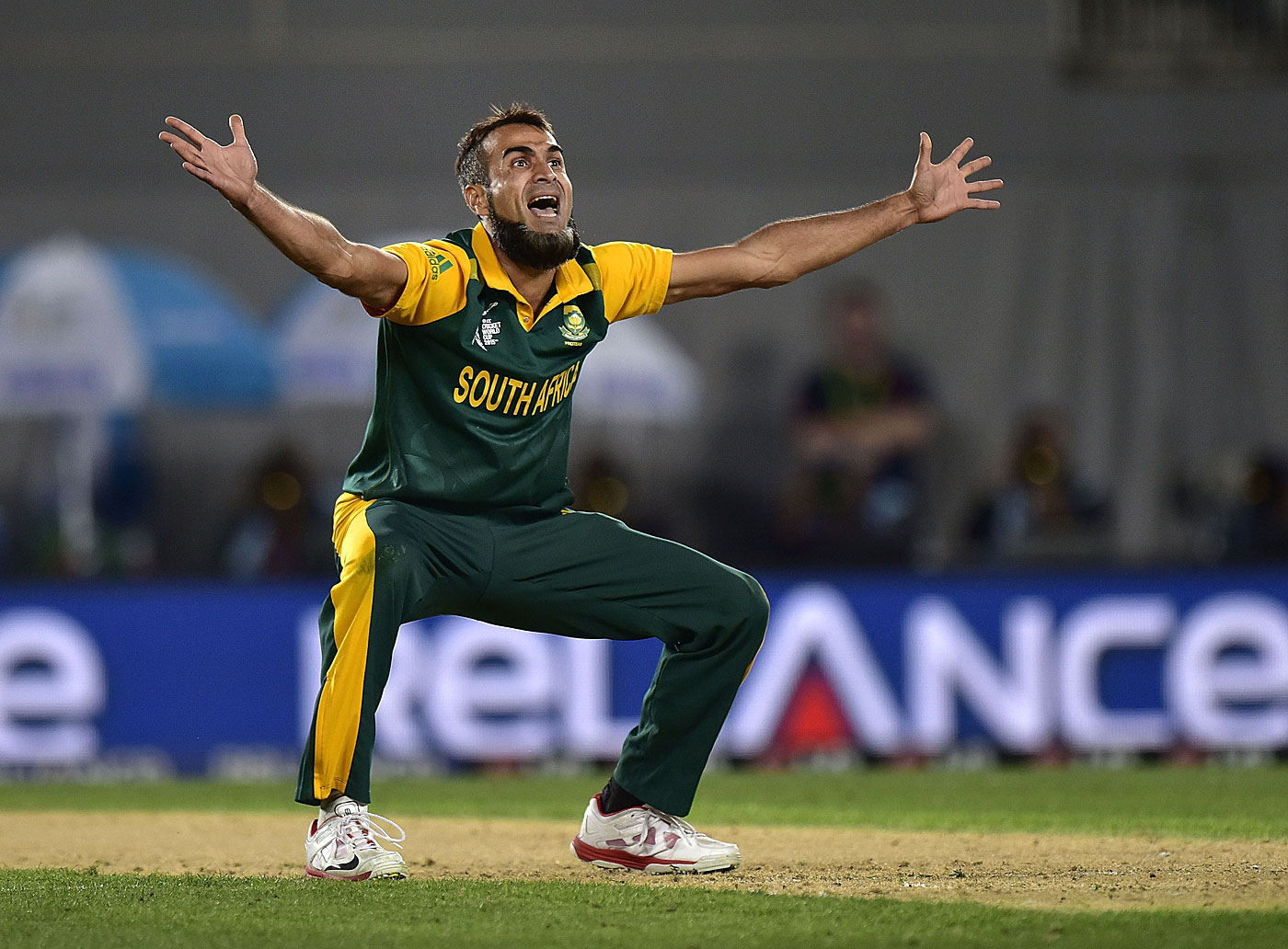
Imran Tahir's appeal against Martin Guptill looked straightforward but Hawk-Eye differed © AFP
Enlarge
I don't trust the data. Don't worry, this isn't another Peter Moores thinkpiece. It's Hawk-Eye or ball-tracker or whatever you want to call it. I don't trust it. I don't trust the readings it gives.
This isn't a flat-earth theory, though flat earth does come into it, I suppose. How on earth can six cameras really predict the movement of a ball (a non-perfect sphere prone to going out of shape at that) on a surface that is neither flat nor stable? A ball that's imparted with constantly changing amounts of torque, grip, flight, speed and spin, not to mention moisture.
----- Also Read
------
When Hawk-Eye, a prediction system with a known and well-publicised propensity for minor error (2.2 millimetres is the most recent publicly available figure) shows a fraction less than a half of the ball clipping leg stump after an lbw appeal, can we take that information on face value and make a decision based upon it?
During Tuesday's World Cup semi-final, my long-held conspiracy theory bubbled over. How, I wondered, could the ball that Imran Tahir bowled to Martin Guptill in the sixth over - the turned-down lbw shout from which the bowler called for a review - have passed as far above the stumps as the TV ball-tracker indicated? To the naked eye it looked wrong. The predicted bounce on the Hawk-Eye reading looked far too extravagant.
Worse, why upon seeing that projection did every single person in the pub I was in "ooh" and "aah" as though what they were seeing was as definitive and irrefutable an event as a ball sticking in a fieldsman's hands, or the literal rattle of ball on stumps? Have we just completely stopped questioning the authority of the technology and the data?
Later I checked the ball-by-ball commentary on ESPNcricinfo. Here's what it said: "This is a flighted legbreak, he looks to sweep it, and is beaten. Umpire Rod Tucker thinks it might be turning past the off stump. This has pitched leg, turned past the bat, hit him in front of middle, but is bouncing over, according to the Hawkeye. That has surprised everybody. That height has come into play here. It stays not-out."
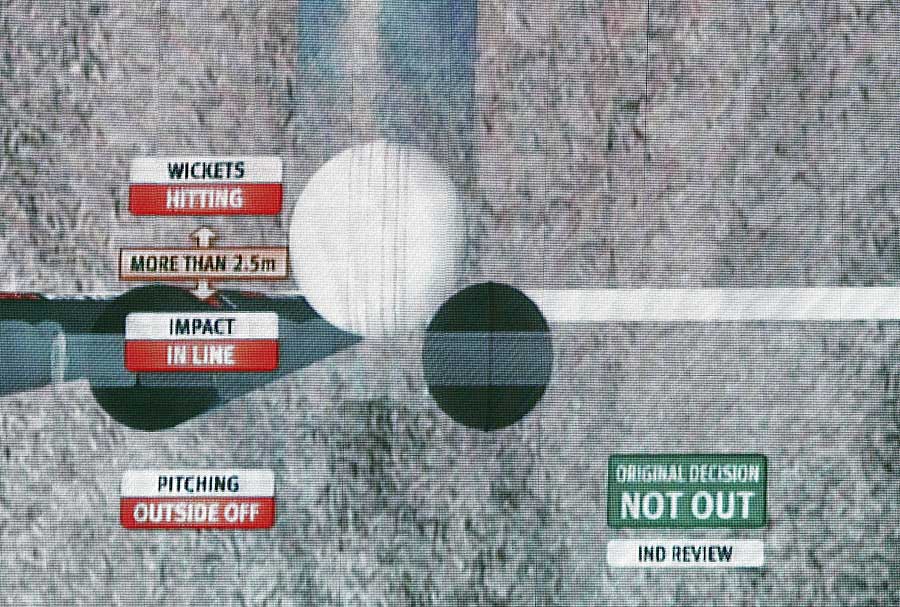
Why don't we question the authority of a technology that has a well-publicised margin of error?  © Getty Images
Enlarge

It surprised me, but did it surprise everybody? Probably not. More TV viewers seemed to accept the call than question it. When you've watched enough cricket though, some things just look a little off. To me this one didn't add up. Guptill made another 28 runs, not a trifling matter in the context of the game.
A disclaimer: though I distrust it for lbw decisions, I'm not saying that Hawk-Eye is all bad. It's great for "grouping" maps to show you where certain bowlers are pitching the ball, because tracking where a ball lands is simple. What happens next I'm not so sure on, particularly when the spinners are bowling.
To be fair, Hawk-Eye's inventor Paul Hawkins was a true pioneer and has arguably made a greater contribution to the entertainment factor of watching cricket on TV than many actual players manage. That's the thing though: it's entertainment. In 2001, barely two years after Hawkins had developed the idea it had won a BAFTA for its use in Channel 4's Ashes coverage that year. It wasn't until 2008 - seven years later - that it was added as a component of the Decision Review System. Quite a lag, that.
On their website, admittedly not the place to look for frank and fearless appraisal of the technology, Hawk-Eye (now owned by Sony) claim that the fact TV viewers now expect a reading on every lbw shout is "a testimony to Hawk-Eye's reputation for accuracy and reliability". But it's not, is it? All that it really tells us is that we are lemmings who have been conditioned to accept the reading as irrefutable fact upon which an umpiring decision can be made. But it's a prediction.
Not even Hawk-Eye themselves would call it a faultless system. Last December the company admitted they had got a reading completely wrongwhen Pakistan's Shan Masood was dismissed by Trent Boult during the Dubai Test. In this instance, the use of only four cameras at the ground (Hawk-Eye requires six) resulted in the operator making an input error. Why it was even being used under those conditions is more a question for the ICC, I suppose.
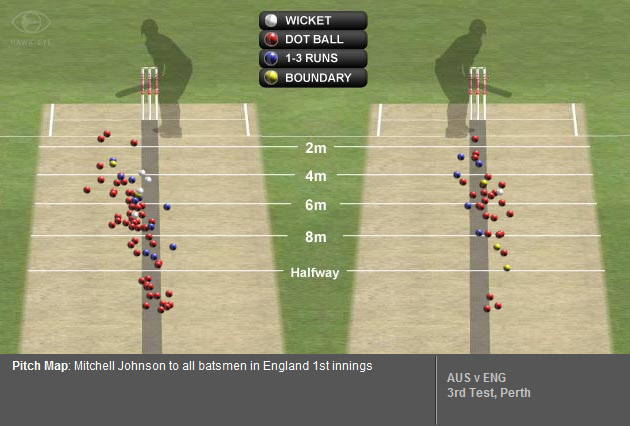
It's not all bad: Hawke-Eye gives great insight into where bowlers are pitching their deliveries  © Hawk-Eye
Enlarge

The Masood debacle highlights an interesting issue with regards to the cameras though. Understandably given the pay cheques at stake and that Hawk-Eye is a valuable component of their coverage, TV commentators rarely question the readings even in cases as puzzling as the Masood verdict. Mike Haysman is one who stuck his neck out in a 2011 Supersport article. Firstly, Haysman echoed my earlier thought: "The entertainment factor was the exact reason they were originally introduced. Precise decision-making was not part of the initial creative masterplan." The technology has doubtless improved since, but the point remains.
More worryingly though, Haysman shone a light on the issue with the cameras upon which Hawk-Eye depends. At that point an Ashes Test, for instance, might have had bestowed upon it a battalion of deluxe 250 frame-per-second cameras, whereas a so-called lesser fixture might use ones that captured as few as 25 frames-per-second. Remember: the higher the frame rate the more accurate the reading. Put plainly, for the past five years the production budget of the rights holder for any given game, as well as that game's level of perceived importance, has had an impact on the reliability of Hawk-Eye readings. Absurd.
As a general rule, the more you research the technology used in DRS calls, the more you worry. In one 2013 interview about his new goal-line technology for football, Paul Hawkins decried the lack of testing the ICC had done to verify the accuracy of DRS technologies. "What cricket hasn't done as much as other sports is test anything," he started. "This [football's Goal Decision System] has been very, very heavily tested whereas cricket's hasn't really undergone any testing." Any? Then this: "It's almost like it has tested it in live conditions so they are inheriting broadcast technology rather than developing officiating technology." Does that fill you with confidence?
Hawkins and science-minded cricket fans might bray at the suggestion that Hawk-Eye can't be taken as law, but in lieu of any explanation of its formulas, machinations and the way it's operated (also known as proprietary information) it's hard for some of us to shake the doubt that what we're seeing with our eyes differs significantly from the reading of a computer.

Wednesday, 25 March 2015

Why Bank of England employees are reading my A-level economics textbook

Alain Anderton in The Guardian

A Freedom of Information request by the Times, showed that Economics, my A-level textbook and the “bible for those seeking a handle on basic economics”, was the most issued book from the library of the Bank of England. Since it was first published in 1991, the book has been the bestselling text in the A-level economics market. Generations of economists have learned their basic economics from studying it. However, it isn’t the economists at the Bank of England who are borrowing the book now. The bank has helpfully explained that it provides development for secretaries, graduates and school leavers. Panic over – the Bank of England is not being run by economists consulting a school textbook.

What is good about this news is that it means the Bank of England is serious about education and professional development. In Economics, you will find out that these are essential for the growth of the economy. They raise productivity levels of workers and contribute to our national wellbeing. Other topical points raised in the book include the fact that increasing the supply of oil on to world markets will lead to a fall in the price of oil; if you cut government spending, at least in the short term, aggregate demand will fall and so will GDP; that global warming is the result of market failure; and that directors and managers of companies might be more concerned with maximising their own benefits than the benefits of the shareholders of the company.

It is also good news that people want to find out about economics. Since the financial crisis of 2008, the numbers of people studying A-level economics have more than doubled, suggesting that these uncertain times have sparked the curiosity of 16- to 18-year-olds about the world in which they live.

Economics at A-level is fundamentally about studying models: ways of looking at the world and making sense of it. But it is also about evaluating the world around us. Was there an alternative for the UK to fiscal austerity in 2010? Does it matter that the UK persistently runs a current account deficit on the balance of payments? Should we regulate banks more? Would a significant rise in the minimum wage be good or bad and for whom? In A-level exams, only candidates who can show they understand basic economic models and appreciate that there are many sides to each issue will get top marks.

Should our politicians be studying some basic economics? The answer to that is obviously yes. What is particularly disheartening about much current political discourse is the failure of politicians to admit that there will be costs and disadvantages to their policies. Our adversarial system means that any such admission is seized upon by the media and blown up out of all proportion. The simple fact is that almost any economic decision has its costs and benefits.

The first concept an A-level student may well learn is the principle of opportunity cost. If you buy a car, you lose the benefits of what you could otherwise have bought with that money. If the government cuts taxes, what are the benefits that are going to be lost as a result of that decision, benefits like higher government spending or a lower national debt? However, to some extent we get the politicians we deserve. Too many people seem to think that there are simple answers to complex problems; we don’t want to pay for the choices we make. For example, we want high-quality public services but we don’t want to pay for them in taxes.

Our grasp of economics would be more mature if the acceptance of costs and benefits that are being acknowledged in classrooms were also being acknowledged at our dinner tables, in our local council chambers and in parliament.

Tuesday, 24 March 2015

Inflation falls to 0%: what does it mean for the UK economy?

With average earnings growing by just under 2%, living standards should rise and interest rates should remain low but it’s not all good news

Larry Elliott in The Guardian

Britain is within a month of a period of deflation. When the figures for March come out next month lower energy bills mean that the cost of living will be lower than it was a year earlier.

These are uncharted waters for the UK, at least in the modern era. There have been times when inflation has turned negative but they have been few and far between since the second world war, and there have been none since the move to the consumer prices index as the preferred yardstick.

The general assumption is that this is good news, for two reasons. The first is that the fall in inflation boosts living standards, because wages are rising faster than prices. Wages have risen extremely slowly since the recession of 2008-09 and even against a backdrop of falling unemployment are currently only going up by 1.6% a year.

But the sharp drop in oil prices in the second half of 2014 has pushed inflation lower and meant those modest wage increases now stretch further. This is clearly welcome news for the government, eager to fend off Labour’s accusation that the coalition has presided over a cost-of-living crisis. The opposition will say that the recent increase in living standards does not make up for the earlier falls.

The second boost to consumers comes from the outlook for interest rates. It will come as no surprise to the Bank of England that inflation now stands at zero, and the Bank’s governor, Mark Carney, has said it would be “foolish” to cut the cost of borrowing in response to what is thought to be a temporary fall in commodity prices.

That said, the Bank is not going to be in a hurry to raise rates either. All nine members of the Bank’s monetary policy committee are in favour of official interest rates remaining at 0.5%, which is where they have been since early 2009. They look like remaining there for the rest of this year, and one MPC member – Andy Haldane, the Bank’s chief economist – says he can contemplate voting to cut borrowing costs.

That’s because there’s a potential dark side to the fall in inflation, namely the risk that it becomes a permanent feature of the economic landscape. The reason the majority of economists view February’s zero inflation as benign is because they think lower unemployment will put upward pressure on wage settlements. Higher pay deals will start to push up inflation at a time when last year’s drop in oil prices starts to unwind. There is, on this view, little prospect of deflation becoming embedded, as it did in Japan.

This, though, assumes that wage settlements are not dragged lower by the drop in inflation. The fact that average earnings are growing at an annual rate of below 2% even after two years of a relatively robust period of growth is indicative of a labour market where employers are able to secure workers cheaply. They may be tempted to be even less generous once inflation goes negative.

Saudi Arabia and Iran - The real enemies of Islam