Search This Blog

Saturday, 16 May 2020

Humans are not resources. Coronavirus shows why we must democratise work

Our health and lives cannot be ruled by market forces alone. Now thousands of scholars are calling for a way out of the crisis. Nancy Fraser, Susan Neiman , Chantal Mouffe, Saskia Sassen, Jan-Werner Müller, Dani Rodrik, Thomas Piketty, Gabriel Zucman, Ha-Joon Chang, and many others write in The Guardian 


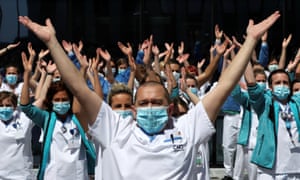
Healthcare workers protest against the handling of the coronavirus crisis in Liège, Belgium, May 2020. Photograph: Yves Herman/Reuters


Working humans are so much more than “resources”. This is one of the central lessons of the current crisis. Caring for the sick; delivering food, medication and other essentials; clearing away our waste; stocking the shelves and running the registers in our grocery stores – the people who have kept life going through the Covid-19 pandemic are living proof that work cannot be reduced to a mere commodity. Human health and the care of the most vulnerable cannot be governed by market forces alone. If we leave these things solely to the market, we run the risk of exacerbating inequalities to the point of forfeiting the very lives of the least advantaged.

How to avoid this unacceptable situation? By involving employees in decisions relating to their lives and futures in the workplace – by democratising firms. By decommodifying work – by collectively guaranteeing useful employment to all. As we face the monstrous risk of pandemic and environmental collapse, making these strategic changes would allow us to ensure the dignity of all citizens while marshalling the collective strength and effort we need to preserve our life together on this planet.

Every morning, men and women, especially members of racialised communities, migrants and informal economy workers, rise to serve those among us who are able to remain under quarantine. They keep watch through the night. The dignity of their jobs needs no other explanation than that eloquently simple term “essential worker”. That term also reveals a key fact that capitalism has always sought to render invisible with another term, “human resource”. Human beings are not one resource among many. Without labor investors, there would be no production, no services, no businesses at all.

Every morning, quarantined men and women rise in their homes to fulfil from afar the missions of the organisations for which they work. They work into the night. To those who believe that employees cannot be trusted to do their jobs without supervision, that workers require surveillance and external discipline, these men and women are proving the contrary. They are demonstrating, day and night, that workers are not one type of stakeholder among many: they hold the keys to their employers’ success. They are the core constituency of the firm, but are, nonetheless, mostly excluded from participating in the government of their workplaces – a right monopolised by capital investors.

To the question of how firms and how society as a whole might recognise the contributions of their employees in times of crisis, democracy is the answer. Certainly, we must close the yawning chasm of income inequality and raise the income floor – but that alone is not enough. After the two world wars, women’s undeniable contribution to society helped win them the right to vote. By the same token, it is time to enfranchise workers.

Representation of labour investors in the workplace has existed in Europe since the close of the second world war, through institutions known as works councils. Yet these representative bodies have a weak voice at best in the government of firms, and are subordinate to the choices of the executive management teams appointed by shareholders. They have been unable to stop or even slow the relentless momentum of self-serving capital accumulation, ever more powerful in its destruction of our environment. These bodies should now be granted similar rights to those exercised by boards. To do so, firm governments (that is, top management) could be required to obtain double majority approval, from chambers representing workers as well as shareholders.

In Germany, the Netherlands and Scandinavia, different forms of codetermination (Mitbestimmung) put in place progressively after the second world war were a crucial step toward giving a voice to workers – but they are still insufficient to create actual citizenship in firms. Even in the United States, where worker organising and union rights have been considerably suppressed, there is now a growing call to give labour investors the right to elect representatives with a supermajority within boards. Issues such as the choice of a CEO, setting major strategies and profit distribution are too important to be left to shareholders alone. A personal investment of labour; that is, of one’s mind and body, one’s health – one’s very life – ought to come with the collective right to validate or veto these decisions.

This crisis also shows that work must not be treated as a commodity, that market mechanisms alone cannot be left in charge of the choices that affect our communities most deeply. For years now, jobs and supplies in the health sector have been subject to the guiding principle of profitability; today, the pandemic is revealing the extent to which this principle has led us astray. Certain strategic and collective needs must simply be made immune to such considerations. The rising body count across the globe is a terrible reminder that some things must never be treated as commodities. Those who continue arguing to the contrary are imperilling us with their dangerous ideology. Profitability is an intolerable yardstick when it comes to our health and our life on this planet.

Decommodifying work means preserving certain sectors from the laws of the so-called free market; it also means ensuring that all people have access to work and the dignity it brings. One way to do this is with the creation of a job guarantee. Article 23 of the Universal Declaration of Human Rights reminds us that everyone has the right to work, to free choice of employment, to just and favourable conditions of work and to protection against unemployment. A job guarantee would not only offer each person access to work that allows them to live with dignity, it would also provide a crucial boost to our collective capability to meet the many pressing social and environmental challenges we currently face. Guaranteed employment would allow governments, working through local communities, to provide dignified work while contributing to the immense effort of fighting environmental collapse. Across the globe, as unemployment skyrockets, job guarantee programs can play a crucial role in assuring the social, economic, and environmental stability of our democratic societies.

The European Union must include such a project in its green deal. A review of the mission of the European Central Bank so that it could finance this program, which is necessary to our survival, would give it a legitimate place in the life of each and every citizen of the EU. A countercyclical solution to the explosive unemployment on the way, this program will prove a key contribution to the EU’s prosperity.

We should not react now with the same innocence as in 2008, when we responded to the economic crisis with an unconditional bailout that swelled public debt while demanding nothing in return. If our governments step in to save businesses in the current crisis, then businesses must step in as well, and meet the general basic conditions of democracy. In the name of the democratic societies they serve, and which constitute them, in the name of their responsibility to ensure our survival on this planet, our governments must make their aid to firms conditional on certain changes to their behaviours. In addition to hewing to strict environmental standards, firms must be required to fulfil certain conditions of democratic internal government. A successful transition from environmental destruction to environmental recovery and regeneration will be best led by democratically governed firms, in which the voices of those who invest their labor carry the same weight as those who invest their capital when it comes to strategic decisions.

We have had more than enough time to see what happens when labor, the planet, and capital gains are placed in the balance under the current system: labor and the planet always lose. Thanks to research from the University of Cambridge, we know that “achievable design changes” could reduce global energy consumption by 73%. But those changes are labor intensive, and require choices that are often costlier over the short term. So long as firms are run in ways that seek to maximise profit for their capital investors alone, and in a world where energy is cheap, why make these changes? Despite the challenges of this transition, certain socially minded or co-operatively run businesses – pursuing hybrid goals that take financial, social and environmental considerations into account, and developing democratic internal governments – have already shown the potential of such positive impact.

Let us fool ourselves no longer: left to their own devices, most capital investors will not care for the dignity of labour investors, nor will they lead the fight against environmental catastrophe. Another option is available. Democratise firms; decommodify work; stop treating human beings as resources so that we can focus together on sustaining life on this planet.
Friday, 15 May 2020

Under cover of coronavirus, the world's bad guys are wreaking havoc

The pandemic has allowed strongmen and tyrants to get away with murder and mayhem while we look the other way writes Jonathan Freedland in The Guardian 

 
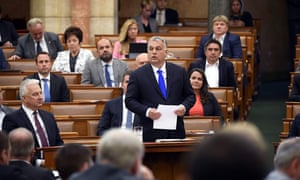
‘Viktor Orbán has long sought to rule Hungary as an autocrat, but the pandemic gave him his chance, allowing him to brand anyone standing in his way as unwilling to help the leader fight a mortal threat.’ Photograph: Tamás Kovács/AFP via Getty Images


Under the cover of coronavirus, all kinds of wickedness are happening. Where you and I see a global health crisis, the world’s leading authoritarians, fearmongers and populist strongmen have spotted an opportunity – and they are seizing it.

Of course, neither left nor right has a monopoly on the truism that one should never let a good crisis go to waste. Plenty of progressives share that conviction, firm that the pandemic offers a rare chance to reset the way we organise our unequal societies, our clogged cities, our warped relationship to the natural world. But there are others – and they tend to be in power – who see this opening very differently. For them, the virus suddenly makes possible action that in normal times would exact a heavy cost. Now they can strike while the world looks the other way.

For some, Covid-19 itself is the weapon of choice. Witness the emerging evidence that Bashar al-Assad in Damascus and Xi Jinping in Beijing are allowing the disease to wreak havoc among those groups whom the rulers have deemed to be unpersons, their lives unworthy of basic protection. Assad is deliberately leaving Syrians in opposition-held areas more vulnerable to the pandemic, according to Will Todman of the Center for Strategic and International Studies. As he puts it: “Covid-19 has provided Assad a new opportunity to instrumentalize suffering.”

Meanwhile, China continues to hold 1 million Uighur Muslims in internment camps, where they contend now not only with inhuman conditions but also a coronavirus outbreak. Those camps are cramped, lack adequate sanitation and have poor medical facilities: the virus couldn’t ask for a better breeding ground. What’s more, Uighur Muslims are reportedly being forced to work as labourers, filling in for non-Muslims who are allowed to stay home and protect themselves. That, according to one observer, “is reflective of how the Republic of China views [Uighur Muslims] as nothing but disposable commodities”.

Elsewhere, the pandemic has allowed would-be dictators an excuse to seize yet more power. Enter Viktor Orbán of Hungary, whose response to coronavirus was immediate: he persuaded his pliant parliament to grant him the right to rule by decree. Orbán said he needed emergency powers to fight the dreaded disease, but there is no time limit on them; they will remain his even once the threat has passed. They include the power to jail those who “spread false information”. Naturally, that’s already led to a crackdown on individuals guilty of nothing more than posting criticism of the government on Facebook. Orbán has long sought to rule Hungary as an autocrat, but the pandemic gave him his chance, allowing him to brand anyone standing in his way as unwilling to help the leader fight a mortal threat.

Xi has not missed that same trick, using coronavirus to intensify his imposition of China’s Orwellian “social credit” system, whereby citizens are tracked, monitored and rated for their compliance. Now that system can include health and, thanks to the virus, much of the public ambivalence that previously existed towards it is likely to melt away. After all, runs the logic, good citizens are surely obliged to give up even more of their autonomy if it helps save lives.

For many of the world’s strongmen, though, coronavirus doesn’t even need to be an excuse. Its chief value is the global distraction it has created, allowing unprincipled rulers to make mischief when natural critics at home and abroad are preoccupied with the urgent business of life and death.

Donald Trump gets plenty of criticism for his botched handling of the virus, but while everyone is staring at the mayhem he’s creating with one hand, the other is free to commit acts of vandalism that go all but undetected. This week the Guardian reported how the pandemic has not slowed the Trump administration’s steady and deliberate erosion of environmental protections. During the lockdown, Trump has eased fuel-efficiency standards for new cars, frozen rules for soot air pollution, continued to lease public property to oil and gas companies, and advanced a proposal on mercury pollution from power plants that could make that easier too. Oh, and he’s also relaxed reporting rules for polluters.
Trump’s Brazilian mini-me, Jair Bolsonaro, has outstripped his mentor. Not content with mere changes to the rulebook, he’s pushed aside the expert environmental agencies and sent in the military to “protect” the Amazon rainforest. I say “protect” because, as NBC News reported this week, satellite imagery shows “deforestation of the Amazon has soared under cover of the coronavirus”. Destruction in April was up by 64% from the same month a year ago. The images reveal an area of land equivalent to 448 football fields, stripped bare of trees – this in the place that serves as the lungs of the earth. If the world were not consumed with fighting coronavirus, there would have been an outcry. Instead, and in our distraction, those trees have fallen without making a sound.

Another Trump admirer, India’s Narendra Modi, has seen the same opportunity identified by his fellow ultra-nationalists. Indian police have been using the lockdown to crack down on Muslim citizens and their leaders “indiscriminately”, according to activists. Those arrested or detained struggle to get access to a lawyer, given the restrictions on movement. Modi calculates that majority opinion will back him, as rightist Hindu politicians brand the virus a “Muslim disease” and pro-Modi TV stations declare the nation to be facing a “corona jihad”.

In Israel, Benjamin Netanyahu – who can claim to have been Trumpist before Trump – has been handed a political lifeline by the virus, luring part of the main opposition party into a government of national unity that will keep him in power and, he hopes, out of the dock on corruption charges. His new coalition is committed to a programme that would see Israel annex major parts of the West Bank, permanently absorbing into itself territory that should belong to a future Palestinian state, with the process starting in early July. Now, the smart money suggests we should be cautious: that it suits Netanyahu to promise/threaten annexation more than it does for him to actually do it. Even so, in normal times the mere prospect of such an indefensible move would represent an epochal shift, high on the global diplomatic agenda. In these abnormal times, it barely makes the news.

Robin Niblett, director of Chatham House, argues that many of the global bad guys are, in fact, “demonstrating their weakness rather than strength” – that they are all too aware that if they fail to keep their citizens alive, their authority will be shot. He notes Vladimir Putin’s forced postponement of the referendum that would have kept him in power in Russia at least until 2036. When that vote eventually comes, says Niblett, Putin will go into it diminished by his failure to smother the virus.

Still, for now, the pandemic has been a boon to the world’s authoritarians, tyrants and bigots. It has given them what they crave most: fear and the cover of darkness.

Why the Modi government gets away with lies, and how the opposition could change that

As with Putin’s Russia and Trump’s America, India faces a ‘fire-hosing of falsehood’. Mere fact-checking won’t defeat it writes SHIVAM VIJ in The Print


Illustration by Soham Sen | ThePrint Team


The Narendra Modi government announces a grand stimulus ‘package’ that it claims is worth Rs 20 lakh crore or ‘10 per cent’ of India’s GDP. But barely a fraction of it is new money being pumped into the economy. What is made to look like a stimulus is mostly a grand loan mela.

The Modi government is making hungry migrant labourers pay train fare. When this became a political hot potato, it said it was paying 85 per cent per cent of the fare and the state governments were paying the rest 15 per cent. Truth was that that 85 per cent was notional subsidy — in effect, the migrants were being charged the usual fare, and in some places, even more.

If no one else, at least the endless sea of migrant labourers would be able to see through the ‘85 per cent’ lie. It is curious that the Modi government openly lies — lies that are obvious and blatant. Just a few examples:

Narendra Modi said on the top of his voice that there had been no talk of a National Register of Citizens (NRC) in his government, when in fact both the President of India and the Home Minister had said it in Parliament.

Narendra Modi said the purpose of demonetisation was to destroy black money but when that didn’t work, his government kept changing goal-posts. Many lies to hide one truth: that demonetisation had failed.

Electoral bonds make political donations opaque, but the Modi government says they bring transparency. The full list of the Modi government’s lies could fill a library.

DOUBLETHINK

The Modi government has made lying an art form. This non-stop obvious lying was described by George Orwell as doublethink: “Every message from the extremely repressive leadership reverses the truth. Officials repeat ‘war is peace’ and ‘freedom is slavery,’ for example. The Ministry of Truth spreads lies. The Ministry of Love tortures lovers.”

People are thus expected to believe as true what is clearly false, and also take at face value mutually contradictory statements. The Modi government talked about NRC, but it also did not talk about it. The Modi government is making migrants pay for train fares, but at the same time, it is not charging them. Doublethink also applies other Orwellian principles — Newspeak, Doublespeak, Thoughtcrime, etc.

But why do people accept it all so willingly? Why do the people who are lied to every day go and vote for the same BJP?

There are many obvious answers to this question: weak opposition, mouthpiece media, social media manipulation, and Modi’s personality cult that makes his voters repose great faith in him.

But the lies are so obvious, you wonder why anyone would lie so obviously. Surely, when someone is caught lying they can’t be considered credible anymore?

What’s happening here is the plain assertion of power. Our politics has become a contest of who gets to lie and get away with it and who will have to go on a back-foot when their lies are caught.

When the Modi government lies so blatantly, it is basically saying: ‘Yes we will lie to make a mockery of your questions. Do what you can.’

Fire-hosing of falsehood

In 2016, Christopher Paul and Miriam Matthews wrote a paper for RAND Corporation, an American think-tank, in which they analysed propaganda techniques used by the Vladimir Putin government in Russia. They called it the “Firehose of Falsehood” (read it here). The Russian model is not to simply make you believe a lie — the lie is often so obviously a lie, you’d be a fool to believe it. The idea is to “entertain, confuse and overwhelm” the audience.

They identified four distinct features of the Putin propaganda model, all of which are true for the Modi propaganda machinery as well, as they are for Donald Trump’s.

1) High volume and multi-channel: The Modi propaganda machine will bombard people with a message through multiple channels. By “multiple” we really mean multiple — you will even see Twitter handles claiming to be Indian Muslims saying the same things as the far-Right Hindutva handles. Of course, some of the Muslim handles are fake. But when you see everyone from Akshay Kumar to Tabassum Begum support an idea, you’re inclined to doubt yourself. If everyone from Rubika Liyaquat to your WhatsApp-fed uncle is saying the same thing, it must be right. If so many people are saying the Citizenship (Amendment) Act will grant citizenship and not take it away, they must be right.

2) Rapid, continuous and repetitive: The hashtags, memes and emotionally charged videos will be ready before any announcement is made. The moment the announcement is made, both social and mainstream media will start bombarding you with messages in support of it. The volume and speed of the propaganda will barely leave you with the mind space to judge for yourself.

While the government will be careful to avoid saying it is not charging migrants, its deniable propaganda proxies will go around suggesting exactly that until the voice of the doubters has been drowned out. (A liberal journalist I know actually thought the migrants were not having to pay train fares anymore.)

3) Lacks commitment to objective reality: In other words, fake news. We know why fake news works: confirmation bias, information overload, emotional manipulation, the willingness to believe a message when it is shared by a trusted friend, and so on. There’s no dearth of this in the Modi propaganda ecosystem. There are countless fake news factories like OpIndia and Postcard News. Moreover, the mainstream media itself has been co-opted to manufacture fake news at scale, as the absolutely fictional charges of JNU students wanting India to be split into pieces (“Tukde tukde gang”) shows.

PM Modi himself is happy to lie for political posturing: from attributing a fake quote to Omar Abdullah, to saying there are no detention centres in the country, to exaggerating all kinds of data.

4) Lacks commitment to consistency: This is the bit where the fake news and claims are exposed, and yet they don’t hurt the leader. One day the Modi government says demonetisation is for destroying black money and next day it says it was to push cashless transactions, and third day it says the idea was to widen the tax base.

Ordinarily, such contradictions should hurt the credibility of Modi and his government. But, coupled with the three points above, the RAND researchers suggest, “fire hosing” manages to sell the changed narrative as new information, a change of opinion, or just new, advanced or supplementary facts presented by different actors.

How to fight the fire-hosing of falsehood

The RAND corporation researchers also suggest five ways for the United States to counter the Russian “fire-hosing of falsehood”. These are applicable to any actor who undertakes this propaganda model, including Modi and Trump.

1. First Information Report: Try to be the first in presenting information on a particular issue. In shaping public opinion, the first impression can be the last impression. (With our lazy opposition, this ain’t happening, but the Congress party’s announcement of paying train fares for migrant labourers was one example of creating the first impression of an issue.)

2. Highlight the lying, not just the lies: The world needs fact-checkers, but they’re not going to be able to stop the fire-hosing of falsehood. That’s like taking paracetamol for Covid-19. You may need it for the fever, but it won’t kill the virus.What might treat the virus of fire-hosing, however, according to the RAND researchers, is to chip away at the credibility of the liar by simply pointing out that he’s a serial liar. M.K. Gandhi’s assertion of truth as the core of his politics, for example, served the purpose of painting the British colonial rule as being based on falsehoods.

3. Identify and attack the goal of the propaganda: Instead of simply fact-checking the propaganda, the political opponents need to understand the objective of the lies and attack those. So, if the objective of lying about migrants having to pay for train fares is to not let them travel for free, the opposition should spend great time and energy addressing migrant labourers about how the government is being insensitive to their plight. This will take a lot more work on the ground, and simply tweeting facts won’t be enough.

4. Compete: Across the world, fire-hosing of falsehood is becoming a powerful propaganda tool. Those who want to defeat such propaganda may have to do their own fire-hosing of falsehood. As the Hindi saying goes, iron cuts iron. When public opinion is being manipulated with fake news and lies, the opposition cannot win the game with mere fact-checking. It may have to do its own rapid and continuous misinformation with little regard for the truth. The RAND researchers suggest this is what the US should do against Russia.

5. Turn off the tap: Lastly, attack the opponent’s supply chain of lies. If opposition-ruled states are not cracking down on fake news and communal hate-mongers in their states, for example, they’re making a huge mistake.

I am more left than you think

Jaggi Vasudev in The Indian Express

I am far more “left” than people can imagine, but I am not crazy left, where you make sure people are left out of all development and all possibilities. My idea of left is a more fair and just administration. I say “more” because there is no such thing as an absolutely fair and just society. All we can create is a society where things are largely happening in a fair manner, and if people are not equal, at least they have equal opportunity.

What left means is your life is not about yourself; your life is about the community. The Isha Yoga Center is a commune — in a way, it is a communist arrangement. Nobody is asking how much you have, your religion, caste, where you come from, who your father is. We will treat you like we treat everyone else. If you rise and show some special qualities, we will honour that as well. Communism means everyone is sharing and living together. For instance, you are willing to give away your phone to someone who does not have one, or at least share it with your neighbour because, after all, you are a party member. In the Yoga Center we do such things effortlessly. This is absolute left.

But the people who claim they are “left” are not living like that. Many are just living in their own home, talking left philosophy. Their lifestyle, opinions and attitude do not show that they are left or liberal. One aspect of this is that they feel only they should have freedom of speech and nobody else. Liberal means whatever is in my heart I will speak, and you should listen and tell me what is wrong with it.

You cannot point out one thing and just say, “No, I do not like it.” That will not work.

If you believe that your opinion is much more sacred than the people’s will in a democratic society, then you have a fundamental problem. When a majority of the people elect a government, even if you do not personally like it, it is still your government. It is not someone else’s government. For me, this is India’s government and I will support it. Not because I am someone’s fan or because of any political ideology, but simply because I am a citizen of India. The country is offering a certain order, facilities and fundamentals for us to live and work. For that, I will abide by whatever the government says by law.

You can vote against a Bill in Parliament, you can express what you think is wrong with it. If we have some concerns about a certain law, we can say, “this is our concern, please fix it”. But it is still the government’s choice whether they want to fix it or go ahead with it. So then you say: “I will take to the streets — my right to protest.” You have the right to protest for sure, but you do not have the right to disrupt even one citizen’s life. You have no right to block the road, cut off the water or electricity or whatever else. You must ask for permission, find an area, sit there and protest. The democratic process has enough proper platforms where you can protest.

If you do not agree with the law, there is a court where you can go. If it is in any way illegal, it will get knocked down.

But if it is legal and you still do not like it, you must strive hard to win the next election — that is the only way you can do it in a democratic country. Many people are not able to digest this simple fact. They do not have the necessary commitment to work for five years and somehow win the election next time. They just want to sit at home, wine and dine all their life but protest about everything that the government does. You cannot lose the election and pass the laws. If the losers want to pass laws and carry the trophy, it is not fair.

The real message behind 'stay alert': it'll be your fault if coronavirus spreads

This meaningless phrase allows the government to shift blame to the public for failing to be sufficiently responsible writes Owen Jones in The Guardian


Officially, the new strategy is “personal responsibility” and “good, solid British common sense”, as our prime minister colourfully describes it; unofficially, operation blame the public is well under way. As media outlets query why London’s trains and buses are rammed despite government advice, our transport secretary, Grant Shapps, pleads with silly old commuters not to “flood” back on to public transport.

The small flaw is that the government has ordered millions of workers to return to their jobs, and given the continued failure to invent teleporters, they need a means to bridge the distance between their homes and their work. If you’re a Londoner earning more than £70,000 a year, this is no big deal: about 80% have access to a car, and most can work from home. Unfortunately, nearly half of the capital’s citizens – and over 70% of those earning less than £10,000 – do not have access to a car: if you want to understand those images of packed trains and buses, start here. 

It is unsurprising that a government that has presided over Europe’s worst death toll is so invested in shifting the blame. Was it “good, solid British common sense” to pursue herd immunity and impose a lockdown later than other European nations, even despite having advance notice of the horrors of Lombardy? Perhaps, indeed, it was “good, solid British common sense” to send vulnerable patients back to care homes without testing them for coronavirus first, seeding the illness in a sector in which up to 22,000 people may have died? Or, who knows, perhaps “good, solid British common sense” could explain how frontline staff have been left exposed for a lack of personal protective equipment?

But the strategy in the government’s new approach is clear. “Stay alert” is meaningless, of course, except to devolve responsibility for what happens next to individuals. Grownups don’t need a nanny state to hold their hands, scoff the government’s outriders: rather than relying on detailed instructions and central diktat, we should rely on our judgment. The implication, of course, is that if there is another spike in infections and death, that will be the public’s fault for not exercising adequate levels of personal responsibility.

Here is a revival of the ideals of High Thatcherism, except applied to a pandemic. Back in the 1980s, what were once known as social problems requiring collective solutions – such as unemployment and poverty – became redefined as individual failings. “Nowadays there really is no primary poverty left in this country,” declared Margaret Thatcher herself. “In western countries we are left with the problems which aren’t poverty. All right, there may be poverty because people don’t know how to budget, don’t know how to spend their earnings, but now you are left with the really hard fundamental character – personality defect.”

If you were poor, it became an increasingly popularised attitude that it was because you were feckless, workshy, stupid and lazy. Thanks to the former Tory minister Norman Tebbit, “get on your bike” became a national cliche: it was more convenient, of course, for the government to pretend that mass unemployment was caused by a lack of effort, graft and can-do determination, rather than monetarist economics that ravaged entire industries.

What the dogma of “personal responsibility” does is erase the inequalities that scar, disfigure and ultimately define society. It pretends that we are all equally free, that our autonomy over our lives and circumstances are the same; that a middle-class professional working from home with access to a car can make the same choices as a cleaner expected to work halfway across a city.

The estimated 60,000 people who have so far died in this national calamity were not wrested from their families because the public failed to be responsible, and neither will the deaths to come in the weeks ahead. Any uptick in infections won’t be down to someone standing one metre rather than two away from their parent in a park. It won’t be down to people inviting neighbours round for forbidden cups of tea in their kitchens, instead of paying poverty wages to cleaners to wash away their dirt.

The explanation will instead be straightforward: the government relaxed a lockdown to force disproportionately working-class people into potentially unsafe environments at the behest of employers who have prioritised economic interests over human life. Another aggravating factor will be the abandonment of clear instructions in favour of confusion. It may well be this is a deliberate strategy, to claim that the government was perfectly clear, but the public let the team down by not showing enough “good, solid British common sense”. Whatever happens, the attempt to shift blame for the most disastrous government failure since appeasement on to the public must not succeed.
This is on them: they did this, and we must not let them forget it.

Goodhart’s law comes back to haunt the UK’s Covid strategy

Chris Giles in The Financial Times 


Every so often, public policy provides a reason to discover or remember the value of Goodhart’s law. The UK’s response to coronavirus is a powerful and tragic example.  


Named after Charles Goodhart, a financial guru, former chief economist of the Bank of England and a sheep farmer, the maxim is about the dangers of setting targets. When a useful measure becomes a target, the law states, it often ceases to be a good measure.  

Mr Goodhart developed the law after observing how Margaret Thatcher’s government in the 1980s targeted the supply of money to control inflation but then found the monetary aggregates lost their previously strong relationship with inflation. Inflation ran out of control even when the government held a tight grip on the money supply.  

What was true in 1980s UK economic policy is regularly experienced in the private sector. Far too often companies hit their top-down targets without improving underlying performance.  

In the current crisis, target-setting is altogether more important. Early in March, Italy’s government strove to protect the nation’s health by locking down the Lombardy region. Initially, this led to a mini exodus that probably increased the spread of the disease to other parts of the country.  

But it is in the UK where Goodhart’s law was most obviously overlooked. Throughout the crisis, “protect the NHS” has been the government’s core target. Along with “stay at home” it was the slogan repeated daily to “save lives”.  

At first sight, nothing seemed amiss. Ensuring hospitals would not be overwhelmed seems so obviously necessary. Who would have wanted to see them starved of funds in a public health crisis? And their staff needed to be given all necessary equipment to battle the pandemic. With many weeks of experience, however, the slogan and associated numerical targets for making hospital beds available have been nothing short of a disaster. The evidence is overwhelming that instead of saving lives, they have cost them. 

While the government focused on hospitals, care homes were given much less priority. Over the past five years between mid-March and the end of April, an average of 17,700 people have died in England and Wales’s care homes. This year, the total is just above 37,600. There is a debate over whether coronavirus was recklessly seeded into care homes when patients were moved there from hospitals. But there can be no doubt that relegating care homes to second division status contributed to the 19,900 excess deaths in the care sector.  

Far more people than normal have also been dying at home and most of the excess deaths have not been classified as related to Covid-19 on death certificates. We do not yet know precisely why, but at the height of the crisis local doctors were asking their elderly patients to think hard about whether they really wanted to go to hospital or use the emergency services. A fit and sharp relative of mine received two of these calls.  

The exact causal links will take time to establish. But 29,874 people have died at home since mid-March in England and Wales, 10,800 more than normal. 

No one should think the government’s ambitions deliberately cost lives. But it was a deadly example of Goodhart’s law. The moment “protect the NHS” became the mantra, people dying elsewhere or without being tested didn’t count. 

By comparison, the much criticised target of performing 100,000 coronavirus tests a day by the end of April was better conceived. Although the health department fiddled definitions to hit the goal for one day, earning a rebuke from the statistical regulator, the effort has left the UK better positioned for its ultimate objective of testing, tracking and isolating those with the virus. 

Goodhart’s law always pops up in unexpected places. The failure in this crisis to think through the incentives created by the “protect the NHS” slogan will haunt Britain for many years.

Thursday, 14 May 2020

The coronavirus slayer! How Kerala's rock star health minister helped save it from Covid-19

KK Shailaja has been hailed as the reason a state of 35 million people has only lost four to the virus. Here’s how the former teacher did it writes Laura Spinney in The Guardian 


‘Our clinics for respiratory disease meant we could look out for community transmission’: KK Shailaja, health minister.


On 20 January, KK Shailaja phoned one of her medically trained deputies. She had read online about a dangerous new virus spreading in China. “Will it come to us?” she asked. “Definitely, Madam,” he replied. And so the health minister of the Indian state of Kerala began her preparations.

Four months later, Kerala has reported only 524 cases of Covid-19, four deaths and – according to Shailaja – no community transmission. The state has a population of about 35 million and a GDP per capita of only £2,200. By contrast, the UK (double the population, GDP per capita of £40,400) has reported more than 40,000 deaths, while the US (10 times the population, GDP per capita of £51,000) has reported more than 82,000 deaths; both countries have rampant community transmission.

As such, Shailaja Teacher, as the 63-year-old minister is affectionately known, has attracted some new nicknames in recent weeks – Coronavirus Slayer and Rockstar Health Minister among them. The names sit oddly with the merry, bespectacled former secondary school science teacher, but they reflect the widespread admiration she has drawn for demonstrating that effective disease containment is possible not only in a democracy, but in a poor one. 

How has this been achieved? Three days after reading about the new virus in China, and before Kerala had its first case of Covid-19, Shailaja held the first meeting of her rapid response team. The next day, 24 January, the team set up a control room and instructed the medical officers in Kerala’s 14 districts to do the same at their level. By the time the first case arrived, on 27 January, via a plane from Wuhan, the state had already adopted the World Health Organization’s protocol of test, trace, isolate and support.

As the passengers filed off the Chinese flight, they had their temperatures checked. Three who were found to be running a fever were isolated in a nearby hospital. The remaining passengers were placed in home quarantine – sent there with information pamphlets about Covid-19 that had already been printed in the local language, Malayalam. The hospitalised patients tested positive for Covid-19, but the disease had been contained. “The first part was a victory,” says Shailaja. “But the virus continued to spread beyond China and soon it was everywhere.”

In late February, encountering one of Shailaja’s surveillance teams at the airport, a Malayali family returning from Venice was evasive about its travel history and went home without submitting to the now-standard controls. By the time medical personnel detected a case of Covid-19 and traced it back to them, their contacts were in the hundreds. Contact tracers tracked them all down, with the help of advertisements and social media, and they were placed in quarantine. Six developed Covid-19.

Another cluster had been contained, but by now large numbers of overseas workers were heading home to Kerala from infected Gulf states, some of them carrying the virus. On 23 March, all flights into the state’s four international airports were stopped. Two days later, India entered a nationwide lockdown.


FacebookTwitterPinterest Indian citizens arriving from the Gulf states are bussed to a quarantine centre. Photograph: Arunchandra Bose/AFP via Getty Images

At the height of the virus in Kerala, 170,000 people were quarantined and placed under strict surveillance by visiting health workers, with those who lacked an inside bathroom housed in improvised isolation units at the state government’s expense. That number has shrunk to 21,000. “We have also been accommodating and feeding 150,000 migrant workers from neighbouring states who were trapped here by the lockdown,” she says. “We fed them properly – three meals a day for six weeks.” Those workers are now being sent home on charter trains.

Shailaja was already a celebrity of sorts in India before Covid-19. Last year, a movie called Virus was released, inspired by her handling of an outbreak of an even deadlier viral disease, Nipah, in 2018. (She found the character who played her a little too worried-looking; in reality, she has said, she couldn’t afford to show fear.) She was praised not only for her proactive response, but also for visiting the village at the centre of the outbreak.

The villagers were terrified and ready to flee, because they did not understand how the disease was spreading. “I rushed there with my doctors, we organised a meeting in the panchayat [village council] office and I explained that there was no need to leave, because the virus could only spread through direct contact,” she says. “If you kept at least a metre from a coughing person, it couldn’t travel. When we explained that, they became calm – and stayed.”

Nipah prepared Shailaja for Covid-19, she says, because it taught her that a highly contagious disease for which there is no treatment or vaccine should be taken seriously. In a way, though, she had been preparing for both outbreaks all her life.

The Communist Party of India (Marxist), of which she is a member, has been prominent in Kerala’s governments since 1957, the year after her birth. (It was part of the Communist Party of India until 1964, when it broke away.) Born into a family of activists and freedom fighters – her grandmother campaigned against untouchability – she watched the so-called “Kerala model” be assembled from the ground up; when we speak, this is what she wants to talk about.

The foundations of the model are land reform – enacted via legislation that capped how much land a family could own and increased land ownership among tenant farmers – a decentralised public health system and investment in public education. Every village has a primary health centre and there are hospitals at each level of its administration, as well as 10 medical colleges.

This is true of other states, too, says MP Cariappa, a public health expert based in Pune, Maharashtra state, but nowhere else are people so invested in their primary health system. Kerala enjoys the highest life expectancy and the lowest infant mortality of any state in India; it is also the most literate state. “With widespread access to education, there is a definite understanding of health being important to the wellbeing of people,” says Cariappa.

Shailaja says: “I heard about those struggles – the agricultural movement and the freedom fight – from my grandma. She was a very good storyteller.” Although emergency measures such as the lockdown are the preserve of the national government, each Indian state sets its own health policy. If the Kerala model had not been in place, she insists, her government’s response to Covid-19 would not have been possible.


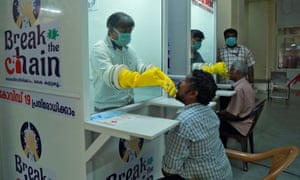
FacebookTwitterPinterest A walk-in test centre in Ernakulam, Kerala. Photograph: Reuters

That said, the state’s primary health centres had started to show signs of age. When Shailaja’s party came to power in 2016, it undertook a modernisation programme. One pre-pandemic innovation was to create clinics and a registry for respiratory disease – a big problem in India. “That meant we could spot conversion to Covid-19 and look out for community transmission,” Shailaja says. “It helped us very much.”

When the outbreak started, each district was asked to dedicate two hospitals to Covid-19, while each medical college set aside 500 beds. Separate entrances and exits were designated. Diagnostic tests were in short supply, especially after the disease reached wealthier western countries, so they were reserved for patients with symptoms and their close contacts, as well as for random sampling of asymptomatic people and those in the most exposed groups: health workers, police and volunteers.

Shailaja says a test in Kerala produces a result within 48 hours. “In the Gulf, as in the US and UK – all technologically fit countries – they are having to wait seven days,” she says. “What is happening there?” She doesn’t want to judge, she says, but she has been mystified by the large death tolls in those countries: “I think testing is very important – also quarantining and hospital surveillance – and people in those countries are not getting that.” She knows, because Malayalis living in those countries have phoned her to say so.

Places of worship were closed under the rules of lockdown, resulting in protests in some Indian states, but resistance has been noticeably absent in Kerala – in part, perhaps, because its chief minister, Pinarayi Vijayan, consulted with local faith leaders about the closures. Shailaja says Kerala’s high literacy level is another factor: “People understand why they must stay at home. You can explain it to them.”

The Indian government plans to lift the lockdown on 17 May (the date has been extended twice). After that, she predicts, there will be a huge influx of Malayalis to Kerala from the heavily infected Gulf region. “It will be a great challenge, but we are preparing for it,” she says. There are plans A, B and C, with plan C – the worst-case scenario – involving the requisitioning of hotels, hostels and conference centres to provide 165,000 beds. If they need more than 5,000 ventilators, they will struggle – although more are on order – but the real limiting factor will be manpower, especially when it comes to contact tracing. “We are training up schoolteachers,” Shailaja says.

Once the second wave has passed – if, indeed, there is a second wave – these teachers will return to schools. She hopes to do the same, eventually, because her ministerial term will finish with the state elections a year from now. Since she does not think the threat of Covid-19 will subside any time soon, what secret would she like to pass on to her successor? She laughs her infectious laugh, because the secret is no secret: “Proper planning.”