Search This Blog

Thursday, 26 October 2017

On Militant Atheism - Why the Soviet attempt to stamp out religion failed

Giles Fraser in The Guardian


The Russian revolution had started earlier in February. The tsar had already abdicated. And a provisional bourgeois government had begun to establish itself. But it was the occupation of government buildings in Petrograd, on 25 October 1917, by the Red Guards of the Bolsheviks that marks the beginning of the Communist era proper. And it was from this date that an experiment wholly unprecedented in world history began: the systematic, state-sponsored attempt to eliminate religion. “Militant atheism is not merely incidental or marginal to Communist policy. It is not a side effect, but the central pivot,” wrote Aleksandr Solzhenitsyn. Lenin compared religion to venereal disease.

Within just weeks of the October revolution, the People’s Commissariat for Enlightenment was established to remove all references to religion from school curriculums. In the years that followed, churches and monasteries were destroyed or turned into public toilets. Their land and property was appropriated. Thousands of bishops, monks and clergy were systematically murdered by the security services. Specialist propaganda units were formed, like the League of the Godless. Christian intellectuals were rounded up and sent to camps.

The Soviets had originally believed that when the church had been deprived of its power, religion would quickly wither away. When this did not happen, they redoubled their efforts. In Stalin’s purges of 1936 and 1937 tens of thousands of clergy were rounded up and shot. Under Khrushchev it became illegal to teach religion to your own children. From 1917 to the perestroika period of the 1980s, the more religion persisted, the more the Soviets would seek new and inventive ways to eradicate it. Today the Russian Orthodox churches are packed full. Once the grip of oppression had been released, the faithful returned to church in their millions.

The Soviet experiment manifestly failed. If you want to know why it failed, you could do no better than go along to the British Museum in London next week when the Living with Gods exhibition opens. In collaboration with a BBC Radio 4 series, this exhibition describes some of the myriad ways in which faith expresses itself, using religious objects to examine how people believe rather than what they believe. The first sentence of explanation provided by the British Museum is very telling: “The practice and experience of beliefs are natural to all people.” From prayer flags to a Leeds United kippah, from water jugs to processional chariots, this exhibition tells the story of humanity’s innate and passionate desire to make sense of the world beyond the strictly empirical.

Jill Cook, the exhibition’s curator, remembers going into pre-glasnost churches like Kazan Cathedral in St Petersburg, which had been converted into a museum of atheism. One of the items she has included in the exhibition is a 1989 velvet and silk embroidered image of Christ, for the back of a cope. The person who made this image had no other vestments to work from – they had all been destroyed – other than those she had seen lampooning Christianity in the museum of atheism. What had been a piss-take has been repurposed into a devotional object. Services resumed in Kazan Cathedral in 1992.

The penultimate image of the exhibition is a 1975 poster of a cheeky-looking cosmonaut walking around in space and declaring: “There is no god.” Below him, on Earth, a church is falling over. This was from the period of so-called scientific atheism.


 A poster showing a cosmonaut walking in space and saying: ‘There is no god.’ By Vladimir Menshikow, 1975. Photograph: British Museum

But there is one last exhibit to go. Round the corner, a glass case contains small model boats with burnt matchsticks in them representing people huddled together. And two tiny shirts that had been used as shrouds for drowned children. At the side of them is a small cross, made from the wood of a ship that was wrecked off the Italian island of Lampedusa on 11 October 2013. The ship contained Somali and Eritrean Christian refugees, fleeing poverty and persecution. Francesco Tuccio, the local Lampedusa carpenter, desperately wanted to do something for them, in whatever way he could. So he did all he knew and made them a cross. Just like a famous carpenter before him, I suppose. And what this exhibition demonstrates is that nothing – not decades of propaganda nor state-sponsored terror – will be able to quash that instinct from human life.
Too scared to speak up? How to be more confident

Laura Barton in The Guardian


Above the entrance to Manchester Grammar School lies a coat of arms and a Latin inscription: “Sapere Aude”. Ian Thorpe, then the school’s development officer, translated it for me – “Dare to Be Wise” – as we stood in the front quad on a warm day last July. First used by the Roman poet Horace in his book of Epistles, the phrase was later employed by the philosopher Immanuel Kant: “Dare to know! ‘Have the courage to use your own understanding’ is … the motto of the enlightenment,” he wrote. And it makes a fine motto, too, for a school that counts among its alumni the writer Thomas de Quincy and the director Nicholas Hytner.

Manchester Grammar is the largest all-boys day school in the country, and when I visited they were in the throes of summer sports’ day: a loudspeaker reeled race results out across the grass, a large marquee stood by the track. There was, I felt, a sense of gentle splendour – there in the trees that line its long driveway, mature and broad-branched, and in the quad designed in the style of an Oxbridge college. Certainly, the school wants for little: it stands on a 28-acre site, has a history dating back to the early 16th century, and commands fees a little shy of £12,000 a year.

In the cool of the library, I joined Thorpe, his colleague Laura Rooney and some of their students. We talked about the benefits of the school, their previous educational experiences at a “rowdy” primary and a local state comprehensive. “There’s more attention to individual pupils here,” said one. “When I came to this school, I felt more important,” said another. Rooney spoke of the school’s old boys’ network. “We look after them for the rest of their lives,” she said, and told of how, only the previous week, she had arranged a sixth-form work experience placement with an Old Mancunian who is now a vehicle engineer for a Formula One team.

The boys were open, articulate and delightful, their demeanour imbued with a confidence I found striking. But a school such as Manchester Grammar engenders confidence – not just through the depth and breadth of its education, but through the sense of history and lineage it bestows upon its pupils, the belief that it is quite something to join the ranks of Old Mancunians, the familiarity with Oxbridge and the professional world, a feeling of ease in a variety of social settings and occasions. And although not every public school child will brim with confidence, many will go on to live their lives with the deep-rooted sense that they have worth.

Confidence is a peculiar beast. At its most fulsome it can seem repellent. In some cases it could even prove dangerous – consider the circumstances brought about by the unwavering confidence of Donald Trump or Nigel Farage, for instance, or the kind of financial maelstrom unleashed by the overconfidence of stock market traders. Yet as I left Manchester Grammar that July day I felt a great wash of sadness that not all young people will know that sense of self-assurance; that many will spend their lives feeling perpetually on the back foot. And I wondered whether confidence might be something we can learn at any stage in life.

To an extent, confidence is something hardwired into us from birth. A study of 3,700 twins by behavioural geneticist Corina Greven at King’s College London and Robert Plomin of the Institute of Psychiatry, for instance, concluded that academic self-confidence was 50% nature and 50% nurture. Women, meanwhile, have a biological tendency to seek acceptance and avoid conflict, while men tend to take more risks under pressure, meaning that, in some lights, women might appear to lack inner confidence.

But external factors play a huge role in shaping our feelings of self worth. Let’s say you are white and male and raised in a detached house in the home counties. You attend a fee-paying school, your family is financially secure and well-educated – as it has been for generations. It seems brain-numbingly obvious to suggest your levels of confidence are likely to be higher than if you were female, black and state-educated, growing up in a single-parent family on benefits living on a council estate in, say, Burnley.

“No working-class kid, however self-confident, is ever going to be made the editor of the Evening Standard without any journalistic experience, in the way that George Osborne was,” says the writer and broadcaster Stuart Maconie, who has written often on matters of class, politics and regional divide. “What he has is a complicated nexus, a network of power and relationships that means you can’t really fail.” Underpinning that sort of confidence, he adds, is “actual material and political power and I think this is forgotten sometimes when well-meaning people are accusing working-class kids of lacking the confidence and self-assertion that comes with middle-class people”.


FacebookTwitterPinterest Illustration: Dom McKenzie

Some of the reasons for this are glaringly obvious, while others exert a more subtle force. John Grindrod is the author of Concretopia: A Journey Around the Rebuilding of Post-War Britain. “For hundreds of thousands of years, our confidence has been shaped by the environments that we are allowed into or not allowed into,” he says, pointing out that, by its nature, castle design led to the feeling that those inside were protected by its architecture, while those outside were not. After the war, Grindrod notes, this began to shift. “We saw a desire to try to create buildings that were more transparent and more permeable,” he says. “An egalitarian architecture as a panacea to a lot of issues around people feeling very disconnected from power.”

But the issue is that we do not live in an egalitarian society. The design of a public school such as Eton has much in common with, say, the colleges of Oxbridge, as well as the Inns of Court and the Houses of Parliament. If you grow up among these kinds of buildings, you are not only less likely to be daunted by their grandeur but ,on the contrary, you will feel at home, as if you belong there and they speak your language. “When the competition to build the Houses of Parliament came along in the 1830s, you were only allowed to enter buildings that were neo-gothic or Tudor,” adds Grindrod. “People who understood this vernacular, of course, would have been to Oxford and Cambridge and all those other hallowed institutions.”

There have been architectural ripostes to the established elite, however. Maconie speaks fondly of St George’s Hall in Liverpool, a neoclassical building begun in 1841, when the city was flourishing: “It’s designed to be the first thing you see when you get off the train at Lime Street, this grand edifice, and it’s supposed to say, ‘We’re not bowing to anyone, we’re supremely self-confident and we’re as good a city as anywhere in the world.’ You see that in a lot of Manchester’s cottonopolis-era architecture. A sort of swagger in bricks.”

“Swagger” is one of those words often used to describe confident northerners – particularly men. “I think of the self-confidence of the north in terms of, say, the Gallagher brothers [from Oasis], that and Arthur Seaton [from Alan Sillitoe’s Saturday Night and Sunday Morning],” says Maconie. “That kind of self-confidence is born, to a degree, of failure. You get a lot of street confidence in northern males, it’s an ‘I’m never really going to make anything of myself in terms of money or power or prestige, but I can enjoy the prestige of being the loudest guy in the pub.’”

Confident women, meanwhile, often find they are described as “bossy” or “snobby”. Katty Kay presents BBC World News America – you may remember her as the presenter whom Dr Ben Carson, the former candidate for the Republican presidential nomination, tried to silence during a live TV discussion of Trump’s alleged sexual assaults, asking for her microphone to be turned off. She is also the co-author of The Confidence Code: The Science and Art of Self-Assurance – What Women Should Know.

Kay is the daughter of a diplomat, she attended Oxford, and worked for the Bank of England before beginning her career in journalism. Despite this grounding, professional confidence has been a quality that has often alluded her, and she attributes its cause to “thinking I wasn’t bright enough, and I was conscious of not being confident enough”.

But she is aware that she is not alone. “Evidence of women underestimating their abilities is comprehensive and across the board,” she says. “It exists in sports, it exists in politics, it exists in business, it exists in the military.” It is quite the reverse for men. “One of the most reliable social studies you can do is to give men and women a scientific reasoning quiz,” she says. “Men tend to overestimate their abilities by more than 30%. Women routinely underestimate their abilities.” In reality, the quiz results reveal men and women tend to do about the same.

This, of course, has implications for both an individual’s career and the workplace in general. “Hewlett Packard has done work on promotions,” Kay continues. “Women will apply for promotions when they have 100% of the skill set, men will go for those same promotions with 60% of the skill set, because they figure they’re going to learn the rest when they get there – and they’re right, they will, and so could we. It’s one of the biggest factors I think in why women hold themselves back at work. Now, there are lots of structural reasons, the playing field is not level, but we are also not going for those promotions, we’re not asking for those pay rises in the way that men do.”

During the last few months I have been making a radio series about confidence – what it is, where it comes from, why some of us have it and others don’t, and what to do about it if your confidence levels are in short supply. I should note that I am not a confident person. I spent my entire first term at primary school allowing myself to be called Louise because I was too shy to tell them my name was actually Laura. I also recently gave a talk at a festival and, for fear that I was taking up everyone’s valuable time, began early, then garbled through it at high speed and low volume, apologising frequently. I did not ask for a lectern, or for the window on to the noisy street to be closed, I did not allow myself to stop and breathe, because I feared that to do any of these things – things that would have benefited both the audience and myself – might have been considered arrogant.

It seems to me that confidence has much to do with space – with how much room you feel able and allowed to take up. Grow up in a detached house with several acres and you might feel entitled to more room than someone raised in a terrace or a high rise with a tiny balcony. Attend a school where the class sizes are smaller, where fees are paid, and the buildings are grander, and you will learn early that you have a right to spread out, raise your voice, ask for more.

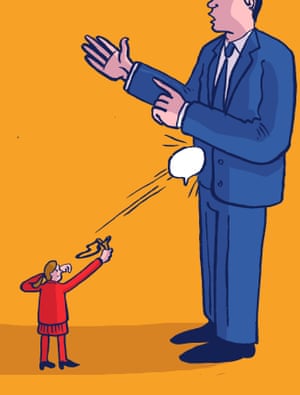
To muddy things further, girls are raised to believe that being smaller is preferable; in a hundred thousand ways we receive the message that we should be quieter, thinner, less demanding, in case we are deemed bossy, or our views too strident, or in case a man asks for our microphone to be turned off. To ask for a pay rise, then, is demanding; it says I am worthy of more – and to women, who have spent their lives being told that they should be less, this is conflicting. Men, meanwhile, are raised to be go-getters, to conquer and to win.

But, male or female, we are all a mess of contradictions: the business leader who can’t make small talk, the party animal who balks at intimacy. I feel relatively self-assured so long as you can’t see me – so I can write an article, or present a radio programme, or be as cocky as you like on email, but in the decade that I worked in the Guardian’s offices, it filled me with dread to have to walk over to speak to my editor.

In the making of this series, there have been moments when I have begun to question whether confidence is such a marvellous thing at all. I don’t know if I always trust it, and certainly I have wondered whether confidence always has to equate with brashness – whether there might not be a quieter, gentler form of self-worth. I have thought often of something Maria Konnikova, author of a book about con artists, The Confidence Game, said to me: “I have to be very wary of people who speak confidently. That is actually a sign that you should be a little bit more sceptical of them.” And I’ve considered the state of the world and wondered whether maybe all the big mouths and hot-talkers should just pipe down for a moment. “I certainly look around me at the world and see strong, confident men who seem to be leading us into very dark places,” Maconie notes. “Isn’t quiet, modest competence a better thing? Ease in one’s own skin, I think, is a different matter. To not feel beholden to anyone or inferior to anyone, that’s hard-acquired, I think, and that comes from a long immersion in what you do. Sometimes a little more discretion and humility might be a good thing.”

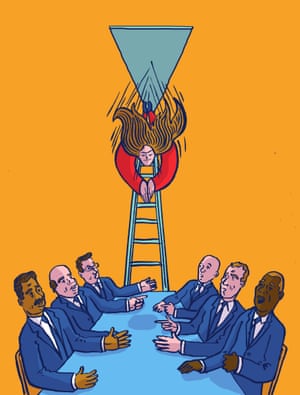
Susan Cain is the author of Quiet: The Power of Introverts in a World That Can’t Stop Talking. She cites a recent study by the Kellogg School in the US which found that in an average large meeting, three people do 70% of the talking. “And that’s horrifying,” she says, “because if you imagine it, everyone in those large meetings is equally likely to have good ideas but we’re only hearing from three of those people. That is just so much power and mind talent that has never seen the light of day.”

The problem, she says, is that we have created a culture in our schools and workplaces where those people who “are just more vocal, who are more dominant, more willing to take up space are automatically accorded all kinds of advantages, both consciously and unconsciously”. But if you consider that a third to a half of the population is introverted, perhaps it is time for us to change the culture rather than change ourselves.

Still, we have grown accustomed to trying to change ourselves. Visit the self-help section of any bookshop and you will find any number of guides to gaining confidence: Susan Jeffers’ Feel the Fear and Do It Anyway, Paul McKenna’s Instant Confidence, Russ Harris’s The Confidence Gap among them. One of the bestsellers is BrenĂ© Brown’s Daring Greatly. In 2010, Brown, a research professor at the University of Houston, gave a TED talk called The Power of Vulnerability which has gone on to be one of the most-viewed TED talks of all time (31,649,423 views at time of writing). Brown’s theory is that we acquire true confidence through vulnerability. “Courage starts with showing up and letting ourselves be seen,” she writes.

The School of Life, the educational company founded by Alain de Botton, takes a similar approach. It runs a popular confidence workshop and publishes a guide, On Confidence, that draws on the wisdom of Erasmus’s 1509 essay In Praise of Folly, and suggests that a willingness not only to be vulnerable but also to be a fool is crucial to evolving greater self-worth. “There’s a type of underconfidence that arises specifically when we grow too attached to our own dignity and become anxious around any situation that might seem to threaten it,” it states. “We hold back from challenges in which there is any risk of ending up looking ridiculous, which comprises, of course, almost all the most interesting situations.” The happy news is that, far from regarding it as an elusive gift, confidence is rather “a skill based on ideas about our place in the world, and its secrets can be learned”.


Katty Kay, agrees. “I see confidence almost like building blocks,” she says. “It’s almost a tangible physical commodity. You get confidence by doing things and trying stuff that’s hard for you and when you do those things it’s like you bank a bit of confidence, you put it in your confidence wall.” Not so long ago she was called to a meeting on Middle East affairs at the White House. “And I thought: ‘Oh my God, I’m a fraud, all these people are super-duper experts, what am I doing here? I’m just a generalist!’” When they reached the Q&A part of the meeting, Kay noted how “the men in the room just jump in with questions, and I’m sitting there thinking to myself: ‘I must ask a question, I can’t be one of only two women and neither of us ask questions!’ And eventually I think: ‘For God’s sakes, Katty, you’re nearly 50! Put your hand in the air and ask a question!’ So I put my hand up, and the question comes out, and the Earth didn’t open up and swallow me whole. And the next time I was in that situation it was that bit easier because I had banked a bit of confidence.”

It’s an approach echoed by Brown. “Courage is a habitus, a habit, a virtue: You get it by courageous acts,” she writes. “It’s like you learn to swim by swimming. You learn courage by couraging.” The brain, after all, is not rigidly set, but malleable and open to change, and so we can learn to be bolder through repetition and reward.

A 2014 study at Dartmouth College, looked at the role of the frontostriatal pathway, which connects the medial prefrontal cortex, implicated in self-knowledge, to the ventral striatum, which provides feelings of reward and motivation. Researchers used magnetic imaging to measure both the physical parameters of that pathway, which it termed the “road” and the activity levels on that pathway, termed the “traffic”.

Participants answered questions about how they rated themselves in the short and the long-term with regard to qualities such as “happy”, “hard-working”, “pessimistic” and “depressed”. The researchers found that an individual with a strong “road” was likely to experience higher long-term self-esteem. Higher “traffic” levels on the pathway, meanwhile, showed momentary rises in self-esteem. They also only saw “traffic” when participants rated themselves with positive qualities, not negative ones. So if we think about ourselves positively, the areas of the brain connected with motivation, pleasure and reward are stimulated.

“Just like mastering any other talent, gaining self-assurance requires repetition and time,” writes Dr Stacie Grossman Bloom, a neuroscientist who has examined the role that neuroscience can play in raising confidence. “The first step is to push back against the obstacles we know stand in our way by being mindful of the situation, and deciding to be confident. Making that complex decision is a multi-step process that taps into our emotions and engages many other parts of the brain. It doesn’t matter what level of self-assurance you start at, the more time and effort you dedicate to practicing being more confident, the faster your brain will change and the faster you’ll master it.”

At the Impact Factory in north London, Jo Ellen Grzyb runs workshops on communication, negotiation and public speaking. Over the course of her career she has developed her own tricks for pushing back against obstacles and mustering confidence. If, for example, you find yourself in a meeting in which only three people are blathering on, you might consider interjecting for the good of your colleagues. “You put on your Superwoman or Superman cape and you are rescuing everyone else,” she says. “Because if I’m thinking, ‘I have to speak, I have to speak, what am I going to say?’, I’m all in my head. But if I think, ‘I can rescue this meeting’, then that builds my confidence because I’m not just doing it on my behalf, I’m doing it for the whole room.”

There are physical tools, too. “You think you don’t have the confidence to interrupt this blusterer,” she says. “But if you begin to speak and you give eye contact to everybody but that person, it’s one of those little tiny magic tricks, because that person is being ignored. It’s not being rude, but you can change the dynamic very quickly. Speak, make eye contact – but not with the person who is taking up all the space.”

Among many roles, Patsy Rodenburg is head of voice at the Guildhall School of Music and Drama in London, and works with actors, teachers, world leaders and members of the corporate world, teaching on matters of voice and presence. “Although I can’t talk about the psychology of confidence, I know what it looks like in the body, and the breath, and the voice and the pace,” she says. “Often people who are trying to be confident and aren’t swing the pendulum the other way and they’re too loud. They take up too much space.” Others are “collapsed in their bodies. They don’t want to make eye contact, so there is a withdrawal from the world. You disappear. You stop breathing. It’s the equivalent of the mouse with the hawk above it.”

Her advice is that there is no overnight fix for the underconfident. “It takes consciousness, choice, but also simple exercises that might have to be done for the rest of your life. Technique is for the moments when you’re upset, disturbed or fearful.” She asks people where they feel uncomfortable in these moments. “All these tensions stop us breathing,” she says. “And breath is the fundamental thing in using our voice and connecting to people. So we have to get the breath low and deep and not rushed.”

For a lot of women, it’s a matter of lifting the sternum, for others it might be finding some kind of external connection. “I might be sitting at a desk feeling scared,” she suggests. “So I’m just putting my hand against a desk and I’m just gently pushing. And if you push against the desk, and your feet are on the floor, you can re-set the breath. It’s about re-setting. You’ve just got to come back into yourself.”

Conversely, coming back into yourself is often a matter of stepping out of yourself. “Somebody who is incredibly confident has authority and stillness and they’re interested in us,” Rodenburg says. “Real confidence has gravitas. And when we’re fully present, we’re interested in something outside ourselves. So one of the best things you could do if you’re not feeling confident is just listen to others, and be attentive.”

Once, I thought gaining confidence might require me to become someone else entirely – someone harder and louder and more bruising. But really I think it is a matter of stepping beyond yourself; an adventure of sorts, into the unknown and the brilliantly possible. It is about taking up as much space as you need. About daring to be wise. And, if necessary, it’s about keeping a steadying hand on the table.

Wednesday, 25 October 2017

Modi government's big bank bailout


The Nature of Money, Modern Money and Bitcoin

Yanis Varoufakis


Video 2 - Political Economy - The Red Pill in Social Sciences

Brexit 'more complex than first moon landing', says academic study

Philip Oltermann in The Guardian


Nasa photograph of Buzz Aldrin walking on the moon. Photograph: Swann Auction Galleries


Britain extricating itself from the European Union will be “incomparably more complex” than the first moon landing, an academic study has found.

Roland Alter, a professor at Heilbronn University in Germany who specialises in risk assessment, said he had been inspired to carry out his analysis after comments by the Brexit secretary, David Davis, that he was “running a set of projects that make the Nasa moonshot look quite simple”.

But after analysing the two situations Alter said he concluded that Davis’s analogy “missed the point”. “Both project moonshot and project Brexit are in their own way extremely complex projects. The key difference is that the USA was aware of the complexity of its undertaking.”

The paper, to be published in the journal of the German Society for Project Management early next year, analyses the comparative complexity of Britain’s withdrawal from the EU and Nasa’s first moon landing using a risk assessment model developed by the Canadian government in 2007 to determine the risk and complexity of public sector projects. 

The study singles out a number of factors that make the mission launched by Theresa May’s triggering of article 50 in March 2017 more complex than the 1969 moonshot. That mission was accomplished within eight years of John F Kennedy setting the goal “of landing a man on the moon and returning him safely to the Earth”.

While the then US president had been aware of the complexity of the task from the start and deliberately fudged the timetable of the mission by adding the words “before this decade is out” in his historic speech, developments in the Brexit negotiations had revealed an “ever-widening gulf between the complexity of the project and its organisational capacity”, according to the study.

The crucial difference between the two projects, according to Alter, was that the Nasa mission had a definable “landing zone”, namely the moon. In terms of complexity, its challenges had lain mainly in developing and applying new technologies.

“The situation in Great Britain is completely different in this respect,” his paper concludes. “The project was authorised by a referendum phrased in general terms and does not have a clearly defined ‘landing zone’.”

Alter, who previously worked as a strategist for Siemens, also teaches a course on catastrophically managed projects, which includes modules on Berlin’s much-delayed new airport, the over-budget Scottish parliament at Holyrood, Airbus’s ill-fated A400M Atlas aircraft and the Iraq war. “Brexit is not part of the course yet, but it’s a hot contender for the top spot,” Alter said.

Tuesday, 24 October 2017

How do Non Disclosure Agreements Work?

Shannon Bond and Jane Croft in FT


Many of the women who have spoken about sexual harassment by Harvey Weinstein, the Hollywood film producer, signed non-disclosure agreements. Such agreements have been criticised for being a tool used by the wealthy and powerful to silence victims. 

What is an NDA? 

An NDA is a legal agreement signed between two parties to share confidential information or to keep trade secrets private. They are widely used in the business world, such as in mergers and acquisitions, where one company receives sensitive financial information about a business it wants to buy. 

“The original legitimate point of a non-disclosure agreement is for people to talk about business ideas together and make sure someone does not run off and start their own venture,” says Robert Ottinger, founder of the Ottinger Firm, a US employment law practice. 

NDAs are also used in employment settlements so that workers cannot speak about events that happened during their employment, such as sexual harassment. 

“What is absolutely de rigueur in our business these days is the employer pays you money and you will never say anything about it again,” says Kathleen Peratis, head of the sex discrimination and sexual harassment practice group at the New York law firm Outten & Golden. 

“They’ve been used more lately to hide people’s dirty secrets. The consequence is the public never knows,” Mr Ottinger says. “We sign settlement agreements every week, and you can’t tell anyone but your spouse, your accountant and your lawyer.” 

How secure are NDAs? 

NDAs are legally binding. However, once confidential information enters the public domain, there is a question as to how an NDA could be enforced. 

“If the information is something very, very bad, such as allegations of sexual harassment against an employer, there is a public interest argument that this should not be covered up,” says one UK employment lawyer. “If other women who have not signed NDAs suddenly start speaking out then there is a question of whether the information is still confidential or has now entered the public domain. If it is now deemed as public, an employer would be unlikely to succeed in the courts if they sought damages against someone who has breached an NDA.” 

Ms Peratis says clients have recently asked about the consequences of breaking their confidentiality agreements. “What I say is, you made a deal. If you choose to violate that deal, you are at risk of having this guy demand what the contract allows him to demand. But I also tell them, if you’re the first to come out with this your risk is high. If you’re the third or fourth, your risk is not so high.” 

In the UK, lawyers reject the idea that there will be a flood of parties breaching NDAs in light of the Weinstein case. However, there is a possibility that the use of gagging clauses may be curbed, particularly in the UK public sector, which have historically been used to stop workers flagging safety concerns. 

What is the legal position for an employee who breaks an NDA? 

In both the UK and US, an ex-employee can be sued for breaching a confidentiality agreement. A company can seek damages from the former staff member and can try to claw back all or part of any financial settlement. In the UK, they can also seek an injunction preventing the former employee from speaking out again. 

Paul Quain, partner at GQ Employment Law, says UK employment settlement agreements usually have a clause in the agreement that allows ex-employees to speak out about confidential information if they are “required by law, HMRC [HM Revenue & Customs], any regulatory body”. 

This means that an ex-employee would be able to speak to UK lawmakers at a parliamentary select committee hearing, to UK tax investigators or to the UK financial regulator despite having signed such an NDA. 

In the US, NDAs cannot lawfully prevent people from reporting claims to law enforcement and government agencies, such as the Equal Employment Opportunity Commission, or responding to a subpoena. 

US federal law does stop “employers from preventing employees from their right to engage in what are called ‘concerted activities’,” says Maya Raghu, director of workplace equality at the National Women’s Law Center in Washington. “That can include restraining or preventing employees from discussing sexual harassment complaints among themselves. That can be an unfair labour practice.” 

How does an NDA differ from a non-disparagement agreement? 

Non-disparagement agreements are more specific than NDAs and mean that both parties (such as an employer and employee) agree not to make derogatory or adverse statements about each other. 

Are the numbers of NDAs increasing? 

Mr Quain says the number of NDAs has been increasing since the 1970s and 1980s as companies have become more concerned that sensitive information could be leaked. “It may be that companies started to get their fingers burnt and confidential information was made public. They are now pretty standard in employment settlement agreements,” he says. 

Ms Peratis recalls the first time she saw such an agreement mooted, about 40 years ago. “I said to the lawyer on the other side, ‘Ah, you want silence. That’s going to cost you a little more.’” 

Today, she says, “no conversation like that ever occurs any more because it is absolutely expected that with every single employment settlement agreement there will be a confidentiality agreement . . . Anybody who says these days I am not going to agree to confidentiality is not going to get a deal.”

Non Disclosure Agreements: a legal weapon used to silence and intimidate

Shannon Bond in The FT

Companies, and individuals, have a range of ways to make sure stories about misconduct do not spread. 

Most financial settlement agreements between accused and accuser include non-disclosure provisions that bar the person receiving the financial settlement from talking about their allegations or even revealing the amount of the settlement, according to lawyers who have represented women in sexual harassment cases. Non-disparagement provisions, which prevent an alleged victim from speaking ill of the person or company they have accused, are also common. 

The penalties for breaking this silence can be steep. “A lot of defendants and the companies they work for are powerful. They can put in draconian liquidated damages provisions in the event there is disclosure,” says one lawyer who has worked on such cases. 

For example, an alleged victim might be forced to pay back not just the full amount of the settlement but also an additional financial penalty and the other party’s legal fees. “There is a lot of fear hanging over your head,” the lawyer says. 

Many of the women who received settlements after accusing Roger Ailes, the former Fox News chief executive and Bill O’Reilly, one of its key presenters, of sexual harassment do not feel free to speak publicly about their experiences because of NDAs. That includes Gretchen Carlson, who received a $20m settlement in a lawsuit she filed against Ailes in 2016 that set off a cascade of allegations about the cable news network’s most powerful figures. 

Ms Carlson has become an advocate for prohibiting forced arbitration clauses and their accompanying NDAs. “We have chosen as a culture to silence the victims either with settlements where you are gagged from ever saying what happened to you or enforced arbitration, which is a part of employment contracts now, and here’s the key — it’s secret,” she told CBS News last week. 

However, NDAs cannot lawfully prevent people from reporting claims to law enforcement and government agencies, such as the Equal Employment Opportunity Commission in the US, or responding to a subpoena. 

Allegations of sexual harassment or misconduct can also be kept quiet by limiting what employees can say about their workplaces. Employment contracts often include NDAs. Many also require that any complaints, including sexual harassment, be resolved in private arbitration rather than a courtroom. Those arbitration-only clauses — which are being challenged in a Supreme Court case — typically limit what a worker can say about the complaint and the ensuing arbitration. 

“All of these operate to silence survivors of sex harassment and sex assault from coming forward and reporting, and they also help shield serial harassers from accountability,” says Maya Raghu, director of workplace equality at the US National Women’s Law Center. “As we’ve seen in the last few weeks, many survivors feel like ‘I’m the only one who this has happened to’ — so they stay silent.”