Search This Blog

Thursday, 20 February 2014

Climate change deniers have grasped that markets can't fix the climate


The refusal to accept global warming is driven by corporate interests and the fear of what it will cost to try to stop it

Planet Earth in Outer Space
'In the words of Nicholas Stern’s 2006 report, climate change is “the greatest market failure the world has ever seen”.' Photograph: Corbis
It's an unmistakable taste of things to come. The floods that have deluged Britain may be small beer on a global scale. Compared with the cyclone that killed thousands in the Philippines last autumn, the deadly inundations in Brazil or the destruction of agricultural land and hunger in Africa, the south of England has got off lightly.
But the message has started to get through. This is exactly the kind of disaster predicted to become ever more frequent and extreme as greenhouse gas-driven climate change heats up the planet at a potentially catastrophic rate. And it's exposed the David Cameron who wanted to "get rid of all the green crap" and who slashed flood defence spending by £100m a year as weak and reckless to his own supporters.
Of course there have been plenty of floods in the past, and it's impossible to identify any particular weather event as directly caused by global warming. But as the Met Office's chief scientist Julia Slingo put it, "all the evidence suggests that climate change has a role to play in it". With 4% more moisture over the oceans than in the 1970s and sea levels rising, how could it be otherwise?
If it weren't for the misery for the people at the sharp end, you might even imagine there was some divine justice in the fact that the areas hit hardest, from the Somerset Levels to the Thames valley are all Tory heartlands. It's the same with the shale gas fracking plans the government is so keen on: the fossil fuel drilling and mining so long kept away from the affluent is now turning up on their Sussex doorstep.
How do the locals feel that their government cut flood defences for the areas now swimming in water in the name of austerity, while one in four environment agency staff is being axed and the environment secretary, Owen Paterson, slashed his department's budget for adaptation to global warming by 40%?
Not too impressed, to judge by the polling. But then, paradoxically, Paterson is in fact a climate change denier in what was supposed to be "the greenest government ever", a man who refused to accept a briefing from the chief scientific adviser at the energy and climate change department, reckons there are benefits to global warming and thinks "we should just accept that the climate has been changing for centuries". Of course he's not alone among Conservatives in being what one of his cabinet colleagues called "climate stupid". The basic physics may be unanswerable, 97% of climate scientists agree that carbon emissions are dangerously heating up the planet, the Intergovernmental Panel on Climate Change warn it's 95% likely that most of the temperature rise since 1950 is due to greenhouse gases and deforestation, the risk of a global temperature rise tipping above 1.5–2C be catastrophic for humanity.
But the climate flat-earthers are having none of it. As a result, what should be a pressing debate about how to head off global calamity has been reframed in the media as a discussion about whether industrial-driven climate change is in fact taking place at all – as if it were a matter of opinion rather than science.
The impact of this phoney controversy during an economic crisis has been dramatic: in the US, the proportion of the population accepting burning fossil fuels drives climate change dropped from 71% to 44% between 2007 and 2011. In Britain, the numbers who believe the climate isn't changing at all rose from 4% to 19% between 2005 and 2013 (though the floods seem to be correcting that).
The problem is at its worst in the Anglo-Saxon world – which has also historically made the largest contribution to pumping carbon into the atmosphere. Take Australia, which is afflicted by longer and hotter heatwaves, drought and bushfires. Nevertheless, its rightwing prime minister Tony Abbott dismisses any link with climate change, which he described as crap, and has promised to repeal a carbon tax on the country's 300 biggest polluters. The move was hailed by his political soulmate, the Canadian prime minister and tar sands champion Stephen Harper, as an important message to the world. And in the US, climate change denial now has the Republican party in its grip.
What lies behind the political right's growing refusal to accept the overwhelming scientific consensus? There's certainly a strong tendency, especially in the US, for conservative white men to refuse to accept climate change is caused by human beings. But there shouldn't be any inherent reason why people who believe in social hierarchies, individualism and inequality should care less about the threat of floods, drought,  starvation and mass migrations than anyone else. After all, rightwing people have children too.
Part of the answer is in the influence of some of the most powerful corporate interests in the world: the oil, gas and mining companies that have strained every nerve to head off the threat of effective action to halt the growth of carbon emissions, buying legislators, government ministers, scientists and thinktanks in the process. In the US, hundreds of millions of dollars of corporate and billionaires' cash (including from the oil and gas brothers Koch) has been used to rubbish climate change science. That is also happening on a smaller scale elsewhere, including Britain.
But climate change denial is also about ideology. Many deniers have come to the conclusion that climate change is some kind of leftwing conspiracy – because the scale of the international public intervention necessary to cut carbon emissions in the time demanded by the science simply cannot be accommodated within the market-first, private enterprise framework they revere. As Joseph Bast, the president of the conservative US Heartland Institute told the writer and campaigner Naomi Klein: for the left, climate change is "the perfect thing", a justification for doing everything it "wanted to do anyway".
When it comes to the incompatibility of effective action of averting climate disaster with their own neoliberal ideology, the deniers are absolutely right. In the words of Nicholas Stern's 2006 report, climate change is "the greatest market failure the world has ever seen".
The intervention, regulation, taxation, social ownership, redistribution and global co-operation needed to slash carbon emissions and build a sustainable economy for the future is clearly incompatible with a broken economic model based on untrammelled self-interest and the corporate free-for-all that created the crisis in the first place. Given the scale of the threat, the choice for the rest of us could not be more obvious.


Why Mumbai's new air terminal has gone off the rails


Sharing the name Chhatrapati Shivaji, the airport and train terminus have much in common: both were once the future
Cities: Mumbai 1, t2
The new terminal 2 at Chhatrapati Shivaji international airport, in Mumbai. Photograph: Punit Paranjpe/AFP/Getty Images
The long-awaited airport terminal at Mumbai's Chhatrapati Shivaji airport finally opened its aerobridges and check-in counters to passengers this month. In the buildup, any number of journalists had been led on tours through the new facility, and I'd absorbed their reports with a mixture of awe and amusement. The new terminal – the T2 – has 5,000 square metres of landscaping, I learned, and 21,000 square metres of retail space for luxury shops. Some reports also noted that the terminal, which will serve about 40 million passengers each year, will have access to 101 toilet blocks.
In Mumbai, nativists have ensured that almost every new building is named after the 17th-century warrior-king Shivaji, and as I read about the splendours of the new terminal at Chhatrapati Shivaji, I couldn't help thinking about another Chhatrapati Shivaji terminus across town – a hyperkinetic railway station that used to be known as the Victoria terminus.
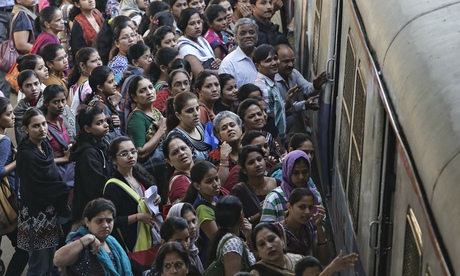
That terminus is used by 3.75 million people every day, which means it gets as many visitors in 11 days as the terminal at the airport terminal has in a year. But the rail travellers only have access to 83 toilets and urinals – not toilet complexes like the air passengers have, but 83 individual toilets.
When it was opened more than a century ago, however, the Chhatrapati Shivaji railway terminus, which bears an uncanny resemblance to London's St Pancras, was the T2 of its time. It featured state-of-the-art everything, even state-of-the-art art. Its impressive stone façade is alive with sculptures of gargoyles and squirrels and flying birds that were executed under the guidance of Lockwood Kipling, the principal of the JJ School of Art down the road (his son, Rudyard, would grow up to become poet laureate of the empire).
Cities: mumbai 2, rail People on a platform inside Chhatrapati Shivaji terminus, previously known as Victoria terminus, railway station in Mumbai. Photograph: David Pearson/Rex

The new terminal at Mumbai's airport also features a profusion of artworks. Press reports say that more than 7,000 exhibits have been assembled, some by contemporary artists and others from across the ages, reaching back to the 6th century. In fact, the airport website describes the T2 display as "India's largest public art programme". The curator of the collection, Rajeev Sethi, told The New York Times: "The concept of art in public space is a very serious issue because art cannot shrivel up and shrink into investment portfolios or disappear into godowns [warehouses] or galleries. It has to be in the public domain."
The difference between the two terminuses demonstrates just what's going wrong with Mumbai. After two decades of economic liberalisation, its middle class has been so brainwashed into believing privatisation is the solution for all their problems that the city seems to have forgotten what public actually means. As art historian Rahul D'Souza points out: "Richer residents are quite willing to accept the idea that an art exhibition can be public, even if it can accessed only by people who have bought an international air ticket." This attitude will surely have a profound effect on Mumbai's politics in the near future.
The middle-class aspiration for exclusivity is a jarring disjuncture with the mythology and history of a city that lives the best part of its life in full view of its neighbours, with one of the highest population densities in the world (it packs 22,937 people into each square kilometre, compared to 5,285 people in London). The size of the average Mumbai family is 4.5 people, and the average home size is 10 square metres, so some of their most private moments transpire in the midst of a crowd.
Much of Mumbai's easy urbanity has been forged in the sweaty confines of its public transport system, by far the most extensive in India. In its compartments, people of different castes and communities are forced to share benches and be wedged together in positions of daring intimacy. This is only to be expected when 5,000 commuters are stuffed into trains built to carry 1,800 – a density that the authorities describe as the "super-dense crushload". The commonplace negotiations of the commute – such as the convention of allowing a fourth traveller to sit on a bench built for three, but only on one buttock – force an acknowledgement of other people's needs that characterises Mumbai life.
Cities: mumbai 3, art A woman looks at artwork on display at terminal 2 at Chhatrapati Shivaji airport. The new terminal holds around 7,000 works of art. Photograph: Danish Siddiqui/Reuters

The Mumbai commute, in addition to being compacted, is very long – for some, it could involve a journey of two hours each way. This has given rise to the institution of "train friends", people who travel in a group in the same section of the same compartment every morning, sharing stories of their triumphs and disappointments and even celebrating their birthdays by bringing in sweets for their companions.
Despite the enormous effort they sometimes entail, the accommodations of the commute are barely perceptible to the outsider. Because of the unavoidable press of bodies at peak hours, women travel in separate carriages – but every so often, couples who cannot bear to be parted or a clueless out-of-town pair will blunder into the "general compartment". When this happens, the other men will strain to provide the woman a millimetre or two of space around her, creating a cocoon in which she is magically insulated from the accidental nudge of limbs and torsos.
This isn't to suggest that life on the rails is all smiles and sunshine. As is to be expected on a long, sweaty journey, arguments do break out, mostly over trivial matters involving the placement of a limb or a bag in awkward proximity to a fellow passenger's face. But these exchanges rarely culminate in fisticuffs. The crowd around the belligerents can be counted on to defuse the tension quickly, usually with the remark, "These things happen. You have to adjust".
Sadly, though, the spirit of compromise so evident on the trains is evaporating on the streets outside. To watch Mumbai traffic in motion is to see the ferocious sense of entitlement in which India's moneyed classes have wrapped themselves. Mumbai's vehicles refuse to give way to ambulances, and honk furiously at old people and schoolchildren trying to cross the street. They never stop at zebra crossings, frequently jump red lights, and routinely come down the wrong way on no-entry streets. Because an estimated 60% of cars are driven by chauffers, more than in most other parts of the world, car owners have the fig-leaf of pretending that they aren't responsible for transgressions they actually encourage. And this sense of self-importance is pandered to by the government's budgetary allocations. Though the vast majority of Mumbai residents use the overburdened public transport system to get around, a disproportionate amount of development money has been poured into road projects.
Cities: mumbai 4, womenr so Female commuters wait to cram into a ladies only carriage on a rush hour train from Chhatrapati Shivaji rail terminus. The trains were designed to carry around 1,800 passengers, and currently hold around 5,000 per journey. Photograph: Danish Siddiqui/Reuters

The city has built approximately 60 flyovers and elevated roadways in recent years – facilities that have paradoxically made the congestion on the roads far worse. As incomes expand, traffic is growing at a rate of 9% a year, with an estimated 450 new vehicles being added to Mumbai's narrow streets every day. As a result, peak-hour traffic crawls ahead at an average of 10kmh – less than half the speed clocked by winners of the city's annual marathon. It merely proves the adage so beloved of planners around the world: "Building more roads to prevent traffic congestion is like a fat man loosening his belt to prevent obesity."
The imbalance so apparent between Mumbai's transport system and its airport seem sure to polarise political attitudes in the city even more sharply. The city's middle classes have become so enamoured of their privatised comforts, they are forgetting that great cities get their reputation not from the access-restricted pleasures they afford the few, but the public amenities that are available to all. The chasm between the elite and the working classes has long been the playground for populist politicians, here and elsewhere. But over the last few years, such divisions in Mumbai have literally been reinforced by concrete. Unless this changes, my city will lose the common ground on which to make common cause.

The psychological dominance of Mitchell Johnson


Jon Hotten in Cricinfo
How do you stop Mitchell Johnson?


Beginning a post with that question naturally implies there is now going to be some kind of an answer. Well, there won't be one here, beyond the obvious, and that is that time will stop him, as time stops them all. He bowls with the ghosts of Larwood and Thommo and Holding and all of the other terrors behind him. (My own personal nightmare? Sylvester Clarke, the brooding Grendel of The Oval, who would come and knock on the hotel room doors of opposing batsmen to let them know exactly what he was about to do.) Johnson has, in a few short months, entered the realm of men who have exerted a strange psychological dominance with the overwhelming pace of their bowling.

The compelling aspects of the Johnson story lie there, because the hold he has is not just on batsmen, it is on the collective imagination of everyone watching him bowl. As Russell Jackson observed in the Guardian newspaper this week, each Johnson spell has become event television. The thrilling news the Centurion Test brought with it was that the Ashes was no one-off: if Johnson could do his thing away from home against Test cricket's best team, then it can happen anywhere to anyone. After a single game, there are echoes of what he did to England, which was to induce a kind of deep-rooted demoralisation that extended beyond the field and into the psyche (he was not playing alone, of course, but he was a spearhead). It was as if he had pulled out a pin that held the team and organisation together, and the unit just sprang apart - injury, illness, retirement, disharmony all had their way.  - injury, illness, retirement, disharmony all had their way.
As the Cricket Australia Twitter account reported a little too gleefully - Ryan McLaren will miss the second Test with Johnson-induced concussion. There is also a run of luck that feels familiar: Dale Steyn stricken with food poisoning, Morne Morkel falling on his shoulder, and other phenomena not directly connected to Mitch but part of a general entropic slide. Just as England had players central to their strategy reaching the end of the road, so South Africa are absorbing the loss of Jacques Kallis: it's hard to think of a single player more difficult to replace. The captains of both teams happen to be left-hand openers, and Mitch is regularly decapitating both.
At the heart of all of this, as many have observed, is Johnson's pure and thrilling speed, channelled now into short and violent spells in which he bowls either full or short. This is the game reduced to its chilling basics. And yet there is mystery here too, and while unravelling it offers no answer to stopping Johnson, it may explain a little further what is causing such devastation.
The speed gun says that Johnson is bowling at speeds of up to 150kph, areas that other bowlers have touched. Because of the way in which speed guns work, deliveries of the sort that skulled Hashim Amla and Ryan McLaren registered more slowly due to where they pitched. (I'm sure that was great consolation to both players as the ball thudded into their heads.)
However, as the great Bob Woolmer revealed in his book The Art And Science Of Cricket, the nature of speed is not absolute because it is relative in the eyes of the batsman facing it. His research showed that the very best players - those who are euphemistically referred to as "seeing the ball early" - are actually reacting to a series of visual clues offered by the bowler in the moments before release.
Players who have faced Johnson speak of the sensation of the ball appearing "late" in his action, as his arm swings from behind his body. This is perhaps a combination of a couple of factors: the "clues" that Johnson offers in his run-up and delivery stride might be slightly less obvious than in other bowlers, and that his already ferocious pace is magnified by the extra micro-seconds that a batsman takes to pick the line and length of the ball (all the more impressive given that Johnson essentially only offers two lengths, and little variation on his themes).
Thus, with Mitch, the flexible nature of speed perception is working in his favour. Only the truly blessed - AB de Villiers, Kevin Pietersen et al - can play him with a little more certainty.
Pietersen was moved to tweet last week about the huge difference between 140kph and 150, just as his near-namesake Alviro was dismissed with a waft to the keeper. He said that you can "instinctively" play the wrong shot in those circumstances. What he was driving at was that Johnson offers no time for anything other than instinct, no margin to correct that first thought.
This is theory, of course. What can't be conveyed as easily is the psychological pressure that speed exerts. Players are wobbling to the crease with their minds consumed by thoughts of what he can do, and it becomes a self-fulfilling prophecy. South Africa are on a slide that will take tremendous resolution, as well as skill, to stop. In Smith they have one of Test cricket's most redoubtable men, and in de Villiers and Amla two of the most sublimely talented. It is absolutely fascinating to watch, and Mitch has done the game a great service in his phoenix-from-the-flames revival. This is cricket at its sharpest physical and psychological point.

Wednesday, 19 February 2014

A great defence of the decision to stop publication of 'The Hindus by Wendy Doniger'

CONTROVERSY
Untangling The Knot
The many strands entangled in l' affaire Doniger involve issues that are too important to be left to the predictable and somewhat stale rhetoric about Hindutva fanatics or lamenting the role of the Indian government and judiciary
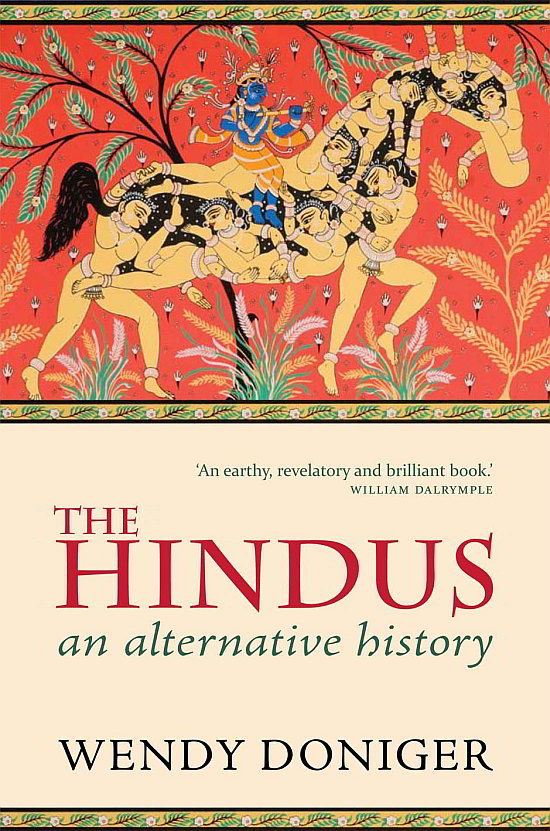
The controversy about Penguin India’s decision to withdraw and pulp Wendy Doniger’s The Hindus: An Alternative History brings to the surface issues likely to trouble scholars of India for years to come. First, the obvious: the banning of any book violates academic or intellectual freedom. Rightly so, this leads to moral indignation among the intelligentsia of India and the West. Our ancestors fought for this freedom, sometimes sacrificing their lives. Not to protect it amounts to betraying their legacy. 
Yet, in this case, the rhetoric is predictable and somewhat stale: 
“Another bunch of Hindutva fanatics have succeeded in having a book by a respected academic banned because they feel offended by its contents. They have not understood the book, give ridiculous reasons, and threaten publisher and author with dire consequences if the book is not withdrawn. The Indian judiciary is caving in to religious fanaticism and practically abolishing freedom of speech in India.”
This readymade reaction may sound cogent but it covers up major questions: What brings Hindu organizations to filing petitions that make them the butt of ridicule and contempt? Whence the frustration among so many Indians about the way their culture is depicted? Why is this battle not fought out in the free intellectual debate so typical of India in the past?

So many strands are entangled in this knotty affair that it is no longer clear what is at stake. To move ahead we first need to untangle the knot, but this requires that we take unexpected perspectives and question entrenched convictions. Drawing on the work of S.N. Balagangadhara, this piece hopes to give one such perspective.
I
Imagine you are born in the 1950s as a Hindu boy with intellectual inclinations. As you grow up, your mother takes you to the temple and shows you how to do puja. Your grandparents tell you stories about Bhima’s strength, Krishna’s appetite, Durvasa’s temper… Perhaps you rejoice when Rama rescues Sita, feel afraid when Kali fights demons, or cry when Drona demands Ekalavya’s thumb as gurudakshina. Your father is indifferent to most of this stuff, but then he is very moody so you prefer to stay away from him in any case.
In school, you are taught about the history of India. You learn that Hinduism grew out of the Brahmanism imported during the Aryan invasion. The caste system is a fourfold hierarchy imposed by the Brahmin priesthood, so you are told, and untouchability is the bane of Hindu society. Caste discrimination needs to be eradicated, as Gandhi said, while the scientific temper should displace superstitious tradition, as Nehru taught.

Your teachers present this account as the truth, along with Newton’s physics and Darwin’s evolutionary theory. You feel bad about your “backward religion” and ashamed about “the massive injustice of caste.” For some time, as a student, you also mouth this story in the name of progress and social justice. Yet you feel that there is something fundamentally wrong with it. You sense that it misrepresents you and your traditions—it distorts your practices, your people, and your experience, but you don’t know what to do about it.
What is the problem? Well, the current discourse on Indian culture and society is deeply flawed, even though it dominates the educational system and the media. This story about “Hindu religion” and “the caste system” started out as an attempt by European minds to make sense of their experience of India. Missionaries, travellers, and colonial officials collected their observations; Orientalists and other scholars ordered these into a coherent image of India. In the process, they drew on a set of commonplaces widespread in European societies, which all too often reflected a Christian critique of false religion.
The resulting story transforms India into a deficient culture: 
“India has its dominant religion, Hinduism, created by cunning Brahmin priests; this religion sanctions social injustice in the form of a fixed caste hierarchy; instead of freedom and equality, it represents inequality and social constraint; it is basically immoral.” 
With some internal variation, this story is presented as a truthful description of Indian culture. Contemporary authors use different conceptual vocabularies to explain or interpret “Hinduism” and “caste,” from Marx and Freud to Foucault and Žižek. But the so-called “facts” they seek to explain are already claims of the Orientalist discourse, structured around theological ideas in secular guise. In fact, they are nothing more than reflections of how Europeans experienced India. No wonder then that the story does not make sense to those who do not share this experience.

II
Back to the 1970s now: you are studying hard, for your parents want you to become an engineer. Yet you are more interested in history and the social sciences. You want to make sense of your unease with the dominant story about Indian culture. So you turn to the works of eminent professors at elite universities from the Ivy League to JNU. What do you find? They repeat the same story, in a jargon that makes it even more opaque. You become more frustrated. Everywhere you turn, people just reproduce the same story about Hinduism and caste as the worst thing that ever happened to humanity: politicians, activists, teachers, professors, newspapers, television shows… They may add some qualifications but to no avail. After spending a few years in America, you return to India, get married, and have two kids. They come home from school with questions about “the wrongs of Hinduism and the caste system.” You don’t know what to tell them. Your frustration and anger rise to boiling point. You feel betrayed by the intellectual classes.
What are the options of Indians going through similar experiences? They cannot challenge the story about Hinduism and caste intellectually for they do not possess the tools to do so. They are neither scholars nor social scientists so they cannot be expected to grasp the conceptual foundations of the dominant story, let alone develop an alternative. Maximally, they can condemn it as “racist” or “imperialist.” Even there, they are ambiguous. They feel that the West is ahead of India in so many ways. In their society, corruption is the rule and the caste system refuses to go away, but then most people around them nevertheless appear to be good men and women. How to make sense of this? There are no thinkers able to help them solve these problems.

III
When you turn 45, your children leave home. One fine day a colleague tells you he is with the RSS and hands you some literature. Here is an outlet for venting your anger and frustration, the rhetoric of Hindu nationalism: 

“Be a patriotic Indian; the Hindu nation is great; caste is only a blot on its glory; Indian intellectuals are communists engaged in an anti-Indian conspiracy; and foreign scholars must be out to divide the country.” 

This rhetoric does not give you any enlightenment or insights into your traditions; actually, it feels quite shallow. But it at least gives some relief and puts an end to the blame and insult heaped onto your traditions. With some fellow warriors you decide that the miseducation of India should stop. What is the next step?

At this point, there are ready made traps. First, it is difficult not to notice how those in power in India decide what gets written in the textbooks. Under British rule, it was the classical Orientalist account. Mrs Gandhi allowed the Marxists to take control of the relevant government bodies (they could acquire only “soft power” there, after all) and reject Indian culture as a particularly backward instance of false consciousness. For decades now, secularists have set the agenda and funded research projects and centres for “humiliation and exclusion studies.” Once the BJP comes to power, why not rewrite the textbooks and run educational bodies according to Hindutva tastes?

Second, there are examples of successful attempts at having books banned in the name of religion. Rushdie’s Satanic Verses is the cause célèbre. The relevant section of the Indian Penal Code crystallized in the context of early 20th-century controversies about texts that ridiculed the Prophet Muhammad. At the time, some jurists argued that non-Muslims could not be expected to endorse the special status given by Muslims to Muhammad as the messenger of God. That would indirectly force all citizens to accept Islam as true religion. Yet it was precisely there that Muslim litigants succeeded. If one group could use the law to indirectly compel all citizens to accept its claims concerning its holy book, religious doctrines and divine prophet, why not follow the same route?

Third, American scholars of religion came in handy for once. They had identified some questions they considered central to religious studies: What is the relation between insider and outsider perspectives? Who has the right to speak for a religion, the believer or the scholar? Originally, these were questions essential to a religion like Christianity, where accepting God’s revelation is the precondition of grasping its message. Yet the potential answers turned out to be useful to others: “Only Hindus should speak for Hinduism and scholarship can be allowed only in so far as it respects the believer’s perspective.”

What gives Hindu nationalists the capacity to conform so easily to these models? This is because they generally reproduce the Orientalist story about Hinduism, just adding another value judgement. They may believe they are fighting the secularists; in fact, they are also prisoners of what Balagangadhara has called “colonial consciousness.” That is, the Western discourse about India functions as the descriptive framework through which Hindu nationalists understand themselves and their culture. They also accept that this culture is constituted by a religion with its own sacred scriptures, gods, revelations, and doctrines. Within this framework, they can then easily mimic Islamic and Christian concerns about blasphemy and offence. Add the 19th-century Victorian prudishness adopted by the Indian middle class and you get prominent strands of the Doniger affair.

Consider the petition by Dinanath Batra and the Shiksha Bachao Andolan Samiti. Doniger’s suggestion that the Ramayana is a work of fiction written by human authors—a claim that would hardly create a stir in most Indians—is now transformed into a violation of the sacred scriptures of Hinduism. The petition claims that the cover of the book is offensive because “Lord Krishna is shown sitting on buttocks of a naked woman surrounded by other naked women” and that Doniger’s approach is that “of a woman hungry of sex.” It expresses shock at her claim that some Sanskrit texts reflect the “glorious sexual openness and insight” of the era in which they were written. To anyone familiar with the harm caused by Christian attitudes towards sex-as-sin, this would count as a reason to be proud of Indian culture. Yet the grips of Victorian morality have made these Hindus ashamed of a beautiful dimension of their traditions. 

IV
In the meantime, our middle-aged gentleman’s daughter has gone into the humanities and her excellent results give her entry to a PhD programme in religious studies at an Ivy League university. After some months, she begins to feel disappointed by the shallowness of the teaching and research. When compared to, say, the study of Buddhism, where a variety of perspectives flourish, Hinduism studies appears to be in a state of theoretical poverty. Refusing to take on the role of the native informant, she begins to voice her disagreement with her teachers. This is not appreciated and she soon learns that she has been branded “Hindutva.”

Around the same time, she detects a series of factual howlers and flawed translations in the works of eminent American scholars of Hinduism. When she points these out, several of her professors turn cold towards her. She is no longer invited to reading groups and is avoided at the annual meetings of the American Academy of Religion. In response, this budding researcher begins to engage in self-censorship and looks for comfort among NRI families living nearby. Her dissertation, considered groundbreaking by some international colleagues, gets hardly any response from her supervisors. Looking for a job, the difficulties grow: she needs references from her professors but whom can she ask? She applies to some excellent universities but is never shortlisted. Confidentially, a senior colleague tells her that her reputation as a Hindutva sympathiser precedes her. Eventually, she gets a tenure-track position at some university in small-town Virginia, where she feels so isolated and miserable that she decides to return to India.

Intellectual freedom can be curbed in many ways. The current academic discourse on Indian culture is as dogmatic as its advocates are intolerant of alternative paradigms. They trivialize genuine critique by reducing this to some variety of “Hindu nationalism” or “romantic revivalism.” All too often ad hominem considerations (about the presumed ideological sympathies of an author) override cognitive assessment. Thus, alternative voices in the academic study of Indian culture are actively marginalized. This modus operandi constitutes one of the causes behind the growing hostility towards the doyens of Hinduism studies.

Again this strand surfaces in the Doniger affair. When critics pointed out factual blunders from the pages of The Hindus, this appears to have been happily ignored by Doniger and her publisher. She is known for her dismissal of all opposition to her work as tantrums of the Hindutva brigade. The debates on online forums like Kafila.org (a blog run by “progressive” South Asian intellectuals) smack of contempt for the “Hindu fanatics,” “fundamentalists” or “fascists” (read Arundathi Roy’s open letter to Penguin). More importantly, they show a refusal to examine the possibility that books by Doniger and other “eminent” scholars might be problematic because of purely cognitive reasons.

For instance, the petition charges Doniger with an agenda of Christian proselytizing hidden behind the “tales of sex and violence” she tells about Hinduism. This generates ridicule: Doniger is Jewish and she is a philologist not a missionary. Indeed, this point appears ludicrous and lacks credibility when put so crudely. As said, it also reflects the Victorian prudishness to which some social layers have succumbed. Yet, it pays off to try and understand this issue from a cognitive point of view.

A major problem of early Christianity in the Roman Empire was how to distinguish true Christians from pagan idolaters. Originally, martyrdom had been a helpful criterion but, once Christianity became dominant, the persecution ended and there were no more martyrs to be found. The distinction between true and false religion could not limit itself to specific religious acts. Those who followed the true God should also be demarcated from the followers of false gods by their everyday behaviour. Sex became a central criterion here. Christians were characterized in terms of chastity as opposed to pagan debauchery. (If you wish to see how this image of Greco-Roman paganism lives on in America, watch an episode of the television series Spartacus.)

From then on, Christians believed they could recognize false religion and its followers in terms of lewd sexual practices. Early travel reports sent from India to Europe, like those of the Italian traveller Ludovico di Varthema, confirmed this image of pagan idolatry: “Brahmin priests” and “superstitious believers” engaged in a variety of  “obscene” practices from deflowering virgins in various ways to swapping wives for a night or two. Conversion to Christianity would entail conversion to chastity.

Reinforced by Victorian obsessions, this style of representing Indian religion reached its climax in the late 19th century. Hinduism was said to be the prime instance of “sex worship” and “phallicism,” notions popular at the time for explaining the origin of religion. Take a work by Hargrave Jennings—cleric, freemason, amateur of comparative religion—imaginatively titledPhallic Miscellanies; Facts and Phases of Ancient and Modern Sex Worship, As Illustrated Chiefly in the Religions of India (1891). The opening sentence goes thus: “India, beyond all countries on the face of the earth, is pre-eminently the home of the worship of the Phallus—the Linga puja; it has been so for ages and remains so still. This adoration is said to be one of the chief, if not the leading dogma of the Hindu religion…”It goes on to explain that “according to the Hindus, the Linga is God and God is the Linga; the fecundator, the generator, the creator in fact.” In other words, the Hindus view the phallus as their divine Creator and its worship is their dogma. This is one of a series of works from this period, expressing both fascination and disgust.

This focus on sex remained central to the popular image of Indian religion in the Western world. In her infamous Mother India (1927), the American Katherine Mayo writes that the Hindu infant that survives the birth-strain, “a feeble creature at best, bankrupt in bone-stuff and vitality, often venereally poisoned, always predisposed to any malady that may be afloat,” is raised by a mother guided by primitive superstitions. “Because of her place in the social system, child-bearing and matters of procreation are the woman’s one interest in life, her one subject of conversation, be her caste high or low. Therefore, the child growing up in the home learns, from earliest grasp of word and act, to dwell upon sex relations” . From there, Mayo turns to a reflection on the obsession for “the male generative organ” in Hindu religion. Among the consequences are child marriage and other immoral practices: “Little in the popular Hindu code suggests self-restraint in any direction, least of all in sex relations” .

In short, the connection established between Hinduism and sexuality was based in a Christian frame that served to distinguish pagan idolaters from true believers. Wendy Doniger’s work builds on this tradition. Like some of her predecessors, she appreciates the sexual freedom involved, but then she also tends to stress two aspects: sex and caste. This is not a coincidence, for these always counted as two major properties allowing Western audiences to appreciate the supposed inferiority of Hinduism. In other words, the sense that the current depiction of Indian traditions in terms of caste and sex is connected to earlier Christian critiques of false religion cannot be dismissed so easily.

Does this mean that researchers should give in to the campaigns of holier-than-thou bigots? Does it justify the banning or withdrawal of books? Not at all! First, who will decide what counts as true knowledge and what as salacious or gratuitous insult? In the US, evangelicals would like to remove Darwin’s Origin of Species from schools because they consider it unscientific and offensive. If it continues to follow its current route, the Indian judiciary may well end up banning a variety of such books. Second, book bans fail to have any fundamental effect on the kind of work produced about India. The epitome of the “sex and caste” genre, Arthur Miles’ The Land of the Lingam(1937), was banned many decades ago. Even though political correctness altered the language use and removed explicit mockery, many works continue to represent Hinduism along similar lines. Third, the Kama Sutra and the Koka Shastra, the temples of Khajuraho and Konarak, Tantric traditions and the Indian science of erotics are all fascinating phenomena, which need to be studied and understood. But we have an equal responsibility to make sense of the concerns of Indians horrified by the currently dominant depiction of their traditions. All this research should happen in complete freedom or it shall not happen at all.

V
The dispute about Doniger’s book is a product of all these forces, including the peculiarities of the Indian Penal Code (better left to legal experts). What is the way out? How can we untangle the knot?

To cope with complex cases like these, the first step should take the form of scientific research. The disagreement with the work of Doniger and other scholars can be expressed in a reasonable manner. The theoretical poverty and shoddy way of dealing with facts and translations exhibited by such works can be challenged on cognitive grounds. This is the only way to alleviate the frustration of our Hindu gentleman (a grandfather by now) and to illuminate the intellectual concerns of his daughter. In any case, we need to appreciate how the current story about Hinduism and caste continues to reproduce ideas derived from Christianity and its conceptual frameworks. As long as we keep selling the experience that one form of life (Western culture) has had of another (Indian culture) as God-given truth, the current conflict will not abate and our understanding of India will not progress.

But the same goes for using the Indian Penal Code to have books banned. Inevitably, this has chilling effects on the search for knowledge, at a time when India needs free research more than ever to save it from catastrophe. As is always the case, scientific research will bring about unexpected and unorthodox results. At any point, some or another group may feel offended by these, but this should never prevent us from continuing to pursue truth.

Unfortunately, the Indian government and judiciary have taken the route of succumbing to “offence” and “atrocity” claims by all kinds of communities. Given the political situation, this is unlikely to change any time soon. We can express moral outrage today. But tomorrow the challenge is to develop hypotheses that make sense of the current developments in India, including the violent rejection of the dominant representations of Indian culture. These need to show the way to new solutions so that an end may be brought to the banning and destruction of books in a culture that was always known for its intellectual freedom.

Tuesday, 18 February 2014

How Mitchell Johnson's speed scrambles the mind


South Africa thought they were well prepared to face Australia, but their plans overlooked the extra pace of Mitchell Johnson
Mitchell Johnson
Mitchell Johnson in full-speed mode during his devastating display in the first Test win over South Africa. Photograph: Themba Hadebe/AP

THE JOHNSON PROBLEM

Russell Domingo, South Africa's coach, never played first-class cricket. But he is a whizz with numbers. "I am," Domingo told Firdose Moonda, "very driven by technical and strategic aspects and analysis." AB de Villiers says of Domingo: "He likes his stats." No doubt, then, that his team thought they were well-prepared. Hashim Amla said before the first Test with Australia: "I don't think in this series there's too many surprise factors." Mitchell Johnson? "We've played against him before," said Faf du Plessis. "It's nothing we haven't seen … we're ready." All Australia's talk, Graeme Smith said, was just so much "bull". South Africa's batsmen had their plans, ones based on experience and analysis. "Everyone has a plan," as Mike Tyson put it, "'til they get punched in the mouth."
At 85mph, a ball takes 0.52sec to travel 22 yards. That's less time than it takes Usain Bolt to complete his first stride, and a little more than it takes you to blink. It's how long a batsman has to spot the length and line of the delivery, pick a shot to play, and then pull it off. To do it right, he needs to judge the position of the ball to within around three centimetres, and time the arrival of the bat to within three milliseconds. Any further, any sooner, any slower, and the ball misses the sweet spot. Put like that, hitting a cricket ball begins to seem like a preternatural act, as impossible as pinching a fly from the air with a pair of chopsticks.
They say it takes a minimum of 100 milliseconds for the brain to produce even the simplest action, and around double that to do something only a little more complex, like flicking a light switch. Benjamin Libet, a physiologist at the University of California, found that it took between 400 and 500 milliseconds for the brain to complete all the processes needed to produce a subjective experience. In cricket, the time constraint imposed by the speed of the delivery often exceeds the time available to process information. Against fast bowling, a batsman operates at a speed that outstrips his own consciousness. So how is it done?
It's not that the best Test batsmen have quicker reactions than anyone else. As Peter McLeod, a member of Oxford University's Department of Experimental Psychology, explained to John McCrone in the New Scientist: "There is surprisingly little difference between top-class athletes and good, fit ordinary people. In laboratory tests of reactions using unskilled tasks, most people show much the same reaction time of about a fifth of a second."
In his book Wait: The Art and Science of Delay, Frank Partnoy breaks that half a second down into still smaller chunks. Roughly, the first 150 milliseconds is seeing the ball. The last 100 milliseconds is spent playing the shot. In one of his studies, McLeod found that it is impossible for any batsman – he tested Allan Lamb, Wayne Larkins, and Peter Willey – to correctly react to any deviation the ball makes in the final 200 milliseconds of its flight. What matters then, is that chunk in the middle, the 150 milliseconds between seeing the ball and playing it. Partnoy calls this the "ball identification stage", a phrase he borrowed from the tennis coach Angel Lopez, who says similar processes are at work when a player returns a serve. It's what happens in this little window that separates the best from the rest.
When the ball is released, you and I might see a blur and have time enough to think through the first two letters of the curse we'll finish when the ball has passed. A batsman sees an ordered set of possibilities. He draws on information he has about the pace and style of the bowler, the condition of the pitch, and his own form. Add to that what he gathers from the anatomical position of the bowler during delivery, and finally, most importantly, what he observes during the first few milliseconds of the ball's flight.
After that, it is all anticipation. No one, despite everything your school coach ever told you, actually watches the ball on to the bat. Instead, the batsman's eye vellicates to the spot where he thinks the ball will bounce. The skill of a batsman, McLeod says, "lies in how they use visual information to control motor actions once they have picked it [the ball] up". It can't be taught, but is honed over hours of practice and play. We call it muscle memory.
At 95mph, a ball takes 0.47sec to travel 22 yards. That extra 10mph robs the batsman of 0.05sec. Which seems like nothing at all. But it's not. McLeod found that 0.05sec is the difference between a club and a Test cricketer. "We precisely measured how long different players took to swing and when they began their swings," McLeod explained. He looked at a range of players, from "true amateurs to top professionals". And he found that the professionals were quicker, "though not by much – just in the range of tens of milliseconds quicker". McLeod says: "What matters crucially is just a tiny time window of about fifty milliseconds in all. That makes all the difference."
Fifty milliseconds. The difference between an amateur and a pro, between 85mph and 95mph, between Mitchell Johnson and Jimmy Anderson. "There is," Kevin Pietersen tweeted last week while he was watching the Test, "a HUGE difference when facing someone at 140kmh compared to 150kmh … When you are facing someone as quick as Mitchell, your instinct occasionally makes you do things you shouldn't. PACE causes indecision."
The process must be disrupted, too, by the fear of being hit. The instinct to avoid being injured is even more ingrained than that of hitting the ball and the two can pull in opposite directions. It was telling that De Villiers, the one batsman who played Johnson well, explained afterwards "once you don't have that fear of getting hurt then I feel you play a lot better."
You could see that indecision in the first innings dismissal of Graeme Smith, who spotted the short ball, shaped to hook it, then changed his mind, and ended up spooning the ball to slip. It's only a little more speed, and a little less time. But it's enough to skew the complicated subconscious calculations of the best batsmen, accustomed as they are to having 50 milliseconds more to work with. Such slender margins, but such significant differences.

Monday, 17 February 2014

The power of good team culture


Teams that encourage individualism along with a sense of belonging to the larger group are likelier to succeed
Ed Smith in Cricinfo

Does team spirit exist? To its critics it is "an illusion glimpsed only in victory", as the footballer Steve Archibald famously argued. To outright cynics, it is worse than that: a convenient excuse for captains and managers to justify getting rid of good players on spurious grounds.
The problem is partly one of language. Many uses of "team spirit" are misleading, even meaningless. If team spirit is defined as untroubled laughter and bonhomie, then I'm afraid all teams - even the most spirited ones - suffer huge fluctuations in mood and temper. A team, like a family, cannot be elated all the time.
Another flawed use of the phrase congratulates players on their "team-spiritedness" for kindly but showy irrelevances. This is also a mistake. One day soon a football defence will concede a goal at a corner because they are too busy congratulating each other for heading away the last corner - and, in attending to "team spirit", forgetting to do their jobs.
I'm all for encouragement and support, but I am suspicious of the cricketing fad for tapping team-mates on the back when they "stop" a ball trickling along the infield at 3mph, or the now mandatory dressing-room standing ovation and overhead clapping that greets every on-field milestone. All this has little to with the "supported" player and a lot to do with the "supporting" one. Look at me, he is saying, what a good team man I am! It is usually just mannered behaviour. When a dressing-room standing ovation is awarded to even the most routine hundred, it logically follows that a new celebration is required to mark the really special centuries - perhaps a shirts-off, punching-the-air, post-goal pile-up on the balcony? This, however, will only be a temporary solution until it, too, becomes routine.
Nor can team spirit conjure short-term miracles. In that sense of the phrase, team spirit is indeed overrated. Ask any great captain how much team spirit helps when the opposition is 500 for 2 and his bowling attack is on its knees. Answer: not much use at all. As with great captaincy, we expect too much of team spirit. It is not about pulling rabbits out of hats.
But rather than throw out the idea of team spirit, we should take more care to define it properly. Instead of giddiness, it is about respect. In place of superficial and irrelevant kindness, it is about tough love. Rather than a short-term panacea, it is a long-term strategy.
A better term is culture. If we started using "team culture" instead of "team spirit", then a lot of misunderstandings would be avoided.
 
 
Good culture does not uphold the silly pretence that elite sportsmen have no self-interest at stake. Within a very strong team culture, it is possible to talk openly about the inevitable transition from one generation to the next
 
Let me give you an example of bad team culture. In county cricket, players mostly travel around the country in individual cars rather than a single team bus, two or three team-mates in each car. One other piece of background information is that after about ten years playing for one team, county pros are awarded a "benefit year" - an archaic system sponsored by the clubs - that entitles them to raise extra money, over and above their salaries, through private fundraising. It is very time-consuming and tiring - a benefit year is almost like having another job - but it can be lucrative.
One day, I picked up a colleague before the first match of the season. We were both senior players and got on pretty well. "How are you?" I asked, as he got into the car. "To be honest, I could do with an injury so I can miss some cricket and work on my benefit year." If only two of us had been in the car, the comment would have been selfish but harmless. Sitting in the back seat, however, was an 18-year-old who had only played a handful of county matches. So the cynical comment undermined the younger player's healthy excitement about the match and the new season. It sent the message: my own bank balance is more important than the team winning. Sadly, this was the culture the senior player had inherited from his mentors, and they from theirs. The money-first culture was passed on from one generation to the next.
If you don't believe in team culture, try imagining an All Black rugby player saying that comment within earshot of a young player, or envisage a similar scene within Steve Waugh's Australian team. I can't imagine it.
So what does a good culture look like? Sport relies on necessary personal ambition and individualism. But that can exist alongside a sense of tradition and institutional respect. The result is a kind of individualism-plus.
Good culture does not uphold the silly pretence that elite sportsmen have no self-interest at stake. Indeed, within a very strong team culture, it is possible to talk openly - even affectionately - about the inevitable transition from one generation to the next.
Here is a story about three similar players - now aged 43, 34 and 29 - who had overlapping careers at the same football club. Twenty-five years ago, a midfield player emerged who ran the game with his precise, attacking passing. Fifteen years ago, a junior came along who was even better - and the two men played alongside each other, sharing insights and tactical wisdom. Five years after that, a third playmaker, a tiny teenager, pitched up to train with the team. The oldest midfielder watched the new boy. "You've seen that?" he said to the middle "brother". "You'll push me towards the exit, but that guy will send us both into retirement!"
Only, he didn't, not completely. The older player turned to coaching, where he harnessed the brilliance of the other two. The team? Barcelona. Their names? Pep Guardiola, Xavi Hernandez and Andres Iniesta.
The culture of Barcelona begins at La Masia, their youth academy. When the football writer Simon Kuper visited La Masia, the director explained how it remained home to the players even when they were superstars: "Messi and Iniesta drop by to eat. They come to us with their problems, as they would to their mother and father. We know their glories, we know their miseries."
In sport, business or education, culture is always central to long-term institutional excellence. But it is subtle and often scarcely visible: a sense of belonging, trust and continuity; knowledge being shared and challenged; competitiveness developing alongside mutual respect; the reinforcement of fun as well as toughness.
Good culture in a school does not mean that every pupil is deliriously happy every minute of the day. But it does mean that bullying is rare and respect develops across different activities. Good culture is always partly self-regulating. In the 18th century, the precursors of the London Stock Exchange were the informal exchanges in coffee shops. They developed their own systems of rules and enforcement. Those who didn't settle their accounts were "named and shamed" by their peers and labelled "lame duck". It is the same with teams. In a strong team culture, senior players should feel empowered to challenge colleagues who are undermining the group ethic.
Here is the difficult part. Culture is hard to build, easy to undermine. It often begins with difficult, unpopular decisions. The power of good culture will often be mocked. But it is real, all right. That's how Barcelona develop so many of their own stars, and how the All Blacks - despite New Zealand's tiny talent pool - always stay at the top.