Search This Blog

Sunday, 29 December 2013

Food banks in the UK: cowardly coalition can't face the truth about them

Conservatives cannot admit a real fear of hunger afflicts thousands
food bank
Donated food at a a food bank. Photograph: Christopher Thomond for the Guardian
I went to the Trussell Trust food bank round the corner from the Observer's offices just before Christmas. If I hadn't been reading the papers, I would have assumed it represented everything Conservatives admire. As at every other food bank, volunteers who are overwhelmingly churchgoers ran it and organised charitable donations from the public.
What could be closer to Edmund Burke's vision of the best of England that David Cameron says inspired his "big society"? You will remember that in his philippic against the French revolution, Burke said his contemporaries should reject its dangerously grandiose ambitions , and learn that "to love the little platoons we belong to in society, is the first principle (the germ, as it were) of public affections". Yet when confronted with displays of public affection – not in 1790 but in 2013 – the coalition turns its big guns on the little platoons.
It would have been easy for the government to say that it was concerned that so many had become so desperate. This was Britain, minsters might have argued, not some sun-beaten African kleptocracy. Regardless of politics, it was a matter of common decency and national pride that Britain should not be a land where hundreds of thousands cannot afford to eat. The coalition might not have meant every word or indeed any word. But it would have been in its self-interest to emit a few soothing expressions of concern, and offer a few tweaks to an inhumanely inefficient benefits system, if only to allay public concern about the rotten state of the nation.
But the coalition is not even prepared to play the hypocrite. Iain Duncan Smith showed why he never won the VC when he was in the Scots Guards when he refused to face the Labour benches as the Commons debated food banks on 18 December. He pushed forward his deputy, one Esther McVey, a former "TV personality". All she could say was that hunger was Labour's fault for wrecking the economy. She gave no hint that her government had been in power for three years during which the number attending food banks had risen from 41,000 in 2010 to more than 500,000. Her remedy was for the coalition to help more people into work.
If she had bothered talking to the Trussell Trust, it would have told her that low-paid work is no answer. Its 1,000 or so distribution points serve working families, who have no money left for food once they have paid exorbitant rent and fuel bills.
But then no one in power wants to talk to the trust. As the Observer revealed, Chris Mould, its director, wrote to Duncan Smith asking if they could discuss cheap ways of reducing hunger: speeding up appeals against benefit cuts; or stopping the endemic little Hitlerism in job centres, which results in unjust punishments for trivial transgressions. In other words, a Christian charity, which was turning the "big society" from waffle into a practical reality, was making a civil request. Duncan Smith responded with abuse. The charity's claims to be "non-partisan" were a sham, he said. The Trussell Trust was filled with "scaremongering" media whores, desperate to keep their names in the papers. But he had their measure.
Oh, yes. "I understand that a feature of your business model must require you to continuously achieve publicity, but I'm concerned that you are now seeking to do this by making your political opposition to welfare reform overtly clear."
Ministers will not confess to making a mistake for fear of damaging their careers. But it is not only their reputations but an entire world view that is at stake. Put bluntly, the Conservatives hope to scrape the 2015 election by convincing a large enough minority that welfare scroungers are stealing their money. They cannot admit that a real fear of hunger afflicts hundreds of thousands. Hence, Lord Freud, the government's adviser on welfare reform, had to explain away food banks by saying: "There is an almost infinite demand for a free good."
My visit to the food bank showed that our leaders' ignorance has become a deliberate refusal to face a social crisis. Of course, the volunteers help working families and students as well as the unemployed and pensioners. Everyone apart from ministers knows about in-work poverty. As preposterous is the Tory notion that the banks are filled with freeloaders.
You cannot just swan in. You get nothing unless a charity or public agency has assessed your need and given you a voucher. The trust is at pains to make sure that the beggars – for hundreds of thousands of beggars is what Britain now has – receive a balanced diet. To feed a couple for five days, it gives: one medium pack of cereal, 80 teabags, a carton of milk, two cans apiece of soup, beans, tomatoes and vegetables, two portions of meat and fish, fruit, rice pudding, sugar, pasta and juice. That this is hardly a feast is confirmed by the short list of "treats", which, "when available", consist of "one bar of chocolate and one jar of jam".
Sharon Cumberbatch, who runs the centre, tells me that she is so worried that shame will deter her potential clients that she packages food in supermarket bags so no one need know its source. The clients, when I met them, reinforced her point that they were not the brazen freeloaders of Tory nightmare. They trembled when they told me how they did not know how they would make it into the new year.
Most of all, it was the volunteers who were a living reproof to a coalition that can cannot correct its errors. They not only distribute food but collect it. They stand outside supermarkets all day asking strangers to buy the tinned food they need or hand out leaflets in the streets or plead with businesses to help. Sharon Cumberbatch is unemployed but she works to help others for nothing. Her colleagues said they manned the bank because hunger in modern Britain was a sign of a country that was falling apart. Or as one volunteer, Richard Moorhead, put it to me: "I am gobsmacked that people are going hungry. I'm ashamed."
The coalition can call such attitudes political if it wants – in the broadest sense they are. But they are also patriotic, neighbourly, charitable and kind. They come from people who represent a Britain the Conservative party once claimed a kinship with, and now cannot bring itself to talk to.

Which will be the big economies in 15 years? It's not a done deal


Will China, Russia and Mexico, governed by extractive elites, really do so well? Is Europe such a write-off? And what about Britain?
china market beijing
How will China fare as an economy in the next 15 years? Photograph: Martin Puddy/Getty Images/Asia Images
Here is a puzzle that preoccupies futurologists, business strategists, economists and the world's foreign offices. Who is going to do best or worst economically over the next 15 years out of the world's current top 10 economies? In 2013,  the US is comfortably number one, twice the size of China and two-and-half times the size of the number three, Japan. After Germany at fourth comes a cluster of countries with less than a trillion dollars of GDP separating them. France just pips Britain at sixth. Then follow Brazil, Russia, Italy and Canada with India, hurt by the collapse of the rupee, just outside the top 10 at 11. 
The conventional wisdom, informed by conventional economics, is clear, represented faithfully by the conservative-leaning Centre for Economics and Business Research (CEBR) in its annual world economic league table released last week. The European economies, especially France and Italy, will sink down the league table, burdened by taxation, welfare and ageing populations. China is inexorably rising to take over the top spot, but in 2028, later than the CEBR thought last year. India will climb to number three. Russia will do well, as will Mexico and eventually Brazil. The UK, if it continues to shrink the state, keeps taxes low, deregulates its labour markets, continues to be open to immigration and disengages with Europe, may only fall one place in the 2028 ranking to seventh. But even though the UK and US will fare better than mainland Europe, the relative decline of the west will continue.
Britain's conservative press seized on the projections with glee, proof positive that George Osborne is on the right track and Euro-scepticism is triumphant. The Express trumpeted: "Booming Britain will be top dog as the rest of Europe stagnates", while one commentator in the Mail wrote of Britain's "renaissance":  the CEBR had handed the chancellor a "weapon with which to attack Labour's agenda of despond and false promises".
Hmm. Booming Britain? Renaissance? The problem is that the economic theory that supports these predictions is itself in crisis. By prioritising the role of low taxes, deregulation, the inevitable efficiency of markets and the accompanying inevitable inefficiency of the state as drivers of growth, it assumes that the last 30 years – and in particular the 2008 financial crisis – had not happened. These are the terms in which UCL's Professor Wendy Carlin, leading the programme at the Institute for New Economic Thinking (INET) to reframe the economics curriculum to include economics' new advances, describes the state of much current teaching and debate, exemplified by both the CEBR report and the reaction to it.
For the best economics now has much more sophisticated understanding of what drives innovation, investment, productivity and growth than the simple faith in low tax and loosely regulated markets. It criticises the refusal to understand the complexity of how economies and societies create and assimilate paradigm-changing technologies. Nor is there room for assessing the quality of a country's entire institutional nexus – from company organisation to the accountability of government – in building inclusive, value-creating capitalism rather than extractive, value-capturing capitalism. The best brains in economics are now working on how economies work in reality, rather than as prospectuses for rightwing politicians and newspapers.
For example, in Why Nations Fail, MIT's Daron Acemoglu and Harvard's James Robinson present the results of 15 years of research into the rise and fall of countries and their economies. It is a far cry from the CEBR analysis, arguing that what differentiates countries is the quality and effectiveness of their economic and political institutions. Capitalism has to be shaped and governed to allow the new continually to reshape and even destroy the old: it has to allow multiple runners and riders, lots of experimentation and harness whole societies into accepting and taking risks. This happens best when economic and political institutions do not fall into the hands of one party or a group of self-interested oligarchs who essentially extract value; they need to be open and inclusive, constantly pushing back against the wealth extractors.
Acemoglu and Robinson are right, although inclusiveness and accountability go well beyond the democratic political institutions on which they focus – and for whose lack they doubt predictions of China's continuing inexorable rise. It extends to the integrity and soundness of the financial system, how effectively governments accept the risk of investing in frontier technologies that private entrepreneurs  never undertake alone, how companies are prevented from falling into the hand of self-interested, overpaid boards and ensuring that workplaces are inclusive too. But they do recognise, along with the IMF and OECD, that growing inequality menaces vigorous societies. It is a proxy for how effectively an elite has constructed institutions that extract value from the rest of society. Professor Sam Bowles, also part of the INET network,  goes further. He argues that inequality pulls production away from value creation to protecting and securing the wealthy's assets: one in five of the British workforce, for example, works as "guard labour" – in security, policing, law, surveillance and forms of IT that control and monitor. The higher inequality, the greater the proportion of a workforce deployed as guard workers, who generate little value and lower overall productivity.
The CEBR does warn that the break-up of the UK,  if Scotland votes for independence,  would qualify its optimistic predictions. But it never asks why Scottish voters might be so disillusioned if the Euro-sceptic, low-tax, low-regulation world it paints is so rosy: perhaps the Scots understand better than conventional economists what is really going on. More of what the CEBR recommends as the route to future riches – placing  our faith in markets and individual incentives along with disregarding  inequality and the dysfunctionality  of our institutions –  could break Britain up.
It is also reason to be sceptical about most of its projections. Will China, Russia and Mexico, governed by extractive elites, really do so well? Is Europe such a write-off? After all, Mr McWilliams, the affable Euro-sceptic who runs the CEBR, warned more than two years ago that European leaders had a month to save the euro.
I also bet that the US, if the destructive Tea Party can be held at bay, will hold on to the top spot. Britain, it is true, could catch up with Germany, but only if it builds on the effective industrial policy the coalition is developing and consigns small-state conservatism to the dustbin. Above all, I doubt the endless rise of Asian and Latin-American autocracies. The west is not dead yet.

Friday, 27 December 2013

Brainwashed by the cult of the super-rich


Followers, in thrall to Harrods and Downton Abbey, repeat the mantra that the greed of a few means prosperity for all
Champagne
'We are invited to deceive ourselves into believing we are playing for the same stakes while worshipping the same ideals, a process labelled ­'aspiration'.' Photograph: Alamy
Last week, Tory MP Esther McVey, Iain Duncan Smith's deputy, insisted it was "right" that half a million Britons be dependent on food banks in "tough times". Around the same time, the motor racing heiress Tamara Ecclestone totted up a champagne bill of £30,000 in one evening. A rich teenager in Texas has just got away with probation for drunkenly running over and killing four people because his lawyers argued successfully that he suffered from "affluenza", which rendered him unable to handle a car responsibly. What we've been realising for some time now is that, for all the team sport rhetoric, only two sides are really at play in Britain and beyond: Team Super-Rich and Team Everyone Else.
The rich are not merely different: they've become a cult which drafts us as members. We are invited to deceive ourselves into believing we are playing for the same stakes while worshipping the same ideals, a process labelled "aspiration". Reaching its zenith at this time of year, our participation in cult rituals – buy, consume, accumulate beyond need – helps mute our criticism and diffuse anger at systemic exploitation. That's why we buy into the notion that a £20 Zara necklace worn by the Duchess of Cambridge on a designer gown costing thousands of pounds is evidence that she is like us. We hear that the monarch begrudges police officers who guard her family and her palaces a handful of cashew nuts and interpret it as eccentricity rather than an apt metaphor for the Dickensian meanness of spirit that underlies the selective concentration of wealth. The adulation of royalty is not a harmless anachronism; it is calculated totem worship that only entrenches the bizarre notion that some people are rich simply because they are more deserving but somehow they are still just like us.
Cults rely on spectacles of opulence intended to stoke an obsessive veneration for riches. The Rich Kids of Instagram who showed us what the "unapologetically uber-rich" can do because they have "more money than you" will find further fame in a novel and a reality show. Beyond the sumptuous lifestyle spreads in glossies or the gift-strewn shop windows at Harrods and Selfridges, and Gwyneth Paltrow's Goop website, shows like Downton Abbey keep us in thrall to the idea of moolah, mansions and autocratic power. They help us forget that wealthy British landowners, including the Queen, get millions of pounds in farming subsidies while the rest of us take back to the modest homes, which we probably don't own, lower salaries and slashed pensions. Transfixed by courtroom dramas involving people who can spend a small family's living income on flower arrangements, we don't ask why inherited wealth is rewarded by more revenue but tough manual labour or care work by low wages.
Cue the predictable charge of "class envy" or what Boris Johnson dismisses as "bashing or moaning or preaching or bitching". Issued by its high priests, this brand of condemnation is integral to the cult of the rich. We must repeat the mantra that the greed of a few means prosperity for all. Those who stick to writ and offer humble thanks to the acquisitive are contradictorily assured by mansion-dwellers that money does not buy happiness and that electric blankets can replace central heating. Enter "austerity chic" wherein celebrity footballers are hailed for the odd Poundland foray, millionaire property pundits teach us how to "make do" with handmade home projects and celebrity chefs demonstrate how to "save" on ingredients – after we've purchased their money-spinning books, of course.
Cultish thinking means that the stupendously rich who throw small slivers of their fortunes at charity, or merely grace lavish fundraisers – like Prince William's Winter Whites gala for the homeless at his taxpayer-funded Kensington Palace home – with their presence, become instant saints. The poor and the less well-off, subject to austerity and exploitation, their "excesses" constantly policed and criminalised, are turned into objects of patronage, grateful canvasses against which the generosity of wealth can be stirringly displayed. The cult of the rich propounds the idea that vast economic inequalities are both natural and just: the winner who takes most is, like any cult hero, just more intelligent and deserving, even when inherited affluence gives them a head start.
We are mildly baffled rather than galvanised into righteous indignation when told that the rich are being persecuted – bullied for taxes and lynched for bonuses. The demonising of the poor is the flip side of the cult of the rich or, as a friend puts it, together they comprise the yin and yang of maintaining a dismal status quo. It is time to change it through reality checks, not reality shows.

Why Atheists need rituals too

To move many away from religion, atheism has to weave itself into the social fabric and shed its image of dour grumpiness
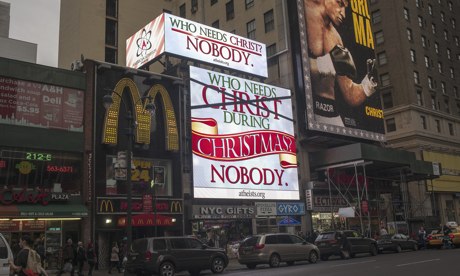
A billboard sponsored by the American Atheists organisation in New York
A billboard sponsored by the American Atheists organisation in New York. Photograph: Richard Levine/Demotix/Corbis
The last time I put my own atheism through the spin cycle rather than simply wiping it clean was when I wanted to make a ceremony after the birth of my third child. Would it be a blessing? From who? What does the common notion of a new baby as a gift mean? How would we make it meaningful to the people we invited who were from different faiths? And, importantly, what would it look like?
One of the problems I have with the New Atheism is that it fixates on ethics, ignoring aesthetics at its peril. It tends also towards atomisation, relying on abstracts such as "civic law" to conjure a collective experience. But I love ritual, because it is through ritual that we remake and strengthen our social bonds. As I write, down the road there is a memorial being held for Lou Reed, hosted by the local Unitarian church. Most people there will have no belief in God but will feel glad to be part of a shared appreciation of a man whose god was rock'n'roll.
When it came to making a ceremony, I really did not want the austerity of some humanist events I have attended, where I feel the sensual world is rejected. This is what I mean about aesthetics. Do we cede them to the religious and just look like a bunch of Calvinists? I found myself turning to flowers, flames and incense. Is there anything more beautiful than the offerings made all over the world, of tiny flames and blossom on leaves floating on water?
Already, I am revealing a kind of neo-paganism that hardcore rationalist will find unacceptable. But they find most human things unacceptable. For me, not believing in God does not mean one has to forgo poetry, magic, the chaos of ritual, the remaking of shared bonds. I fear ultra-orthodox atheism has come to resemble a rigid and patriarchal faith itself.
This is not about reclaiming "feeling" as female and reason as male. Put simply, it seems to be fundamentally human to seek narratives, find patterns and create rituals to include others in the meanings we make. If we want a more secular society – and we most certainly do – there is nothing wrong with making it look and feel good.
Yet as I attend yet another overpoweringly religious funeral of a woman who was not religious – as I did recently – I see that people do not know what else to do. They turn to organised religion's hatch 'em, match 'em and dispatch 'em certainties. For while humanists work hard to create new ceremonies, many find them vapid. Funerals are problematic, as one is bound by law to dispose of the body in a certain way. I always remember the startled look of the platitudinous young vicar who visited our house after my grandad died, when my mum said, "Don't come round here with your mumbo-jumbo. If I had my way I'd put him in the vegetable patch with some lime on him."
Unless someone has planned their own funeral it can be difficult, but naming or partnership ceremonies are a chance to think about what it is we are celebrating. A new person, love, being part of a community. For my daughter's, we pieced together what we wanted, but I found some of the humanist suggestions strange. "Odd parents" for godparents? No thanks. I guess it's just a matter of taste.
What, then, makes ceremony powerful? It is the recognition of common humanity; and it is very hard to do this without borrowing from traditional symbols. We need to create a space outside of everyday life to do this. We can call it sacred space but the demarcation of special times or spaces is not the prerogative only of the religious. One of the best ceremonies of late was the opening of the Olympics, where Danny Boyle created a massive spectacle that communicated shared values in a non-religious way. It was big-budget joy. Most of us don't have such a budget but there has to be some nuance here. We may not have God. We may find the fuzziness of new age thinking with its emphasis on "nature" and "spirit" impure, but to dismiss the human need to express transcendence and connection with others as stupid is itself stupid.
Our ceremony had flowers and fires and Dylan, a Baptist minister and the Jabberwocky, half-Mexican siblings and symbols, a Catholic grandparent reading her prayer, a Muslim godparent and kids off their heads on helium at the party. A right old mishmash, then, but our mishmash.
In saying this I realise I am not a good atheist. Rather like mothering, perhaps I can only be a good enough one. But to move many away from religion, a viable atheism has to weave itself into the social fabric and shed this image of dour grumpiness. What can be richer than the celebration of our common humanity? Here is magic, colour, poetry. Life.

A Commune in Capitalist China

China cancels plans for Mao's 120th but in one village, his spirit lives on

Communist party in rethink on television series and celebration, but last commune remains a shrine
Chinese commune
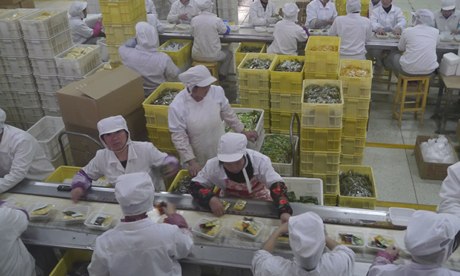
Workers at the noodle factory in Nanjiecun, China, which is still run as a commune. Photograph: Tania Branigan for the Guardian
The day begins at 6.15am, as The East Is Red blasts through the speakers and echoes down the wide, empty streets, past the blazingly white statue of Chairman Mao, his right hand aloft in perpetual salute.
It ends at dusk with the closing refrain of another revolutionary classic: "The socialist society will surely succeed! A communist society will surely be achieved!"
Nanjiecun is as close as anywhere in China comes to fulfilling that pledge: a commune in a land that long ago embraced capitalism. Land is still farmed collectively. Its 10,000 inhabitants spend food tokens in public grocery stores. Inside the gates, the clatter and clamour of modern life vanishes; exhortations from the Great Helmsman replace advertising slogans. Each home, provided by the government, has the same furniture – down to its electronic Mao calendar.
As China celebrates the 120th anniversary of Mao Zedong's birth this week, Nanjiecun officials believe him as relevant as ever.
"Only Chairman Mao thought can lead to common wealth," explained Wang Hongbin, the party secretary. "Although he has left us, we hope his spirit is immortal."
At its height, Mao's influence was felt not only in Asia but across Africa and in the bourgeois west. In Paris, student radicals waved their Little Red Books. The British left was less enthused, but when police arrested a man and woman in London last month on suspicion of slavery, it emerged that the roots of the case lay in a Maoist sect founded in the 70s.
"There was great variety in what people read into Maoism," said Julia Lovell of Birkbeck, University of London, who is writing a book on its global legacy.
"Some saw him as the heir to Stalin; a doctrinaire Communist leader. Others ran with the idea of Mao as an anarchic democrat; as a guerrilla leader; as a man of the people but also a philosopher and poet. You have this strange contradiction: admiration for him as a proletarian, but also as a cultured intellectual."
At home in China, Mao's portrait hangs in Tiananmen Square and his face gazes from banknotes. His birthplace, Shaoshan, has spent 15.5bn yuan (£1.56bn) on tourism projects.
Since becoming leader in 2012, Xi Jinping has consciously embraced some Mao-style tactics, such as holding televised "criticism and self-criticism" sessions, for people to highlight others' faults, and confess their own. But he has also said anniversary celebrations should be simple and pragmatic. A TV series on Mao has been dropped and a birthday concert rebranded as a new year gala.
Officials celebrate an icon of national revival and Communist party rule, rather than the revolutionary whose thinking was described as a "spiritual atom bomb".
Yet his promise of economic equality has renewed appeal in a country beset by corruption, injustice and a gulf between rich and poor, as the popularity of Bo Xilai's quasi-Maoist platform proved before the Chongqing party secretary's downfall last year.
With its dated atmosphere, quiet streets, wholesome ethos and street-corner Tannoys, Nanjiecun is uncannily reminiscent of the 60s TV show The Prisoner: a staged, self-contained world out of place and time.
To Fan Jinggang, who manages Utopia, the Beijing bookstore known as a centre of modern Maoism, it is not an anomaly but an inspiration.
"If all villages in China took Nanjiecun's path, farmers' rights would be guaranteed and living standards would be higher than now," said Fan. "You would not see so many farmers exploited in cities. They would not be discriminated against … The rights of the proletariat would be guaranteed and the polarisation between rich and poor would not happen."
Many of the social ills he lists are also cited by the liberals he denigrates: environmental degradation, wasted resources, corruption, social discontent.
But his diagnosis is wholly different: "The transformation of the Communist party is the root of all problems in China," he said. "The rebels, to a large degree, have kidnapped the Communist party and the republic."
Current plans for reform suggest a further embrace of privatisation and marketisation, which he warned would intensify economic polarisation and social instability.
Fan points to the successes of Mao's reign: then, life expectancy soared from 35 to 68 years, workers were respected politically, and there were warmer relations between cadres and the people.
"History has proven that Chairman Mao's thought is the truth," he said.
But others remember him as the man whose leadership caused tens of millions of deaths in the Great Famine and the chaos and violence of the Cultural Revolution. When China embraced reforms after his death, hundreds of millions climbed out of poverty.
It is impossible to know how many in China share Fan's views, but it is probably true that their numbers are easily underestimated. Many are poor, often old, and they lack connections and influence.
Utopia's website was closed after Bo's purge, although a sister site still publishes leftist content. Fan complained that he could not share his opinions freely, blaming neoliberalism among officials and in the media, which does not run leftist opinions, and which attacks individuals and their point of view, he said.
Still, neo-Maoists are more tolerated by authorities than those calling for multiparty elections. And while they complain of being silenced, they are frequently intolerant of other views. When the prominent economist Mao Yushi criticised Mao Zedong as a "backstage orchestrator who wrecked the country and brought ruin to the people",leftists petitioned for his arrest and threatened the 84-year-old with violence.
Nanjiecun's officials avoid this brand of harsh ideological rhetoric: they are confident in their sedate course.
"Because it's common wealth, we don't have big disparities between rich and poor … Living and working here, you don't have pressure, because the group will help you solve problems," said the party secretary, Wang.
"When people work together and are optimistic and active, that's a good atmosphere. People talk and laugh together."
When Nanjiecun land was decollectivised, local farmers simply handed it back. Fields are now tended by a team and a grain ration given to residents. Officials and workers are paid but also enjoy free water and power, free meals in canteens, and free medical care.
Despite reports of significant debt in 2008, officials insist the town is prospering. Nanjiecun promises security in a world of casual employment, scant social welfare and soaring property prices – which is why young people who have ventured out to China's busiest cities often opt to return.
Government-run factories do, however, include a joint venture with a Japanese noodle-maker. In theory, there are no private shops, but the staff of a grocery store seem surprised to learn this. And though labourers from outside contribute according to ability, they do not receive according to their need.
"Everyone wants to live in Nanjiecun, but it's hard to qualify," said 21-year-old Xiao Li, who works as a guide to the village but lives elsewhere.
Much of the Mao memorabilia, such as the full-size replicas of his former homes in the botanical gardens, seems aimed primarily at tourists. His statue was erected in 1993 and the giant portraits around it – Marx, Engels, Lenin and Stalin – went up the following decade.
Qi Hongyao, a local, had brought a visiting friend to admire the figure. But he was perplexed by the idea that Nanjiecun might be a model for other places.
"In the past, people never went outside and didn't know what life outside was like. In the past, people just wanted warm clothes and enough food. Now they have more, so they want more," he said. "You can't go back."

Monday, 23 December 2013

There's a new jobs crisis – we need to focus on the quality of life at work


British workers face low wages, but are also being hurt by job insecurity, stress and the demand of long hours
British Prime Minister David Cameron (R)
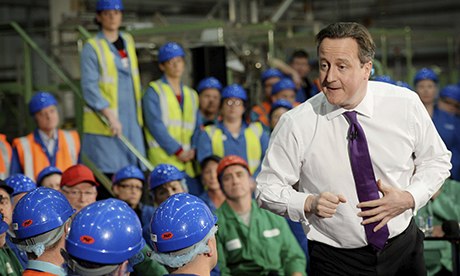
David Cameron addresses workers at a factory in Britain. ‘The dominant free-market ideology has convinced Britons that consumption is the ultimate goal of life, and that their work is only a means to gaining the income to buy the goods and services to derive pleasure from.’ Photograph: Stefan Rousseau/AFP/Getty Images
With economic growth now picking up and unemployment inching its way downwards, things are beginning to look up for Britain's economy. Except that it does not seem that way to most people.
David Cameron may be in denial, but most people in Britain are experiencing a "cost of living crisis", as Labour puts it. Growth in nominal wages has failed to keep up with the rise in prices. With real wages predicted by the Office for Budget Responsibility not to recover to the pre-crisis level until 2018, we are literally in for a "lost decade" for wage earners in Britain.
Worse, the crisis for British wage-earners is much more than the cost of living. It is a work crisis too. Take unemployment. For most people this results in a loss of dignity, from the feeling of no longer being a useful member of society. When combined with economic hardship, this loss makes the jobless more likely to suffer depression and even to take their own lives, as starkly shown by Sanjay Basu and David Stuckler in The Body Economic. There is even some evidence, published in the British Medical Journal, thatout of work people become more prone to heart diseases. Unemployment literally costs human lives.
On this account British workers have been doing badly since the financial crisis began. Though the unemployment rate has fallen, it still stands at 7.4%. Most people find this rate acceptable, if regrettable – but that is only because they've been taught to believe that full employment is impossible. We may not be able to go back to the mid-1960s and the mid-70s, when the jobless rate was between 1% and 2%, but a rate much lower than today's is possible, if we had different economic policies.
There is also the issue of job security. The feeling of insecurity is inimical to our sense of wellbeing, as it causes anxiety and stress, which harms our physical and mental health. It is no surprise then that, according to some surveys, workers across the world value job security more highly than wages.
On this account too, British workers have been doing very poorly. The rise in the number of zero-hours contracts is only the most extreme manifestation of increasing insecurity for the workforce. The 2010 European Social Survey revealed that a third of British workers feared losing their jobs – giving Britain, together with Ireland, the highest sense of job insecurity in Europe.
Then there's the issue of the quality of work. Even if you are getting the same real wage – which most British workers are not – wellbeing is reduced if your work becomes less palatable. It may have become more strenuous because, say, the company has just turned up the speed of the conveyor belt in the factory, as happened to Charlie Chaplin in Modern Times. Or the stress level may have increased because the company reduced your control over your work, as Amazon did when it decided to attach GPS machines to its warehouse staff.
Whatever form it takes, any deterioration in the quality of work can harm the worker's wellbeing. And this is what has been happening to many employees in Britain.
The European Social Survey also revealed that a quarter of British workers have had to do less interesting work. The 2012 Skills and Employment Survey revealed that British employees are now working with much greater intensity than before the crisis; the proportions of jobs requiring high pressure, high speed and hard work all rose significantly from 2006.
And then there is the issue of commuting. Britons spend more hours travelling to and from work than any other workforce in Europe. But to make thing worse, the quality of the commute has been deteriorating. The failure to invest in transport has meant more crowded and more frequently disrupted journeys in many regions of the country. Recent surveys have also revealed that more and more people are working while they commute, at least in part to cope with increased workload.
Once we take into account all these dimensions, it becomes evident that the "cost of living crisis" is only one – albeit important – part of a broader problem that is afflicting most people in Britain.
Despite the graveness of the situation, this wider crisis – perhaps we can call it the "general living crisis" – is not seriously discussed because over the last few decades we have come to neglect work as a serious issue.
During this period, most Britons have come to see themselves mainly – or even solely – as consumers, rather than workers. The dominant free-market ideology has convinced them that consumption is the ultimate goal of life, and that their work is only a means to gaining the income to buy the goods and services to derive pleasure from. At the same time, the decline of the trade union movement has made many people believe that being a "worker" is something of an anachronism.
As a result, policies are narrowly focused on generating higher income, while any suggestion that we spend money on making jobs more secure and work less stressful, if it is ever made, is dismissed as naive. Yet this neglect of work-related life is absurd when most adults of working age devote more than half their waking hours to their jobs – especially if we include the time spent in commuting and, increasingly, out-of-hours work. We simply cannot ignore this when judging how well we are doing.
If we are to deal with the "general living crisis" we need to radically change our perspectives on what is a good life. We need to accept that consumption is not the end goal of our life, and stop measuring our wellbeing simply on the basis of earnings. We need to explicitly take the quality of our work-related life into account in judging our wellbeing. Let's start taking work seriously.

Sunday, 22 December 2013

'If an issue of morality is to be decided by majority, then fundamental right has no meaning'

The Idea Exchange


Retd Delhi HC Chief Justice and the man behind a landmark verdict decriminalising homosexuality, Justice A P Shah feels the Supreme Court setting aside that order is unfortunate. At this Idea Exchange moderated by Senior Editor (Legal Affairs) Maneesh Chhibber, he also talks about his new assignment as Law Commission chief, where he is looking into electoral reforms, live-in relationships and age of juvenility

Maneesh Chhibber: Can you explain how you wrote your Section 377 judgment?

I wouldn't like to comment on the Supreme Court judgment but that doesn't bar me from speaking about the rights of LGBTs, the Constitutional morality we talked about in the high court case, and the government's position.

Let me start with this — some speak of this as a 'western disease'. First of all, it is not western. Temple imagery and essential scriptures show there is some evidence of homosexuality being practised in this country... The British brought in Section 377 and there is the presumption that one of the reasons was (they feared) their army and daughters would be tainted by Oriental vices... What is so startling is that Section 377 travelled back to England. Later it was repealed, in the sense that their judicial committee recommended that for consenting adults it should not be a crime.

This is the position in almost all of Europe, US.

There are critical nuances of the (Supreme Court) judgment which I would not like to go into, but I would like to tell you about how far it is permissible for the State to legislate on the ground of public morality. What is envisaged by the Constitution is not popular morality. Probably public morality is the reflection of the moral normative values of the majority of the population, but Constitutional morality derives its contents from the values of the Constitution.

For instance, untouchability was approved by the majority, but the Constitution prohibited untouchability as a part of social engineering. Sati was at one time approved by the majority, but in today's world, it would be completely inconsistent with the Constitution... In public morality and Constitutional morality, there might be meeting points. For instance, gambling. That would be prohibited by law, and that's also the perception of public morality.

I think the real answer to this debate is Constitutional morality. And this is the most important point — it has to be traced to the counter-majoritarian role of the judiciary. A modern democracy is based on two principles — of majority rule and the need to protect fundamental rights. The very purpose of fundamental rights is to withdraw certain subjects from the vicissitudes of political controversy, to place them beyond the reach of majorities, and establish them as legal principles to be applied by the courts. It is the job of the judiciary to balance the principles ensuring that the government on the basis of numbers does not override fundamental rights.

(Editor's Comment - Does the judiciary have the power to create a new fundamental right?)

I would like to refer to my own notes and preparation. In case of a moral legislation, when it is being reviewed by a Constitutional court, then the rule of 'majority rules' should not count, because if the issue of morality is to be decided by the majority, as represented by the legislature and Parliament, then the fundamental right has no meaning. It is to be decided on the basis of Constitutional values and not majority rule.

About homosexuality being a disease... this is no longer treated as a disease or a disorder. There is near unanimous medical, psychiatric opinion that it is just another expression of human sexuality.

With this, I come to the last part, that 'What is the harm to the LGBT (with this law), that ultimately these provisions are not enforced'. It is true that in the last 150 years there might have been 200 prosecutions... But even when these provisions are not enforced, they reduce sexual minorities to — what one author (in a US judgment) has referred to — 'unapprehended felons'.

Apart from the misery and fear, a few more of the consequences of such laws are to legitimise and encourage blackmail, police and private violence, and discrimination. We could see some evidence that was placed before us, what is called the 'Lucknow incident'. This was a support group to create awareness about AIDS etc, they were arrested, and although they should have been released on bail immediately, they remained in custody for more than two months because of Section 377.

Rakesh Sinha: What was the first thought that crossed your mind when the Supreme Court overturned your ruling?

That it is unfortunate.

Coomi Kapoor: One reason for the conservativeness of the judgments of courts may be the ages of the judges.

I was 62, about to retire (at the time he gave the Section 377
judgment).

Seema Chishti: Do you think the big mistake in the rush for criminal law amendment in the wake of the December 16 gangrape was to not make it gender neutral? If that was made gender neutral, and you recognised man to man harassment, it would take away the need for 377?

There was an urgent need to make certain changes in the existing rape laws, there cannot be two opinions on that. I think it was touched with haste. Not only were there some lacunae but also it should have gone beyond the provisions which they made. Perhaps the government was not prepared to commit to the other reforms suggested by the Justice Verma committee.

Seema Chishti: Given the public mood to 'clean up' things, the Lokpal is being seen as a very important tool. Do you think we are running into a problem? We anyway had a problem about judges appointing themselves, and now we have a Lokpal who sits in judgment over elected persons. Who is going to monitor the monitors?

When the idea of appointing a Lokpal was mooted, it was on the lines of the institution of ombudsman in many countries. Ombudsman is not necessarily an anti-corruption body, it's about good governance. In India, administrative committees' reports found that this institution was necessary to fight corruption in high places. We have made a sort of an amalgamation of ombudsman and anti-corruption body, with more emphasis on anti-corruption. I have seen the Bills, appeared before the select committee of the present Lokpal Bill, and had seen the Jan Lokpal Bill conceived by Arvind Kejriwal and Prashant Bhushan. The Jan Lokpal Bill, I feel, is creating a monster.

The first thing is accountability. The other ombudsman institutions are accountable to Parliament, to the legislature. If you create an institution which is neither accountable to the executive nor the legislature, there will be no system of checks and balances.

The Lokpal Bill is not as strong as the Jan Lokpal Bill; thankfully, it's a much more balanced. The whole idea of the CBI being placed under the control of the Lokpal is not really a bright idea. You should not make one institution so strong that it can override all other institutions and constitutional systems.

Seema Chishti: And the judges appointing themselves?

Now, there is a Bill, but it is nothing new. In 1990, such a Bill was introduced by Dinesh Goswami. Unfortunately, the government had to go. There have been two reports of the Law Commission suggesting that there should be a judicial commission. In a 1993 judgment, the Supreme Court read the word 'consultation' to mean 'concurrence', and this is how the primacy is vested in the Chief Justice of India. It has been very strongly criticised. First, it's not transparent, and second, there is no input about the ability of a possible candidate because it's only a judges' committee, sitting in a closed room deciding about appointments, elevations, more like a club. It has encouraged a lot of sycophancy. Thankfully, the government has brought the Bill.

Prawesh Lama: There have been cases of rape law being misused. Recently, an NGO director committed suicide after being accused of assault. Should there be a mechanism to ensure laws aren't misused?

It is Indian tendency to give knee-jerk reactions. After the episode of December 2012, there were reactions. We go to extremes and forget rationality. Also, these laws will not work unless we have police reforms and judicial reforms simultaneously. What is the use of a very strict law if police are lacking in integrity or are inefficient?

Aneesha Mathur: The Delhi High Court has consistently given judgments saying that there should be a re-look at how police are dealing with these laws. Even in the Section 377 judgment, the Supreme Court said that exactly defining an unnatural act is not possible, and we'll have to see how the courts deal with it. What can the judiciary do to ensure there's no misuse?

The judiciary has its limitations. I know of half a dozen judgments of the Supreme Court on improving the present conditions, but there is no change in the situation. One of the criticisms labelled against PIL jurisdiction is that judiciary has to rely on the good faith of the executive. Have the orders passed on PILs changed the lives of ordinary Indians? Judiciary is no substitute for political activism or for legislative processes.

Krishna UPPULURI*: India's Deputy Consul General in New York Devyani Khobragade has been arrested as per the US laws. Can we use Indian laws to prosecute homosexual diplomats?

This would be going beyond the diplomatic limits.

Utkarsh Anand: Do you think Justice A K Ganguly should step down?

I should not talk on this issue.

Utkarsh Anand: A Supreme Court Committee was constituted to inquire into the allegations against him. Should the committee have indicted him while simultaneously saying that we don't have jurisdiction over retired judges?

It was a critical situation for the court. When something leaked in the media, the whole institution came under a cloud. What he was saying is absolutely correct because, even as per the Vishakha guidelines, the case would not fall within the powers of the Supreme Court Committee. But if the committee had simply said that it has no jurisdiction, it would have reflected very badly on the institution. I think the committee was right, the three judges were right. I read the order as an assurance to the people that the institution cares for these matters, though they can't take any action.

Maneesh Chhibber: One of the biggest problems of the judiciary is that it is a most exclusive club. Any transparency law, they are the last ones to implement it. Don't you think this hurts the institution?

I think transparency is the hallmark of any judiciary. All administrative decisions taken by the court should be on the website — how much is spent by the institution, how many cases are disposed of. All this information, and not only about pendency and disposal by the judges but also the entire functioning of the court should be in the public domain.

Ankita Mahendru*: What is your view on the legal process followed by the US in the arrest of Devyani Khobragade.

What I read in your newspaper is that this is the standard procedure. Where we are really missing the point is about the victim. What about the maid?

Amulya Gopalakrishnan: A lot of feminist activists want the rape law to be made gender specific for the victim and gender neutral for the perpetrator. Parliament did not do that. A lot of men who are raped are left out. Is it possible to draft a law like that?

The existing provisions can be slightly amended so as to make them gender neutral. The draft is not bad, it can be improved.

Vandita Mishra: Over the past few years, there has been a weakening of the political executive and the legislature. Parliament has not functioned as it should have. That has led to the judiciary overreaching in many cases. Do you think there are dangers to this?

After the Emergency, the judiciary took up the role of a protector of human rights of the marginalised and the disadvantaged. If you look at the PILs entertained by courts in those times, they were in the nature of social action, social interest litigation, not really a PIL. Slowly, the court expanded its jurisdiction and then we had (PILs on) good governance, corruption-free government or the rule of law, judicial appointments. But what happened after 2001 is that you could file a PIL about anything under the sun. Many of these PILs are not connected with human rights issues and that is the real danger. Some of the PILs entertained were about monkey menace, sealing of shops, traffic management or role of tourists in wildlife sanctuary. Just see to what extent courts have gone into policymaking. One example is the river linking case. Almost all experts said that it is not feasible. In spite of that, the court issued directions. Nothing happened thereafter, that is a different issue. Judicial activism is for issues for which there was earlier a legislative solution. This could be almost touching judicial imperialism or judicial adventurism.

The other problem is the creeping eliticism in the judiciary. I was shocked to see so much concern about the occupants of the Campa Cola building among the media and judiciary. What about the thousands of families who, for some beautification of the city and Commonwealth Games, are asked to move 20 km away from Delhi?

Maneesh Chhibber: In its review petition in the Section 377 case, the Centre is saying that while lawmaking is the sole responsibility of Parliament, it's the task of the court to judge the constitutional validity of laws. Isn't the executive ceding to the judiciary?

The court has to decide when it comes to a human rights issue. But if it is a policy matter, the legislature has precedence. If the Delhi High Court was right in its conclusion that there is violation of Articles 14, 15 and 19 and 21 — if that is the position — then it is the court which could deal with it, even if there is no amendment in the law. But that does not absolve the government from taking the call and making the amendment. They could have done it when the laws were changed in the wake of the Delhi gangrape case. There might be a lack of political will.

Rakesh Sinha: There is an ongoing debate on the age of juvenility. But child rights workers have concerns too.

We have taken it up, appointed an experts' committee in the Law Commission.

Muzamil Jaleel: What is your view on amendments in the UAPA or the Armed Forces Special Powers Act.

I have spoken against these laws several times. I feel that certain rights should not be compromised. It is the burden of democratic countries that they have to deal with the problem of terrorism, and they have to fight it with one arm tied down.

Prawesh Lama: Shouldn't police officers be punished when they arrest an innocent person and brand him a terrorist?

Apart from action against the concerned police officers, we should have laws to give some remedy to the person who has been wronged by the system.