Search This Blog

Sunday, 1 September 2013

Obama is all about 'universal rights' - except for Muslims

It's time the president acknowledges that systematized discrimination against Muslims is real and thriving

Barack Obama
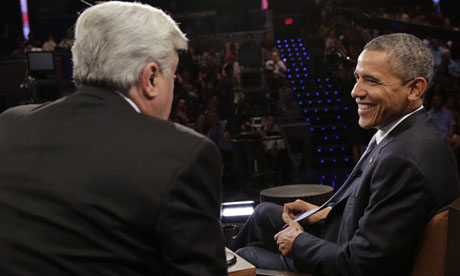
Jay Leno talks with President Barack Obama during a commercial break on 6 August 2013. Photograph: Paul Drinkwater/NBC/Getty Images
I was watching President Obama employ his devilish charisma, in routine fashion, on The Tonight Show with Jay Leno in early August. The banter dissipated as the interview took a more serious turn to embassy closures, Edward Snowden and, finally, Russia. Obama condemned President Vladimir Putin for Russia's recent "homosexual propaganda" bill saying:

"When it comes to universal rights, when it comes to people's basic freedoms, whether you are discriminating on the basis of race, religion, gender or sexual orientation, you are violating the basic morality that should transcend every country."

I was left rattled by the president's statement. Obama, who made history last year whenhe expressed his support for same-sex marriage, was comfortably unabashed in impugning Russian leadership on the reprehensible policy, as he should have been. But as a Muslim American, neither the irony nor the hypocrisy of his statement, championing "universal rights", was lost on me.
As we've witnessed time and time again domestically, most recently with the Associated Press revelation that the NYPD designated Muslim houses of worship and community centers as terrorist organizations, the United States is no stranger to legalizing discrimination. In the elusive pursuit of true equality, President Obama has made considerable and long overdue progress in securing the rights of the LGBT community. But he in no way can tout the badge of "basic morality" until he acknowledges that many Americans are being confronted with institutionalized discrimination in every tier of the government hierarchy. Racism, Islamophobia and prejudice run amok in our society, but when discriminatory practice is etched into law, it harkens back to a sinister time in our nation's history.
Regrettably, branding mosques as terrorist enterprises doesn't exactly move the needle given the NYPD's history of targeted surveillance and monitoring of the region's Muslim community. Invidious policy and religious profiling are not confined to the NYPD either. This is just the latest in a mounting string of offenses by government agencies against Muslim Americans. The FBI maintains an intimidatingly lengthy catalog of 15,000 spies, three times as many as there were 25 years ago. In a post 9/11 climate many of them operate as informants in mosques throughout the nation. The mosque that I grew up attending in Irvine, California, was infiltrated by one such informant, who worked so hard to plant seeds of violence and terrorism in the minds of its congregants that members of the mosque immediately reported him.
"Geo-mapping", the FBI's purported tactical crime fighting tool, was exposed as a covert mapping program to track and monitor Muslim communities engaging in constitutionally protected activity, without any suspicion of crime. Leaked FBI training materials have also cemented what we already know – the agency religiously profiles Muslims,instructing its agents that "mainstream" Muslims are terrorist sympathizers and the Muslim practice of giving charity is a cover for funding "combat".
It doesn't end there. Seven states have passed anti-Shariah legislation, redundant and extraneous laws that explicitly prohibit the use of foreign law in American courts, as already established by our nation's constitution. The bills passed in these states, most recently North Carolina, alienate the Muslim community and unfairly paint them as adherents of an archaic, anti-Western system, playing up longstanding stereotypes and stoking fears. Open-ended guidelines for Homeland Security initiatives, like the Suspicious Activity Reporting program, give credence to the subjective biases of citizens and law enforcement alike, allowing for religious profiling when dubbing something as "suspicious". And that is apart from the FBI Watch List and the TSA's No-Fly List.
TSA memos have indicated that their passenger screening process includes "things passengers might do which also might be things a terrorist would do, eg, pray to Allah right before the flight that you might have 90 virgins in heaven". Needless to say, many of these counter-terrorism measures disproportionately target Muslims. We see this disparity even in federal prison, where Muslims make up only 6% of the general federal prison population, but comprise two thirds of the inmates in Communication Management Units (CMU), prison units furtively created to isolate certain prisoners.
And all the while, the president has remained unnervingly silent.
I shouldn't have to point to statistics that most informants actually acted as agent provocateurs in terrorism probes. I also shouldn't have to cite that there is a dearth of evidence to prove that these national security measures, like the SAR program, are effective in combatting terrorism. I shouldn't have to clarify that there is no specter of Shariah law looming on the horizon and that Muslims are not looking to prop up a crescent and star flag in state capitols. And I've come undone at the thought of having to explain, again, that the overwhelming majority of Muslims being spied on, monitored, tracked and, in the case of 16 year old US citizen Abdulrahman Awlaki, killed – by federal, state and local agencies- are innocent of any wrongdoing.
My father's Islamic name should not place him on a watch list. When I pray in the airport, I should expect law enforcement to protect my right to do so, not jot notes in a security memo. And I should be able to attend my mosque without fear of reprisal, from anti-Muslim bigots and FBI spies alike. Being Muslim does not make me a criminal. I shouldn't have to say it, but secret measures that profile Muslims and veiled discriminatory policies assume as much.
This is not a "new low for the NYPD"; it's a dangerous manifestation of a foregone conclusion: in the name of national security, the civil rights afforded to Muslim Americans are being deliberately curtailed. It's time that the president acknowledges that systematized discrimination against Muslims is real and thriving, and expands the reach of his advocacy for universal human rights to include Muslim Americans.
Dark moments of institutionalized racism, alienation and ostracism besmirch this nation's history. It is all too coincidental that we recently marked the 50th anniversary of Martin Luther King Jr's legendary "I have a dream" speech – the impetus that led the FBI to surreptitiously launch one of the biggest surveillance operations in history – spying on Dr King himself. The idea that the government was looking for dirt on Dr King to discredit and destroy him seems ludicrous and offensive today. Here's hoping the president sees the historical irony.

Why liberal America is in two minds over military action


If President Obama says Syria has used chemical weapons, most American liberals are likely to trust him
President Obama answers questions about Syria
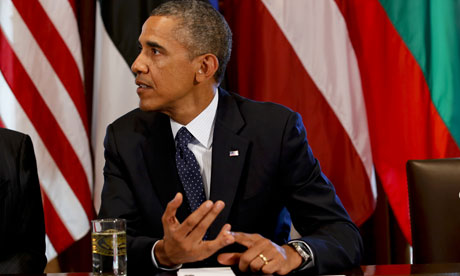
If Barack Obama says Syria has used chemical weapons, most American liberals are likely to trust him. Above, the president answers press questions about Syria at the White House on 30 August 2013. Photograph: Aude Guerrucci-Pool/Getty Images
As President Obama announces he will seek congressional authorisation for military intervention in Syria, the American left finds itself conflicted. According to the Pew Research Centre, 56% of Republicans support military action compared with 46% ofDemocrats; 24% of Republicans and 34% of Democrats are opposed.
While these are not majorities in opposition to intervention, they are sizable portions of the American public, especially among Democrats. So why has the anti-war left, which organised demonstrations with hundreds of thousands of participants in the runup to the Iraq war, been invisible on Syria?
There are three reasons. First, the anti-war movement has withered over the past six years, as Democrats rose to power and withdrew the US from Iraq.
Second, it is harder to organise the left against a Democratic president. Partisans on both sides are understandably less outraged by aggressive use of executive authority in national security when their own party is in power, since they assume a president from their party is more honest and competent. If President Obama says Syria has used chemical weapons, most liberals are unlikely to fear it is a repeat of George W Bush's false claims that Iraq possessed weapons of mass destruction.
Third, a limited bombing campaign against Syria would claim few, if any, American lives. Nato's recent intervention in Libya successfully prevented atrocities against civilians at an estimated cost to the US of only $1.1bn.
The politics of military interventions often create unusual political alignments. Elites, centrists, newspaper editorials and the top foreign policy advisers in both parties tend toward hawkishness, while each party has a non-interventionist wing on its perimeter. Among Republicans these tend to be small government absolutists. Among Democrats it is the leftwing, including members of the House progressive caucus. More than 100 House members, from both parties, had signed letters to Obama stating that he must receive congressional approval before taking military action. Establishment Democrats are generally sympathetic to circumscribed humanitarian interventions, such as the Nato bombing campaign in Kosovo during the Clinton administration. If the cost is manageable and the cause is moral, they see the intervention as warranted. That's why, for example, Tom Perriello, a former congressman who opposed the Iraq war and now runs the Centre for American Progress action fund, is in favour of a "surgical" strike against Assad.
But one of Perriello's colleagues, Matt Duss, a CAP foreign policy analyst, argues that the costs of intervention outweigh the benefits. Writing in the American Prospect, Duss worries that US intervention could strengthen the Assad regime's internal political appeal, provoke a Syrian retaliation against Israel, and empower hardliners and marginalise moderates in Syria's ally Iran.
Most of all, liberal intellectuals fret about the rule of law, both domestically and internationally. Some left-leaning domestic law experts, such as Scott Lemieux, had argued that for Obama to take military action without congressional approval would be illegal. Liberal foreign policy experts, such as Mark Leon Goldberg, say it would be illegal under international law and set a precedent that more belligerent future presidents might abuse, as Bush did in Iraq. Liberals worried about international legitimacy are especially leery now that the British parliament has voted not to join an action against Syria.   
Some liberals are trying to put the humanitarian case for a bombing campaign in its proper context. Matthew Yglesias of Slate notes that, based on estimates from charitable organisations, "if the United States was able to spend the $1.1bn we spent on the Libya operation on long-lasting insecticide-treated bed nets we could have saved almost 590,000 lives" [by preventing malaria]. This is the kind of internationalism liberals hoped Barack Obama would pursue.
When Democrats nominated Obama in 2008, they were choosing a change from the pro-war centrism of the Clintons. They wanted a president who had opposed the Iraq war, and they chose a constitutional lawyer who had spent a comparatively short time in Washington, DC. But, on national security matters, Obama has consistently made the same choices Hillary Clinton would have made. Syria is just the latest example of that. We now await the vote in Congress.

Why the rupee can keep falling

S A Aiyer in Times of India
People ask me, will the exchange rate go to Rs 70 to the dollar? I reply, why not Rs 80?
Indian analysts are in denial. They don’t dare face up to the full consequences of the global financial hurricane originating in the US. This will keep blowing for 12-18 months.
To revive the US economy, the Federal Reserve has been pumping out $85 billion of cash per month (called quantitative easing). With the US economy recovering, the Fed plans to reduce this cash bonanza in stages to zero. Emerging markets like India have long enjoyed a slice of this $85 b/month. Not only will fresh flows stop, older flows will reverse to the US, a net turnaround of hundreds of billions.
This storm has knocked the rupee down almost 25% in two months. It is the first of many storms that will hit not just India but the whole developing world, with every tightening of the money tap by the Fed.
Expect a second Asian Financial Crisis. This will cause much less damage than the earlier one in 1997-99. Then, Asian countries had low forex reserves, excessively high debt, and semi-fixed exchange rates. Learning from 1997, Asian countries (including India) now have large forex reserves, less debt, and floating exchange rates. This makes them far more resilient, so they will not collapse as in 1997. But they will suffer substantial damage. Countries with large current account deficits like India will suffer the most. But even Malaysia, which runs a surplus, has seen its currency crash 10%.
A crashing currency raises the prices of all items that can be imported or exported. This erodes people’s purchasing power — by maybe 2.5 to 3% of GDP in India’s case. That is hugely recessionary, as is already evident in the latest data showing falling production of services as well as manufactures.
Such a recession can, in theory, be combated by monetary and fiscal stimuli, as in 2008. But today money must be kept tight to check inflation, so no monetary stimulus is possible. Finance Minister P Chidambaram has sworn to limit the fiscal deficit to 4.8% of GDP, so no fiscal stimulus is possible either. With GDP growth and revenues falling far below budgeted numbers, and oil and fertiliser subsidies rising, he will have to slash Plan investment to meet his fiscal target.
The breach will not be filled by private investment — few businessmen will invest when domestic demand is collapsing. So, the economy will spiral downwards.
One theoretical solution is use a depreciated currency to stimulate export-led growth. If exports grow 20% per year for two years, that will help weather the storm. However, as we found in 1997, when all developing countries are hit, all cannot suddenly increase exports at the same time: the West lacks enough absorption capacity. Besides, India’s investment climate is terrible — files just don’t move, with or without bribes. Many Indian companies would rather invest abroad. Politicians are more focused on distributing goodies before the election than on slashing red tape.
Finance ministry analysts say the equilibrium exchange rate is Rs 58-60 per dollar. They say irrational panic has caused overshooting, and economic fundamentals will soon force the dollar’s value back to Rs 60.
Warning: similar things were said when Asian currencies began to slide in 1997. Far from recovering, they crashed further. The Indonesian rupiah went from 2,500 per dollar all the way to 18,000.
Why so? Because when a currency crashes, that itself changes the economy’s fundamentals. Domestic purchasing power falls, causing a recession. Prices shoot up, negating the positive effects on exports. Corporations that have borrowed abroad heavily go bust. Banks that have lent to such borrowers (and others hit by recession) cannot recover their loans. International rating agencies downgrade such economies, inducing further capital flight.
India’s fundamentals have already changed. GDP growth in the first quarter is down to 4.4%. It could fall to 3.5-4% over the full fiscal year. A slowing economy will help reduce the current account deficit, but hit the fiscal deficit. Wholesale prices had been falling but are accelerating again, dampening purchasing power. All industries face slowing revenues and rising costs, eroding profits. Tax revenue may grow by hardly half the budgeted estimate of 19%.
Disinvestment can happen only at throwaway prices. Chidambaram is a determined disciplinarian, but may be powerless to stop global hurricanes. The threat of a credit downgrade has become very real.
Right now, there is a lull in the financial storm, and the rupee has regained some ground. But this storm will blow, off and on, for 12-18 months. Gird your loins.

Saturday, 31 August 2013

Another financial crisis looms if rich countries can't kick their addiction to cash injection


Five years on from the last crash, quantitative easing remains the weapon of choice for governments unwilling to challenge the current economic model
Matthew Richardson on the world economy
Illustration by Matthew Richardson
Just as people started to think that things were getting calmer – if not exactly brighter – in the rich countries, things have become decidedly slower and more volatile in the so-called "emerging market" economies. At the centre of the (unwanted) attention at the moment is India, which is seeing a rapid outflow of capital and thus a rapid fall in the value of its currency, the rupee. But many other emerging market economies, other than China, have also seen similar outflows and weakening of currencies recently.
This is not necessarily a bad development. The currencies of many emerging market economies, especially those of Brazil's real and South Africa's rand, had been significantly over-valued, damaging their export competitiveness. Devaluation could actually help these economies put their growth on a more sustainable path.
However, people are rightly worried that too rapid flows of capital out of these countries may cause excessively fast devaluations, resulting in currency crises and thus financial crises, as happened in eastern Asia back in 1997. Situations like this can arise because the currencies of the emerging countries have been propped up by something that can quickly disappear – that is, the large inflows of speculative capital from the rich countries. Given its nature, such capital is ready to pull out at any moment, as an increasing portion of it has been doing for several months.
This is a stark reminder that things are still not well with the world economy, five years on from the outbreak of the biggest financial crisis in three generations in September 2008.
We have had such huge capital inflows into the emerging economies mainly because of quantitative easing (QE) by the central banks of the US, Britain, and other rich countries, which injected trillions of dollars into the world economy, in a desperate attempt to revive their moribund economies.
In its initial phase, QE may have had acted like an electric shot to someone who just had a cardiac arrest. But subsequently its boosting effects have been largely through the creation of unsustainable asset bubbles – in the stock market, in property markets and in commodity markets – that may burst and generate another round of financial crises. On top of that, it has caused much collateral damage to developing countries, by overvaluing their currencies, helping them generate unsustainable credit booms, and now threatening them with the prospect of currency crises.
If its effects are at best debatable and at worst laying the ground for the next round of financial crises, why has there been so much QE? It is because it has been the only weapon that the rich country governments have been willing to deploy in order to generate an economic recovery.
QE has become the weapon of choice by these governments because it is the only way in which recovery – however slow and anaemic – could be generated without changing the economic model that has served the rich and powerful so well in the past three decades.
This model is propelled by a continuous generation of asset bubbles, fuelled by complex and opaque financial instruments created by highly leveraged banks and other financial institutions. It is a system in which short-term financial profits take precedence over long-term investments in productive capabilities, and over the quality of life of employees. If the rich countries had tried to generate recovery through any other means than QE, they would have to seriously challenge this model.
Recovery driven by fiscal policy would have involved an increase in the shares of public investment and social welfare spending in national income, reducing the share going to the rich. It would have generated new public sector jobs, which would have weakened the bargaining power of capitalists by reducing unemployment.
Recovery based on a "rebalancing" of the economy would have required policies that hurt the financial sector. The financial system would have to be re-engineered to channel more money into long-term investments that raise productivity. Exchange rates would have to be maintained at a competitive level on a permanent basis, rather than at an over-valued level that the financial sector favours. There would have to be greater public investment in the training of scientists and engineers, and greater incentives for them to work in and with the industrial sector, thus shrinking the recruitment pool for the financial industry.
Given all this, it is not a big surprise that those who benefit from the status quo have persisted with QE. What is surprising is that they have actually strengthened the status quo, despite the mess they have caused. They have successfully pushed for cuts in government spending, shrinking the welfare state to the extent that even Margaret Thatcher could not manage. They have used the fear of unemployment in an environment of shrinking social safety nets to force workers to accept more unstable part-time jobs, less-secure contracts (zero-hour contracts being the most extreme example), and poorer working conditions.
But is this maintenance, or even fortification, of the ancient regime likely to continue? It may, but it may not. Greece, Spain, and other eurozone periphery countries could explode any day, given their high unemployment and deepening strains of austerity. In the US, which is considered the home of quiescent workers, the call for living wages is becoming louder, as seen in the current strikes by fast-food restaurant workers. The British are (overly) patient people, but they may change their mind when the full extent of budget cuts unfolds in the coming months.
All of these stirrings may amount to little, especially given the weakened state of trade unions, except in a few countries, and the failure of the parties on the left of centre to come up with a coherent alternative vision. But politics is unpredictable. Five years after the crisis, the real battle for the future of capitalism may be only just beginning.

Friday, 30 August 2013

This perverse rage against the poor


HARISH KHARE in the hindu
  
edit page statecradft 300813
The Hinduedit page statecradft 300813

With the economic boom petering out, those who benefitted from it are angry with the government for the Food Security Bill because it is paying attention to the needs of the underprivileged for a change


This week’s received wisdom insists that the Indian economy has irretrievably collapsed because on Monday, the Lok Sabha passed the National Food Security Bill (NFSB). The Hindu Business Lineheadline (Aug.28, page 1) said it all: “Re, Sensex sink on fears Food Bill will feed deficit.” The subtext of the lament appears to be that the rupee decline was the market’s way of registering a pointed disapproval of the food security initiative. The Schadenfreude-wallahs are as happy as are the market-reformers that the United Progressive Alliance (UPA) leadership has been fixed so gloriously for venturing into a “populist” course of action. The bandwagon routine has acquired a momentum of its own; even Hindi and other vernacular newspapers have allowed themselves to be mesmerised by the crisis-mongering on television. This, though, is no time to panic. This is the time to strike a balance between short-term difficulty and long-term promises and commitments.

What wrong signals?

Once every few decades comes a moment in a Republic’s life when a few fundamental commitments have to be renewed — or rejected. This is one such week, a time to test our core beliefs. It is also the time to ask a fundamental question: since when in this country has a veto been ceded to the markets and its manipulators, at home and abroad, to decide the issues of equity, social justice and economic fairness? There is something inherently perverse in the suggestion that this much-needed welfare measure would send out the “wrong” signals. Pray to whom? Those half-a-dozen professional financial manipulators in London?

Indeed, economists can always be relied upon to argue that there is always a better way to do anything. Some are competing among themselves to declare that this food security initiative will neither work, nor fetch any votes for the ruling party. Let us make no mistake. Beyond all these sophisticated arguments is a certain class prejudice, resentful that so many resources are being “wasted” for the poor and other socially disadvantaged people, that in this age of “reforms,” political considerations and calculations are being allowed to determine the allocation of societal resources.

This misses the very essence of the concept of political legitimacy in a democratic arrangement. A democracy survives and prospers only when every stakeholder gets an abiding sense of participation, partnership and entitlement. We often seem to keep forgetting that politics is all about who gets what at whose expense. During these last five years, at least for most of the time, the corporates and their policy preferences have been accorded unprecedented acceptance. The time is ripe to strike a new balance. And the NFSB does just that.

Reform by stealth

If we are honest with ourselves, we will have no difficulty in acknowledging that for 20 years, economic reforms have been operationalised without a political mandate. Not until recently when the Congress party held a public meeting to rally opinion behind the Manmohan Singh government’s FDI policy, did any political party have the courage to proclaim openly and boldly its commitment to “economic reforms.” Yet, the “reforms” have been routinely and regularly proclaimed to be “irreversible,” irrespective of the political colour of the government in New Delhi. The process has well been summed up in that evocative phrase, “reform by stealth.”

So now, when we are confronted with a veritable economic meltdown, we are ill-equipped to attend to the more serious and more debilitating crisis of our democratic project running out of its popular legitimacy. India’s democratic arrangements no longer appear to have the requisite social and political sanctions behind them. And we are unable to deal adequately with the systemic overload because our public discourse has been hijacked by a self-serving advocacy crowd and by a professionally disoriented media. For example, a year ago there was carping all around that the crony capitalists and the corrupt politicians were robbing the nation of its wealth, and we staged massive spectacles of resentment at Jantar Mantar; now, a year later, we are ranting and raving that we are not listening to or heeding those who rig the stock markets.

If shouting and screaming every evening could produce solutions to difficult and complex problems, India would have been the most efficacious and working corner of planet Earth. Despite the obvious disapproval of the shouting class, the UPA leadership has gone ahead with the Food Security Bill. Hence, the exaggerated anger.

As social philosopher Roberto Mangabeira Unger points out, a peaceful social order is in itself not enough; “ [S]ociety must be set up in a manner capable of justification in the yes of each of its members.” In political economy terms, each section of society, and every stakeholder gets to determine: what is in it for me? The Democratic Project is a social compact, an indefinable construct, but nonetheless one that hinges on a promise of a fair deal for all. The poor are asking this question with greater urgency — and in the Maoist-strongholds with arms and blood — as decades of “economic growth” have produced new inequities and disparities.

Rather than wait for the next round of the “Maoist” violence to jerk us back to harsh realities, what the Food law does is that at one stroke, it sends out a message that the Indian state has not turned its back on the poor, and that the have-nots continue to have a claim on the collective resources, and that they have not been left to their own devices or to the market’s curative potency.

This message has to be understood and appreciated in the context of the growing preference in some quarters for authoritarian solutions — throw out the encumbering paraphernalia of social equity or fairness, and let the floodgates of enterprise and business acumen be thrown wide open.

Resenting interventionism

A decade of economic prosperity has allowed millions and millions of middle-class families to realise their upwardly revised aspirations and life experiences; at the same time, the UPA saw to it that the welfare state kept expanding the “social agenda,” providing a safety net against the vagaries of the market.

Now, the good days have seemingly come to an end, and there is anger that the state remains equally mindful of the welfare poor. We all thought that the poor have been disappeared from the policy drawing room; and suddenly, they are back with almost a veto. The narrative-controllers resent that. Just when they thought they had successfully defanged the Indian state of its interventionist impulses, here comes the Food Security Bill.

The bill can be seen as the other side of the “stimulus” coin. The 2008-2009 stimulus was used by the super-rich to buy real estate in London and other European cities. At that time, no one seemed to find anything inherently wrong at this massive, disproportionate allocation of resources for so few. None of it was invested here to create jobs; instead, the super-rich petulantly proclaimed that the government was not sufficiently attentive to their “sentiment” and hence they would take their ball (Indian savings and taxpayers) and play in other economies. No one complained; instead, the government was blamed for the corporate sector’s misplaced priorities.

If subsidised food can reduce the food spending of the poor, and place some surplus money in their hands, which would then be spent in India, that may end up stimulating domestic consumer demand. It would be a kind of stimulus lite, for the poor.

A ruling party in India is called upon to fulfil its basic obligation to keep intact the democratic credentials of the “system.” The food security legislation is a partial response to that obligation and must be applauded.

Practise swadeshi, save the rupee

By Kingshuk Nag in the Times of India

The only way to save the rupee and to prevent its free fall is to start practising swadeshi all over again. Yes, you read it correctly. As a nation we are living beyond our means and you can’t continue doing so unless we want India to crash (and not the rupee alone). That is exactly what is happening: the crash of the rupee is a symptom of the problems that ail the economy. Although sarkari economists et al are trying to explain away the problem by changes in the Fed rates in the US and a revival in the US economy this is a very shallow explanation. Just because the Indonesian rupiah, the South African rand and the Brazilian real have been competing with the rupee in depreciating against the US dollar, there is no reason to wish away our problems.

------
Also read

Gresham’s Law in Present day India


-----

Next time you bite corn produced in Australia, oranges raised in California and apples from god knows where, think deeply whether as a nation we can afford this. Maybe middle class and upper middle class consumers can afford these imported fruits at an individual level, but certainly not as a nation. When India’s foreign exchange earnings are not enough to cover our imports, it is a no-brainer that we cannot. Stopping such imports and also of other edibles like cheese is not going to make any one worse off. The question that we should ask ourselves is: cannot good quality fruits be grown in the country that we have to spend precious foreign exchange to import them?

In the good old days, students used to travel abroad for higher studies after they completed their MA to take admission in PhD and other such programs in top universities. The learning in these top universities would be far superior to what could be had in high institutions in the country. But things have changed in the last two decades: these days you can find  parents sending their children abroad to do their undergraduate degrees. Why? This is possibly because it has become a fad to send children abroad. Parents say that they have the money so they will send their children abroad. While this may be true, the fact of the matter is that as a nation we cannot afford precious foreign exchange to spend on children studying at the undergraduate level and doing basic technical courses. A pertinent question to ask is whether the education infrastructure is so poor that there are no colleges in the country to impart a basic degree. So the issue is why this fad for a foreign education?  

However you would not have seen any economist or politician who waxes eloquent on TV holding forth on the rupee speak anything about all this. Most of their conversation revolves around the tight monetary policy of the RBI and the decline in growth impetus, etc This misses the real issue. The fact of the matter is that the process of liberalization that was kick-started in 1991 is so lopsided that it promoted the culture of consumption without any breaks. (Editor's comment - i.e. the Kerala model, but Kerala has the advantage of foreign remittances to pay for the consumption culture.) True, before liberalization the economy was in shackles and the consumption in the country was artificially restricted. This was by way of import curbs and by the process of licensing. Thus things like washing machines were treated as luxuries although in reality it was a great boon for families especially those with working women. 

Liberalization provided a great opportunity to break the shackles and set up a modern, efficient manufacturing base in India. Well that really did not happen adequately. Had that happened India would have become a major exporter of manufactured goods that would have been enough to take care of India’s import requirements (of which oil imports is a major component). But India continued to be an exporter of raw material. For example till the ban in exports of iron ore, the country was exporting iron ore to China. A country which is focused on its growth (like China is) would have instead tried to manufacture steel from this iron ore which could have been exported instead. This would have resulted in more foreign exchange earnings. But India had no such strategy in place.

Instead of exporting manufactured goods, India has become an importer of raw materials. A good example is coal that is imported into the country for fuelling thermal power stations. This is in spite of the fact that India sits on reserves of billions of tons of coal reserves. India spent $18 billion in coal imports in the last fiscal year 2012-13. This is by no account a small sum.

But while exports did not go up, imports of not only coal and petroleum products (valued at $169.25 billion in the last fiscal year) but other consumer goods also went up.

World class manufacturing facilities did not come up in India due to many reasons. But primarily the culprit is the policy paralysis in the country for many years that resulted in inadequate infrastructural facilities whether it was electricity generation, port facilities or proper roads. Bureaucratic hassles and widespread corruption in granting permissions played a none-too-insignificant role in this process. 

Entrepreneurs finding a bleak scenario soon realized that realty was a booming sector where large profits could be made without much hassles. As a result entrepreneurs of all hues and colors turned to realty. This includes top names in the Indian corporate sector. Even many IT companies started dabbling in real estate. With politicians joining in the game, realty became the name of the game. Thus the high growth evidenced in the country in the period 2000-2009 and especially between the years 2005-2008, is nothing but an indication of the rapid growth in the real estate sector that led to bourgeoning cities (never mind the poor infrastructure). But the increase in the growth of the realty sector is an artificial growth that may add to national income yet doing nothing to increase India’s exports. A huge middle class, which has earned moolah through direct speculation in realty or by working in companies whose profits have soared due to their investments in real estate, started feeling empowered. And this empowerment was reflected through increased consumption. This has led to spiralling imports. It may not be out of place that India’s savings rate has plummeted in the last five years. From 36.9 per cent in fiscal year 2007-08, it tumbled to 30.8 in 2012-13 and is expected to go down to 30 per cent by the end of fiscal year 2013-14.

The rupee may have tumbled in the last two weeks, but the signals were there for anybody to see for the last few months. In the last fiscal year India’s imports of gold soared to $50 billion. This was not due to the proclivity of the Indian consumers to own the yellow metal. Rather it was a signal from the market that the rupee could not be trusted to hold its value. Gold was being imported, because people preferred to hold their savings in the form of the yellow metal than in the form of the Indian rupee in banks or investments.

Whether it is an individual, household or a nation, nobody can live beyond their means. You have to cut the coat according to the cloth that you have. Thus there is no other way for India and as Indians we have to learn to live within our means. The time has come to reduce to zero the imports of inessentials and restrict the imports to the essentials. The control raj came with a lot of ills, but independence also comes with responsibilities. From 1991 to 2013, the pendulum has swung from one extreme to the other. It is time to restore balance in our lives, think in terms of age old concepts like import substitution and check the rampant spread of this consumerist culture. Otherwise doomsday is not far away.

Asaram Bapu's moment of reckoning


Dileep Padgaonkar in the Times of India

Every murky controversy that involves a self-appointed dispenser of cures for all physical, psychic and societal ailments sheds a harsh light on two on developments that have surfaced across the world in the late twentieth and early twenty-first centuries: the rise of blind faith at a personal level and of politics rooted in religious radicalism. Both seek to provide an anchor to individuals and communities trapped in a maelstrom of unprecedented change spear-headed by technological innovations and the globalised economy.
------
Also read
-----
These are perceived as threats to cultures and ways of life, to deeply-entrenched religious beliefs and to moral certitudes. And the riposte of ordinary folk to such threats is to repose their trust in those who claim to have a privileged access to God. Indeed, even when such individuals are caught with, so to speak, their pants down, the faithful are willing to overlook their trespasses. The yawning gap between what they preach – austerity, abstinence, altruism – and what they practice – an opulent life-style, sexual promiscuity and a no-holds-barred acquisitiveness – is of little concern to them.
The case of Asumal Harpalani aka Asaram Bapu is significant in this regard. Ever since he was accused of molesting a minor girl, the media have unveiled his trajectory from his birth in a family of modest means in the Sindh province of British India to one of the country’s most prosperous and influential ‘spiritual’ gurus. It tells a fascinating story of the transformation of a bootlegger – whose family arrived in Ahmedabad after Partition -into a figure who has built an empire that is conservatively estimated to be worth more than Rs. 10,000 crores and who, according to his official website, has twenty million followers in India and abroad. 
These followers have apparently not turned hostile to Asaram despite the contrasts between what he preaches and what he practices. He owns a posse of expensive cars, travels business class, ensures that he isn’t frisked by security at airports and continues to expand his real estate empire. Neither the cases of land-grabbing nor the cases of four youths who ‘disappeared’ in his institutions – the mutilated bodies of two of them were later found on the banks of the Sabarmati – have diminished his appeal.
That explains why most politicians take care not to rub him the wrong way. To take him to task is to alienate a sizeable section of the Hindu vote. Or so they reckon.  Congress leaders have yet to pull him up for his alleged sexual assault on a minor girl. But it is the BJP that takes the cake. Leaders like Uma Bharati and Pravin Togadia have rushed to his defence. In videos that have gone viral on Youtube other worthies of the Sangh Parivar have hailed him as a genuine saint. And the ‘saint’ himself has called the latest allegations a political conspiracy to frame him while son and presumptive heir has dubbed the minor girl as ‘mentally deranged.’
Armed with this support, Asaram has been able to defy law enforcers with impunity. On the grounds that he was engaged in meditation, he kept police waiting for several hours before he deigned to receive a summons to appear for questioning. He then grandly declared that he would not appear before the concerned authorities right away since he has a busy schedule until September 18. And he has continued to visit his scores of ashrams and educational institutions, address the faithful, heap scorn of the media and denounce his critics in a language that suits not a spiritual leader but, well, a clandestine seller of adulterated spirits. Such are the methods of the proponents of a Hindu Rashtra – the very ones that are dear to the proponents of a strident, Islamic rule in Muslim-majority countries or to literalist Christian evangelists in many parts of the world.
The only hope in this sordid saga is that the girl who has accused Asaram of molesting her will stick, along with her parents, to her courageous stand to expose him for what he is: a charlatan who tarnishes the uplifting traditions of Hinduism with his questionable conduct. Should the police do their job and arrest him without delay and haul him up before the courts, the victim would be vindicated.
The parties that swear by the rule of law will then fall in line while those who place their religious faith above the law and the Constitution will be shamed to follow suit. By and by, his blind devotees, too, would realise that the ‘saint’ they venerate is a man of straw. Keep your fingers crossed.