Search This Blog

Thursday, 29 August 2013

We should have been traumatised into action by this war in 2011. And 2012. But now?

Robert Fisk in The Independent 29 Aug 2013

Before the stupidest Western war in the history of the modern world begins – I am, of course, referring to the attack on Syria that we all now have to swallow – it might be as well to say that the Cruise missiles which we confidently expect to sweep onto one of mankind’s oldest cities have absolutely nothing to do with Syria. 
They are intended to harm Iran. They are intended to strike at the Islamic Republic now that it has a new and vibrant president – as opposed to the crackpot Mahmoud Ahmedinejad – and when it just might be a little more stable.  Iran is Israel’s enemy.  Iran is therefore, naturally, America’s enemy.  So there is nothing pleasant about the regime in Damascus.  Nor do these comments let the regime off the hook when it comes to mass gassing.  But I am old enough to remember that when Iraq – then America’s ally – used gas against the Kurds of Hallabjah in 1988, we did not assault Baghdad.  Indeed, that attack would have to wait until 2003, when Saddam no longer had any gas or any of the other weapons we nightmared over.  And I also happen to remember that the CIA put it about in 1988 that Iran was responsible for the Hallabjah gassings, a palpable lie that focused on America’s enemy whom Saddam was then fighting on our behalf.  And thousands – not hundreds – died in Hallabjah.  But there you go.  Different days, different standards.
And I suppose it’s worth noting that when Israel killed up to 17,000 men, women and children in Lebanon in 1982 in an invasion supposedly provoked by the attempted PLO murder of the Israeli ambassador in London – it was Saddam’s mate Abu Nidal who arranged the killing, not the PLO, but that doesn’t matter now – America merely called for both sides to exercise “restraint”.  And when, a few months before that invasion, Hafez al-Assad – father of Bashar – sent his brother up to Hama to wipe out thousands of Muslim Brotherhood rebels, nobody muttered a word of condemnation.  “Hama Rules,” is how my old mate Tom Friedman cynically styled this bloodbath.  Anyway, there’s a different Brotherhood around these days – and Obama couldn’t even bring himself to say ‘boo’ when their elected president got deposed.
So what in heaven’s name are we doing?  After countless thousands have died in Syria’s awesome tragedy, suddenly – now, after months and years of prevarication – we are getting upset about a few hundred deaths.  We should have been traumatised into action by this war in 2011.  And 2012.  But now?  Why?  Well, I suspect I know the reason.  I think that Bashar al-Assad’s ruthless army might just be winning against the rebels whom we secretly arm.  With the assistance of the Lebanese Hizballah – Iran’s ally in Lebanon – the Damascus regime broke the rebels in Qusayr and may be in the process of breaking them north of Homs.  Iran is ever more deeply involved in protecting the Syrian government.  Thus a victory for Bashar is a victory for Iran.  And Iranian victories cannot be tolerated by the West.
And while we’re on the subject of war, what happened to those magnificent Palestinian-Israeli negotiations John Kerry was boasting about?  While we express our anguish at the hideous gassings in Syria, the land of Palestine continues to be gobbled up.  Israel’s Likudist policy – to negotiate for peace until there is no Palestine left – continues apace, which is why King Abdullah of Jordan’s nightmare (a much more potent one than the ‘weapons of mass destruction’ we dreamed up in 2003) grows larger:  that Palestine will be in Jordan, not in Palestine.
But if we are to believe the nonsense coming out of Washington, London, Paris and the rest of the ‘civilised’ world, it’s only a matter of time before our swift and avenging sword smiteth the Damascenes.  To observe the leadership of the rest of the Arab world applauding this destruction is perhaps the most painful historical experience for the region to endure.  And the most shameful.  Save for the fact that we will be attacking Shiite Muslims and their allies to the handclapping of Sunni Muslims.  That’s what civil war is made of. 

Tuesday, 27 August 2013

Is it time to rewrite the laws of physics?


'Time is an illusion. Lunchtime doubly so,” said Ford Prefect in Douglas Adams’s The Hitchhiker’s Guide to the Galaxy. For the past century, mainstream physics has agreed with him. To most of us, it seems obvious that the world is moving steadily forward through time, from a known past, through an active present, into a mysterious future. But, as Einstein said, “physicists believe the separation between past, present, and future is only an illusion, although a convincing one”.
“Mainstream physics basically eliminates time as a fundamental aspect of nature,” explains Prof Lee Smolin, a physicist at the Perimeter Institute for Theoretical Physics, in Ontario, Canada. “It does that in various ways, but the most common is the so-called 'block universe’ picture, which is derived from general relativity.”
Under this system, what is actually real is not our passage through time, but the whole of reality at once. “Imagine taking a movie of your life,” says Prof Smolin, “and laying out the frames on a table, and saying: that is your life. There is no now, there is no change.”
He thinks that it is high time – so to speak – this view was overturned. In his new book Time Reborn, he makes the case that time is a fundamental reality of the universe, and that without it, too many of the big questions of physics are left unanswerable.
The question of what time is, and whether it is real or illusory, is an ancient one. Even before Plato, Greek philosophers were debating whether, as Heraclitus said, you cannot step in the same river twice, that all is flux and change, or whether Parmenides was right and that change is an illusion, that the universe simply exists as an unchanging lump.
The first person to address the issue in depth, according to Dr Julian Barbour, author of The End of Time, was St Augustine. He was baffled by it, and said as much. “What then is time?” Augustine wrote. “If no one asks of me, I know; if I wish to explain to him who asks, I know not.” Still, he did make an attempt to explain it, coming to the surprisingly modern conclusion that there could not have been time before the world, because there would have been no change, and without change, time is meaningless.
Sir Isaac Newton, a thousand years later, disagreed. He held the common-sense view – instinctively shared by the rest of us – that time is absolute, marching on regardless of the doings of the stuff of the universe. It was Einstein who showed that it was no such thing. According to his theories of relativity, time and space are part of an interwoven fabric: the presence of matter changes both, stretching the fabric like a weight on a sheet.
His theories are counterintuitive – arguing that someone who is travelling ages slower than someone who is standing still, and that time goes faster the further we get from the surface of the Earth – but at least, in his universe, there is such a thing as time.
“Einstein, in a way, makes time something real – with the idea of space-time, he makes it as real as space,” says Dr Barbour. But there is a fundamental difference, which leads us to one of the great problems with our concept of time: “We get the impression that we are always moving through time, when we can perfectly happily sit still and have no impression that we are moving through space. That’s a very big mystery, because the laws of physics work exactly the same way whether you run them forwards or backwards.”
Clearly, that is not how we perceive the world. We see babies be born, grow old and die; water flowing downhill; and wood burning to ash. “If you drop an egg on the floor, it breaks, and there is no way you can put that egg back together again,” says Dr Barbour.
This is due to a property called entropy, or disorder. The second law of thermodynamics dictates that the universe will move from ordered, low-entropy states to disordered, high-entropy states: ice will melt and coffee will cool, until everything is the same temperature, and everything is mixed together in an undifferentiated mass. “According to the fundamental laws of physics as we know them, it shouldn’t make any difference which way you look at them. And yet it is clearly the case that entropy increases,” Dr Barbour says.
That leaves an awful lot of questions unanswered – which is where Prof Smolin’s ideas come in. “The second law dictates that any system in disequilibrium should come quickly to equilibrium,” he points out. “But our universe, even though it’s more than 13 billion years old, is very far from equilibrium.”
This is due to particular facts about the laws of physics – such as the strength of gravity, or the precise set of particles we observe – and the very specific way that the universe began. But Prof Smolin points out that we still do not know why those laws are as they are, or why the universe should have started in its particular way: “There seems to be no simple principle that picks out the standard model of particle physics from a vast number of equally likely possibilities.” Uncountable billions of other universes could have existed in which there would be no stars, no planets, and no us.
Prof Smolin’s point is that, for modern physics, in which time is treated as an illusion, this question is unanswerable. “The initial conditions and laws, in the block universe model, are just part of the universe. It would be like asking a computer to explain the program it’s running.” But if we treat the laws as things that could have been different had history gone differently, or that can change with time, “then time has to exist prior to those laws, and then it has to be real in a way that the block universe doesn’t allow”.
There is a risk with much of theoretical physics that it strays into a realm of philosophy, away from the science of experiment and reality. Prof Smolin insists that this is not the case: his idea of “real time” includes hypotheses that make testable predictions. One such experiment might be to use quantum computers, which, in theory, will be able to detect the evolution of physical laws. Dr Barbour (whose book tends to support the time-is-an-illusion school of thought), says that observations of astronomical phenomena called gamma-ray bursts might also show violations of Einstein’s laws at the universe’s smallest scale – although so far, he says, they have proved remarkably robust.
If Prof Smolin is right, he believes that it will have implications far beyond academic physics. “A lot of our thinking about many things, from the nature of being human to political and environmental problems, are poisoned by the belief that the future is already determined and that we can’t find truly novel solutions,” he says. “For example, in economics, the insistence that the laws are formalised in a timeless mathematical setting, like Newtonian physics, leads to some incorrect ideas, which helped contribute to the economic disaster of 2008.” A model of the world in which “the future is open, and the universe can discover novel structures, novel ideas, creates a very different idea of our possibilities” – and could lead to some very different thinking.
Whether he’s right or not, only time itself will tell. Certainly, physics has done away with the concept of time for so long that simply saying that it is real feels almost revolutionary.

None of the experts saw India's debt bubble coming. Sound familiar?


India's economic problems reflect a global boom-to-bust pattern. Why do policymakers act surprised?
india bubble
'The Indian economy has been in trouble for quite a while already, and only wilful blindness could have led to ignorance on this.' Illustration: Daniel Pudles
So now India is the latest casualty among emerging economies. Over the past 10 days, the rupee has slid to its lowest-ever rate, and the Indian economy may well be on the verge of a full-blown currency crisis. In this febrile situation, it is open season for rumours and pessimistic predictions, which then become self-fulfilling.
This means that even if there is a slight market rally, investors quickly work themselves into even more gloom. Each hurriedly announced policy measure (raising duties on gold imports, some controls on capital outflows, liberalising rules for capital inflows and so on) has had the opposite of the desired effect. Everything the government does seems to be too little, too late – or even counterproductive.
These are all classic features of the panic phase of a financial market cycle. This doesn't mean that a crash is inevitable, but clearly it is possible. The real surprise in all this is that investors and Indian policymakers are surprised. For some reason, they apparently did not foresee this turn of events, even though the story of every financial crisis of the past, and many in the very recent past, should have caused some nostrils to twitch at least a year or two ago.
The Indian economy has been in trouble for quite a while already, and only wilful blindness could have led to ignorance on this. Output growth has been decelerating for several years, and private investment has fallen for 10 consecutive quarters. Industrial production has declined over the past year. But consumer price inflation is still in double digits, providing all the essential elements of stagflation (rising prices with slowing income growth).
At the moment the external sector is the weakest link. Exports are limping along but imports have ballooned (including all kinds of non-essential imports like gold), so both trade and current account deficits are at historically high levels. They are largely financed by volatile short-term capital. This has already started leaving the country: since June more than $12bn has been withdrawn by portfolio investors alone.
This situation is the result of internal and external imbalances that have been building up for years. The Indian economic boom was based on a debt-driven consumption and investment spree that mainly relied on short-term capital inflows. This generated asset booms in areas such as construction and real estate, rather than in traded goods. And it created a sense of financial euphoria that led to massive over-extension of credit to both companies and households, to compound the problem.
Sadly, this boom was also "wasted" in that it did not lead to significant improvements in the lives of the majority, as public expenditure on basic infrastructure, as well as nutrition, health, sanitation and education did not rise adequately.
We should know by now that such a debt-driven bubble is an unsustainable process that must end in tears, but those who pointed this out were derided as killjoys with no understanding of India's potential. Something similar is occurring in a number of other Asian economies that are also feeling the pain at present, such as Indonesia – while the Brazilian economy shows some similar features. The current Indian problems may be extreme, but they reflect what should now be a familiar process in all major regions of the world.
The typical story, which was elaborated half a century ago by Charles Kindleberger, goes something like this: a country is "discovered" by international investors and therefore receives substantial capital inflows. These contribute to a domestic boom, and also push up the real exchange rate. This reduces the incentives for exporters and producers of import substitutes, so investors look for avenues in the non-tradable sectors, such as construction and real estate. So the boom is marked by rising asset values, of real estate and of stocks. The counterpart of all this is a rising current account deficit, which no one pays much attention to as long as the money keeps flowing in and the economy keeps growing.
But all bubbles must eventually burst. All it takes is some change in perception for the entire process to unravel, and then it can unravel very quickly. The trigger can be a change in global conditions, or a sharp slowdown in domestic income growth, or political instability, or even economic problems in a neighbouring country. In India Ben Bernanke of the US Federal Reserve is being blamed for bringing this on, but it could easily have been some other factor. Once the "revulsion" in markets sets in, the very features that were celebrated during the boom are excoriated – by both investors and the public – as examples of crony capitalism, inefficiency and such like. The resulting financial crisis hits those who did not really benefit so much from the boom, by affecting employment and the incomes of workers.
This is what has just started to happen in India, and is also likely to happen in several other emerging markets. But essentially the same process has already unfolded many times before in different parts of the world: Latin America in the 1980s, Mexico in 1994-95, south-east Asia in 1997-98, Russia in 1999-2000, Argentina in 2001-02, the US in 2008, Ireland and Greece in 2009, and so on.
Why are we so startled each time? And why do we never, ever, see it coming?

Sunday, 25 August 2013

Countries are now being held to ransom by special-interest factions

Power is fragmenting. But what is the true cost to democracy?

Countries are now being held to ransom by special-interest factions – look at the Tea Party in the US or Ukip in Britain
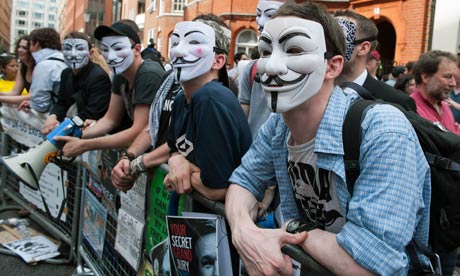
Supporters of Wikileaks founder Julian Assange
Supporters of Wikileaks founder Julian Assange, wearing Guy Fawkes masks: 'The digital age, globalisation and higher levels of education have equipped more people to become insurgents or to form single-issue pressure groups.' Photograph: Will Oliver/AFP/Getty Images
Power is leaching from the centre, even as the complexities of national and international challenges multiply. It is the hallmark of our times. Whether political or religious leaders, CEOs or five-star generals – all are more constrained in what they can do.
This is a pattern across all societies. The digital age, globalisation and higher levels of education have equipped more people to become insurgents or to form single-issue pressure groups. It is a world where the opportunities to be a Julian Assange, Beppe Grillo, Osama bin Laden, George Soros or Nigel Farage grow by the day. Power is draining away from those in whom it is formally placed, but with no obvious substitute in sight.
As Moisés Naím writes in The End of Power, there are three interrelated dynamics gnawing away at formal power structures – what he calls "the more revolution, the mobility revolution and the mentality revolution". There are more literate, educated people worldwide than ever before who refuse to be regimented and controlled as they once were. They are mobile, migrating and exchanging information to an unparalleled degree. Moreover, fewer will take anything for granted: they expect their voice to be heard, whether on the streets of Cairo, on social media in China or in anti-fracking protests in Sussex.
Naím is the first to concede that the dispersion of power is frequently a force for good. One obvious benefit is that autocracy is on the wane. In 1989, Freedom House reckoned that only 69 countries could be counted as democracies: today, the number has reached 117.
It is also good that the chances of mass war on a 20th-century scale are shrinking: in a world of declining power,, as US generals are relearning in Afghanistan, war is won differently today. It is the fast-moving insurgent who can capture hearts and minds or the terrorist cyberhacker who ends up ahead. But as Naím wryly remarks, the decay of power even undermines the insurgent terrorist groups themselves. He reports that 26 of 45 terrorist organisations dissolved, not from being beaten militarily, but from internal strife and challenge. Al-Qaida's greatest weakness is its own factionalisation, as will be the Taliban's.
It is this tendency to fragmentation and the chorus of often irrational voices insisting that their demands be met that most concerns Naím. It may be easier to establish a single-issue NGO, a religious movement or a political faction, but that does not mean that the consequence is necessarily always beneficial.
There is now certainly hyper-competition from new religious groups, or from blogs, tweets and websites trying to sway your opinion. But the consequences can be perverse. The rise of charismatic religion may challenge centralised, formerly powerful religious groupings that have lost their way, such as Catholicism, under increasing siege from the rise of Pentecostal churches in Africa and South America. But religious fundamentalism's grip on logic and rationality is even more tenuous.
Similarly, millions of blogs and tweets have forced news consumers to fall back on trusted, established sources, aiding media concentration rather than diminishing it.
But the "more, mobility and mentality revolutions" have their most obvious malign impact on politics in general and the political party in particular. Naím observes that parties are the engine room of democracies: they gather a constellation of interest groups around a common set of principles that offer a compass for government. Everywhere, political parties are succumbing to the rise of uncompromising single-issue pressure groups, lobbyists and funders, and the corresponding decline of supporters who want common values expressed. It is now not just parties but whole countries that are held to ransom by a faction or interest group holding a simplified but impossible view of the world – Naim's "terrible simplifiers".
One obvious example is the US Republican party, now in thrall to the Tea Party movement, which sees no value in compromise, but instead worships at the altar of an imagined US constitution that allegedly guarantees a nightwatchman state. Another example is the emergence of the Pirate party in Sweden and Germany. However, interestingly, Naím sees Britain as the laboratory that conclusively proves his point. The rise of Scottish and Welsh nationalism and Ukip, along with the hollowing out of both the Conservative and Labour parties, make the country increasingly hard to govern .
This must, in part, explain the collapse in Labour and Conservative party membership over the past 50 years and the consequent weakening of their capacity to create formal and informal coalitions of a broad set of interest groups around common values.
Ed Miliband's and Labour's failures predictably get the most attention from the press – identikit pieces about his lack of forcefulness, clarity and too much equivocation – as if a new leader could magically solve the problem, but with no understanding of the much wider context in which any political leader now operates.
The Tory party's problems, driven by similar forces, are arguably even more acute. At any other time, David Cameron would be seen as a classic mainstream Tory. Today, he is marginalised by as many as 200 backbenchers owing their position to constituency association selectorates, some of no more than 100 activists, in thrall to "terrible simplicities" on tax, Europe, immigration and welfare.
Any genuinely tough call – to put property taxation on 2013 rather than 1991 values, accept the need for immigration, cigarette packaging or even build the HS2 train line – is made incomparably harder or is simply off-limits because of the veto of a single-issue pressure group that a party is no longer strong enough to take on.
It is the decay of power. The centre fragments and power devolves to myriad new forces that often exercise their power with narrow obsessions in mind. Who now speaks for the whole? Who keeps a macro view, mediating competing interests and conflicts and has the courage to make decisions based on a strategic view of all our interests, not just sectional ones?
Parties have to fight back –arguing better, crystallising policies better, running primaries to select their candidates to widen their appeal – as does our democracy. Representative government was a great invention. It now has to be saved from the single-issue, monomaniac, simplifying, self-interested vandals – a much more interesting position for Mr Miliband to take than a belated "me too" conversion to a referendum on the EU.

Friday, 23 August 2013

Cheating: It's in our blood

Nicholas Hogg in Cricinfo
We are built to cheat. Our DNA demands that we take the opportunities that increase our chance of survival. In Stanley Kubrick's adaptation of Arthur C Clarke's 2001: A Space Odyssey, it is the bone-wielding apes who viciously club the unarmed apes. No lingering guilt about what is fair inhibits their bloody victory. But these are primates fighting over territory in a tooth-and-claw scrabble without values to impinge their survival instincts, distant cousins of refined cricketers imbued with a sense of moral duty to a sport that has long been elevated above other recreation as a bastion of fair play.
------
Also Read

On Walking - Advice for a Fifteen Year Old


-----
However, it is the codified rules, empirical rather than moral, that ultimately define a sport. In football you cannot touch the ball with your hands, in rugby football you can. Bereft of guidelines a sporting contest debases back to the savannah. Medieval, unruly versions of the beautiful game involved neighbouring villages fighting to move a ball from one field to another. These riotous matches, with surging mobs hacking, wrestling and lurching back and forth across muddied fields - much like a Five Nations clash from the 1980s - were banned in 1314 by an Edward II Royal Decree that declared "hustling over large balls" as an act "from which many evils may arrive."

Cricket, conversely, has often been taught in an effort to instil morality and sportsmanship. The phrase "It's just not cricket" has been popularised to describe underhand behaviour in wider society. The MCC, the owner of the Laws of Cricket since the 18th century, included a Preamble on this "Spirit of Cricket" in its updated 2000 code: "Cricket is a game that owes much of its unique appeal to the fact that it should be played not only within its Laws but also within the Spirit of the Game. Any action which is seen to abuse this Spirit causes injury to the game itself."
Occasionally players do contravene this near-mystical ethic of cricketing spirit. In 1981, six runs were needed from the last ball of the third World Series Cup final between Australia and New Zealand, and Australian captain Greg Chappell instructed his brother Trevor to bowl underarm. New Zealand's No. 10 Brian McKechnie blocked the grubber and then hurled his bat away in disgust. Outrage followed, and the Australian Cricket Board acknowledged that Chappell's action "was within the laws of the game" but as the MCC would formally state, "that it was totally contrary to the spirit in which cricket has been, and should be, played".
The unwritten code of fair play had been broken, and a week later the law was changed to ban underarm bowling. Like religion, the Spirit of Cricket is a concept universally understood but not universally practised.
In the first Ashes Test at Trent bridge, Stuart Broad edged Ashton Agar to first slip and stood his ground when he knew full well he was out. Sensing that he might escape justice, his face was that of a boy wiping away the crumbs of a stolen cookie - never has he looked more like the nefarious Malfoy from Harry Potter than when he realised his stay of execution.
It is the same player, whether on the village green or Test match arena, stuttering "I really wasn't sure if I'd hit it" who demonstrates an ancient skill - not only to others but also to oneself.
"In a competition for mates, a well-developed capacity for self-deception is an advantage," writes philosopher John Gray in Straw Dogs. "The same is true in politics, and many other contexts."
Including, one would argue, when at the crease.
"If they believe the lie," says Victor Gombos, a psychologist at California State University, "it's easier to be convincing." That golden duck turned into a century is sweeter still if the guilty man can free himself of the crime.
The walk-or-not-to-walk conundrum is a direct test of moral fortitude against genetics - a measure of character extended to home umpires in club games when they, as well as the appealing fielders, are well aware that the ball held aloft in the keeper's glove did indeed feather their team-mate's bat - and a prime example of how lying, whether to oneself or to others, is a pre-programmed ability.
Cheating will advance too. Silicone tape and Murray Mints. Sunscreen made of beeswax. Each mutation of advantage will result in a tweak of governance
"Almost all children lie," notes the director of the Institute of Child Study at Toronto University, Dr Kang Lee. In 2010, after studying 1200 children Lee claimed that lying "is a sign they have reached a new developmental milestone" and evidence of a fast-developing brain. He was quick to negate the link between juvenile deception and graduation into adult fraudsters - and, we presume, dishonest cricketers.
Whether Broad not walking constitutes a lie is debatable. No one asked him if he had hit the ball. And, as many great batsmen have done before him, he is entitled to wait on the umpire's decision. But a cheat? If so, he is certainly not the first, or the last.
In a 2013 survey conducted for the MCC and the Cricket Foundation, one in 20 children questioned admitted they were proud to have achieved victory dishonestly. With 22 players involved in a cricket match, that correlates to at least one dedicated cheater per game. This will to sporting power, to win at all costs, was highlighted in Dr Robert Goldman's 1984 survey that claimed over 50% of athletes would take an undetectable drug that assured them five years of glory.
Darwinism teaches that a quest for truth is often contrary to our survival. The truth is that Broad edged the ball to first slip, and the deception prolonged his life. Here, the "victory" gene, as I shall briefly rename Dawkins "selfish" original, is in conflict with what is considered fair play. Morality is built on the shifting sands of time, place and culture, and in natural selection the human mind pursues evolutionary success, not values.
Therefore as we evolve, the rules, and how they are applied, must adapt too. Sporting laws that fail to keep players in check will die off like dodos. Cricket changes because we are inventive mammals with the capacity for creativity - cheating.
The DRS will improve. Hot Spot and Snicko will see and hear with Orwellian focus. The Ministry of Truth will reign over every high-definition microsecond of every televised game, and on-field umpires - such as Tony Hill on the third morning at Chester-le-Street, when the big-screen replays confirmed his error and the players were halfway off the pitch before he raised his finger to an empty wicket - will be no more than conduits for decisions made by circuit boards.
And cheating will advance too. Silicone tape and Murray Mints. Sunscreen made of beeswax. Each mutation of advantage will result in a tweak of governance. While the coming youth play warped forms of our beloved game, and we casually forget this is a sport born on grassy meadows with curving bats and gates of sticks instead of stumps - an evolving game - our fading generation will hark back to a time when cricket was cricket, and a batsman could stand his ground whether he had hit the ball or not.

Emerging market rout threatens wider global economy


The $9 trillion (£5.8 trillion) accumulation of foreign bonds by the rising powers of Asia, Latin America and the emerging world risks going into reverse as one country after another is forced to liquidate holdings to shore up its currency, threatening to inflict a credit shock on the global economy.

A Pakistani money exchange dealer displays foreign currency notes at his roadside stall in Karachi
Fears of Fed tightening have pushed borrowing costs worldwide to levels that could threaten global recovery Photo: AFP
India’s rupee and Turkey’s lira both crashed to record lows on Thursday following the US Federal Reserve releasing minutes which signalled a wind-down of quantitative easing as soon as next month.
Dilma Rousseff, Brazil’s president, held an emergency meeting on Thursday with her top economic officials to halt the real’s slide after it hit a five-year low against the dollar. The central bank chief, Alexandre Tombini, cancelled his trip to the Fed’s Jackson Hole conclave in order “to monitor market activity” amid reports Brazil is preparing direct intervention to stem capital flight.
The country has so far relied on futures contracts to defend the real – disguising the erosion of Brazil’s $374bn reserves – but this has failed to deter speculators. “They are moving currency intervention off balance sheet, but the net position is deteriorating all the time,” said Danske Bank’s Lars Christensen.
A string of countries have been burning foreign reserves to defend exchange rates, with holdings down 8pc in Ecuador, 6pc in Kazakhstan and Kuwait, and 5.5pc in Indonesia in July alone. Turkey’s reserves have dropped 15pc this year.
“Emerging markets are in the eye of the storm,” said Stephen Jen at SLJ Macro Partners. “Their currencies are in grave danger. These things always overshoot.” 
It was Fed tightening and a rising dollar that set off Latin America’s crisis in the early 1980s and East Asia’s crisis in the mid-1990s. Both episodes were contained, though not easily.
Emerging markets have stronger shock absorbers today and largely borrow in their own currencies, making them less vulnerable to a dollar squeeze. However, they now make up half the world economy and are big enough to set off a crisis in the West.
Fears of Fed tightening have pushed borrowing costs worldwide to levels that could threaten global recovery. Yields on 10-year bonds jumped 47 basis points to 12.29pc in Brazil on Thursday, 33 points to 9.72pc in Turkey, and 12 points to 8.4pc in South Africa.
There had been hopes that the Fed might delay its tapering of bond purchases, chastened by the jump in long-term rates in the US itself. Ten-year US yields – the world’s benchmark price of money – have soared from 1.6pc to 2.9pc since early May.
Hans Redeker from Morgan Stanley said a “negative feedback loop” is taking hold as emerging markets are forced to impose austerity and sell reserves to shore up their currencies, the exact opposite of what happened over the past decade as they built up a vast war chest of US and European bonds.
The effect of the reserve build-up by China and others was to compress global bond yields, leading to property bubbles and equity booms in the West. The reversal of this process could be painful.
“China sold $20bn of US Treasuries in June and others are doing the same thing. We think this is driving up US yields, and German yields are rising even faster,” said Mr Redeker. “This has major implications for the world. The US may be strong to enough to withstand higher rates, but we are not sure about Europe. Our worry is that a sell-off in reserves may push rates to levels that are unjustified for the global economy as a whole, if it has not happened already.”
Sovereign bond strategist Nicolas Spiro said India is “caught between the Scylla of faltering growth and the Charybdis of currency depreciation” as hostile markets start to pick off any country with a large current account deficit. He said India’s central bank is playing with fire by reversing its tightening measures to fend off recession. It has instead set off a full-blown currency crisis that is crippling for companies with dollar debts.
India is not alone. A string of countries across the world are grappling with variants of the same problem, forced to pick their poison.

Kerrigan's dream turned nightmare

Why does a cricketer's long-cherished hope of performing on the biggest stage often crumble on the big day?
Aakash Chopra in Cricinfo

The sight of Simon Kerrigan bowling on day one of his Test debut made spectators stare at him in disbelief, then condemn his selection, and later feel sorry for the poor lad. His cherished childhood dream, of playing for England, had turned into a nightmare on his first day at the office.
The knowledge that many of his senior colleagues either boast Test centuries on debut, or remarkable bowling figures, must have weighed heavy too. That mindset of inflated expectations and fear of failure can affect a debutant horribly sometimes.
Kerrigan's first over went for ten runs; his next two included a huge full toss and a half-tracker that made him look woefully out of place. A stage as big as the Ashes can trigger a terrible chain of slip-ups, one leading to the next: a nasty trap with no exit.
On the one hand, the fantasy of playing for the country is so vivid and the visualisation so real, you as a debutant can almost feel your team-mates giving you high fives and the crowd standing up to applaud. On the other hand, you spend sleepless nights, twisting and turning, mulling over the possibility of being dismissed first ball, or getting hit for a four.
Days before the debut, you wear the team kit and stand in front of the mirror in the confines of your room, practising. While you're busy appreciating the gleaming national emblem on the breast of your t-shirt, performance anxiety, quite unnoticed, finds a way into the mindset. The cheers and applause you imagined are replaced by murmurs and disapproval. Doubt makes an unwelcome appearance, and pressure starts to make itself felt.
Thoughts of what if things go wrong, what if the ball doesn't come out right from the hand, what if my feet don't move when the bowler delivers, start surfacing. The more you try to shoo them away, the stronger they become. You know that you must break the chain and sleep peacefully on the eve of the game, but that's the last thing that happens. The thought of realising your dream keeps you awake, till exhaustion - emotional and physical - takes over and you crash.
Some top athletes foresee this predicament and train themselves to deal with it. Indian Olympic gold medalist shooter Abhinav Bindra stayed up many nights in the run-up to the big event. He knew that sleep might desert him on the eve of the big final, and so he meticulously prepared himself to perform in spite of a lack of sleep. As he had guessed, he couldn't sleep the night before his big performance in Beijing, but that didn't affect his performance.
Sachin Tendulkar, too, didn't sleep well for about a fortnight leading into the match against Pakistan in the 2003 World Cup. If performance anxiety can keep seasoned sportsmen on edge, spare a thought for Kerrigan, who was thrown into one of the most high-profile Tests of the year on debut.
 
 
Thoughts of what if things go wrong, what if the ball doesn't come out right from the hand, what if my feet don't move when the bowler delivers, start surfacing. The more you try to shoo them away, the stronger they become
 
For him, the morning of the match, the warm-ups, the presentation of the cap, must have all passed in a jiffy. One moment you are warming up, the next you have a bat or ball in hand, practising your skill set, and then, before you've absorbed the first few drills, the captains are out in the middle for the toss. One part of you wants proceedings to slow down so you can soak it all in, the other part, impatient and excited, wants to get it all over and done with as soon as possible. Then you're there, in the middle, 45,000 pairs of eyes watching your every move. In theory you're with ten other men of your clan; in reality you're alone.
I distinctly remember playing my first ball on my Test debut. Even though I felt reasonably well prepared, I prayed I would not get out first ball. A part of me felt paralysed with anxiety. I'm glad the other part was still awake and helped me take a single off the first ball. A monkey the size of a dinosaur was off my back. Looking back at it, what if I had played and missed for a while and hadn't got a single for the first 25 balls? I'm certain I would have melted under the pressure and played a rash shot.
That was what happened to Kerrigan, unfortunately. Shane Watson, in imperious mood, went after the debutant, and he didn't know how to react. A man who had bowled over 9000 balls in first-class cricket and had taken 164 wickets ended up bowling chin-high full tosses and long hops.
It could possibly have been Kerrigan's worst-ever bowling spell at any level, and unfortunately it came in the biggest match of his career, in front of a packed house. Stage fright took control of him and the dream turned into a nightmare in the space of 12 balls. His past stats report that Kerrigan has been a much better bowler than what we saw on the first day at The Oval. But it will require a miracle comeback from him in this Test, or immense faith from the selectors and captain to restore his confidence.
He may still be able to turn it around, for a bowler doesn't only get six opportunities in an over but also many overs to bowl in a match. However, that also means that you stand to be exposed many times over, as opposed to a batsman, whose misery might last only a few balls.
The great Shane Warne and many others have recovered from forgettable debuts. Simon Kerrigan would want to find consolation in that, and the famous Zen saying, "The arrow that hits the bull's eye is the result of one hundred misses."