Search This Blog

Tuesday, 2 July 2013

Farming subsidies: this is the most blatant transfer of cash to the rich

As the British government cut benefits for the poor at home, in Europe it fought to keep millions in subsidies for wealthy farmers

Daniel Pudles 02072013
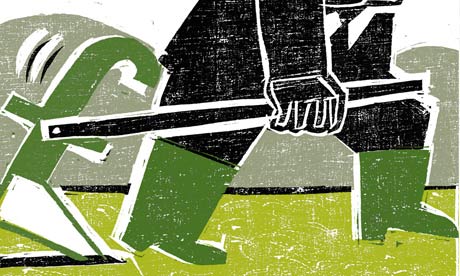
‘Most of the land in Britain is owned by very rich people, including millionaires from abroad who pay no UK taxes.' Illustration by Daniel Pudles
It's the silence that puzzles me. Last week the chancellor stood up in parliament to announce that benefits for the very poor would be cut yet again. On the same day, in Luxembourg, the British government battled to maintain benefits for the very rich. It won. As a result, some of the richest people in the country will each continue to receive millions of pounds in income support from taxpayers.
There has been not a whimper of protest. The Guardian hasn't mentioned it. UK Uncut is silent. So, at the other end of the spectrum, is the UK Independence party.
I'm talking about the most blatant transfer of money from the poor to the rich that has occurred in the era of universal suffrage. Farm subsidies. The main subsidy, the single farm payment, is doled out by the hectare. The more land you own or rent, the more money you receive.
Since 1999, more progressive European nations have been trying to limit the amount of public money a farmer can capture under the common agricultural policy. It looked as if, this year, they might at last succeed. But throughout the negotiations that ended last week, two governments in particular resisted: those resolute champions of the free market, Germany and the UK. Thanks to their lobbying, any decision has yet again been deferred.
There were two proposals for limiting handouts to the super-rich, known as capping and degressivity. Capping means that no one should receive more than a certain amount: the proposed limit was €300,000 (£250,000) a year. Degressivity means that beyond a certain point the rate received per hectare begins to fall. This was supposed to have kicked in at €150,000. The UK's environment secretary, Owen Paterson, knocked both proposals down.
When our government says "we must help the farmers", it means "we must help the 0.1%". Most of the land here is owned by exceedingly wealthy people. Some of them are millionaires from elsewhere: sheikhs, oligarchs and mining magnates who own vast estates in this country. Although they might pay no taxes in the UK, they receive millions in farm subsidies. They are the world's most successful benefit tourists. Yet, amid the manufactured terror of immigrants living off British welfare payments, we scarcely hear a word said against them.
The minister responsible for cutting income support for the poor, Iain Duncan Smith, lives on an estate owned by his wife's family. During the last 10 years it has received €1.5m in income support from taxpayers. How much more obvious do these double standards have to be before we begin to notice?
Thanks in large part to subsidies, the value of farmland in the UK has tripled in 10 years: it has risen faster than almost any other speculative asset. Farmers are exempted from inheritance tax and capital gains tax. They can build, without planning permission, structures which lesser mortals would be forbidden to erect, boosting both their capital and income. And they have a guaranteed income from the state. Yet all we hear from their leaders is one long whinge.
I have yet to detect a word of gratitude from the National Farmers' Union to the hard-pressed taxpayers who keep its members in such style. The NFU, dominated by the biggest landowners, has a peculiar genius for bringing out the violins. It pushes forward small, struggling hill farmers. The real beneficiaries of its policies are the arable barons hiding behind them.
An uncapped subsidy system damages the interests of small farmers. It reinforces the economies of scale enjoyed by the biggest landlords, helping them to drive the small producers out of business. A fair cap (say of €30,000) would help small farmers compete with the big ones.
So here's the question: why do we keep deferring to Big Farmer? Why do its sob stories go unchallenged? Why is this spectacular feudal boondoggle tolerated in the 21st century?
Here are three possible explanations. A high proportion of the books aimed at very young children are about farm animals. There is usually one family of every kind of animal, and they live in harmony with each other and the rosy-cheeked farmer. Understandably, slaughter, butchery, castration, separation, crates and cages, pesticides and slurry never feature. The petting farms that have sprung up around Britain reify and reinforce this fantasy. Perhaps these books unintentionally implant – at the very onset of consciousness – a deep, unquestioned faith in the virtues of the farm economy.
Perhaps too, after being brutally evicted from the land through centuries of enclosure, we have learned not to go there – even in our minds. To engage in this question feels like trespass, though we have handed over so much of our money that we could have bought all the land in Britain several times over.
Perhaps we also suffer from a cultural cringe towards people who make their living from the land and the sea, seeing their lives, however rich and cossetted they are, as somehow authentic, while ours feel artificial.
Whatever the reason, it's time we overcame these inhibitions and confronted this unembarrassed robbery of the poor by the rich. The current structure of farm subsidies epitomises the British government's defining project: capitalism for the poor and socialism for the rich.

The subversive world of online drug dealing


Encrypted websites selling illegal drugs may render prohibition obsolete, but their profit-driven nature could be just as harmful
A marijuana plant
Drugs … 'there will always be a market'. Photograph: Anthony Bolante/Reuters
A nameless admin at Atlantis, a website selling everything from magic mushrooms to marijuana to crack cocaine, posted an advert on YouTube last week. The video was swiftly taken down, but not before about 40,000 people had seen it, copied down the strange URL and gone off to investigate. It's part of a bold new marketing campaign to allow people to easily buy illegal drugs, wherever they are in the world. Whether that's a good or bad thing is debatable.
Atlantis is a competitor to the Silk Road, an underground online market where drugs are bought and sold openly, sent to users under plain wrap in the mail. But where the Silk Road hides and does not share its URL very widely, Atlantis is shockingly blatant and comes over like a cocky web start-up. It is paying dividends: the site's owners claim to have processed half a million dollars in deals since March. There are allegations that it is a honeypot, drawing in ex-Silk Road vendors by charging lower fees, and offering proprietary encryption, rather than demanding that users learn PGP software (Pretty Good Privacy). This means the site's owners might be able to see where dealers on the site are sending drugs to, and identify customers, or listen in on email conversations and begin to expose dealers. Might the DEA have set up a bogus site to ensnare the unwary?
While nothing any government does around privacy should surprise us nowadays, from indiscriminately recording our every thought and whim, to spying on the grieving parents of murdered children with the aim of smearing their characters, the emergence of Atlantis and sites like it into the mainstream does raise the interesting prospect of a new war on encryption. Encryption software, most commonly PGP, scrambles your mail, making it impossible for a third party who does not own two special "keys" to read your mail. 
Now the Prism and Tempora cats are out of the bag, and it's dawned on almost everyone what fools they've been, I'd guess that governments will soon be very keen to control encryption and will use the drug problem as a straw man defence for their next wave of intrusion. Note to government, it didn't work last time. To quote John Callas, who helped invent PGP with Phil Zimmerman: "PGP is just math, and you can't ban math."
In the UK, though, encryption can be a de facto crime under the Regulation of Investigatory Powers Act (Ripa), the Labour-era assault on civil liberties. Refuse to hand over the private keys to your private files and you can and will be jailed. IT website The Register reported in 2009 that the first person jailed under part three of Ripa was "a schizophrenic science hobbyist with no criminal record". Found with a model rocket as he returned from Paris, he refused to give police the keys to his encrypted data: indeed, he refused to speak at all, and was jailed for 13 months. Six months into his sentence the man was sectioned under the Mental Health Act and does not know when he will be released.
It's pretty easy to see what the initial official response to sites such as Atlantis will be. There'll be a concerted media campaign to scare people off. A few big busts of users, plus an attempted and likely very public assault on Bitcoin, the anonymous currency used to pay for the drugs.
But Bitcoin is essentially unassailable, because the currency has no central bank, and is made and maintained by a network of users. There's now enough of it in circulation to become a closed and private economy. Bitcoin is divisible into eight decimal places – 0.00000001 BTC is the smallest amount that can be handled in a transaction – so there's plenty of spare capacity. Perhaps an attack on Tor might work? Tor is the anonymising software that enables these markets to be hosted and accessed secretly. To quote Andrew Lewman, the Tor project's spokesman: 
"Our code is all open source, everything we do is open source, and is mirrored all over the world. So even if, for whatever reason, let's say the paedophile-terrorist-druglords and the four horsemen of the apocalypse take over Tor and that's the majority usage, then the current Tor network could shut down, and just like a phoenix it will get born again. Then maybe we'll have 10 or 1,200 Tor networks because everyone starts running their own."
The only way to tackle online markets such as this is to make postal procedures hugely onerous. But that costs. The Royal Mail is about to be privatised and no one wants to invest. With 96% of its staff supporting a strike and opposing privatisation, it's hard to see workers agreeing to new requirements to scan every piece of post for drugs. In any case, queues in understaffed offices are so lengthy and the entire process of posting a letter so redolent of the frustrating world before the net there would be a customer revolt.
And there's no way sniffer dogs can tackle the circa 70m pieces of just domestic post at the sorting offices each day. When I was researching my book on the internet drugs trade, the Royal Mail refused to answer even the simplest questions about steps taken to identify packages containing drugs. The reason for that, postmen have told me privately, is that there are none. There's a new Russian anonymous market, that has just come online too. There will be many more, since prohibition makes their operation profitable and their use logical.
Free market economics, whose rules of supply and demand we so conspicuously ignore in this vast sector of the economy, make simple herbs and plant extracts or simply produced chemicals worth many millions of pounds per tonne. And so there will always be a market. That market has now been virtualised: Drugs 2.0 – click here to buy now.
But while I smile in disbelief at the defiance and subversion of sites like Silk Road and Atlantis, I can't help thinking that this cavalier dismantling of the failed and discredited prohibition model, replacing it with another system driven by private profit with no regard to people's health, risks exposing people to similar harms as prohibition did. Note past tense.  

Monday, 1 July 2013

Not talking about death only makes it more lonely and frightening


In the absence of faith, death cafes can provide a space for us to talk about what a good ending might be
New York death cafe
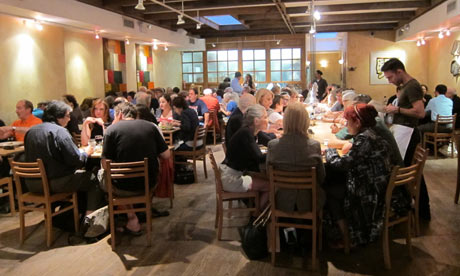
‘The idea of the death cafe has caught on, with more than a hundred meetings having taken place in Britain and the United States.'
This is a familiar scenario. I am sitting at the side of somebody's bed in hospital. They are dying. It's not an especially comfortable bed, being designed for ease of cleaning and to help nurses lift patients safely. The sound environment is punctuated by the noise of other people's distress and intermittent bleeping from the apparently reassuring presence of technology – often referred to as life-saving, though of course it can never really deliver on that promise. The flimsy curtain provides little privacy.
Friends and relatives arrive and tell the patient they are looking "really well". This is often code for: we don't want to talk about the fact that you are dying. Anyway, the priest is here. He can do all that existential stuff. The people in white coats obviously have the physical aspect of things covered. The patient, emotionally drained by illness, colludes with this distressing lie through a simple "thank you". It's distressing because the patient often wants to talk about it. Not talking about it is lonely and thus all the more frightening. Is this really how we want to die?
When Jon Underwood introduced the idea of the Death Café into the English speaking world in 2011 as an offshoot of the Swiss Café Mortel movement, it was with the belief that we have outsourced all talk of death to medics, priests and undertakers. This displacement of death-talk from everyday speech, he suggested, robs us of agency over one of the most significant things we will ever have to face. First, he approached local cafes in east London to see if they would host a gathering to talk about death. They thought the idea bizarre, ghoulish. So he set up in his front room and asked his mum to lead the first session.
Since then the idea has caught on and more than a hundred meetings have taken place in the UK and the US. It's not a space for religious proselytising – though people of all faiths and none are welcome. It is not for the recently bereaved. It's more a way of addressing the ever-present reality of death among those for whom it is not a live issue. "It can be very liberating because the way our society shuts down conversations about death can be claustrophobic and stifling," says Underwood.
My own religious perspective on death and dying is that secular atheism is proving to be a very expensive and a terrible burden on the NHS. When we come to value life simply in terms of itself and "the amount of self-referential advancement obtained in it", as one commentator has put it, then death is seen as doubly frightening because it strikes not just at life itself, which is bad enough, but at the very core of our value system. Medicine thus shoulders the unreasonable burden of justifying our existence. So we charge the medics to do everything they can to keep us alive. And the bills pile up.
Most of us want to die quickly and before our physical condition deteriorates to such an extent that life becomes intolerable. But this is a comforting avoidance – the fantasy of "getting out of life alive", as theologian Stanley Hauerwas puts it. As is all talk of euthanasia: the figures from those places where it is legal demonstrate that only a tiny percentage of people ever choose this route. In an aging population, most of us will die gradually. In the absence of religious belief, we need to develop a language that will help us address what a good death might look like.
Can we, for instance, start talking about having a natural death in the same way that we can now talk about having a natural birth? Or about dying at home, surrounded by our loved ones and not by machines? Discussions like this might enable us to get off the escalator to intensive care, that miserable and soulless place where more and more of us are now dying.

Who owns patriotism?


People count, not battles – yet the right, looking back in wonder, seems only to love only a sliver of Britain
Annual battle of Hastings re-enactment
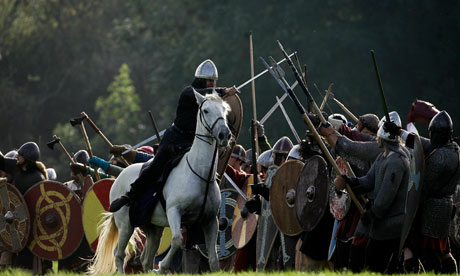
Enthusiasts dressed as Saxon and Norman warriors re-enact the 1066 battle of Hastings. Photograph: Matthew Lloyd/Getty Images
George Osborne has pledged £1m to restore the battlefield of Waterloo (1815) in Belgium, which paves the way for the restoration of the sites of all kinds of victories abroad; ministers are also excited about Agincourt (1415). If they continue on this trajectory, the Tories will eventually find themselves back at Hastings (1066), which should really mash their heads. (I think they have been watching the White Queen too much, which is a shame, because TV history has the same relationship to real history as gastronomy has to kebab vans.)
I am not sure how this works – how do you renovate a battlefield, anyway? – and I admit to limited faith in such memorials. They have too many emergency exits for places that have witnessed catastrophe, and too many children throwing chips. I would always prefer a book to a battlefield, if I could find a decent public library. Mud doesn't do analysis, and tea shops illuminate nothing. This is the politics of the National Trust.
It is clearly part of the Tory plan to make Britain feel like a wonderful country, even though it may not feel that wonderful beyond Whitehall: food banks; rising inequality; homelessness; and the ghastly spectacle of the wealthy enjoying a parody of homelessness by camping at Glastonbury in yurts, and treating litter as a sort of fascinating art installation that somebody else will buy.
Surely we must agree with Edmund Burke when he said: "To make us love our country, our country ought to be lovely"? No, that is too complicated and presumably expensive; it is better to look to the past when the future seems so foul, and austerity stretches into the horizon like an ever-receding phantom. We have the horrid plan to send children from state schools to the battlefields of the western front – and the second prize is? – and we have Michael Gove, a man who always looks, to me, in need of a chin to stroke, attempting to rewrite the national curriculum in the style of Enoch Powell drugged by Jean Plaidy.
Who owns patriotism? The left has been too quick to surrender its spoils to the right, largely because so many progressive ideas came from across the Channel, along with the plague. (Did you know the plague ship docked at Weymouth? That is surely worth a plaque). Socialism's relationship to internationalism did it harm, although it should not have done, because the right's definition of patriotism is elitist, confused and often completely bogus. Nigel Farage of Ukip, who is considered dangerously patriotic, at least by the Tories, based more on his ownership of a Barbour, I think, than on any coherent political philosophy, is exposed as a (failed) tax avoider – how patriotic! – and the track where Jessica Ennis trained will be shuttered, due to the cuts.
Obviously monarchy confounds everything, because it drugs us into confusing love of country with hierarchy, obedience and submission; too often patriotism simply means surrender to the status quo. To applaud the monarchy for spending £5,000 a night on the Duchess of Cambridge's lying-in, for instance, might be considered patriotic, while to complain that she should make do with a world famous NHS hospital is not. Patriotism stripped of proper definition is a cheap political trick and it lies all the time; who remembers, for instance, that in Churchill's five-man war cabinet of 1940, two Tories (Chamberlain and Halifax) were for negotiating with Hitler and two Labour men (Attlee and Greenwood) were not?
It is obvious that the right loves only a sliver of Britain; and so it is time for Labour to claim patriotism for itself. It began with Ed Miliband's theft of Disraeli's One Nation creed at the party's 2012 conference, which is not as improper as it sounds; Disraeli toyed with many things before he chose Toryism, and his series of progressive social reforms were a Victorian marvel.
Ed Balls has called for Labour to "recapture the spirit and values and national purpose" of 1945; translate the rhetoric into policy and who knows what worlds we could build? A patriotic nation loves all its citizens, and does not only look back in wonder. Greatness lives in the day; even dogs know that.

Thursday, 27 June 2013

On the spectrum of deceit, ministers have gone off the scale


Statistics have long been argued one way or the other, but this government twists them beyond reality to suit its ruthless agenda
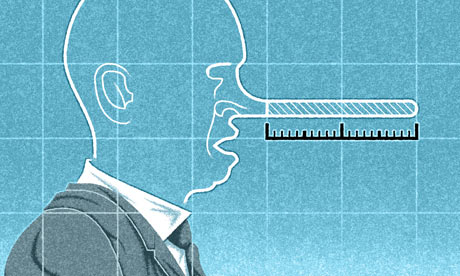
Matt Kenyon on political lies
Illustration by Matt Kenyon
"Lies, damn lies and statistics," they say. "Torture a statistic enough and it will tell you anything," they say. Aphorisms that once sounded sound wry and urbane now make me want to set fire to things. I know, it is a risky old business, making a threat of arson, but I've already done it in an email, so this will hardly be news to GCHQ.
Worldwide, the era of post-truth politics began some time ago; during the last US elections, there were how-to guides for media outlets. "How does one evolve for the post-truth age?" asked the Atlantic, and it was a serious question. If you were trained in the "he-said, she-said" mode of reporting ("the chancellor says we are on the road to recovery; the shadow chancellor says, on the contrary, we are up shit creek with a baguette for a paddle") that will seem to you to be the fair and defensible way of doing things. If, however, one party starts to peddle a deliberate falsehood ("the chancellor says the deficit has gone down; the shadow chancellor says, on the contrary, the ONS figures show the deficit has gone up" – this is an example from real life, and happened on Tuesday), then the act of reporting both positions, in a tone of impartiality, serves to give them equal weight. Your neutrality shores up a lie.
-------
Also Read

Ministers who misuse statistics to mislead voters must pay the price

Lies, damned lies and Iain Duncan Smith


-------


This is for newshounds to tie themselves in knots over; I have never aimed at nor pretended impartiality. But I did prefer it when politicians, broadly speaking, told the truth. I have a pretty high tolerance for personal fibbing, who did and didn't have sex with whom, who was driving when the speed limit was broken. I don't enjoy, but I accept as the price of human variety, perspectives so different to mine that we exist in the orbit of extra-fact, our ideological magnets repelling one another so strongly that facts wouldn't help, because we'd never get close enough to jointly examine them (examples: Osborne on the Philpotts' benefits lifestyle; Hunt on the unaffordability of the NHS; Gove on most things). I used to get riled by the misuse of statistics, but at least that's done on the shared understanding that people should tell the truth in public life. A fact may turn out to have so much topspin that it isn't really true, but so long as the politicians have plausible deniability the contract isn't broken.
That deal is over. As Daniel Knowles of the Economist pointed out, more in impatience than in anger: "Over the last few months, as welfare cuts have started, questionable numbers have floated out of Iain Duncan Smith's office into the public debate like raw sewage." The protest group Disabled People Against Cuts collated 35 major untruths to emit from the government since 2010, and almost half of them came from IDS, who is well known to the (statistics) authorities, and has been reprimanded many times. If I were in charge, I would institute an asbo system in parliament; beyond a certain number of lies, MPs would have to sport a visible tattoo so that the casual onlooker would know to double-check their remarks.
The key things to watch with IDS are claims that the benefit cap is working; claims that the Work Programme is working; claims that the benefit system is rife with fraudsters; any claim about jobless households; most things he says about foreigners (with the caveat that if he is talking about a specific foreigner, José Mourinho or Angelina Jolie, it's likely that defamation laws will keep him on the straight and narrow); and everything he says about family breakdown.
But what chilled me most was the (relatively) minor lie, put about in November 2010, that private sector rents had fallen by 5% the previous year, while the amount paid by local authorities in housing benefit had gone up by 3% (Inside Housing analysed and rejected the claim). The clear implication was that people claiming the benefit were on the take – it was never said outright because it would have been functionally impossible (housing benefit is paid directly to the landlord); yet there it was, an impression hanging in the air, yet more craftiness from the feckless spongers.
David Cameron, meanwhile, has been reprimanded by the Office for Budget Responsibility (for lying about what it had said); and by the UK Statistics Authority for lying about the direction of the national debt (he said we were "paying it down", when in fact we were beefing it up). Osborne, besides lying this week about the deficit, has been reprimanded by the OBR (for lying about the nation's risk of bankruptcy) and by the UKSA. Amusingly, the Office for National Statistics was recently reprimanded by the UKSA for allowing the chancellor to pretend that a raid on the Bank of England's cash pile was equivalent to tax receipts. It's a carousel of meta-rebukes, as Osborne pulls ever more agencies into his circle of deliberate untruth.
There is a point on the spectrum of deceit at which the totally unprincipled, who will say anything to hold sway (I put Osborne in this category), meet the deeply religious, who are so sold on the notion of their own superiority that it is not necessary for reality to support them, merely for us all to be quiet, while they set us on the course of righteousness (and IDS in this one). But more important than any of their motives – there must, surely, be conservatives who would rather lose the argument than win it like this.

Just remember what many Tories thought of Nelson Mandela in the apartheid years


Soon we will be inundated with heartfelt speeches – but we mustn't let those who opposed Mandela's struggle pretend they didn't
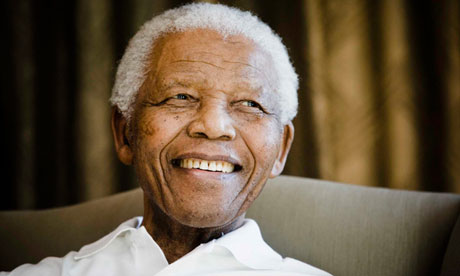
Nelson Mandela
A smile that came from the centre of the Earth ... Nelson Mandela. Photograph: Media24/Gallo Images/Getty Images
As the vigil continues outside the hospital, we don't know how close to the final freedom Nelson Mandela is. But after the strange denials that this old, sick man is dying I want to talk not with pity but of his power. Before the pygmy politicians line up to pay tribute to this giant, I want to remember how he lived so much for so many. Part of my memory is that he was not a living saint to the very people whose staff will now be writing their "heartfelt" speeches.
Really, I have no desire to hear them from leaders of parties who described his organisation as terrorist, who believed that sanctions were wrong, whose jolly young members wore T-shirts demanding he be strung up. Of course, not all Tories were pro-apartheid, but I can already feel the revisionism revving up.
So we must recall how it really was. The struggle against apartheid was the one thing that unified the left. I came to it accidentally. Isn't that how politicisation happens sometimes? Via extraordinary people, unlikely meetings, chance encounters?
Like this one: in 1981 I had just come back from travelling around South America and got a job in a care home with Haringey Social Services in north London. Some of the local kids were in big trouble – the girls were on the game at 14, the boys breaking into houses and stealing cars. A large, in every sense of the word, African woman became my ally there. She was always encouraging them to be lawyers despite their constant truanting. We were an unlikely pair, but she believed in "discipline" and I believed in "manners" so we would talk late into the night. She was one of the poshest people I had ever met – she drank Perrier water, which at that time was exotic beyond belief. Sometimes she would weep after receiving calls from South Africa and talk of murders and assassinations. Sometimes she would take me out for cocktails and get diplomatic cars from embassies to take me home. Her name was Adelaide Tambo, the wife of Oliver. They were the exiled leaders of the ANC.
I began to know what this meant. How Mandela had ridden to power in 1952 in the Defiance Campaign, how he was harassed and, of course, finally taken to Robben Island. To that tiny cell. The Tambos had to leave much later. One night she called me as she was locked out of her house in Muswell Hill. "Can't you just break a window? "No Suzanne," she said. "The windows are all bullet proof glass." That's how they lived.
This personal introduction to the ANC is my story but everyone I knew opposed apartheid. Indeed, who could support such barbarism? This was more than racism – there is only one race, called the human race. Botha's regime did not regard black people as humans but as animals.
By 1984 Jerry Dammers had written Free Nelson Mandela. But apartheid continued to exist, propped up by the Tories. Some of their elder statesmen, such as Norman Tebbit, still see Thatcher's policy as a success. David Cameron denounced it in 2006, saying she had been wrong to condemn the ANC as terrorists and to have opposed sanctions. Too late for those veteran campaigners such as Peter Hain, who had seen the massacres in the townships and knew it was a life-or-death struggle.
Indeed, when I saw Mandela in later years having his garden surreally being "made over" by Alan Titchmarsh or being cuddled by random Spice Girls, I wondered if they had ever heard Gil Scott-Heron's Johannesburg (1975) or been at the anti-apartheid demos outside the South African embassy where we were all kettled.
When we hear Cameron's inevitable tribute, don't forget that in 1989, aged 23, he went on a "jolly" to South Africa paid for by a firm that did not want sanctions busted. This does not mean he supported apartheid, but by then it would have been impossible not to know of the regime's brutality. Many people knew, and boyotted South African goods.
I see Dylan Jones, a Cameron fan, has written a book on Live Aid, defining the 80s as caring: more anodyne revision. The key concert of the 80s was the more political and consciousness-raising Free Nelson Mandela one, not long after. Mandela himself was there on stage with that smile that came from the centre of the Earth. The glare of his grin made us cheer and cry. The glare of the sun, when he was breaking rocks in Robben Island, had permanently damaged his eyesight, but not his mind. When he walked to freedom he wrote, that unless he left bitterness and hatred behind, "I would still be in prison."
This is wonderful, but do not let his story be rewritten, do not let those who opposed his struggle pretend they didn't.
"There is no passion to be found playing small," he said. He told his own people to recall the past. I ask simply, before we are inundated with those who want to bask in his afterglow, that we remember our own past too. It is sad, but let him go. I just wanted to remind you of how it was before he passes and before the "official" rewrite of history begins. Forgiveness is possible. Forgetting isn't.

Wednesday, 26 June 2013

Politicians who demand inquiries should be taken out and shot


From Stephen Lawrence to Bloody Sunday, an inquiry serves as the establishment's get out of jail free card
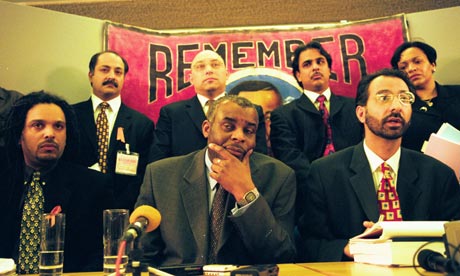
lawrence inquiry 1999
Neville Lawrence, Stephen Lawrence's father, at a press conference responding to the publication in 1999 of the report of the Macpherson inquiry into the Stephen Lawrence killing. 'The call for yet another inquiry into the Stephen ­Lawrence murder – by some counts the 17th – must make it the most interrogated death in history.' Photograph: Sean Smith for the Guardian

There should be a public inquiry. Indeed there should be a judicial inquiry, a veritable "judge-led" inquiry. Into what? That does not matter. An inquiry has become the cure-all for any political argument. Whether the subject is a dud police force, a dud hospital, a dud quango or a dud war, only a judicial inquiry will atone for wrongdoing and do penance for public sins.
An inquiry defers blame. It throws the ball into the long grass and kicks the can down the road. This week's call for yet another inquiry into the Stephen Lawrence murder – by some counts the 17th – must make it the most interrogated death in history. As withBloody Sunday and Hillsborough, a British scandal is measured not in deaths but in juridical longevity.
Politicians who demand inquiries should be taken out and shot. In almost every failure in a public service – run by or regulated by ministers – we know perfectly well what happened and who was in charge. Guilt should lie at the top, or at some recognised cut-off point. An inquiry merely replaces the straight, sure arrow of accountability with the crooked line of pseudo justice. It is the establishment's get out of jail free card.
For a minister to set up an inquiry – or his opponent to call for one – is like a bankrupt board of directors calling in consultants. The hope is that it may soften the line of blame, fog the argument, postpone the day of reckoning. A minister declares, "I have asked the distinguished Lord Justice So-and-So to leave no stone unturned." By the time he does, the minister prays he may have moved on. The furniture of blame will have rearranged itself.
Almost all public inquiries are nowadays political. In 1998 Tony Blair, eager to push forward his Ulster peace process, set up yet another inquiry into Bloody Sunday. The Saville inquiry became a scandal of judicial extravagance and delay (into which, of course, there was no inquiry). In 2009 Gordon Brown wished to take the heat out of the Iraq war before an election. He set up the Chilcot inquiry, now so dormant it can be of use only to scholars of latter-day Blairism. Two years later David Cameron, under attack for his links to News Corporation, sought a judge known to be eager for higher office and chose Lord Justice Leveson to investigate press ethics. From the resulting shambles Cameron escaped scot free.
In the Victoria Climbié inquiry of 2001, thunderbolts of damnation were hurled on to the heads of hapless social workers. Trials and inquiries cursed officials, police, councillors and local managers. Lord Laming's subsequent report came up with 108 recommendations, so many as to allow responsibility to disperse like seeds from a dandelion. When a minister says "we are all to blame", he means no one is.
The recent bevy of inquiries into the Staffordshire and Cumbrian hospital scandals has shone a mesmerising light on modern quangocracy. Highly paid officials with ill-defined jobs that are nothing to do with health argue over who said what, when and to whom. The row cannot save a single patient, while the resources diverted must jeopardise thousands. The salaries and fees roll on.
Government by retrospective inquiry is not government at all. It is a first rough stab at history. Its strangest feature is the deference shown to lawyers and legal process. All professions have their biases and the law is no exception. The sanctity of court process, important in trying a criminal case, is hardly relevant to the politicised context of a modern public inquiry. Judges, for good reason, do not speak the language of politics. As we can see from their hysteria over legal aid, they certainly have no comprehension of budgetary priorities.
Those attending the 2003 Hutton inquiry into the death of David Kelly found it an eerily legalised process. It led to a whitewash so unconvincing it had to be repeated, in effect, a year later by Lord Butler. The Leveson inquiry was likewise conducted as if it were a trial of the press for the mass murder of celebrity reputations. No attention was paid to the ethics of the electronic media, let alone to those of lawyers who were equally assiduous users of hacking services. The reality is that inquiries set up to get politicians off a hook usually do so by finding some other individual or group to hang on that same hook.
De Tocqueville remarked that the intrusion of lawyers into every corner of government meant that "scarcely any political question … is not resolved into a judicial question". A lawyer is to a modern politician what a priest was to a medieval one – someone on hand to help in a scrape, to dispense indulgence for wickedness.
If political accountability were truly a matter for judicial determination, parliament could pass laws and go home, leaving judges to decide on their efficacy. Everything could be rolled into one ongoing, everlasting public inquiry, to which every political upset could be referred for trial and execution. Parliament could be removed to the royal courts of justice with the lord chief justice as Mr Speaker.
We know what this would be like. We can see it today following the centralisation of town and country planning by Cameron's eccentric commissar, Eric Pickles. Local plans and decisions based on them have been superseded by Pickles's targets and instructions to his planning inspectors. This plays so fast and loose with local discretion that any planning application is worth taking to appeal. Planning is no longer a local function but determined ad hoc by Whitehall inspectors, followed by public inquiries and potential judicial review. It is not planning but financial combat.
As a result, planning is set to join immigration in the soaring total of judicial reviews. What was once a relatively smooth mechanism for deciding what sort of building should occur and where has become a judicial free-for-all (or rather costly-for-all). Expediting government through legal process is a contradiction in terms.
Democracy cannot work without a clear line between a decision and someone who can be held responsible. That means clear when the decision is taken, not clear to subsequent inquiry. Big centralised organisations such as the NHS stretch that line to breaking point. Public inquiries validate that breakage. They are a menace. Lawyers should stick to the law. Elected politicians who screw up should come clean and resign.