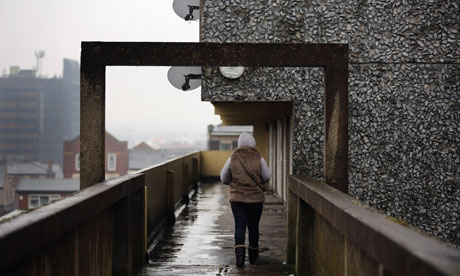
'In almost everything
we now hear about economic disadvantage, to be one of the economy's
losers isn't about being a vicitm of forces beyond your control, but
character failings'. Photograph: ALIKI SAPOUNTZI / aliki image li/Alamy
Six years ago, I wrote a
piece for the Guardian
about a phenomenon that had been bubbling away for a few years, and had
started to become inescapable. It all seems rather quaint now:
Prince William
allegedly taking part in a "chav-themed fancy dress party" at
Sandhurst; Oxford colleges hosting "chav bops"; the privately educated
creators of
Little Britain
entertaining their devotees with comedic representations of the
so-called underclass. But there it was: to be living on an estate, and
in receipt of benefits, and possibly out of work, was to not just to be
fair game for Oxford undergraduates, the future king and a certain kind
of TV comedian, but the butt of a huge national joke. Some of us
wondered where exactly what was briefly known as "The New Snobbery" was
headed.
We now know. Its cultural aspects were merely the tip of
the iceberg –
as the Labour party engaged in the rebranding of social
security as "welfare"
and its ministers raged against "benefit cheats", something poisonous
was being embedded at the core of our national life. While the
Conservative party grimaced through a fleeting modernisation, it sat
there, ready to be picked up by a Tory-led administration and taken to
its logical conclusion.
Tuesday sees the Commons vote on the
welfare uprating bill, via which the government wants to cap increases
in working-age benefits at 1% and in the process portray Labour as – to
quote the Observer's
Andrew Rawnsley –
the party of "skiving fat slobs". Throughout the coming year, the grim provisions of the
Welfare Reform Act
will be upon us, snatching away money from hundreds of thousands of
people, and commencing the uncertain era of universal credit. It is a
token of the government's agenda that in moving in on just about anyone
who receives state help (apart from those electorally vital pensioners),
they are simultaneously lionising hard-working families while snatching
money off them – which is the basis of Labour's creditable opposition
to the bill, though that does not quite let them off the hook.
Most of
the opposition seem incapable of challenging the "strivers v skivers"
dichotomy, and are therefore leaving one modern shibboleth unchallenged:
that even with swaths of the country economically dead, to be on
out-of-work benefits is to be degenerate, and unable to grasp the
soul-cleansing wonders of toil, however low paid.
Meanwhile, the
same people who rage against the nanny state have become its loudest
advocates. Last week, in partnership with a thinktank called the Local
Government Information Unit,
Westminster council
came up with a report that was seemingly based on a neo-Hogarthian
caricature of people on limited incomes – again, many of them actually
in work.
The text
said this: "The increasing use of smart cards for access to leisure
facilities, for instance, provides councils with a significant amount of
data on usage patterns. Where an exercise package is prescribed to a
resident, housing and council tax benefit payments could be varied to
reward or incentivise residents." To translate: they should be able to
pack anyone who is obese and on benefits off to the gym, on pain of
having their money cut.
Just before Christmas, the Tory backbench MP Alec Shelbrooke i
ssued a private member's bill
proposing that all benefits aside from pensions and those covering
disability be delivered via a "welfare cash card" that would only cover
"priority purchases" and outlaw "luxury goods such as cigarettes,
alcohol, Sky television and gambling". He was echoing noises made by
people at the top of government: in June 2012, in a
speech on future welfare reform, David Cameron floated the idea of paying benefits "in kind". Iain Duncan Smith is working on the same idea for "
problem families".
This is nothing to do with practical policy: it is about grandstanding
on the basis of crass stereotypes, and the Victorian idea
that only the
affluent should be allowed pleasure – not to mention a weird definition
of "luxury".
Last week came my favourite outburst so far. Free-market oracle
John Redwood said
in response to news that
bookmakers are situating the majority of their
addictive fixed-odds gambling machines in areas where most people don't
have much money: "I put it down to the fact that poor people believe
there's one shot to get rich. They put getting rich down to luck and
think they can take a gamble. They also have time on their hands. My
voters" – he's the MP for Wokingham, in Berkshire – "are too busy
working hard to make a reasonable income." Note that distinction between
people who are poor, and those who are "too busy working hard", as if
he has not bothered to think about who it is who empties his office bin.
In
almost everything we now hear about economic disadvantage, there is the
same belief, embodied in such government schemes as the Work Programme,
that 40-plus years of deindustrialisation matters not, and to be one of
the economy's losers isn't about being a victim of forces beyond your
control, but character failings.
This, it's often said, is what the majority of the public believe, but perhaps things are more complicated. Last week,
the TUC
put out the results of a survey by YouGov. On average, people
apparently think 41% of the social security budget goes to those who are
unemployed, and 27% is spent on fraudulent claims, whereas the true
figures are 3% and 0.7% respectively. However, while 48% of people
support the welfare uprating bill, 63% think benefits should go up in
line with wages, prices or both. In other words, many people are
confused, and their answers depend on how you phrase the questions.
Funny, that.
You will not turn this unprecedented tide of
nastiness and bigotry by using statistics. If it can be stopped, that
will happen via arguments built on emotion, and a conversation about
exactly what kind of country we ought to be. A shame, perhaps, that Rowan Williams
has left Lambeth Palace: he did a pretty good job of opposing a lot of
what the government was doing to the benefits system, and apparently
brought most of his church with him. A pity, too, that whereas past
attacks on the welfare state sparked revolts that were expressed
culturally just as much as politically, people who write TV dramas,
plays, songs and novels seem to have little interest in what's
happening.
Over the next 12 months, some of the fundamentals of
Britain's future will become clear. In the meantime, consider the words
of writer and artist John Berger, written 20 or so years ago, but
pertinent today:
"The poverty of our century is unlike that of any
other. It is not, as poverty was before, the result of natural scarcity,
but of a set of priorities imposed upon the rest of the world by the
rich. Consequently, the modern poor are not pitied but written off as
trash."