Search This Blog

Thursday, 29 May 2014

Twelve ways to fix politics


Our politicians have lost all credibility. If they want us to engage with them, they had better mend their ways

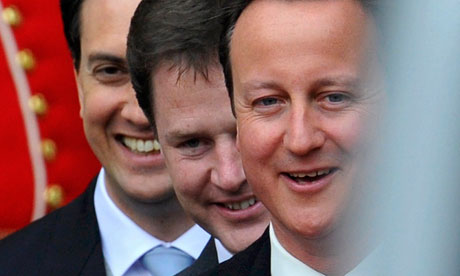
Britain's political leaders Nick Clegg, David Cameron and Ed Miliband
(L-R) Britain's opposition Labour Party leader Ed Miliband, Deputy Prime Minister Nick Clegg and Prime Minister David Cameron leave after the wedding ceremony of Prince William and Kate Middleton at Westminster Abbey, in central London, April 29, 2011. Photograph: Toby Melville/Reuters
What do the watery eyes of Nick Clegg and the resurfacing of Tony Blair mean? How many more pictures of a man with a pint of beer can anyone bear? Has a whole political class lost the election? What can be done to end their misery? Here are a dozen suggestions as to how politicians might do better ...
1 Forget this talk of reconnection with voters – it sounds stalkerish. Most people have never had a relationship with a political party in the first place. How come politicians carry on as if we were married to them? At what stage in politicians' careers, I often wonder, did they become so surrounded by like-minded people that they didn't notice that we left them long ago?
I learned this salutary lesson when I was working for a small but influential political monthly. Our circulation was smaller than that of Metal Detecting Weekly. Politics as it is practised is regarded by many as a similarly odd hobby. Only without the fun of going round a beach with headphones on.
2 If all political careers end in failure, then perhaps they all start with beliefs? These folk are sucked into a system in which those beliefs are so compromised, they become unintelligible to much of the electorate, who would be hard-pressed to say what their MP actually stands for. Anyone who appears to believe something or "be real" stands out. This is now called "character", as if having a set of extremely rightwing views is actually a sign of amazing individualism under a Tory government. Thus Miliband's current gig – "I feel your racist pain" – is never going to work. Coming from a guy whose parents fled fascism, it is painful. You can't outflank a single-issue politician by accepting their belief system.
3 The so-called "professionalising" of politics is widely despised. No one should become an MP without having done other jobs. The media doesn't count as a job! The small genetic pool of Oxbridge PPE types is bound to produce intellectually inbred and inferior thinkers. This is fine if we want cloned technocrats – but shouldn't we want the democracy that represents us to look like us?.
4 No one should stand for a seat in a place to which they have no connection. Why on earth should ambitious Londoners be helicoptered into safe seats? I have heard talk that the standard of MPs would drop if it were left to local talent alone. Yes, really.
5 Language: the terrible fear of actually saying something results in verbless slogans and expensive logos. Hardworking Britain Better Off, for instance, appears as if it were the result of a brainstorming session that had to be abandoned halfway through as a fire alarm went off. The making up of new phrases should always ring alarm bells. If you can't tell voters who you are and what you want to do with the pre-existing vocabulary and vernacular of the entire English language, surely that's not good.
6 Be honest about what you can and cannot do. Climate change and inequality are global problems. The idea that any economy can survive on its own is clearly nuts, as is the idea that children need to be schooled as if it were the 1950s. No man is an island, not even Nigel Farage. Because nowadays no island is an island.
7 Get with the programme. Alongside loss of reverence for politicians has been a flattening of media hierarchy due to social media. It no longer works to think of us as passive consumers of politics produced from on high. Unless, of course, you are the BBC,which covered the Euro elections as if none of us could use a calculator, thus calling it for Ukip from the very start.
This is a huge turnoff and though we perk up to any signs of actual leadership, whole swathes of debate are happening completely outside the traditional forums.
8 Spit it out. Much feels like a charade if policies are spun. What does a smaller state mean if not privatisation? Why not spell out the need to regulate big business instead of pretending market processes will self-adjust? Why has so little changed with the banking system? Don't underestimate those you seek to represent. We understand the need for regulation and safety nets.
9 Jokes. If they haven't occurred to you, then don't pay a committee to write them into your speeches. Even when professional comedians are involved, there is nothing more offputting than the phrase "topical comedy".
10 Media training. Don't go there. We can spot it a mile off. I blame Bill Clinton and his famous handshake that involved clasping your elbow with his free hand. I have always experienced media-trained politicians as strangely unsuccessful gropers with inappropriate smiles who practise unblinking eye contact.
11 Real life. This means more than two children and a wife who went to Zara and the claim you once liked a CD. Hinterland remains an undervalued asset. We are currently governed by those for whom culture and education is everything to do with getting a better job and nothing to do with having a better life.
12 Don't blame us. The disenchantment of the electorate means that the political class has to change or be changed. It's no use them crying, Sunset Boulevard style: "I am big. It's the politics that got small." The reality is that they have shrunk themselves into a self-regarding circle jerk propped up by a lazy media, just when the problems actually became epic. If they won't be part of the solution, they are part of the problem.


Wednesday, 28 May 2014

It's simple. If we can't change our economic system, our number's up


It's the great taboo of our age – and the inability to discuss the pursuit of perpetual growth will prove humanity's undoing
'The mother narrative to all this is carbon-fuelled expansion. Our ideologies are mere subplots.'
'The mother narrative to all this is carbon-fuelled expansion. Our ideologies are mere subplots.' Photograph: Alamy
Let us imagine that in 3030BC the total possessions of the people of Egypt filled one cubic metre. Let us propose that these possessions grew by 4.5% a year. How big would that stash have been by the Battle of Actium in 30BC? This is the calculation performed by the investment banker Jeremy Grantham.
Go on, take a guess. Ten times the size of the pyramids? All the sand in the Sahara? The Atlantic ocean? The volume of the planet? A little more? It's 2.5 billion billion solar systems. It does not take you long, pondering this outcome, to reach the paradoxical position that salvation lies in collapse.
To succeed is to destroy ourselves. To fail is to destroy ourselves. That is the bind we have created. Ignore if you must climate change, biodiversity collapse, the depletion of water, soil, minerals, oil; even if all these issues miraculously vanished, the mathematics of compound growth make continuity impossible.
Economic growth is an artefact of the use of fossil fuels. Before large amounts of coal were extracted, every upswing in industrial production would be met with a downswing in agricultural production, as the charcoal or horse power required by industry reduced the land available for growing food. Every prior industrial revolution collapsed, as growth could not be sustained. But coal broke this cycle and enabled – for a few hundred years – the phenomenon we now call sustained growth.
It was neither capitalism nor communism that made possible the progress and pathologies (total war, the unprecedented concentration of global wealth, planetary destruction) of the modern age. It was coal, followed by oil and gas. The meta-trend, the mother narrative, is carbon-fuelled expansion. Our ideologies are mere subplots. Now, with the accessible reserves exhausted, we must ransack the hidden corners of the planet to sustain our impossible proposition.
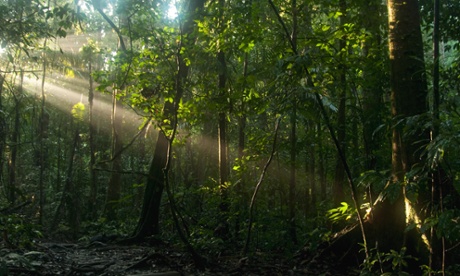
On Friday, a few days after scientists announced that the collapse of the west Antarctic ice sheet is now inevitable, the Ecuadorean government decided to allow oil drilling in the heart of the Yasuni national park. It had made an offer to other governments: if they gave it half the value of the oil in that part of the park, it would leave the stuff in the ground. You could see this as either blackmail or fair trade. Ecuador is poor, its oil deposits are rich. Why, the government argued, should it leave them untouched without compensation when everyone else is drilling down to the inner circle of hell? It asked for $3.6bn and received $13m. The result is that Petroamazonas, a company with a colourful record of destruction and spills, will now enter one of the most biodiverse places on the planet, in which a hectare of rainforest is said to contain more species than exist in the entire continent of North America.
Almost 45% of the Yasuni national park is overlapped by oil concessions.  Yasuni national park. Murray Cooper/Minden Pictures/Corbis

The UK oil firm Soco is now hoping to penetrate Africa's oldest national park, Virunga, in the Democratic Republic of Congo; one of the last strongholds of the mountain gorilla and the okapi, of chimpanzees and forest elephants. In Britain, where a possible 4.4 billion barrels of shale oil has just been identified in the south-east, the government fantasises about turning the leafy suburbs into a new Niger delta. To this end it's changing the trespass laws to enable drilling without consent and offering lavish bribes to local people. These new reserves solve nothing. They do not end our hunger for resources; they exacerbate it.
The trajectory of compound growth shows that the scouring of the planet has only just begun. As the volume of the global economy expands, everywhere that contains something concentrated, unusual, precious, will be sought out and exploited, its resources extracted and dispersed, the world's diverse and differentiated marvels reduced to the same grey stubble.
Some people try to solve the impossible equation with the myth of dematerialisation: the claim that as processes become more efficient and gadgets are miniaturised, we use, in aggregate, fewer materials. There is no sign that this is happening. Iron ore production has risen 180% in 10 years. The trade body Forest Industries tells us that "global paper consumption is at a record high level and it will continue to grow". If, in the digital age, we won't reduce even our consumption of paper, what hope is there for other commodities?
Look at the lives of the super-rich, who set the pace for global consumption. Are their yachts getting smaller? Their houses? Their artworks? Their purchase of rare woods, rare fish, rare stone? Those with the means buy ever bigger houses to store the growing stash of stuff they will not live long enough to use. By unremarked accretions, ever more of the surface of the planet is used to extract, manufacture and store things we don't need. Perhaps it's unsurprising that fantasies about colonising space – which tell us we can export our problems instead of solving them – have resurfaced.
As the philosopher Michael Rowan points out, the inevitabilities of compound growth mean that if last year'sthe predicted global growth rate for 2014 (3.1%) is sustained, even if we miraculously reduced the consumption of raw materials by 90%, we delay the inevitable by just 75 years. Efficiency solves nothing while growth continues.
The inescapable failure of a society built upon growth and its destruction of the Earth's living systems are the overwhelming facts of our existence. As a result, they are mentioned almost nowhere. They are the 21st century's great taboo, the subjects guaranteed to alienate your friends and neighbours. We live as if trapped inside a Sunday supplement: obsessed with fame, fashion and the three dreary staples of middle-class conversation: recipes, renovations and resorts. Anything but the topic that demands our attention.
Statements of the bleeding obvious, the outcomes of basic arithmetic, are treated as exotic and unpardonable distractions, while the impossible proposition by which we live is regarded as so sane and normal and unremarkable that it isn't worthy of mention. That's how you measure the depth of this problem: by our inability even to discuss it.

Tuesday, 27 May 2014

Thomas Piketty's real challenge was to the FT's Rolex types


If the FT's attack on the radical economist's 'rising inequality' thesis is right, then all the gross designer bling in its How To Spend It section can be morally justified
Rolex watch
The adverts in the FT and other reputable papers – mainly for large watches, first-class air travel, portable fine art etc – should be collectively retitled How To Hide It
Thomas Piketty's Capital was still No 3 on the Amazon bestseller list when the Financial Times dropped its front-page bombshell. By picking through the spreadsheets the "rock-star French economist" had placed online, the FT concluded that his key data appeared to be "constructed out of thin air".
Piketty's claim that inequality in the west has risen since the 1970s is wrong, says the FT's Chris Giles. And on this basis, Piketty's view that rising inequality is the central contradiction of capitalism, and will get worse, is also wrong.
It is always right to trawl through data. There is so much grossing and smoothing in economics, and so little of the realtime peer review that happens in science, that data should always be challengable. But the gleeful response to Piketty's "errors" on the rightwing Twittersphere did not happen because some FT pointy-heads discovered a few fat-finger inputs. It happened because, if Giles is right, then all the gross designer bling advertised in the FT's How To Spend It can be morally justified: it is evidence of rising social wealth in general, not the excess of a few Rolex types.
But the attack does not quite come off. For Sweden and France, the FT's conclusions barely diverge from Piketty's. For Britain and the US they do: the official figures capture the general curve of inequality downwards in the mid-20th century, but shatter into incoherence after 1970, failing to match Piketty's claim that wealth inequalities have increased.
There is an obvious reason for this: since time immemorial the rich have been averse to declaring their wealth. But after 1979 capitalism was restructured to promote wealth accumulation, ending the "euthanasia of the rentier" Keynes had designed into the postwar system.
Unlike income, which has been vigorously taxed since the mid-19th century and therefore recorded, personal wealth was, after 1979, the subject of a half-hearted cat-and-mouse game in which the cat and the mouse were wont to share yachting trips to the Aegean on a regular basis. That's why the work of Piketty and his collaborators had to be based on a mixture of inheritance tax data and surveys, plus a large amount of calculation.
Piketty's figures show a clear upward trend to inequality in the UK since the 70s; the FT's preferred official data dissolves into a series of squiggles that show nothing conclusive. And let's be clear why: the HMRC currently estimates that the top 10% of the population own 70% of the wealth, while the Office for National Statistics thinks they own just 44%. The discrepancy occurs because, of course, there is neither requirement nor desire to record actual market wealth at all. There are only inheritance tax returns on estates big enough to pay it.
The old Inland Revenue figures for UK wealth were so wonky that they abandoned efforts to calculate them: but in their last attempt (2005) they said that on top of £3.4tn "identified" wealth in the UK, a further £1.7tn had to be assumed that was either not declared or belonged to people who slipped through the net.
For this reason one of Piketty's key demands is the automatic sharing of bank information between states and banks. The principle is simple, he writes: "National tax authorities should receive all the information they need to calculate the net wealth of every citizen." Why that might be needed is understood if you flick through the wealth management magazines produced by the FT and other reputable papers. The adverts – mainly for large watches, first-class air travel, portable fine art, tax haven accountants and capacious luggage – deliver a clear subliminal message. They should be collectively retitled "How To Hide It".
In the end, Piketty did not claim there had been a vast increase in wealth disparities since the 1970s. Piketty's prediction is that the moderate rise in inequality under neoliberalism is set to gather pace in the 21st century, taking us back to Victorian levels by 2050. His prediction is based on simple maths: if growth is low, and the bargaining power of labour low, and the returns on capital high, then it is more logical to sit on assets and speculate rather than accumulate wealth by work, invention or entrepreneurial risk.
Piketty asks the question that mainstream economics doesn't want to answer: do we want a society based on work and ingenuity or on rent?
It's not an academic question. Figures from Lloyds Private Bank show UK asset wealth grew from £4.7tn to £7.8tn in the decade to 2013, with most of that generated by the rising value of financial portfolios, and all wealth growing faster than incomes and inflation. If Piketty's figures are wrong, the probable cause – beyond the odd transcription error – is a mild overestimation of a clear trend, generated in an attempt to uncover modern capitalism's guilty secret. If the FT's figures are wrong, it is because they rely on those of governments that have become – as Peter Mandelson once put it – "intensely relaxed about people becoming filthy rich".
But the most important question is the future: if Piketty is right then we have to "euthanase" the rentier class all over again. Only taxes on current wealth – and an end to opaque "wealth management" trails that end up in Switzerland or Cyprus – will prevent capitalism generating levels of social inequality that destroy it.
Paul Mason is economics editor at Channel 4 News and the author of Why It's Kicking Off Everywhere.

Sunday, 25 May 2014

10 Reasons To Love Uruguay's José Mujica, World's Poorest President


By Medea Benjamin in Countercurrents
18 May, 2014
Huffington Post

President José Mujica of Uruguay, a 78-year-old former Marxist guerrilla who spent 14 years in prison, mostly in solitary confinement, recently visited the United States to meet with President Obama and speak at a variety of venues. He told Obama that Americans should smoke less and learn more languages. He lectured a roomful of businessmen at the U.S. Chamber of Commerce about the benefits of redistributing wealth and raising workers' salaries. He told students at American University that there are no "just wars." Whatever the audience, he spoke extemporaneously and with such brutal honesty that it was hard not to love the guy. Here are 10 reasons you, too, should love President Mujica.


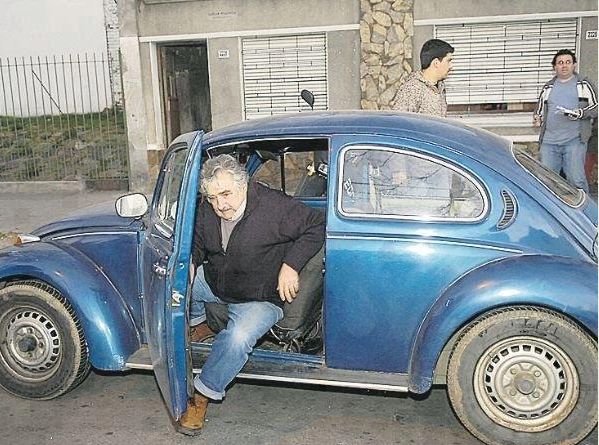
1. He lives simply and rejects the perks of the presidency. Mujica has refused to live at the Presidential Palace or have a motorcade. He lives in a one-bedroom house on his wife's farm and drives a 1987 Volkswagen. "There have been years when I would have been happy just to have a mattress," said Mujica, referring to his time in prison. He donates over 90 percent of his $12,000/month salary to charity so he makes the same as the average citizen in Uruguay. When called "the poorest president in the world," Mujica says he is not poor. "A poor person is not someone who has little but one who needs infinitely more, and more and more. I don't live in poverty, I live in simplicity. There's very little that I need to live."

2. He supported the nation's groundbreaking legalization of marijuana. "In no part of the world has repression of drug consumption brought results. It's time to try something different," Mujica said. So this year, Uruguay became the first country in the world to regulate the legal production, sale, and consumption of marijuana. The law allows individuals to grow a certain amount each year and the government controls the price of marijuana sold at pharmacies. The law requires consumers, sellers, and distributors to be licensed by the government. Uruguay's experience aims to take the market away from the ruthless drug traffickers and treat drug addiction as a public health issue. Their experiment will have reverberations worldwide.

3. In August 2013, Mujica signed the bill making Uruguay the second nation in Latin America (after Argentina) to legalize gay marriage. He said that legalizing gay marriage is simply recognizing reality. "Not to legalize it would be unnecessary torture for some people," he said. In recent years, Uruguay has also moved to allow adoption by gay couples and openly gay people to serve in the armed forces.

4. He's not afraid to confront corporate abuses, as evidenced by the epic struggle his government is waging against the American tobacco giant Philip Morris. A former smoker, Mujica says that tobacco is a killer that needs to be brought under control. But Philip Morris is suing Uruguay for $25 million at the World Bank's International Center for Settlement of Investment Disputes because of the country's tough smoking laws that prohibit smoking in enclosed public spaces and require warning labels, including graphic images of the health effects. Uruguay is the first Latin American country and the fifth nation worldwide to implement a ban on smoking in enclosed public places. Philip Morris, the largest cigarette manufacturer in the United States, has huge global business interests (and a well-paid army of lawyers). Uruguay's battle against the tobacco Goliath will also have global repercussions.

5. He supported the legalization of abortion in Uruguay (his predecessor had vetoed the bill). The law is very limited, compared to laws in the U.S. and Europe. It allows abortions within the first 12 weeks of the pregnancy and requires women to meet with a panel of doctors and social workers on the risks and possible effects of an abortion. But this law is the most liberal abortion law in socially conservative, Catholic Latin America and is clearly a step in the right direction for women's reproductive rights.

6. He's an environmentalist trying to limit needless consumption. At the Rio+20 Summit in 2012, he criticized the model of development pushed by affluent societies. "We can almost recycle everything now. If we lived within our means -- by being prudent -- the 7 billion people in the world could have everything they needed. Global politics should be moving in that direction," he said. He also recently rejected a joint energy project with Brazil that would have provided his country with cheap coal energy because of his concern for the environment.

7. He has focusing on redistributing his nation's wealth, claiming that his administration has reduced poverty from 37 percent to 11 percent. "Businesses just want to increase their profits; it's up to the government to make sure they distribute enough of those profits so workers have the money to buy the goods they produce," he told businessmen at the U.S. Chamber of Commerce. "It's no mystery -- the less poverty, the more commerce. The most important investment we can make is in human resources." His government's redistributive policies include setting prices for essential commodities such as milk and providing free computers and education for every child.

8. He has offered to take detainees cleared for release from Guantanamo. Mujica has called the detention center at Guantanamo Bay a "disgrace" and insisted that Uruguay take responsibility to help close the facility. The proposal is unpopular in Uruguay, but Mujica, who was a political prisoner for 14 years, said he is "doing this for humanity."

9. He is opposed to war and militarism. "The world spends $2 billion a minute on military spending," he exclaimed in horror to the students at American University. "I used to think there were just, noble wars, but I don't think that anymore," said the former armed guerrilla. "Now I think the only solution is negotiations. The worst negotiation is better than the best war, and the only way to insure peace is to cultivate tolerance."


10. He has an adorable three-legged dog, Manuela! Manuela lost a foot when Mujica accidentally ran over it with a tractor. Since then, Mujica and Manuela have been almost inseparable.
Mujica's influence goes far beyond that of the leader of a tiny country of only 3 million people. In a world hungry for alternatives, the innovations that he and his colleagues are championing have put Uruguay on the map as one of the world's most exciting experiments in creative, progressive governance.

Thomas Piketty's economic data 'came out of thin air'


French economist's bestselling book on growing inequality in west undermined by 'inexplicable' data, says Financial Times
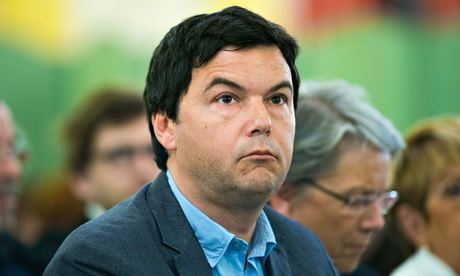
French economist Thomas Piketty
French economist Thomas Piketty says his data can be improved but the conclusion on growing inequality is unlikely to change. Photograph: Rex Features
Only a few days ago, the "rock star" economist Thomas Piketty had the world at his feet. He had lectured at the White House, the International Monetary Fund and the United Nations.
His 577-page Capital in the Twenty-First Century, an unexpected bestseller, was economics' answer to The Da Vinci Code. Based on a simple premise – that the dynamics of wealth accumulation are causing global inequality levels to widen – it was lauded by economists and business leaders alike.
Lord Turner, the former chairman of the Financial Services Authority, described Capitalas "a remarkable piece of work," while the Nobel prizewinning economist, Paul Krugman, writing in the New York Review of Books, said Piketty's work will "change both the way we think about society and the way we do economics".
Now, in a move that has delighted his manifold critics on the right, who view Piketty's tome as a dangerous, modern-day successor to Karl Marx's Das Kapital, the 43-year-old French economist has found himself attracting a less welcome form of attention. The Financial Times has suggested that Piketty's work contains a series of errors that appear to fatally undermine large parts of his thesis. The normally restrained paper claims that some of the data Piketty uses to support his arguments about yawning inequality in Britain and Europe are dubious or inexplicable. Some of this, the paper suggests, may be down to straightforward transcription errors. More damningly, the FTclaims, "some numbers appear simply to be constructed out of thin air".
The paper goes as far as to suggest its findings are similar to those last year that undermined the work of the Harvard economists, Carmen Reinhart and Kenneth Rogoff, which analysed the relationship between growth and debt and was subsequently found to have been based on a flawed spreadsheet.
Bloomberg described the claims as a bombshell and there has been no shortage of commentators suggesting the story is huge. Some on the right have also been gleeful, suggesting the FT's story will scupper Piketty's chances of landing a Nobel prize. But, as the dust settles, even many of his critics have been reluctant to claim that Piketty has been left badly wounded by an impenetrable row over the selection and interpretation of data, nor do they accept that the FT's claims have done much to damage his over-arching thesis.
Piketty himself told the FT: "I have no doubt that my historical data series can be improved and will be improved in the future … but I would be very surprised if any of the substantive conclusion about the long-run evolution of wealth distributions was much affected by these improvements." It was Piketty who made the data freely available so that others could check his work and influential publications and think tanks have given him their backing.
The Economist concluded that "analysis does not seem to support many of the allegations made by the FT, or the conclusion that the book's argument is wrong".
If anything the row has fuelled further interest in a book that is still in Amazon's top 20 and has reportedly sold more than 200,000 copies, an unprecedented amount for an economics book.
Declan Gaffney, writing on the Institute for Public Policy Research blog, concluded: "No doubt that framework will be modified over time in the light of new evidence and theory, but it seems likely that we will be looking at wealth concentration and broader aspects of economic and social change through the lens of Capital for a long time to come."
For the lay person attempting to referee the row, and having to interpret such abstruse concepts as the Gini coefficient and, as Gaffney neatly summarises, whether "the r > g inequality is amplifying the reconcentration trend", illumination is hard to discern. For its critics, further confirmation of why economics is called the dismal science.

Saturday, 24 May 2014

The Problem with the Pankaj Mishras and Arundhati Roys of Indophiles

Omar Ali in Outlook India


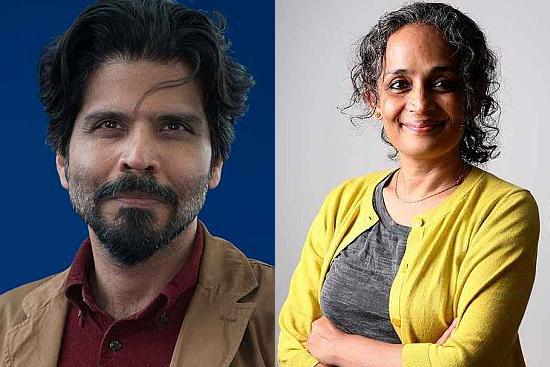
Pankaj Mishra and Arundhati Roy have both spoken by now about the election results in India and if you are a Modi voter, you are likely not too happy with their views. I would like to suggest that if you are not a Modi voter, you should also be a bit unhappy at how much attention these particular writers get as “the voice of the Left/Liberal/Secular side of India”. I really think that far too many highly educated South Asian people read Pankaj Mishra, Arundhati Roy and their ilk.

Obviously, I also believe far too many people in the Western elite read them, but at least their admiration is more understandable. They need native informants who can reinforce their preconceived notions and if these native informants helpfully repeat the Western Left’s own pet theories back to them, so much the better. That is not my main concern today. 

I am concerned that too many good, intelligent Desi people who want to make a positive contribution to their societies and whose elite status puts them in a position to do so are lost to useful causes because they have been enthralled by fashionable writers like Pankaj Mishra, Arundhati Roy and Tariq Ali (heretofore shortened to Pankajism, with any internal disagreements between various factions of the People’s Front of Judea being ignored).
The opportunity cost of this mish-mash of Marxism-Leninism, postmodernism, “postcolonial theory”, environmentalism and emotional massage (not necessarily in that order) is not trivial for liberals and leftists in the Indian subcontinent. It's worth noting that there is no significant market for Pankajism in China or Korea for advice about their own societies, though they may use it as an anti-imperialist propaganda tool should the need arise; a fact that may have a tiny bearing on some of the difference between China and India.

I believe the damage extends beyond self-identified liberals and leftists; variants of Pankajism are so widely circulated within the English speaking elites of the world that they seep into our arguments and discussions without any explicit acknowledgement or awareness of their presence. 

What I present below is not a systematic theses (though it is, among other things, an appeal to someone more academically inclined to write exactly such a thesis) but a conversation starter:

1. There are some people who have what they regard as a Marxist-Leninist worldview. This post is NOT about them. Whether they are right or wrong (and I now think the notion of a violent “people’s revolution” is wrong in some very fundamental ways), there is a certain internal logic to their choices. 

They do not expect electoral politics and social democratic reformist parties to deliver the change they desire, though they may participate in such politics and support such parties as a tactical matter (for that matter they may also support right wing parties if the revolutionary situation so demands). 

They are also very clear about the role of propaganda in revolutionary politics and therefore may consciously take positions that appear simplistic or even silly to pedantic observers, in the interest of the greater revolutionary cause. 

Their choices, their methods and their aims are all open to criticism, but they make some sort of internally consistent sense within their own worldview. In so far as their worldview fails to fit the facts of the world, they have to invent epicycles and equants to fit facts to theory, but that is not the topic today. IF you are a believer in “old fashioned Marxist-Leninist revolution” and regard “bourgeois politics” as a fraud, then this post is not about you.

2. But most of the left-leaning or liberal members of the South Asian educated elite (and a significant percentage of the educated elite in India and Pakistan are left leaning and/or liberal, at least in theory; just look around you) are not self-identified revolutionary socialists. 

I deliberately picked on Pankaj Mishra and Arundhati Roy because both seem to fall in this category (if they are committed “hardcore Marxists” then they have done a very good job of obfuscating this fact). 

Tariq Ali may appear to be a different case (he seems to have been consciously Marxist-Leninist and “revolutionary” at some point), but for all practical purposes, he has joined the Pankajists by now; relying on mindless repetition of slogans and formulas and recycled scraps of conversation to manage his brand. 

If you consider him a Marxist-Leninist (or if he does so himself), you may mentally delete him from this argument.

3. The Pankajists are not revolutionaries, though they like revolutionaries and occasionally fantasize about walking with the comrades (but somehow always make sure to get back to their pads in London or Delhi for dinner). 

They are not avowedly Marxist, though they admire Marx; they strongly disapprove of capitalists and corporations, but they have never said they would like to hang the last capitalist with the entrails of the last priest. 

So are they then social democrats? Perish the thought. They would not be caught dead in a reformist social democratic party.

4. They hate how Westernization is destroying traditional cultures, but every single position they have ever held was first advocated by someone in the West (and 99% were never formulated in this form by anyone in the traditional cultures they apparently prefer to “Westernization”). 

In fact most of their “social positions” (gay rights, feminism, etc) were anathema to the “traditional cultures” they want to protect and utterly transform at the same time. They are totally Eurocentric (in that their discourse and its obsessions are borrowed whole from completely Western sources), but simultaneously fetishize the need to be “anti-European” and “authentic”.

Here it is important to note that most of their most cherished prejudices actually arose in the context of the great 20th century Marxist-Leninist revolutionary struggle. e.g. the valorization of revolution and of “people’s war”, the suspicion of reformist parties and bourgeois democracy, the yearning for utopia, and the feeling that only root and branch overthrow of capitalism will deliver it. These are all positions that arose (in some reasonably sane sequence) from hardcore Marxist-Leninist parties and their revolutionary program (good or not is a separate issue), but that continue to rattle around unexamined in the heads of the Pankajists.

The Pankajists also find the “Hindu Right” and its fascist claptrap and its admiration of “strength” and machismo alarming, but Pankaj (for example) admires Jamaluddin Afghani and his fantasies of Muslim power and its conquering warriors so much, he promoted him as one of the great thinkers of Asia in his last book. This too is a recurring pattern. Strong men and their cults are awful and alarming, but also become heroic and admirable when an “anti-Western” gloss can be put on them, especially if they are not Hindus. i.e. For Hindus, the approved anti-Western heroes must not be Rightists, but this second requirement is dropped for other peoples.

They are proudly progressive, but they also cringe at the notion of “progress”. They are among the world’s biggest users of modern technology, but also among its most vocal (and scientifically clueless) critics. Picking up that the global environment is under threat (a very modern scientific notion if there ever was one), they have also added some ritualistic sound bites about modernity and its destruction of our beloved planet (with poor people as the heroes who are bravely standing up for the planet). All of this is partly true (everything they say is partly true, that is part of the problem) but as usual their condemnations are data free and falsification-proof. They are also incapable of suggesting any solution other than slogans and hot air.


Finally, Pankajists purportedly abhor generalization, stereotyping and demagoguery, but when it comes to people on the Right (and by their definition, anyone who tolerates capitalism or thinks it may work in any setting is “Right wing”) all these dislikes fly out of the window. They generalize, stereotype, distort and demonize with a vengeance.
You get the picture...there are emotionally satisfying and fashionable sound bites that sound like they are saying something profound, until you pay closer attention and most of the meaning seems to evaporate. 

My contention is that what remains after that evaporation is pretty much what any reasonable “bourgeois” reformist social democrat would say.

Pankaj and Roy add no value at all to that discourse. And they take away far too much with sloganeering, snide remarks, exaggeration and hot air.

5. This confused mish-mash is then read by “us people” as “analysis”. Instead of getting new insights into what is going on and what is to be done, we come out by the same door as in we went; we come out with our opinions seemingly validated by someone who uses a lot of big words and sprinkles his “analysis” with quotes from serious books. 
We then discuss this “analysis” with friends who also read Pankaj and Arundhati in their spare time. Everyone is happy, but I am going to make the not-so-bold claim that you would learn more by reading The Economist, and you would be harmed less by it. 

6. Pankajism as cocktail party chatter is not a big deal. After all, we have a human need to interact with other humans and talk about our world, and if this is the discourse of our subculture, so be it. But then the gobbledygook makes its way beyond those who only need it for idle entertainment. Real journalists, activists and political workers read it and it helps, in some small way, to further fog up the glasses of all of them. The parts that are useful are exactly the parts you could pick up from any of a number of well informed and less hysterical observers (if you don’t like theEconomist, try Mark Tully). What Pankajism adds is exactly what we do not need: lazy dismissal of serious solutions, analysis uncontaminated by any scientific and objective data, and snide dismissal of bourgeois politics.

7. If and when (and the “when” is rather frequent) reality A fails to correspond with theory A, Pankajists, like Marxists, also have to come up with newer and more complicated epicycles to save the appearances; and we then have to waste endless time learning the latest epicycles and arguing about them. 

All of this while people in India (and to a lesser and more imperfect extent, even in Pakistan) already have a reasonably good constitution and, incompetent and corrupt, but improvable institutions. There are large political parties that attract mass support and participation. There are academics and researchers, analysts and thinkers, creative artists and brilliant inventors, and yes, even sincere conservatives and well-meaning right-wingers. 

I think it may be possible to make things better, even if it is not possible to make them perfect. “People’s Revolution” (which did not turn out well in any country since it was valorized in 1917 as the way to cut the Gordian knot of society and transform night into day in one heroic bound) is not the only choice or even the most reasonable choice. 
Strengthening the imperfect middle is a procedure that is vastly superior to both Left and Right wing fantasies of utopian transformation. The system that exists is probably not irreparably broken and can still avoid falling into fascist dictatorship or complete anarchy, but my point is that even if they system is unfixable and South Asia is due for huge, violent revolution, these people are not the best guide to it.

Look, for example at the extremely long article produced by Pankaj on the Indian elections. This is the opening paragraph:

In A Suitable Boy, Vikram Seth writes with affection of a placid India's first general election in 1951, and the egalitarian spirit it momentarily bestowed on an electorate deeply riven by class and caste: "the great washed and unwashed public, sceptical and gullible", but all "endowed with universal adult suffrage.
Well, was that good? Or bad? Or neither? Were things better then, than they are now? There is also a hint that universal adult suffrage was a bit of a fraud even then. That seems to be the implication, but in typical Pankaj style, this is never really said outright (that may bring up uncomfortable questions of fact). I doubt if any two readers can come up with the same explanation of what he means; which is usually a good sign that nothing has been said.

There follows a description of why Modi and the RSS are such a threat to India. This is a topic on which many sensible things can be said and he says many of them, but even here (where he is on firmer ground, in that there are really disturbing questions to be asked and answered) the urge to go with propaganda and sound bites is very strong. And the secret of Modi’s success remains unclear. 

We learn that development has been a disaster, but that people seem to want more of it. If it has been so bad, why do they want more of it? Because they lack agency and are gullible fools led by the capitalist media? If people do not know what is good for them, and they have to be told the facts by a very small coterie of Western educated elite intellectuals, then what does this tell us about “the people”? And about Western education?

Supporters will say Pankaj has raised questions about Indian democracy and especially about Modi and the right-wing BJP that need to be asked. And indeed, he has. But here is my point: the good parts of his article are straightforward liberal democratic values. Mass murder and state-sponsored pogroms are wrong in the eyes of any mainstream liberal order. If an elected official connived in, or encouraged, mass murder, then this is wrong in the eyes of the law and in the context of routine bourgeois politics. That politics does provide mechanisms to counter such things, though the mechanisms do not always work (what does?). 

But these liberal democratic values are the very values Pankaj holds in not-so-secret contempt and undermines with every snide remark. It may well be that “a western ideal of liberal democracy and capitalism” Is not going to survive in India. But the problem is that Pankaj is not even sure he likes that ideal in the first place. In fact, he frequently writes as if he does not. But he is always sufficiently vague to maintain deniability. There is always an escape hatch. He never said it cannot work. But he never really said it can either... 

To say “I want a more people friendly democracy” is to say very little. What exactly is it that needs to change and how in order to fix this model? These are big questions. They are being argued over and fought out in debates all over the world. I am not belittling the questions or the very real debate about them. But I am saying that Pankajism has little or nothing to contribute to this debate. 

Read him critically and it soon becomes clear that he doesn’t even know the questions very well, much less the answers... But he always sounds like he is saying something deep. And by doing so, he and his ilk have beguiled an entire generation of elite Westernized Indians (and Pakistanis, and others) into undermining and undervaluing the very mechanisms that they actually need to fix and improve. It has been a great disservice.
By the way, the people of India have now disappointed Pankaj so much (because 31% of them voted for the BJP? Is that all it takes to destroy India?) that he went and dug up a quote from Ambedkar about the Indian people being “essentially undemocratic”. I can absolutely guarantee that if someone on the right were to say that Indians are essentially undemocratic, all hell would break loose in Mishraland.
See this paragraph: 
In many ways, Modi and his rabble – tycoons, neo-Hindu techies, and outright fanatics— are perfect mascots for the changes that have transformed India since the early 1990s: the liberalisation of the country's economy, and the destruction by Modi's compatriots of the 16th-century Babri mosque in Ayodhya. Long before the killings in Gujarat, Indian security forces enjoyed what amounted to a licence to kill, torture and rape in the border regions of Kashmir and the north-east; a similar infrastructure of repression was installed in central India after forest-dwelling tribal peoples revolted against the nexus of mining corporations and the state. The government's plan to spy on internet and phone connections makes the NSA's surveillance look highly responsible. Muslims have been imprisoned for years without trial on the flimsiest suspicion of "terrorism"; one of them, a Kashmiri, who had only circumstantial evidence against him, was rushed to the gallows last year, denied even the customary last meeting with his kin, in order to satisfy, as the supreme court put it, "the collective conscience of the people".
Many of these things have indeed happened (most of them NOT funded by corporations or conducted by the BJP incidentally) but their significance, their context and, most critically, the prognosis for India, are all subtly distorted. Mishra is not wrong, he is not even wrong. To try and take apart this paragraph would take up so much brainpower that it is much better not to read it in the first place. There are other writers (on the Left and on the Right) who are not just repeating fashionable sound bites. Read them and start an argument with them. Pankajism is not worth the time and effort. There is no there there…

PS: I admit that this article has been high on assertions and low on evidence. But I did read Pankaj Mishra’s last (bestselling) book and wrote a sort of rolling review while I was reading it. It is very long and very messy (I never edited it), but it will give you a bit of an idea of where I am coming from. You can check it out at this link: Pankaj Mishra’s tendentious little book

Thursday, 22 May 2014

How Modi defeated liberals like me

Shiv Visvanathan in The Hindu


What secularism did was it enforced oppositions in a way that the middle class felt apologetic and unconfident about its beliefs, its perspectives. Secularism was portrayed as an upwardly mobile, drawing room discourse they were inept at


On May 17, Narendra Modi revisited Varanasi to witness a pooja performed at the Kashi Vishwanath temple. After the ritual at the temple, he moved to Dashashwamedh ghat where an aarti was performed along the river. The aartiwas more than a spectacle. As a ritual, it echoed the great traditions of a city, as a performance it was riveting. As the event was relayed on TV, people messaged requesting that the event be shown in full, without commentary. Others claimed that this was the first time such a ritual was shown openly. With Mr. Modi around, the message claimed “We don’t need to be ashamed of our religion. This could not have happened earlier.”
At first the message irritated me and then made me thoughtful. A colleague of mine added, “You English speaking secularists have been utterly coercive, making the majority feel ashamed of what was natural.” The comment, though brutal and devastating, was fair. I realised at that moment that liberals like myself may be guilty of something deeper.
At the same time moment, some Leftists were downloading a complete set of National Council of Educational Research and Training (NCERT) textbooks fearing that the advent of Mr. Modi may lead to the withdrawal of these books. The panic of some academics made them sound paranoid and brittle, positing a period of McCarthyism in India. It also brought into mind that both Right and Left have appealed to the state to determine what was correct history. With the advent of the Right, there is now a feeling that history will become another revolving door regime where the official and statist masquerade as the truth.
Secularism as a weapon

I am raising both sets of fear to understand why Left liberals failed to understand this election. Mr. Modi understood the anxieties of the middle class more acutely than the intellectuals. The Left intellectuals and their liberal siblings behaved as a club, snobbish about secularism, treating religion not as a way of life but as a superstition. It was this same group that tried to inject the idea of the scientific temper into the constitutions as if it would create immunity against religious fears and superstitions. By overemphasising secularism, they created an empty domain, a coercive milieu where ordinary people practising religion were seen as lesser orders of being.
Secularism became a form of political correctness but sadly, in electoral India it became an invidious weapon. The regime used to placate minorities electorally, violating the majoritarian sense of fairness. In the choice between the parochialism of ethnicity and the secularism of citizenship, they veered toward ethnicity. It was a strange struggle between secularism as a form of piety or political correctness and people’s sense of religiosity, of the cosmic way religion impregnated the everydayness of their lives. The majority felt coerced by secular correctness which they saw either as empty or meaningless. Yet, they correctly felt that their syncretism was a better answer than secularism. Secularism gave one three options. The first was the separation from Church and State. This separation meant an equal distance from all religions or equal involvement in all religions. There was a sense that the constitution could uphold the first but as civilisations, as communities we were syncretic and conversational. One did not need a parliament of religions to be dialogic. Indian religions were perpetually dialogic. The dialogue of medical systems where practitioners compared their theologies, their theories and their therapies was one outstanding and constructive example.
There was a secondary separation between science and religion in the secular discourse. Yet oddly, it was Christianity that was continuously at odds with science while the great religions were always open to the sciences. Even this created a form of coerciveness, where even scientists open to religion or ritual were asked to distance themselves from it. The fuss made about a scientist coming to office after Rahukalam or even discouraging them from associating themselves with a godman like Sai Baba was like a tantrum. There is a sense of snobbery and poetry but more, there is an illiteracy here because religion, especially Christianity shaped the cosmologies of science. In many ways, Ecology is an attempt to reshape and reinvent that legacy.
Tapping into a ‘repression’

What secularism did was it enforced oppositions in a way that the middle class felt apologetic and unconfident about its beliefs, its perspectives. Secularism was portrayed as an upwardly mobile, drawing room discourse they were inept at. Secularism thus became a repression of the middle class. For the secularist, religion per se was taboo, permissible only when taught in a liberal arts or humanities class as poetry or metaphor. The secularist misunderstood religion and by creating a scientific piety, equated the religious with the communal. At one stroke a whole majority became ill at ease within its world views.
Narendra Modi sensed this unease, showed it was alienating and nursed that alienation. He turned the tables by showing secularism — rather than being a piety or a propriety — was a hypocrisy, or was becoming a staged unfairness which treated minority violations as superior to majoritarian prejudices. He showed that liberal secularism had become an Orwellian club where some prejudices were more equal than others. As the catchment area of the sullen, the coerced, and the repressed became huge, he had a middle class ready to battle the snobbery of the second rate Nehruvian elite. One sensitive case was conversion. The activism of Hindutva groups was treated as sinister but the fundamentalism of other religions was often treated as benign and as a minoritarian privilege. There was a failure of objectivity and fairness and the infelicitous term pseudo-secularism acquired a potency of its own.
While secularism was a modern theory, it was impatient in understanding the processes of being modern. Ours is a society where religion is simultaneously cosmology, ecology, ritual and metaphor. Most of us think and breathe through it. I remember a time when the epidemics of Ganesha statues were drinking milk. Hundreds of believers went to watch the phenomena and came away convinced. I remember talking to an office colleague who returned thrilled at what she had seen. I laughed cynically. She looked quietly and said, “I believe, I have faith, I saw it. You have no faith so why should the Murtitalk to you.” I realised that she felt that I was deprived. She added that the mahant of a temple where the statue had not drank milk had gone into exile and meditation to make up for his inadequacy. I realised at that moment that a lecture on hygroscopy or capillary action (the scientific explanations) would have been inadequate. I could not call her illiterate or superstitious. It was a struggle about different meanings, a juxtaposition of world views where she felt her religion gave her a meaning that my science could not. I was reminded that the great Danish physicist, Niels Bohr had a horseshoe nailed to his door. When Bohr was questioned about it, he commented that it won’t hurt to be there. Bohr had created a Pascalian Wager, content that if the horseshoe brought luck it was a good wager, but equally content that if it was inert it did no harm. I wish I had replied in a similar form to my friend.
For a pluralism of encounters

I realise that in many places in Europe, there has been a disenchantment with religion. I have seen beautiful churches in Holland become post offices as the church confronted a sheer lack of attendance. But India faces no such problem and we have to be careful about transplanting mechanical histories.
Ours is a different culture and it has responded to religion, myth and ritual. The beauty of our science Congress is that it resembles a miniature Kumbh Mela. But more, our religions have never been against science and our state has to work a more pluralistic understanding of these encounters. Secularism cannot be empty space. It has to create a pluralism of encounters and allow for levels of reality and interpretation. Tolerance is a weak form of secularism. In confronting the election, we have to reinvent secularism not as an apologetic or disciplinary space but as a playful dialogue. Only then can we offer an alternative to the resentments that Mr. Modi has thrived on and mobilised. I take hope in the words of one of my favourite scientists, the Dalai Lama. When George Bush was waxing eloquent about Muslims, the Dalai Lama commented on George Bush by saying, “He brings out the Muslim in me.” I think that captures my secular ethic brilliantly and one hopes such insights become a part of our contentious democracy.