Search This Blog

Wednesday, 26 October 2016

In excruciating pain. Unable to sleep. Yet John is still ‘fit for work’

Aditya Chakrabortty in The Guardian
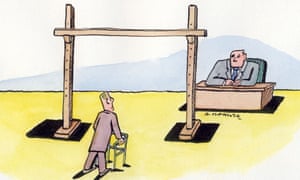
 
Illustration: Andrzej Krauze


John’s world was torn apart on a Monday morning three weeks ago. First came a text message that read: “We will ring you within 2-3 hours to discuss the outcome of your work capability assessment.” Then the phone went. A “decision maker” at the Department for Work and Pensions told John he’d been judged fit for work – despite his extreme pain, despite all his doctors had said. One of the benefits he needed to live on – employment and support allowance – would stop immediately.



Maximus fit-for-work tests fail mental health patients, says doctor


You may have seen the new film I, Daniel Blake; John is living it. Just like Ken Loach’s character, he’s in his late 50s. He too is in no condition to hold down a full-time job, yet has been told by his own government that he must find work. His story tells you that the nightmare depicted by Loach and the scriptwriter Paul Laverty is neither fictional nor historical – but is being visited right now on our friends, our neighbours and us.

Just like Daniel Blake, John is slowly being crushed between the twin forces of a lumbering, unsympathetic, tick-box, brown-envelope bureaucracy, and a Tory government hellbent on slashing social security. The result is that a disabled man is today being forced to look for jobs that he can’t possibly do, purely to get benefits that won’t even keep a roof above his head.

John doesn’t want his full details made public. “A mauling by the rightwing press would be more than I could bear.” But he’s funny, good on Victorian novels and gentler than I would be in his position. His life has been shaped by an attack he suffered one evening in London 30 years ago. It left him in hospital for three months – and with major injuries to his leg, back and shoulder. They’ve got worse over the years, causing him to give up work about 15 years ago. He recently had a knee replacement; doctors are now contemplating a tricky operation on his spine.
He’s on Tramadol and other heavy-duty painkillers, yet even on the best of days he still has constant pins and needles. At other times, “it’s like someone is stamping on my spine in heavy hobnail boots and smashing nails into my feet and up my leg.” Even on sleeping pills, he hasn’t managed more than three hours a night for over 15 years.

This spring the government decided to test John’s capability for work. I’ve seen the forms myself: in his best exam-boy handwriting, John answers the questions with an almost painful trustingness. No exaggeration, no flinching from admitting that he sometimes wets himself. When it came to assessment day, he took along a local councillor, Denise Jones. At the testing centre run by Maximus – the outsourced provider of assessments – he faced the usual robotic questions about whether he could lift an empty box.

Then came the physical examination. The table was so high John can’t believe he managed to climb on it; Jones says he did, just. Both say the effort cost him visible struggle and pain – and both recall that the “healthcare professional” said she didn’t want to examine him. But the report stripping John of his ESA says it was he who “declined examination”.

That’s not the only discrepancy. The report talks of “lower back pain” – nothing about the legs or feet. It claims he can stay in one place for an hour – no mention of John’s need to move every 10-15 minutes. Other details that John and Jones remember coming up – the hours it takes him just to stretch out in the morning; his habit of falling over; the fact his pain is constant – are simply missing. Jones says in puzzlement: “The report looks like it was just cut and paste.”

I put these and several other detailed points to the DWP last week, but was advised on Monday that John’s was now a “historic claim”. Maximus would need to write to the DWP, then await the details to be posted back – a process that could take about a week. “A giant bureaucracy,” the Maximus spokesman said. If that’s how the head of communications for the company at the centre of this bureaucracy sees things, what hope for the likes of John?

I received instead a “generic response”, which states in part: “We will look into the issues raised in this particular case. All of our healthcare professionals – doctors, nurses and physiotherapists – are fully qualified with a minimum of two years’ postgraduate experience and they receive ongoing training.”

None of this helps John, but it’s not meant to. While awaiting the “reconsideration” of his claim, he’s been to the jobcentre and signed a declaration that he can work for 40 hours a week and commute 90 minutes each way. Both claims are a lie – the stupid, necessary lies John must now tell to get money. Perhaps he should have lied like that in the first place, rather than getting into debt just to keep going. This is for a man who doesn’t drink, doesn’t smoke and hasn’t been to the cinema in two years.

His “coach” has lined him up for computer training and a course on how to do a CV. John doesn’t need either, but then this Kafka-meets-IDS bureaucracy in which Britons hand cash to private companies to frustrate other Britons isn’t about what anyone wants or needs. It has more in common with a correctional process – complete with nonsense tasks, the aggressive emphasis on procedure, and the disregard for people. There is only the occasional pinprick of humanity, like the DWP official who at the end of one phone call thanked John “for not shouting at me”.

John’s story is part of a much bigger national process, in which austerity Britain is narrowing down who deserves to live here. On the reject pile go “shirkers”, “benefit tourists” (however many they are), refugees fleeing the bombs of Syria who look insufficiently childlike. And disabled people who, according to the Centre for Welfare Reform, have been hit nine times harder by the Tories’ cuts than has any other group.

Loach’s film ends in defiance. “When you lose your self-respect you’re done for,” says Daniel Blake. But I wonder what it takes to keep your self-respect in a system intent on dehumanising you. I met a couple earlier this year; the husband faced a cut to his disability benefits. Paul Chapman remembered what he’d told his wife, Lisa: “The best thing we can do now is … I’ll clear off and I won’t take my tablets. And it’ll be over then. I won’t be here.” All for the sake of £49 a week.

Denise Jones can see how knackered John is, how often he wells up. “In three weeks, he’s collapsed,” she says. John knows it too. “I don’t want anybody to know how bad this is,” he tells me. “I don’t want anybody to see me so weak. I just feel beaten.” Not for the last time that morning, he breaks down crying.

Tuesday, 25 October 2016

I’m white and working class. I’m sick of Brexiters saying they speak for me

Phil McDuff in The Guardian


Ordinary hard-working people have genuine concerns about immigration, and to ignore immigration is to undemocratically ignore their needs.” Other than the resurgent importance of jam, this is the clearest message we are supposed to take out of Brexit.

So concerned are we that the government’s hands are tied that it must send all the doctors back where they came from. It must crack down on students coming here to get educated in our universities in exchange for money. It must check teenagers’ teeth lest we accidentally extend compassion to a Syrian adult.

Who are “ordinary hard-working people” though? It seems the consensus following Brexit is that they’re the marginalised white working class; the people who have been left behind by modernity, who feel alienated by the “liberal metropolitan elite”. I’m a white man from the north-east, living in strongly Brexit-voting Middlesbrough, so you might expect me to tell you all off for looking down on us from your ivory towers. But the truth is that this outbreak of “the poor proles can’t help it” is both incorrect and patronising.

The working class mostly lack our own voices in the media. Instead, we are reported on. This reporting seems, even now, to believe that the true working-class identity is, as Kelvin MacKenzie put it in the 1980s, “a right old fascist”. Culturally insular, not interested in or smart enough to understand real news, generally afraid of people not like him (it’s always a him).

Migrants and native people of colour are stripped of their right to a working-class identity, and even cast as the enemy of the “real” (ie white) working class. I spoke to Marsha Garratt, a working-class, mixed-race woman who heads up the All In Youth Project, and she was cutting about the “underreporting of positive stories of solidarity between all members of the working class, including ethnic minorities”. Working-class history is migrant history, but we ignore that because it does not match what we believe to be authentic.

Likewise any of us who are white and born here, but refuse to blame migrants for the result of government policies, are cast as the “metropolitan elite” even if we’re earning the same amounts and living in the same towns. Working-class identity becomes necessarily and by definition anti-migrant.


We’re not the only people with concerns. It’s just that everyone else seems to have them on our behalf


Once everyone who doesn’t fit is excluded, those who remain are transformed from real people into weaponised stereotypes to be turned against those who resist the advance of jam-obsessed fascism. Even the complexity within people is stripped out as individuals are merged into a howling mass whom you must “understand” or risk losing your tolerant, liberal credentials.

We’re not the only people with concerns. It’s just that everyone else seems to have them on our behalf, out of the charity of their hearts. The white middle classes are just as likely to be disturbed by brown faces or foreign accents as the white working classes are, but they are generally educated enough to realise they can’t just come out and say it. Working-class poverty, framed as the result of the strains these new arrivals place on our generous social safety net, provides the cover for them to object to immigration even though they are unharmed by it. 

But our other “genuine concerns” – such as school and hospital funding, benefits and disability payments, the crushing of industries that formed the backbones of our local economies – are ignored or dismissed out of hand. They are cast as luxuries, an irresponsible “tax and spend” approach, or they are turned back on us as evidence of our own fecklessness and lack of ambition. When we say “we need benefits to live because you hollowed out our towns in pursuit of a flawed economic doctrine,” we are castigated for being workshy, and told we only have ourselves to blame. If we alter our complaints to blame foreign people it’s a different story. “I can’t get a council house because they’ve all been sold to private landlords,” gets nothing. “I can’t get a council house because they’ve all gone to bloody Muslims,” gets on the front page of the tabloids.

Just as we are given identities as good or bad working-class people based on whether we adequately perform our roles as good little workers or whether we insolently insist on being disabled, unemployed or unionised, so our authenticity as working-class people depends on our use for political ends. Are we salt of the earth yeomen, or skiving thickos milking the system, or drains on the already stretched infrastructure? That all depends: are we kicking out immigrants or privatising a clinic today?

If we only matter to politicians when we can be used as to defend old bigotries about hordes of eastern Europeans stealing our women and poisoning our jam, then we don’t matter at all.

How to be a vice-captain

Brad Haddin in Cricinfo


Wind the clock back to March 2013. I'm boarding a flight home from India with Michael Clarke. He's out of the final Test of that series in Delhi with a back flare-up, while I'm travelling home after being the injury replacement for Matthew Wade in Mohali.

Plenty has gone on in the preceding week or so, the "homework"-related suspensions of Shane Watson, Mitchell Johnson, Usman Khawaja and James Pattinson in particular. So we take the opportunity to speak pretty openly about how the team is functioning, and how unhappy everyone is with the way the Indian tour has panned out, in the way some players have been treated and the mood around the team.

For one thing, expectations of behaviour seem to be driven by management rather than players, and that's something that needs to change.

Mickey Arthur is yet to be replaced by Darren Lehmann, but it's an important conversation in terms of how Michael thinks the team should operate in the coming months. It helps too that having been away from the team for a while, I can see things from an angle Michael isn't seeing. One change in the interim is the much more experienced side chosen for the Ashes tour that follows.

While I did not officially hold the title at the time, that's a good example of how a deputy should operate. Vice-captaincy is a low-profile job that's not fully understood by many, but it is vital to helping get a successful team moving in the right direction together. One bedrock of the gig is to have a deputy committed to that role, rather than thinking about being captain himself. That was certainly the case with me.

The other foundation of the job is a relationship with the captain that allows you to speak frankly with him about where the team is going - in private rather than in front of the team. Keeping an ear to the ground and communicating with other players and then relaying that to the leader when necessary. Having gone back a long way with Michael, we had that sort of dynamic.

These conversations should be honest enough to be able to say, "I don't think this is working, and this is how the group is feeling", or "I think you might have missed this". These aren't always the easiest conversations, but they have to happen from a place of mutual respect. The captain can either take note or disregard it, but the main thing is that he knows how things are tracking when he does make his final call on a given issue. That doesn't happen without a healthy relationship between captain and deputy.

Overall, the role of the vice-captain is to complement what the captain does. Your job is to make sure the younger guys are feeling a part of the team and that they understand the standards that you want to set in the group and that your behaviour is not to be compromised.

You pick up on the little things around the team, like being punctual, wearing the right uniforms and treating people inside and outside the team with respect, and have a quiet word to guys here and there if they need a reminder. That then flows into attention to detail in the middle.

Michael was a very good tactical captain who was always in control on the field. My job, relative to him - and similarly for other senior players - was to make sure the mood of the team was right, and to set standards for the younger guys to follow; to be sure they knew what it meant to be an Australian cricketer. The vice-captain should be the guy to drive that.
Once we got to England in 2013, I took it upon myself to spend time with each player to talk about the brand of cricket we wanted to play and also to make sure guys were talking and reflecting on the game and each other, whether we'd had a good day or a bad day.

We did that after a close loss in the first Test at Trent Bridge and that was a good moment - we weren't retreating into ourselves in defeat. Once again, that flowed well into the success we had later, because guys were talking and enjoying each other's good days, having commiserated through the bad ones.

For a long time in cricket, I think that sort of thing happened pretty organically. But in an era when the game is so professionalised and guys are jetting around playing T20 tournaments when not with Australia or even their domestic teams, it takes thoughtful effort to make sure it still happens. If anything, vice-captaincy has grown in importance for that reason.

I mentioned earlier that one key to the job is not wanting the captaincy.
If you look back through the recent history of Australian cricket, the examples are plentiful. Geoff Marsh was a terrific lieutenant to Allan Border, Ian Healy to Mark Taylor, and Adam Gilchrist to Ricky Ponting.

Once we got to England in 2013, I took it upon myself to spend time with each player to talk about the brand of cricket we wanted to play

They are three contrasting characters, but what they had in common was no great desire to be captain. I saw Gilly's work up close as a junior member of the squad, and he was a terrific link man between the leadership and the team. As fellow glovemen, I also saw how the role behind the stumps gave you a great perspective to support the captain.

There have been other times, of course, when the vice-captain is the heir-apparent. That was the case for Taylor, when he was deputy to AB, for Steve Waugh, when he replaced Heals as vice-captain to Taylor, and for Michael, when he was appointed deputy to Ricky after Gilly retired. All those guys will tell you that it put them in awkward positions at times, not knowing whether to intervene in things or not, whether on or off the field.

Similarly, Watson had a difficult time as Michael's deputy because they did not have the same open relationship to discuss things that I was fortunate enough to have. That's something for Cricket Australia to keep in mind whenever it makes these appointments.

Right now, Steven Smith has an able deputy in David Warner. To me, this relationship should work because, like Michael and I, these two have known each other for years. Davey is growing into the role at present, evolving from his former "attack dog" persona into someone more measured. If he ever wants a reminder of how vice-captaincy should or shouldn't work, he needs only to think back to a year like 2013 and the team's contrasting fortunes.

Monday, 24 October 2016

Batting against the bouncer

Ashley Mallett in Cricinfo


Fast bowlers use the short ball as a legitimate weapon to unsettle any batsman. It is a fair and reasonable tactic that has stood the test of time.

On that terrible day at the SCG in November 2014, Phillip Hughes appeared to misjudge the pace of the ball and looked to be through his hook shot before he was struck in the neck, clear of the protective face of the helmet.

It was a shocking, freak accident and, especially for Phil's family and friends, so terrible in its finality.

In the wake of the Hughes' tragedy there has been a disturbing number of quality batsmen being struck on the helmet. The "hit" list is not dominated by mid- to lower-order batsmen. In recent times players of the calibre of Steven Smith, Shane Watson, Michael Clarke, Chris Rogers and Virat Kohli have copped heavy blows to the helmet.

When looking at footage of the incidents, you see all too clearly that all of the players who were hit were not watching the ball and they were struck on the side of the helmet. 


Just a couple of weeks after Hughes' tragic death, Australia played India at the Adelaide Oval. The ground was packed but the silence was deafening the instant Kohli was hit on the helmet from the first ball he faced from Mitchell Johnson.

Kohli, one of the best and most exciting batsmen in the world, was not watching the ball.

If some of the world's best batsmen are taking their eye off the ball, what's happening to batting technique among the young, emerging cricketers?

All parents want their children to be safe, but just sticking a helmet on them is not the only solution here. Youngsters need to learn to watch the ball like a hawk and to play short-pitched bowling.

Junior coaches everywhere must look at what they are doing. Proper technique against short-pitched bowling starts the day the youngster picks up a cricket bat, eager to learn the game. The Chappells were five years old when they did.

Former Test opening batsman Ashley Woodcock coaches juniors and seniors at University Cricket Club in Adelaide. He learnt the rudiments of batting from his older brother Steve.

"Two basic shots are the backward defence and the forward defence," Woodcock said. "With the modern-day forward press, it makes life difficult to get back and across to a short-pitched delivery. In the days before helmets a batsman had no choice. He had to watch the ball."

Long-time South Australian captain Les Favell used to invite a current State player to accompany him on coaching trips to the country areas. He stressed to the youngsters that "all the attacking shots are linked to two basic shots: the forward and back defence."

When a batsman plays back, the movement is back and across. From that position he can cut, pull or hook. Shots developed from the forward defence are the off and the cover drives and shots off the pads.

Among the list of players who accompanied Favell on those trips were Garry Sobers and Barry Richards. Both men had a back-and-across first movement. Those basic movements are important, all done while never taking your eye off the ball.

Against fast bowling a back-and-across first movement allows the batsman to get in behind the line of flight. If the ball is wide he can allow it to pass, but he can hook a short ball that is passing over leg stump if he is back and across his stumps, with his head inside the line of flight. This technique is terrific because even if he makes a mistake and misses the ball, his head is inside the line and out of harm's way.

England's Colin Cowdrey scored centuries against West Indian speedsters Wes Hall and Charlie Griffith in the early 1960s. He likened the challenge of facing a fast bowler to be akin to a boxer moving his feet swiftly, never taking his eyes off his opponent, easily swaying away from danger.

Ian Redpath, a former Australian Test opener, rarely hooked the ball, yet he scored three centuries in 1975-76 against West Indies, whose attack included Andy Roberts and Michael Holding. Redpath's method was make the West Indies bowlers bowl to him. Anything short, shoulder to head high, he swayed out of the way, waiting for a ball of full length to drive for four. 


Last Friday, during the elimination final of the Matador Cup at Drummoyne Oval, New South Wales opening batsman Daniel Hughes was struck on the side of his helmet as he attempted to hook a short ball from Victoria's Peter Siddle. Hughes fell to his knees as concerned fieldsmen rushed to his side. The medical officer at the ground, Dr John Orchard, immediately ordered Hughes to take a concussion test. After undergoing the test, Hughes (retired hurt on 23) was ruled out of taking further part in the match. A "concussion substitute" (Nick Larkin) took his place.

Fellow NSW batsman Nic Maddinson replaced Hughes in the order. He too was struck a blow on the helmet and was assessed under Cricket Australia's new Concussion and Head Trauma Police by medical staff on the ground and allowed to bat on. He played on and belted a match-winning 86.

These incidents further highlight how dangerous the game has become mainly because of poor technique against short-pitched bowling and batsmen taking their eye off the ball.

Former Test captain Ian Chappell was a good hooker and I can't remember him being hit in the head at any stage of his first-class career.

"When you're quickly on to the front foot it's impossible to get inside the line of the delivery to play the shot more safely," he said.

"I can't believe they [Cricket Australia] held a review of safety and it didn't include the technique of playing the short ball."

Bob Simpson, a former Australian Test opener and captain, was adamant that technique against fast bowling generally seemed to be lacking.

"I think the helmet gives a batsman a false sense of security," he said.

Don Bradman reckoned the most important aspect of batting was to watch the ball. Arguably Australia's best batsman since Bradman, Greg Chappell, nowadays Cricket Australia's talent manager, said the bigger issue is that the helmets are now heavier and cause players to stand more upright to manage that weight.

"This puts their weight back on their heels more than the players of the past who were more on the balls of their feet," Greg said. "They find it harder to change position quickly so they are more prone to get hit than a nimble-footed player.

"The fact that they know that they are less likely to get badly hurt, there is not the same incentive to develop a good method to deal with short balls. We didn't have that luxury so we had to get into a better position.

"The two keys to not getting hit are to be on the balls of your feet and to watch the ball."

In relation to coaching youngsters in the art of batting, Greg suggested starting with a soft ball. "Unlike our father [Martin Chappell], I wouldn't recommend using a hard ball from the start.

"Use a soft ball and include short balls early by getting a youngster to hit to areas. What I mean by hitting to areas is to set the session up anywhere but a net. A tennis court is ideal so the kid has a feeling of space around them, but the ball can't go too far. Apart from ensuring that the grip and stance are comfortable, relaxed and efficient, I wouldn't 'teach' the kid anything else."

Greg advocated setting three "scoring zones" - square of the wicket on the off-side, square of the wicket on the leg side and straight back past the bowler.

"If one can cut, pull and drive, one can be a great player. Think Graeme Pollock - those three shots were all he needed. Every other shot is a derivative of those three anyway."

Greg sets up a coaching session by bowling from the net of a tennis court to the youngster batting on the base line. Scoring zones are from the back corner of the net to mid-pitch both sides. He lobs the ball to the batsman and direct them to a target. For example, if the ball is lobbed full and straight, Greg will say, "Okay son, I want you to hit it to the net straight past me".

If a cut shot to the point boundary is required, the ball is lobbed short and wide of the off stump.

"I include balls bouncing up to chest and head height very early so it becomes part of the whole rather than a separate part of the learning," Greg said.

"Most kids quickly work out that if they shift their body to the off side of the short ball they can hit it hard through the leg-side target area. As they get more proficient, I cramp them for room with more speed to see how they cope. If they have a problem, I ask them what they think the solution is rather than 'telling them what to do. It generally works extremely well and the kids progress quickly."

Martin Chappell gave his three boys this advice: "You have a bat in your hand for one reason and one reason only and that is to score runs. Learn to use the bat properly and you will never get hit."

Greg believes good footwork is nothing more than developing the ability to shift one's body from one position to another to free one's arms to hit the ball to the intended target area.

"This is what Bradman did better than the rest of us," he said.

For the sake of the health of our international and emerging batsmen, let's hope the administrators take heed of the sound advice from three of Australia's batting legends.

By all means, let's have lighter, stronger batting helmets, but the very first step in safety for batsmen against any bowler is to watch the ball.

The ICC can't afford to take its eye off the ball over this safety issue. Safety for batsmen is a global priority. Batsman getting hit on the head - whether while wearing a helmet or not - are vulnerable to serious injury.

Proper technique when playing the short stuff is paramount and every batting coach from the grassroots to the Test arena needs to take heed.