Search This Blog

Tuesday, 20 September 2016

Your new iPhone’s features include oppression, inequality – and vast profit


Aditya Chakrabortty in The Guardian


Human battery hens make Apple’s devices in China. The company, which has a bigger cash pile than the US government, symbolises a broken economic system
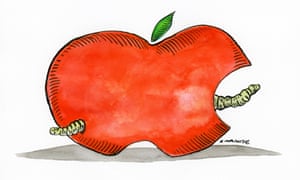
Illustration by Andrzej Krauze


Soon enough, we will see the first obituaries for openness, free trade and globalisation. When those writers ponder how wealthy countries turned towards the politics of Donald Trump and Nigel Farage, they should devote a large chapter to Apple. Because the world’s richest company is a textbook example of how the promises made after the fall of the Berlin Wall have been made a mockery of.

Whatever marvels have been shoved into the new iPhones, the devices serve to increase the gulf between the super-rich and the rest of us, bilk countries of rightful tax revenues, and oppress Chinese workers even while depriving Americans of high-paying jobs. Arrogant towards critics and governments, glutted with cash and yet plainly out of ideas, Apple is elegant shorthand for a redundant economic system.
None of this is how we’re meant to think of Apple, the multinational that is both on your side yet restlessly questing ahead. While launching the iPhone 7 this month, its marketing chief, Phil Schiller, explained why this model came without a earphone socket: “It really comes down to one word: courage. The courage to move on, do something new, that betters all of us.” Such patchouli-scented Californian dipshittery was lapped up by the 7,000-strong crowd and lightly mocked by the press – but it also helps to obscure some of the less tolerable aspect of the iPhone business model, such as the conditions in which it is made.

If you own an iPhone it was assembled by workers at one of three firms in China: Foxconn, Wistron and Pegatron. The biggest and most famous, Foxconn, came to international prominence in 2010 when an estimated 18 of its employees tried to kill themselves. At least 14 workers died. The company’s response was to put up suicide nets, to catch people trying to jump to their death. That year, staff at Foxconn’s Longhua factory made 137,000 iPhones a day, or around 90 a minute.

One of those attempted suicides, a 17-year-old called Tian Yu, flung herself from the fourth floor of a factory dormitory and ended up paralysed from the waist down. Speaking later to academic researchers, she described her working conditions in remarkable testimony that I then covered for the Guardian. She was essentially a human battery hen, working over 12 hours a day, six days a week, swapped between day and night shifts and kept in an eight-person dorm room.

After the scandals of 2010, Apple vowed to improve conditions for its Chinese workers. It has since published a number of glossy brochures extolling its commitments to them. Yet there is no evidence that the Californian firm has given back a single penny of its gigantic profit margins to its contractors to ensure better treatment of the people who actually make its products.

Over the past year, the US-based NGO China Labor Watch has published a series ofinvestigations into Pegatron, another iPhone assembler. It sent a researcher on to the assembly line, interviewed dozens of Pegatron staff and analysed hundreds of pay stubs. Among its findings are that staff still work 12 hours a day, six days a week – one and a half hours of that unpaid. They are forced to do overtime, claims the NGO, and provided with illegally low levels of safety training.

The researcher was working on one iPhone motherboard every 3.75 seconds, standing up for the entirety of his 10.5-hour shift. Such is the punishment endured at Apple’s contractors to make a living wage, apparently.
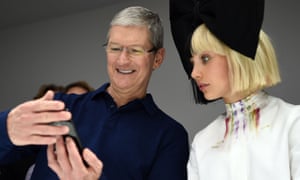

FacebookTwitterPinterest Tim Cook with dancer Maddie Ziegler. The Apple CEO ‘rejects a €13bn tax bill from the EU as ‘political crap’’. Photograph: Josh Edelson/AFP/Getty Images

The Shanghai local government has raised the minimum wage over the past year; Pegatron has responded by cutting subsidies on things such as medical insurance so that the effective hourly pay for its staff has fallen.

When questioned about these reports, Pegatron provided a statement that read in part: “We work hard to make sure every Pegatron facility provides a healthy work environment and allegations suggesting otherwise are simply not true … We have taken effective measures … to ensure employees do not work more than 60 hours per week and six days per week.”

At another of Apple’s major contractors, Wistron, a Danish human-rights NGO last year found extensive evidence of forced student labour. Teenagers doing degrees in accountancy or business management were sent for months to an assembly line at Wistron. This is a serious violation of International Labour Organisationconvention, yet investigators for Danwatch found evidence that thousands of students were doing the same work and backbreaking hours there as the adults – but costing less.

The teenagers told Danwatch that they were working against their will. “We are all depressed,” one 19-year-old girl said. “But we have no choice, because the school told us that if we refused, we would not get our diploma.” Despite several requests for comment, Wistron did not respond.

That investigation was not at a factory making iPhones, but Apple confirmed that Wistron and Pegatron were two of their major assemblers in China. While it did not wish to say anything on the record, Apple’s press officers pointed me to the audits it had commissioned into its supplier factories. Yet the inspections are almost conveniently skimpy.

Look at the report Apple commissioned into Foxconn in 2012, after those suicide attempts. Foxconn is the largest private employer in China, with around 400,000 workers at the Longhua factory alone. Yet the report for Apple, complementary to an investigation already being carried out by the Fair Labor Association, admits to looking at just three of those plants for three days apiece. Jenny Chan, one of the foremost scholars of Chinese labour abuses and co-author of the forthcomingDying for an iPhone, calls it “parachute auditing – a way to allow ‘business as usual’ to carry on”. A very profitable way, as it happens. While iPhone workers for Pegatron saw their hourly pay drop to just $1.60 an hour, Apple remained the most profitable big company in America, pulling in over $47bn in profit in 2015 alone.

What does this add up to? At $231bn, Apple has a bigger cash pile than the US government, but apparently won’t spend even a sliver on improving conditions for those who actually make its money. Nor will it make those iPhones in America, which would create jobs and still leave it as the most profitable smartphone in the world.

It would rather accrue more profits, to go to those who hold Apple stock – such as company boss Tim Cook, whose hoard of company shares is worth $785m. Friends of Cook point to his philanthropy, but while he’s happy to spend on pet projects, he rejects a €13bn tax bill from the EU as “political crap” – whileboasting about how he won’t bring Apple’s billions back to the US “until there’s a fair rate … It doesn’t go that the more you pay, the more patriotic you are.” The tech oligarch seems to think he knows better than 300 million Americans what tax rates their elected government should set.

When the historians of globalisation ask why it died, they will surely find that companies such as Apple form a large part of the answer. Faced with a binary choice between an economic model that lavishly rewarded a few and a populism that makes lavish promises to many, between Cook on the one hand and Farage on the other, the voters went for the one who at least didn’t bang on about “courage”.
Saturday, 17 September 2016

The Intellectual Yet Idiot

by Nassim Nicholas Taleb

What we have been seeing worldwide, from India to the UK to the US, is the rebellion against the inner circle of no-skin-in-the-game policymaking “clerks” and journalists-insiders, that class of paternalistic semi-intellectual experts with some Ivy league, Oxford-Cambridge, or similar label-driven education who are telling the rest of us 1) what to do, 2) what to eat, 3) how to speak, 4) how to think… and 5) who to vote for.

But the problem is the one-eyed following the blind: these self-described members of the “intelligenzia” can’t find a coconut in Coconut Island, meaning they aren’t intelligent enough to define intelligence hence fall into circularities — but their main skill is capacity to pass exams written by people like them. With psychology papers replicating less than 40%, dietary advice reversing after 30 years of fatphobia, macroeconomic analysis working worse than astrology, the appointment of Bernanke who was less than clueless of the risks, and pharmaceutical trials replicating at best only 1/3 of the time, people are perfectly entitled to rely on their own ancestral instinct and listen to their grandmothers (or Montaigne and such filtered classical knowledge) with a better track record than these policymaking goons.


Indeed one can see that these academico-bureaucrats who feel entitled to run our lives aren’t even rigorous, whether in medical statistics or policymaking. They cant tell science from scientism — in fact in their eyes scientism looks more scientific than real science. (For instance it is trivial to show the following: much of what the Cass-Sunstein-Richard Thaler types — those who want to “nudge” us into some behavior — much of what they call “rational” or “irrational” comes from their misunderstanding of probability theory and cosmetic use of first-order models.) They are also prone to mistake the ensemble for the linear aggregation of its components as we saw in the chapter extending the minority rule.

The Intellectual Yet Idiot (IYI) is a production of modernity hence has been accelerating since the mid twentieth century, to reach its local supremum today, along with the broad category of people without skin-in-the-game who have been invading many walks of life. Why? Simply, in most countries, the government’s role is between five and ten times what it was a century ago (expressed in percentage of GDP). The IYI seems ubiquitous in our lives but is still a small minority and is rarely seen outside specialized outlets, think tanks, the media, and universities — most people have proper jobs and there are not many openings for the IYI.

Beware the semi-erudite who thinks he is an erudite. He fails to naturally detect sophistry.

The IYI pathologizes others for doing things he doesn’t understand without ever realizing it is his understanding that may be limited. He thinks people should act according to their best interests and he knows their interests, particularly if they are “red necks” or English non-crisp-vowel class who voted for Brexit. When Plebeians do something that makes sense to them, but not to him, the IYI uses the term “uneducated”. What we generally call participation in the political process, he calls by two distinct designations: “democracy” when it fits the IYI, and “populism” when the plebeians dare voting in a way that contradicts his preferences. While rich people believe in one tax dollar one vote, more humanistic ones in one man one vote, Monsanto in one lobbyist one vote, the IYI believes in one Ivy League degree one-vote, with some equivalence for foreign elite schools, and PhDs as these are needed in the club.


More socially, the IYI subscribes to The New Yorker. He never curses on twitter. He speaks of “equality of races” and “economic equality” but never went out drinking with a minority cab driver. Those in the U.K. have been taken for a ride by Tony Blair. The modern IYI has attended more than one TEDx talks in person or watched more than two TED talks on Youtube. Not only will he vote for Hillary Monsanto-Malmaison because she seems electable and some other such circular reasoning, but holds that anyone who doesn’t do so is mentally ill.

The IYI has a copy of the first hardback edition of The Black Swan on his shelves, but mistakes absence of evidence for evidence of absence. He believes that GMOs are “science”, that the “technology” is not different from conventional breeding as a result of his readiness to confuse science with scientism.

Typically, the IYI get the first order logic right, but not second-order (or higher) effects making him totally incompetent in complex domains.
In the comfort of his suburban home with 2-car garage, he advocated the “removal” of Gadhafi because he was “a dictator”, not realizing that removals have consequences (recall that he has no skin in the game and doesn’t pay for results).

The IYI is member of a club to get traveling privileges; if social scientist he uses statistics without knowing how they are derived (like Steven Pinker and psycholophasters in general); when in the UK, he goes to literary festivals; he drinks red wine with steak (never white); he used to believe that fat was harmful and has now completely reversed; he takes statins because his doctor told him to do so; he fails to understand ergodicity and when explained to him, he forgets about it soon later; he doesn’t use Yiddish words even when talking business; he studies grammar before speaking a language; he has a cousin who worked with someone who knows the Queen; he has never read Frederic Dard, Libanius Antiochus, Michael Oakeshot, John Gray, Amianus Marcellinus, Ibn Battuta, Saadiah Gaon, or Joseph De Maistre; he has never gotten drunk with Russians; he never drank to the point when one starts breaking glasses (or, preferably, chairs); he doesn’t know the difference between Hecate and Hecuba; he doesn’t know that there is no difference between “pseudointellectual” and “intellectual” in the absence of skin in the game; has mentioned quantum mechanics at least twice in the past five years in conversations that had nothing to do with physics.

He knows at any point in time what his words or actions are doing to his reputation.

But a much easier marker: he doesn’t deadlift.

Friday, 16 September 2016

The beat of cricket


PETE LANGMAN in Cricinfo


 Getting the timing right, when playing and elsewhere, sets you free


Time, as a wiser man than I once said, is the author of authors. No matter how fast we run in the hope of outpacing it, it always catches up with us. This is because it is attached to our heels with elastic. And it always has the last word, just as it does the first.

Cricket also has an elastic view of time, packing its excitement into barely a quarter of the actual minutes available. In Test match cricket, each ball bowled is in motion for between six and 12 seconds, with the important bit, from hand to bat, taking up barely an entire second. A typical hour's play, containing, say, 13 overs, thus involves barely 15 minutes of action, of which around two minutes are ball to bat to field. They also serve, as Milton would say.

And yet, within this game of contradictions built on dichotomy, this game that challenges us on every level, forcing us into unnatural positions, demanding fluidity when for the greater part of every match the entire field is almost entirely still, within this game the great players appear to manufacture their own time. Time is the umpire of umpires, if you like.

It's no wonder that when we are struggling with our personal game we explain it in temporal terms: we can't time the ball; the rhythm in our run-up has gone. It even works for keepers: a mistimed take bounces out of rather than buries itself into the glove.

I was once at a milonga, an organised event where you dance the tango, where tradition has it that the women choose their partner for each dance. I noticed one gentleman, maybe in his late fifties, who was in high demand. He danced a simple dance, little more than the basic walk of tango, but he was obviously preferred over the younger and flashier leaders, all leg flicks and twirls. I asked one of his partners why he was so popular (even though I thought I had it nailed), and the response was that he just felt better. I'd been watching his feet, however. The reason he felt better was because he knew where the beat was. This meant that his dancing partners could predict when his feet were aiming at, which made for a dance in which coordination was total, where two dancers merged into one. The others were merely there or thereabouts.

But cricket revolves around the ball, and specifically getting the ball to bend to our will rather than somebody else's. And to do that we need as much information about it as possible. In fact, we need to predict where it's going to be at any given time in its trajectory. Only in this way can it be propelled to just the right length, hit with just the right amount of force into just the right gap, clasped at just the right moment.

 When you play music (by which I mean contemporary popular music; classical music, with a conductor, is a different kettle of fish), the living and breathing heart of the music is the drummer, for they define the groove, they create the contingent time in which the music exists. For the ensemble to work, each instrument must find its place within that time, as asserted on the drum kit. The bass, for example, will find its home in the kick drum, not played at the same time, but inside the drumbeat. The bass must make the kick drum play a note. In similar fashion, the guitar must make the hi-hat or snare play a chord. For a drummer to play at their best, they must be balanced, relaxed and confident in every stroke. They must feel themselves inside the beat and avoid second-guessing their instincts. The best drummers produce a groove so big, so fat, that each beat acts as though it has its own gravity, with the default placement of a note being in the exact centre of each beat.

It is this knowledge of the beat's precise centre that allows the ensemble player freedom to make a rhythm that is irresistible, a rhythm so simple, so beyond mere precision that it enters the realms of inevitability. From this place, the note can be placed a little in front of the beat, a little behind, on top, underneath... the player controls the note, and thus the music.

And so it is in cricket.

When a bowler's run-up goes, the suggested fix is invariably technical, but what is needed is for them to tap into how it felt when all was dandy. They must feel like the drummer - relaxed, balanced, confident. They must feel that the ball is part of them, on a string, as is said of Jimmy Anderson when he's in the groove. The game is not the time to practise but just to kick back and play.
For the batsman, the process is the same. As you wait for the bowler to deliver the ball, so you tap into the feel of the game, allow your body to connect with it, and as the ball traces its arc towards you, your instinct knows where the centre of the ball is. Then control is yours. Play it early, play it late, play it spot on. Close the face, open the face, show the maker's name. Whichever you choose, the ball will obey.


Cricket is all about timing, and timing is not technique, it's feel.
Perhaps, just perhaps, if we learn to feel differently, to trust our instincts to place the ball, bat or gloves just so, it might just help us to slot back into the groove.

Tuesday, 13 September 2016

Britain’s bosses fat and lazy? For once, Liam Fox has a point

Aditya Chakrabortty in The Guardian

Liam Fox ranks among the chief fantasists behind Brexit, deplores gay marriage as “social engineering”, and thinks nothing of claiming 3p from taxpayers for a car journey of less than 100m. But even a snake-oil salesman sometimes speaks the truth and in criticising British business as “too lazy and too fat on our successes”, he has a point.

I know, I know. Why defend a Tory headbanger who otherwise thirsts for cuts to the NHS budget and the slashing of taxes upon the rich? Why entertain lectures from someone whose only attempt at job creation was the boondoggle he shamelessly awarded his former best man?

Yet when the international trade secretary says, “If you want to share in the prosperity of our country, you have a duty to contribute to the prosperity of our country”, I fail to muster up the outrage. I share neither Fox’s views on the causes nor his suggestions on the solution. But he is on to something.

For the past six years, the Tory party has barely paused from laying into British workers. From Iain Duncan Smith to George Osborne, senior ministers wrote off a sizeable chunk of this country as “skivers”. The screws were twisted so hard that jobseekers who decline zero-hours contracts are now penalised with benefit sanctions.

And the Tories did all this with the simpering connivance of Nick Clegg’s LibDems. If you think that era ended with David Cameron, remember that Theresa May’s cabinet boasts luminaries who wrote a report stating: “Too many people in Britain … prefer a lie-in to hard work. Once they enter the workplace, the British are among the worst idlers in the world.”

Ever since 2010, the Tories have tried to pin the blame for economic sluggishness on the shirking Brits. At the same time, their ministers have boasted, with all the regularity of a cuckoo clock, about how the number of British people in work is now at a record high. As a matter of logic, both things cannot be true. The British cannot be both workshy and working more than ever before. The Tories have been fibbing – and at last one of their number has come out and said as much.

The real problem in Britain isn’t its workers: it’s the bosses. By this, I’m not getting at the poor old line managers. I mean those right at the top of big business who have got away with paying themselves too much and investing too little in their workers, their businesses and their society.

Consider pay. While the average British worker is barely better off than in 2008, wages for those at the top of British business have just kept soaring. Researchers at the High Pay Centre recently went through the accounts of the FTSE 100 largest companies. They found that chief executives raked in an average of £5.5m in 2015, up 10% from the year before.

Bung in the lavish pension arrangements and generous bonuses and the average chief executive now earns the same as 129 of their employees. There is no justification for such a wide disparity: no one is as productive as 129 other people. We have gone beyond “Because I’m Worth It” to “Because I Said So” (and my mates on the remuneration committee backed me up). Even when shareholders revolt, as happened at BP over the £14m handed out to its chief executive despite huge losses, they are roundly ignored.

The TUC has just crunched the numbers on how much investment the private sector makes in this country. Of the 29 leading industrialised countries, the UK comes in at 27. Businesses in Estonia, the Czech Republic, Poland: all invest more in plants, equipment and the rest. The only countries that do worse are Greece and Iceland.

We have the same calamitous showing in spending on research and development. A few years ago, the Sheffield University physicist Prof Richard Jones went through the figures. He wrote: “In 1979 the UK was one of the most research-intensive economies in the world. Now, among advanced industrial economies, it is one of the least.” All of our competitors – the US, Japan, France and Germany – have maintained or increased their spending on research. South Korea and China are breathing down our necks. But the British capitalist class prefers the safe bets, the quick bucks – and the mega handouts to the senior executives and the shareholders.

Vice chairman of Stronger In campaign calls off Liam Fox after saying is Britain ‘fat and lazy’
Friday afternoons on the golf course? Fox may have watched one too many episodes of Terry and June. But what’s clear is that Britain’s bosses pay themselves far more than is justified either by comparison with their workers or on their performance. They have spent years relying on taxpayers to top up poverty pay and on the regulators to allow pensions holidays – just so they could hand out more money to shareholders.

They take what academic Kevin Farnsworth estimates at £93bn a year in corporate welfare – cash handouts and subsidies. But they react with horror to the notion of decent wages or chipping in for apprenticeships, rather than treating them as the normal overheads of doing business in a developed country. If that’s not fat and lazy, I don’t know what is.

Of course there are good and non-greedy bosses. But I have spent six years hearing the view that the British are lazy spongers with barely a demurral from most of the media or the political classes. It is high time to push the pendulum back a little.

Fox sees the answer to all this as more slash and burn: of taxes, of red tape, of public spending. That is delusional. Britain has spent 40 years making the burden on business easier, and the results have been to create a capitalist class so sluggish and short-term that it now threatens the continuation of capitalism.

Better, by far, to have a more honest capitalism: in which the responsibilities of business – on taxes, on pay and on investment – are laid out alongside their rights.