The financial markets no longer know what is good for them or what is bad for them – so how can they know who to blame when things go increasingly wrong
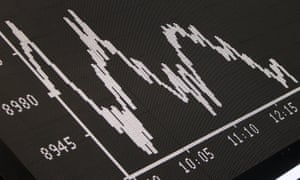
‘Financial markets are becoming increasingly odd, wanting more expensive money and oil to restore confidence’ Photograph: Daniel Roland/AFP/Getty Images
One of the oddest things about 2016, so far at least, is how economic “common sense” is being twisted in all sorts of ways to explain what’s going on in the global economy.
By the end of 2015 market “commentators” were clamoring for an interest rate rise from the Federal Reserve to “restore confidence”. Normally, the only reason to raise rates is if there is inflation in the economy and you want to squeeze it out.
Problem: there was no inflation in the US, or almost anywhere else, at the end of 2015.
World markets in turmoil for a second day
So despite that rather obvious fact, the markets got the rise that they wanted and … it helped lower economic activity, precisely as one would expect, which has had a decidedly negative impact on confidence.
Generally speaking, when you make something more expensive – in this case, money – people buy less of it. But in this world, “the markets” were arguing that people would buy more of something if you made it more expensive, and that would produce “confidence”, so they would buy more, which is a bit odd, to say the least.
The next bit of oddness, apparent as we entered into 2016, was that the fall in commodity prices, especially oil, was not good news. Yet falling commodity prices means that everyone who is not a commodity producer or an oil company pays less for their inputs, and can then spend more on other stuff, which has to be good – right?
But “the markets”, once again, figured different. Falling oil prices were now seen as a bad thing, with markets in January having a mini heart attack as oil prices fell below $30 a barrel. When pressed as to why this was a bad thing, no one in these markets seemed to have a clear answer. But the markets freaked out anyway.
A cause for this volatility had to be found, and it was, by the middle of January, in the form of China’s banking sector. And so for the past month the markets have been fretting about the non-performing Loans (NPL’s) in China … and their “dodgy” economic statistics.
But just last year the IMF, who has plenty of data on NPL’s everywhere, brought the yuan into its basket of reserve currencies, which is hardly what you would do if you thought it was all going to pot. After all, China’s statistics and loan book have been questionable for years … but so has Italy’s and Ireland for that matter. And China has literally trillions of dollars (and other currencies) in reserves to throw at the problem – not to mention a decidedly non-democratic state that can, and often does, just make things “go away”.
So why is China now the cause of all ills? Along with China, cheap money, and everything else? Quite possibly because the world has changed, fundamentally, and financial markets are incentivised not to recognise this.
Today there is no inflation anywhere that isn’t due to a currency collapse brought on when the country that issues the currency is heavily dependent on imports, such as Russia and Brazil.
Globalisation, and concerted action for 30 years by the political right, has killed the ability of labour to demand higher wages, hence record inequality and super low inflation. Meanwhile, yields on assets, and interest rates in such a world, will stay “long and low” well beyond 2016 as global savings outpace global investment, and everyone except the US tries to run an export surplus.
This is an ugly world for financial markets, used to delivering the types of returns that people thought normal before the crash: 6 to 8%, liquid, and abundant. That money was made in a period when interest rates and inflation rates across the world fell year on year from abnormally high levels. In that world it was hard not to make money.
But now we find ourselves in a post-crisis world in which the old tricks no longer work despite growth at 1.5%, inflation at 0.5% and interest rates in some places at minus 0.25%.
Rather than face this fact, “the markets” blame China, this week, or it’s the Fed’s rate policy, last month, or its quantitative easing (another bête noir for markets of long standing).
But here’s the bad news. It’s not their fault. “Long and low as far as you go” driven by ageing populations in developed countries that save more than they spend pushing down interest rates and consumption to the point of deflation as everyone tries to run a surplus is the reality of the world today.
So what will the rest of 2016 look like?
Just like we have seen so far – periodic “inexplicable” and “what the heck” moments as markets everywhere hunt for causes to explain away something very inconvenient. That the game has changed for financial markets – that there is no going back to the boom times – and that the world going forward is a much more boring, and much less “finance friendly” place, than “the markets” want to admit. Most of all to themselves.
One of the oddest things about 2016, so far at least, is how economic “common sense” is being twisted in all sorts of ways to explain what’s going on in the global economy.
By the end of 2015 market “commentators” were clamoring for an interest rate rise from the Federal Reserve to “restore confidence”. Normally, the only reason to raise rates is if there is inflation in the economy and you want to squeeze it out.
Problem: there was no inflation in the US, or almost anywhere else, at the end of 2015.
World markets in turmoil for a second day
So despite that rather obvious fact, the markets got the rise that they wanted and … it helped lower economic activity, precisely as one would expect, which has had a decidedly negative impact on confidence.
Generally speaking, when you make something more expensive – in this case, money – people buy less of it. But in this world, “the markets” were arguing that people would buy more of something if you made it more expensive, and that would produce “confidence”, so they would buy more, which is a bit odd, to say the least.
The next bit of oddness, apparent as we entered into 2016, was that the fall in commodity prices, especially oil, was not good news. Yet falling commodity prices means that everyone who is not a commodity producer or an oil company pays less for their inputs, and can then spend more on other stuff, which has to be good – right?
But “the markets”, once again, figured different. Falling oil prices were now seen as a bad thing, with markets in January having a mini heart attack as oil prices fell below $30 a barrel. When pressed as to why this was a bad thing, no one in these markets seemed to have a clear answer. But the markets freaked out anyway.
A cause for this volatility had to be found, and it was, by the middle of January, in the form of China’s banking sector. And so for the past month the markets have been fretting about the non-performing Loans (NPL’s) in China … and their “dodgy” economic statistics.
But just last year the IMF, who has plenty of data on NPL’s everywhere, brought the yuan into its basket of reserve currencies, which is hardly what you would do if you thought it was all going to pot. After all, China’s statistics and loan book have been questionable for years … but so has Italy’s and Ireland for that matter. And China has literally trillions of dollars (and other currencies) in reserves to throw at the problem – not to mention a decidedly non-democratic state that can, and often does, just make things “go away”.
So why is China now the cause of all ills? Along with China, cheap money, and everything else? Quite possibly because the world has changed, fundamentally, and financial markets are incentivised not to recognise this.
Today there is no inflation anywhere that isn’t due to a currency collapse brought on when the country that issues the currency is heavily dependent on imports, such as Russia and Brazil.
Globalisation, and concerted action for 30 years by the political right, has killed the ability of labour to demand higher wages, hence record inequality and super low inflation. Meanwhile, yields on assets, and interest rates in such a world, will stay “long and low” well beyond 2016 as global savings outpace global investment, and everyone except the US tries to run an export surplus.
This is an ugly world for financial markets, used to delivering the types of returns that people thought normal before the crash: 6 to 8%, liquid, and abundant. That money was made in a period when interest rates and inflation rates across the world fell year on year from abnormally high levels. In that world it was hard not to make money.
But now we find ourselves in a post-crisis world in which the old tricks no longer work despite growth at 1.5%, inflation at 0.5% and interest rates in some places at minus 0.25%.
Rather than face this fact, “the markets” blame China, this week, or it’s the Fed’s rate policy, last month, or its quantitative easing (another bête noir for markets of long standing).
But here’s the bad news. It’s not their fault. “Long and low as far as you go” driven by ageing populations in developed countries that save more than they spend pushing down interest rates and consumption to the point of deflation as everyone tries to run a surplus is the reality of the world today.
So what will the rest of 2016 look like?
Just like we have seen so far – periodic “inexplicable” and “what the heck” moments as markets everywhere hunt for causes to explain away something very inconvenient. That the game has changed for financial markets – that there is no going back to the boom times – and that the world going forward is a much more boring, and much less “finance friendly” place, than “the markets” want to admit. Most of all to themselves.