Yasmin Alibhai Brown in the Independent
Tony Blair is a very busy man – so many calling on him, so little time. He had, apparently, agreed to speak at a conference on world hunger in Stockholm. Last year his very good friend Bill Clinton spoke at this same gathering, organised by Eat, a non-profit organisation set up by Swedish philanthropists. But a slight hitch came up with the Blair booking: reports suggest our erstwhile PM allegedly wanted £330,000 for a 20-minute sermon. (Clinton got £327,000 for 30 minutes.) Eat thought the fee too high, although Blair’s office insists money wasn’t spoken of and he simply had a previous engagement.
For whatever reason, Blair will not now orate stirringly on how to save the millions who live on less than 82 pence per day. Tony’s office says the money was to go to the Cherie Blair Foundation for Women. But like cheap room deodorisers, that late fragrance of good intent cannot overpower the bad smell coming from this story.
The Fifa drama is also all about money. Football does not even have a bit part. All the top men drive fast in the fog of power and wealth, without a moral compass, and still pretend that they are maligned heroes. Prince William lectures them about probity and corruption without so much as a second thought for the royal finances and tax secrecy.
This week also had Iain Duncan Smith, a fervent Catholic and man of some wealth, considering draconian child benefit restrictions. To save £2.5bn per year he wants to cut the payment from £20.70 for the first child to £13.70 – and is also looking at restricting benefits to two children. To this quiet man, poverty must be as hard to understand as godlessness.
Meanwhile, well-heeled George Osborne is to meet the Queen to review grants given to the royals. The boilers are too old, the energy bills for all those palaces too high. Unlike other pensioners, our monarch will not have to resort to hot water bottles, of that we can be sure. Nor will she visit those in her kingdom who shiver day and night, have barely enough to eat and live in rat-infested rooms.
This was also the week when Thomas Cook was humbled after failing to respond with basic humanity to the parents of two young children who died of carbon monoxide poisoning in a Corfu hotel.
I find all this alien and deeply baffling. How do the rich think? How are they so solipsistic, so self-serving and self-promoting? Are they born that way or are they raised as members of a particularly hard tribe? We must try to understand people who have it all, now that we are to be governed by a clique of the very privileged.
And so, in that spirit, I made myself read a column penned by entrepreneur Luke Johnson, son of Paul Johnson, the former editor of the New Statesman who walked briskly rightwards to become an ardent Tory.
To be successful, you need a dream team, sayest Luke, a blue-eyed dynamo and chairman of Risk Capital Partners: “First and foremost is the spouse... to provide emotional and practical backing. Self-employment can be desolate. Most entrepreneurs are obsessives, and often selfish in the pursuit of their ambitions. They require a tolerant spouse to provide relief...” Also a devoted “Super PA”. I gave up reading halfway through, because the man was so unutterably self-satisfied. Getting into these mindsets is harder than I thought.
Now, most Ugandan Asians are natural-born moneymakers. The exiles who were resented and unwanted in 1972 have made good. Many are millionaires and right wing. Like the Tory minister Priti Patel, too many of my ex-compatriots believe in self-reliance, low taxes, hard punishment and a social Darwinism. Benefits, in their view, only encourage layabouts and wastrels.
I had relatives back in Uganda who lived in grand houses, paid no tax and expected deference. Among my classmates, a few became doctors, the rest went into business and, yes, made bucks. I think I was born with a mutant gene.
Two guys with big money offered to marry me. One still hoots when he sees my Nissan Micra and always follows up with some unsolicited advice: “You are clever and very stupid. Money would make you powerful.
“All these politicians come to us. They don’t read your words – who cares about what you say? We make the world go round. You, your type, and lazy bastards on benefits make it slow down. You should be worshipping us.” So glad I didn’t marry the bald, fat scumbag.
These capitalists really do see themselves as redeemers, even those who pay their staff the lowest wages and do little to make the world a better place. Men such as Bill Gates do use their money to alleviate poverty, but they are rare.
The rest, even when they give cash, want something in return – an honour, a name on some grand wall, a PR victory. Sure, if they help the arts or the unemployed, give them the accolades and respect they crave. But what of the CEOs and shareholders who feel no social obligations, yet want more gratitude or see themselves as victims of deep ingratitude?
Tom Perkins, a US venture capitalist, complained that the recent war on the rich was like “the Holocaust”. (He later apologised.) Sam Zell, the American chief executive of an equity company – and a zealous defender of the top one per cent of global earners – says “subsidising people and disincentivising [the poor]” through benefits is the problem. Those who don’t succeed don’t want to try.
I read books on the minds and methods of the rich. They think selfishness is a virtue and that poverty (not money) is the root of all evil, that it is the end not the means which matter and that welfare for failure leads to more failure. They belong only to each other. The wider good does not exist. I see that now.
The future – political and economic – belongs to these masters of the universe. There is no alternative, no fight back. Even Labour now sucks up to them. Bleak times.
Sunday, 14 June 2015
Love, intuition and women. Science would wither without them
Boyd Tonkin in the Independent
As it sometimes does, last October the Nobel Committee for the prize in physiology or medicine split its award. Half the pot (of eight million Swedish kronor in all) went to the British-American neuroscientist John O’Keefe, the other to the Norwegian couple who have charted the grid cells in the brain that enable our pathfinding and positioning skills via a sort of “internal GPS”.
May-Britt Moser and Edvard I Moser first met at high school and have worked together over 30 years. Professor Moser (May-Britt) said after the Nobel nod: “It’s easy for us because we can have breakfast meetings almost every day.” Professor Moser (Edvard) stated: “We have a common project and a common goal … And we depend on each other for succeeding.”
“There were a lot of things that made me decide to marry Edvard,” the other Professor Moser has recalled. Not all had to do with neurological breakthroughs. Once, Edvard gave her a huge umbrella. Open it, he said. “So I opened it above my head, and it rained down small beautiful pieces of paper with little poems on about me.”
This week, another Nobel laureate in the same discipline – Sir Tim Hunt, 2001 – found himself in need of a titanium umbrella in order to fend off the media flak. The 72-year-old biochemist told a conference in South Korea that “girls” caused mayhem in the lab. “You fall in love with them, they fall in love with you and when you criticise them, they cry.” Cue the avalanche of outrage that has now driven Sir Tim – married, by the way, to the distinguished immunologist Professor Mary Collins – out of his honorary post at University College, London. In Britain, where only 13 per cent of scientific and engineering professionals are female, his off-the-cuff “banter” has gone down like a tungsten (denser than lead) balloon.
So it should. Yet the champions of equality in science who have justly hooted at Sir Tim’s antique ditty might spare a thought for the Mosers’ partnership. The Norwegian pair are not alone in fusing personal commitment with top-grade scientific collaboration. Last year, in a fascinating study for Nature, Kerri Smith reported that, according to the US National Science Foundation, “just over one-quarter of married people with doctorates had a spouse working in science or engineering”. A 2008 survey found that the proportion of research posts that went to couples had risen from 3 per cent in the 1970s to 13 per cent.
Smith consulted a range of high-flying scientific double acts. They included the Taiwanese cell biologists Lily and Yuh-Nung Jan, who have collaborated since 1967. Lily Jan praised the joint progress made possible by a “very consistent long-term camaraderie”. After years of long-distance romance and research, physicists Claudia Felser and Stuart Parkin now live together in Germany with plum posts at the Max Planck Institutes in (respectively) Dresden and Halle. “Lufthansa and United Airlines will be very unhappy,” said Parkin.
These partnerships in life and lab follow a different, far more equal, pattern to the liaison of master and muse, once common in the arts. Scientists tend not to bother much with history. But the rising number of collaborating duos will know that they can hail as their forerunners the most intellectually fertile pairing of all: between Marie Sklodowska-Curie and Pierre Curie.
Marie had plentiful Hunts of her own to vanquish. In 1903, only a late objection by a Swedish mathematician with feminist sympathies prevented her first Nobel Prize, in physics, from going to Pierre and Henri Becquerel alone. Not that the Nobel selectors learned their lesson. Lise Meitner, who first explained the significance of nuclear fission, never got the call. When Francis Crick, James Watson and Maurice Wilkins shared the Nobel for their work on DNA in 1962, no mention was made of Rosalind Franklin (who had died in 1958). Her research into the double‑helix structure had made their triumph possible.
As any woman scientist will tell you, such neglect and condescension die hard and slow. Yet the atavistic Hunt and his denouncers share a common position. Both would banish Eros from the bench. Cases such as the Mosers suggest that, in some conditions, intimate bonds may even seed creativity. Expel love from the lab, and who knows what angels of deliverance might flee as well?
Besides, in science or any other pursuit, the same seeker can benefit at different stages both from solitary striving and intimate collaboration. You will find moving proof of this in the “autobiographical notes” that Marie Curie appended to her 1923 memoir of her husband. As a lonely Polish student in 1890s Paris, she relished her independence, even at the cost of cold, hunger and isolation in a freezing garret. She wrote: “I shall always consider one of the best memories of my life that period of solitary years exclusively devoted to the studies, finally within my reach, for which I had waited so long.”
Later, as she and Pierre experimented to isolate radium and investigate its properties in a tumbledown hut on the Paris School of Physics site, another kind of bliss took hold: “It was in this miserable old shed that we passed the best and happiest years of our life, devoting our entire days to our work.” Marie and Pierre’s shared quest embraced rapture as well as reason: “One of our joys was to go into our workroom at night; we then perceived on all sides the feebly luminous silhouettes of the bottles or capsules containing our products. It was really a lovely sight and one always new to us. The glowing tubes looked like faint, fairy lights.”
Note the poetry. Sir Tim, in contrast, reveals himself as a strict dualist. Love and tears will ruin your results. On the one hand lies intellect, on the other emotion. As always, the female serves as proxy for the latter. Yet the binary mind in which Hunt believes no more exists in physics than in painting. Investigate the history of scientific discovery and you plunge into a wild labyrinth of Curie-style ecstasies, hunches, chances, blunders, windfalls, visions, guesses, serendipities and unsought “Eureka!” moments.
However, at the entrance to this theme park of happy accidents one statement should stand. Louis Pasteur said: “Chance favours only the prepared mind.” The intuitive breakthrough that rewrites all the rules happens to people who have toiled and failed, toiled again and failed better. Vision blesses the hardest workers. “I’m enough of an artist to draw freely on my imagination,” Einstein said in 1929. “Knowledge is limited. Imagination encircles the world.” But he could get away with such New Agey bromides only because he was Albert Einstein.
Still, the scientific evidence in favour of intuitions, dreams and visions is strikingly widespread. In 1865, August Kekulé slumps in front of the fire and, in a reverie, sees the atoms of the benzene molecule “twisting and moving around in a snake-like manner”. Then, “one of the snakes got hold of its own tail, and tauntingly the whole structure whirled before my eyes”.
In 1869, Dmitri Mendeleev grasps the structure of the periodic table in another dream. In a Budapest park in 1882, Nikola Tesla recites Goethe’s Faust and then imagines the electrical induction motor. “The idea came like a flash of lightning and in an instant the truth was revealed… The images I saw were wonderfully sharp and clear.”
More recently, the Nobel-winning biochemist Kary Mullis has written a Thomas Pynchon-like account of the day in 1983 when during a nocturnal drive in California he “saw” the pattern of the DNA polymerase chain reaction that kick-started genetic medicine. With his girlfriend (a chemist in the same lab), he had left for a weekend in the woods. “My little silver Honda’s front tyres pulled us through the mountains… My mind drifted back into the laboratory. DNA chains coiled and floated. Lurid blue and pink images of electric molecules injected themselves somewhere between the mountain road and my eyes…”
A self-mythologising tinge colours many such memoirs of inspiration. They uncannily tend to resemble one another. All the same, these “Eureka!” narratives have a consistent theme, of a break or rest after thwarted labour. The pioneer of quantum mechanics Paul Dirac wrote that “I found the best ideas usually came, not when one was actively striving for them, but when one was in a more relaxed state”; in his case, via “long solitary walks on Sundays”. In science, the unconscious can work hardest when the intellect has downed tools.
In which case, the flight from emotion – from Tim Hunt’s dreaded tears and love – may sterilise more than fertilise. Shun “girls”, by which he seems to mean all subjectivity, and the seeker risks falling into an antiseptic void.
But enough: it feels unscientific, to say the least, to pillory a bloke for a gaffe that shows up a culture and an epoch more than an individual man. Perhaps Sir Tim, and the Royal Society that clumsily rushed to distance itself from him despite its own distinctly patriarchal history, could lay the matter to rest with a suitable donation. It ought to go to the Marie Curie charity for terminal care, which since 1948 has enlisted science and research to strengthen love – and to dry tears.
As it sometimes does, last October the Nobel Committee for the prize in physiology or medicine split its award. Half the pot (of eight million Swedish kronor in all) went to the British-American neuroscientist John O’Keefe, the other to the Norwegian couple who have charted the grid cells in the brain that enable our pathfinding and positioning skills via a sort of “internal GPS”.
May-Britt Moser and Edvard I Moser first met at high school and have worked together over 30 years. Professor Moser (May-Britt) said after the Nobel nod: “It’s easy for us because we can have breakfast meetings almost every day.” Professor Moser (Edvard) stated: “We have a common project and a common goal … And we depend on each other for succeeding.”
“There were a lot of things that made me decide to marry Edvard,” the other Professor Moser has recalled. Not all had to do with neurological breakthroughs. Once, Edvard gave her a huge umbrella. Open it, he said. “So I opened it above my head, and it rained down small beautiful pieces of paper with little poems on about me.”
This week, another Nobel laureate in the same discipline – Sir Tim Hunt, 2001 – found himself in need of a titanium umbrella in order to fend off the media flak. The 72-year-old biochemist told a conference in South Korea that “girls” caused mayhem in the lab. “You fall in love with them, they fall in love with you and when you criticise them, they cry.” Cue the avalanche of outrage that has now driven Sir Tim – married, by the way, to the distinguished immunologist Professor Mary Collins – out of his honorary post at University College, London. In Britain, where only 13 per cent of scientific and engineering professionals are female, his off-the-cuff “banter” has gone down like a tungsten (denser than lead) balloon.
So it should. Yet the champions of equality in science who have justly hooted at Sir Tim’s antique ditty might spare a thought for the Mosers’ partnership. The Norwegian pair are not alone in fusing personal commitment with top-grade scientific collaboration. Last year, in a fascinating study for Nature, Kerri Smith reported that, according to the US National Science Foundation, “just over one-quarter of married people with doctorates had a spouse working in science or engineering”. A 2008 survey found that the proportion of research posts that went to couples had risen from 3 per cent in the 1970s to 13 per cent.
Smith consulted a range of high-flying scientific double acts. They included the Taiwanese cell biologists Lily and Yuh-Nung Jan, who have collaborated since 1967. Lily Jan praised the joint progress made possible by a “very consistent long-term camaraderie”. After years of long-distance romance and research, physicists Claudia Felser and Stuart Parkin now live together in Germany with plum posts at the Max Planck Institutes in (respectively) Dresden and Halle. “Lufthansa and United Airlines will be very unhappy,” said Parkin.
These partnerships in life and lab follow a different, far more equal, pattern to the liaison of master and muse, once common in the arts. Scientists tend not to bother much with history. But the rising number of collaborating duos will know that they can hail as their forerunners the most intellectually fertile pairing of all: between Marie Sklodowska-Curie and Pierre Curie.
Marie had plentiful Hunts of her own to vanquish. In 1903, only a late objection by a Swedish mathematician with feminist sympathies prevented her first Nobel Prize, in physics, from going to Pierre and Henri Becquerel alone. Not that the Nobel selectors learned their lesson. Lise Meitner, who first explained the significance of nuclear fission, never got the call. When Francis Crick, James Watson and Maurice Wilkins shared the Nobel for their work on DNA in 1962, no mention was made of Rosalind Franklin (who had died in 1958). Her research into the double‑helix structure had made their triumph possible.
As any woman scientist will tell you, such neglect and condescension die hard and slow. Yet the atavistic Hunt and his denouncers share a common position. Both would banish Eros from the bench. Cases such as the Mosers suggest that, in some conditions, intimate bonds may even seed creativity. Expel love from the lab, and who knows what angels of deliverance might flee as well?
Besides, in science or any other pursuit, the same seeker can benefit at different stages both from solitary striving and intimate collaboration. You will find moving proof of this in the “autobiographical notes” that Marie Curie appended to her 1923 memoir of her husband. As a lonely Polish student in 1890s Paris, she relished her independence, even at the cost of cold, hunger and isolation in a freezing garret. She wrote: “I shall always consider one of the best memories of my life that period of solitary years exclusively devoted to the studies, finally within my reach, for which I had waited so long.”
Later, as she and Pierre experimented to isolate radium and investigate its properties in a tumbledown hut on the Paris School of Physics site, another kind of bliss took hold: “It was in this miserable old shed that we passed the best and happiest years of our life, devoting our entire days to our work.” Marie and Pierre’s shared quest embraced rapture as well as reason: “One of our joys was to go into our workroom at night; we then perceived on all sides the feebly luminous silhouettes of the bottles or capsules containing our products. It was really a lovely sight and one always new to us. The glowing tubes looked like faint, fairy lights.”
Note the poetry. Sir Tim, in contrast, reveals himself as a strict dualist. Love and tears will ruin your results. On the one hand lies intellect, on the other emotion. As always, the female serves as proxy for the latter. Yet the binary mind in which Hunt believes no more exists in physics than in painting. Investigate the history of scientific discovery and you plunge into a wild labyrinth of Curie-style ecstasies, hunches, chances, blunders, windfalls, visions, guesses, serendipities and unsought “Eureka!” moments.
However, at the entrance to this theme park of happy accidents one statement should stand. Louis Pasteur said: “Chance favours only the prepared mind.” The intuitive breakthrough that rewrites all the rules happens to people who have toiled and failed, toiled again and failed better. Vision blesses the hardest workers. “I’m enough of an artist to draw freely on my imagination,” Einstein said in 1929. “Knowledge is limited. Imagination encircles the world.” But he could get away with such New Agey bromides only because he was Albert Einstein.
Still, the scientific evidence in favour of intuitions, dreams and visions is strikingly widespread. In 1865, August Kekulé slumps in front of the fire and, in a reverie, sees the atoms of the benzene molecule “twisting and moving around in a snake-like manner”. Then, “one of the snakes got hold of its own tail, and tauntingly the whole structure whirled before my eyes”.
In 1869, Dmitri Mendeleev grasps the structure of the periodic table in another dream. In a Budapest park in 1882, Nikola Tesla recites Goethe’s Faust and then imagines the electrical induction motor. “The idea came like a flash of lightning and in an instant the truth was revealed… The images I saw were wonderfully sharp and clear.”
More recently, the Nobel-winning biochemist Kary Mullis has written a Thomas Pynchon-like account of the day in 1983 when during a nocturnal drive in California he “saw” the pattern of the DNA polymerase chain reaction that kick-started genetic medicine. With his girlfriend (a chemist in the same lab), he had left for a weekend in the woods. “My little silver Honda’s front tyres pulled us through the mountains… My mind drifted back into the laboratory. DNA chains coiled and floated. Lurid blue and pink images of electric molecules injected themselves somewhere between the mountain road and my eyes…”
A self-mythologising tinge colours many such memoirs of inspiration. They uncannily tend to resemble one another. All the same, these “Eureka!” narratives have a consistent theme, of a break or rest after thwarted labour. The pioneer of quantum mechanics Paul Dirac wrote that “I found the best ideas usually came, not when one was actively striving for them, but when one was in a more relaxed state”; in his case, via “long solitary walks on Sundays”. In science, the unconscious can work hardest when the intellect has downed tools.
In which case, the flight from emotion – from Tim Hunt’s dreaded tears and love – may sterilise more than fertilise. Shun “girls”, by which he seems to mean all subjectivity, and the seeker risks falling into an antiseptic void.
But enough: it feels unscientific, to say the least, to pillory a bloke for a gaffe that shows up a culture and an epoch more than an individual man. Perhaps Sir Tim, and the Royal Society that clumsily rushed to distance itself from him despite its own distinctly patriarchal history, could lay the matter to rest with a suitable donation. It ought to go to the Marie Curie charity for terminal care, which since 1948 has enlisted science and research to strengthen love – and to dry tears.
George Osborne got away with his Big Lie.
William Keegan in the Guardian
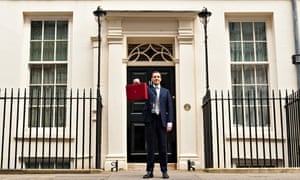
What's now in the box? Osborne outside 11 Downing Street before delivering his last budget speech ahead of May's general election. Photograph: Dominic Lipinski/PA
The inquest on Labour’s electoral defeat will run and run, and the recriminations will no doubt persist throughout the party’s inordinately long timetable for selecting a new leader. But there is a limit to which candidates should surrender to the Big Lie that George Osborne, more than anyone else, has managed to get away with.
Take a report in the Times’s recent “investigation” into Labour’s “disastrous campaign”. We are told that “as early as 2010, Labour’s pollsters sent a memo saying the party should argue ‘the deficit is the number one challenge facing the country’ and back ‘tough spending cuts’.”
The truth is that the deficit was not the problem: it was the solution. What the much-maligned government of Gordon Brown did was to recognise this, and act accordingly. One of the principal beneficiaries of this sensible Keynesian response was George Osborne, who inherited the economy in which the prospect of a 1930s depression had been warded off. He proceeded to make wholly misleading analogies with the state of the benighted Greek economy and embark on a programme of austerity which Ed Balls rightly warned would stop the recovery in its tracks.
It is not for me to join the chorus maintaining that Labour should have admitted that all the extra spending on schools and hospitals was a mistake. The most serious mistake was not to get across with sufficient emphasis that by far the biggest contribution to a rise in public sector debt was caused by the banking crisis. Moreover, as my old mentor, the Nobel laureate Professor Amartya Sen, pointed out recently in a lecture reproduced in the New Statesman: “Even if we want to reduce public debt quickly, austerity is not a particularly effective way of achieving this (which the European and British experiences confirm)”.
It is tragic that the Big Lie was not dealt with by Ed Miliband. Apparently he dismissed advice from Alastair Campbell, way back, that he should commission an independent report, by a respected figure, on Labour’s past spending plans – plans that had been supported at the time by Messrs Cameron and Osborne. Even the Times reflects that such a report “would almost certainly have cleared Labour of blame, with a minor dispute around whether the party could have spent less in 2007”.
But the deficit story was allowed to run and run, and poor Miliband failed to scotch it on at least two prominent occasions. Yet, as Sir Nicholas Macpherson, the Treasury’s top civil servant, has stated: “The 2008 crisis was a banking crisis pure and simple.”
That crisis was a cataclysm. It demanded a short-term approach to warding off catastrophic consequences, and a long-term approach to reducing a national debt that, notwithstanding the impact of the crisis, remained, as Sen emphasises, remarkably low by historical standards. As he says, put quite simply, for reducing the debt, “we need economic growth; and austerity, as Keynes noted, is essentially anti-growth”.
But such wisdom will cut no ice with a cocky chancellor who can hardly believe his luck at how Labour played into his hands. By winning a mere 37% of votes cast, he thinks he now has the support of the country for a renewal of austerity. He plans a budget which – by not treating capital expenditure as something to be financed over the lifetime of the project, but from a single year’s revenue – is going to place huge burdens on the public services. Just brace yourselves for the real cuts.
Osborne’s first austerity programme brought us reductions in capital expenditure when borrowing costs for much-needed projects were negligible. In the past year or so, he has finally woken up to this country’s infrastructure problems and – who knows? – before long may even find himself reinventing the National Economic Development Office.
As Sen points out, had the British public been frightened after the second world war by the debt ratio, which was more than twice what it has been in recent years, “the NHS would never have been born, and the great experiment of having a welfare state in Europe (from which the whole world from China, Korea and Singapore to Brazil and Mexico would learn) would not have found a foothold”.
Take a report in the Times’s recent “investigation” into Labour’s “disastrous campaign”. We are told that “as early as 2010, Labour’s pollsters sent a memo saying the party should argue ‘the deficit is the number one challenge facing the country’ and back ‘tough spending cuts’.”
The truth is that the deficit was not the problem: it was the solution. What the much-maligned government of Gordon Brown did was to recognise this, and act accordingly. One of the principal beneficiaries of this sensible Keynesian response was George Osborne, who inherited the economy in which the prospect of a 1930s depression had been warded off. He proceeded to make wholly misleading analogies with the state of the benighted Greek economy and embark on a programme of austerity which Ed Balls rightly warned would stop the recovery in its tracks.
It is not for me to join the chorus maintaining that Labour should have admitted that all the extra spending on schools and hospitals was a mistake. The most serious mistake was not to get across with sufficient emphasis that by far the biggest contribution to a rise in public sector debt was caused by the banking crisis. Moreover, as my old mentor, the Nobel laureate Professor Amartya Sen, pointed out recently in a lecture reproduced in the New Statesman: “Even if we want to reduce public debt quickly, austerity is not a particularly effective way of achieving this (which the European and British experiences confirm)”.
It is tragic that the Big Lie was not dealt with by Ed Miliband. Apparently he dismissed advice from Alastair Campbell, way back, that he should commission an independent report, by a respected figure, on Labour’s past spending plans – plans that had been supported at the time by Messrs Cameron and Osborne. Even the Times reflects that such a report “would almost certainly have cleared Labour of blame, with a minor dispute around whether the party could have spent less in 2007”.
But the deficit story was allowed to run and run, and poor Miliband failed to scotch it on at least two prominent occasions. Yet, as Sir Nicholas Macpherson, the Treasury’s top civil servant, has stated: “The 2008 crisis was a banking crisis pure and simple.”
That crisis was a cataclysm. It demanded a short-term approach to warding off catastrophic consequences, and a long-term approach to reducing a national debt that, notwithstanding the impact of the crisis, remained, as Sen emphasises, remarkably low by historical standards. As he says, put quite simply, for reducing the debt, “we need economic growth; and austerity, as Keynes noted, is essentially anti-growth”.
But such wisdom will cut no ice with a cocky chancellor who can hardly believe his luck at how Labour played into his hands. By winning a mere 37% of votes cast, he thinks he now has the support of the country for a renewal of austerity. He plans a budget which – by not treating capital expenditure as something to be financed over the lifetime of the project, but from a single year’s revenue – is going to place huge burdens on the public services. Just brace yourselves for the real cuts.
Osborne’s first austerity programme brought us reductions in capital expenditure when borrowing costs for much-needed projects were negligible. In the past year or so, he has finally woken up to this country’s infrastructure problems and – who knows? – before long may even find himself reinventing the National Economic Development Office.
As Sen points out, had the British public been frightened after the second world war by the debt ratio, which was more than twice what it has been in recent years, “the NHS would never have been born, and the great experiment of having a welfare state in Europe (from which the whole world from China, Korea and Singapore to Brazil and Mexico would learn) would not have found a foothold”.
We were helped after the war by a loan from the US (mainly) and Canada, which was finally paid off in 2006. And a war loan dating from the first world war was finally redeemed earlier this year!
Osborne has rightly attracted ridicule, even from friendly commentators, for his absurd plan to try to bind all future governments to a law that demands not just budget balance but budget surpluses during “normal times” – a phrase that opens up great scope for debate. Apart from anything else, it is evident from the frequent revisions to statistics, and therefore analysis made by the Office for National Statistics and the Office for Budget Responsibility, that it is often not obvious at the time whether one is indeed living in “normal times”.
Rather like his distinguished predecessor, Lord Lawson, Osborne has become obsessed by “rules”. But as one of Macpherson’s distinguished predecessors, Sir Douglas Allen, used to say, what matters is not budget balance, let alone budget surplus, but a balanced economy. That is not what is on offer from the present chancellor.
Saturday, 13 June 2015
Marking exam papers exposes the flaws in teaching

It is staggering how many teaching staff I know that do not read examiners’ reports or even the exam specification and so their class often misses out on marks. Photograph: Alamy
The Secret Teacher in The Guardian
A detailed but incorrect answer appears beside every question on an exam sheet. The answers are peppered with technical language but their ideas make little sense. This is one of the most frustrating errors I see as an exam marker.
I took the position up a few years ago after some persuasion from a colleague and the lure of some extra holiday money. I was told that it would be excellent training and help me to become a more effective classroom teacher as I would understand the demands of the exam boards more closely.
Yes it is true that I understand the application of mark schemes better than before, and it definitely looks good on my CV. But I don’t think I can do it much longer.
Each year, I clear my diary for June and plan my time carefully to ensure that I can mark to a strict timetable, giving the papers my highest level of focus. And every year I become more and more depressed by the standard of the responses and the restrictive nature of the mark schemes.
The most saddening answers are simply left blank, or there could be a crossed out sentence. This may be understandable at GCSE for a short answer, but I have seen full essay questions left blank in A-level exams. I cannot help but picture the student sat in the exam hall, pen in hand and nothing to write. I wonder how they feel; it makes me sad and angry that maybe they’ve not had all the help they deserve from their teacher.
On another occasion a GCSE student covered a whole page in calculations trying to work out a simple percentage change question. They drew a box and arrows pointing to their eventual (wrong) answer, but they must have spent at least 20 minutes on a question that should take no more than two.
The Secret Teacher in The Guardian
A detailed but incorrect answer appears beside every question on an exam sheet. The answers are peppered with technical language but their ideas make little sense. This is one of the most frustrating errors I see as an exam marker.
I took the position up a few years ago after some persuasion from a colleague and the lure of some extra holiday money. I was told that it would be excellent training and help me to become a more effective classroom teacher as I would understand the demands of the exam boards more closely.
Yes it is true that I understand the application of mark schemes better than before, and it definitely looks good on my CV. But I don’t think I can do it much longer.
Each year, I clear my diary for June and plan my time carefully to ensure that I can mark to a strict timetable, giving the papers my highest level of focus. And every year I become more and more depressed by the standard of the responses and the restrictive nature of the mark schemes.
The most saddening answers are simply left blank, or there could be a crossed out sentence. This may be understandable at GCSE for a short answer, but I have seen full essay questions left blank in A-level exams. I cannot help but picture the student sat in the exam hall, pen in hand and nothing to write. I wonder how they feel; it makes me sad and angry that maybe they’ve not had all the help they deserve from their teacher.
On another occasion a GCSE student covered a whole page in calculations trying to work out a simple percentage change question. They drew a box and arrows pointing to their eventual (wrong) answer, but they must have spent at least 20 minutes on a question that should take no more than two.
Some students miss out on recognition because they lack the simple skill of clear handwriting; we cannot award the marks if we can’t read the answer. If it is illegible, there is no choice but to only credit the parts I can read.
Then there’s the other side of the scale: some essays are magnificent and show understanding of a topic that goes far beyond the requirements of the course. These are beautifully written and include complex analysis worthy of an undergraduate. But many of these responses go uncredited if they do not fit the exacting standard of the mark scheme.
I have seen some students get marks “capped” because they haven’t included a certain phrase or diagram, even though their overall work was of a high standard. This is reflected in the classroom and I have students asking how many sentences of analysis they need, and how many evaluation points. Whatever happened to writing a good essay and answering the question to the best of your ability?
I understand that exams are necessary to be able to award qualifications to students, and that mark schemes can ensure that grades are fair and consistent – perhaps this is something that cannot be changed. But I just cannot stop picturing the students sat in the exam halls, some with nothing to write at all, some writing illegibly, and others writing brilliantly but not being rewarded.
It’s clear something isn’t working if a student is enrolled on a course, but ends up without anything to show for it.
Some students do not engage – perhaps because they are not supported emotionally at home and in school – and cannot cope with the demands of study. Others are simply not on the right course. Even more worryingly, too many students fail to achieve because of poor teaching.
It is staggering how many teaching staff I know that do not read examiners’ reports or even the exam specification and so their class often misses out on marks.
It all boils down to time. We don’t need another initiative or want the system to change again but teachers need support to deliver well-designed courses and give detailed feedback to students. This would happen if class sizes were more manageable, reducing the level of marking we have to get through. It really is that simple.
Education and exams should not be the final stage for young people, but the start of their life. Yet, too many are beginning this journey far behind their peers. Let’s not let students down. We are measured by their results for that one year; but they may be measured by these grades for life.
Subscribe to:
Comments (Atom)