Search This Blog

Tuesday, 4 July 2023

No Affirmative Action in University Admissions: US Supreme Court

 From The Economist


Should a fair country allow citizens to be treated differently based on the colour of their skin? Most people would say that it should not. But others insist that it should—if the ends are suitably enlightened.

Not long after America dismantled two centuries of slavery and segregation, it embarked on a project of “affirmative action”: a system of legally sanctioned positive discrimination for African-Americans (later expanded to other “under-represented minorities”) who sought entry to selective universities. At the time the affront to liberal norms of fairness and equality under the law was assuaged by the fact that the beneficiaries of the policy were oppressed not long ago. Yet after half a century, one marked with more racial progress than setbacks, it remained the case that an applicant to America’s top universities with the right skin colour had a much better chance of admission than one with identical credentials but the wrong skin colour. On June 29th the Supreme Court terminated the scheme.

It was right to do so. That is because affirmative action rested on contorted constitutional logic. It was also broadly unpopular outside progressive circles. Worst of all, it only marginally ameliorated America’s yawning racial gaps. Despite the sermonising of its administrators, even with race-based affirmative action the country’s best universities never represented America. The very same universities offer extreme preferences to children of alumni and donors—a shadow, unjustifiable affirmative-action scheme for the white and wealthy hidden behind the prominent one for black and Hispanic applicants (a disproportionate share of whom were wealthy themselves).

The Supreme Court’s ruling will reverberate widely. “Eliminating racial discrimination means eliminating all of it,” wrote Chief Justice John Roberts in his majority opinion. This will surely encourage lawsuits to end racial preferences in other areas, such as government contracting. But the immediate impact will be on university admissions.

A touch of class

Something better can come out of the demise of the present regime. Start with the shaky legal justification for race-conscious college admissions. After the civil war, America’s constitution was amended to guarantee all of its citizens due process and equal protection under the law, regardless of their race. Yet for decades, under Jim Crow, many states prevented black people from voting, forbade inter-racial marriage and enforced racial segregation in schools, among other outrages. After the correction of the civil-rights era, America began to try to live up to its constitutional promise. It passed landmark civil-rights legislation that forbade unequal treatment “on the ground of race, colour, or national origin”.

Yet for decades the Supreme Court allowed positive discrimination in universities. How so? The policy was justified, the justices of the day argued, not as reparations for a terrible past, but because the value of diversity was compelling for promoting “cross-racial understanding and the breaking down of racial stereotypes”. It was always odd that affirmative action was explicitly crafted for the benefit of students’ white peers. Nonetheless elite universities leapt on the rationale of diversity, using it to construct racially balanced classes while suggesting that these were the happy result not of quotas, which are banned, but of “race-conscious” holistic admissions schemes that treated people as individuals and not as avatars for their racial group.

Contrary to the dissent of the court’s liberal justices, who claim the new ban “will serve only to highlight the court’s own impotence in the face of an America whose cries for equality resound”, Americans were not happy with the old policy. In 2020 even liberal Californians voted down a referendum to reinstate affirmative action, banned in the state since 1996. Polls show that many more Americans oppose taking race into account for admissions than favour it. That is true also of Asian Americans, who typically lean left but bear the heaviest cost of race-based admissions because they are deemed “over-represented” (despite suffering discrimination in their own right).

The court’s decision could be the catalyst for fairer admissions. The extraordinary benefits that Harvard and Yale shower upon the children of alumni and donors make a mockery of meritocracy and those institutions’ self-professed progressivism. Those practices should go.

Universities that wish to do their bit for social justice should stop using race as an (often inaccurate) proxy for disadvantage and start looking at disadvantage itself. Instead of giving a leg-up to members of groups that are on average badly off, they should favour individuals who are actually poor. One randomised controlled trial found that simply offering application-fee waivers to promising students from poor backgrounds dramatically increased the chance of their applying to, and attending, highly selective universities.

There is reason to worry that elite universities will seek stealthy ways to preserve racial preferences. Many are dropping requirements for standardised tests, which would make quiet discrimination against members of unfavoured groups who do well on such tests harder to detect. Some are busily searching for loopholes. In a letter sent to its students and alumni, Harvard, which was party to one of the Supreme Court cases, quoted a portion of the majority opinion that opens the door to considering race if an applicant were to write about it in a submitted essay. “We will certainly comply with the Court’s decision,” its leadership wrote, impishly.

Rather than coaxing a generation of minority students into drafting adversity statements—and continuing to admit the hereditary mediocracy through the backdoor—schools like Harvard would do well to try to craft a fairer system of admissions. These universities should not be proud of the well-monied (albeit multicoloured) monoculture they have inculcated. They should take the opportunity to become the progressive institutions they claim to be. 

Why are Vietnam’s schools so good? Government Intervention or Free Markets


It understands the value of education and manages its teachers well from The Economist

Children playing football in a courtyard.
 

Ho chi minh, the founding father of Vietnam, was clear about the route to development. “For the sake of ten years’ benefit, we must plant trees. For the sake of a hundred years’ benefit, we must cultivate the people,” was a bromide he liked to trot out. Yet despite years of rapid economic growth, the country’s gdp per person is still only $3,760, lower than in its regional peers, Malaysia and Thailand, and barely enough to make the average Vietnamese feel well-nurtured. Still, Ho Chi Minh was alluding to a Chinese proverb extolling the benefits of education, and on that front Vietnam’s people can have few complaints.

Their children go through one of the best schooling systems in the world, a status reflected in outstanding performances in international assessments of reading, maths and science. The latest data from the World Bank show that, on aggregate learning scores, Vietnamese students outperform not only their counterparts in Malaysia and Thailand but also those in Britain and Canada, countries more than six times richer. Even in Vietnam itself, student scores do not exhibit the scale of inequality so common elsewhere between the genders and different regions.

A child’s propensity to learn is the result of several factors—many of which begin at home with parents and the environment they grow up in. But that is not enough to explain Vietnam’s stellar performance. Its distinctive secret lies in the classroom: its children learn more at school, especially in the early years.

In a study in 2020, Abhijeet Singh of the Stockholm School of Economics gauged the greater productivity of Vietnam’s schools by examining data from identical tests taken by students in Ethiopia, India, Peru and Vietnam. He showed that between the ages of five and eight Vietnamese children race ahead. One more year of education in Vietnam increases the probability that a child can solve a simple multiplication problem by 21 percentage points; in India the uplift is six points.

Vietnamese schools, unlike those in other poor countries, have improved over time. A study published in 2022 by researchers at the Centre for Global Development, a think-tank based in Washington, dc, found that in 56 of 87 developing countries the quality of education had deteriorated since the 1960s (see chart). Vietnam is one of a small minority of countries where schools have consistently bucked this trend.

The biggest reason is the calibre of its teachers. Not that they are necessarily better qualified; they are simply more effective at teaching. One study comparing Indian with Vietnamese students attributes much of the difference in scores in mathematical tests to a gulf in teaching quality.

Vietnam’s teachers do their job well because they are well-managed. They receive frequent training and are given the freedom to make classes more engaging. To tackle regional inequality, those posted to remote areas are paid more. Most important, teacher assessment is based on the performance of their students. Those whose pupils do well are rewarded through presitigious “teacher excellence” titles.

Besides such carrots, a big stick is the threat of running foul of the ruling Communist Party. The party apparatus is obsessed with education. This percolates down to school level, where many head teachers are party members.

The obsession has other useful effects. Provinces are required to spend 20% of their budgets on education, which has helped regional equity. That the party pays such close and relentless attention also ensures that policies are adjusted to update curriculums and teaching standards. Society at large shares the fixation. Vietnam’s families are committed to education because of its ingrained Confucianism, suggests Ngo Quang Vinh, a social-sector officer at the Asian Development Bank. He says that even poorer parents fork out for extra private tutoring. In cities, many seek schools where teachers have won “excellence in teaching” titles.

All this has reaped rich rewards. As schools have improved, so has Vietnam’s economy. But growth is testing the education system, suggests Phung Duc Tung, the director of the Mekong Development Research Institute, a think-tank in the capital, Hanoi. Firms increasingly want workers with more sophisticated skills, such as team-management, that Vietnamese students are not trained for. Growth has also pulled in migrants to cities, overburdening urban schools. More and more teachers are forsaking education for higher-paying jobs in the private sector. To ensure Vietnam remains best-in- class, the government will have to tackle these trends. As Ho Chi Minh liked to remind people, cultivation requires constant attention. 

Our shared values deserve better than a pointless term like ‘spirit of cricket’

The culture of English cricket is but one concept of morality – no person, and certainly no country, has a monopoly on virtue writes Jonathan Liew in The Guardian


So let’s talk about Nepal v Ireland in the Oman Quadrangular Twenty20 series last year. Ireland are 114 for eight in the 19th over when the ball is hit towards mid-on. The Oman bowler Kamal Singh lunges at it in his follow-through. At the same time the Ireland non-striker, Andy McBrine, tries to scamper through for a single. The pair collide. McBrine falls over. Singh keeps his balance, and tosses the ball to the wicketkeeper Aasif Sheikh, with the batter still sprawled on the turf, miles out of his ground.

The laws of cricket have nothing to say on situations such as this. Neither player is deliberately obstructing the other; neither player can avoid the collision without giving up a significant sporting advantage. Sheikh is perfectly at liberty to complete the run-out. But he does not. He holds on to the ball and lets McBrine complete the single, an act of sporting goodwill that will later earn him the International Cricket Council’s Spirit of Cricket award.

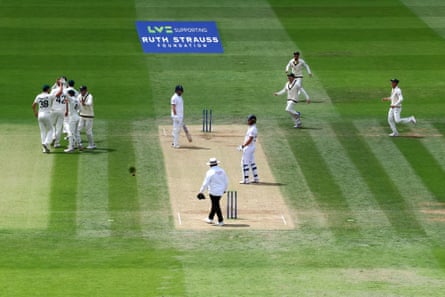
Yes, here we go again: a think-piece about the current Ashes series that has very little to do with the current Ashes series. One of the reasons the dismissal of Jonny Bairstow by Alex Carey on Sunday has created so much noise is because it is one of those issues where no expertise whatsoever is required to express an opinion. Anyone can participate in this game: Rishi Sunak, Sue off Twitter, Jeremy Vine, your best mate who doesn’t really know anything about cricket but thinks Josh Tongue is a funny name. Let’s fulminate. Let’s pontificate. Let’s play.


At which point we run into the minor inconvenience of Law 20.1.2, which is basically unequivocal on the point that Bairstow was out. Nobody really seems to dispute this, or even have a workable alternative to the law as it stands. What, then, is everyone arguing about? Ultimately, it comes down to ownership and territory and narrative and culture: who gets to define cricket, and in whose benefit they do so. And thus it is again – with deepest apologies – necessary once again to discuss Bazball.

There is a common thread running through England’s new vibes-based style of cricket and the piqued outrage that has greeted Bairstow’s stumping. Both, ultimately, are grounded in an idea of impunity and presumption: an assertion that England and England alone gets to adjudicate on what is good for the game. We get to say what constitutes entertainment. We get to decide how Test cricket must be saved. And, by extension, we get to judge what is sporting and fair, the norms of behaviour that our opponents will be expected to follow. You can keep your silly rules. We stand for more.

Of course, England is by no means alone in its sense of exceptionalism. Australia has long declared itself the moral arbiter of where “the line” stands in terms of sledging. India creates most of the sport’s revenue, and before long it will probably conclude that it should be creating most of the sport’s morality as well. The through-line here is power: the power to generate headlines, to set an agenda, to establish norms and impose them on others. In a sport as ritualistic as cricket, governed as much by tacit understandings and shared assumptions as written laws, this kind of soft power allows those with a platform to build an ethical framework around their own values and priorities.


Is it outlandish to posit that the reason Bairstow strayed out of his ground was because he had internalised a mindset in which rules were optional and the vibe was the thing? Feels like the end of the over? Hell, assume it probably is. The dismissal felt wrong to me, and it may well have felt wrong to you too. But then we have all been steeped in the culture of English cricket, with all its inherent flaws and biases and blind spots. It is but one concept of sporting morality, and it is probably about time we recognised there were others.

The real shame here is that so much of the discourse either falls along tribal lines or is couched in pointless terms such as “spirit of cricket”. Perhaps we need an alternative vocabulary here: what is unsatisfyingly described as the “spirit of cricket” is so often just a kind of basic empathy, a politeness, a willingness to treat others as one would wish to be treated. There is common ground to be found here, a recognition that there are parts of every sport that rules cannot delineate, because humans are complex and life is messy and the best sports express the very fullest of both. 

Let Carey be judged on his own free will, just as Sheikh was when he refused to rugn out McBrine. But you will also need to know that after Ireland’s reprieve McBrine hit the next ball for six, the last two wickets put on 13 runs and Ireland won a tight low-scoring game. Sheikh’s conscience may have been clear. But his team probably ended up bottom of the table as a result. “It would have been unfair to the opponent,” he said later. “We wouldn’t be pleased if our team had got the wicket in that manner, since it would be against our culture.”

Let us have a conversation about what cricket’s shared values should really be, and let those with the smallest platforms speak first. Let us recognise that no person, and certainly no country, has a monopoly on virtue. Let us fulminate. Let us pontificate. This is, after all, everyone’s game, and everyone can play.

Monday, 3 July 2023

‘Same old Aussies, always cheating!’ Chants cut deep for a nation still scarred by sandpaper

It was shocking to watch a baying crowd at Lord’s hurl abuse at players for effecting a stumping within the laws of the game writes Megan Maurice in The Guardian

In most sports, players simply follow the rules laid out for them, which are enforced by umpires or referees. If they break a rule, a consequence is applied and play resumes. There are times, naturally, when athletes are accused of being unsporting, but there is rarely a drawn-out debate over players following the rules exactly as written and being scolded for doing so.

Cricket is a very different beast in many ways. No more clearly did we see this play out than on day five of the second Ashes Test. Where the two cricketing nations of England and Australia are concerned, history is a living and hotly contested document, one that is constantly being grappled over and argued about. So as soon as Jonny Bairstow was stumped by Alex Carey and the third umpire sent him on his way, battle lines were drawn between Australian fans staking out their ground on the side of a “fair and legal dismissal” and the English abandoning their Sunday lunch plans to fight for “the spirit of cricket”. 

For those Australians, the incident cut deep. The scars of sandpaper-gate are still visible. Memories are fresh of cricket heroes crying on international television, the prime minister indicting it as a “shocking disappointment” and Australian cricket being brought into disrepute. It all sits just below the surface. Yet as difficult as it was, most Australian fans took the criticism on the chin; they were equally disappointed with the team and prepared for the onslaught of derision.

However, this is a new era of the Australian men’s cricket team. The biggest criticism most people can make of captain Pat Cummins is that he cares too deeply about social issues. Coach Andrew McDonald seems satisfied to work in the background, rather than front the media. The team has rehabilitated its image considerably over the last five years.

So it was painful for the scars to be ripped open so forcefully and painfully as boos rang out around Lord’s, followed by cries of “Aussie! Aussie! Aussie! Cheat! Cheat! Cheat!” and “Same old Aussies, always cheating!”

Then there was the abuse of players as they walked through the Long Room to lunch, which was perhaps even more galling considering the waiting list of approximately 29 years and £500 ($955 AUD) annual membership fee paid to be part of this exclusive club.


With history simmering under the surface, it was shocking to watch the baying crowd hurl abuse at the touring players – not for breaking a key law of the game around attempting to alter the condition of the ball – but for their keeper throwing the ball at the stumps and effecting a stumping within the laws of the game.

Once the immediate injustice of the situation settled down, responses have mostly been tinged with bemusement. Most people can name a similar incident that occurred in club or junior cricket, with an unsuspecting batter, who did not quite have a grasp on what a crease was or the importance of staying in one while batting, caught out by a more wily wicketkeeper.  

Many Australians have been quick to point out the hypocrisy of the uproar from England – with incidents from Bairstow’s shy at the stumps of Marnus Labuschagne the day before, to his similar dismissal of New Zealand’s Colin de Grandhomme in a 2022 Test match, to current England coach Brendon McCullum’s dismissal of Sri Lanka’s Muttiah Muralitharan while the latter was celebrating the century of teammate Kumar Sangakkara.

The mood of the nation was neatly summed up by cricket writer Dan Liebke who noted: “Always very interesting to me how the spirit of cricket seems to revolve around England batters being allowed to bat on even when they’re out.”

Between the jokes, there is a genuine confusion about what the “spirit of cricket” entails and when it is applied. These debates usually crop up whenever a Mankad is effected, but to have widened the field to include stumpings makes things even more complicated. For Australian fans, it was one thing to face up to the accusation of cheating when it was true, but quite another when it occurred in this murky, grey area between the rules and the mysterious “spirit of the game” – an area for which England, at least, seem to hold a map.

Pakistan's Unending Debt Enslavement

Dr. Ikramul Haq in The Friday Times

Nearing 76 years of independence, our leaders in power want to celebrate liberation from colonial rule after pushing the country into a deep debt trap. This paradox depicts what Zulfikar Ali Bhutto highlighted in his masterpiece, Myth of Independence. What makes the situation more painful is the fact that every time a new loan is obtained, those in power express jubilation as if an extraordinary goal has been achieved.

The signing of a nine month US$ 3 billion standby arrangement (SBA) with International Monetary Fund (IMF) on June 29, 2023, was commemorated like August 14, 1947 by Premier Shehbaz Sharif and Finance Minister Muhammad Ishaq Dar et al. The same was the practice in all earlier governments and mindset of previous rulers. This indeed is the worst possible manifestation of our subjugated ruling elites—tragically all governments, civil and military alike, have forced the nation to remain incarcerated in the debt prison.

In 2016, I brought up the burning issue of debt enslavement of Pakistan and the callous attitude of our ruling elites. In 2023, the situation is no different, rather worse. All the six budgets presented by the PML- N government from 2013-2018, four by the Pakistan Tehreek-i-Insaf (PTI) from 2018 to 2022 and two by Pakistan Democratic Movement (PDM) from 2022 to 2023 have common characteristics, with the main emphasis on ensuring economic enslavement through burgeoning debts. The PDM with their fourth-time Finance Minister Ishaq Dar heading the economy has finally obeyed all of IMF’s commands in a revised budget 2023-24, as he did when PML-N obtained a US$ 6.6 billion bailout package in 2013.

Our history of IMF programs is old and seemingly never ending. On December 19, 2019, as per a statement issued by IMF, its Executive Board completed the first review of Pakistan’s economic performance under the Extended Fund Facility (EFF). Completion of the review allowed Pakistan to draw Special Drawing Rights (SDR) 328 million (about US$ 452.4 million), bringing total disbursements to SDR 1,044 million (about US$ 1,440 million). It may be remembered that IMF Executive Board approved the 39-month, SDR 4,268 million (about $6 billion at the time of approval of the arrangement, or 210 percent of quota) Extended Fund Facility (EFF) for Pakistan on July 3, 2019. It was later extended to June 30, 2023, but as in the past ended unsuccessfully with new short term 8-month US$ 3 billion SBA for which complete credit is given by Ishaq Dar to Premier Shehbaz Sharif

For the coalition government of PTI claiming prior to elections that “we will never beg” obtaining IMF’s US$6 billion bailout was a great “achievement,” though the conditions imposed by the lender of the last resort were the most stringent in our history of getting such packages since 1958.

It is a matter of record that the PTI coalition government secured over US$13 billion in foreign loans in the fiscal year 2019-20 alone! It was the second highest amount in history. Making things more painful was the reality that we started borrowing just “to repay maturing external debt and cushion the shrinking foreign exchange reserves.” During the fiscal year 2017-18, we received gross loans of $13.2 billion from bilateral and multilateral lenders including, IMF and commercial creditors, according to a report, quoting data compiled by the Ministry of Economic Affairs.

Pakistan received $29.2 billion in foreign loans from 2017-2019 that included US$26.2 billion by the PTI government since August 2018. Out of this, US$19.2 billion was used just to repay maturing external debt and the remaining was added to “external public and publicly guaranteed debt.” The resultant increase in debt-servicing as repayments contracted as new foreign loans, increased substantially. For the fiscal year 2020-21, the cost of external debt servicing was estimated at Rs. 315 billion though we had secured over US$300 million or about Rs. 50 billion temporary relief from the G20 group’s moratorium on debt servicing.

In fiscal year 2018-19, Pakistan borrowed US$16 billion, including balance of payments support from Gulf countries, and returned US$9.1 billion worth of loans. In fiscal year 2019-20, gross foreign loans stood at US$13.2 billion and repayments amounted to slightly above US$10 billion. The Ministry of Finance said we did not have any option but “to borrow to repay maturing loans and stabilize foreign currency reserves that dipped below $10 billion in May 2020 after the outflow of hot foreign money of over $3 billion”.

According to a press report, “the withdrawal of hot foreign money, on the one hand, exposed the State Bank of Pakistan’s (SBP) ill planning and on the other highlighted the fragility of foreign exchange reserves that were built on the back of foreign borrowing. The dip in foreign exchange reserves triggered panic borrowing by the economic managers of the PTI government.” Resultantly, the government “started borrowing from the commercial, bilateral and multilateral creditors exceeded the budgetary target due to the dip in SBP’s foreign currency reserves, low inflows under the Saudi oil facility and the decision not to float Eurobonds valuing at $3 billion. The PTI government, like its predecessor, has also been unable to fully capitalize on non-debt creating inflows like exports, remittances and foreign direct investment”, the report added. 

Like the previous PML-N government, the PTI also relied on short-term foreign commercial loans. Against the budgetary estimate of $2 billion, it took $3.4 billion in foreign commercial loans. Commercial loans are always considered expensive due to their short maturity period and relatively higher interest rates compared with the official bilateral and multilateral credit. Two Chinese financial institutions, China Development Bank ($1.7 billion) and Bank of China ($500 million), provided about two-thirds or $2.2 billion of total foreign commercial loans. Dubai Bank extended $564 million, Ajman Bank $300 million, Citibank $148 million, Standard Chartered $27 million and Suisse Bank AG $205 million.

The PTI government also sought US$15 billion in gross foreign loans in 2020-21 for debt servicing and building foreign currency reserves in the absence of non-debt creating inflows. Out of the estimated external borrowing of US$15 billion, nearly US$10 billion, or two-thirds, were used to return the maturing loans, excluding interest payments. The pattern under the PDM has not changed, rather assumed further accentuation.

Decades of dependence of local and foreign debts has made Pakistan a weak and vulnerable state—though every government keeps on harping the mantra of having nukes and an unparallel ‘strategic location.’ Now Ishaq Dar after inking fresh SBA with IMF, while terming it a “great success” proudly claimed: “… the government convinced the IMF that it would be very unfair if $ 2.5 billion balance amount of the concluding program was not given to Pakistan… only potential of the mines sector of the country is six thousand billion dollars. Pakistan possesses substantial assets amounting to $3000 billion… We need to make efforts to free our economy from foreign aid.”

It may be remembered that on concluding talks with IMF in 2018, the PML-N government proudly announced: “this is the first time we have successfully completed the program in 15 years and the sixth in its 58-year relationship with IMF.” The detail story of that sordid subjugation and what happened thereafter was highlighted here in 2019 and more recently on this paper’s pages.

IMF Agreements (1958-2023)

Since 1958, Pakistan has entered into 23 programs with the IMF. On December 8, 1958 the military government signed a one-year Standby Arrangement (SBA), which it terminated prematurely in nine months. The second SBA was signed on March 16, 1965 and concluded on March 15, 1966. Yet another one-year SBA completed on May 17, 1973. The fourth SBA, signed on August 11, 1973, ended on August 10, 1974. The fifth one was on November 11, 1974 and concluded on November 10, 1975. The sixth was signed on March 9, 1977—it was terminated exactly after one year. On November 24, 1980, an Extended Fund Facility (EFF) was concluded which lasted for three years—ended on November 23, 1983. After a gap of five years, two simultaneous programs, Structural Adjustment Facility (SAF) and SBA were signed on December 28, 1988. Both continued beyond the agreed timeframe and ended in 1990 and 1992, respectively.

The ninth program, again a one-year SBA, was signed on September 16, 1993 but was terminated prematurely on February 22, 1994. The 10th program comprised two separate facilities—SAF and EFF—signed on February 22, 1994 for a period of three years. However, both the facilities were terminated much before maturity—on December 13, 1995. The 11th SBA was signed on December 13, 1995. It ended on September 30, 1997. The 12th program was of two separate facilities, the Poverty Reduction Growth Facility (PRGF) and an EFF. Both were signed on October 20, 1997 and continued till October 19, 2000. Under the 13th program, another SBA was signed on November 29, 2000 and continued until September 30, 2001.

The 14th Extended Credit Facility/PRGF was signed on June 12, 2001 and terminated on May 12, 2004. A three-year SBA was signed on November 24, 2008 but was prematurely terminated on September 12, 2010 after Pakistan could not initiate tax and energy reforms. The PML-N signed an agreement in September 2013 and was successfully completed. The PTI government’s US$ 6 billion extended EEF ended unsuccessfully on June 30, 2023. Under the just concluded SBA, the IMF would give US $3 billion dollars within a period of nine months and the first tranche of the US$ 1.1 billion would be released after the IMF board meeting in mid July 2023.

Finding the right path 

Managing a high fiscal deficit coupled with massive debt burden is the toughest challenge faced by our economic managers. The obvious and undisputed solution is substantial increase in resources and drastic reduction in spending, but it is easier said than done. For the last many decades, Pakistan’s fiscal policy has remained under immense pressure owing to perpetual failure of underperformance of Federal Board of Revenue (FBR), continued security related outlays, rise in wasteful expenditure and greater than targeted subsidies, losses of State-owned Enterprises (SOEs) etc. Other alarming elements remained great fiscal deficit, sluggish exports and high imports.

The burgeoning fiscal deficit and ever-increasing debt burden are not isolated phenomena. These are related to lack of political will to undertake fundamental structural reforms, enforce fiscal discipline, crackdown on parallel economy, increase tax collection, abolish perks and benefits of the ruling elites, eliminate wasteful expenses, dismantle rent-seeking structures, ensure rule of law, and stop reckless borrowing and ruthless spending. The perpetual failure to tap the actual tax potential has forced successive governments to rely more and more on external and internal borrowings, pushing the country into a ‘debt prison.’ In the just ended fiscal year 2023, the FBR failed to meet even the original target of Rs. 7470 billion, what to speak of the revised figure of Rs. 7640 billion even after mini budget, levying additional oppressive taxes of more than Rs. 270 billion through the Finance (Supplementary) Act of 2023 and Tax Laws (Amendment) Act, 2023

Collection of below potential revenue of Rs. 7.15 trillion (provisional) by FBR has raised serious questions about the State’s ability to meet its needs, in fact to ensure its economic viability, Collection of Rs. 16 trillion at federal level alone is not possible without restructuring the entire tax system for enhancing revenues to decrease/eliminate the burgeoning fiscal deficit, which is estimated at Rs. 7.5 trillion in the federal budget of 2023-24 . Even in the revised budget of 2023-24 and Finance Act 2023 approved on June 21, 2023, there is nothing to tax the high net-worth rich and mighty sections of society through progressive direct taxation.

Taxes are byproduct of economic growth and the new federal and provincial governments after general elections 2023 should not impose further oppressive taxes even if suggested by IMF. New vistas of non-tax revenues should be explored by making locked assets productive, ending circular debt and losses in SOEs, and drastic cut in wasteful non-development expenditure. Efforts should be made to achieve high economic growth of over 7 percent for a sustainable period of at least one decade.

Are we ready to put our house in order through fundamental structural reforms? Nadeem Ul Haque, Vice-Chancellor of Pakistan Institute of Development Economics (PIDE) has very rightly pointed out: “The IMF or no donor or external friend can help us with putting our house in order. We have to build a modern state and a modern society that is responsible and ready to participate in the global economy of the 21st century. Without that we will continue to bleed and require the IMF again and again.” 

Let us take the example of Finland, a small country of 5.56 million people with GDP of nearly US$ 300 billion in 2022 (Pakistan with population of 225 million has a GDP of around US$ 350 billion, it was US$ 348.3 billion in 2021). In 2022, Finland’s tax-to-GDP ratio was 43 percent and ours only 10.1 percent.

Unfair taxation is the biggest impediment in the way of economic and industrial growth. What a tragedy that the rich and mighty get VIP facilities, plots, perks and benefits at taxpayers’ expense. They are the beneficiaries of the state’s resources—generated mainly by the poor farmers, suppressed landless tillers and toiling industrial workers. Pakistan is not a poor country—the state’s kitty is empty because of unwillingness of the rich to pay due taxes, the colossal wastage of taxpayers’ money on unproductive expenses and non-exploitation of vital natural and human resources.

Absentee landlords, a list which now include mighty generals who have been allotted State lands under award and rewards, have been resisting proper personal taxation on their enormous income and wealth. This anti-people alliance of military-judicial-civil complex, corrupt and inefficient politicians and greedy businessmen controlling and enjoying at least 90% the State resources contribute less than 2% towards national revenue collection and nobody talks about it.

We can easily generate taxes of Rs. 16 trillion through FBR alone. The dire need in today’s Pakistan is rapid industrialization, especially promoting agro-based industries to provide employment to the poor rural population and ensure fair distribution of resources to reduce inequalities. The IMF or any other donor will not tell us how to achieve these goals. We will have to promote research to find our own solutions to become a modern and dynamic nation as pleaded by Dr. Nadeem Ul Haque and many others.

Resource mobilization should be given priority to build infrastructure, facilitate growth of small and medium sized firms in the industrial sector and small farms in the agricultural sector for an employment intensive and equitable economic growth process. To end economic apartheid, large corporations, especially loss-bearing SOEs, with equity stakes for the poor can be established through public-private partnerships. This would set the stage for a structural change that could help achieve economic growth for the people and by the people, which is presently confined to the elites only.

Saturday, 1 July 2023

Never Meet Your Hero

The saying "Never meet your hero" is a cautionary advice that suggests it's best to avoid meeting or getting too close to someone you greatly admire or look up to. The underlying idea is that meeting them in person may shatter the idealized image you have of them, leading to disappointment, disillusionment, or a loss of respect.

Here are a few reasons why this saying holds some truth:

  1. Idealization: When we admire someone from a distance, we tend to create an idealized version of them in our minds. We focus on their achievements, talents, and positive qualities. However, meeting them in person may reveal their flaws, shortcomings, or simply the fact that they are human like everyone else. This contrast between the idealized image and reality can be disheartening.


  2. Unmet Expectations: Meeting your hero can come with high expectations. You might anticipate an extraordinary experience or hope for a deep personal connection. However, in reality, the interaction may not live up to your expectations. They may not meet your assumptions or be as interested in engaging with you as you had hoped. This discrepancy can be disappointing and lead to a sense of letdown.


  3. Human Imperfection: Heroes, like all humans, have their flaws and make mistakes. By meeting them, you become more aware of their imperfections, which can tarnish the pedestal on which you had placed them. You might discover they hold different beliefs, behave in ways that clash with your values, or have made questionable decisions. This revelation can be disillusioning and alter your perception of them.


  4. Loss of Mystery: Part of the allure of heroes lies in the mystery and intrigue surrounding them. When you meet them and learn more about their personal lives, their struggles, and their everyday routines, the enigma may dissipate. This loss of mystery can diminish the charm and fascination you had felt toward them.

It's important to note that while this saying holds some truth, it doesn't mean that meeting your hero will always result in disappointment. Some people have positive experiences and develop deeper admiration and respect for their heroes after meeting them. However, the saying serves as a reminder to be prepared for the possibility that reality may not match your expectations, and it encourages appreciating and respecting people for their accomplishments while acknowledging their humanity.