Monday, 28 March 2022
Friday, 25 March 2022
Confidence Tricks: Pakistan
Abdul Moiz Jaferi in The Dawn
By 2050, Pakistan will become the third most populous country in the world with 380 million mostly poor people. The Pakistanis working towards making those future millions a reality, are doing so today fuelled by largely imported foodstuff. Before you start screaming at the fromagers and the chocolatiers, they are not really to blame. Our daal is from abroad, and so is the oil it is cooked in. Our broiler chicken is fed foreign produce and even our naan dough is supplemented with imports.
We are already a food-insecure country, even though agriculture is supposed to be our backbone. Our once formidable cotton produce struggles to keep up with the region. Without investment in seed quality and technology, our cotton crop is now only fit to make coarse materials. Farmers have no incentive from the state to support essential crops, so they plant fields upon fields of water-hungry sugarcane, producing a crop which goes into a regressively controlled and speculative sugar industry and comes out as per the whims of billionaires with private planes.
Pakistan earns about eight thousand billion rupees a year in tax and non-tax revenue. Let’s try and approximate this as a single naan. About half of that naan is put together with sales tax and customs duties — indirect and retrogressive taxation which extracts without discriminating between the poor buyer and the rich. An eighth of the naan is income tax, which is paid in large part by a million-odd poor souls caught in the net of ‘deductions at source’, who are either too weak or too caught in the net to get away with tax theft. These poor souls do silly things, such as subscribe to English-language print dailies like this one, whilst their trader neighbours rely on WhatsApp videos for their news stories, drive flashier vehicles, and write odes to their fictional poverty for the taxman and get away with it. A quarter of the naan is non-tax revenue; a final eighth is put on the table by federal excise duties and miscellaneous levies such as those on petroleum.
When it comes to spending this money, Pakistan gives just under half the naan away to its provinces, who have many more responsibilities after the 18th Amendment but have not expanded their own revenue portfolios, nor devolved power or funding to local government. We then give away three-eighths to debt servicing. Those adept at math will guess that we have about an eighth left. Most of that goes to the military. We then borrow some more to run the actual government and pay pensions.
From the first day of work, we are in fresh debt, eating borrowed naan. Our economy is propped up by the sustenance sent home by unskilled labour, who toil to make foreign deserts green in conditions of modern-day slavery.
Countries break from such fatal cycles through improvement in their people — education and inclusion. Our basic public education system has been reduced to the worst possible state while our higher education system produces unnecessary degrees instead of focusing on skill-based diplomas. Our doctoral circuit is best known for being an elaborate diploma mill, where dummy publications print you onwards to hollow PhD glory.
If you consider the threat of violent force to be a commodity, it is our major produce and international bargaining chip. We bring to the table our possible nuisance value and take back whatever the world is willing to give us if we promise to keep it in check. At the head of the institutions which regulate our use of force are people who realise that their own powerful hand spins the roulette wheel which determines many fates, including their own.
Meanwhile, the pinnacle of the established order in our country enjoys millions of dollars’ worth of retirement packages and is bestowed with state land as service gifts and depreciated duty-free luxury vehicles as buy-offs. Golf clubs are carved out of mountains for their subsidised leisure; lakeside vistas become their sailing clubs.
Our country’s largest corporate players are owned and run by the military. I would say our country’s largest political player is also the military, but then this paper might not print it and, as penance, I might have to go to a seminar at Lums, where, a satirical publication noted, a management scientist recently turned up to speak for the whole day.
When you throw a no-confidence motion against a prime minister into this mix, it seems minor in scale. A sleight of hand compared to the larger circus that is the running of our country. When you factor in that the process through which he is being removed is itself riddled with the same interference from unelected quarters which had drawn condemnation from across the aisle when he was first brought in, the farce is highlighted further.
The opposition, previously being unable to remove the Sadiq Sanjrani pony from the merry-go-round that is our political arena, has now realised where the ticket booth is. Everyone is now jumping the queue to exchange their lofty slogans for a ticket on the ride, while the ringmaster promises larger and larger horses as long as the circus stays in town.
If I was part of the management science team which ran Pakistan’s circus, I would encourage my colleagues to wake up and smell the urgency in the air: the poverty which encircles the circus’s manicured boundaries. It is not long before the only solution to all evils will once again present itself as a gross permutation of religion and violence. Unlike last time, when we went after the Russians with it whilst taking American money (which ended up in Swiss banks), this time it threatens to burn without direction or order, and without a care for how much of the forest will remain when the flames are finally doused.
By 2050, Pakistan will become the third most populous country in the world with 380 million mostly poor people. The Pakistanis working towards making those future millions a reality, are doing so today fuelled by largely imported foodstuff. Before you start screaming at the fromagers and the chocolatiers, they are not really to blame. Our daal is from abroad, and so is the oil it is cooked in. Our broiler chicken is fed foreign produce and even our naan dough is supplemented with imports.
We are already a food-insecure country, even though agriculture is supposed to be our backbone. Our once formidable cotton produce struggles to keep up with the region. Without investment in seed quality and technology, our cotton crop is now only fit to make coarse materials. Farmers have no incentive from the state to support essential crops, so they plant fields upon fields of water-hungry sugarcane, producing a crop which goes into a regressively controlled and speculative sugar industry and comes out as per the whims of billionaires with private planes.
Pakistan earns about eight thousand billion rupees a year in tax and non-tax revenue. Let’s try and approximate this as a single naan. About half of that naan is put together with sales tax and customs duties — indirect and retrogressive taxation which extracts without discriminating between the poor buyer and the rich. An eighth of the naan is income tax, which is paid in large part by a million-odd poor souls caught in the net of ‘deductions at source’, who are either too weak or too caught in the net to get away with tax theft. These poor souls do silly things, such as subscribe to English-language print dailies like this one, whilst their trader neighbours rely on WhatsApp videos for their news stories, drive flashier vehicles, and write odes to their fictional poverty for the taxman and get away with it. A quarter of the naan is non-tax revenue; a final eighth is put on the table by federal excise duties and miscellaneous levies such as those on petroleum.
When it comes to spending this money, Pakistan gives just under half the naan away to its provinces, who have many more responsibilities after the 18th Amendment but have not expanded their own revenue portfolios, nor devolved power or funding to local government. We then give away three-eighths to debt servicing. Those adept at math will guess that we have about an eighth left. Most of that goes to the military. We then borrow some more to run the actual government and pay pensions.
From the first day of work, we are in fresh debt, eating borrowed naan. Our economy is propped up by the sustenance sent home by unskilled labour, who toil to make foreign deserts green in conditions of modern-day slavery.
Countries break from such fatal cycles through improvement in their people — education and inclusion. Our basic public education system has been reduced to the worst possible state while our higher education system produces unnecessary degrees instead of focusing on skill-based diplomas. Our doctoral circuit is best known for being an elaborate diploma mill, where dummy publications print you onwards to hollow PhD glory.
If you consider the threat of violent force to be a commodity, it is our major produce and international bargaining chip. We bring to the table our possible nuisance value and take back whatever the world is willing to give us if we promise to keep it in check. At the head of the institutions which regulate our use of force are people who realise that their own powerful hand spins the roulette wheel which determines many fates, including their own.
Meanwhile, the pinnacle of the established order in our country enjoys millions of dollars’ worth of retirement packages and is bestowed with state land as service gifts and depreciated duty-free luxury vehicles as buy-offs. Golf clubs are carved out of mountains for their subsidised leisure; lakeside vistas become their sailing clubs.
Our country’s largest corporate players are owned and run by the military. I would say our country’s largest political player is also the military, but then this paper might not print it and, as penance, I might have to go to a seminar at Lums, where, a satirical publication noted, a management scientist recently turned up to speak for the whole day.
When you throw a no-confidence motion against a prime minister into this mix, it seems minor in scale. A sleight of hand compared to the larger circus that is the running of our country. When you factor in that the process through which he is being removed is itself riddled with the same interference from unelected quarters which had drawn condemnation from across the aisle when he was first brought in, the farce is highlighted further.
The opposition, previously being unable to remove the Sadiq Sanjrani pony from the merry-go-round that is our political arena, has now realised where the ticket booth is. Everyone is now jumping the queue to exchange their lofty slogans for a ticket on the ride, while the ringmaster promises larger and larger horses as long as the circus stays in town.
If I was part of the management science team which ran Pakistan’s circus, I would encourage my colleagues to wake up and smell the urgency in the air: the poverty which encircles the circus’s manicured boundaries. It is not long before the only solution to all evils will once again present itself as a gross permutation of religion and violence. Unlike last time, when we went after the Russians with it whilst taking American money (which ended up in Swiss banks), this time it threatens to burn without direction or order, and without a care for how much of the forest will remain when the flames are finally doused.
Thursday, 24 March 2022
Wednesday, 23 March 2022
Monday, 21 March 2022
Sunday, 20 March 2022
The Kashmir Files holds no ‘grand truth’ to ‘open your third eye’. It exploits cinema’s flaws
Anurag Minus Verma in The Print
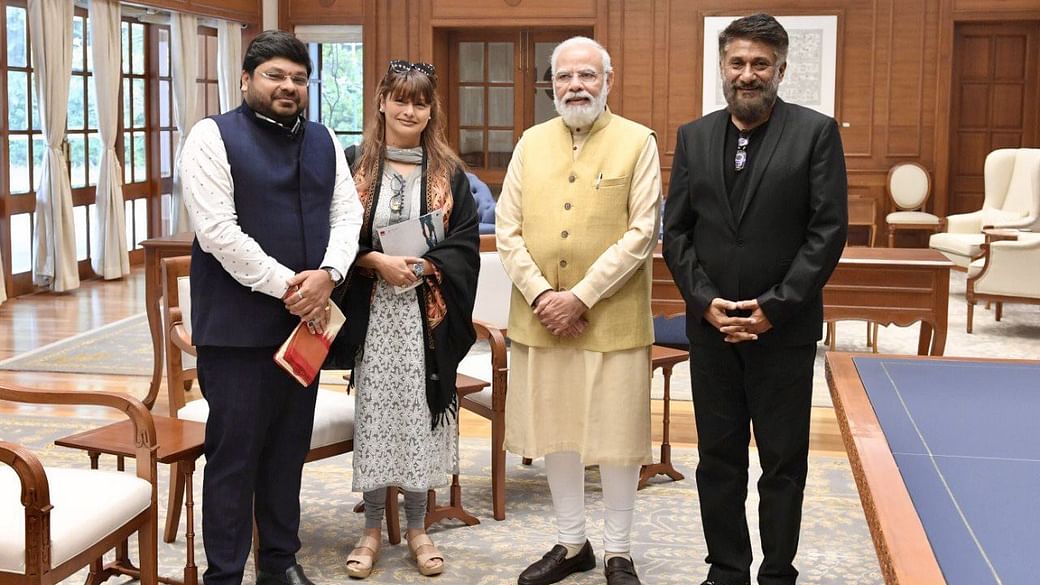 PM Narendra Modi with the crew of The Kashmir Files | Twitter
The Kashmir Files has given major FOMO to many people who believe the film contains some grand truth that they are missing out on. Many Indian audiences made a pilgrimage to the theatres to open their ‘third eye’ and witness ‘the truth’ in its pure and organic form. Passions and emotions ran high in theatres and there were many videos circulating on social media where audiences were seen delivering long speeches as the end title rolled on the screen. Cinema halls are known to give ‘audiences to the filmmaker’ but this film is unique because it gave ‘audiences to audiences’.
A few days ago, Prime Minister Narendra Modi said, with regards to the film, that the entire ‘ecosystem’ worked to hide the truth, and that “a truth suppressed for so long is coming out.” In a Roger Ebert-ian fashion, he gave ‘two thumbs up’ to the film and recommended the film to his MPs. This is a significant recommendation from the head of the country. This creates more suspense about the ‘truth’ that this film claims to possess.
There is now a growing debate where the Right-wingers are saying that ‘propaganda’ of the Left and the liberals (whom they have nicknamed ‘Urban Naxal’) is ‘busted’ and the ‘truth’ is finally being told through cinema. On the other hand, people from opposing ideologies believe that The Kashmir Files is nothing but State-sponsored propaganda. This itself leads to the question: what is the meaning of propaganda in cinema and can we distinguish between ‘good propaganda’ and ‘bad propaganda’?
To answer this question, we need to turn to the history of cinema.
Montage films of Soviet Cinema
The Russian Revolution of 1917 created a political environment that pushed the role of propaganda in cinema. The word ‘propaganda’ at that time didn’t have the negative connotation it has today.
In fact, propaganda was termed as an ‘essential activity’ to spread awareness among the public and ‘stimulate their revolutionary thoughts’. Many great filmmakers emerged in this era who believed in the power of propaganda and they made films that are considered some of the most important artworks in cinematic history. These were filmmakers who gave many film theories that are still taught across the best film schools in the world. Among them, the most prominent is Soviet director Sergei Eisenstein who gave ‘montage theories’ or editing techniques. Most modern editing techniques currently used in Hollywood and Bollywood owe a lot to Eisenstein and Lev Kuleshov’s theories of editing.
As such, the base of cinematic editing techniques lies in the idea of propaganda. No wonder famous French filmmaker Jean-Luc Godard once remarked: “Cinema is truth 24 times a second, and every cut is a lie.” There is a medium of psychological manipulation through the use of editing that every filmmaker uses to present their ideas or ‘truth’ to the public.
Now comes the classic question of ‘good propaganda’ and ‘bad propaganda.’ How can we define ‘propaganda’ when it is inherent to cinema? Can ‘good propaganda’ be termed as the transmission of ideas that expand the mind of an individual and thus contribute to society and bad propaganda as something that restricts the thinking of an individual and converts him to a hateful person? Beth Bennett and Sean O’Rourke (2006) thus “contrast ‘good’ rhetoric, which they claim appeals to reason, with ‘bad’ propaganda, which they claim appeals to the emotions,” as noted by researcher Michael Russel in his 2009 thesis.
Relationship between propaganda and spectators
Any success of propaganda also tells us the relationship between the propaganda-makers and the target audiences. In order for propaganda films to land successfully, a proper launching ground first needs to be created. The Kashmir Files is a classic film for its time and place — in a hyper-nationalistic era, where the Right-wing machinery is working overtime to seize the ‘means of communication’ (whether it’s news channels, social media, or Internet memes); in today’s time when there is unadulterated hate against JNU (Jawaharlal Nehru University) and intellectuals; in this era when bigotry is on free display even by the heads of the states. This is the perfect time for such a film to arrive — the audiences are already in a trance of misinformation and they just want to go to theatres to stamp their prejudices rather than seeking ‘truths’.
This is the reason why one sees the video of people shouting slogans in theatres and openly making hate speeches against Muslims. This is, in fact, the kind of social-political film where you’ll gain more insight about society if you move your gaze away from the white screen of the cinema hall and observe the audience.
A film professor from my alma mater Film and Television Institute of India (FTII) used to say: “The meaning of the film is already in the mind of the public and as a filmmaker, you just need to tap into that subconscious area.” This is the reason people interpret films based on their own realities and truths that they have constructed. In the case of The Kashmir files, Kashmiri Hindus are rightfully ‘relating’ to the film because this is a rare occasion when the stories of unimaginable, horrific tragedies are presented on celluloid. On the other side, some people are ‘relating’ to the film because it confirms their biases against those they hate. This is the kind of film that doesn’t ‘tell’ but rather ‘sells’ the idea of truth to you.
American writer Susan Sontag once remarked: “If cinephilia is dead, then movies are dead too… No matter how many movies, even very good ones, go on being made. If cinema can be resurrected, it will only be through the birth of a new kind of cine-love.”
The Kashmir Files also got released post-lockdown, where the intimate experience of individual watching shifted once again to collective viewing in cinema halls. Here, the cinema hall itself became a space for a national experiment, where ‘we’, the people, flocked together to experience the moving images. In the cinema hall, Kashmiri Pandits became emotional watching the film and hugged each other as an act of shared trauma, whereas many collective haters shouted angry slogans to show that, as a nation, we are together in shared anger against people who allegedly hid the truth for long.
Cinema as a truth-telling medium
This trend of bringing out the ‘truth’ of any historical event through the cinematic medium is a complicated thing to do. Cinema can only bring out one version of the truth, which itself is deeply marinated in the biases of the person telling the story or people sponsoring the film. In cinema, every frame is political by default because by choosing what’s inside the frame, you are, automatically, hiding what’s outside of it. The very frame that your camera chose tells something about the ‘gaze’ and mind of the person who conceptualised it. This is why rather than the accuracy of events presented in the film, what matters the most is how these events are presented to create a psychological effect. How does the film play with the emotion of pre-radicalised society through the usage of cinematic mediums?
There is also a difference between political cinema and politically motivated cinema. The Kashmir Files is the latter, using propaganda to shut minds off rather than stimulate any useful cinematic or social thoughts.
However, an unexpected, and probably undesired, byproduct happens to be the catharsis for Kashmiri Pandits who feel they have ‘witnessed’ their truth being told, ironically through fiction, for we, as a society, talk more about Kashmiri Pandits than talking to them or humanely understanding their plight.
Subscribe to:
Posts (Atom)