Search This Blog

Wednesday, 30 December 2015

Recession, retrenchment, revolution? Impact of low crude prices on oil powers

Guardian writers:  in Moscow  in New York in Lagos  in Tunis  in Caracas  in Cairo and 

A glut of oil, the demise of Opec and weakening global demand combined to make 2015 the year of crashing oil prices. The cost of crude fell to levels not seen for 11 years – and the decline may have further to go.

There have been four sharp increases in the price of oil in the past four decades – in 1973, 1979, 1990 and 2008 – and each has led to a global recession. By that measure, a lower oil price should be positive for the world economy, with lower fuel costs for consumers and businesses in those countries that import crude outweighing the losses to producing nations.

But the evidence since oil prices started falling from their peak of $115 a barrel in August 2014 has not supported that thesis – or not yet. Oil producers have certainly felt the impact of the lower prices on their growth rates, their trade figures and their public finances but there has been no surge in consumer spending or business investment elsewhere.

Economist still reckon there will be a boost from a lower oil price particularly if it looks as if the lower cost of crude will be sustained.

Dhaval Joshi, an economist at BCA, a London-based research company, said: “A commodity bubble has deflated three times in the past 100 years: the first was after world war one; the second was after the 1980s oil shock; the third is happening right now.”

For the big producer countries, this is a major headache, the ramifications of which are only starting to be felt. Oil powers base their spending plans on an assumed crude price. The graphic below shows just how far below water their budgets are.

Joshi says crude prices may fall by a further 35% to reach its long-term trend. That would mean an oil price closer to $25 a barrel - and fiscal crises in some of the world’s most pivotal economies.

Saudi Arabia
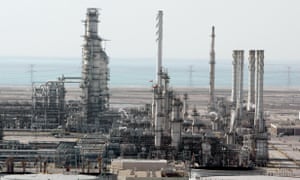

The Ras Tanura oil production plant in Saudi Arabia’s eastern province. Photograph: Bilal Qabalan/AFP/Getty Images

Low oil prices are not just squeezing Saudi Arabia’s domestic budget, imposing austerity on a kingdom not used to it: it is taking its toll on Saudi support for foreign projects too.

The kingdom this week announced swingeing budget cuts for 2016 to address an alarming deficit of 15% of GDP run up this year. Subsidies for water, electricity and petroleum products are likely to be cut, and government projects reined in.

But overseas beneficiaries will face some austerity too. For years, Saudi Arabia has used its oil wealth to support friends and allies around the world, including media organisations, thinktanks, academic institutions, religious schools and charities. Countries that have traditionally benefited from Saudi largesse include Jordan, Lebanon, Bahrain, Palestine and Egypt.

But now the IMF has raised the prospect that Saudi Arabia could go bankrupt in five years without changes to its economic policy, cuts in support to foreign allies seem inevitable.

Egypt’s black-hole economy is potentially the kingdom’s most expensive foreign policy commitment. In recent years, Saudi Arabia has donated billions in cash and oil products but, despite this, the Egyptian economy, battered by war, terrorism and political instability, is facing an acute foreign currency shortage.

Speculation is mounting that Saudi financial support to Egypt is starting to dry up – something the Egyptian authorities have denied – and that this is damaging the bilateral relationship.

There have been some signs of tension. In July, Egypt’s oil minister said he had no objections to importing crude oil from Iran, a move sure to ruffle the Saudis. In September, the Saudi journalist Jamal Khashoggi – known for his closeness to the Saudi state – raised eyebrows when he said the new Egyptian culture minister, Hilmi al-Namnam, who is well known for his secularism and dislike of Wahhabi Islam, should never have been appointed.

So far, the Saudi authorities have given few clear signs about how they are planning to respond to the oil price crisis, let alone lay out a long-term plan for a post-oil Saudi Arabia.

Options under consideration are thought to include cutting construction projects, energy subsidies and public sector wages, introducing new taxes and privatisations, and issuing debt.

Another possibility foreign observers have posited is that the Saudis will be forced to unpeg the riyal from the dollar, although given the potential this would have for uncontrollable knock-on effects on the rest of the economy, this seems likely to be a last resort.

Cuts impacting on ordinary Saudis are something the government will be keen to avoid to maintain political stability, so industry, the public sector and foreign allies are likely to bear the brunt of the economic burden.


Nigeria
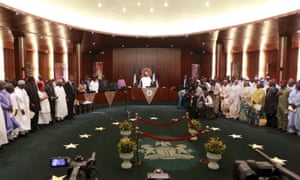

 Nigeria’s president, Muhammadu Buhari, swears in his cabinet in November. Photograph: Afolabi Sotunde/Reuters

The oil price slump has not prevented Nigeria’s new government from unveiling big spending plans – but analysts warn that the generosity is misplaced at a time when oil prices languish below $40 a barrel. 

Nigeria is Africa’s top oil producer and the World Bank estimates crude sales fund about 75% of the country’s budget.

In its £19.8bn budget proposal, the government plans to increase spending by about one quarter over last year’s budget, and to pay for it by improving tax collection and cutting the cost of government.

The budget includes £1.65bn for cash transfers to poor Nigerians. The programme was a campaign promise of the president, Muhammadu Buhari, who was elected in March on a platform of cutting corruption and weaning Nigeria’s economy off its dependence on oil revenue.

But some analysts think the proposed budget is unrealistic during times of $40 oil.

“This brings a dose of reality to a people who have extremely high expectations,” said Bismarck Rewane, the chief executive of Financial Derivatives Co. He predicted the government would have to back down on some of its promises.

Nigeria is Africa’s largest economy, but most of the money is concentrated in the hands of a wealthy elite and about two-thirds of Nigerians live in poverty, according to the United Nations development programme.

Analysis Nigeria overtakes South Africa to become Africa's largest economy. Complicated statistical recalculation adds $240bn to the economy - the equivalent of finding six Ghanas within Nigeria, says Tolu Ogunlesi

Unemployment has climbed this year, hitting 9.9% in the third quarter, according to the National Bureau of Statistics.

Chuba Ezekwesili, research analyst at Nigerian Economic Summit Group, says despite the falling price of crude, the country has been able to avoid a jump in inflation by imposing limits on the availability of foreign currency.

While other major oil producing economies have let their currencies lose value along with oil prices, Nigeria has spent its reserves to prop up the value of the naira. But Ezekwesili says they can only do that for so long.

“They’re sort of delaying the inevitable,” he said. “I feel like eventually it has to give way, and by the time it does I feel the economy is going to be hurt because a lot of businesses can’t work under those conditions.”

Ezekwesili was also sceptical of the government’s ability to generate the revenue necessary to pay for programmes such as cash transfers to the poor. He doubts the government can accomplish its goals of streamlining its costs and generating more revenue by next year.

“One thing I’ve learned about policies in Nigeria is we tend to be very optimistic but it never really works out exactly as we want it to,” Ezekwesili said.

Russia
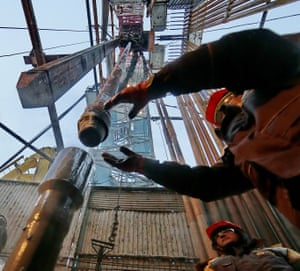

Oil extraction at a Gazprom field in Khanty-Mansiysk, Russia. Photograph: TASS/Barcroft Media

Vladimir Putin goes into 2016 with record approval ratings but the shakiest economic outlook since he took charge. In the 15 years he has been at the helm, 2015 was the first year that real wages registered a decline, something that did not happen even during the 2008-09 financial crisis.

Oil and gas exports make up about half of the Russian budget, and the rouble rate has been strongly linked to the price of oil.


Sanctions against Russia, particularly the ban on Russian banks seeking western credit, combined with falling oil prices in late 2014 to create a perfect storm that demolished the rouble, with the currency losing half of its value against the dollar, reviving memories of previous crashes. The currency regained some of its value by spring, but falling oil prices in autumn have caused it to fall back to lows similar to those it experienced in late 2014.
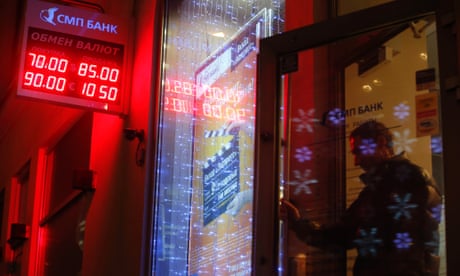


Rouble in freefall despite rate hike


Falling oil prices were one of the principal reasons for the collapse in the Soviet economy, and some economists are warning of history repeating itself. Riding on a wave of high oil prices for most of his presidency, the Russian president did not expect such a sharp downturn. Last October, Putin said that if the price of oil fell below $80 a barrel, the world economy would crash. A range of other top Russian officials made similar statements, in effect ruling out the possibility that oil could fall below $70.

Some analysts say the rouble is still overvalued, and the current oil price should theoretically push the rouble down further. This is necessary to balance the budget: the fewer dollars Russia receives for the oil it sells, the higher the exchange rate needs to be for the budget to receive the requisite amount of roubles. For the budget to balance at 65 roubles, not far off the current rate, the price of oil should be $70, a recent Bank of America Merrill Lynch report found.

For ordinary Russians, it could be a tough year ahead. Those who were used to travelling abroad have already had to scale back as the rouble made the cost of visiting foreign cities prohibitive; and rising food prices have made it harder to balance the books for many families.

The 2016 budget, fixed in October, requires oil to be at $50 in order to run a 3% deficit within “acceptable” rouble rate limits, meaning if the price does not rise soon, cuts will need to be made or reserves spent. The war in Syria is an extra cost, and the announced increases in military spending are not likely to be reversed.


US
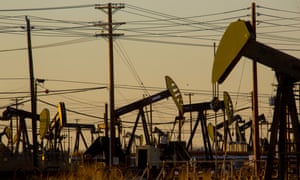

Belridge, California, is one of the oldest and largest oilfields in the US containing tens of thousands of wells, many of which are being fracked. Photograph: Les Stone/Corbis

Filling up at the gas station hasn’t been this cheap in the US since the recession. The nationwide average price of a gallon of regular is now $2.02 (£1.36), down 58 cents from this time last year, according to auto club AAA, and expected to fall further.

Scared that North America’s oil boom threatens its grip, Opec, the oil cartel, stepped up production and forced a price war that has driven oil prices down to below $35 a barrel. US consumers have benefited from lower petrol prices to the tune of about $700 a year, according to the US government, and that money is fuelling consumer spending. According to a recent report from JP Morgan, 80% of that saving is being spent on goods and services.

But the collapsing price of oil has also cast a shadow over the US energy industry – formerly one of the country’s fastest growing employers. Fracking – the controversial process of extracting oil and gas from shale rock – has become less attractive to investors as the oil price has fallen, and tens of thousands of jobs have been lost as a result. This year, the International Energy Agency said low oil prices would “slam the brakes” on the US shale industry and the impact is already being felt across the country’s oil producing areas.

The US energy sector has cut more than 90,000 jobs this year, according to outplacement company Challenger, Gray & Christmas. And while the overall US unemployment rate has continued to fall, in Texas unemployment has risen since August, according to the Bureau of Labour Statistics. In North Dakota, home of the Bakken shale oil field, more than 17% of the mining jobs – which include oil and natural gas – have disappeared in the past year. More jobs look certain to be lost in the coming months.

North of the border in Canada, things are even worse. In Alberta, “the Texas of the north”, job layoffs and the downturn of the economy have been blamed for a 30% rise in suicides between January and June, compared with 2014. In Saskatchewan, another energy-dependent region, there have been 19% more suicides this year.

Daniel Pavilonis, senior commodity broker with RJO Futures, said the situation was only likely to get worse for those employed in the US energy sector. “There are oil tankers just sitting off the coast because we don’t need more supply. We have too much,” he said. “There’s oversupply and a lack of anybody trying to tighten production because they don’t want to lose market share.”

As a result he predicts oil prices will go lower, taking more jobs with it. But for most consumers, it’s a win. Unlike other global economic trends, the oil price fall actually benefits average Americans, said Pavilonis. “This is our money,” he said. “For most people, it’s a good thing.”

Venezuela
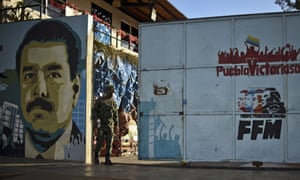

A mural depicts President Nicolás Maduro, who, having lost the Venezuelan National Assembly, has a battle to keep economy and his leadership afloat. Photograph: Luis Robayo/AFP/Getty Images

In most of the world, falling oil prices have caused significant reductions in petrol prices. But in the country with the world’s largest oil reserves, the oil glut could force a price rise.

“It’s probably the only place in the world where with oil prices so low, they may raise gasoline prices,” says Pedro Méndez, an informal taxi driver in Caracas, the Venezuelan capital, who fills the tank of his Ford Laser for less than a dollar.

But the lower the price of oil goes, the deeper Venezuela’s economy sinks. It’s near total dependence on crude exports for hard currency has seen the government of president Nicolás Maduro struggling to try keep the economy afloat.

The political effect is already being felt. Gripped by spiraling inflation, chronic shortages of basic goods and a quickly depreciating currency, Venezuelan voters this month gave the opposition an overwhelming majority in the new legislature, which takes office in January.

Each $1 drop in oil prices results in more than $685m in lost yearly oil income for PDVSA, the state-owned oil company, according to analysts.

And every drop in crude prices means less funding for the health, education and housing and other social welfare programmes that won Maduro’s predecessor, Hugo Chávez, widespread support for his self-styled “Bolivarian revolution”.

While dwindling oil revenue hurts the social programmes, Antonio Azpurua, a financial consultant with CFS Partners/LA Group, says it could be a blessing in disguise, allowing Venezuela to wean itself of its dependence on crude. “Venezuela needs to take advantage of low oil prices to build its industrial base,” he says.

With a super-majority in the National Assembly, the opposition could reverse some of Maduro’s populist measures, which have contributed to the current economic crisis. They could also choose to raise petrol prices.


Iran

Iranians took to the streets to celebrate the nuclear deal which will mean they can more freely trade their oil. Photograph: Abedin Taherkenareh/EPA

Iran is rushing to implement the landmark nuclear accord in order to cash in on sanctions relief as early as next month, but the plummeting price of oil is tempering its expectations even though its economy has become less dependent on crude sales.

Tehran currently exports 1.1m barrels of oil per a but the Iranian oil minister, Bijan Zanganeh, has announced that the country is aiming to double that amount within six months of sanctions being lifted, hoping it will return to the pre-sanctions level of 2.2m.

Although the EU lifted Iranian sanctions in October after the Vienna nuclear agreement, the measures will only come into effect after what has become known as “implementation day”, the unknown date when the UN nuclear watchdog, IAEA, will verify that Iran has taken the necessary steps as outlined under the nuclear deal. Iran is expediting whatever it can to bring this date forward to as early as January.

In an effort to woo foreign investment in the post-sanctions era, Iran put a set of new lucrative oil and gas contracts, worth more than $30bn, on the market this month. But all these efforts have come at a time when global oil prices are falling as a result of a crude surplus of 2m barrels a day, a phenomenon Tehran blames on the Saudis.

“The drop in oil prices hurts all oil producers, not just Iran,” said Amir Handjani, president of PG International commodities trading services and a member of the board directors of RAK Petroleum.

“Saudi Arabia is very aware that Iran will be able to sell its crude unencumbered by sanctions on the international market very soon and will use all means at its disposal to make sure Iran doesn’t recapture the market share it lost over the past four years,” he said.

“Basically, Riyadh’s message to Tehran is simple: we can endure low oil prices for a while; can you?”

But the experience of years under sanctions has made the Iranian economy “incredibly resilient”, according to Handjani. Iran’s economy faced huge economic problems in recent years due to international sanctions imposed over Tehran’s nuclear programme. Plummeting oil prices only added to economic woes in a country with the world’s fourth-largest oil reserves.

“To be sure, low oil prices deny Tehran much needed revenue but unlike the Saudis, Iran’s economy is not solely dependent on oil exports. Oil revenue accounts for about 15% of Iran’s GDP,” Handjani told the Guardian. Sanctions have forced Iran to diversify its economy, he said. It has a large manufacturing base, IT sector, and robust agro-industries, which make its economy on the whole “much more balanced” than Saudi Arabia.

“The Iranian economy has absorbed so many shocks over the past 36 years, from war to sanctions, that the pain of low oil prices now, as it breaks from international isolation, pales in comparison.”

Without naming Saudi Arabia, Zanganeh said last week that it was clear which country had an excess of supply and that there was “no ambiguity about who they are”. On the occasion of unveiling new oil contracts, the Iranian minister said last month that his country was willing to play a major role in oil supply and was even ready to work with American companies. “The way for the presence of these companies in Iran’s oil industry is open,” he said at the Iran Petroleum Contracts Conference in Tehran.

The deputy managing director of the national Iranian oil company (NIOC) told the Guardian in September that the Iranian government was earning more from tax than oil for the first time in almost half a century as the country shifts its traditional reliance on crude to taxation revenues in the face of falling oil prices. Critics say Iran is unlikely to maintain that equation when the lifting of sanctions allows it to export more oil.

According to Opec, Iran on average was selling oil at $38.92 a barrel in November, $5.63 less than the average in October, which is the worst drop among the group’s members.


Libya
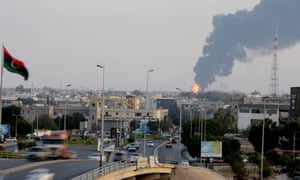

Fuel depots and tankers have been targets for years in the struggle for control of Libya and its oil resources. Photograph: EPA

Plunging oil prices are threatening disaster in Libya, where civil war has left the population depending on fast-dwindling oil revenues to survive.

Libya has Africa’s largest oil reserves and in normal times this provides 95% of the country’s export revenues, keeping the economy afloat. But civil war between rival governments at either end of the country has shattered the economy, leaving the population almost wholly dependent on revenue generated overseas.

The crash in oil prices has halved revenues, and shortages of foodstuffs and medicines – even petrol – are starting to be felt.

This cash squeeze has triggered a three-way battle for control of what remains of the country’s oil wealth. Much of Libya’s largest group of oil fields, the Sirte Basin, is now held by Islamic State, which has interposed itself between forces of the rival governments. Most of what remains is in eastern Libya, held by the elected parliament based in Tobruk.

Tobruk is using its status as the internationally recognised government to battle in foreign courts for the right to income from other producing fields, opposing the state-owned National Oil Corporation, whose headquarters remains in Tripoli, held by a rival parliament.

Tobruk has set up a second National Oil Corporation, based in eastern Libya, and last month demanded international oil companies switch payments that currently go to Tripoli.

Countering that, Tripoli’s NOC chief, Mustafa Sanallah, convened a conference in London in October calling on oil buyers to stick with him. Two of the world’s largest oil buyers, Glencore and Vitol, have agreed, but the eastern government has vowed legal action.

London courts are likely to be the proving ground for this test of wills, with both governments already gearing up for a precedent-setting high court battle, due early next year, for control of the Libya Investment Authority, the country’s £65bn sovereign wealth fund.

But whoever wins control of what remains of the oil industry may find it a pyrrhic victory. John Hamilton, director of London’s Cross-border Information, says the glut of oil on world markets and turbulence around the few remaining oil ports means Libyan oil has already been “priced out” by many buyers.
Tuesday, 22 December 2015

Zimbabwe to make Chinese yuan legal currency after Beijing cancels debts

Yuan becomes the latest currency to be approved for public transactions in Zimbabwe, as the southern African nation seeks to increase trade with Beijing


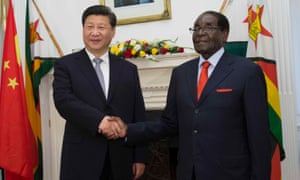
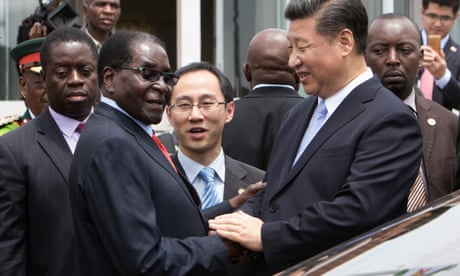
The yuan will become legal tender after Chinese president Xi Jinping visited Zimbabwe in early December for talks with president Robert Mugabe. Photograph: Huang Jingwen/Xinhua Press/Corbis


Agence France-Presse


Zimbabwe has announced that it will make the Chinese yuan legal tender after Beijing confirmed it would cancel $40m in debts.


“They [China] said they are cancelling our debts that are maturing this year and we are in the process of finalising the debt instruments and calculating the debts,” minister Patrick Chinamasa said in a statement.


Robert Mugabe greets China's Xi Jinping as 'true and dear friend' of Zimbabwe


Chinamasa also announced that Zimbabwe will officially make the Chinese yuan legal tender as it seeks to increase trade with Beijing.

Zimbabwe abandoned its own dollar in 2009 after hyperinflation, which had peaked at around 500bn%, rendered it unusable.

It then started using a slew of foreign currencies, including the US dollar and the South African rand.

The yuan was later added to the basket of the foreign currencies, but its use had not been approved yet for public transactions in the market dominated by the greenback.

Use of the yuan “will be a function of trade between China and Zimbabwe and acceptability with customers in Zimbabwe,” the minister said.

Zimbabwe’s central bank chief John Mangudya was in negotiations with the People’s Bank of China “to see whether we can enhance its usage here,” said Chinamasa.

China is Zimbabwe’s biggest trading partner following Zimbabwe’s isolation by its former western trading partners over Harare’s human rights record.

In reaction veteran president Robert Mugabe adopted a “look East policy”, forging new alliances with eastern Asian countries and buttressing existing ones.

In early December, Chinese president Xi Jinping stopped over in Zimbabwe in a rare trip by a world leader to the country, and presided over the signing of various agreements, mainly to upgrade and rebuild Zimbabwe’s infrastructure such as power stations.

Saturday, 19 December 2015

Vyapam - The mystery of India’s deadly exam scam

Aman Sethi in The Guardian

On the night of 7 January 2012, a stationmaster at a provincial railway station in central India discovered the body of a young woman lying beside the tracks. The corpse, clothed in a red kurta and a violet and grey Puma jacket, was taken to a local morgue, where a postmortem report classified the death as a homicide.

The unidentified body was “a female aged about 21 to 25 years”, according to the postmortem, which described “dried blood present” in the nostrils, and the “tongue found clenched between upper and lower jaw, two upper teeth found missing, lips found bruised”. There was a crescent of scratches on the young woman’s face, as if gouged by the fingernails of a hand forcefully clamped over her mouth. “In our opinion,” the handwritten report concluded, “[the] deceased died of asphyxia (violent asphyxia) as a result of smothering.”


Three weeks later, a retired schoolteacher, Mehtab Singh Damor, identified the body as his 19-year-old daughter Namrata Damor – who had been studying medicine at the Mahatma Gandhi Medical College in Indore before she suddenly vanished one morning in early January 2012. Damor demanded an investigation to find his daughter’s killer, but the police dismissed the findings of the initial postmortem, and labelled her death a suicide.

The case was closed – until this July, more than three years later, when a 38-year-old television reporter named Akshay Singh travelled from Delhi to the small Madhya Pradesh town of Meghnagar to interview Namrata’s father. Singh thought that Namrata’s mysterious death might be connected to an extraordinary public scandal, known as the Vyapam scam, which had roiled the highest echelons of the government of Madhya Pradesh.

For at least five years, thousands of young men and women had paid bribes worth millions of pounds in total to a network of fixers and political operatives to rig the official examinations run by the Madhya Pradesh Vyavsayik Pariksha Mandal – known as Vyapam – a state body that conducted standardised tests for thousands of highly coveted government jobs and admissions to state-run medical colleges. When the scandal first came to light in 2013, it threatened to paralyse the entire machinery of the state administration: thousands of jobs appeared to have been obtained by fraudulent means, medical schools were tainted by the spectre of corrupt admissions, and dozens of officials were implicated in helping friends and relatives to cheat the exams.


A fevered investigation began, and hundreds of arrests were made

A fevered investigation began, and hundreds of arrests were made. But Singh suspected that the unsolved murder of Namrata Damor – and the baffling insistence of the police that she had flung herself from a moving train – might be part of a massive cover-up, intended to protect senior political figures, all the way up to the powerful chief minister of Madhya Pradesh.

By the time Singh came to interview Mehtab Singh Damor, the Vyapam scam had begun to seem like something more deadly than an unusually large bribery scandal. Since 2010, more than 40 doctors, medical students, policemen and civil servants with links to the Vyapam scam had died in mysterious circumstances.

The state government, under relentless pressure from its political opponents, insisted that none of the dead had been murdered – the media, they contended, had simply stitched together a series of unconnected natural deaths. “Whoever is born has to die one day,” the state’s home minister, Babulal Gaur, said in a memorable TV interview, citing Hindu scripture. “This is the mrityu lok” – the realm of death.
Advertisement


When Akshay Singh arrived at the Damor home, Namrata’s father sat him down on a heavy wooden armchair in his living room, silenced the television, and handed over a well-thumbed file stuffed with photocopies of petitions, police reports, and court papers. Tea arrived on a tray; Singh picked up a cup and turned his attention to Namrata’s postmortem report and the coroner’s feathery scrawl.

As he sipped his tea, Singh turned as if to ask a question, but his face froze, his left arm shivered, his open mouth gasped for air, tiny bubbles of spittle formed on his lips before he collapsed in his chair, the dead woman’s case file motionless in his lap.

“We lay him down on the floor, loosened his clothes and sprinkled his face with water,” recalled Rahul Kariaya, an Indore-based journalist who took Singh to Damor’s house, “I checked his pulse and I knew right away, Akshay Singh was dead.”
* * *

Within hours of Singh’s death, the long-simmering Vyapam scandal exploded from the inside pages of newspapers on to primetime television. It soon emerged that the Madhya Pradesh police had ended their investigation into Namrata Damor’s death on the basis of a second postmortem report, prepared by a doctor who later admitted that he had not examined the body and had based his findings solely on photographs provided by the police. Namrata Damor, according to this postmortem, had killed herself because of a failed relationship.

“I want everyone across the country to ask themselves one question,” the country’s most bombastic TV news presenter, Arnab Goswami, bellowed one night in July, waving copies of both postmortem reports on his popular nightly programme. “How does a postmortem come to the conclusion, [without] using any evidence, that the ‘victim is disappointed in love and has caused annoyance of her parents?’”
Advertisement


The Vyapam scandal began as an old-fashioned scam in a country with a long and storied history of corruption. Officials at the testing agency, along with their political backers and a network of fixers and touts, had charged preposterous sums of money to guarantee candidates either a government job or admission to a state medical college by fixing the results of the entrance examinations. Cheating of this sort was not a new phenomenon – but the enormous scale of the racket, the involvement of top government officials and medical colleges, and the alleged murder of suspects made the Vyapam scam into an explosive political controversy. The four-week long summer session of the Indian parliament in 2015 was completely paralysed by demands from the opposition Congress party for the resignation of Shivraj Singh Chouhan, the Bharatiya Janata Party (BJP) chief minister of Madhya Pradesh.

When the scandal first became public in 2013, the Madhya Pradesh government assembled a special taskforce of state police officers to investigate the allegations. It moved quickly, sweeping up everyone from individual students and their parents to the chief minister’s personal secretary. By the time of Singh’s sudden death in July 2015, the taskforce had already arrested an astonishing 2,235 people – of whom 1,860 were released on bail after questioning.

The list of top state officials placed under arrest reads like the telephone directory of the Madhya Pradesh secretariat. The most senior minister in the state government, Laxmikant Sharma – who had held the health, education and mining portfolios – was jailed, and remains in custody, along with his former aide, Sudhir Sharma, a former schoolteacher who parlayed his political connections into a vast mining fortune. Another minister, Gulab Singh Kirar, simply disappeared rather than face questioning from the police. (Many of those accused have protested their innocence, but it may take years for the prosecution to secure any convictions.)

Among those detained by the taskforce were half a dozen aides to top state ministers – but from the start, opposition parties insisted that the probe was an elaborate charade, intended to convey a sense of urgency to the public while protecting the chief minister. The preponderance of aides among the arrested fuelled speculation that underlings had been forced to fall on their swords to protect their bosses.

And then, as the investigation widened, people started dying. Some had perished before the taskforce had a chance to interrogate them – such as Anuj Uieke, a medical student accused of working as a middleman connecting exam aspirants and Vyapam officials. He died along with two friends also accused of involvement in the scam when a truck ploughed into their car in 2010. Others apparently took their own lives, like Dr Ramendra Singh Bhadouriya, who was accused of cheating his way to a medical college seat in 2008 and then helping others do the same. He was found hanging from the ceiling fan in his home in January 2015. (Five days later, his mother took her own life by drinking acid.) Another suspect, Narendra Tomar – a seemingly healthy 29-year-old veterinary doctor at a government hospital, who had been arrested for his role as a middleman in the scam – had a sudden heart attack in jail this June and died in hospital the next day.


In July 2014, the dean of a medical college in Jabalpur, Madhya Pradesh, Dr SK Sakalle – who was not implicated in the scandal, but had reportedly investigated fraudulent medical admissions and expelled students accused of obtaining their seats by cheating – was found burned to death on the front lawn of his own home. The police initially maintained that Sakelle had doused himself in kerosene and set himself alight; an unusual means of suicide for a doctor with easy access to a wide range of toxins. But they were forced to reopen their investigation one year later, when Sakelle’s colleague and close friend, Dr Arun Sharma, who took over as dean of the medical college, was found dead in a Delhi hotel alongside a half-empty bottle of whisky and a strip of anti-depressant pills.
Advertisement


In March of this year, Shailesh Yadav, the 50-year-old son of the governor of Madhya Pradesh – the formal head of state government, appointed by the president of India – died of a suspected brain haemorrhage in his family home. Both the governor and his son were implicated in the scam.

Each new death brought a flurry of headlines, and increasingly excited speculation about conspiracies and cover-ups. “Who is killing all these people?” the TV presenter Goswami demanded on air one night – inviting viewers to tag their tweets on the story with #KillingAScam.

Through it all, the government of Madhya Pradesh insisted that the series of deaths was nothing more than a coincidence – a conspiracy theory cooked up by its political opponents – and that the state police taskforce was conducting an exemplary investigation of the scandal. But the death of Akshay Singh, which brought the national spotlight on to the case, forced the government to ask for a probe by the notionally autonomous Central Bureau of Investigation (CBI). In an interview with the Indian Express newspaper, Chouhan, the chief minister of Madhya Pradesh, said he was satisfied by the state police investigation, but agreed to a CBI investigation to clear “an atmosphere of falsehood” that “would have eventually affected the wellbeing of the state”.

When I arrived in the state capital, Bhopal, a beautiful city of lakes, greenery, and double-storey buildings, at the end of July, the local press had coined a cruel pun on the chief minister’s first name. Rather than Shivraj – after the Hindu god Shiva – they were calling him Shavraj, or King of the Corpses.
* * *

In 2013, the year the scam was first revealed, two million young people in Madhya Pradesh – a state the size of Poland, with a population greater than the UK – sat for 27 different examinations conducted by Vyapam. Many of these exams are intensely competitive. In 2013, the prestigious Pre-Medical Test (PMT), which determines admission to medical school, had 40,086 applicants competing for just 1,659 seats; the unfortunately named Drug Inspector Recruitment Test (DIRT), had 9,982 candidates striving for 16 vacancies in the state department of public health.

For most applicants, the likelihood of attaining even low-ranking government jobs, with their promise of long-term employment and state pensions, is incredibly remote. In 2013, almost 450,000 young men and women took the exam to become one of the 7,276 police constables recruited that year – a post with a starting salary of 9,300 rupees (£91) per month. Another 270,000 appeared for the recruitment examination to fill slightly more than 2,000 positions at the lowest rank in the state forest service.

It was on the morning of the medical exam in 2013 that the Vyapam scandal began to unravel. A team of policemen raided the Hotel Pathik, a seedy £5-a-night motel on the outskirts of Indore, the largest city in Madhya Pradesh.

In room 13, the police came upon a young man readying himself for that morning’s exam. He handed over a voter identity card, introducing himself as exam candidate Rishikesh Tyagi, but when the police asked him his father’s name and his date of birth, he said he could not remember.

“On doing strict interrogation,” a police report of the incident reads, “he told his correct name as Ramashankar … he told us he came to give the examination in the name of Rishikesh Tyagi.”

Ramashankar, the police alleged, was already studying medicine in Uttar Pradesh, and had accepted 50,000 rupees (£500) to take the exam on behalf of Rishikesh Tyagi. Twenty such impostors were arrested that morning, 18 of whom had come from out of town to impersonate young students who felt they could not pass the entrance exams themselves.
Advertisement


The impersonators led the police to Jagdish Sagar, a crooked Indore doctor who had set up a lucrative business that charged up to 200,000 rupees (£2,000) to arrange for intelligent but financially needy medical students to sit examinations on behalf of applicants who could afford to pay. Police claimed that Sagar had amassed a fortune in land, luxury cars, and jewellery from the racket: according to a report in the Hindustan Times (headline: “Vintage Wine, Bed of Cash”), he slept on a mattress stuffed with 1,300,000 rupees. But Sagar, one policeman told me, was only the most prominent of a swarm of middlemen who offered similar services.

Standardised testing in India is a heroic and misguided attempt to compensate, over three short hours, for a young lifetime’s worth of inequities of caste, class, gender, language, region and religion, and the crushing inadequacy of the state-run schooling system. It is the only consideration for achieving college admissions or government employment. Nothing else matters – not your grades over 12 years of school, nor any hobbies, interests or transformative life experiences.

The competition is so intense, and India’s schools so poor that, according to the National Statistics and Sampling Office, a quarter of all students in India are enrolled in tuition centres. In some states, that figure is as high as 90%. The private tuition industry grew 35% over a five-year period from 2008 to 2013, as reported in a 2013 survey by the Indian Associated Chambers of Commerce and Industry, and is expected to be worth around £27bn by 2015.

This fevered demand for after-school classes has turned tuition centres into well-known brands – represented by star students who have secured the highest test results, whose bespectacled and slightly woebegone faces are plastered, like football stars, on billboards along rural highways, crowded railway stations, dusty bus stands, and outside schools and colleges.

The tuition industry has taken over entire towns, such as Kanpur in Uttar Pradesh, where students come from across the country to sleep in cramped hostels, subsisting on fried snacks and shuttling from coaching centre to coaching centre under the tutelage of “celebrity” teachers. While established centres advertise “world-class” facilities and faculties, less well-known institutes offer tales of improbable success, such as the poster I saw in Kanpur for a centre called The New Tech Education, featuring four young women in hijab and celebrating a “Miracle in the history of pre medical institute, all the 4 sisters of middle class family became doctor.”

The explosion of tuition centres, and the scarcity of jobs, has only intensified the desperation to grasp the tiny number of university places and jobs that are made available each year. “The impostor system has its roots in the world of the tuition centres,” I was told by a medical student who I met at his college hostel in Gorakhpur, in the neighbouring state of Uttar Pradesh, where Sagar had recruited most of his fraudulent candidates. “Centres conduct weekly exams and post the results on their bulletin boards, which makes it easy for touts to spot both – bright students who can work as impostors, and weak students looking to cheat their tests,” he said.


Once I started doing well in my tests, touts started calling, promising me 100,000 rupees for two days’ work

“Once I started doing well in my tests, touts started calling me every week promising me 100,000 rupees (£1,000) for two days’ work. He said, I’d be flown to an examination centre, put up in a five-star hotel, and flown back to home – all I had to do was solve a paper.” My source said he had declined their overtures – but one of his classmates did not, and is now in jail in a Vyapam-related case.

Beginning in the late 1990s, investigators allege, Sagar and his out-of-town impostors helped hundreds of students cheat the medical exams. But eventually Sagar’s ambitions widened, and he turned to a man called Nitin Mohindra.
* * *

Nitin Mohindra is a short, pudgy man with a receding hairline, descending paunch, and lampshade moustache, who joined Vyapam in 1986 at the age of 21 as a data entry operator. By the time he met Jagdish Sagar, he had risen through the ranks to become the agency’s principal systems analyst, without ever drawing much attention to himself.

His colleagues recalled that he had only twice been the subject of any office gossip – both times for arriving at work in slightly flashy new cars: a Honda City in 2008, and Renault Duster SUV a few years later. “And he wore very nice shirts,” one colleague told me. “Nothing fancy, but you could tell that the material was just better quality than everyone else’s shirts.”

In 2009, police claim, Sagar and Mohindra had a meeting in Sagar’s car in Bhopal’s New Market bazaar, where the doctor made an unusual proposition: he would give Mohindra the application forms of groups of test-takers, and Mohindra would alter their “roll numbers” to ensure they were seated together so they could cheat from each other. According to Mohindra’s statement to the police, Sagar “offered to pay me 25,000 rupees (£250) for each roll number I changed.”


This came to be known as the “engine-bogie” system. The “engine” would be one of Sagar’s impostors – a bright student from a medical college, taking the exam on behalf of a paying customer – who would also pull along the lower-paying clients sitting next to him by supplying them with answers.
Advertisement


Vyapam officials showed me seating plans from examination centres to illustrate how Mohindra ensured that engines and bogies not only sat together, but were allotted seats in the last few benches in each examination room – far from the moderator – to make it easier for them to cheat. From 2009 to 2013, the police claim, Mohindra tampered with seating assignment for at least 737 of Sagar’s clients taking the state medical exam.

The scam became even more sophisticated in 2011, when the Madhya Pradesh state government appointed Pankaj Trivedi, a lecturer at a government college in Indore, as the controller of examinations at Vyapam – responsible for ensuring the security of the testing process. According to the police, Trivedi, who is now in jail, came under pressure from influential state ministers and officials to provide jobs and admissions for their relatives and friends. New to the job, Trivedi turned to Mohindra, who devised a solution that was dazzling in its simplicity. Students who had paid to have their results fixed were told to attempt only those questions for which they knew the answers, and leave the rest blank.

“Mohindra hooked all of Vyapam’s computers to a common office network and retained all administrator privileges,” said Tarun Pithode, an energetic young civil servant who was appointed Vyapam’s new director to set things straight after the scam broke. After the multiple-choice exam sheets were scanned, Mohindra could access the computer that stored the results, and alter the answers as he wished.

Once the results had been altered on the computer, Mohindra would approach the exam observers and ask for the original answer sheet, claiming that the student had requested a copy under India’s Right to Information Act. He would then sit in Trivedi’s office and fill out the originals so that they tallied with the altered version saved on the computer

The most glaring example of this method was discovered in the case of Anita Prasad, a daughter of Prem Chand Prasad, the personal secretary to Chief Minister Chouhan. She had passed the PMT exam in 2012 with the assistance of Trivedi and Mohindra – but failed to follow their instructions, and attempted to answer all of the questions, many of them incorrectly. When police investigators later obtained a copy of her original answer sheet, they found that Vyapam officials had used correction fluid to blank out her wrong answers and pencil in the correct ones instead.

“In our review, we found almost every system had been subverted,” Pithode said. “For example, every question paper set has an ‘answer key’ that is put into a self-sealing envelope before the exam and opened only at the time of tabulating results. Trivedi would seal the envelope in the presence of observers, but later would simply tear open the envelope, make copies of the key, and put the original document into a new envelope.”

Over the course of only two years, police allege, Mohindra and Trivedi conspired to fix the results of 13 different examinations – for doctors, food inspectors, transport constables, police constables and police sub-inspectors, two different kinds of school teachers, dairy supply officers and forest guards – which had been taken by a total of 3.2 million students.

Amidst this tangle of impostors, engine-bogies and altered answer sheets, the police soon found a spreadsheet on Nitin Mohindra’s hard drive that listed the names of hundreds of students who had paid to cheat the exams – along with the names of the minister, bureaucrat or fixer who had referred the student to Mohindra and the agreed payment.

The list included political heavyweights such as Uma Bharati, a former chief minister of Madhya Pradesh who is now the water minister in Prime Minister Narendra Modi’s cabinet – and a longtime rival of Shivraj Singh Chouhan.

With the police in possession of Mohindra’s spreadsheet and a ready list of suspects, the case seemed to be heading to a speedy closure. But in February this year, the opposition Congress party – which had been demanding for months that Chouhan resign over the scam – made a startling claim. The police taskforce, they alleged, had tampered with the spreadsheet of conspirators to remove the name of the chief minister and replace it with the names of his rivals. The changes were made in “at least 48 places”, the Congress leader Digvijaya Singh – another former chief minister of Madhya Pradesh – claimed when we met in his office in New Delhi. “The chief minister’s name was either removed all together, or replaced with the name of Uma Bharati.”
* * *


The Central Bureau of Investigationtook over the case in July of this year. But there is little reason to believe that its findings will resolve the scandal. In 2013, India’s Supreme Court famously described the country’s premier investigating agency as a “caged parrot” for its susceptibility to political pressure from the reigning central government. And while the investigation drags on, it has been further muddied by an elaborate and increasingly impenetrable series of allegations and counter-allegations between the ruling BJP and the opposition Congress over the veracity of the evidence seized from Mohindra’s computer.

Two days after Mohindra’s arrest in 2013, a policeman showed up at the office of Prashant Pandey, a cyber-security expert with pointed sideburns, bouffant hair, a handlebar moustache and a taste for fitted waistcoats.

Pandey is the proprietor of a firm called Techn07. In a detailed resume he sent me after our first meeting, Pandey claimed to have helped the Madhya Pradesh police crack cases involving Islamist terrorists, tax evaders, kidnappings, and political murders – along with the Vyapam investigation. (The head of the Vyapam taskforce did not respond to multiple requests for comment, but state officials and police officers confirmed that Pandey had done work for the Indian Revenue Service and the Vyapam taskforce.)

“The policeman said his seniors had seized a hard drive from a suspect, but the local police station did not have a SATA cable to connect it to their desktop,” Pandey recalled when we met in his lawyer’s office in Delhi. “I gave him a cable, but the policeman wanted to make sure the connector was working and so he plugged it into one of my computers.” Pandey said that once he connected the drive, his computer automatically began to make a mirror image. The policeman had a cup of tea and left.

Two months later, Pandey said, the Vyapam taskforce paid him to install hidden cameras in their interrogation cells in Bhopal. (Pandey showed me a bill, dated March 2014, for a “bullet camera”, a Sony voice recorder, and various accessories, along with copies of cheques from the state finance ministry, to prove he had worked for the government in the past.)

Pandey said that he had worked for the Vyapam taskforce for more than six months – until the relationship soured in June 2014, when the Congress party released phone records alleging that Sadhna Singh, the wife of Shivraj Singh Chouhan, had made 139 calls from the chief minister’s residence to the ringleaders of the scam, Nitin Mohindra and Pankaj Trivedi. (The chief minister dismissed the allegations as a fabrication, and the matter was never investigated by the police.)

The police arrested Pandey, and jailed him on charges of trying to sell confidential phone records. His computers were seized, he said, and he was interrogated for three days. “All they asked me was, ‘What do you know about the chief minister and Vyapam.’” He was released on bail, but claims he was picked up again in the middle of the night, and taken to a safe house for further interrogation. “They said, you give anyone any more information and you are finished,” he told me.


I decided to fight back and expose all these corrupt officials. I realised that the police had doctored the evidence

“I decided to fight back and expose all these corrupt officials,” Pandey continued. “I realised that I had a mirror image of Nitin Mohindra’s hard drive, and on comparing the Excel sheet submitted by the police in court, and the Excel sheet from my copy of Mohindra’s hard drive, I realised that the police had doctored the evidence to save the chief minister.” Through his lawyer, Pandey leaked the information to the Congress leader Digvijaya Singh, who released it to the public.

The state government insists that it is Pandey – and the Congress party – who have tampered with the evidence. The Madhya Pradesh police submitted Mohindra’s hard drive to a government forensic laboratory in Gujarat, which certified the authenticity of their version of the document. Pandey’s lawyers, on the other hand, submitted his copy of the spreadsheet to a well-regarded private forensic lab in Bangalore, which verified that his was the original copy. So the BJP-led government has its own version of the evidence, and the Congress opposition has another – a neat parable for the general condition of Indian political debate. It will fall to the Supreme Court (and perhaps yet another forensic lab) to decide whose report to believe.
Advertisement


In the meantime, Mohindra’s lawyer, Ehtesham Qureshi, has seized on the controversy to insist that the case against his client has been fabricated. “If the police have altered the Excel sheet in my client’s hard drive,” Qureshi told me, “how can we trust any of the supposed evidence seized from his computer?” The police, he alleges, have kept Mohindra in jail for two years by filing a succession of cases against him, one each 90 days, to prevent him from becoming eligible for bail. “My client, who is a poor, middle-class person, is being made a scapegoat to protect the wealthy and powerful,” Qureshi said. “They are going to keep him in forever, because if he gets out and starts speaking, who knows what will happen.”
* * *

When I met Rajendra Shukla, Madhya Pradesh’s minister for public relations, power and electricity, and mines and minerals – the man with the unenviable task of managing the fallout from the Vyapam scam – he calmly insisted that the massive scale of the multiple ongoing investigations was proof that the state government had nothing to hide.

“Several senior people have been arrested in connection with this case,” Shukla told me one evening at his residence in Bhopal. “This means no one is being shielded and the probe has been conducted in a fair way.” He declared that the chief minister was completely innocent, and added – very plausibly – that “if senior people had not been arrested, the opposition would have said this is a cover up.”

But what of the deaths? “Please read this booklet,” Shukla said, reaching for a glossy pamphlet titled Vyapam: Propaganda and Reality. “It should answer most of your questions.”

The 23-page booklet, which the state government has distributed widely in Madhya Pradesh and Delhi, praises Chouhan’s administration for its swift and decisive action in appointing a police taskforce to investigate the case, and reviews each fatality alleged to be connected to Vyapam in succinct paragraphs, nearly all of which end with some variation on the following phrase: “The family has not expressed any doubt about his death so far.”

The booklet considers the deaths of 31 people: 11 died in road accidents, five allegedly committed suicide, two drowned in ponds, and three lost their lives to “excessive liquor consumption” – all of which have come under suspicion precisely because of the apparent reluctance of the state police to investigate any of the deaths allegedly connected to the scandal. Shukla and his government, however, insist that all these deaths, while tragic, have no connection to the Vyapam scandal to begin with.

Namrata Damor, the young woman found dead on the railway tracks in 2012, is not mentioned in the government’s list of deaths allegedly linked to Vyapam. When I met her father Mehtab, however, he also insisted that his daughter had no connection to the scam.

But why would anyone want to kill his daughter? “She fell into bad company,” he said, “When a young girl from a small town like Meghnagar goes to a city like Indore, there are always people who could prey on her.”

Yet after our meeting, I spoke to Rahul Karaiya, the local journalist who had gone to interview Damor with the television reporter Akshay Singh shortly before Singh’s death – which remains unsolved. Karaiya sent me a video clip from a “sting operation” that had been conducted by a local TV station four years earlier.

The clip, from 2011 – prior to Damor’s death – records Gaurav Patni, who identifies himself as a fourth-year student at a city medical college, speaking with a reporter on the assumption that his camera was off. Patni claims that he is planning to get out of the business of fixing Vyapam exams because of the increasing difficulty in getting people through and collecting their payments.


“Last year we got only two students through, I’ll even tell you the names,” he says, “One is a girl from Indore, Namrata Damor … You can ask around, they haven’t even paid as yet.”


Was Namrata killed because she did not, or could not, pay whoever had rigged her exam? Her father, understandably, refused to entertain such speculation. He said the police, who had left him waiting years for any news in his daughter’s death, were now floating wild theories to cover up their own incompetence.

The police aren’t the only ones floating theories. The scandal was so vast that almost everyone I met in Madhya Pradesh knew someone connected to it – and it quickly became clear that Vyapam had become the stuff of myth and legend: everyone had a theory, and no scenario was too implausible to entertain.

In an interview with the Hindustan Times earlier this year, a policeman, whose own son was accused in the scam and died in a road accident, advanced an unlikely yet tantalising theory. He argued that the Vyapam taskforce – under pressure to conduct a credible probe that nevertheless absolved top government officials – had falsely named suspects who were already deceased in order to shield the real culprits.

A competing theory, voiced by journalists covering the scandal in Bhopal, proposes that it will be all but impossible to determine whether the deaths are connected to Vyapam, because the families of many of the dead refuse to admit that their children paid money to cheat on their exams – for fear that the police might arrest the bereaved parents as well.

All this suggests that it is unlikely that the truth behind the Vyapam deaths will ever be established. Rather than a simple scam, Vyapam appears to be a vast societal swindle – one that reveals the hollowness at the heart of practically every Indian state institution: inadequate schools, a crushing shortage of meaningful jobs, a corrupt government, a cynical middle class happy to cheat the system to aid their own children, a compromised and inept police force and a judiciary incapable of enforcing its laws.
* * *

While the investigation goes nowhere, some of the hundreds of students implicated in the scam have begun to feel like its victims. In Indore, I met a young man who I’ll call Ishan. The son of an impoverished lower-caste family in rural western Madhya Pradesh, neither of his parents can read or write. After moving to Indore in 2007, he spent four years at a series of tuition centres preparing for the medical exam, which he finally passed in 2011. Two years later, when he was a student at medical college, he was swept up in the Vyapam investigation and accused of serving as an agent for one of Jagdish Sagar’s impostors.

“Students preparing for their exams would often approach me for advice,” Ishan told me. “One day a boy asked me for a phone number for a doctor known to Jagdish Sagar. I gave the number because the doctor was our senior from medical school.” Ishan’s friend cleared the exam, was picked up by the police, and mentioned Ishan’s name in the interrogation.


Six years of my life are wasted, my dream of becoming a doctor over. It will take the rest of my life to clear my name

“Now the police claim I am a middleman in the Vyapam scam,” he said, “I spent three months in jail before I was granted bail. My college admission has been cancelled, six years of my life are wasted, and my dream of becoming a doctor is over. I know I will be exonerated, the police have no evidence against me, but it will take the rest of my life to clear my name. Now tell me, why shouldn’t someone in my place commit suicide?”

At a lawyer’s office in Bhopal, I heard a similar tale from a man who had come to help secure bail for his brother, another accused in the scam.

“My brother was arrested four months ago for paying someone to ensure he cleared the police constable exam in 2012,” the man told me. “Some people in our village said, ‘This is Madhya Pradesh, nothing happens without money.’ My brother sold his land and paid them 600,000 rupees.”
Advertisement


In August that year, he was one of 403,253 people who appeared for the recruitment test to become a police constable. When he passed it was clear to everyone that he had a bright future ahead of him – and so he was soon married off. Four months after his marriage, his name popped up in the scam, he lost his job and he was hauled off to prison.

“So now my brother has a wife and his first child, but no job, no land, no money, no prospects and a court case to fight,” the man said. “You can write your story, but write that this is a state of 75 million corrupt people, where there is nothing in the villages and if a man comes to the city in search of an honest day’s work, the politicians and their touts demand money and then throw him into jail for paying.”

It seemed plausible that some of Vyapam deaths really were suicides – that people did hang themselves, jump off trains, and drink themselves to death rather than meeting their demise at the hands of mysterious assassins. Many of the accused had, at great personal expense, through fraud or perseverance, succeeded in overcoming a system designed to reward a microscopic minority with the lifelong privilege of permanent employment, only to see their rewards snatched away after the fact. But these deaths were not “unrelated to Vyapam”, as the government kept insisting. Rather, they seemed a consequence of the prevailing corruption common to both the scandal and and investigation that shows no sign of ever concluding.

“A scam like this is going to take years to investigate,” a lawyer representing several of the thousands of accused told me. “The CBI just doesn’t have the manpower to investigate so many deaths and arrests. When the CBI took the case from the police, they literally sent a truck to gather all the documents.”

So the case, in all likelihood, will ultimately collapse into a giant, disorganised pile of court hearings and paperwork. Memories of the dead will fade away, while the living spend the rest of their lives appearing in court to defend themselves from the accusation that they once cheated on their exams.
* * *

On 9 October this year, the Supreme Court reviewed the progress of the Vyapam case with some satisfaction, noting that the mysterious deaths had suddenly ceased since the investigation was taken away from the Madhya Pradesh police and handed to the CBI.

“I was wondering that from the time the court had ordered the CBI probe into the case and decided to monitor the investigations,” the chief justice, HL Dattu, asked, “how come not a single death has been reported?”

One week later, the driver of a train en route to Bhopal spotted a corpse on the tracks. The body was later identified as Vijay Bahadur, a retired Madhya Pradesh bureaucrat, who had served as an observer for at least two Vyapam exams. His wife, who had been travelling with him, told the police that Bahadur had stepped out of their train compartment and into the corridor to shut the door of their carriage, and never returned. The CBI has now added Bahadur to the list of suspected Vyapam-related fatalities – and begun an investigation into his death.

Sunday, 13 December 2015

Oxford and Cambridge condemned over failure to improve state school access


Hard-hitting report by Social Mobility and Child Poverty Commission takes elite colleges to task.

 
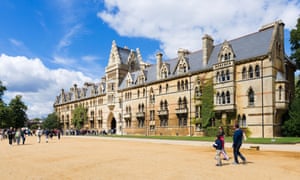
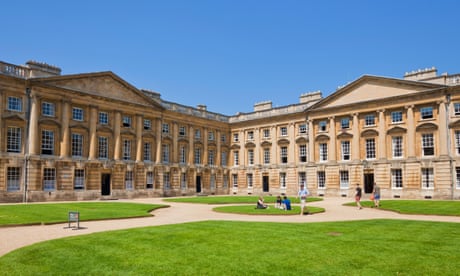
Christ Church College, Oxford, is among those that offered fewer than 50% of places to pupils from state school. Photograph: Alamy


Daniel Boffey in The Guardian


The universities of Oxford and Cambridge are facing an unprecedented attack from government advisers for their failure to increase the number of state school pupils studying at Oxbridge colleges.

The elite institutions’ records will be criticised and individual colleges named and shamed in a hard-hitting annual report by the Social Mobility and Child Poverty Commission.

The failure of some major Oxbridge colleges to accept even half of their intake from state schools will be criticised in the strongest terms by the public body, the Observer has learned. The commission will say on Thursday that while attainment of top A-level grades by those from the least wealthy backgrounds is poor, with just 2.2% of the most deprived gaining good grades, these statistics offer no excuse for Oxbridge’s intake figures.


Oxbridge colleges named and shamed for failing to admit poorer students


Written by the former Labour cabinet minister Alan Milburn and former Tory cabinet minister Gillian Shephard, his deputy on the commission, the report is expected to say that:

■ Despite an increase of 6% in the proportion of state-educated pupils between 2003-04 and 2013-14, independently schooled pupils still make up around two-fifths of the intake at both Oxford and Cambridge.

■ To meet their benchmarks for disadvantaged pupils, Oxford would need to increase the percentage of state school pupils by a quarter (24%) and Cambridge by a fifth (18%).

■ Large discrepancies between Oxbridge colleges in the number of offers to made to applicants from the state sector illustrate that many should be doing much more.

■ Some colleges make less than half of their offers to state-educated pupils. The worst performers are University College (Oxford), Robinson (Cambridge), St Peter’s (Oxford), Trinity (Oxford) and Christ Church (Oxford).

■ Even the best performers in this regard still give a quarter or more of their places to the privately educated. The Observer understands that the commission will welcome Oxbridge’s increasing use of contextual measures as a means of addressing the under-representation of lower-income and state-educated students, but demand greater and better use of it.

Three years ago the appointment of the then vice-chancellor of Bedfordshire university, Professor Les Ebdon, to head the Office for Fair Access (Offa), was nearly blocked over his championing of contextual information when offering places. Michael Gove, then education secretary, reportedly lobbied at the time that Ebdon was an advocate of social engineering rather than excellence in universities.

However, the commission will dismiss those concerns. A source said it believed that “too often in the past, university applicants have missed out because of a lack of opportunity to demonstrate their potential”.

They will provide statistics to show that poor children who are high-attaining at 11 are four times less likely to go on to an elite university than their high-attaining wealthier peers.
The source added: “It is right that where a young person has attended a poor-performing secondary school, is a care leaver or comes from an area with stubbornly low higher education participation, their predicted and actual grades should be considered in that light. The commission will call for this practice to be encouraged and continued.”

While using contextual data to judge between pupils with top grades, Oxbridge colleges have resisted reducing their A-level demands, claiming that they wish to retain their reputation for excellence.

However, under a “Realising Opportunities” scheme involving 16 universities including Bristol, UCL, Exeter, Warwick and York, tutors are allowed to give offers which are two grades below course entry requirements.

The eligibility criteria include evidence that the pupil lives in a neighbourhood which has a low progression rate to higher education or an area which has a high level of financial, social or economic deprivation; comes from a home where neither parent attended university in the UK or abroad; is in receipt of or entitled to discretionary payments; is in receipt of or entitled to free school meals.

Earlier this year Offa prompted an angry reaction from some of the country’s top institutions when it called for a doubling of admissions of teenagers from poor families over the next five years. In 2011, 22,000 teenagers (20%) from the poorest fifth of school-leavers, went to university. Offa wants that to increase to 40,000.

Damien Shannon, who sued St Hugh’s College, Oxford, in 2013 when, despite winning a postgraduate place on academic merit, he was told that without £12,900 to fund living costs he would not be welcome, applauded the commission’s intentions.

The son of a single mother from a council estate in Mansfield, Nottinghamshire, Shannon said he had only applied to Oxford after a chance meeting with a professor who said he was “quite bright and should have a go”. Shannon decided to represent himself in a legal action against the college’s extremely expensive and hostile barristers on the grounds that it was discriminating against poor pupils.

Despite initially appearing to take a hard line, the college put up the white flag and settled out of court. It gave him his place and it reviewed and reformed its policies. Shannon is now a high-flying civil servant.

Shannon, who did his first degree at Salford university and the Open university, said: “I loved my time at St Hugh’s and I go back all the time now. But studying there as an undergraduate would not have occurred to me in a million years, no more than living in Buckingham Palace.”

Looking down the list of the worst-performing Oxbridge colleges, Shannon said he could also also see a trend. “The decision on admissions is made by the colleges and not the faculty for undergraduates,” he said. “I have always thought that was a mistake. I don’t know how a college can divorce an academic decision from the knowledge that a candidate who comes with resources may be more useful for the college in the future.

“I do not think it is any coincidence that the richest colleges are the ones who seem minded to accept the richest applicants.”

Shannon, 29, who now gives talks to pupils at Paddington Academy in London on attaining a place at Oxbridge, added: “Contextual data is not a new idea it has just gone out of vogue. A man called David Miliband, who went on to be foreign secretary, received a place at Oxford University on the basis of contextual data.

“If it was a good idea 30 years ago, it is a good idea today. If it was right for David Miliband, then I don’t see why it wouldn’t be right for the children from poorer backgrounds today.

Thursday, 10 December 2015

Yes, the Tories are deceitful – but I take my hat off to their political sorcery

Owen Jones in The Guardian

David Cameron’s EU negotiation is a sham. He knows it, and so do the ardent Tory proponents of Brexit. The prime minister understands that a considerable source of anti-EU hostility is motivated, above all else, by opposition to immigration. And so he conducts a charade, pledging to satisfy a lust to close British borders by compelling EU migrants to work in Britain for four years before they can receive in-work benefits.

He didn’t need Sir Stephen Nickell, a senior official at the Office for Budget Responsibility, to tell MPs that the impact of such a move would be “not much”. No impartial source has offered evidence suggesting that it would work, or that the vast majority of migrants are attracted by anything other than work and a fondness for Britain. This is politics as illusion, with Cameron as chief illusionist, and the magician George Osborne completing the circus troupe.

Yes, the EU is examining a proposal for an “emergency brake” on migrants entering Britain under certain circumstances. But this is something for which Cameron reportedly has little passion, and he is redoubling his efforts to secure a four-year limit.

As one EU diplomat told the Financial Times: “The reason Cameron hasn’t gone for this must be that the problem that he has in Britain is mainly one of perception, not of real economic impact.” And that is what matters to an illusionist: how something is perceived, rather than how it actually is.

For the Tories, immigration works in their favour whatever happens – or at least until their opponents come up with a convincing message. They have set an arbitrary immigration limit that has been repeatedly – and devastatingly – missed. Its main achievement is to further undermine the public’s faith in politicians delivering what they promise. Nonetheless, if immigration remains high it means an issue on which the left is poorly trusted remains a political priority in the minds of millions. Sure, it risks boosting the currently flagging Ukip, but though Nigel Farage’s diminished purple army is an imprecise weapon it certainly inflicts significant damage on the Tories’ Labour opponents. If immigration decreases, then the Tories can claim success and warn that the opposition would reopen the gates.

Illusions are what the Tories excel at. They back Labour’s spending – down to the last penny – when in opposition, then in government claim that it was financial extravagance that plunged the country into economic chaos. The crash may have originated in Britain’s financial hub, a sector whose lavish donations keep the Conservatives financially afloat, but Cameron and Osborne skilfully transformed a crisis of the market into a crisis caused by state spending. A failing of laissez-faire economics was spun into a historic opportunity to scale back the state. Like immigration, the colossal failure to close the deficit in a single parliament – as Osborne had solemnly promised – became a success, ensuring that an issue on which Labour was poorly trusted remained salient.

An alleged scandal involving Tory private donors became an opportunity to introduce a lobbying bill that left corporate titans alone, instead focusing on NGOs that might scrutinise the Tories’ record. And so on.

This is written not as a complaint; it is partly a love letter. The Tories are very good at politics – even if it is a strategy soaked in dishonesty and deceit – and that is why they are the world’s most successful electoral force. What the Conservatives understand is that politics is as much about sentiments and emotions as anything else. Labour went into the last general election with arguably more policies than any other opposition in modern history. But there was no vision or coherent message to bring them together: a ragtag of policies thrown into the ether, as though Which? magazine had become a political party.

Voters are not political geeks, like me, but people with lives to lead – and they do not spend their time poring over the details of individual policies. The Tories offered clear, simple messages that had emotional resonance, rather than Labour’s blend of stale technocracy and political consumerism. Labour’s timid offer for the poorest (spare a moment for the £8 minimum wage) and lack of anything to say to those in the increasingly insecure middle was trumped by a comfort blanket of security and stability.

Polling shows that the gap between public perceptions and reality is very wide indeed, and in a manner that can only benefit the right. One poll found that the public believed benefits fraud was 34 times greater than was actually the case; immigration was double its real level; and teenage pregnancy was 25 times higher than official estimates. That’s not because the public has been bombarded with, say, assertions from the media and politicians that benefit fraud accounts for £24 of every £100 claimed rather than just 70p. Instead, they have been subjected to a regular diet of emotionally compelling stories: of extreme examples of benefit fraudsters with multiple children and luxurious lifestyles.

It would be easier to assail the cold, disingenuous Machiavellianism that constitutes the Tories’ political strategy. The Tories are a merry band of illusionists, excelling at distorting perceptions rather than dealing in actual realities. To believe that politics is conducted solely at the level of reason is to lose. This is what the embattled opposition to the Tories has to learn. It needs to appeal to people’s emotions, their hopes as well as their insecurities; to take crises and ably turn them to their advantage, rather than being tripped or even consumed by them; to have a coherent message that can be easily translated into a pub conversation as well as one conducted on the doorstep.

The opposition doesn’t need to copy the dishonesty and deceit of the Tories. But it does need to learn from them if Labour is to succeed again.

Tuesday, 8 December 2015

The fall of Jersey: how a tax haven goes bust

Oliver Bullough in The Guardian


As you approach Jersey by air, your plane’s shadow touches cliffs rising from the English Channel, then patchwork fields with wooded dingles between them, then four‑square buildings with groomed lawns. Down below, the island is lush and verdant, set in a sparkling procession of eastward-marching waves. It looks like a bit of Devon that ran away to sea and did rather well for itself.

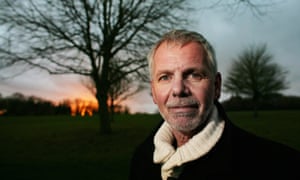
John Christensen grew up in one of those handsome houses, a Norman manor surrounded by fields. “It was heaven,” he said. “There were fantastic beaches, a strong sense of fun, because of the tourism industry. The Beatles played at Springfield in 1963, stuff like that. It was cool.”

Christensen, who was born in 1956, is almost exactly the same age as Jersey’s offshore finance industry. While he was playing with his brothers in the grand rooms of the family home, Jersey lawyers were spotting one of the most profitable loopholes in history.

At that time, the world severely restricted the movement of money. Politicians blamed financial speculators for the Great Depression of the 1930s, and had imposed capital controls to prevent something similar happening again. Pounds were trapped in Britain, where taxes were high. If a person died wealthy, their heirs had to give 80% of any inheritance over £1m to the government.

There was Jersey’s business opportunity: the island had no inheritance tax. If wealthy Brits invested their millions in Jersey, some now-forgotten genius realised, the UK exchequer could not touch them. The money poured in, because the schemes did not end with inheritance: almost any tax could be avoided there, if you planned it right. Where wealthy individuals started, banks soon followed, utterly transforming the island. Bankers and tax exiles moved into St Peter, the parish where Christensen grew up, driving up prices and importing the values and conversation of the City of London to this improbable place.

“Who wants to pay taxes on profits in London when you could do it in Jersey?” Christensen recalled. “It was changing enormously, particularly by the early 1970s when the really big players began to establish themselves.”

Today, the offices of those big players form a wall of glass along the seafront of Jersey’s capital, St Helier: Credit Suisse, Citi, HSBC, Société Générale, PWC. And they oversee a vast amount of money. By 2007, Jersey – home to just 100,000 people – held almost £220bn of deposits, and administered another £221bn of funds, as well as hundreds of billions in trusts. The finance sector’s profits that year were more than £1bn, unemployment was barely 1%, and gross national income per person was significantly higher than in Britain or the US.

From the waterfront, the money spreads inland. St Helier is a prosperous resort with cafes, theatres and covered markets. It is cleaner, busier, neater, brighter than almost any seaside town you will find on the British mainland. Appearances are deceptive, however. Jersey looks rich – but it is heading towards bankruptcy.

In April, officials announced that the budget would be short £125m a year by 2019. “What went wrong?” asked the Jersey Evening Post. And that was just the start of it. By June, the annual deficit – now known on the island as the “black hole” – had been revised upwards to £145m, more than £1 in every five that the government spends. “The black hole is so big,” according to Connect, a Jersey business magazine, that “filling it will take the equivalent of shutting down every school in the island, laying off every teacher, letting the parks turn into overgrown jungles and having our roads literally fall apart.”

That is quite a hole, and the question is, how can Jersey fill it? The solutions are not pretty: voluntary redundancies, compulsory redundancies, new taxes, fewer public services.

Jersey bet its future on finance, allowing its other industries to shrivel, in the belief that it could live well in perpetuity from moving other people’s money around. If that belief was false, then does its fate await another island off the coast of France – one that has also pledged its future to finance? In short, is Jersey’s worrying present Britain’s bleak future?
* * *

Jersey is 19 miles from France, 85 miles from England. It is not a country, nor is it part of another country. It is half-British, half-something-else – 45 square miles of self-governing ambiguity entirely surrounded by water. It gained this peculiar status in 1204, when King John lost the Duchy of Normandy to France. Or rather, he lost most of it. He managed to keep the duchy’s offshore possessions – Jersey, Guernsey, Alderney, Sark, Herm, plus assorted rocks, reefs and islets, collectively known as the Channel Islands.

The French took a while to accept the situation: London and Paris tussled over the islands for almost 300 years. Eventually, however, Pope Sixtus IV intervened and, in 1481, issued a papal bull of neutrality. England and France could wage war, but the Channel Islands, by religious injunction, could not. The result was that Jersey traded unimpeded with both sides, and thus its enchanted inbetween life began.

This ambiguous status – Jersey was British enough to have the pound but not British enough to pay taxes – lay at the heart of the island’s offshore industry. By the end of the 1960s, Jersey’s banks had deposits of almost £300m, 10 times the per capita ratio of the UK. In 1970 alone, deposits increased by 45%, and then kept on rising.

The gentleman farmers that ran the island had no experience running an offshore financial centre. So, in 1969, they poached an English economist named Colin Powell from the government of Northern Ireland, to help them understand what was going on. He has guided finance’s colonisation of Jersey ever since, in one role or another. (Some people call him “Jersey’s Jeeves”, which is not exactly flattering to the gentlemen farmers.)


Mount Orgueil Castle overlooking Grouville Bay in Gorey, Jersey. The island looks prosperous but is going broke. Photograph: Alamy

Powell’s approach to British taxes was curiously anarchic for a government economist, akin to the contempt of early pirate radio DJs for the overmighty BBC. “If the attractions of Jersey as a low-tax area stem from the high levels of UK taxation, the island should not be criticised for offering an escape,” Powell argued, in a study of Jersey’s economy published in 1971. In other words: if laws are dumb, there is nothing wrong with working around them.

Jersey did very well out of the strategy that Powell mapped out for it, and the 1970s continued where the 1960s left off. Many of the big North American, European and British banks opened branches in St Helier. They brought the money in and sent it out again, often on the same day. But that allowed them to, in essence, stamp “Made in Jersey” on it, rather than “Made in Britain”, which lowered the tax burden. Jersey’s officials began to describe the island as a “specialist offshoot of the City”: London without the rules, or the taxes.

Powell turned 80 this year, and his current official role is to advise Jersey’s government on “international affairs”. He is long-nosed and lean, and has a disconcertingly precise power of recall over almost any detail of his five decades on the island. He came to Jersey at a time when the British empire’s decline was almost complete. As the old colonies gained independence, Brits returned home, and there were fewer and fewer places to stash their hard-earned pounds out of the reach of Her Majesty’s tax collectors. In 1974, the UK’s top marginal rate of tax on investments income hit 98%. Faced with the prospect of keeping just tuppence of every pound in dividends they earned, rich Britons put as much into Jersey as they could.

“They know that Jersey has political stability, doesn’t have political parties. It’s not going to be faced with a sudden swing to the left, or swing to the right, or whatever direction, a change of tax arrangements. It’s also got fiscal stability,” Powell explained, during a long evening interview in his surprisingly modest office in St Helier.

Foreign businesses that registered in Jersey paid no tax at all, while the local banks, lawyers, accountants, and administrators that helped them paid 20% on their incomes – a fraction of that paid by their counterparts in the UK. The rate was low but, with this much business going on, the government’s coffers swelled. In the three decades after Powell took over, Jersey’s annual budget increased, in real terms, fivefold.

Jersey built new schools, new hospitals, new roads, a new harbour, a new marina. Unemployment was barely 2%. The government had so much money that it squirrelled away a year’s worth of expenditure just in case. And all the time, income tax was only 20p in the pound. There was no inheritance tax; no VAT; no capital gains tax; no tax on corporate profits if your business was outside Jersey. Compare that with strife-torn Britain where, until the very end of Margaret Thatcher’s time in office, the top marginal rate of income tax was 60%, and one in eight adults was out of work.

A gushing article published in 1984 by Chatham House’s World Today magazine noted that Jersey residents had almost twice as many phones per household as Brits, and more than twice as many cars. The island was a miracle of plenty, which somehow combined a comprehensive welfare state with tax rates to satisfy enthusiastic libertarians. Its reputation was of a well-regulated haven in the midst of the political turmoil then afflicting the UK, and the money kept pouring in.

By the end of the 1980s, Jersey had evolved from simply serving UK depositors keen to avoid tax. It was now happy to help anyone, from anywhere, to avoid anything. When officials in Moscow wanted to hide the Communist party’s funds in the last days of the Soviet Union, they put them in Jersey. When post-Soviet oligarchs wanted to obscure their ownership of assets, they structured them through Jersey. When South Africans wanted to avoid apartheid-related sanctions, they did so through Jersey.


By the end of the 1980s, Jersey was happy to help anyone, from anywhere, to avoid anything

Powell had so much work to do keeping track of the economy he had unleashed that, in 1987, he hired an assistant, John Christensen, the local boy from the Norman manor house. Middle-aged men from Jersey are often of a particular type. They are slim and straight-backed, tanned and neat, with an accent that is somewhere between BBC and colonial. Christensen, who is now 59, is the type’s epitome.

Christensen had volunteered for Oxfam while studying in Britain, and was never a particularly enthusiastic recruit to his native island’s new industry. He remembers complaining about how Jersey was keeping money for corrupt African officials, and being told “nobody gives a shit about Africa anyway”. Over the years, he became increasingly troubled by the amount of dirty money coming in, and the fact no one on the island appeared to care.

For Christensen, the final indignity came in 1993 when a foreign exchange trader defrauded investors (mostly Americans) out of $26m via a Jersey subsidiary – a scam that local authorities refused to investigate for years.

When the scandal attracted the attention of a reporter from the Wall Street Journal a few years later, there was little doubt about the identity of Jersey’s “senior civil servant” who said, of his colleagues: “They are totally out of their depth”. It was effectively Christensen’s resignation letter. He felt that the island was helping foreign villains hide stolen wealth, and wanted no part of it. Besides, the business seemed to be doing as much harm as good to Jersey itself.

“Price inflation had made house prices and labour market costs so high that virtually no other industry apart from finance – international finance – could survive,” Christensen explained. “The housing market was at London levels, no locals could afford to buy, unless they were employed either in the public sector or the finance sector.”

Jersey had not heard the last of him, however. Now there may be times when Powell wishes he had never hired Christensen at all.
* * *

In 1998, the day after quitting his job, John Christensen quit Jersey too, taking with him a decade’s worth of pent-up frustration and a whole lot of insider knowledge. He resolved to reveal what he knew about how offshore finance really works, which has made him an irritant to Jersey’s authorities and a hero to its critics: the closest thing the island has to a Trotsky.

Perhaps his most notable comrade in this struggle is the accountant and Quaker Richard Murphy, whom he met by chance in 2002. “Richard and John have done magical things, absolute miracles,” said Pat Lucas, a teacher on Jersey and another veteran campaigner against the offshore industry. “They have changed the whole narrative.”

Christensen and Murphy were among the founders of the Tax Justice Network(TJN), which investigates the offshore industry, and publishes a Financial Secrecy Index, to assess how tax havens attract illicit cash.

The biennial index, launched in 2009, has consistently ranked Jersey in or close to the top 10 jurisdictions facilitating “illicit financial flows and capital flight” – ahead of the British Virgin Islands, Panama and Gibraltar. Newspapers from around the world picked up on the studies, and highlighted Jersey’s role in sucking wealth out of the countries that need it most.

Every new version of the index was a grenade of bad publicity lobbed at Jersey, increasingly damaging to the island’s reputation. Jersey Finance, the government-funded body for promoting the island’s financial industry, dismissed the 2013 index as “contrived propaganda”, but officials struggled to gain much of a hearing, something many of them appear to find extremely frustrating.


John Christensen, director of the Tax Justice Network and the closest thing Jersey has to a Trotsky. Photograph: Martin Godwin for the Guardian

Christensen and Murphy are not solely responsible for Jersey’s troubles but sometimes, when talking to officials, you could be forgiven for thinking they were. (At one point during my interview with the former treasury and resources minister Philip Ozouf, he appeared temporarily to forget he was talking to me. “What’s wrong about that, Mr Murphy? That’s good stuff,” he said, as if fantasising about taking on the turbulent accountant.)

As for Christensen, it is an article of faith on Jersey that he only criticises the island because, in 1998, he did not get a promotion. (“It’s baggage, yeah,” said John Harris, of the Jersey Financial Services Commission, the island’s regulator. “He has baggage, serious baggage.”) This is something Christensen denies, though he is not the kind of man to get into a slanging match.

Murphy, on the other hand, is combative – he advised Jeremy Corbyn during his leadership campaign for the Labour party – and has no such reservations. “They have for 10 years refused to accept that, fundamentally, their business model is, to use a technical term, fucked,” he told me.

If Christensen, Murphy and their gang had been Jersey’s only opponents, the island’s feelings would be hurt, but it would otherwise probably remain unharmed. In Brussels, however, the island has enemies with more powerful weapons than bad publicity. Officials in European countries were furious about Jersey helping their citizens avoid taxes. In 1997, they began to take action.

In a new code of conduct, the EU insisted that all members (as well as those jurisdictions that wanted equal access to its market, such as Jersey) tax local and non-local companies the same. The rules were not to be imposed for another decade, but it was immediately clear that they threatened to destroy Jersey’s business model, which was reliant on giving foreign companies tax advantages denied to locals.

Technically, officials had a choice: they could either raise taxes for foreigners, or cut them for locals, providing everyone ended up being treated the same way. In reality, however, Jersey had no choice at all – not if it wanted to keep its finance industry. Dozens of other small jurisdictions had followed its lead into financial services and, if it raised taxes for everyone to 20%, all the lucrative trade would evaporate from its computer screens, only to condense in places with lower levies: the Isle of Man, Dublin, Singapore or Hong Kong.

So, in 2008, it abolished taxes for all companies except financial firms (which pay 10%) and utilities (which were left with the 20% rate). The two main tax bands gave the policy its name: Zero-10. And thus, the black hole opened. Between 2009 and 2010, tax receipts from companies fell by almost two-thirds: from £218m to £83m.

As public awareness of the black hole has grown, so has criticism of the government. “This was, once upon time, an inclusive island where we all felt as one, whether you were a politician or a road sweeper or a nurse, whoever. We all shared in the prosperity,” said Nick Corbel, head of Jersey’s branch of Unite, when we met in May. “As a Jerseyman, as someone who was born on the island, and I can trace my heritage back, I love this island, love its people, I love how we used to do things here. But it’s depressing, personally depressing, seeing where this island’s heading, the total lack of compassion and understanding from our leaders There is nothing there at all, they’re absolutely cold.”

Ozouf, the architect of Zero-10, lost his ministerial position after last autumn’s elections, and now works as a sort of roving ambassador. It was in that capacity that we met in Jersey’s Westminster office in September. He is passionate, fluent, charming and prone to speaking in extremely long sentences, without taking a breath. He immediately launched a long denial of the existence of a black hole at all.

“Let’s be clear about what a black hole is. A black hole is an amount of money, which needs to be found in order for the government to put in place its plan to make substantial investments in education and healthcare and improve our society.”

There is something in what he says – nearly half of the deficit is indeed caused by extra spending on healthcare and education – but that is not really the point. The criticism stems from how the government has tried to fill the black hole that it opened. In 2008, it introduced a sales tax, which now adds 5% to the price of almost everything. That has not raised enough money, so now it is looking at other charges: including for medical services, sewage disposal, and more. It is looking to cut benefits for pensioners, single parents and young people, and to lay off public sector workers.

Officials argue that there is significant room for cuts, and perhaps there is. In Jersey, the average state employee earns £900 a week, almost twice the equivalent salary in the UK. However you look at it, though, ordinary people, through higher prices and pay freezes, job losses and benefit cuts, are plugging a hole left by a massive corporate tax break. By 2012, the sales tax was raising more revenue than the tax on companies.

But Ozouf continues to insist that Jersey had no choice. He needed to cut taxes to keep finance on the island, not least because there are no other industries left to plug the gap.
* * *

There is a claim often made in Jersey that the local economy is a stool with three legs: finance, tourism and agriculture. Before finance, tourism was the sturdiest of the three and the basis of the island’s prosperity. Jersey’s message to postwar British holidaymakers was simple but effective: we’re like France, but without the French people. In 1979, almost 1.5 million people came to Jersey on holiday, the place where you could speak English and eat chips. In 2014, there were just 338,000. The Jersey tourism industry has, essentially, collapsed.

The number of beds in the island’s hotels has almost halved since the late 1990s, and many of the businesses that are left look tired. One hotel on the waterfront in St Helier advertises Fawlty Towers-themed dining nights. It looks out onto a salt-water pool that fills up at high tide, so swimmers do not have to walk out across the beach for a dip. There is a market for that, obviously, but it is not a growing one.

Ted Vibert, 77, ran Jersey’s tourism promotion campaign in the early 1960s, and despairs of what has happened to the island. When we spoke this summer, he had just been to Cyprus for a week at a beachfront hotel, where he could eat and drink as much as he liked, for £400 all in. Low-cost airlines, improved communications, and easier travel have all made foreign holidays cheaper, and Jersey has not tried to compete. Vibert blames finance. It pushed up prices, attracted the best talent, and drew the government’s attention away from tourism. Who needs the hassle of serving tea to middle-aged Brits when you already have more cash than you know what to do with?

Before tourism, the third leg of the stool – agriculture – did most work supporting the island. Jersey is sunny and fertile. Its high-quality woollen goods gave a name – “jersey” – to any kind of long-sleeved top. Jersey cattle, with their deliciously rich milk, and Jersey royal potatoes are famous well beyond the island.

But when I walked for six hours across the island in September, from the airport eastwards, then up to the north coast, I saw just one dairy herd – a clump of honey-gold cows blinking stupidly over a gate – and not much sign of anything but fallow fields, waiting for the potatoes to be planted again in spring. In the 1980s, Jersey glittered with greenhouses growing tomatoes, broccoli, cauliflowers and flowers for the UK market. It does not any more.

“It’s been a gradual decline from the 1970s, when finance took off,” said Graham Le Lay, president of the Jersey Farmers’ Union. “Generally the island is much more prosperous because of it. It’s just unfortunate that it’s been the farmers who’ve been the meat in the sandwich.”

Jersey in the late 1950s, when the island’s offshore finance industry opened for business. Photograph: Popperfoto/Getty Images

Jersey’s financial sector is now seven times larger than the agricultural and hospitality sectors put together. Since the 1970s, the island’s economy has lost two legs, and now Jersey is worryingly dependent on that last leg staying strong.

Jersey has no thinktanks or pollsters. The only daily newspaper, the Jersey Evening Post, was until recently owned by the chief minister, and even now tends to follow the government’s line. As a result, it is extremely hard to get a sense of what ordinary Jerseymen and women think about the transformation of their home from a bucket-and-spade tourist resort to the frontline of financialisation.

It was while looking for pointers that I came across Marigold Dark, a racy dystopian thriller about an alcoholic Jersey private eye confronted with corrupt coppers, amoral financiers and a wealthy foreign oligarch keen to buy up the island. The fictional locals in the book, which was published in March, are resigned to their fate. “We all know that foreign money has the run of this place,” one says. “But it’s quite another thing altogether to openly replace the Jersey flag with a set of splayed arse cheeks and a dollar sign.”

The author, Paul Bisson, is an English teacher in St Helier. The book, he told me, is a satire, but it reflects a genuine unease about what has happened to the island. “The finance industry has been good to Jersey in the years gone by. But what irks me is the fact we seem to have put too many eggs in one basket, it’s almost like we’ve surrendered part of our soul to finance,” he said, over tea in a cafe in the middle of St Helier. He did not really know if other people shared his concerns. Most people don’t much like to talk about it, he told me.

Most people prefer not to get engaged in politics at all. The States Assembly influences every aspect of life on Jersey, and crafts the regulations for the island’s financial sector, but it does so with almost no popular involvement. Turnout in St Helier was less than 30% in last year’s general election.

The speaker of the assembly – the bailiff, who is also the chief judge – is unelected, while its members are chosen from a talent pool slightly smaller than that of Crawley borough council. That’s a worrying prospect for anyone keen on rigorous oversight, and it has translated into important aspects of financial regulation going through on the nod.

It is hardly surprising that Jersey’s politicians should want to protect its finance sector, however, even at the cost of the rest of the economy disappearing. The miracle of offshore has conjured wealth for everyone lucky enough to live on Jersey. In betting terms, Jersey picked the fastest and strongest horse in the field, and staked its future on it. Then the horse had a heart attack.
* * *

It is only when the tide goes out, Warren Buffett has said of financial skulduggery, that you discover who has been swimming naked. When the credit crunch sucked the liquidity out of the world’s markets, Jersey was revealed to be not so much skinny-dipping, as dumping toxic waste on the beach.

The first inklings of Jersey’s role in the greatest financial crisis in history came in August 2007, when HBOS – the bank created out of Halifax and the Bank of Scotland – announced it was going to loan money to a Jersey-registered debt vehicle named Grampian Funding, which had assets of £18bn.

“News that Grampian existed, never mind that it was the largest banking conduit in Europe and now needed financial assistance from its parent, came as a total shock, akin to discovering a face you thought you were familiar with had suddenly grown an enormous protrusion,” the Scotsman wrote at the time.

And, as grim news followed grim news that autumn, bank after bank – among them, most dramatically, Northern Rock – admitted that they too had their own Jersey-based shadow operations funding the mortgages that eventually blew up the British financial system.

The problems of the struggling banks mostly came down to the same thing: they borrowed money, processed it and lent it out via a giant financial sausage machine. That was not a problem as long as there was money available. As soon as the credit supply stopped, however, there was no meat to go in the sausages, and the whole machine seized up. So how come no one noticed what the banks were up to? They put the sausage machines in Jersey, in something called charitable trusts. When you create a trust, you no longer own your assets, so you do not have to declare ownership, but the trustee carries out the instructions you issued when you did own them. There is no public register of trusts.


The Esplanade in St Helier, Jersey, home to many of the island’s offshore banking offices. Photograph: Alamy

Jersey’s trust law allowed banks to obscure the vast number of mortgages they were issuing, making it look like HBOS was safe from the US housing crash when actually it had $30bn invested in American mortgages. This enthusiastic lending stripped banks of the cushions of cash they normally keep to protect them if their loans go bad. When the market collapsed, the banks were unprotected. They had been so greedy for business, they had undermined their own future.

Such misuse of trusts was not new. The US energy giant Enron had used Jersey to hide the extent of its debts prior to its collapse in 2001. What was new in the credit crunch was quite how much this chicanery ended up costing the British taxpayer.

On 17 February 2008, Britain said it would nationalise Northern Rock (which had its own Jersey trust named Granite), the first in a series of banks brought into public ownership. The final cost of picking up the pieces of these exploded banks was in the hundreds of billions of pounds. Jersey did not contribute a penny to cleaning up the mess it had made.

The US, Britain and the EU have since obliged Jersey to exchange information on any citizens using the island’s banks, some of which now refuse to serve UK-resident clients.

This has all put Jersey officials on the defensive, and they have hired academics to combat their troublingly persistent critics. One report examined the impact of Jersey on the UK, and argued that it supported 180,000 British jobs. Another report last year suggested that Jersey could be central to attracting investment into Africa. A third report defended offshore finance, and dismissed the Tax Justice Network’s calculation that tax havens hide up to $32tn from proper scrutiny.

“Their argument [that of the TJN] is largely based on the fact that it [offshore finance] is illegitimate and not transparent and I think that’s just, like, so 10 years ago. These guys need to get up to speed,” said John Harris, director general of the Jersey Financial Services Commission. “The requirements we put through are as strict as anywhere in the world, and a damn sight better than mainland economies.”

Chief Minister of Jersey Ian Gorst and other officials insist that the island is now more transparent than many onshore jurisdictions. (In 2015, the island fell to 16th on the TJN’s financial secrecy index, behind Germany, the US, Japan and the UK.) Gorst and his allies say that Jersey’s new approach is shown in the case of General Sani Abacha, the brutal 1990s military ruler of Nigeria. Yes, Jersey looked after his money in the bad old days but, in 2014, Jersey returned £315m to the Nigerian authorities. It no longer wants that kind of client.

They insist that this is a reformed Jersey, running neighbourly policies with the rest of the world, filling a niche for a well-regulated offshore jurisdiction. But does that niche exist? If Jersey cannot act like a tax haven, what exactly is the point of it? That, anyway, is what the world’s banks appear to have concluded.

The number of banks licensed on Jersey fell from 73 at the turn of the millennium to 33 last year. Bank deposits peaked in 2007 and by 2014 had fallen by almost 40% to £136.6 billion. The island’s financial industry contracted by a third over the same period, and the number of its clients fell by a sixth in 2014 alone.

Meanwhile, the rest of Jersey’s economy is worryingly hollow. One in 10 of its jobs are now based on zero hours contracts, compared to one in 40 in the UK.


One in 10 of Jersey's jobs are now based on zero hours contracts, compared to one in 40 in the UK

All of this makes it look less and less likely that Jersey will be able to raise the taxes it needs to fill its black hole, which means that there is a lesson here for Britain. With high property prices, a brain drain into financial services, successive governments favouring banking over other industries, and a revolving door between finance and public administration, the parallels between Jersey and its larger island neighbour are too obvious to ignore. In fact, the Tax Justice Network has a name for the phenomenon: “the finance curse”.

“For two decades, I’ve heard Jersey politicians promising to diversify the island’s economy, but the island is now more dependent on offshore finance than it was 20 years ago,” Christensen said. “If George Osborne is serious about wanting to build a northern powerhouse, he should read up on the finance curse and take appropriate measures to tackle the dominance of the City of London.”
* * *

Jersey, however, appears as determined as ever to ignore Christensen’s warnings. The government has been touring the world in search of new business, in south-east Asia, the Middle East, in Russia and in Africa. “[The world] changed very dramatically during the financial crisis,” Chief Minister Gorst told the assembly in June. “We are in a fight. We are in a fight for our survival. We are in a fight for jobs and the prosperity of our children.”

His government is building new offices, to house the people who will move the money around, when it arrives. Key to this strategy is the Jersey International Finance Centre, a vast new project that will add half a million square feet of floorspace to the office buildings along St Helier’s esplanade. The architect’s plans for the first block show a glass and steel box, with a woman in high-heeled sandals striding briskly past, files under her arm. The sun is shining, the pavement is free of litter.

It looks lovely, but locals are not convinced, not least because there are as yet almost no companies to go into these offices. In June, some 3,000 protesters formed a human chain around the site and waved signs asking “What part of NO don’t you understand?”

In October, a committee from the States Assembly said the project was not commercially viable, posed a considerable risk to the public purse, and would cost more money than it would earn. Only one tenant has signed up to lease premises in the new development, which looks extraordinarily speculative for a government already facing a cash crunch. Construction has begun anyway.

Perhaps Jersey has bet so much on finance that it can no longer afford to stop increasing its stake. It will have to keep doubling its bet until the money runs out. If it cannot live forever from finance, it looks like it is going to die in the attempt.