Search This Blog

Tuesday, 17 June 2014

The incredibly malleable spirit of cricket

Ed Smith in Cricinfo

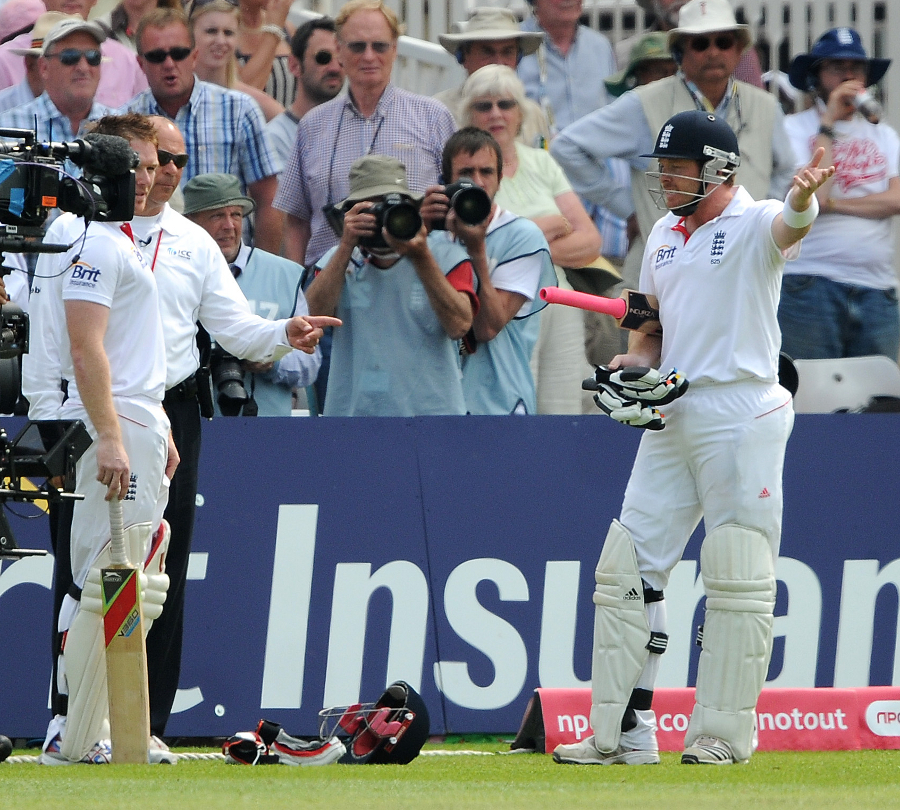
Ian Bell vents his frustration during the confusion before tea, England v India, 2nd npower Test, Trent Bridge, 3rd day, July 31, 2011
Ian Bell was out in the Trent Bridge Test against India in 2011... until he wasn't © PA Photos 
Enlarge

Two British satirists, the late John Fortune and John Bird, mastered the art of explaining slippery subjects through humour. They would take a major news story and apparently merely knock it about in a light, spontaneous chat on TV. But their mischievous dialogues often took us closer to the heart of the matter than acres of self-important newsprint. (Here they are in a famous sketch from 2007 about the financial crisis)
How I would have loved them to address cricket's confusion about the "spirit of cricket". The old controversy was reignited this month when Sri Lanka "Mankaded" Jos Buttler. In the spirit of admiration rather than emulation, in this piece I imagine a conversation between the two great satirists, reflecting on Mankading and cricket's odd attitudes towards morality...
"So what is it, this spirit of cricket thing? Presumably it's about behaving with dignity out on the pitch and that kind of stuff?"
"Oh no, not really. Most players can get away with swearing at each other non-stop for five days without contravening the spirit of cricket. We don't get involved morally at that level. Better to turn a blind eye."
"You mean sledging - that's the right term isn't it? - does not contravene the spirit of cricket?"
"Not really. No, cricket tends to celebrate verbal abuse as "banter", even though it's very rarely funny. Let's put it this way. If someone sledges you all day in a Test match, the correct response in modern cricket is to go up to him at the end of play and say, "I loved the way you showed real passion about playing for your country, you seem like a champion cricketer, can I buy you a drink, as I'm sure you're a great bloke off the pitch."
"So the appropriate response to someone calling you a "f****** ****" for seven hours is to say, 'Thanks, can I buy you a beer?'"
"Exactly."
"Now I'm confused. So abusing someone who is simply doing his job is fine. But when an opponent performs a run-out, entirely within the laws of the game, he has broken the spirit of cricket, and the crowd starts booing and the whole occasion is apparently demeaned?"
"You are beginning to understand how the phrase "spirit of cricket" can be thrown around."
"But what could Sri Lanka have done to avoid the Mankading? Other than the threat of a Mankad, there's no other way of preventing a batsman setting off for a run from an advanced position is there?"
"Not really."
"And I suppose, in the heat of battle in elite sport, no one offers warnings before acting within the laws, do they?"
"Well, actually Sri Lanka offered two warnings."
"So they offered two warnings to an opponent who was - deliberately or, in this instance, accidentally - gaining an illegal advantage, and yet they still broke the spirit of cricket?"
"According to lots of people, yes."
Everything up to and including my actions are "within the spirit of cricket". Anything I don't like about the actions of other players is "against the spirit of cricket"
"So if acting within the laws is against the spirit of cricket, what does upholding the spirit of cricket look like?"
"It's about not taking advantage of the fact that a man can lose his mind immediately before eating a slice of cake."
"I'm sorry, you've lost me."
"Back in 2011, poor Ian Bell offered a plea of temporary insanity brought about by the immediate temptation of a slice of cake. The 'spirit of cricket' jury gave him a reprieve, effectively a second life as a batsman."
"You're joking, right?"
"Deadly serious. Ian Bell made a brilliant hundred at Trent Bridge against India. But after the last ball before tea, he lapsed in concentration and assumed that the ball had crossed the boundary when in fact it hadn't. As he sauntered off for tea, the Indian team dislodged the bails, and Bell was run out. That is indeed out, according to the laws. But after an English delegation went to the Indian dressing room to complain, India retracted their appeal.
"That is, they invited Bell to bat again. Not because he wasn't out, but because they now realised that the prospect of tea had clearly clouded Bell's mind. Pundits agreed that everyone had behaved superbly. After all, how could a man be expected to remember the laws of the game when he can already sniff the aroma of chocolate cake in his nostrils?"
"This spirit of cricket is incredibly complex and malleable, isn't it? It looks as though you can explain or condemn almost anything using the rhetoric of the spirit of cricket."
"Exactly. That's the magic of it. It's all about not crossing a line."
"Whose line?"
"My line."
"What do you mean your line?"
"Everything up to and including my actions are 'within the spirit of cricket'. Anything I don't like about the actions of other players is 'against the spirit of cricket'."
"So it's possible for two people to argue for hours about someone 'crossing the line' without anyone knowing what or where the line is?"
"Exactly. That's the brilliance of the idea."
"Let's go back to the Mankading controversy. Wasn't there some background controversy about the bowling action of Senanayake, the bowler who performed the Mankading?"
"Senanayake's action has been reported as suspicious by several officials - i.e. it may be deemed a throw rather than a bowl. He will have to go to Cardiff to have his action specially filmed and analysed to see if it is legal after all."
"But isn't there a risk, when spin bowlers have to attend special testing, that they will simply bowl with a slightly different and 'more legal' action during the forensic examination?"
"What do you mean 'risk'? Basically, almost everyone who is tested eventually gets cleared. Think of the whole thing as a cooling off process."
"But what about the bowlers who don't have questionable actions? Aren't they placed at an unfair disadvantage by having to bowl in the traditional manner?"
"What do you think this is, a charity? This is cut-throat, elite sport. There is no room for sentimentality."
"Except the spirit of cricket?"
"Except for that, of course."

-------

The Economist on Mankading

THERE was a controversial incident during England’s one day international (ODI) against Sri Lanka at Edgbaston last night. Sachithra Senanayake, a Sri Lankan bowler, ran out Jos Buttler, England’s best ODI batsman on current form, while he was backing up (pictured). In other words, as Mr Senanayake ran in to bowl, Mr Buttler wandered down the wicket to make it easier to complete a quick run. Having spotted this (and apparently having already warned Mr Buttler twice), Mr Senanayake stopped in his delivery stride, removed the bails and appealed for the run-out. Despite having the opportunity to withdraw the appeal, Angelo Mathews, Sri Lanka's captain, backed his bowler and Mr Buttler was given out.
“Mankading”, as it is known, named after Vinoo Mankad, an early proponent of the art, highlights an interesting divide. By and large it is frowned upon by professional players. Alastair Cook, England’s captain, described the incident as “a pretty poor act”, adding, apparently without irony, “there is a line and I think that line was crossed tonight.” Backing up as the bowler approaches, pros argue, has long been an accepted part of the game. As with many de facto sporting rules (which might also include footballers returning the ball to the opposition when a player is injured or the "neighbourhood play" in baseball, in which umpires will call a runner out so long as the fielder's foot is in the general vicinity of the bag) a team allows opposing batsmen to get away with it because they expect to be granted the same courtesy themselves. In this sense, they are entitled to be angry when the unwritten code is breached. Certainly, Mr Matthews could have few complaints were he now to be run-out in a similar fashion. Indeed, it is classic game theory on his part: weighing up the short-term benefit of disrupting a stable equilibrium against the long-term consequences of retaliation in kind.
But judging by others’ reaction to the incident, non-professionals (including your correspondent) see nothing wrong with Mankading. Stealing a few yards before the bowler has released the ball is gaining an unfair advantage. Put-upon bowlers, who have watched as the game has been skewed further and further in favour of batsmen, have every right to call them out on it. What is more, their right to do so is enshrined in the laws of the game, which state: "The bowler is permitted, before releasing the ball and provided he has not completed his usual delivery swing, to attempt to run out the non-striker."
Nonetheless, abiding by rules is not the same as acting in a right-minded way. Thepreamble to the laws of the game say cricket "should be played not only within its Laws but also within the Spirit of the Game". But who are the guardians of ethical norms in sport? It increasingly seems as if the principles of professional players are accepted, de facto, as correct. And they have judged that Mankading is not permissible but, for example, appealing for an LBW decision when the bowler knows the ball to be missing the stumps is. It is the same in other sports. In football, pundits talk, in pseudo-moralistic terms, about strikers having “every right to go down” when they sense the merest contact from an opponent in the penalty box. The moral imperative, they seem to argue, lies with the defender not to touch the attacker, rather than on the attacker not to play-act.
It is perhaps inevitable that professionals should become sport's moral arbiters. After all, their conduct is watched by millions every match. This has the effect of normalising their behaviour. What is more, when public judgment is required it is undertaken by ex-professionals on sports programmes, who tend to share their sensibilities. In their defence, there is also perhaps a case that professionals, paid to eke out every advantage, are more aware of where sport’s pressure points lie, and so are the best judges of what constitutes a crossing of the moral line. But either way, eventually that relentless professional viewpoint is bound to dominate everyone else’s thinking.
There might be an argument for moral relativism; that given the pressures they face, professionals should play to different standards than the rest. But this, it seems, is just a way of saying that professionals’ conduct can be less ethical than others’. And there is a difference between what has become accepted and what is right. In an ideal world, it would be the amateurs who would have the right to decide what is morally acceptable on the sport’s field; the enthusiasts that ruled as philosopher kings above the self-interested professionals. Having played Sunday cricket for many years, your correspondent suspects that those who most cherish cricket’s spirit are to be found on the village green, not the county square. If they say Mankading is moral, who are the pros to disagree?
Monday, 16 June 2014

Beware the politician who thinks a debate about ‘British values’ is the way to voters’ hearts

Yasmin Alibhai Brown in The Independent

Here we go round the mulberry bush repeating the same old verses – fine when you are a three-year-old, but really not for a PM. Margaret Thatcher, Tony Blair and Gordon Brown crusaded for “British values”, and now David Cameron does the same, prompted, I suspect, by the looming Scottish referendum and the disquieting “Trojan Horse” confrontation.
The crisis at some Birmingham schools must be dealt with fairly and robustly. Academies and free schools give parents and governors too much power, and this is the result. The fanatically ideological and thoroughly incompetent Michael Gove created this mess. But, as ever, when in trouble of their own making, British politicians either blame immigrants or evoke Britishness, as if it is a magic spell that will get voters to love them again. It always turns out to be a hex.
Last week, once again, Britishness was talked up by some, knocked about by others and mocked by many. Watch Huffington Post’s Mehdi Hasan speaking for one minute on this – droll, wry and very British. Some nations push patriotism so relentlessly that it becomes oppressive and enforces conformism. I was on Sky News with the Telegraph journalist Andrew Gilligan, who believes we should emulate America’s brand of flag-waving, unexamined patriotism. I really can’t see that happening.
Contrariness is what I most admire about my fellow Brits, plus their instinctive scepticism and questioning of authority, which comes out of a particular history. Of course, the state and establishment know that everyday nonconformity diverts actual revolutionary movements or resistance. At a time of purposely engineered poverty and inequality, even the poor worship the royals and blame fellow citizens rather than their rulers. Yet, still, having lived under the controlling, undemocratic British Empire, one of my biggest and best surprises was to come and settle in this mischievous, quirky and open motherland.
The critical mind and voice should indeed be promoted among the young of all backgrounds. And personal autonomy, too. I was on the advisory group led by Sir Bernard Crick that, after much deliberation, introduced the citizenship curriculum in schools. Children were taught binding values, rights and responsibilities, and it proved a good way to create a sense of common purpose and emphasise commonalities between various peoples of the UK. Taught properly, pupils are enabled to question governmental obsessions, the economic system, ruling elites, each other’s faiths or cultures, and spun histories. Although Gove declared his support for this education in 2013, teachers tell me it is withering on the vine, pushed out by other core subjects.
Politicians don’t want to encourage such dissent, this fundamental enacting of Britishness. Remember the draconian policing of student marches against university fee rises, and UK Uncut and trade union demos. And now Boris Johnson wants water cannon to be part of the arsenal against legitimate protests. Nothing about this is simple.
We should take proper pride in our arts and writers and the beautiful, most amazing language that everyone in the world wants to learn. However, many of the qualities that Cameron listed as British are global. We didn’t invent democracy and, when barely 35 per cent of people turn out to vote here, South Africa can be counted more democratic than us. The rule of law? It’s a universal desire. So, too, a craving for personal and political liberty. Tolerance cannot be owned by any one country, and this latest attempt by British politicians to claim it sounds terribly like propaganda when racism is, once more, stalking us people of colour and migrants.
Whose Britishness shall be deemed exemplary? Those proud brutes Rod Liddle and Richard Littlejohn? Shall we put on to the curriculum their nasty new books, lamenting the white, superior, sexist nation they grew up in? Or do we go for Danny Boyle and Suzanne Moore’s inclusive and ever-transforming, kaleidoscopic Britishness? Then there is Alan Bennett’s lovely, kind, left version. And Shami Chakrabarti’s, based on principles and powerful historical moments when liberty was enshrined in law. You could lock Simon Jenkins, Nigel Farage, Helena Kennedy and Lenny Henry in a castle for a month and still they would not agree on the defining characteristics of our nationhood.
If getting drunk is a typically British thing to do, I want no part of it. Hating incomers seems to be a British pastime. Sorry, can’t join in. And don’t expect me to despise those on benefits either. The Empire was not glorious for the ruled, and you can’t make us celebrate such a complex history. Britain holds itself up as a beacon of human rights and freedoms, but duplicitously undercuts all our basic rights and freedoms. We surely cannot exult Magna Carta when we now have secret courts, the state spying on us all and withholding information from us.
In 2007, when we went through another episode of evangelical, revivalist Britishness, an establishment newspaper asked its readers for a single sentence that defined it. The winning entry was this: “No motto, please, we’re British”. And no enforced patriotism either. Do we want to be like the French?

Saturday, 14 June 2014

Welcome to Pseudo-Democracy – Unpacking the BJP Victory: Irfan Ahmad


MAY 25, 2014
by  in Kafila
Guest Post by IRFAN AHMAD
This article offers a preliminary analysis of what the Modi phenomenon means in terms of BJP’s sweeping win on 16 May. It makes four propositions.
First, we stop seeing it as an individual phenomenon centered on the personality of Modi even as his votaries as well as some critics tend to view it that way.
Second, the Modi phenomenon is triumph of a massive ideological movement at the center of which stands the Rashtriya Swayamsewak Sangh, RSS. Sharply distinguishing between the BJP and the RSS is a naivety; the RSS’ influence goes far beyond as numerous politicians under its influence have gone to the non-RSS parties in the same way as politicians from the non-RSS parties have joined the RSS-BJP collective.
Third, the BJP victory is neither due to development nor due to anti-corruption but due to Hindutva dressed as development so that both were rendered synonymous. The BJP victory, I contend, is an outcome of a violent mobilization against “the other”, Muslims.
Fourth, BJP’s victory is not the triumph of democracy but its subversion. Charting a different genealogy of demokratiain Greek, I argue how it is pseudo democracy.
As I explain these propositions, I request readers to be somewhat patient –they are a bit long, like the night of 16 May.   
Charisma: Assembled, Loaded and Televised
In a live interview to a Singapore-based television channel on the final day of voting, I was asked what I thought of Modi as a “very charismatic person” and his track record of economic growth and delivery. Clearly, Modi’s charisma was no longer merely national; it was internationalized much like the profiteering McDonald as a brand. Such a ubiquity of wave or charisma of Modi entails understanding charisma afresh. For sociologist Max Weber, charisma means the belief among followers in a leader that he has an extraordinary quality as a gift from the grace of God. But how do followers think of someone as a leader in the first place? And how do they subsequently believe that the leader has charisma?
There is no inherent charisma; certainly, not in the 2014 elections. It was built brick by brick by turning corporate theft, ecological degradation and the state-supervised pogrom into development, silenced dissent into celebrated consensus, large crimes into even larger rallies of pride (recall gauraw yātrās). The charismatic leader saw corruption and showed corruption to people only in his rival parties but never told people about Bangaru Laxmans or B.S. Yedurappas and several others within the party whose corruption doesn’t even become a public issue. That is, charisma emanated from showing corruption outside while hiding it within. Yes, it required charisma to dub those speaking out against the state violence of 2002 as promoting divisiveness over development. These “conservatives” clung to the past while the charismatic leader wished to “move ahead” on the highway of future “development” he had already delivered.
In short, the transformation of political ugliness into a bumper sale of development with charismatic Modi at the center required much labor, creativity, coordination, manpower, involvement of internationally-trained professionals, production of comic books to inspire children through Modi’s personal life story and a gigantic sum of money. In one estimate Rs. 5,000 crore (over US $900 million Dollars) was spent on advertisement alone (EPW, 24 May, p.7) –at the rate of Rs. 20 per lunch, the entire population of India, 125 crore, would have enjoyed lunch for full two days. But still all these wouldn’t have mattered significantly if they were not televised by media which obediently did. It won’t be unreasonable to say, then, that Modi’s charisma is a gift from the grace of mammon, television, Google, social media and YouTube.
The Omnipresent Collective behind the Individual
If charisma is not an inherent quality dwelling within the individual – charisma of Vinoba Bhave the “saint” who engineered the Bhoodan movement and is considered one of the most charismatic leaders in independent India was enmeshed in an economic matrix and crafted by the massive political machinery and leaders of that time, Jawaharlal Nehru included (TK Oommen “Charisma, Social Structure and Change”, Comparative Studies in Society and History, 1967)  –what is the political collective that explains Modi’s charisma? The answer is short: the RSS which has the explicit goal of making India into a Hindu state with Muslims as its prime foe. What was distinct about the 2014 elections was that RSS’ myriad organizations –in all age groups, across gender, every walk of life and every corner of India –swung into action on camera. Unlike in the past, the RSS and the BJP publicly and proudly acknowledged their mutual contributions. The mask that the RSS was just a cultural, not political, organization was cast off. So, the question if the BJP government would be remote-controlled by the RSS headquarters in Nagpur is redundant. A day after the victory, Uma Bharti, a senior BJP leader, told NDTV:
There shouldn’t be any hesitation (sankōch) in accepting that the RSS is our policy director (nītī nirdēshak). What they [the RSS] have taught us has got mixed in our blood. Therefore, they don’t even need to remind us [the BJP].
There is no need for remote control [of the BJP by the RSS]. We have come under self-control through them. We too have begun to think the way they think. Therefore, there is no need for a remote control. Now the countrymen have put a stamp of approval on it [the RSS]. A swayamsewak of the RSS who has also been itsparchārak is set to become Prime Minister of the country… People themselves have accepted our ideology.
There is no further need to belabor this point for the Kafila readers. What needs to be stressed is that the influence of Hindutva is not limited to the RSS family for it goes far beyond and deeper. That the ideology of Hindutva –different from Hinduism as a religious tradition(s) prior to the Nineteenth century –is also shared by individuals in explicitly non-Hindutva parties and organizations has a longer history. KM Munshi (1887–1971) joined the Indian National Congress in 1929 and described himself as a Gandhian. While in the Congress, he had developed such close relations with the Hindu Mahasabha (HM) that many, including Bhai Premchand, ex-President of the HM, held that Munshi’s “ideas were just the same as that of the Hindu Mahasabha”. Munshi had also joined the akhāṛās, gymnasia, for “training our [Hindu] race in the art of self-defense”. Given his militancy, he was advised to leave the Congress. Later he established Akhand Hindustan Conference to become its President. That Munshi was a Hindu nationalist determined to reestablish the Hindu glory, calling Muslims “goondas”, foreigners, invaders and Islam constituting a dark chapter in India’s history, was manifest in his numerous writings. Well-known was also his friendship with the Hindutva ideologues: VD Savarkar, BS Moonje, and Shyama Prasad Mookerjee.  Yet, in 1946, M.K. Gandhi asked Munshi to rejoin the Congress (Manu Bhagavan, “The Hindutva Underground”, Economic & Political Weekly, 2008).
Before I come to the post-colonial period, let me mention three other examples. Lala Lajpat Rai (1865–1928) resigned from the Congress to become the President of the Hindu Mahasabha in 1925. On Jawaharlal Nehru’s invitation Shyama Prasad Mookerjee (1901–1953), ex-President of the Hindu Mahasabha and founder of the Jana Sangh, predecessor of the BJP, joined the Cabinet Nehru formed after Partition. Pundit Madanmohan Malaviya (1861–1946), twice presidents of the Congress in 1909 and 1918, became the President of the Hindu Mahasabha in 1923 (Christophe Jaffrelot, Hindu Nationalism Reader, 2006, pp.61–62). With Malaviya’s help, the RSS started its shākẖasat the Banaras Hindu University (Pralay Kanungo, RSS’S Tryst With Politics, 2002, p. 49).
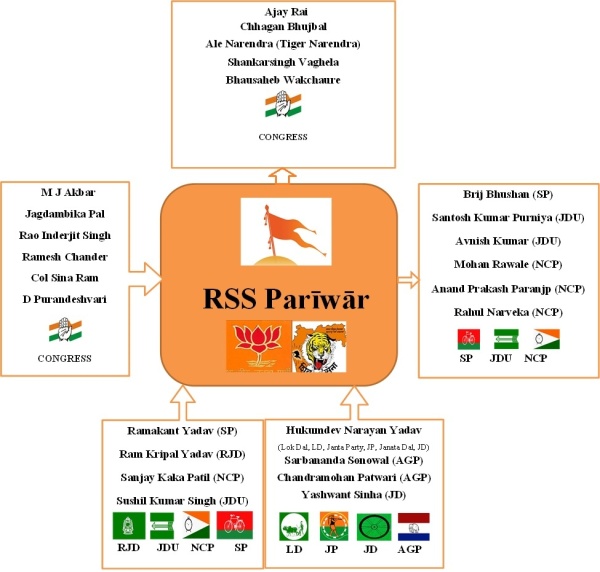
The crisscross between the RSS ideology/family and the non-RSS formations continued after 1947 as the table, by no means complete and based on individuals only (of more recent past) , shows below.
Flow Between RSSnSecular Parties-irfanFlows between the RSS Parīwār and “Secular” Parties, Post-1947
The flow between the RSS ideological camp and the non-RSS parties is epic, not episodic, enduring, not fleeting. It grows out of a sustained ideological groundwork to secure political equivalence. As the table above shows, Ajay Rai switched from the BJP to Samajwadi Party and then to the Congress to contest against Modi in Varanasi. Rarely did Rai ever critique the BJP or Modi. His sole claim against Modi and Arvind Kejriwal was that while his rivals were outsiders to Varanasi he alone was a local (asthānīye) candidate. In a special session of the Gujarat Assembly bidding farewell to Modi, on 21 May, Shankar Sinh Vaghela, Congress Leader of the Opposition not only praised Modi but asked him to build the Ram Temple at Ayodhya (obviously the Babri masjid is not even an issue). He also backed Modi and the BJP on other contentious issues. Friedrich Engels’ (d. 1895) remark that “the names of political parties are never entirely right” has some merit.
My point about the political equivalence is not an external attribution but the self-claim by the RSS which should be duly acknowledged as it is. When asked about the RSS appeal across political parties, Ram Madhav, the RSS spokesperson said in 2009:
We have our members in several political parties, including the Congress. We interact with them regularly…The BJP is closest to us in…ideology. Someone is 10 feet away from us; someone else is 1 km away, that’s the difference.
Responding to a similar question, Mohan Bhagwat, the new RSS Sarsanghchālak, head, offered more details:
Joining parties other than BJP depends on the individual thinking of a swayamsewak. And swayamsewaks are present in many parties. This I can tell you. Have you heard of Tiger Narendra in Andhra [Pradesh]? … Earlier he was in the BJP, now he is not [later Narendra became an MP from the Congress in 1999 and from Telangana Rashtra Samithi in 2004]… I had gone to Varanasi where the President of the city’s weyāpāri mandal was from the Samajwadi Party as well as the gẖatnāyak [group leader] of our shākẖa there. In the camp (mahāshīwir) of Agra many district-level workers of the BSP took part… We don’t count who is from which party or caste…We consider them all Hindus.
Hindutva as Development
It is against this wider backdrop of the organizational infrastructure and ideological apparatus that the claim by the BJP and the media that the latter won on the plank of development should be unpacked. To begin with, there is no single party which is opposed to development; every party vouches for development. So how did development and the BJP become synonymous? Consider Bihar under Nitish Kumar in alliance with the BJP. As long as this alliance was in place, Bihar was projected as a model of development next only to Gujarat. However, as the alliance broke in June 2013, we were told, Bihar’s development not only stopped but also declined. In March 2014, The Times of Indiareported that its GDP dramatically declined from 15.05% during 2012–13 to an estimated 8.82% during 2013–2014. While I am not an economist, this conclusion would be convincing if it also showed a major shift in the policy in less than a year and causally linked it to the decline. So, the message of The Times of India was plain: the BJP alone could guarantee development because after the breakup of alliance, development of Bihar drastically declined. The report was not about political economy. It was more about politics and less about economy.
When the alliance between Nitish Kumar and the BJP was intact, Bihar was also regarded as a well-administered state in terms of law and order, “good governance”, again only next to Gujarat. Soon after the dissolution of the alliance Bihar returned to jungle raj. Giriraj Singh, a key Bihar BJP leader, said: “Since the breakup of alliance [between Nitish Kumar and the BJP] there is nothing called government…law and order [in Bihar]”.
The logic of development as a winning catalyst is flawed because in the states of Bihar and UP –from where the BJP won over 100 seats –the RSS-BJP had systematically manufactured an anti-Muslim polarization to consolidate the “Hindu Vote”. In UP it began with the Muzaffarnagar riots operationalized through an incident in Kaval village in August 2013 as a result of which over 50,000 Muslims were rendered as refugees living in various camps. In early January 2014, with some journalists-academics I visited many camps, including the village Kakra and the police station nearby. There was a perfect harmony in the accounts of villagers, police officials and Kakra chief (pradẖān). They all held that Muslims themselves burnt their houses and willingly left villages to claim compensation from the state government. They were “greedy”. So massive was this propaganda that the simple fact that the promised amount of compensation was far lower than the price of their lost land and properties didn’t matter. The police told us that they made every effort to arrest the culprits responsible for loot and arson but they could not find them. While in Kakra, we found the culpritsliving there without any fear; one of them saying that the police lacked courage to touch them. The Muzaffarnagar riots were preface to the 2014 elections which the BJP won.
Two months later, in October 2013, in Bihar too the anti-Muslim campaign began with the explosions in the Patna rally to be addressed by Modi. Soon after the blast, TV channels such as News 24 showed one Pankaj as culprit and police arresting him. Firstpost reported that Ramnarayan Singh, Vikas Singh and Munna Singh were suspects. Within hours, as Beyondheadlines noted, the narrative changed as did the names of the suspect. Suspects became Muslims and their names began to circulate on television screens. The National Investigation Agency arrested Aftab Alam from Muzaffarpur where my parents live. Though released after a few days, media was awash with equation between Islam and terrorism and both against India. The colony where Alam lived was described as “mini Pakistan” by local Hindi media as well as many people in the “civil society”. So terrorized were Muslims in Muzaffarpur that they stopped greeting Alam after his release. When I expressed my desire to meet Alam, many of my relatives advised me not to. I did meet him.
From the time of the Patna blast the political field was methodically mobilized along the religious lines as a result of which electorally Bihar was as productive to the BJP as was the UP after the Muzaffarnagar riots. It was precisely because of such a line of political enmity sharply drawn well before the elections with a specific electoral purpose that at their conclusion Modi said: “There is no enmity in democracy but there is competition”. Does not this appear like an affirmation through the crooked lane of denial?
Let me conclude this section on development with the statement of Uma Bharti. When asked if Modi would give priority to Hindutva over development, she said:
“Hindutva is breath of life (prān) of India… However, prān remains still in its place… Things which require maintenance are hands, feet and eyes –in other words, development”.
Faces of Pseudo Democracy: Terror of Mercy
A day before counting began Chetan Bhagat wrote a blog for The Times of India. Predicting that the BJP with “near boycott by the Muslim community” will win an “all-time high Hindu power”, he posed questions and answered them as follows:
What do the BJP and Indian majority do with this new Hindu power? Do we use it to settle scores with Muslims? Do we use it to establish a majoritarian, intolerant state where minorities are ‘put in their place’? Do we impose ourselves and say things like, ‘India is the land of Hindus’? Do we make laws more in line with Hindu religion?
Frankly, we may have the power to do some of these things now. It may even appeal to sections of the population. However, be warned. This would be an awful and terrible use of this power. In the long term, such a thought process will only turn us into a conservative, regressive, unsafe and poor country where nobody would want to come for business (emphasis added).
While Bhagat’s questions are clear, his answers are not. Of the items listed in questions, in his answer he refers to “some of these things” leaving it for the readers “which ones”. What is clear, however, is that in warning about the terrible use of power, he brazenly violates the innate worth and dignity of humans and shows concern for them because “nobody would want to come for business”. Such a beastly urge –even beasts don’t have that –where treatment of humans (Muslims) is predicated on the calculations of profit and capital, is not a value for most followers of any religion, including Hinduism, in whose name Bhagat speaks. Bhagat’s vocabulary draws less from religion and more from its entanglement with supremacist nationalism and majoritarian democracy both of which must have been strangers to our forefathers in Vedic times. His invocation of the “Indian majority” which he equates with Hindus is a common, though flawed, understanding of democracy. Many dissenting with Bhagat’s lines of thinking, however, accept the idea of a Hindu majority but reject the BJP’s claim to represent all Hindus by arguing that two-thirds of them did not vote for it. Statistically, it is correct. Philosophically, it is not for it concedes the idea of an ethno majority as central to democracy.
Against the received wisdom political theorist Josiah Ober recently argued that the original meaning of demokratia in Greek is “capacity to do things, not majority rule”. In contrast to monarchia (monos: one) and oligarchia (hoi oligoi: the few), demokratia has no reference to number. It connotes a collective body of people. Since nowhere is any people monolithic, the capacity to do things would be diverse and multiple as would be the cultural goals and political idioms. The equation between democracy and majority rule was pejoratively done by Greek critics of democracy. Is it not strange that contemporary votaries of majority rule like Bhagat share grounds with ancient opponents of democracy?  It is precisely this equivalence between democracy and the rule by majority where majority is construed as a distinct ethno that has caused massive violence across the globe. Theodore Roosevelt’s statement that “Extermination [of Indians] was ultimately as beneficial as it was inevitable” bears testimony to such a bloody notion of democracy.
Shortly before the build-up to the 2014 elections, Uma Bharti told Aaj Tak that “Only right-wing Hindutva leaders can be the savior of Muslims and guarantee their security. Only we can instill confidence and erode fear from the Muslim psyche”. On close reflections, it is not difficult to see that this grand assurance conceals a grander danger and threat. Like terror and mercy security and the very threat to that security are intimately connected; they are the cover and back page of the same book. To invoke Slavoj Žižek, “only a power which asserts its full terrorist…capacity to destroy anything and anyone it wants” can speak of “infinite mercy” by guaranteeing security to Muslims. Does a vocal democracy rob people of their capacity to do things and destine them to be no more than silent objects of securitization?
If not pseudo democracy, how should we name a feverish mobilization whose prime goal was to dismiss, silence, erase or subordinate everything so as to singularly secure Mission 272 plus and whose leader (Amit Shah) vowed to deliver 50 Plus in UP, this plus here and that plus there? If not pseudo democracy, how should we name an election where over 40 Muslims were killed in Assam for exercising their choice (to the killers, theirs was a wrong choice)? If not pseudo democracy, how should we name a polity whose authors like Chetan Bhagat impose cultural assimilation and oblige all those who object to assimilation to apply for “citizenship elsewhere” and who further give the Manichean choice for either “oil and water” or “milk and sugar” but omits the metaphor of a beautiful garden where flowers of all colors can bloom? If not pseudo democracy, how should we name a polity whose leaders like Uma Bharti present fear as freedom, threat as security, death as life and dark, deadly thorn as fresh, white rose?

Pricing Public Transport - India

Editorial in The Hindu 

The launch of the metro railway service in Mumbai, which has enhanced public transport options in the teeming city, would have normally called for unqualified appreciation. However, the row over fares between the State government and Reliance Infrastructure, the latter holding the majority share in this public-private partnership project, has dampened the enthusiasm and in fact raised serious concerns. The outcome of this dispute, which the courts will determine, could affect the future functioning of the project and have a significant bearing on other metro rail schemes that seek private funding and participation. The 11.4-km elevated Mumbai Metro line has improved connectivity and reduced travel time for thousands of passengers. Just before the service was launched, Reliance Infrastructure steeply revised the fares and increased the range of fares, originally fixed at Rs.9 to Rs.13, to Rs.10 to Rs.40. The government has opposed this since it is higher than the pre-agreed fare and decided without any consultation. Reliance Infrastructure has defended the action, stating that under the Metro Railways Act it has the authority to fix fares. The increase in the project cost from Rs.2,356 crore to Rs.4,321 crore and higher operational costs had warranted the change, it asserted.

Almost every metro rail project in the country has overshot the projected cost. Companies often tend to underestimate the cost and inflate user-figures to convince funding agencies that travel by metro rail would be relatively inexpensive. Later, they complain of cost overruns and demand higher allocations. Ticket prices are then raised and the travelling public bears the burden of such poor planning. Fares should be affordable, particularly to the large number of lower-income group users, and should factor in the less visible benefits that accrue from the service. Increasing the use of public transport relieves road congestion, reduces pollution and cuts fuel consumption. Realising this, cities such as Tallinn, the capital of Estonia, have made public travel free for its citizens. Even if Mumbai and other Indian cities do not want to take such a radical route, and decide periodically to review fares, the process should be transparent and fair — more so when the private sector operates public transport. Striving to balance subsidy and revenue is understandable, but high prices should not affect transport choices. Alternative financing options must be explored. Many countries have mobilised funds by imposing additional charges for using private cars, which pollute more and occupy road space disproportionately. The urban future lies in promoting good public transport, and its success depends on fair pricing and quality service.

When Are Foreign Funds Okay?

by Nivedita Menon in Kafila


The Intelligence Bureau has, as we know prepared a document, updating it from the time of the UPA regime (which had reportedly started the dossier) indicating large scale foreign funding for subversive anti-development activities. Such as claiming that you have a greater right to your own lands and to your livelihood than monstrous profit-making private companies. Or raising ecological arguments that might stand in the way of the profits to be made by private corporations and the corrupt state elite, from mining, big dams, multi-lane highways and so on.

The IB report, signed by IB joint director Safi A Rizvi — alleges that the “areas of action” of the foreign-funded NGOs include anti-nuclear, anti-coal and anti-Genetically Modified Organisms protests. Apart from stalling mega industrial projects including those floated by POSCO and Vedanta, these NGOs have also been working to the detriment of mining, dam and oil drilling projects in north-eastern India, it adds. 

Imagine—working against the interests of POSCO and Vedanta! Is there no end to the depraved anti-nationalism of these NGOs!

The average observer of Indian politics—being like me, not as sharp as the IB—might be a little befuddled by this apparently anachronistic allergy of two successive governments and its intelligence gathering organization, towards foreign funding, in an era in which the slightest slowing down of the pace of handing over the nation’s resources to multi-national corporations,  is termed as “policy paralysis”, and attacked as detrimental to the health of the mythical “Sensex”. Older readers might remember that the  inspiring slogan of the legendary Jaspal Bhatti’s Feel Good party was Sensex ooncha rahe hamara.

This post is just to help you figure out then, when it is Okay to applaud foreign funding and when it is not—because otherwise you might post something on your FaceBook page that attacks foreign funding when it is actually Okay—and then how stupid and anti-national you’ll look.  Apart from being arrested and hauled off to jail, a few other “innocent” people might be killed, for as we know, if you did post something “objectionable” to the Hindu Right/India, you’re not innocent and may be legitimately killed. The street gangs of the Hindu Right have been in readiness for this moment when Their Man is PM for some years now.  They also know that Their Man may not publicly defend them at all times—depends on whether they carry out their work in a non-BJP state or not. And whether state assembly elections are coming up there or not. That is called being Drigdarshi. Far-sighted.

So in Maharashtra, Mohsin’s killing was described—in an apparent paradox—by the BJP ‘s central government Home Ministry as “communal” and by the state’s Congress government as merely “a law and order problem”.  But in fact, not a paradox at all.  The BJP is always keen to point out communal violence in states in which it is not in power. And the Congress plays the secular/communal card with the same unprincipled cynicism.

But I digress.

So—When are Foreign Funds Okay?

a) Foreign Funds are Okay if you are BJP.

The Delhi High Court indicted both Congress and BJP in March 2014 for accepting foreign funds from Vedanta subsidiaries in violation of provisions of Foreign Contribution (Regulation) Act. (Vedanta clearly believes in covering all its bases—after all, who knows who will come to power).

BJP and Congress in their defence had argued that Vedanta is owned by an Indian citizen, Aggarwal, and its subsidiaries are incorporated here, therefore they are not foreign sources.

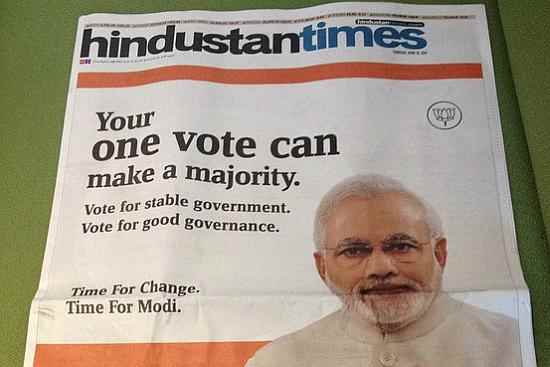
That’s the kind of fine distinction you must learn to make. For instance, there is no cap on parties’ expenditure during elections, only on individual candidates’ spending. Thus, Narendra Modi’s face on the front page of every newspaper and on huge hoardings all over the city did not get counted towards his poll expenditure. A Hindustan Times premium front page advertisement costs Rs 3950 PER SQUARE CENTIMETER.

How many advertisements like this one did you see? In how many newspapers? Over how many days? Where did the money come from?

We don’t know.

But—Remember—It does NOT matter, because Foreign Funds are Okay if you’re the BJP.
(Of course,  today you can say that it is totally Not Okay for Congress to get foreign funds or have foreign people in the family and so on. It’s Open Season on the corrupt and arrogant Congress, and who cares).

Interestingly, the IB Report apparently plagiarized a paragraph from a 2006 speech by Modi attacking anti-Hindu NGOs in which he said, in part:
Funds are obtained from abroad; an NGO is set up; a few articles are commissioned; a PR firm is recruited and, slowly, with the help of the media, an image is created.

I couldn’t decide whether I was more struck by the IB’s promptness in wagging its tail for its new master, or by Modi’s wildly successful replication of his enemy’s strategy!

b) Foreign Funds are okay if you’re the RSS. 

In Britain, Awaaz, South Asia Watch Limited, released an investigative report in 2004 which showed that
  1. RSS’s front organizations have received millions of pounds raised from the  British public. These funds were collected by the Leicester-based registered charity, Hindu Swayamsevak Sangh (HSS) and its fundraising arm Sewa International.
  2. HSS and Sewa International are UK branches of the RSS and the main purpose of their fundraising is to channel money to extremist RSS fronts in India, despite their claim to be nonsectarian, non-religious, non-political and purely humanitarian organizations.
  3. Sewa International’s deep connections with the RSS were not made known to donors and the British public who gave funds in good faith for Indian humanitarian causes. These connections were also unknown to patrons of Sewa International appeals.
In the USA, a report on the India Development and Relief Fund (IDRF) documented the links between the organization, a Maryland, US based charity, and organizations of the Sangh Parivar in India. The IDRF operates in the US under the rules governing tax-exempt charitable organizations. These rules prohibit such organizations from participating in political activity of the kind that involves funnelling money overseas to violent sectarian groups. Further, the report provides evidence to argue that IDRF’s claim of being a non sectarian organization that funds development and relief operations in India is disingenuous at best, and that this claim is strategically designed to insert IDRF into the cultural milieu and goodwill of the Indian diaspora as the ‘charity of choice’. The report on a close scrutiny of the projects that the IDRF funds, of the IDRF itself, of the affiliations of its office-bearers, and of the organizations that support it and raise funds for it, concluded that the IDRF is fully linked with the Sangh Parivar and the Hindutva movement in India.

c) Foreign Funds Are Okay in the Defence Sector.

Soon after taking over, the Narendra Modi government gave the go-ahead to 100 percent FDI in the Defence Sector. About this, retired air chief marshal Fali Homi Major said:
“It’s an excellent move. We want to be indigenous and we must. When I say indigenous, the product should be Indian and the intellectual property rights should be Indian. But that does not mean you can’t take foreign assistance with foreign technology—that is needed.”
Major said this move will allow international companies into the sector and dismantle the public sector’s monopoly, for of course, the worst monopoly is the public sector’s monopoly—the monopoly of multi-national companies is healthy and historically inevitable.

Foreign Investment caps have been raised in many other sectors too (because that’s OKAY)—Telecom, Petroleum, Natural gas and Refining.
“Allowing automatic route for foreign investment is the single most critical thing about today’s FDI limit enhancement announcement,” said Devraj Singh, executive director, tax and regulatory practice, at global professional services organization EY. He added that the move will give a boost to FDI as most investors are “scared about the current rules and regulations”.  
Of course, towards that heaven where investors are no longer scared of rules and regulations— THAT”s where every democracy should boldly go. 

d) Foreign Funds Are Okay in setting up nuclear plants. (No, NO—not protesting at—SETTING UP). Not just state funds, but private companies, like the French company AREVA NP (a joint venture between AREVA and Seimens) and private US companies GE Hitachi Nuclear Energy and Westinghouse Electric have all invested in nuclear plants in India. (Of course, the US companies have to export their nuclear reactors, because not a single nuclear plant has been commissioned in the US since the 1979 Three Mile Island accident. This is the phenomenon of outsourcing of dirty technology which the enlightened Western public will no longer accept in their backyards. Like the flooding of India with petrol guzzling SUVs that are no longer welcome on European and American roads).

e) Foreign Funds Are Okay for building roads, infrastructure and “clean energy”. These are large corporations stepping in—they are swooping down for the profits, not to build an ecologically sustainable world! What will this mean for poor people’s (i.e. the majority of India’s) access to basic needs?

Of course, where profits are doubtful the government has to step in, for risks can be taken only with taxpayers’ money, not with the money of shareholders of companies, right? Thus, the government has decided to fund the Rs 4,500-crore Eastern Peripheral Expressway project, after it received no bids from private players due to various delays. At the time of request for qualification, Reliance Infrastructure, IRB, Srei-OHL consortium and IL&FS showed interest in the project but nobody turned up with price bids. Thanks to delays, the private developers “got cold feet and their calculations on revenues and margins went haywire”  - (translation: possibility of fewer profits).

f) Foreign Funds are Okay if they come from eBay owner Pierre Omidyar. 

Omidyar Network is the philanthropy arm of eBay billionaire Pierre Omidyar. Since 2009, Omidyar Network has made more investments in India than in any other country in its portfolio. These investments were largely thanks to Jayant Sinha (the son of BJP stalwart Yashwant Sinha), who was hired in October 2009 to establish and run Omidyar Network India Advisors. During Sinha’s tenure, Omidyar Network steered a large portion of its investments into India, so that by 2013, India investments made up 18% of Omidyar Network’s committed funds of well over $600 million, and 36% of the total number of companies in its portfolio. Some of this investement was in organizations with  “distinctly political agendas”.

In February this year, Sinha stepped down from Omidyar Network in order to advise Modi’s election campaign, and to run for elections in Jharkhand from a BJP ticket, and he won.  Shortly after Sinha left Omidyar Network to help Modi win, Modi gave a speech calling for opening India’s e-commerce market to foreign companies such as Ebay, whose largest shareholder is Pierre Omidyar.

Nicely it all comes together, no?

Now—Omidyar is indeed known to have been active in “pro-democracy” NGOs and other organizations in other countries, but these NGOs, far from hampering “development”, work closely with Washington,
“to bring down regimes considered insufficiently open to the strip-mining of national wealth and resources by Western elites. The aim, as in Ukraine, where Omidyar’s partnership with government was particularly active, is to replace the regimes with technocrats willing to stick the shock doctrine cattle prod to their own people.”
So Omidyar is very very pro “development”—that’s the kind of foreign funding that is totally Okay.

g) Foreign Funds are Okay in the Privatization of Water.

The NDA government in 2002 produced  a National Water Policy that envisaged privatizatation of water, and not to be outdone, the UPA government prepared a document entitled “Draft National Water Policy (2012)” that is orientated towards promoting the wholesale privatization of water delivery and sanitation. 
Says Olivier Petitjean:
French multinationals Suez and Veolia have been eager to present India as a new El Dorado for water privatization. The largely untapped India market, with its almost infinite potential, would allow them to renew with commercial expansion, restore their reputation, and prove that private water management—a model that has come under heavy criticism recently, both in France and abroad— is still a valid option in today’s world.  
Veolia’s projects are running into trouble, but the idea of privatization of water and foreign investment in it has not been abandoned by either BJP or Congress.

Confederation of Indian Industries, the second of Modi’s two parents (the other being the RSS), is all for water privatization. A few days ago, Mukund Vasudevan, CII executive member of the National Water Committee, called for tiered water pricing across the country.
“If you manage pricing, you will automatically manage water supply”, he said, adding: “We are working with the government on how to create structure pricing. The pricing structure should cover all — industries, agriculture and consumers,even those below poverty line.”
While we awaited the election results, contemplating the possibility of Modi winning, the best case scenario I could envisage was a version of UPA 2, but activated out of its policy paralysis—that is, loot of common resources for corporate profit, unfettered by any democratic constraint whatsoever.

Looks like it’s UPA 2 PLUS the MSG Strategy of Managing Minorities as demonstrated in Gujarat.

It’s going to be a hard day’s night.