Search This Blog

Saturday, 13 April 2013

Throw out the myths about Margaret Thatcher


The reality was that Thatcher was neither popular nor successful economically. Labour must make a clean break with her policies
north sea oil
A North Sea oil rig off the Scottish Coast, pictured in 1988: 'During Thatcher's time in office, government oil receipts amounted to 16% of GDP.' Photograph: George Steinmetz/ George Steinmetz/Corbis
It is a truism that history is written by the victors. As Margaret Thatcher's economic policies were continued after she left office, culminating in economic catastrophe in 2008, it is necessary to throw out the myths peddled about her. The first is that she was popular. The second is that she delivered economic success.
Unlike previous governments, Thatcher's never commanded anything close to a majority in a general election. The Tories' biggest share of the vote under her was less than 44% in 1979, after which her vote fell. The false assertions about her popularity are used to insist that Labour can only succeed by carrying out Tory policies. But this is untrue.
The reason for the parliamentary landslide in 1983 was not Thatcher's popularity – her share of the vote fell to 42% – but the loss of votes to the defectors of the SDP and their alliance with the Liberals. Labour's voters did not defect to the Tories, whose long-term decline continued under Thatcher.
Nor did Thatcher deliver economic success, still less "save our country" in David Cameron's silly and overblown phrase-mongering. In much more difficult circumstances in 1945, the Labour government, despite war debt, set itself the task of economic regeneration, introduced social security and pensions, built hundreds of thousands of homes and created the NHS. In the 31 years before Thatcher came to office the economy grew by about 150%; in the 31 years since, it's grown by little more than 100%.
Thatcher believed that the creation of 3 million unemployed was a price worth paying for a free market in everything except labour. Thatcher's great friend Augusto Pinochet used machine guns to control labour, whereas Thatcher used the less drastic means of anti-union laws. But their goal was the same, to reduce the share of working class income in the economy. The economic results were the reason for Thatcher's falling popularity. As the authors of The Spirit Level point out, the inequality created led to huge social ills, increases in crime, addictions of all kinds and health epidemics including mental health issues.
Thatcher's destruction of industry, combined with financial deregulation and the "big bang", began the decline of saving and accumulation of private- and public-sector debt that led directly to the banking crisis of 2008. The idea that bankers would rationally allocate resources for all our benefit was always a huge lie. Now the overwhelming majority are directly paying the price for this failed experiment through the bailout of bank shareholders.
Thatcher was sustained only by one extraordinary piece of luck. Almost the moment she stepped over the threshold of Downing Street the economy was engulfed in an oil bonanza. During her time in office, government oil receipts amounted to 16% of GDP. But instead of using this windfall to boost investment for longer-term prosperity, it was used for tax cuts. Public investment was slashed. By the end of her time in office the military budget vastly exceeded net public investment.
This slump in investment, and the associated destruction of manufacturing and jobs, is the disastrous economic and social legacy of Thatcherism. Production was replaced by banking. House-building gave way to estate agency. The substitute for decent jobs was welfare. Until there is a break with that legacy there can be no serious rebuilding of Britain's economy.
The current economic crisis is already one year longer than the one Thatcher created in the early 1980s. In effect the policies are the same now, but there is no new oil to come to the rescue.
Labour will win the next election due to the decline in Tory support, which is even lower under Cameron than Thatcher. But Labour must come to office with an economic policy able to rebuild the British economy – which means a clean break with the economic policies of Thatcher. Labour can build an alliance of the overwhelming majority struggling under austerity: a political coalition to redirect resources towards investment and sustainable prosperity using all the available levers of government.
We can succeed by rejecting Thatcherism – the politics and economics of decline and failure.

News is bad for you – and giving up reading it will make you happier


News is bad for your health. It leads to fear and aggression, and hinders your creativity and ability to think deeply. The solution? Stop consuming it altogether
  • The Guardian
news montage
Out of the ­10,000 news stories you may have read in the last 12 months, did even one allow you to make a better decision about a serious matter in your life, asks Rolf Dobelli. Photograph: Guardian/Graphic
In the past few decades, the fortunate among us have recognised the hazards of living with an overabundance of food (obesity, diabetes) and have started to change our diets. But most of us do not yet understand that news is to the mind what sugar is to the body. News is easy to digest. The media feeds us small bites of trivial matter, tidbits that don't really concern our lives and don't require thinking. That's why we experience almost no saturation. Unlike reading books and long magazine articles (which require thinking), we can swallow limitless quantities of news flashes, which are bright-coloured candies for the mind. Today, we have reached the same point in relation to information that we faced 20 years ago in regard to food. We are beginning to recognise how toxic news can be.
News misleads. Take the following event (borrowed from Nassim Taleb). A car drives over a bridge, and the bridge collapses. What does the news media focus on? The car. The person in the car. Where he came from. Where he planned to go. How he experienced the crash (if he survived). But that is all irrelevant. What's relevant? The structural stability of the bridge. That's the underlying risk that has been lurking, and could lurk in other bridges. But the car is flashy, it's dramatic, it's a person (non-abstract), and it's news that's cheap to produce. News leads us to walk around with the completely wrong risk map in our heads. So terrorism is over-rated. Chronic stress is under-rated. The collapse of Lehman Brothers is overrated. Fiscal irresponsibility is under-rated. Astronauts are over-rated. Nurses are under-rated.
We are not rational enough to be exposed to the press. Watching an airplane crash on television is going to change your attitude toward that risk, regardless of its real probability. If you think you can compensate with the strength of your own inner contemplation, you are wrong. Bankers and economists – who have powerful incentives to compensate for news-borne hazards – have shown that they cannot. The only solution: cut yourself off from news consumption entirely.
News is irrelevant. Out of the approximately 10,000 news stories you have read in the last 12 months, name one that – because you consumed it – allowed you to make a better decision about a serious matter affecting your life, your career or your business. The point is: the consumption of news is irrelevant to you. But people find it very difficult to recognise what's relevant. It's much easier to recognise what's new. The relevant versus the new is the fundamental battle of the current age. Media organisations want you to believe that news offers you some sort of a competitive advantage. Many fall for that. We get anxious when we're cut off from the flow of news. In reality, news consumption is a competitive disadvantage. The less news you consume, the bigger the advantage you have.
News has no explanatory power. News items are bubbles popping on the surface of a deeper world. Will accumulating facts help you understand the world? Sadly, no. The relationship is inverted. The important stories are non-stories: slow, powerful movements that develop below journalists' radar but have a transforming effect. The more "news factoids" you digest, the less of the big picture you will understand. If more information leads to higher economic success, we'd expect journalists to be at the top of the pyramid. That's not the case.
News is toxic to your body. It constantly triggers the limbic system. Panicky stories spur the release of cascades of glucocorticoid (cortisol). This deregulates your immune system and inhibits the release of growth hormones. In other words, your body finds itself in a state of chronic stress. High glucocorticoid levels cause impaired digestion, lack of growth (cell, hair, bone), nervousness and susceptibility to infections. The other potential side-effects include fear, aggression, tunnel-vision and desensitisation.
News increases cognitive errors. News feeds the mother of all cognitive errors: confirmation bias. In the words of Warren Buffett: "What the human being is best at doing is interpreting all new information so that their prior conclusions remain intact." News exacerbates this flaw. We become prone to overconfidence, take stupid risks and misjudge opportunities. It also exacerbates another cognitive error: the story bias. Our brains crave stories that "make sense" – even if they don't correspond to reality. Any journalist who writes, "The market moved because of X" or "the company went bankrupt because of Y" is an idiot. I am fed up with this cheap way of "explaining" the world.
News inhibits thinking. Thinking requires concentration. Concentration requires uninterrupted time. News pieces are specifically engineered to interrupt you. They are like viruses that steal attention for their own purposes. News makes us shallow thinkers. But it's worse than that. News severely affects memory. There are two types of memory. Long-range memory's capacity is nearly infinite, but working memory is limited to a certain amount of slippery data. The path from short-term to long-term memory is a choke-point in the brain, but anything you want to understand must pass through it. If this passageway is disrupted, nothing gets through. Because news disrupts concentration, it weakens comprehension. Online news has an even worse impact. In a 2001 study two scholars in Canada showed that comprehension declines as the number of hyperlinks in a document increases. Why? Because whenever a link appears, your brain has to at least make the choice not to click, which in itself is distracting. News is an intentional interruption system.
News works like a drug. As stories develop, we want to know how they continue. With hundreds of arbitrary storylines in our heads, this craving is increasingly compelling and hard to ignore. Scientists used to think that the dense connections formed among the 100 billion neurons inside our skulls were largely fixed by the time we reached adulthood. Today we know that this is not the case. Nerve cells routinely break old connections and form new ones. The more news we consume, the more we exercise the neural circuits devoted to skimming and multitasking while ignoring those used for reading deeply and thinking with profound focus. Most news consumers – even if they used to be avid book readers – have lost the ability to absorb lengthy articles or books. After four, five pages they get tired, their concentration vanishes, they become restless. It's not because they got older or their schedules became more onerous. It's because the physical structure of their brains has changed.
News wastes time. If you read the newspaper for 15 minutes each morning, then check the news for 15 minutes during lunch and 15 minutes before you go to bed, then add five minutes here and there when you're at work, then count distraction and refocusing time, you will lose at least half a day every week. Information is no longer a scarce commodity. But attention is. You are not that irresponsible with your money, reputation or health. Why give away your mind?
News makes us passive. News stories are overwhelmingly about things you cannot influence. The daily repetition of news about things we can't act upon makes us passive. It grinds us down until we adopt a worldview that is pessimistic, desensitised, sarcastic and fatalistic. The scientific term is "learned helplessness". It's a bit of a stretch, but I would not be surprised if news consumption, at least partially contributes to the widespread disease of depression.
News kills creativity. Finally, things we already know limit our creativity. This is one reason that mathematicians, novelists, composers and entrepreneurs often produce their most creative works at a young age. Their brains enjoy a wide, uninhabited space that emboldens them to come up with and pursue novel ideas. I don't know a single truly creative mind who is a news junkie – not a writer, not a composer, mathematician, physician, scientist, musician, designer, architect or painter. On the other hand, I know a bunch of viciously uncreative minds who consume news like drugs. If you want to come up with old solutions, read news. If you are looking for new solutions, don't.
Society needs journalism – but in a different way. Investigative journalism is always relevant. We need reporting that polices our institutions and uncovers truth. But important findings don't have to arrive in the form of news. Long journal articles and in-depth books are good, too.
I have now gone without news for four years, so I can see, feel and report the effects of this freedom first-hand: less disruption, less anxiety, deeper thinking, more time, more insights. It's not easy, but it's worth it.

Unravelling the Narine mystery


How does the KKR offspinner continue to bamboozle batsmen? Because he knows when to bowl what
April 13, 2013


Sunil Narine was outstanding yet again, Mumbai Indians v Kolkata Knight Riders, IPL, Mumbai, May 16, 2012
Sunil Narine believes in the less-is-more philosophy © AFP 
Enlarge
It's hard to remain a mystery today, what with all the footage available for replays in slow-motion and every player painstakingly scrutinised. The action has shifted from the 22 yards to the editing table.
Yet Sunil Narine continues to beat technology and stay ahead of most analyses. Even though he has been scanned time and again, he manages to get the better of batsmen and fascinate spectators.
He's not the first mystery spinner; there have been quite a few who batsmen couldn't decipher immediately, if at all. Yet there's something about this lad from the West Indies, with a peculiar hairdo and an equally peculiar action that has enthralled aficionados worldwide.
In his debut IPL season, last year, Narine took 24 wickets and helped Kolkata Knight Riders win the trophy for the first time. But it isn't just his ability to take wickets that makes everyone sit up and take note, it's the way he spins around hapless batsmen.
One particular over that he bowled to his fellow West Indian, Andre Russell, in the opening match of this season's IPL comes to mind, because it looked like Russell had no idea which way the ball would turn after pitching. Each time almost, he played down one way when the ball was heading the other.
It's not too hard to decipher a doosra or a carrom ball from an offspinner while watching on TV, when the camera gives us the view from the back, but Narine's variations are hard to pick even for viewers sitting at home. So what chance did Russell have?
By bowling even his offspinners with a scrambled seam, Narine manages to keep the batsman guessing which one will head the other way. And since he bowls both his variations from the front of the hand (the doosra is usually bowled from the back of the hand), you have to look very closely at which way his fingers are turning at the point of release - not an easy job.
But it isn't just the variations or his ability to disguise them that make Narine a difficult bowler to bat against in T20. There are many bowlers who have more variations up their sleeve. All good legspinners have three deliveries (legspin, googly and a flipper), and most offspinners these days also possess more than a couple variations (offspin, doosra and a carrom ball), but it isn't about the quantity, it's about the quality of execution. Having different types of deliveries won't mean much unless you know when to use them.
In fact, Narine has only two variations in his bag - a regular offspinner and the one that goes away after pitching. But unlike other spinners, he is a master when it comes to using his subtle variations, and he rarely overdoes them.
In his first over in this year's IPL, he did not bowl a single away-going delivery. He realised that there was some turn and bounce on the Eden Gardens pitch, so he was better off bowling offbreaks. In fact, in the entire game, he didn't bowl a single away-going delivery to the well-set Mahela Jayawardene, having arranged a leg-side field for him. If Jayawardene had picked the variation, Narine would have run the risk of leaking runs. But against Russell, Narine strengthened the off-side field, with a slip as an attacking option, and bowled the other one repeatedly. His ability to judge the demands of the situation and then move from being smart and defensive to brave and aggressive sets him apart.
In addition to his game sense and variety, Narine's pace and his effective stock ball make it very tough to score off him. He bowls really flat and slightly quicker but without compromising on turn off the surface. If there's something in the pitch for the spinners, he really rips them across the right-handers and away from the left-handers.
The delivery that got David Warner in the first match was an example of his ability to turn the ball with bounce at reasonably high speed. His pace and flat trajectory take away the batsman's crucial attacking strategy - stepping down the track to play the lofted shot. There aren't many who can hit the long ball without coming out of the crease.
If you can't come down the track, you look to either slog-sweep towards cow corner or go deep into the crease to pull the slightly shorter deliveries. Narine's extra turn and bounce on pitches like the one at the Eden Gardens make both these shots tough to execute. The turn ensures the ball misses the bat's sweet spot. If that fails, the bounce ensures the ball's impact on the bat is higher than the batsman is comfortable with. Either way the batsman rarely gets the intended height or distance.
If batsmen look for five or six runs off a Narine over instead of going after him, he might not turn out to be such a prolific wicket-taker. Unfortunately for all IPL teams, Knight Riders' captain, Gautam Gambhir, brings Narine on either in the Powerplay or during the death overs. That forces batsmen to go after Narine and increases his chances of picking up wickets. I won't be surprised if he finishes as one of the top wicket-takers this season as well
.

Friday, 12 April 2013

Mark Steel: You can't just shut us up now that Margaret Thatcher's dead


Maybe a more modern way of broadcasting the news would have been for Davina McCall to announce it, saying: “She’s gone, but let’s have a look at some of her best bits.” Then we could see her denouncing Nelson Mandela as a terrorist and befriending General Pinochet.

Instead it began as expected, with the Hurds, Howes and Archers phoning in their “remarkables” and “historics”, and we were reminded how she brought down the Berlin Wall and rescued Britain, then an article in The Times claimed she was responsible for ending apartheid, and it seemed by today we’d be hearing she stopped Gibraltar being invaded by Daleks and made  our goldfish feel proud to be British and took  8 for 35 against Australia to win the Ashes.

“Even those who disagreed with her, respected her as a conviction politician”, it was said many times, as if everyone would participate in the mourning. But soon it was impossible to pretend there was a respectful consensus, not because of the odd party in the street, but from a widespread and considered contempt. In many areas it must have been confusing for Jehovah’s Witnesses, as every time they knocked on a door and asked, “Have you heard the good news”, they’d be told “Yes mate, I have, do you want to come in for a beer?”

Before long came the complaints, such as Tony Blair saying: “Even if you disagree with someone very strongly, at the moment of their passing you should show some respect.” Presumably then, when Bin Laden was killed, Blair’s statement was: “Although I didn’t agree with Osama’s policies, he was a conviction terrorist, a colourful character whose short films were not only fun but educational as well. He will be sadly missed.”

The disrespect was inevitable, as millions were opposed to her not because they disagreed with her, but because she’d helped to ruin their lives. If someone robs your house, you don’t say: “I disagreed with the burglar’s policy, of tying me to a chair with gaffer tape and stripping the place bare, even taking the pickled onions, which I consider to be divisive. But I did admire his convictions.”

For example, a Chilean woman living in Britain was quoted in The Nationmagazine, saying: “The Thatcher government directly supported Pinochet’s murderous regime, financially, via military support, even military training. Members of my family were tortured and murdered under Pinochet, who was one of Thatcher’s closest allies and friend. Those of us celebrating are the ones who suffered deeply.” Yes, but she was able to buy shares in British Gas so she was better off in other ways. In so many areas, the party that insists we show compassion for their departed heroine made a virtue of showing none when she was their leader. She didn’t just create unemployment, she gloried in it. Her supporters in the City revelled in their unearned wealth all the more because they could jeer at those with nothing.

But this week Thatcher fans have been unrestrained in their abuse for anyone not displaying “compassion”. Maybe we should give them the benefit of the doubt and accept they’ve just discovered it. They’re all going to the doctors saying: “I’ve been getting this strange sort of caring feeling towards someone who isn’t me. Do I need antibiotics?” If they’re puzzled as to why there isn’t universal sadness this week, maybe they should visit Corby. It’s a town that was built in the 1930s, entirely round a steelworks, and thousands of unemployed Scots moved there for the work. As a result its people still have a strong Scottish accent, even though it’s in Northamptonshire.

But in 1980 Margaret Thatcher’s government shut down most of the steel industry, as part of her plan to break the unions, and the effect on Corby was like someone taking control of the Lake District and concreting in the lakes.

I was there to record a radio show about the town, and met Don and Irene, both in their seventies, at the Grampian Club. Don’s father had walked to Corby from Larkhall, near Glasgow, in 1932. I mentioned the steel strike and plant closure to Don, but he gestured as if it had somehow passed him by. It would have to be mentioned in the show, so I tried to find someone in the town with a story, an anecdote, something. But no one wanted to say a thing about it. During the recording, I asked if anyone had a story to tell from those days, but no one did, until it felt as if the whole audience collectively passed a motion that went: “I think you’d best move on to another subject, Mark.”

Afterwards in the bar, Irene told me: “We weren’t being rude, love, when we didn’t have a lot to say about the closure. But it wasn’t an easy time. Don marched from Corby to London with a banner. It made him angry about everything, we split up for a year because it was too much to live with. But we were lucky, two of our closest friends committed suicide in the months after the closure. So people would rather forget about those times really. But apart from that we really enjoyed the show.”

Still, even those who disagree with her policies, will surely commend her achievements.
Strangely, it’s now her supporters who are insulting her memory, with a funeral paid for by the taxpayer. Surely it would be more fitting to leave her where she is, and say: “If you can’t stand on your own two feet, you can't expect help from the state.”

Wednesday, 10 April 2013

The Herbalife saga is practically a made-for-Hollywood script


Herbalife is a diet company that excels at drama. It has Wall Street titans sparring, KPMG resigning and investors confused
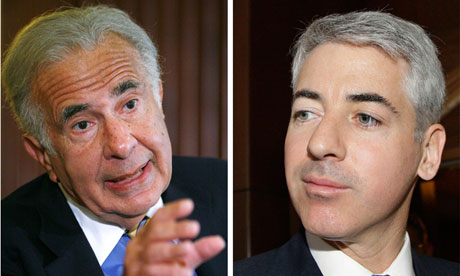
Bill Ackman and Carl Icahn
Bill Ackman (right) traded insults with fellow hedge funder Carl Icahn on television over Herbalife. Photograph: Reuters
There is something about diet company Herbalife that makes very rich men act very strangely. The weight-loss company should be relatively unremarkable. Instead it's been in the center of a dramatic story that should have Hollywood calling.
It has everything – intense, dashing hedge-fund titans embroiled in a public war, allegations of pyramid schemes, billions of dollars riding on on the outcome and now, as of today, a rogue auditor who risked his entire career by allegedly squirreling away inside information to make himself a profit. The Herbalife scandal even features Carl Icahn, one of the 1980s corporate raiders who reportedly inspired the timeless capitalist character of Gordon Gekko. If Wall Street wars got Oscars, Herbalife would be a top contender.
With so much heady money and power surrounding Herbalife, it's no surprise that the wafting scent of greed would envelop one of the people whose virtue should have been above reproach: the company's auditor, the prestigious accounting firm KPMG.
Auditors are not glamorous people. If investment bankers are the popular, fratty jocks of the financial world, and traders are the kids who love to hang out with their Camaros, auditors are more like the bespectacled stars of the math team. They are accountants – precise and cautious by nature – and, as a result, they have all the usual attendant social insecurities that nerds do: they're so happy just to be invited to the party that they may not judge too carefully the underage drinking and drugs that are going on. When auditors get into trouble – as they did with companies like Enron and WorldCom – it's usually because they were too eager to please their clients that they kept quiet when they saw something wrong. They didn't want to lose their place at the party.
So the "rogue auditor" is a rare character to cast. Auditors are often guilty of neglect, or looking the other way; rarely do they do something really bold and reckless like trade on inside information. Yet, apparently prompted by the drama around Herbalife, this is what a partner with the company's auditor, KPMG, did, according to Herbalife.
KPMG fired the rogue auditor on 5 April and told Herbalife about the whole debacle yesterday. This morning, Herbalife's stock was halted for an unusually long time – two hours – as the company tried to decide how to tell investors.
During that time, traders and journalists took to Twitter to speculate on what could possibly be so horrible that it would require the company to completely stop trading its stock for most of the morning.
The answer, it turns out, was pretty bad.
The partner at KPMG was entrusted with combing Herbalife's financial statements for errors. Unfortunately, according to Herbalife's version of the story, he also shared the company's confidential information with someone else, presumably so they could make a profit of their own. That would give him an incentive to mess with the company's results to help his own financial interests. As a result, KPMG's entire opinion on the company is reduced to worthless chaos; the auditor said it had to withdraw its reports on Herbalife for the last three fiscal years.
Herbalife, already embroiled in months of wars between its investors, hastened to assure everyone that the company was still sound. It stressed that KPMG had resigned as its auditor purely because of the possible insider trading and "not for any reason related to Herbalife's financial statements, its accounting practices, the integrity of Herbalife's management or for any other reason".
Herbalife managed to contain the damage: by halting the stock for two hours, it had raised expectations that the news would be far worse. The stock fell only 1% on the news when it finally came out. However, there was still evidence of chaos. In the same statement, Herbalife said that KPMG had said the three years of financial statements could both be "continued to be relied upon" and "should no longer be relied upon".
So that clears things up.
This only adds another twist for the Herbalife saga that's been playing out on the larger Wall Street stage. It was only three months ago that the distinguished Carl Icahn was publicly trading insults on television with Bill Ackman, the silver-haired, baby-faced boy wonder of investing. Ackman has argued that Herbalife is a pyramid scheme and has bet against the company; Icahn took the other side of the bet. Daniel Loeb, who was previously a friend of Ackman's, shocked the investing world by switching allegiances and taking Icahn's side.
There's a lot more information that has yet to come out about the problem with KPMG and Herbalife. That's good if you're in Hollywood. It means there's enough time to run through the casting. What do you think of Alan Alda, Elliott Gould, or Frank Langella to play Carl Icahn? John Slattery to play Bill Ackman? Michael Sheen as Dan Loeb? Philip Seymour Hoffman as the rogue auditor?
Now who's going to call John Grisham and tell him about all this?

Margaret Thatcher and misapplied death etiquette


The dictate that one 'not speak ill of the dead' is (at best) appropriate for private individuals, not influential public figures
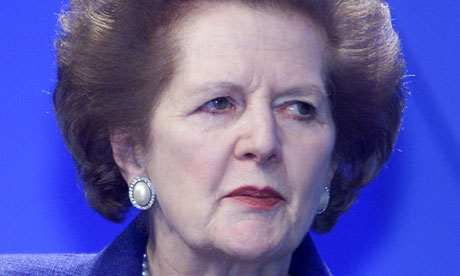
Margaret Thatcher
Margaret Thatcher Photograph: Don Mcphee
News of Margaret Thatcher's death this morning instantly and predictably gave rise to righteous sermons on the evils of speaking ill of her. British Labour MP Tom Watsondecreed: "I hope that people on the left of politics respect a family in grief today." Following in the footsteps of Santa Claus, Steve Hynd quickly compiled a list of all the naughty boys and girls "on the left" who dared to express criticisms of the dearly departed Prime Minister, warning that he "will continue to add to this list throughout the day". Former Tory MP Louise Mensch, with no apparent sense of irony, invoked precepts of propriety to announce: "Pygmies of the left so predictably embarrassing yourselves, know this: not a one of your leaders will ever be globally mourned like her."
This demand for respectful silence in the wake of a public figure's death is not just misguided but dangerous. That one should not speak ill of the dead is arguably appropriate when a private person dies, but it is wildly inappropriate for the death of a controversial public figure, particularly one who wielded significant influence and political power. "Respecting the grief" of Thatcher's family members is appropriate if one is friends with them or attends a wake they organize, but the protocols are fundamentally different when it comes to public discourse about the person's life and political acts. I made this argument at length last year when Christopher Hitchens died and a speak-no-ill rule about him was instantly imposed (a rule he, more than anyone, viciously violated), and I won't repeat that argument today; those interested can read my reasoning here.
But the key point is this: those who admire the deceased public figure (and their politics) aren't silent at all. They are aggressively exploiting the emotions generated by the person's death to create hagiography. Typifying these highly dubious claims about Thatcher was this (appropriately diplomatic) statement from President Obama: "The world has lost one of the great champions of freedom and liberty, and America has lost a true friend." Those gushing depictions can be quite consequential, as it was for the week-long tidal wave of unbroken reverence that was heaped on Ronald Reagan upon his death, an episode that to this day shapes how Americans view him and the political ideas he symbolized. Demanding that no criticisms be voiced to counter that hagiography is to enable false history and a propagandistic whitewashing of bad acts, distortions that become quickly ossified and then endure by virtue of no opposition and the powerful emotions created by death. When a political leader dies, it is irresponsible in the extreme to demand that only praise be permitted but not criticisms.
Whatever else may be true of her, Thatcher engaged in incredibly consequential acts that affected millions of people around the world. She played a key role not only in bringing about the first Gulf War but also using her influence to publicly advocate for the 2003 attack on Iraq. She denounced Nelson Mandela and his ANC as "terrorists", something even David Cameron ultimately admitted was wrong. She was a steadfast friend to brutal tyrants such as Augusto Pinochet, Saddam Hussein and Indonesian dictator General Suharto ("One of our very best and most valuable friends"). And as my Guardian colleague Seumas Milne detailed last year, "across Britain Thatcher is still hated for the damage she inflicted – and for her political legacy of rampant inequality and greed, privatisation and social breakdown."
To demand that all of that be ignored in the face of one-sided requiems to her nobility and greatness is a bit bullying and tyrannical, not to mention warped. As David Wearing put it this morning in satirizing these speak-no-ill-of-the-deceased moralists: "People praising Thatcher's legacy should show some respect for her victims. Tasteless." Tellingly, few people have trouble understanding the need for balanced commentary when the political leaders disliked by the west pass away. Here, for instance, was what the Guardian reported upon the death last month of Hugo Chavez:
 " To the millions who detested him as a thug and charlatan, it will be occasion to bid, vocally or discreetly, good riddance."
Nobody, at least that I know of, objected to that observation on the ground that it was disrespectful to the ability of the Chavez family to mourn in peace. Any such objections would have been invalid. It was perfectly justified to note that, particularly as the Guardian also explained that "to the millions who revered him – a third of the country, according to some polls – a messiah has fallen, and their grief will be visceral." Chavez was indeed a divisive and controversial figure, and it would have been reckless to conceal that fact out of some misplaced deference to the grief of his family and supporters. He was a political and historical figure and the need to accurately portray his legacy and prevent misleading hagiography easily outweighed precepts of death etiquette that prevail when a private person dies.
Exactly the same is true of Thatcher. There's something distinctively creepy - in a Roman sort of way - about this mandated ritual that our political leaders must be heralded and consecrated as saints upon death. This is accomplished by this baseless moral precept that it is gauche or worse to balance the gushing praise for them upon death with valid criticisms. There is absolutely nothing wrong with loathing Margaret Thatcher or any other person with political influence and power based upon perceived bad acts, and that doesn't change simply because they die. If anything, it becomes more compelling to commemorate those bad acts upon death as the only antidote against a society erecting a false and jingoistically self-serving history.

In this nuclear standoff, it's the US that's the rogue state


The use of threats and isolation against Iran and North Korea is a bizarre, perilous way to conduct foreign relations
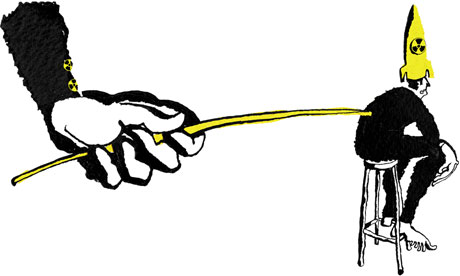
Mellor nuclear
'The alleged crises over North Korea and Iran are just not serious enough to warrant the classroom language of ­shunning and punishment.' Illustration by Belle Mellor
By coincidence two clashes over nuclear issues are hitting the headlines together. North Korea and Iran have both had sanctions imposed by foreign governments, and when they refuse to "behave properly" they are submitted to "isolation" and put in the corner until they are ready to say sorry and change their conduct. If not, corporal punishment will be administered, since they have been given fair warning by the enforcers that "all options are on the table".
It's a bizarre way to run international relations, one we continue to follow at our peril. For one thing, it is riddled with hypocrisy, and not just because states that have hundreds of nuclear weapons are bullying states that have few or none. The hypocrisy is worse than that. If it is offensive for North Korea to talk of launching a nuclear strike at the United States (a threat that is empty because the country has no system to deliver the few nuclear weapons that it has), how is it less offensive for the US to warn Iran that it will be bombed if it fails to stop its nuclear research?
Both states would be resorting to force when dialogue is a long way from being exhausted. They would also be acting against international law. That is patently clear if North Korea ever managed to launch a nuclear strike against South Korea or the US, but the same is true of an altogether more feasible attack on Iran. There is no conceivable scenario under which the United Nations security council would authorise the United States, let alone Israel, to take military action, even if Iran were to tear up its long-standing statement that nuclear bombs are un-Islamic and produce one. So why does Washington go on with its illegal threats?
The underlying cause of most international tension is the unwillingness of powerful states to recognise that we live in a multipolar world. The idea of hegemony, often sanitised as "leadership", is unacceptable. In a post-colonial era there are multiple centres of authority, international influence and soft power, and we should rejoice when new or old states, individually or collectively, have the courage and ability to challenge another state's ambition to be a superpower. States will always make common cause or "coalitions of the willing" on specific issues, but interests fluctuate and priorities change – and we should junk the cold war-style system of military alliances and ideological or sectarian camps.
Let us go further and drop the figment of an "international community", at least in its current western definition as "the United States and its friends". By the same token, let's correct the myopia around isolation. When the leaders of 120 nations travelled to Tehran to ratify Iran's presidency of the Non-Aligned Movement last August, it was risible to hear US officials still talking of Iran being "a rogue state".
In Washington and Whitehall it may seem self-evident that the international community should arm the opposition to Syria's President Assad, but that is not the view of the world's largest democracy, India, or of the most democratic African and Latin American states, South Africa and Brazil. When their leaders convened with Russia and China (in the new Brics coalition) in Durban last month, they "re-affirmed our opposition to any further militarisation of the conflict" and called for a political settlement.
Of course, the non-aligned and Brics summits were barely covered by the US media in its news or comment columns, the normal technique of reality suppression used by American opinion-formers and policy-makers. Rami Khouri, the distinguished US-trained Lebanese writer, calls it "professionally criminal". After a month in the US recently, he found that coverage of Iran was based on "assumptions, fears, concerns, accusations and expectations almost never supported by factual and credible evidence". In as much as these distortions build public support for a military attack on Iran, he finds it as culpable as the media's role in the runup to the attack on Iraq a decade ago.
The alleged crises over North Korea and Iran are just not serious enough to warrant the classroom language of shunning and punishment. Dialogue and respect for other people's positions are the better course. Discuss everything as a package rather than dangle incentives one by one like sweets.
Ironically, it was Iran at the recent talks with security council members that suggested a roadmap with a clear end state: the acceptance of Iran's right to enrich uranium like any other signatory of the non-proliferation treaty. In other words, the issue is primarily a matter of national dignity and sovereignty. Meanwhile, the US declined to promise to lift all sanctions whatever Iran does.
On Korea the best approach is also comprehensive. This would mean trying to reach the full-scale peace treaty that was never concluded when the war ended 60 years ago. North Korea wants a treaty as a sign, like Iran, that the US accepts it as a legitimate state. Steps towards one were agreed in 2007 and a few positive moves followed. But they collapsed when the mentality of suspicion and sanctions revived under the pressure of electoral politics in Seoul and Washington and the arrival of an inexperienced new leader in Pyongyang. It is not too late to drop the self-defeating language of "rogue states" beyond the pale of the "international community" and try again.