Search This Blog

Monday, 20 March 2017

Meritocracy: the great delusion that ingrains inequality

Jo Littler in The Guardian


We must create a level playing field for American companies and workers!” shouted Donald Trump in his first address to Congress last month, before announcing that tighter immigration controls would take the form of a “merit-based” system.


Like so many before him, Trump was wrapping political reforms in the language of meritocracy, conjuring up the image of a “fair” system where people are free to work hard to activate their talent and climb the ladder of success.

Since becoming prime minister, Theresa May has also promised to make Britain “the world’s great meritocracy” (or, in The Sun’s phrase, a “Mayritocracy”). She reiterated this pledge when announcing her revival of the grammar schools system, abandoned in the 1960s. “I want Britain to be a place where advantage is based on merit not privilege,” she proclaimed, “where it’s your talent and hard work that matter, not where you were born, who your parents are or what your accent sounds like.”

In the wake of the 2008 financial crash, many people noticed that the meritocracy they had been taught to believe in wasn’t working. The idea you could be anything you wanted to be, if only you tried hard enough, was increasingly hard to swallow. Even for the relatively pampered middle classes, jobs had dried up, become downgraded and over-pressured, debt had soared and housing was increasingly unaffordable.


Even Thatcher presented herself as an enemy of vested interests and a promoter of social mobility

This social context, created through 40 years of neoliberalism, was reflected on TV: in Breaking Bad, being brilliant at chemistry was not enough to guarantee mainstream career progression or even survival; the evisceration of social support was the backdrop to The Wire; and the precarious creative labour depicted in Girls was very different to the glamorous stability shown a decade earlier in Sex and the City.

In the face of this instability, May and Trump have managed to resuscitate the idea of meritocracy to justify policies that will increase inequality. They use different cultural accents: Trump’s brash rhetoric panders overtly to racism and misogyny; May presents herself as a fair-minded headmistress of the home counties. But their political logic is intertwined, as indicated by the indecent haste with which May rushed to the White House post-election. Both acknowledge inequality but prescribe meritocracy, capitalism and nationalism as the solution. Both want to create economic havens for the uber-rich while deepening the marketisation of public welfare systems and extending the logic of competition in everyday life.

When the word meritocracy made its first recorded appearance, in 1956 in the obscure British journal Socialist Commentary, it was a term of abuse, describing a ludicrously unequal state that surely no one would want to live in. Why, mused the industrial sociologist Alan Fox, would you want to give more prizes to the already prodigiously gifted? Instead, he argued, we should think about “cross-grading”: how to give those doing difficult or unattractive jobs more leisure time, and share out wealth more equitably so we all have a better quality of life and a happier society.


‘May and Trump have managed to resuscitate the idea of meritocracy to justify policies that will increase inequality.’ Photograph: Stefan Rousseau/PA

The philosopher Hannah Arendt agreed, arguing in a 1958 essay: “Meritocracy contradicts the principle of equality … no less than any other oligarchy.” She was particularly disparaging about the UK’s introduction of grammar schools and its institutional segregation of children according to one narrow measure of “ability”. This subject also troubled the social democratic polymath Michael Young, whose 1958 bestseller The Rise of the Meritocracy used the M-word in an affably disparaging fashion. The first half of his book outlined the rise of democracy; the second told the story of a dystopian, meritocratic future complete with black market trade in brainy babies.

But in 1972, Young’s friend the American sociologist Daniel Bell gave the concept a more positive spin when he suggested that meritocracy might actually be a productive engine for the new “knowledge economy”. By the 1980s the word was being used approvingly by a range of new-right thinktanks to describe their version of a world of extreme income difference and high social mobility. The word meritocracy had flipped in meaning.

Over the past few decades, neoliberal meritocracy has been characterised by two key features. First, the sheer scale of its attempt to extend entrepreneurial competition into the nooks and crannies of everyday life. Second, the power it has gathered by drawing from 20th-century movements for equality. Meritocracy has been presented as a means of breaking down established hierarchies of privilege.

Even Margaret Thatcher, despite her social conservatism, presented herself as an enemy of vested interests and a promoter of social mobility. Under New Labour, meritocracy embraced social liberalism, rejecting homophobia, sexism and racism. Now, we were told, really anyone could “make it”.

Those who did “make it” – the enterprising mumpreneur, the black vlogger, the council estate boy-turned-CEO – were spotlighted as parables of progress. But climbing up the social ladder became an increasing individualised matter, and as the rich got richer the ladders became longer. Those who didn’t make it were ignored or positioned as having personally failed. Under the coalition and Conservative governments, meritocratic yearning took a more punitive turn. In David Cameron’s “aspiration nation”, you were either a striver or a skiver; the very act of hoping to reach upwards became a moral obligation. Those who could not draw on existing reservoirs of privilege were told to worker harder to catch up.

The fact is, meritocracy is a myth. Social systems that reward through wealth, and which increase inequality, don’t aid social mobility, and people pass on their privilege to their children. The Conservatives have made this situation far worse by raising the inheritance tax threshold. And their reintroduction of grammar schools would involve using extremely narrow educational measures to divide children and to privilege the already privileged (often with the help of expensive private tutors). As the geographer Danny Dorling has said, it is a system of “educational apartheid”.

“Merit” itself, moreover, is a malleable, easily manipulated term. The American scholar Lani Guinier has shown how, in the 1920s, Harvard University curbed the number of Jewish students admitted by stipulating a new form of “merit”: that of “well-rounded character”. A more recent example was supplied by the reality TV filmmaking contest Project Greenlight, in which the white actor Matt Damon repeatedly interrupted black producer Effie Brown to tell her that diversity wasn’t important in film production: decisions, he explained, have to be “based entirely on merit”. This “Damonsplaining” was widely ridiculed on social media (“Can Matt Damon tell me why the caged bird sings?”). But it illustrated how versions of “merit” can be used to ingrain privilege – unlike clear criteria for specific roles, combined with anti-discrimination policies.

It is not hard to see why people find the idea of meritocracy appealing: it carries with it the idea of moving beyond where you start in life, of creative flourishing and fairness. But all the evidence shows it is a smokescreen for inequality. As Trump, May and their supporters attempt to resurrect it, there has never been a better moment to bury meritocracy for ever.


Sunday, 19 March 2017

I'm glad to see David Davis 'still hasn't looked into' the economic impact of Brexit

Mark Steel in The Independent


Some people are concerned we aren’t prepared for this Brexit situation, so it was heartening to hear Minister David Davis explain what happens if we don’t manage a deal with the EU, by saying he “hadn’t looked into it yet.”

This shows a steady hand, rather than someone who rushes into things by looking into stuff within the first nine months of a job specifically created to look into exactly that stuff. What’s achieved by panicking like that? Because Davis is only Minister for Brexit. How is he supposed to find out anything about Brexit, on top of all the other things in his title?  

The government should create other specific posts to try and match Davis. They could create a Minister for Desiccated Coconut, so that after nine months they can say: “I won’t lie, I haven’t given a passing thought to desiccated coconut.” At least campaigners for  leaving the EU were honest. Before the referendum, supporters of the Leave campaign like Davis always explained that if we left, they didn’t have the slightest idea what would happen, and even came up with the slogan “nine months after the result we’ll confirm we haven’t looked into it”, which as I recall they put on the side of a bus.

Theresa May has insisted that “no deal is better than a bad deal”, which introduced a philosophical edge to Brexit. Because how can anyone know whether it will be better or worse if we haven’t yet looked into it? It’s like saying you have no idea what’s on the other side of the universe, but whatever it is, it’s better than a donkey.

But Davis went even further, explaining: “You don’t need pieces of paper with a number on it to make an economic assessment.” Of course not, an economic assessment isn’t about numbers. When you apply for a mortgage, the bank asks how much you earn, and you say “a bit”, then the bank manager has a think and says: “In that case you’re allowed to borrow a yellowish amount, that reminds you of the sea.” So you ask: “How much will I have to pay back every month?” and they say: “Come back in nine months, by which time I won’t have looked into it yet.”

Asked whether British citizens will continue, after Brexit, to get free healthcare in the EU, Davis said they probably wouldn’t, but added reassuringly: “I have not looked at that one.”

There’s a man on top of his brief. Anyone can be clueless on the general direction of Brexit, but it takes dedication to be even more vague on each specific detail.

Hopefully the foreign health authorities will adopt the same attitude, and when a British citizen arrives at a Spanish hospital with appendicitis, they’re met by an appendicitis doctor who tells them to wait nine months, then they’ll be given a letter saying: “Do you know, I haven’t got the slightest clue about appendixes.”


Davis agreed that UK producers of dairy and meat will face tariffs of up to 40 per cent, conceding: “The numbers in agriculture are high.” It’s a shame he let his side down there, because acknowledging “high” is a bit too specific. Ideally he’d have answered the question by saying: “How long’s a piece of string, mate? I tell you what I do know about meat, I’ve got a lovely recipe for a liver casserole. The ingredients are a chunk of liver, an unspecified volume of stock and in indeterminate degree of vegetables. I won’t give you a piece of paper with exact numbers as that spoils a recipe.”

Asked how Brexit is likely to affect the border between Northern Ireland and the South, he explained it will be “light, not hard”. That was as much detail as he gave, so I expect he means the customs officers will always wear gloves before they put their fingers up your bottom.

This shows the problem Hammond made with his Budget, he gave out exact numbers. He should have said: “The borrowing requirements for the coming year as predicted by the Office of Budget Responsibility are a bit salty and not as soggy as you might think. To this end, National Insurance contributions for the self-employed will be curlier than they have been, and taste of cucumber.” Then he wouldn’t have had to change his mind and look an idiot.

But Davis was impressively consistent. Asked: “Would financial services lose passporting rights to trade in the EU?” he replied: “I expect so, that’s an area of uncertainty.”

Hilary Benn, who was asking the questions on behalf of a parliamentary committee, nodded, which shows how aloof he’s become. Because anyone normal would have gone: “Oh that’s the one area of uncertainty is it? That’s one small zone of ambiguity amidst a sea of poxy certainty with your definite super-accurate answers such as 'oh blimey I haven’t the foggiest idea' is it, Mister David 'Atomic Clock' Davis?”

The committee could have asked if he was a man or a woman, and he’d have said: “In these days of binary non-specific gender types it’s not easy to say, especially as I haven’t looked into it yet.”

You can understand how he was caught on the hop, because the campaign for Britain to leave the EU has only been going on for around 40 years, so they’ve hardly had a moment to consider what to do if they got their way.

But it brings politicians nearer to the common person, because Davis sounded like any random passer-by on a vox-pop for local news. When he finally presents the final treaty, it will just say: “Blimey, phhhh, dear oh dear, there’s all sorts to think about isn’t there? Does anyone know anything about olive oil?”

Thursday, 16 March 2017

And Jesus Said Unto Paul of Ryan ...

Nicolas Kristof in The New York Times

A woman who had been bleeding for 12 years came up behind Jesus and touched his clothes in hope of a cure. Jesus turned to her and said: “Fear not. Because of your faith, you are now healed.”

Then spoke Pious Paul of Ryan: “But teacher, is that wise? When you cure her, she learns dependency. Then the poor won’t take care of themselves, knowing that you’ll always bail them out! You must teach them personal responsibility!”

They were interrupted by 10 lepers who stood at a distance and shouted, “Jesus, have pity on us.”

“NO!” shouted Pious Paul. “Jesus! You don’t have time. We have a cocktail party fund-raiser in the temple. And don’t worry about them — they’ve already got health care access.”

Jesus turned to Pious Paul, puzzled.

“Why, they can pray for a cure,” Pious Paul explained. “I call that universal health care access.”

Jesus turned to the 10 lepers. “Rise and go,” he told them. “Your faith has made you well.” Then he turned back to Pious Paul, saying, “Let me tell you the story of the good Samaritan.

A man was attacked by robbers who stripped him of clothes, beat him and left him half dead. A minister passed down this same road, and when he saw the injured man, he crossed to the other side and hurried on. So did a rich man who claimed to serve God. But then a despised Samaritan came by and took pity on the injured man. He bandaged his wounds and put the man on his own donkey and paid an innkeeper to nurse him to health. So which of these three should we follow?”

“Those who had mercy on him,” Pious Paul said promptly.

Jesus nodded. “So go ——”

“I mean the first two,” Pious Paul interjected. “For the Samaritan’s work is unsustainable and sends the wrong message. It teaches travelers to take dangerous roads, knowing that others will rescue them from self-destructive behaviors. This Samaritan also seems to think it right to redistribute money from those who are successful and give it to losers. That’s socialism! Meanwhile, if the rich man keeps his money, he can invest it and create jobs. So it’s an act of mercy for the rich man to hurry on and ignore the robbery victim.”

 “How hard it is for the rich to enter the kingdom of Heaven,” Jesus mused to himself. “It is easier for a camel to go through the eye of a needle than for a rich person to enter heaven.”

“Let me teach you about love, Jesus — tough love!” Pious Paul explained. “You need a sustainable pro-business model. And you need to give people freedom, Jesus, the freedom to suffer misery and poverty.”

“The Lord God has anointed me to bring good news to the poor,” Jesus replied, emphasizing the last two words. Then he turned to a paralyzed beggar at his feet. “Stand up!” Jesus told the man. “Pick up your mat and go home.” As the man danced about joyfully, Pious Paul rolled his eyes dismissively.

“Look, Jesus, you have rare talent, and it should be rewarded,” Pious Paul said. “I have a partner, The Donald, who would like to work with you: He’d set up a lovely hospital, and the rich would come and pay for you to heal them. You’d get a percentage, and it’d be a real money-spinner. Overhead would be minimal because every morning you could multiply some loaves and fishes. You could strike it rich!”

Blessed are the poor, for theirs is the kingdom of God,” Jesus said. “But woe to you who are rich, for you have already received comfort.”

“Oh, come on, Jesus,” Pious Paul protested. “Don’t go socialist on me again. Please don’t encourage class warfare. The best way to help the needy is to give public money to the rich. That then inspires the poor to work harder, galvanizes the sick to become healthy, forces the lepers to solve their own problems rather than kick back and depend on others. That’s why any realistic health plan has to focus on providing less coverage for the poor, and big tax benefits for the rich. When millions of people lose health care, that’s when a country is great again!”

From everyone who has been given much,” Jesus told him, “much will be required.”

“Well, sure, this hospital would have a foundation to do some charity work. Maybe commissioning portraits of The Donald to hang in the entrance. But let’s drop this bleeding heart nonsense about health care as a human right, and see it as a financial opportunity to reward investors. In this partnership, 62 percent of the benefits would go to the top 0.6 percent — perfect for a health care plan.”

Jesus turned to Pious Paul on his left and said: “Be gone! For I was hungry and you gave me no food; I was thirsty, and you gave me no drink; and I was sick, and you did not help me.”127COMMENTS

“But, Lord,” protested Pious Paul of Ryan, “when did I see you hungry or thirsty or sick and refuse to help you? I drop your name everywhere. And I’m pro-life!”

Truly, I say to you,” Jesus responded, “as you did not help the homeless, the sick — as you did not help the least of these, you did not help me.”


Oxford comma helps drivers win dispute about overtime pay

Elena Cresci in The Guardian
Never let it be said that punctuation doesn’t matter.
In Maine, the much-disputed Oxford comma has helped a group of dairy drivers in a dispute with a company about overtime pay.
The Oxford comma is used before the words “and” or “or” in a list of three or more things. Also known as the serial comma, its aficionados say it clarifies sentences in which things are listed.
As Grammarly notes, the sentences “I love my parents, Lady Gaga and Humpty Dumpty” and “I love my parents, Lady Gaga, and Humpty Dumpty” are a little different. Without a comma, it looks like the parents in question are, in fact, Lady Gaga and Humpty Dumpty.
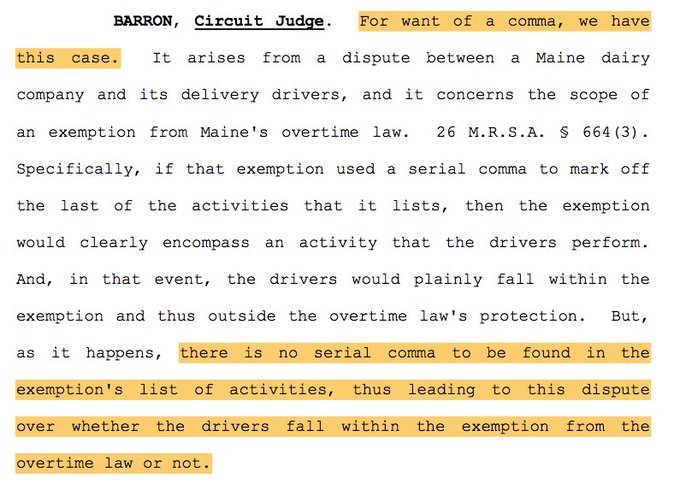
In a judgment that will delight Oxford comma enthusiasts everywhere, a US court of appeals sided with delivery drivers for Oakhurst Dairy because the lack of a comma made part of Maine’s overtime laws too ambiguous.
The state’s law says the following activities do not count for overtime pay:
The canning, processing, preserving, freezing, drying, marketing, storing, packing for shipment or distribution of:
(1) Agricultural produce;
(2) Meat and fish products; and
(3) Perishable foods.
The drivers argued, due to a lack of a comma between “packing for shipment” and “or distribution”, the law refers to the single activity of “packing”, not to “packing” and “distribution” as two separate activities. As the drivers distribute – but do not pack – the goods, this would make them eligible for overtime pay.
Previously, a district court had ruled in the dairy company’s favour, who argued that the legislation “unambiguously” identified the two as separate activities exempt from overtime pay. But the appeals judge sided with the drivers.
We conclude that the exemption’s scope is actually not so clear in this regard. And because, under Maine law, ambiguities in the state’s wage and hour laws must be construed liberally in order to accomplish their remedial purpose, we adopt the drivers’ narrower reading of the exemption.
The Oxford comma ignites considerable passion among its proponents and opponents. In 2011, when it was wrongly reported that the Oxford comma was being dropped by the University of Oxford style guide, there was uproar.
“Who gives a fuck about an Oxford comma?” opens one Vampire Weekend song.
The Guardian style guide has the following to say about Oxford commas:
a comma before the final “and” in lists: straightforward ones (he ate ham, eggs and chips) do not need one, but sometimes it can help the reader (he ate cereal, kippers, bacon, eggs, toast and marmalade, and tea).
Sometimes it is essential: compare
I dedicate this book to my parents, Martin Amis, and JK Rowling
with
I dedicate this book to my parents, Martin Amis and JK Rowling