Search This Blog

Thursday, 19 May 2016

Why a new toilet law could flush cafes and takeaways down the pan

Chitra Ramaswamy in The Guardian
How many seats in a coffee shop does it take to necessitate provision of a customer loo? Fifteen? Five? A solitary stool and a sticky counter? An existential question and one that, according to this toilet-user, depends on a complex set of circumstances, from what’s on the menu to where the chairs are positioned. (Five outside? Toilet unlikely. Four inside? Expect a small, whiffy loo with no paper towels in the dispenser.)
The correct answer, according to section 20 of the 1976 Local Government Miscellaneous Provisions Act, is 10. As in, cafes with fewer than 10 seats are not legally required to provide customer loos. Which is presumably why you can’t scoff a sausage roll in Greggs and then demand use of the washroom but you can order a takeout coffee in a central London Starbucks and get a key to the saddest toilets in Soho. (When it comes to public conveniences don’t be fooled by the romance of a key.)
Despite the 10-seat guideline, thousands of takeaways and coffee shops could now be forced to install a toilet or get rid of seating following a recent case in Hull. Two branches of Greggs, both of which had fewer than 10 seats, lost a legal battle with the council after the judge ruled that not providing facilities gave them an “unfair commercial advantage”. If the ruling, which is being appealed, sets a precedent, as many as 21,500 takeaways and 5,230 coffee shops across the UK – the vast majority of which are small independent businesses – could be affected.
“It would be a major problem,” Raymond Martin, director of the British Toilet Association, says. “Most of these are not going to be able to provide a toilet. Many would be forced to close down.” Would he expect a loo in a takeaway with only a few tables? “It does seem right to provide a toilet if a takeaway allows me to consume food and stay on the premises for a period of time,” he replies diplomatically. “But should we force takeaways to put in toilets? I don’t think we can.”
The real issue, he adds, is the loss of public toilets from our cities and town centres. The law currently does not compel local authorities to provide public toilets – of which there are around 4,000 in the UK – and the result is that Britain has lost more than 40% of its facilities in the past decade. “We reckon we are losing toilets faster than we’re gaining them,” Martin says. “Every day we get calls from councillors saying: ‘We’re thinking of closing some, if not all, of our toilets. What’s our legal position?’ In years gone by, people would have got their food from a takeaway and then used a public toilet later. That is no longer the case.”
Meanwhile stores, supermarkets, petrol stations and other commercial providers have stepped in, hopeful that, after we’ve relieved ourselves in their lovely free toilets, conveniently located right at the back of the store so we have to walk past all their goods to get to them, we’ll do a spot of shopping. Perhaps toilets are the latest trick in retail, the new piped muzak luring us in to spend a penny before we spend, spend, spend. “The government wants people out shopping, eating, keeping the economy flowing,” Martin notes. “But it doesn’t want to provide the toilets.”
Wednesday, 18 May 2016

Making things matters. This is what Britain forgot


Ha-Joon Chang in The Guardian

The neglect of manufacturing and over-development of the financial sector is the cause of the economy’s decline, not fear of leaving the EU.


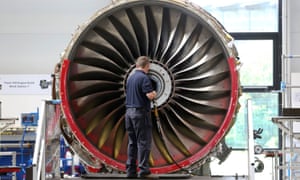
The production line at the Rolls-Royce factory in Derby. Photograph: Bloomberg via Getty Images

It’s being blamed on the Brexit jitters. But the weakness in the UK economy that the latest figures reveal is actually a symptom of a much deeper malaise. Britain has never properly recovered from the 2008 financial crisis. At the end of 2015, inflation-adjusted income per capita in the UK was only 0.2% higher than its 2007 peak. This translates into an annual growth rate of 0.025% per year. How pathetic this performance is can be put into perspective by recalling that Japan’s per capita income during its so-called “lost two decades” between 1990 and 2010 grew at 1% a year.

At the root of this inability to stage a real recovery is the serious imbalance that has developed in the past few decades – namely, the over-development of the UK financial sector and the atrophy of manufacturing. Right after the 2008 financial crisis there was a widespread recognition that the ballooning financial sector needed to be reined in. Even George Osborne talked excitedly for a while about the “march of the makers”. That march never materialised, however, and the share of the manufacturing sector has stagnated at around 10% of GDP.

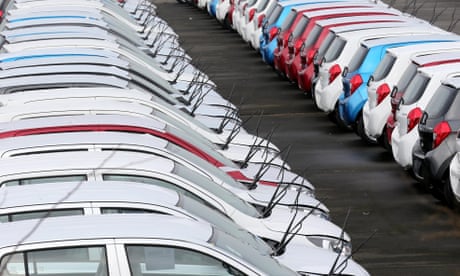
This is remarkable, given that the value of sterling has fallen by around 30% since the crisis. In any other country a currency devaluation of this magnitude would have generated an export boom in manufactured goods, leading to an expansion of the sector.

Unfortunately manufacturing had been so weakened since the 1980s that it didn’t have a hope of staging any such revival. Even with a whopping 30% devaluation, the UK’s trade balance in manufacturing goods (that is, manufacturing exports minus imports) as a proportion of GDP has hardly budged. The weakness of manufacturing is the main reason for the UK’s ever-growing deficit, which stood at 5.2% of GDP in 2015.


UK trade deficit with EU hits new record


Some play down the concerns; the UK, we hear, is still the seventh or eighth biggest manufacturing nation in the world – after the US, China, Japan, Germany, South Korea, France and Italy. But it only gets this ranking because it has a large population. In terms of per capita output, it ranks somewhere between 20th and 25th in the world. In other words, saying that we need not worry about the UK’s manufacturing sector because it is still one of the largest is like saying that a poor family with lots of its members working at low wages need not worry about money because their total income is bigger than that of another family with fewer, high-earning members.

Another argument is that we now live in a post-industrial knowledge economy, in which “making things” no longer matters. The proponents of this argument wheel out Switzerland, which has more than twice the per capita income of the UK, despite – or rather because of – its reliance on finance and tourism.

However Switzerland is actually the most industrialised country in the world, measured by manufacturing output per head. In 2013, that manufacturing output was nearly twice the US’s and nearly three times the UK’s. The discourse of post-industrial knowledge economy fundamentally misunderstands the role of manufacturing in economic prosperity.

First of all, despite the relative increase in the importance of services, the manufacturing sector is still – and will always be – the main source of productivity growth and economic prosperity. It is a sector that is most open to the use of machines and chemical processes, which raises productivity. It is also where most research and development, which generates new technologies, is done. Moreover, it is a sector that produces inputs that raise productivity in other sectors. For example, the recent rise in productivity in the service sector has happened mainly because it is using more advanced inputs produced in the manufacturing sector – computers, fibre-optic cables, routers, GPS machines, more fuel-efficient cars, mechanised warehouses and so on.

Second, many knowledge-intensive services, such as research, engineering and design, that are supposed to be new have always been there. Most of them used to be conducted by manufacturing firms themselves and have become more “visible” recently largely because they have been “spun off” or “outsourced”. We should not confuse the changes in firms’ organisation with the changes in the nature of economic activities.

All of those supposedly knowledge-intensive services sell mostly to manufacturing firms, so their success depends on manufacturing success. It is not because the Americans invented superior financial techniques that the world’s financial centre moved from London to New York in the mid-20th century. It is because the US became the leading industrial nation.

The weakness of manufacturing is at the heart of the UK’s economic problems. Reversing three and a half decades of neglect will not be easy but, unless the country provides its industrial sector with more capital, stronger public support for R&D and better-trained workers, it will not be able to build the balanced and sustainable economy that it so desperately needs.

Tuesday, 17 May 2016

Balochistan Independence is Responsibility of India


Tarek Fatah - The Hindu is not my Enemy - Part 1


Part - 2 Tarek Fatah on how India should deal with Pakistan and Balochistan

Monday, 16 May 2016

The leftwing case for Brexit (one day)

Paul Mason in The Guardian


There are many good reasons for the UK to leave the EU. But exiting now would allow Johnson and Gove to turn Britain into a neoliberal fantasy island.


Jobbik on the march … all over Europe, the EU’s economic failure is fuelling racism and the ultra right. Photograph: Janek Skarżyński/AFP/Getty Images


 The leftwing case for Brexit is strategic and clear. The EU is not – and cannot become – a democracy. Instead, it provides the most hospitable ecosystem in the developed world for rentier monopoly corporations, tax-dodging elites and organised crime. It has an executive so powerful it could crush the leftwing government of Greece; a legislature so weak that it cannot effectively determine laws or control its own civil service. A judiciary that, in the Laval and Viking judgments, subordinated workers’ right to strike to an employer’s right do business freely.

Its central bank is committed, by treaty, to favour deflation and stagnation over growth. State aid to stricken industries is prohibited. The austerity we deride in Britain as a political choice is, in fact, written into the EU treaty as a non-negotiable obligation. So are the economic principles of the Thatcher era. A Corbyn-led Labour government would have to implement its manifesto in defiance of EU law.


And the situation is getting worse. Europe’s leaders still do not know whether they will let Greece go bankrupt in June; they still have no workable plan to distribute the refugees Germany accepted last summer, and having signed amorally bankrupt deal with Turkey to return the refugees, there is now the prospect of that deal’s collapse. That means, if the reported demand by an unnamed Belgian minister to “push back or sink” migrant boats in the Aegean is activated, the hands of every citizen of the EU will be metaphorically on the tiller of the ship that does it. You may argue that Britain treats migrants just as badly. The difference is that in Britain I can replace the government, whereas in the EU, I cannot.

That’s the principled leftwing case for Brexit.

Now here’s the practical reason to ignore it. In two words: Boris Johnson. The conservative right could have conducted the leave campaign on the issues of democracy, rule of law and UK sovereignty, leaving the economics to the outcome of a subsequent election. Instead, Johnson and the Tory right are seeking a mandate via the referendum for a return to full-blown Thatcherism: less employment regulation, lower wages, fewer constraints on business. If Britain votes Brexit, then Johnson and Gove stand ready to seize control of the Tory party and turn Britain into a neoliberal fantasy island.


Dutch far-right leader Geert Wilders goes on trial for inciting hatred


They will have two years in which to shape the post-Brexit economy. Worse, the Tories will be free to use the sudden disappearance of our rights as EU citizens to reshape the UK’s de facto constitution. The man who destroyed state control of education and the man who shovelled acres of free land into the hands of London developers will get to determine the new balance of power between the citizen and the state. So even for those who support the leftwing case for Brexit, it is sensible to argue: not now. The time to confront Europe over a leftwing agenda is when you have a Labour government, and the EU is resisting it.

This is why I have refused to campaign for Brexit, and may even abstain on the day. I also want to see the final offer. As with the Scottish referendum I expect, if the polls show a lead for remain of less than 7%, there will be a politically orchestrated run on sterling; a string of CEOs paraded on to the BBC promising to quit Britain; then a a surprise “final offer” from either Jean-Claude Juncker or an influential group of heads of government. If this offer includes the suspension ofthe social chapter, or further opt-outs that favour the rich over the poor in Britain, then there would be little point in staying in for tactical reasons.

Already, thanks to David Cameron’s Brussels deal, the choice is between out and half-out. I do not think the concessions Cameron achieved in March were negligible. Though the emergency brake on in-work benefits for migrants was reactionary showmanship, the opt-out from “ever closer union” he gained was real. It means there will probably never be another 28-member treaty.

As the Eurozone consolidates, around banking union and cross-border transfers, the Lisbon treaty will be superseded by new, core-country agreements. If that happens, it is likely the UK will be able to legally retreat from some Lisbon commitments. Thus, even without a catastrophic disintegration, it is likely that the UK’s relationship with both the Eurozone and European law will remain negotiable.

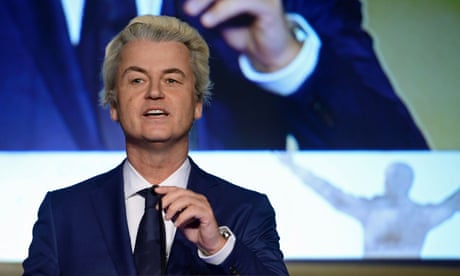
All this suggests that those of us who want Brexit in order to reimpose democracy, promote social justice and subordinate companies to the rule of law should bide our time. But here’s the price we will pay. Hungary is one electoral accident away from going fascist; the French conservative elite is one false move away from handing the presidency to the Front National; in Austria the far-right FPÖ swept the first round of the presidential polls. Geert Wilders’s virulently Islamophobic PVV is leading the Dutch opinion polls.


Hungarian camera operator apologises for kicking refugees


The EU’s economic failure is fuelling racism and the ultra right. Boris Johnson’s comparison of the EU with the Third Reich was facile. The more accurate comparison is with the Weimar Republic: a flawed democracy whose failures fuelled the rise of fascism. And this swing to the far right prompts the more basic dilemma: do I even want to be part of the same electorate as millions of closet Nazis in mainland Europe?

The EU, politically, begins to look more and more like a gerrymandered state, where the politically immature electorates of eastern Europe can be used – as Louis Napoleon used the French peasantry – as a permanent obstacle to liberalism and social justice. If so – even though the political conditions for a left Brexit are absent today – I will want out soon.