Search This Blog

Sunday, 24 January 2016

Want To Reduce Abortions? Don't Stigmatise Sex


The religious conservatives are responsible for high abortion rates; they are responsible for the injury and death of women.


Here is the fact that everyone debating abortion should know. There is no association between its legality and its incidence. In other words, banning abortion does not stop the practice; it merely makes it more dangerous.

The abortion debate is presented as a conflict between the rights of embryos and the rights of women. Enhance one, both sides sometimes appear to agree, and you suppress the other. But once you grasp the fact that legalising women's reproductive rights does not raise the incidence of induced abortions, only one issue remains to be debated. Should they be legal and safe or illegal and dangerous? Hmmm, tough question.

There might be no causal relationship between reproductive choice and the incidence of abortion, but there is a strong correlation: an inverse one. As the Lancet's most recent survey of global rates and trends notes, "The abortion rate was lower … where more women live under liberal abortion laws."

Why? Because laws restricting abortion tend to be most prevalent in places where contraception and comprehensive sex education are hard to obtain, and in which sex and childbirth outside marriage are anathematised. Young people have sex, whatever their elders say; they always have and always will. Those with the least information and the least access to birth control are the most likely to suffer unintended pregnancies. And what greater incentive could there be for terminating a pregnancy than a culture in which reproduction out of wedlock is a mortal sin?

How many more centuries of misery, mutilation and mortality are required before we understand that women — young or middle aged, within marriage or without — who do not want a child may go to almost any lengths to terminate an unwanted pregnancy? How much more evidence do we need that, in the absence of legal, safe procedures, such sophisticated surgical instruments as wire coathangers, knitting needles, bleach and turpentine will be deployed instead? How many more poisonings, punctured guts and burst wombs are required before we recognise that prohibition and moral suasion will not trounce women's need to own their lives?

The most recent meta-analysis of global trends, published in 2012, discovered that the abortion rate, after a sharp decline between 1995 and 2003, scarcely changed over the following five years. But the proportion that were unsafe (which, broadly speaking, means illegal), rose from 44% to 49%.

Most of this change was due to a sharp rise in unsafe abortions in West Asia (which includes the Middle East), where Islamic conservatism is resurgent. In the regions in which Christian doctrine exerts the strongest influence over legislation — west and middle Africa and central and south America — there was no rise. But that's only because the proportion of abortions that were illegal and unsafe already stood at 100%.

As for the overall induced abortion rate, the figures tell an interesting story. Western Europe has the world's lowest termination rate: 12 per year for every 1000 women of reproductive age. The more godly North America aborts 19 embryos for every 1000 women. In South America, where (when the figures were collected) the practice was banned everywhere, the rate was 32. In eastern Africa, where ferocious laws and powerful religious injunctions should — according to conservative theory — have stamped out the practice long ago, it was 38.

The weird outlier is eastern Europe, which has the world's highest abortion rate: 43 per 1000. Under communism, abortion was the only available form of medical birth control. The rate has fallen from 90 since 1995, as contraception has become easier to obtain, but there's still a long way to go.

Facts, who needs 'em? Across the red states of the US, legislators have been merrily passing laws that make abortion clinics impossible to run, while denying children effective sex education. In Texas, thanks to restrictive new statutes, over half the clinics have closed since 2013. But women are still obliged to visit three times before receiving treatment: in some cases this means travelling 1000 miles or more. Unsurprisingly, 7% of those seeking medical help have already attempted their own solutions.

The only reason why this has not caused an epidemic of abdominal trauma is the widespread availability, through unlicensed sales, of abortion drugs such as misoprostol and mifepristone. They're unsafe when used without professional advice, but not as unsafe as coathangers and household chemicals.

In June, the US Supreme Court will rule on the constitutionality of the latest Texan assault on legal terminations, the statute known as HB2. If the state of Texas wins, this means, in effect,the end of Roe v Wade, the decision that deemed abortion a fundamental right in the United States.

In Northern Ireland the new first minister, Arlene Foster, who took office on Monday, has vowed to ensure that the 1967 abortion act, which covers the rest of the United Kingdom, will not apply to her country. Women there will continue to buy pills (and run the risk of confiscation as the police rifle their post) or travel to England, at some expense and trauma. Never mind the finding of a High Court judge: "there is no evidence before this court that the law in Northern Ireland has resulted in any reduction in the number of abortions". It just warms the heart to see Protestant and Catholic fundamentalists setting aside their differences to ensure that women's bodies remain the property of the state.

Like them, I see human life as precious. Like them, I want to see a reduction in abortions. So I urge states to do the opposite of what they prescribe. If you want fewer induced abortions, you should support education that encourages children to talk about sex without embarrassment or secrecy; contraception that's freely available to everyone; an end to the stigma surrounding sex and birth before marriage.

The religious conservatives who oppose these measures have blood on their hands. They are responsible for high abortion rates; they are responsible for the injury and death of women. And they have the flaming cheek to talk about the sanctity of life.
Saturday, 23 January 2016

Silence from big six energy firms is deafening

If this were a competitive market, our fuel bills would be £850 a year instead of £1,100

Patrick Collinson in The Guardian


UK consumers are not seeing their tariffs cut despite the fall in wholesale gas and oil prices. Photograph: Alamy


You cannot hope to bribe or twist the British journalist (goes the old quote from Humbert Wolfe) “But, seeing what the man will do unbribed, there’s no occasion to.” Much the same could be said about Britain’s energy companies. You cannot call them a cartel. But seeing what they do without actively colluding, there’s no occasion to.

Almost every day the price of oil and gas falls on global markets. But this has been met with deafening inactivity from the big six energy giants. Their standard tariffs remains stubbornly high, bar tiny cuts by British Gas last year and e.on, this week.

If this were a competitive market, which reflected the 45% fall in wholesale prices seen over the last two years, the average dual-fuel consumer in Britain would be paying £850 or so a year, rather than the £1,100 charged to most customers on standard tariffs.

But it is not a competitive market. The energy giants know that around 70% of customers rarely switch, so they can be very effectively milked through the pricey standard tariff, which is, itself, set at peculiarly similar levels across the big providers. The advent of paperless billing probably helps the companies, too, with busy householders failing to spot that they are paying way over the odds.

The gap between the standard tariffs and the low-cost tariffs is now astounding – £1,100 a year vs £775 a year. Yes, the 30% of households who regularly switch can, and do, benefit. But why must we have a business model where seven out of 10 customers lose out, while three out of 10 gain?

The vast majority would rather have an honest tariff deal where their energy company passes on reductions in wholesale prices without having to go through the rigmarole of switching.

Instead, we have a regulatory set-up which believes that the problem is that not enough of us switch. It thinks that it will be solved by getting that 30% figure up to 50% or more. Unfortunately, too, many regulators have a mindset that is almost ideologically attuned to a belief in the efficacy of markets, and the benefits of competition. If competition is not working, then they think the answer is simply more competition.

What would benefit consumers in these natural monopoly markets would be less competition and more regulation. We now have decades of evidence of how privatised former monopolies behave, and what it tells us is that they are there to benefit shareholders and bonus-seeking management, rather than customers.

In March we will hear from the Competition and Markets Authority about the results of its investigation into the energy market. Maybe it will conclude that privatisation and competition have failed, but my guess is that it won’t. The clue is in the name of the authority.

• A final word about home insurance. Last week I said every insurer is in on the game, happy to rip-off loyal customers, particularly older ones. I received a letter from a 90-year-old householder in Richmond Upon Thames, who, for 20 years has bought home and contents cover from the Ecclesiastical Insurance company.

After seeing my coverage, he nervously checked his premiums, as he had been letting them go through on direct debit for years without scrutiny.

To his delight, he discovered that Ecclesiastical had, unprompted, been cutting his insurance premiums.

One company, at least, doesn’t think it should skin an elderly customer just because it can probably get away with it. We should perhaps praise the lord there is an insurer out there with a conscience.

Is Ecclesiastical the only “ethical” insurer, or are there any others who are not “in on the game”, asks our reader from Richmond. Let me know!

Is mindfulness making us ill?

It’s the relaxation technique of choice, popular with employers and even the NHS. But some have found it can have unexpected effects

Dawn Foster in The Guardian


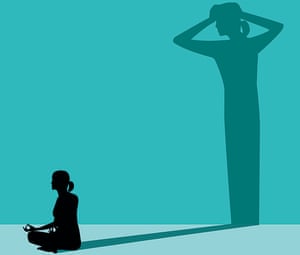
Illustration: Nick Lowndes for the Guardian

I am sitting in a circle in a grey, corporate room with 10 housing association employees – administrators, security guards, cleaners – eyes darting about nervously. We are asked to eat a sandwich in silence. To think about every taste and texture, every chewing motion and bite. Far from being relaxed, I feel excruciatingly uncomfortable and begin to wonder if my jaw is malfunctioning. I’m here to write about a new mindfulness initiative, and since I’ve never to my knowledge had any mental health issues and usually thrive under stress, I anticipate a straightforward, if awkward, experience.

Then comes the meditation. We’re told to close our eyes and think about our bodies in relation to the chair, the floor, the room: how each limb touches the arms, the back, the legs of the seat, while breathing slowly. But there’s one small catch: I can’t breathe. No matter how fast, slow, deep or shallow my breaths are, it feels as though my lungs are sealed. My instincts tell me to run, but I can’t move my arms or legs. I feel a rising panic and worry that I might pass out, my mind racing. Then we’re told to open our eyes and the feeling dissipates. I look around. No one else appears to have felt they were facing imminent death. What just happened?

For days afterwards, I feel on edge. I have a permanent tension headache and I jump at the slightest unexpected noise. The fact that something seemingly benign, positive and hugely popular had such a profound effect has taken me by surprise.

Mindfulness, the practice of sitting still and focusing on your breath and thoughts, has surged in popularity over the last few years, with a boom in apps, online courses, books and articles extolling its virtues. It can be done alone or with a guide (digital or human), and with so much hand-wringing about our frenetic, time-poor lifestyles and information overload, it seems to offer a wholesome solution: a quiet port in the storm and an opportunity for self-examination. The Headspace app, which offers 10-minute guided meditations on your smartphone, has more than three million users worldwide and is worth over £25m. Meanwhile, publishers have rushed to put out workbooks and guides to line the wellness shelves in bookshops. 

Large organisations such as Google, Apple, Sony, Ikea, the Department of Healthand Transport for London have adopted mindfulness or meditation as part of their employee packages, claiming it leads to a happier workforce, increased productivity and fewer sick days. But could such a one-size-fits-all solution backfire in unexpected ways?
Even a year later, recalling the sensations and feelings I experienced in that room summons a resurgent wave of panic and tightness in my chest. Out of curiosity, I try the Headspace app, but the breathing exercises leave me with pins and needles in my face and a burgeoning terror. “Let your thoughts move wherever they please,” the app urges. I just want it to stop. And, as I discovered, I’m not the only person who doesn’t find mindfulness comforting.

Claire, a 37-year-old in a highly competitive industry, was sent on a three-day mindfulness course with colleagues as part of a training programme. “Initially, I found it relaxing,” she says, “but then I found I felt completely zoned out while doing it. Within two or three hours of later sessions, I was starting to really, really panic.” The sessions resurfaced memories of her traumatic childhood, and she experienced a series of panic attacks. “Somehow, the course triggered things I had previously got over,” Claire says. “I had a breakdown and spent three months in a psychiatric unit. It was a depressive breakdown with psychotic elements related to the trauma, and several dissociative episodes.”

Four and a half years later, Claire is still working part-time and is in and out of hospital. She became addicted to alcohol, when previously she was driven and high-performing, and believes mindfulness was the catalyst for her breakdown.
Her doctors have advised her to avoid relaxation methods, and she spent months in one-to-one therapy. “Recovery involves being completely grounded,” she says, “so yoga is out.”

Research suggests her experience might not be unique. Internet forums abound with people seeking advice after experiencing panic attacks, hearing voices or finding that meditation has deepened their depression after some initial respite. In their recent book, The Buddha Pill, psychologists Miguel Farias and Catherine Wikholm voice concern about the lack of research into the adverse effects of meditation and the “dark side” of mindfulness. “Since the book’s been published, we’ve had a number of emails from people wanting to tell us about adverse effects they have experienced,” Wikholm says. “Often, people have thought they were alone with this, or they blamed themselves, thinking they somehow did it wrong, when actually it doesn’t seem it’s all that uncommon.”

One story in particular prompted Farias to look further into adverse effects. Louise, a woman in her 50s who had been practising yoga for 20 years, went away to a meditation retreat. While meditating, she felt dissociated from herself and became worried. Dismissing it as a routine side-effect of meditation, Louise continued with the exercises. The following day, after returning home, her body felt completely numb and she didn’t want to get out of bed. Her husband took her to the doctor, who referred her to a psychiatrist. For the next 15 years she was treated for psychotic depression.

Farias looked at the research into unexpected side-effects. A 1992 study by David Shapiro, a professor at the University of California, Irvine, found that 63% of the group studied, who had varying degrees of experience in meditation and had each tried mindfulness, had suffered at least one negative effect from meditation retreats, while 7% reported profoundly adverse effects including panic, depression, pain and anxiety. Shapiro’s study was small-scale; several research papers, including a 2011 study by Duke University in North Carolina, have raised concerns at the lack of quality research on the impact of mindfulness, specifically the lack of controlled studies.

Farias feels that media coverage inflates the moderate positive effects of mindfulness, and either doesn’t report or underplays the downsides. “Mindfulness can have negative effects for some people, even if you’re doing it for only 20 minutes a day,” Farias says. “It’s difficult to tell how common [negative] experiences are, because mindfulness researchers have failed to measure them, and may even have discouraged participants from reporting them by attributing the blame to them.”

Kate Williams, a PhD researcher in psychiatry at the University of Manchester and a mindfulness teacher, says negative experiences generally fall into one of two categories. The first is seen as a natural emotional reaction to self-exploration. “What we learn through meditation is to explore our experiences with an open and nonjudgmental attitude, whether the experience that arises is pleasant, unpleasant or neutral,” she says.

The second, Williams says, is more severe and disconcerting: “Experiences can be quite extreme, to the extent of inducing paranoia, delusions, confusion, mania or depression.” After years of training, research and practice, her own personal meditation has included some of these negative experiences. “Longer periods of meditation have at times led me to feel a loss of identity and left me feeling extremely vulnerable, almost like an open wound,” Williams says. As an experienced mindfulness teacher, however, she says she is able to deal with these negative experiences without lasting effect.

Rachel, a 34-year-old film-maker from London, experimented with mindfulness several years ago. An old school friend who had tried it attempted to warn her off. “He said, ‘It’s hardcore – you’ll go through things you don’t want to go through and it might not always be positive.’ I suppose sitting with yourself is hard, especially when you’re in a place where you don’t really like yourself. Meditationcan’t ‘fix’ anyone. That’s not what it’s for.”

After a few months of following guided meditations, and feeling increasingly anxious, Rachel had what she describes as a “meltdown” immediately after practising some of the techniques she’d learned; the relationship she was in broke down. “That’s the horrible hangover I have from this: instead of having a sense of calm, I overanalyse and scrutinise everything. Things would run round in my mind, and suddenly I’d be doing things that were totally out of character, acting very, very erratically. Having panic attacks that would restrict my breathing and, once, sent me into a blackout seizure on the studio floor that involved an ambulance trip to accident and emergency.” Rachel has recovered to some extent; she experiences similar feelings on a lower level even today, but has learned to recognise the symptoms and take steps to combat them.


  Illustration: Nick Lowndes for the Guardian

So are employers and experts right to extol the virtues of mindfulness? According to Will Davies, senior lecturer at Goldsmiths and author of The Happiness Industry, our mental health has become a money-making opportunity. “The measurement of our mental and emotional states at work is advancing rapidly at the moment,” he says, “and businesses are increasingly aware of the financial costs that stress, depression and anxiety saddle them with.”

Rather than removing the source of stress, whether that’s unfeasible workloads, poor management or low morale, some employers encourage their staff to meditate: a quick fix that’s much cheaper, at least in the short term. After all, it’s harder to complain that you’re under too much stress at work if your employer points out that they’ve offered you relaxation classes: the blame then falls on the individual. “Mindfulness has been grabbed in recent years as a way to help people cope with their own powerlessness in the workplace,” Davies says. “We’re now reaching the stage where mandatory meditation is being discussed as a route to heightened productivity, in tandem with various apps, wearable devices and forms of low-level employee surveillance.”

One former Labour backbencher, Chris Ruane, recently proposed meditation for civil servants, on the basis that it would cut Whitehall costs by lowering sick leave through stress, rather than making the workplace and jobs less stressful in the first place. “The whole agenda is so fraught with contradictions, between its economic goals and its supposedly spiritual methods,” Davies argues. “It’s a wonder anyone takes it seriously at all.”

Mindfulness has also been adopted by the NHS, with many primary care trusts offering and recommending the practice in lieu of cognitive behavioural therapy (CBT). “It fits nicely with the Nutribullet-chugging, clean-eating crowd, because it doesn’t involve any tablets,” says Bethan, a mental health nurse working in east London. “My main problem with it is that it’s just another word for awareness.”

Over the past few years, Bethan has noticed mindfulness mentioned or recommended increasingly at work, and says many colleagues have been offered sessions and training as part of their professional development. But the move towards mindfulness delivered through online or self-help programmes isn’t for everyone. “It’s fine, but realising you have depression isn’t the same as tackling it,” she says. “I don’t see it as any different from the five-a-day campaign: we know what we should be eating, but so many of us don’t do it. We know that isolating ourselves isn’t helpful when we feel blue, but we still do that.”

Part of the drive is simple cost-cutting. With NHS budgets squeezed, resource-intensive and diverse therapies that involve one-on-one consultations are far more expensive to dispense than online or group therapies such as mindfulness. A CBT course costs the NHS £950 per participant on average, while mindfulness-based cognitive therapy, because it’s delivered in a group, comes in at around £300 a person. “It’s cheap, and it does make people think twice about their choices, so in some respects it’s helpful,” Bethan says.

But in more serious cases, could it be doing more harm than good? Florian Ruths has researched this area for 10 years, as clinical lead for mindfulness-based therapy in the South London and Maudsley NHS foundation trust. He believes it is possible to teach yourself mindfulness through apps, books or online guides. “For most people, I think if you’re not suffering from any clinical issues, or illness, or from stress to a degree that you’re somewhat disabled, it’s fine,” he says. “We talk about illness as disability, and disability may arise through sadness, it may arise through emotional disturbance, like anxiety. Then, obviously, it becomes a different ballgame, and it would be good to have a guided practice to take you through it.” This runs counter to the drive towards online mindfulness apps, delivered without supervision, and with little to no adaptation to individual needs or problems.

But for Ruths, the benefits outweigh the risk of unusual effects. “If we exercise, we live longer, we’re slimmer, we’ve got less risk of dementia, we’re happier and less anxious,” he says. “People don’t talk about the fact that when you exercise, you are at a natural risk of injuring yourself. When people say in the new year, ‘I’m going to go to the gym’ – out of 100 people who do that, about 20 will injure themselves, because they haven’t been taught how to do it properly, or they’ve not listened to their bodies. So when you’re a responsible clinician or GP, you tell someone to get a good trainer.”

Certain mental health problems increase the risk of adverse effects from mindfulness. “If you have post-traumatic stress disorder, there is a certain chance that you may find meditation too difficult to do, as you may be re-experiencing traumatic memories,” Ruths says. “Once again, it’s about having experienced trainers to facilitate that. We’ve seen some evidence that people who’ve got bipolar vulnerability may struggle, but we need to keep in mind that it may be accidental, or it may be something we don’t know about yet.”

Of course, people may not know they have a bipolar vulnerability until they try mindfulness. Or they might have repressed the symptoms of post-traumatic stress disorder, only for these to emerge after trying the practice.

How can an individual gauge whether they’re likely to have negative side-effects? Both Farias and Ruths agree there isn’t a substantial body of evidence yet on how mindfulness works, or what causes negative reactions. One of the reasons is obvious: people who react badly tend to drop out of classes, or stop using the app or workbook; rather than make a fuss, they quietly walk away. Part of this is down to the current faddishness of mindfulness and the way it’s marketed: unlike prescribed psychotherapy or CBT, it’s viewed as an alternative lifestyle choice, rather than a powerful form of therapy.

Claire is clear about how she feels mindfulness should be discussed and delivered: “A lot of the people who are trained in mindfulness are not trained in the dangers as well as the potential benefits,” she says. “My experience of people who teach it is that they don’t know how to help people if it goes too far.”

There is currently no professionally accredited training for mindfulness teachers, and nothing to stop anyone calling themselves a mindfulness coach, though advocates are calling for that to change. Finding an experienced teacher who comes recommended, and not being afraid to discuss negative side-effects with your teacher or GP, means you’re far more likely to enjoy and benefit from the experience.

As both Claire and I have found, there are alternative relaxation methods that can keep you grounded: reading, carving out more time to spend with friends, and simply knowing when to take a break from the frenetic pace of life. Meanwhile, Claire’s experience has encouraged her to push for a better understanding of alternative therapies. “No one would suggest CBT was done by someone who wasn’t trained,” she says. “I’d like to see a wider discussion about what mindfulness is – and on what the side-effects can be.”

Friday, 22 January 2016

Don’t blame China for these global economic jitters

In truth the west failed to learn from the 2008 crash. Any economic ‘recovery’ was built on asset bubbles

Ha Joon Chang in The Guardian


There has never been a real recovery in North America and western Europe since 2008.’ Photograph: Kai Pfaffenbach/Reuters


The US stock market has just had the worst start to a year in its history. At the same time, European and Japanese stock markets have lost around 10% and 15% of their values respectively; the Chinese stock market has resumed its headlong dash downward; and the oil price has fallen to the lowest level in 12 years, reflecting (and anticipating) worldwide economic slowdown.

According to the dominant economic narrative of recent times, 2016 was the year when the world economy would recover fully from the 2008 crash. The US would lead this recovery by generating growth and jobs via fiscal conservatism and pro-business policies. Reflecting the economy’s robust growth, the US stock market reached new heights in 2015, although disrupted by the mess in the Chinese stock market over the summer. By last October, US unemployment had fallen from the post-crisis peak of 10% to 5%, bringing it back close to the pre-crisis low. In a show of confidence, last month the US Federal Reserve finally raised its interest rate for the first time in nine years.


Not far behind the US, the story goes, have been Britain and Ireland. Hit harder than the US by the financial crisis, they have, however, recovered handsomely because they kept their nerve and stuck to the right, if unpopular, policies. Spending cuts, focused on wasteful welfare spending, accelerated job creation by making it more difficult for people to live off the taxpayer. They sensibly didn’t give in to the banker-bashers and chose not to over-regulate the financial sector.

Even the continental European economies have been finally picking up, it was said, having accepted the need for fiscal discipline, labour market reform and cutting business regulations. The world – at least the rich world – was finally set for a full recovery. So what has gone wrong?

Those who put forward the narrative are now trying to blame China in advance for the coming economic woes. George Osborne has been at the forefront, warning this month of a “dangerous cocktail of new threats” in which the devaluation of the Chinese currency and the fall in oil prices (both in large part due to China’s economic slowdown) figured most prominently. If our recovery was to be blown off course, he implied, it would be because China had mismanaged its economy.

China is, of course, an important factor in the global economy. Only 2.5% of the world economy in 1978, on the eve of its economic reform, it now accounts for around 13%. However, its importance should not be exaggerated. As of 2014, the US (22.5%) the eurozone (17%) and Japan (7%) together accounted for nearly half of the world economy. The rich world vastly overshadows China. Unless you are a developing economy whose export basket is mainly made up of primary commodities destined for China, you cannot blame your economic ills on its slowdown.

The truth is that there has never been a real recovery from the 2008 crisis in North America and western Europe. According to the IMF, at the end of 2015, inflation-adjusted income per head (in national currency) was lower than the pre-crisis peak in 11 out of 20 of those countries. In five (Austria, Iceland, Ireland, Switzerland and the UK), it was only just higher – by between 0.05% (Austria) and 0.3% (Ireland). Only in four countries – Germany, Canada, the US and Sweden – was per-capita income materially higher than the pre-crisis peak.

Even in Germany, the best performing of those four countries, per capita income growth rate was just 0.8% a year between its last peak (2008) and 2015. The US growth rate, at 0.4% per year, was half that. Compare that with the 1% annual growth rate that Japan notched up during its so-called “lost two decades” between 1990 and 2010.

To make things worse, much of the recovery has been driven by asset market bubbles, blown up by the injection of cash into the financial market through quantitative easing. These asset bubbles have been most dramatic in the US and UK. They were already at an unprecedented level in 2013 and 2014, but scaled new heights in 2015. The US stock market reached the highest ever level in May 2015 and, after the dip over the summer, more or less came back to that level in December. Having come down by nearly a quarter from its April 2015 peak, Britain’s stock market is currently not quite so inflated, but the UK has another bubble to reckon with, in the housing market, where prices are 7% higher than the pre-crisis peak of 2007.

Thus seen, the main causes of the current economic turmoil lie firmly in the rich nations – especially in the finance-driven US and UK. Having refused to fundamentally restructure their economies after 2008, the only way they could generate any sort of recovery was with another set of asset bubbles. Their governments and financial sectors talked up anaemic recovery as an impressive comeback, propagating the myth that huge bubbles are a measure of economic health.

Whether or not the recent market turmoil leads to a protracted slide or a violent crash, it is proof that we have wasted the past seven years propping up a bankrupt economic model. Before things get any worse, we need to replace it with one in which the financial sector is made less complex and more patient, investment in the real economy is encouraged by fiscal and technological incentives, and measures are brought in to reduce inequality so that demand can be maintained without creating more debts.

None of these will be easy to implement, but we know what the alternative is – a permanent state of low growth, instability, and depressed living standards for the vast majority.