Search This Blog

Tuesday, 17 November 2015

A bird’s eye view of terror

Jawed Naqvi in The Dawn

DIWALI pollution sends droves of Delhi residents scouring for somewhere to breathe. I thus learnt of the Paris outrage watching migratory birds 190 kilometres from the country’s smog capital, off the Agra highway. Sharing the news with a French couple at the Bharatpur avian sanctuary that morning offered a learning curve. They were from the embassy in Delhi. The man scanned the BBC bullet points on my mobile phone and translated the story to his wife. He then took a deep breath, shrugged his shoulders wryly and resumed fixing the telescope on a steel tripod.
The couple had seen a gaggle of rare ducks on the far side of the sanctuary the previous morning, the Frenchman informed me helpfully. The woman sat down silently on a bench atop the watchtower, where we met, as she resumed observing the cormorants in flight. Her knitted eyebrows were a giveaway though to concealed emotion.
That afternoon, in Delhi, still trying to figure out the composed response of the French couple to what I thought was a shocking carnage in their country, I scanned some more of the news. The approach of so many French people was uniformly similar to that of the two bird watchers of Bharatpur.
As Parisians struggled to make sense of their new reality, a report in the New York Times described parents whose children slept through the ordeal while they grappled to fudge the explanation to offer them in the morning why so many planned activities had been cancelled.
To my Indian sensibilities so used to one prime minister declaring aar-paar ki ladai (a fight to the finish) and another flaunting his supposedly 56-inch chest in response to terror provocations, the philosophical demeanour of Bertrand Bourgeois, a 42-year old French accountant, was eye-catching.
He was lost in thought as he cast a fishing line beneath the Invalides bridge. Bourgeois, the NYT told us, normally avoids fishing in Paris. Instead, he preferred the quieter sections of the Seine near his home in Poissy. But after the violence, he said he felt drawn to come into the city out of a sense of solidarity.
What an amazing response compared with the televised clamour in India after a similar attack on Mumbai. Shrill opinion vendors called Prime Minister Manmohan Singh a weakling for refusing to carpet-bomb Pakistan. Singh saw through the insane chorus, as did the ordinary Indian people. They elected him for a second consecutive term just for keeping his nerve and for continuing to talk to Pakistan.
Drum beaters of war anywhere might want to benefit from the insights of Israeli historian Yuval Noah Harari.
“As the literal meaning of the word indicates, terror is a military strategy that hopes to change the political situation by spreading fear rather than by causing material damage,” Harari wrote in The Guardian after the Paris attacks. “This strategy is almost always adopted by very weak parties, who are unable to inflict much material damage on their enemies.”
Whatever be the score of the casualties inflicted by an act of terror it can never be even a fraction of the losses from a conventional war. “On the first day of the battle of the Somme, 1 July 1916, 19,000 members of the British army were killed and another 40,000 wounded,” reminded the author of the international bestseller Sapiens: A Brief History of Humankind.
“By the time the battle ended in November, both sides together had suffered more than a million casualties, which included 300,000 dead. Yet this unimaginable carnage hardly changed the political balance of power in Europe. It took another two years and millions of additional casualties for something finally to snap.”
What was the reaction of President Hollande to the coordinated strikes in Paris? He threatened merciless retribution, but against who? If helpless Syrian or other refugees get caught in the crossfire between the government and the terrorists, well that’s playing to the wrong script.
To avenge the Paris attacks, French warplanes carried out heavy bombardments of the militant group that calls itself Islamic State. Should they not have been doing the bombings without the Paris carnage as justification? Would the terror command centres and fuel hubs not be touched if Paris were not attacked? Hollande can do no more than look over his shoulder to see the Le Pens and the Sarkozys mock him. But that is not the point.
Western powers have struck up a compromise with Russian President Putin for a coordinated strategy in Syria. Have the terrorists in Paris inadvertently cooked the goose of Kiev? What are the chances that a number of states in the Middle East that were seen as a source of strength to the Islamists, led by Israel and Saudi Arabia, accept the conditions implicit in a no-holds-barred targeting of Daesh?
In any case, what is in store in all this for South Asia, more so for Pakistan? We have discussed the hypocrisy of delinking Al Nusra from Al Qaeda. How many shades of extremists has Pakistan got in its arsenal to deal with India and Afghanistan or even Iran? Will a school in Peshawar remain more worthy of protection from future harm than schools in the neighbourhood?
As I was leaving the bird sanctuary, a guide pointed to a row of marble tablets with names embossed of viceroys, maharajas and even of Gen J.N. Chaudhuri. They had shot helpless migratory birds for sport. Lord Linlithgow — 4,273 birds with 39 guns led the field. Gen Chaudhuri shot 556 birds for half a day with 51 guns. That was in September 1964. Had the India-Pakistan war broken out a year before it did, at least the birds might have been spared a predatory assault. Such is the circuitous logic of terror and its remedies. Most people seem to know this though their governments may not.
Sunday, 15 November 2015

India is more sensitive now, not more intolerant

Swaminathan Anklesaria Aiyer in the Times of India
Narendra Modi said in London that “India will not tolerate intolerance”. Secular critics jeered, since the BJP had raised the communal temperature during the Bihar election. Over 50 writers have returned national awards in protest against intolerance. They cite the Dadri beef lynching, murder of three prominent writers, and the ink attack on Sudheendra Kulkarni.
But it’s fiction to pretend that India used to be tolerant and has turned intolerant today. Intolerance has actually diminished substantially. Nothing can compare with the communal killings at Partition in 1947. Communal riots have continued with sickening regularity since then, but diminished in recent years, with the notable exception of 2002.
Ambedkar said violence against dalits was the worst of all. The Indian Constitution banned caste discrimination, yet caste violence remained embedded in society. Dalits could be attacked, raped, killed and humiliated at will, with impunity, by upper castes. This was also true, to a lesser extent, of other backward castes. Villages did not have riots, yet their very ethos was based on the most oppressive threat of caste violence. Fortunately, caste discrimination has fallen gradually, though it remains a harsh reality. The last two decades have seen the rise of almost 4,000 dalit millionaire businessmen, something unthinkable in the past.
Modi will never be forgiven by many for the 2002 Gujarat riots. But JS Bandukwala, the Muslim professor who barely escaped mob murder, told me that the 1969 Gujarat riots were worse. Yet the then Congress chief minister did not resign or become a social pariah. Regional newspapers relegated many of the 1969 incidents to inside pages.
swami

Why? What has changed? The answer is the rise of private TV. This has brought the awfulness of communal violence into every household in every language. In 1969, there was no TV. All India Radio had a radio monopoly. The government deliberately played down the riots, to try and reduce communal tension. Newspapers those days had shoestring budgets. Reporters did not rush from all corners of India to Gujarat, or go into every affected town. Most newspapers depended on briefings from the home ministry, and co-operated with government pleas to play down killings, to douse communal tensions. No photos were published of the blood and gore. Newspapers avoided saying “Hindu” or “Muslim,” and just said “people of another community”.
Media reportage was stronger during the Babri Masjid agitation. But there was no private TV in 1992 to expose the gore and violence of the masjid destruction, or the horrific post-masjid riots.
By the 2002 riots in Gujarat, a media revolution had occurred. Private TV channels with ample resources sent reporters to every riot site. They competed in exposing communal hate and gore. Far from hiding the identity of communities, TV highlighted the Hindu-Muslim divide starkly. Far from trying to douse tension, TV competed in highlighting horrific events, including even fictions like the supposed pregnant woman whose womb was slit by Hindu fanatics.
Did the aggressive media in 2002 increase communal tensions and violence compared with 1969? Quite possibly. Yet the media were right to pull no punches. By conveying the horror of 2002 all over India, they created a revulsion that Modi himself heeded in his next 12 years in Gujarat. Subsequently too, media competition greatly increased coverage of all sorts of discrimination and violence. Events once buried in the inside pages of newspapers became prime time TV news. This improved public sensitivity to discrimination and thuggery, and hence government accountability.
The BJP says it is being treated unfairly today, since there have been a few stray communal incidents but no riots. The BJP was not behind the Dadri or Jammu lynchings, or the killing of rationalist writers, and was actually a victim in the ink-throwing incident. However, BJP spokesmen have found it almost impossible to condemn these incidents outright, and sought to convert the cow into a vote-gaining tactic in Bihar. This BJP hypocrisy has rightly been condemned. Yet its current sins are absolutely nothing compared with 1992 or 2002.
Intolerance has not worsened. Rather, our civic standards have improved, and we are quicker to get disgusted. Competitive TV has made us much more easily horrified, terrified, alarmed, disgusted, and angry. That’s an excellent development. Private TV has not just improved entertainment and variety, but also hugely increased our sensitivity to all that’s wrong in society, to all its horrors and atrocities.
This is a major gain of economic liberalization. In 1991, leftists opposed private TV channels, saying these would be tools in the hands of big business. What rubbish. Private TV has empowered the citizen to view the horrors that government channels had always downplayed and sanitized. That has raised our civic standards, lowering our thresholds for anger and revulsion. Hurrah!

Saturday, 14 November 2015

The global economy is slowing down. But is it recession – or protectionism?

Heather Stewart and Fergus Ryan in The Guardian

For one Chinese company that depends on global trade, fears over the worldwide economy have come to pass already. “The global economy is pretty bleak at the moment,” says Luo Dong, the owner of Doyoung, a Beijing-based exporter of frozen seafood and fruit. “This is having a big effect on us. Our clients’ sales are a lot slower than they used to be, and as purchasing power overseas drops, our exports are taking a hit.”

Luo’s observations were echoed on a wider stage last week, when the Paris-based Organisation for Economic Co-operation and Development voiced the fear gripping many economists: that the drop-off in trade, driven by China, may be a harbinger of something more worrying – a global recession.

Days later, Rolls-Royce became the latest British exporter to face what it called “headwinds” from China, joining a slew of others, from carmaker Jaguar Land Rover to luxury brand Burberry. Meanwhile, commodities including platinum and crude oil resumed their decline in value as investors continued to fret about sliding demand for the raw materials of global commerce. Beijing has cut interest rates six times in less than a year and let the yuan slide against the dollar, underlining the sense of alarm about slowing growth.

Official figures show GDP expanding at around 6.9% in the world’s second-largest economy, conveniently in line with the government’s official target of “around 7%”; but outside analysts believe it may be much weaker. “We find these numbers pretty implausible,” says Andrew Brigden of City consultancy Fathom. “China is slowing a lot more markedly than the official figures show.” Fathom’s calculations, based on alternative indicators such as electricity use, suggest GDP growth of 3% or even less.

However, inside China it feels as though sluggish demand from the eurozone, rather than a homegrown problem, is to blame for the deterioration in the economic weather.

Luo, whose company exports to the US, Europe, Middle East and Africa, says exports have roughly halved since last year. “The worst market has been Europe, largely due to exchange rate fluctuations,” he says.

The European Central Bank has deliberately driven down the value of the single currency by implementing quantitative easing. “The other major factor has been labour costs here, which have gone up about a third,” Luo adds.

For the UK, so far, the impact of global trade headwinds has been relatively mild, notwithstanding the tone of alarm from exporters. Lee Hopley, chief economist at the UK manufacturers’ association EEF, says: “It’s something that’s certainly on our members’ radar, and it’s a source of concern.”


FacebookTwitterPinterest Angel Gurría of the OECD: ‘Global trade, which was already growing slowly over the past few years, appears to have stagnated.’ Photograph: Evaristo Sa/AFP/Getty Images

But for a string of other countries, especially those heavily dependent on commodities exports, the result has been economic chaos – and the OECD fears worse may be to come. After the great financial crisis hit in 2008, reports that demand for exports had “fallen off a cliff”, as it was often put at the time, were among the first signals that a deep downturn was under way.

“Global trade, which was already growing slowly over the past few years, appears to have stagnated,” said Angel Gurría, the OECD’s secretary general, presenting its latest economic forecasts and predicting trade growth of around 2% this year. “What happened in the past 50 years whenever there was such a slowdown in trade growth, it was a harbinger of a very sharp turn of the economy for the worse.”

Gurría explained that the recent slowdown in emerging market economies, led by China, had been particularly damaging because it had come at a time when the advanced economies, in particular the eurozone and Japan, were not yet growing at a robust enough pace to drive global growth.

“A further sharp slowdown in emerging market economies is weighing down on activity and trade. At the same time, subdued investment and productivity growth are checking the momentum of the recovery in advanced economies. It’s a double whammy,” Gurría said.

The OECD’s prescription for this malaise is a collective effort by the advanced economies to ramp up investment – helping to boost demand, improve productivity and generate stronger growth. A similar approach was set out by President Barack Obama on Friday, and he is likely to press for more action to prop up domestic demand at this weekend’s G20 meeting in Turkey.

But with Germany and the UK still enthusiastically espousing austerity, any commitment to new investment seems highly unlikely; so economists have been left trying to count the costs of China’s transition from high-speed, export-led growth to a new economic model at a time when demand in other markets is far from booming.

Economist and China-watcher George Magnus reckons the world will avoid recession, but the damage will be severe for economies that have hitched themselves to the Chinese bandwagon in recent years.

“In Africa, exports to China are 12% of total exports, but three-quarters of the exposure is concentrated among five countries: Angola, South Africa, Democratic Republic of Congo, Republic of Congo and Equatorial Guinea,” he said in a recent blogpost. “In Australia, exports to China are a third of total exports. In Latin America, exports to China are about 2% of regional GDP.”

Most of these countries are exporters of coal, oil and minerals, and their struggles coincide with the end of what became known as the “commodities supercycle” – a decade or so in which prices were held aloft by the belief that demand for raw materials would continue rising, as developing economies became the engines of global growth.


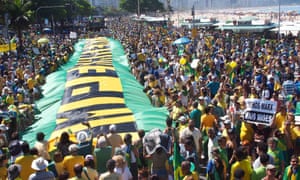
FacebookTwitterPinterest Protests in Brazil, which is now in recession. Photograph: Imago/Barcroft Media

Goldman Sachs’s decision to close down its loss-making Bric fund was a symbolic reminder that the days are gone when the economic rise of Brazil, Russia, India and China (the four countries from which the fund drew its name) seemed guaranteed. Indeed, Brazil and Russia are both in recession.

The US Federal Reserve’s plans to raise interest rates from near zero, which many experts now expect to happen next month, could deepen the agony of countries already struggling with plunging currencies and rising borrowing costs. The International Monetary Fund has warned of a flurry of bankruptcies in emerging economies as rates rise.

“A lot of these countries haven’t been helping themselves: Taiwan, Korea; they’ve all been cranking up their own credit growth,” says Russell Jones of Llewellyn Consulting, an economics advisory firm. But he too believes the world should escape a general slump. “I don’t think we’re on the cusp of a major downturn — probably more of the same.”

Simon Evenett of St Gallen University in Switzerland, who collates detailed data for the thinktank Global Trade Alert, offers an alternative explanation for the recent slide in trade volumes. He calculates that about half of the fall, since exports peaked in September last year, has been caused by the commodity price rout; but the rest, rather than evidence of sickly global demand, has resulted from a creeping rise in protectionism.

His analysis suggests the declines have overwhelmingly taken place in just 28 categories of product. “That’s very concentrated; that makes me doubt that it’s a global downturn.” Eight of these categories are commodities; but the rest map closely on to areas where countries have taken protectionist measures.

In the wake of the financial crisis, policymakers from the G20 countries pledged not to resort to the tit-for-tat protectionism that led to collapsing trade volumes in the wake of the Great Crash of 1929, and was ultimately seen as a contributor to the Great Depression. Since then, there has been little sign of anything with the scope of America’s Smoot-Hawley Act of 1930, which slapped import tariffs on more than 800 products.

But Evenett says there has been a flurry of more subtle manoeuvres: restricting public procurement to domestic firms, for example, or quietly tightening regulations to raise the bar against imports. “I think the China story is adding spice to it, but I think there’s more going on here,” he says.

He is concerned that unless action is taken, politicians will continue to throw sand in the wheels of the international trading system. If he’s right, the downturn seen so far may not be sending a warning signal about global demand; instead, it would be best read as a measure of the fragility of globalisation.

Thursday, 12 November 2015

Saudi Arabia risks destroying Opec and feeding the Isil monster

'Saudi Arabia is acting directly against the interests of half the cartel and is running Opec over a cliff,' says RBC


Ambrose Evans-Pritchard in the Telegraph

The rumblings of revolt against Saudi Arabia and the Opec Gulf states are growing louder as half a trillion dollars goes up in smoke, and each month that goes by fails to bring about the long-awaited killer blow against the US shale industry.
"Saudi Arabia is acting directly against the interests of half the cartel and is running Opec over a cliff"
Helima Croft, RBC Capital Markets
Algeria's former energy minister, Nordine Aït-Laoussine, says the time has come to consider suspending his country's Opec membership if the cartel is unwilling to defend oil prices and merely serves as the tool of a Saudi regime pursuing its own self-interest. "Why remain in an organisation that no longer serves any purpose?" he asked.
Saudi Arabia can, of course, do whatever it wants at the Opec summit in Vienna on December 4. As the cartel hegemon, it can continue to flood the global market with crude oil and hold prices below $50.
It can ignore desperate pleas from Venezuela, Ecuador and Algeria, among others, for concerted cuts in output in order to soak the world glut of 2m barrels a day, and lift prices to around $75. But to do so is to violate the Opec charter safeguarding the welfare of all member states.
"Saudi Arabia is acting directly against the interests of half the cartel and is running Opec over a cliff. There could be a total blow-out in Vienna," said Helima Croft, a former oil analyst at the US Central Intelligence Agency and now at RBC Capital Markets.
The Saudis need Opec. It is the instrument through which they leverage their global power and influence, much as Germany attains world rank through the amplification effect of the EU.
The 29-year-old deputy crown prince now running Saudi Arabia, Mohammad bin Salman, has to tread with care. He may have inherited the steel will and vaulting ambitions of his grandfather, the terrifying Ibn Saud, but he has ruffled many feathers and cannot lightly detonate a crisis within Opec just months after entangling his country in a calamitous war in Yemen. "It would fuel discontent in the Kingdom and play to the sense that they don't know what they are doing," she said.
"We are feeling the pain and we’re taking it like a God-driven crisis"
Mohammed Bin Hamad Al Rumhy, Oman's oil minister
The International Energy Agency (IEA) estimates that the oil price crash has cut Opec revenues from $1 trillion a year to $550bn, setting off a fiscal crisis that has already been going on long enough to mutate into a bigger geostrategic crisis.
Mohammed Bin Hamad Al Rumhy, Oman's (non-Opec) oil minister, said the Saudi bloc has blundered into a trap of their own making - a view shared by many within Saudi Arabia itself.
“If you have 1m barrels a day extra in the market, you just destroy the market. We are feeling the pain and we’re taking it like a God-driven crisis. Sorry, I don’t buy this, I think we’ve created it ourselves,” he said.
The Saudis tell us with a straight face that they are letting the market set prices, a claim that brings a wry smile to energy veterans. One might legitimately suspect that they will revert to cartel practices when they have smashed their rivals, if they succeed in doing so.
One might also suspect that part of their game is to check the advance of solar and wind power in a last-ditch effort to stop the renewable juggernaut and win another reprieve for the status quo. If so, they are too late. That error was made five or six years ago when they allowed oil prices to stay above $100 for too long. But Opec can throw sand in the wheels.
At root is a failure to grasp how quickly the ground has already shifted from under the feet of the petro-rentier regimes. Opec forecasts that oil demand will keep rising relentlessly, adding 21m barrels of oil per day (b/d) to 111m by 2040 as if nothing had changed. They have their heads in the sand.
The climate pledges made for the COP21 summit in Paris by the US, China and India - to name a few - imply a radical shift in the global energy landscape. Subsequent deals by 2025 may well bring a "two degree world" within sight.
The IEA says oil demand will be just 103m b/d in 2040 even under modest carbon curbs. It would collapse to 83.4m b/d if global leaders grasp the nettle. My own view is that it will happen by natural market forces.
The next leap foward in technology is going to be in energy storage. Teams of scientists at Harvard, MIT and the world's elite universities are in a race to slash the cost of batteries - big and small - and overcome the curse of intermittency for wind and solar.
A team in Cambridge says it has cracked the technology for lithium-air batteries that cut costs by four-fifths and enable car journeys of hundreds of miles on a single charge. By the time we reach 2040, it is a fair bet the only petrol cars still on the road will be relics, if they can find fuel at all.
"Everything will be electrified. The internal combustion engine is a dead-end. We all know that, and the car companies ought to know that," said one official handling the COP21 talks.
Opec might be better advised to target prices of $75 to $80 and maximize revenues while it still can, taking advantage of a last window to break reliance on energy and diversify their economies.
The current war of attrition against shale is a hard slog. US output has dropped by 500,000 b/d since April, but the fall in October slowed to 40,000 b/d. Total production of 9.1m b/d is roughly where it was a year ago when the price war began.
"The expectation that a swift tailing-off in tight oil would lead to a rapid rebalancing in the market has proved to be misplaced," said the IEA. Costs are plummeting as rig fees drop and drilling time is slashed.
There is a time-lag effect. Shale cannot keep switching to high-yielding wells forever. Their hedging contracts are running out. The US energy departmentexpects a further erosion of 600,000 b/d next year, but this is not a collapse.
By then Opec will have foregone another half trillion dollars. "What is winning supposed to look like for the Saudis? Can they really endure another year of this?" said Ms Croft.
Opec can certainly bankrupt high-debt frackers but this does not shut down US shale in any meaningful way. The infrastructure and technology will remain. Stronger players will move in. Output will bounce back as soon as oil nears $60.
Shale frackers will respond with lightning speed to any rebound and create a permanent headwind for Opec over years to come, or a sort of "whack-a-mole" effect, contrary to warnings by the IEA this week that Mid-East producers may regain their 1970s stranglehold once rivals are cleared out.
What is clear is that the Opec squeeze has killed off $200bn of upstream oil investment, mostly in offshore projects, Canadian oil sands and Arctic ventures. That will cut oil output in the distant future, but it is a different story.
Saudi Arabia has certainly regained market share, but the cost is causing many in Riyadh to ask whether the brash new team in power has thought through the trade-off. While the Kingdom has deep pockets, they are not limitless. Kuwait, Qatar and Abu Dhabi all have foreign reserves that are three higher per capita.
It has been downgraded to A+ by Standard & Poor's and has a budget deficit of $100bn a year, forcing it to burn through reserves at a commensurate pace and now to tap the global bond market.
Austerity has finally arrived, a nasty shock that was not in the original plan. A confidential order from King Salman - marked "highly urgent" - has frozen new hiring by the state, stopped property contracts and purchases of cars, and halted a long list of projects. The Kingdom will have to slim down the edifice of subsidies and social patronage that keeps the lid on protest.
It is far from clear whether Saudi Arabia can continue to prop up allies in the region and bankroll Egypt, already struggling to defeat Isil forces in the Sinai. An Isil cell captured - and beheaded - a Croatian engineer on the outskirts of Cairo in August, even before the suspected bombing of a Russian airline this month.
The Isil brand has established a front in Libya and has launched attacks in Algeria, where the old regime is fraying, and oil and gas revenues fund the vitally-needed social welfare net.
Iraq is pumping oil a record pace but it is nevertheless spiraling into economic crisis, with a budget deficit of 23pc of GDP. Public sector wages are to be cut. The austerity budget for 2016 - based on $45 oil, down from $80 last year - has set off a political storm.
The government has slashed funding for the "Popular Mobilization" militia fighting Isil. "The Iraqi state faces a grave challenge. The budget crisis makes the status quo intractable," says Patrick Martin from the Institute for the Study of War.
Helima Croft says Isil is now operating close to Iraq's oil facilities near Basra, detonating a car bomb at a market in Zubayr last month. They clearly have the ability to attack energy targets, and have an incentive to do so since oil production within their Caliphate heartland is their main source of income.
Al Qaeda in the Islamic Maghreb showed it could launch a devastating surprise when it crossed into the Sahara two years ago and seized the Amenas gas facility in Algeria, killing 39 foreign hostages. Variants of Isil can strike anywhere they find a weak link.
"We remain concerned that they may eventually set their sights on a major oil facility. These are obvious targets of choice, and none of this geopolitical risk is priced into the market," she said.
Saudi Arabia itself is vulnerable. There have been five Isil-linked terrorist acts on Saudi soil since May. They include an attack on a security facility near the giant oil installation at Abqaiq, where clusters of pipelines offer the most inviting sabotage target in the petroleum world and where the aggrieved Shia minority sit on the Kingdom's oil reserves.
It would be a macabre irony if Saudi Arabia's high-risk oil strategy so enflamed a region already in the grip of four civil wars that the Kingdom was hoisted by its own petard. That would certainly clear the global glut of crude oil.