Search This Blog

Tuesday, 20 January 2015

Kebab Stories - The Shami Kebab

Fawad Ahmed in The Dawn

The Shami is the king of the tea trolley in Pakistan; may it be Eid or a casual drop-in at a friend’s house, the delicious delight is always a hot accompaniment.
The kebab, with the hot pepper, red pepper and green chillies in it, brings a zing not just to the chai but the conversation too. My earliest memory of stealing a taste of the Shami Kebab is right from the pot, just before the patty was made and fried; that is the fun and versatility of Shami Kebab – it's delicious to eat and steal before it is put in a blender to be made silky and fried to a fine finish.
Historian Lizzie Collingham in her book Curry talks about the Shami Kebab at length:
Nawab Asaf-ud-Dulah’s love of food is also said to have led to the invention of the Shami kebab. This is one of Lucknow’s many contributions to kebab cookery. In contrast to the Mughal emperors who ate sparingly, the nawabs of Oudh were gluttons.
Indeed, Asaf-ud-Dulah became so fat that he could no longer ride a horse. He managed to gain vast amounts of weight despite the fact that his ability to chew was compromised by the loss of his teeth. Shami kebabs are supposed to have been created in order to accommodate this problem. They were made out of finely minced and pounded meat known as qeema. While westerners tend to mince meat as a way of using inferior grades, the Mughals would often mince the best cuts. Qeema is frequently referred to in the recipes given by Akbar’s courtier, Abu’l Fazl, as an ingredient for pulaos.
The Mughals liked minced beef, but in Lucknow, the cooks preferred lamb, which produced a softer mince. They would grind the meat into a fine paste and then add ginger and garlic, poppy seeds and various combinations of spices, roll it into balls or lozenges, spear them on a skewer, and roast them over a fire. The resulting kebabs were crispy on the outside but so soft and silky within that even the toothless Asaf-ud-Daulah could eat them with pleasure.
The silky Shami kebabs are a delicious side to any meal, but they can be enjoyed on their own with a side of hot naan, onions and spicy mint chutney. The nanbais (bazaar cooks) of Lucknow were famed for making the best Shami kebabs. Hence, the street bun kebabs sold by street vendors in the subcontinent, more so a specialty of Karachi, is a continuation of the same tradition.
I distinctly remember the most delicious bun kebab I used to have during the '70s and '80s. The vendour stood outside Khayaam cinema in the locality of Nursery, Karachi. I wonder if he still haunts the neighbourhood today?
My research says the first kebabs were stumbled upon by soldiers. It is believed that the Turkish and Persian soldiers enjoyed grilling fresh meat on fire, while it hung wrapped on their swords. The meat chunks were cooked in animal fat and consumed by soldiers who hunted for survival while journeying land to land for conquests.
The word 'kebab' is said to originate from the Arabic language, but the Persians, Turks and central Asians also lay claim to it. It means to fry, burn or cook on a skewer through grilling or open fire cooking.
Kebabs are almost always cooked over charcoal or shallow fried, and not usually deep fried. Kebabs in the west are mostly served on a skewer, or like doner kebab, with a side of pilaf or middle Eastern pita bread.
In the subcontinent, there are more than a dozen popular kebab recipes; chapli kebabboti,seekhbiharigalavati, but none are quite as unique as the Shami Kebab.
Sanjay Thumma, celebrity chef and author, in his article 'Shammi Kebab' pens:
Shami or Shammi kebab literally means the Syrian kebab (Syria is called Sham in Urdu and Hindi) in Arabic. During the Mughal era, Muslim immigrants from the Middle East introduced this kebab to South Asia. The Mughals had employed cooks from all over the Muslim world to serve in the royal kitchens and some of the cooks were from Syria.
Another source states that the word Sham is evening in Hindi and Urdu, and Sham-e-Awadh (evenings in Lucknow), during the days of the Nawabs were unforgettable. Some people also believe that Shami Kebabs originate from the famous village of Sham Churasi in the Hoshiarpur district of Punjab.
Lucknow is acclaimed for its gastronomic sophistication, extravagant lifestyle and love for the performing arts. Its kitchens (called bawarchi khanas) took pride of place in the royal courts, as did their bawarchis or rakabdars (gourmet cooks). The richness of Lucknawi cuisine is in its variety and ingredients, like the subtle flavors of a [perfect] Shammi Kebab.
The Shami Kebab recipe I share with you today comes from my dear mother’s kitchen, the very same that I was caught stealing rather sheepishly, and the Hara Masala kebabs are my dear nani’s specialty. The Hara Masala kebabs are a perfect patty for a kid’s burger, sans green chillie – my children love it in a burger.
Here it is, from my kitchen to yours.

Shami kebab


Ingredients

1 kg ground beef
1 ½ cup chana dal
1 ½ onions, large
1 inch piece of ginger
10 pods of garlic
12 whole red chillie
1 tsp. cumin, heaped
2 tsp. coriander powder
2 sticks cinnamon
3 black cardamoms
20 whole peppercorns
7 to 8 cloves
Salt to taste
24 to 30 ounces of water

Method

Put all ingredients (mentioned above) in a pot of water, and cook until the water completely dries and lentils are cooked and soft to touch.
Let cool and grind until fine to touch.
Add 1 medium finely chopped onion, 2 eggs, 1 bunch of fresh coriander leaves (chopped) and 10 to 12 leaves of mint (chopped). Mix well with ground beef mixture, form kebabs and shallow fry.

Hara masala kebab


Ingredients

2 lbs. ground beef
8 slices of white bread, soaked in water and drained
4 tsp. corn flour, heaped
2 medium sized onions, finely chopped
2 inch piece of ginger
2 eggs
2 tsp. black pepper powder, level
1 bunch coriander, chopped
Salt to taste
4 to 6 green chillie, finely chopped

Method

Mix ingredients together, form patty and shallow fry.

What really makes a good teacher?

Barnaby Lenon in the Telegraph

A NASUWT poll last week found that the majority of parents wanted ‘qualified teachers’ to teach their children. Unsurprising really, until you consider what that word ‘qualified’ really means.
In independent schools, recognised as being among the best in the world, we are free to choose our own teachers. In 2013, pupils in independent schools achieved 32 per cent of all A* grades at A-level.
Our success lies in the quality and expertise of our teachers, yet some may not have a teaching qualification. So what makes a good teacher?
They have four characteristics.
First, they love their subject and have excellent subject knowledge (the two go together). Last year Professor Rob Coe and the Sutton Trust published research into the qualities of the best teachers and this came top of the list.  
It is the reason that some schools are happy to appoint an excellent graduate in a subject like physics even if they don’t have a teaching qualification. They are classified as ‘unqualified’, even though they possess the most important quality of all.
Good subject knowledge matters not only because at the top of the ability range you need to be able to stretch pupils but also because teachers with good knowledge tend to make lessons for younger children more interesting. They have more substance to be interesting about.
Secondly, they need to have the right personality. Teaching is partly acting, and acting ability helps greatly. Above all you need to be able to control a class, because without good discipline nothing worthwhile can be achieved.
So that means good teachers are those whom pupils will respect - and slightly fear if necessary. They are completely in control of what’s going on around them.
Pupils know the teacher will notice if they are misbehaving or if their work is incomplete or copied from another child and will take action - punish the child, perhaps, or require the work to be redone.
But the best teachers are not disciplinarians. They are a velvet hand in an iron glove. Pupils come to know, over time, that they are warm and generous. But they are not to be messed with. Discipline has to come first.
There are other personality traits that matter too. Good teachers are very hard working, putting a huge effort into preparing lessons, marking work and giving extra time to children who need it.
They are able to manage stress. They are passionate about their school and their pupils, keen for all to do well. They are highly organised, because switching in a few seconds from one class to another, keeping track of individuals, remembering which extra duties they are down for, managing record-keeping and databases - all this requires good organisation.
Thirdly, they need to have certain classroom skills. This is why all ‘unqualified’ teachers need some training, both before they start and throughout their first year of teaching.
They need to be shown how to deliver a lesson with pace and interest, how to use digital resources effectively, how to mark work and record those marks, how to write reports, how best to teach tricky concepts, how to ask questions of pupils in the most effective way.
Finally, they need to have high expectations of their pupils. This is a characteristic of all the best teachers. They are determined that every pupil will master their subject. This attitude sets the scene for everything which follows.
Pupils who produce unsatisfactory work must be made to redo it until they achieve a good level. Pupils will be regularly tested to see whether they have understood and learnt the work; those who do badly will be retested.
Excellent teachers believe that it is pupil effort and teaching quality which determine how well a child does, not the ability of the child. The less able children will get there in the end.
So these are characteristics of the best teachers. In terms of weighting, perhaps 30 per cent is subject knowledge, 30 per cent is personality, 30 per cent is level of expectations, 10 per cent classroom skills. Of these, only the last need be the subject of teacher training.

Sunday, 18 January 2015

A tale of two ethnic cleansings in Kashmir

by S A Aiyar in the Times of India

January 19 marks the 25th anniversary of the Azaadi (independence) uprising in the Kashmir Valley, leading to the ethnic cleansing of around 400,000 Kashmir Pandits. For some, this day heralded the rejection of Indian rule by protesting Kashmiris, followed by the bloody suppression of Kashmiri human rights by Indian forces (portrayed in the film ‘Haider’). For the Pandits, it heralded a reign of Muslim terror.
Rahul Pandita has written a heartbreaking first- person account of the Pandit tragedy in ‘Our Moon has Blood Clots’. He shows that ethnic cleansing was not the work of a few Islamic militants, as claimed by optimists. On January 19, Pandita’s Muslim neighbours chanted the Islamic battle cry “Naara-e-taqbeer, Allah-o-Akbar”, made famous as heralding Muslim attacks by the TV film ‘Tamas’. Pandita’s mother swore to kill her daughter and then herself if the house was invaded. The long night passed without an invasion, but many fearful Pandits quickly left.
Soon after, local Muslim boys gathered outside Pandita’s home, and discussed how they would share the houses of departing Pandits and rape their girls. One Muslim boy laughingly said to another, “Go inside and piss: like a dog you need to mark your territory.” Pandita’s terrified father decided to flee.
Official figures say only 219 Pandits were killed in the valley. But the threat of violence was so great, and the chances of curbing it so remote, that lakhs of Pandits fled. Most are now rotting in refugee camps in Jammu.
Recently, an ex-general — also a Pandit — told me the Indian media had underplayed the tragedy of his tribe. I agreed, but added that the media has also ignored the earlier mass expulsion of Muslims from Jammu. This surprised the ex-general: I’ve never heard of that, he declared.
He is not alone. Although our media pride themselves on free and bold speech, they maintain a conspiracy of silence on some issues relating to the supposed “national interest.” This includes the mass killing and expulsion of lakhs of Muslims from Jammu in 1947. That story should be recalled on this sombre anniversary.
Today, Jammu is a Hindu-majority area. But in 1947, it had a Muslim majority. The communal riots of 1947 fell most heavily on Jammu’s Muslims; lakhs fled into what became Pakistan-occupied Kashmir. That turned Jammu’s Muslim majority into a Hindu majority. In sheer scale, this far exceeded the ethnic cleansing of Pandits five decades later.
The jagir of Poonch was a semi-autonomous part of J&K till World War II. Subsequently, the maharaja took direct control and imposed high taxes, with special levies on Muslims. This sparked an anti-tax protest in early 1947, which the maharaja put down with armed force.
Poonch had 50,000 ex-soldiers of the British Indian Army, many of whom still had guns. The maharaja felt threatened by this, and in July ordered all holders of arms to deposit these in police stations. But many arms deposited by Muslim ex-soldiers were then handed out by the maharaja’s police to Hindu and Sikh families, raising communal fears. Muslims responded by purchasing fresh weapons from arms bazaars in neighbouring NWFP province. Sardar Ibrahim Khan, a prominent Poonch politician, organized an armed Muslim force that soon staged a revolt.
The official Indian version holds that the Indo-Pak imbroglio over Kashmir began with the invasion of the valley by Muslim tribesmen in October 1947, obliging the maharaja to accede to India. But many academics, including Christopher Snedden in his book ‘Kashmir: The Unwritten History’, argue that the Poonch revolt was the first step in upending the maharaja’s rule, for purely local reasons unrelated to Indo-Pak claims.
Meanwhile, the bloody partition riots in neighbouring Punjab spilled over into Jammu. Snedden cites estimates of between 70,000 and 237,000 Muslims killed. Historians Arjun Appaduri and Arien Mack in their book ‘India’s World’ give a hair-raising estimate of 200,000 killed and 500,000 displaced in Jammu. Tens of thousands of Hindus were killed and expelled from what became Pakistan-occupied Kashmir, but Muslims were by far the biggest victims.
The ethnic cleansing of Pandits from the valley was more one-sided than that of Jammu Muslims in 1947. Yet in sheer numbers and horrors, the Jammu episode was much worse. We have forgotten what happened then because it is politically and morally inconvenient.
The tragedies of J&K constitute a long, horrific tale of death and inhumanity. It has many villains and no heroes. Both sides have been guilty of ethnic cleansing. Both claim to be victims, forgetting they have also been perpetrators. On the 25th anniversary of the Azaadi uprising, the Hindu-Muslim divide is deeper, and ethnic amnesia more selective, than ever before. Some stories do not have happy endings.

Greek elections: Syriza’s young radicals plot a political earthquake for Europe


Inside its smoke-filled HQ, the far-left party is making plans to defy the EU over Greece’s debt and abolish draconian austerity measures imposed to shore up the euro. But first it must win next Sunday’s general election 
Syriza Alexis Tsipras european parliament elections
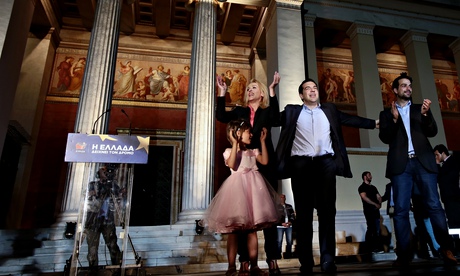
Syriza leader Alexis Tsipras, second right, celebrates success in May’s European parliament elections with Athens governor Rena Dourou, left, and mayoral candidate Gabriel Sakellaridis Photograph: Corbis/Panayiotis Tzamaros
An air of excitement pervades the headquarters of Greece’s far-left Syriza party. In small, smoke-filled rooms, off corridors plastered with posters advertising Marxist seminars and cluttered with coffee cups and leftover meals, staff pore over computers. Most are women, young and intense, cigarettes dangling from lips as they tap into keyboards. The hubbub of chatter is loud. Up narrow staircases people zoom this way and that. For the visitor there is no mistaking that the seven-storey building, overlooking one of Athens’s more rundown squares, is as much a place of workable chaos as it is a well of expectancy.
“Hope is coming,” proclaims a poster pinned to the noticeboards of almost every floor. “Greece is progressing, Europe is changing.”
“Welcome to Syriza,” says Panos Skourletis, the party’s grey-haired spokesman, proffering a guided tour of the offices’ newly renovated media room, “and please forgive the smoke.”
Barely a week before critical elections in a country once again caught up in the eurozone storm, Skourletis is buoyant. It is easy to see why. With every poll giving Syriza an indisputable lead, the radicals are on a roll. For Europe’s growing class of anti-austerians, victory is in sight. “We are going to win,” he enthuses somewhat triumphantly. “There is only one question, and that is by how much.”
If bookies in Athens are to be believed, the odds on the party securing an outright majority are still slim. But, says Skourletis, as the election campaign enters its final stretch things are looking up. “On the basis of data and empirical evidence, we believe we are going to get more and more votes from the undecided, because that is how it has worked for parties in the lead in the past.”
The leftwingers are not alone in taking note of the Greek electorate’s ballot-box intentions. From Westminster to Washington, Madrid to Rome, the 25 January poll is being seen as a potential watershed in the eurozone crisis. If the radicals are catapulted to power, their victory will resonate beyond Greece, reviving fears of Athens being led to the euro exit door.David Cameron and his prime ministerial counterparts in Spain and Portugal, who face electorates themselves later this year, are watching closely. So, too, are mandarins in Brussels and Berlin.
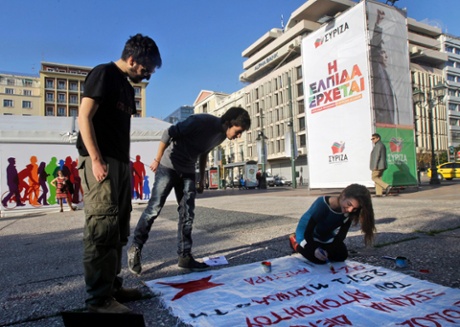
Syriza supporters paint a banner outside anelection rally in central Athens.
Syriza supporters paint a banner outside anelection rally in central Athens. Photograph: Orestis Panagiotou/EPA
From maverick marginals, the leftwingers have moved to centre stage, riding high on opposition to the austerity Athens has been forced to apply in return for €240bn in emergency bailout funds from the EU and International Monetary Fund. Their ascent poses the biggest threat to consensus politics in decades. Alexis Tsipras, Syriza’s firebrand leader, has promised to take an axe to the nexus of interests that have kept Greece’s rotten establishment alive – starting with the media-owning oligarchs who control so much of the country’s internal debate.
“The future has already begun,” he declared after parliament’s failure to elect a president triggered a constitutional provision for early elections.
Shock, anger and fear have marked Greece’s financial meltdown. But five years on, Syriza’s meteoric rise – and imminent electoral victory – also presages the passage of despair. Many Greeks will be inclined to vote for the insurgents as much out of hopelessness as helplessness.
“With our country’s economic crisis, our big opening has been to the decimated middle class,” Skourletis says. “In us they have found a voice.”
The radicals have come a long way from the time I would visit their headquarters back in the early 1990s.Then, conversation inevitably focused on intra-party disputes between Eurocommunists and the Stalinist KKE. Over tiny cups of Turkish coffee – gleefully provided as guests were so rare – Leonidas Kyrkos, the late Eurocommunist leader, would speak of the scandal-ridden nation’s need for “catharsis, ” amid warnings of its tendency to overspend, but bemoan the fact that his utopian views were shared by so few. That he would have a successor, who would emerge from school sit-ins and the anti-globalisation movement to be embraced not only by Greeks but the entire spectrum of Europe’s left, would undoubtedly have mystified him.
In many ways Skourletis personifies the tectonic shift. The son of a public-sector doctor, and owner of a successful company importing tools before the crisis hit, he has seen many of his friends destroyed by the fate that has befallen Greece.
“Like Greeks all over, they availed themselves of the loans that the banks were giving out so freely to buy houses and cars and, then, suddenly found themselves unemployed,” he says, wincing. “Because they are in their 50s, they are unlikely to ever work again, which means they have no prospect of getting a pension either. It’s tragic.”
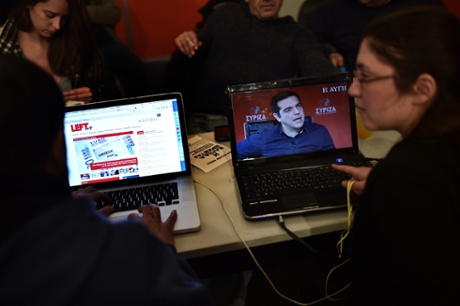
Activists watch an interview with Syriza leader Alexis Tsipras newspaper at the party's election centre in Athens last week.
Activists watch an interview with Syriza leader Alexis Tsipras newspaper at the party’s election centre in Athens last week. Photograph: Aris Messinis/AFP/Getty Images
Precisely because it has been untested by power, Syriza has also been able to count on the support of a younger generation disproportionately hit by job losses.
In the absence of open revolt, the anti-establishment party is regarded as the best form of resistance to policies that have caused a Depression-era recession, worse, analysts say, even than that suffered by the United States in the 1930s.
Although the Greek economy has begun to show the first signs of recovery – the result of rigorous efforts to balance the books by prime minister Antonis Samaras’s outgoing coalition – the effects of such momentous fiscal adjustment have been catastrophic.
GDP has contracted by more than a quarter, around 26% of the population remains out of work, and more than three million live on, or below, the poverty line. Tsipras, last week, likened the measures to “fiscal waterboarding”.
The appetite of Greeks for yet more drama is limited. Almost six years after the country was forced to come clean on the scale of its public spending, they are worn out by relentless cuts and tax rises and are visibly fatigued. Greece itself has been hollowed out. Athens, home to almost half of its 12 million-strong population, has become a casebook study of what happens to capitals when they go broke, its smashed pavements, unkempt parks, boarded up shops and ever multiplying beggars and homeless the tell-tale signs of its financial collapse.
In such a climate, Tsipras’s promise of a public spending spree has gone down well. Across the board, Greeks have welcomed his pledge to tackle the country’s “silent humanitarian crisis” by increasing the minimum wage, reducing taxes and hiring in the public sector. But the euphoria that accompanied past political sea-changes is unlikely to be evident. Many say they will be rooting for Syriza out of protest against the centre-right New Democracy and the centre-left Pasok, the two mainstream parties that,alternating in power for the past 40 years, have been blamed for Greece’s near economic death.
Aware that the vast majority want to remain in the eurozone, Tsipras, who turned 40 last year, has toned down his anti-European rhetoric. Gone are the references to “tearing up” the memoranda of conditions attached to the country’s rescue programmes. Last week he went out of his way to placate German taxpayers, saying that they had “nothing to fear from a Syriza government”.
“Our aim is not for a confrontation with our partners, to get more credits or a licence for new deficits,” he wrote in the economic daily Handelsblatt. “It is to stabilise the country, reach a balanced primary budget and end the bloodletting from German and Greek taxpayers.”
But the charismatic politician still says he has “Merkelism” in his sights. Ending austerity and writing off Athens’s monumental debt – at 177% of GDP the largest in Europe – remain priorities. And with creditors ruling out both, analysts say it will require a major kolotumba, or U-turn, on the part of the leader to avert a head-on collision. Earlier this month the European Central Bank added to the pressure with a stark warning that Greek lenders would be unable to tap funds if bailout conditions were dropped, raising the spectre of a bank run in the months ahead.
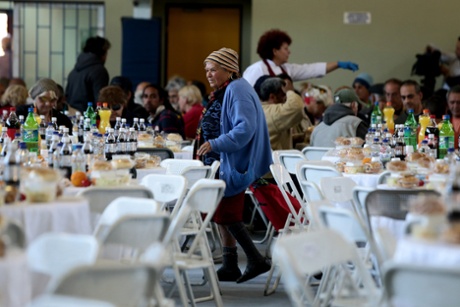
Athens free meal elderly, homeless Easter
A free meal organised by the Athens municipality for elderly, homeless and needy people last Easter.Photograph: Panayiotis Tzamaros/Demotix/Corbis
“Tsipras is entrapped in his own rhetoric,” says Dr Eleni Panagiotarea, a research fellow at Eliamep, Greece’s leading thinktank. “To move from where he is now to pulling off the kolotumba will not only mean a loss of prestige but control over the various far-left factions in his party and, if that happens, it is going to be very difficult for him to get his own MPs to vote through legislation in the future.”
Maoists, Trotskyists, anti-capitalist activists and champagne-swilling ex-trade unionists, who once belonged to the socialist Pasok party, are among the 11 groups that are part of Syriza. At least 30% are militants who openly advocate dumping the euro in favour of the drachma. Tsipras moved up the ranks through Synaspismos, the Eurocommunist party that forms the alliance’s central plank. If he controls 60% of the MPs who are likely to be elected next Sunday, insiders say it would be a “huge achievement”.
“He is faced with a huge dilemma,” says Spyros Lykoudis, who spent more than 20 years in Synaspismos before abandoning the party in disagreement over the need to press ahead with reforms. “If he placates creditors abroad, he stands to lose his own constituency and if he doesn’t he risks bankruptcy.”
Lykoudis, who is now running with To Potami, a centrist party established last year, believes the best solution would lie in the formation of a coalition government.
“And our hope is that it is us who emerges as the country’s third biggest force and not the neo-Nazis in Golden Dawn,” he adds. “If reformers are in his government, it will act as a restraint and make it easier to take measures. As things stand, he is a populist who promises all things to all men.”
The charge that Syriza is composed of dangerous ideologues bent on turning Greece into a Marxist paradise is heartedly rebuffed by cadres.
Instead the leftwingers argue that the centre of gravity in politics has shifted so much to the right since the advent of Thatcherism that the party’s proposals now seem radical. “All the things that sound radical now were standard fare in the golden age of capitalism in the 50s and 60s,” says the economics professor Euclid Tsakalotos, Syriza’s shadow finance minister for the last two years.
Raised in Britain and educated at St Paul’s, the leading London private school, before going to Oxford, Tsakalotos, 54, insists that after years of being subjected to the brutal vagaries of the market, there are growing numbers across Europe who feel excluded from decision-making and the centres of power.
“We are only more radical in the sense that we have been influenced by the anti-global movement and believe in concepts of participatory democracy,” he adds. “The angst Syriza has caused is down to us challenging a system that can’t actually represent the interests of ordinary people.”
In the party’s smoke-filled headquarters, the leftwingers say they are gearing up for a fight. This is the closest they have come to power since the formation, almost 200 years ago, of the modern Greek state, and they are not going to surrender easily.
“Unlike the left elsewhere, we stopped arguing about Trotsky and Stalin and managed to bury our differences,” says the soft-spoken Christoforos Papadopoulos, a member of the party’s political secretariat. “That has been the secret of our success, and you can be sure that when we reach office we are not going to betray what we believe in.”
When the going gets tough, it is likely that Syriza will focus on clamping down on oligarchs and other vested interests to get by. One US cable, revealed by WikiLeaks, described the tycoons as “a small group of people who have made or inherited fortunes …  and who are related by blood, marriage or adultery to political and government officials and/or other media and business magnates.”
“What we will not be doing is making any kolotumbes,” says Papadopoulos, taking a mighty draw on his umpteenth cigarette.
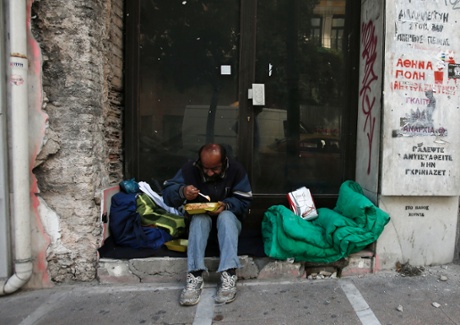
homeless man eats doorway closed shop Athens.
A homeless man eats in the doorway of a closed shop in Athens. Photograph: Thanassis Stavrakis/AP

SYRIZA’S PROMISES

The party aims to end austerity by:
■ Giving free electricity to Greeks whose supplies have been cut off;
■ Providing food stamps to children;
■ Giving health care to the uninsured;
■ Providing a roof for the homeless;
■ Raising the minimum wage to €750 a month from under €500;
■ Introducing a moratorium on private debt repayments to banks above 30% of disposable income.
In addition, Syriza says it will call for Greece’s “unsustainable” €320bn euro debt load to be drastically reduced and interest repayments cut. It wants an international conference to be held on the issue in an echo of the treatment given Germany after the second world war.
It also wants to abolish the economic privileges enjoyed by the Greek Orthodox church and shipping industry, reduce military spending, raise taxes on big companies and set a 75% tax on incomes over €500,000.