Search This Blog

Tuesday, 11 November 2014

Making Haleem and Nihari

Haleem

Ingredients (7 grains)
1 cup wheat
¼ cup plus 1 tbsp. barley
¼ cup white maash dal (Urud)
¼ cup moong dal
¼ cup masoor dal
¼ cup basmati rice
1 cup chana dal
½ to ¾ cup oil
2 ½ lbs (Preferably boneless veal or beef stew (without fat), mutton and chicken can be used as well.)
1 ½ cup chicken or beef stock
1 ½ heaped tbsp red chillie powder (increase or decrease to taste if needed)
Salt to taste
2 to 3 tbsp ginger garlic paste
1 tbsp (heaped) coriander powder
1 ½ tsp level turmeric powder
1 ½ large onions (sliced for frying)
Ingredients for Dum (sealed pot cooking)
1 level tsp garam masala powder
¼ tsp jayfal powder
¼ tsp javatree powder
½ tsp black cumin
½ tsp green cardamom powder
Ingredients for garish (or to be served on the side)
Lemon wedges, chopped cilantro and green chillie, fried onions, julienned ginger, chaat masala, yoghurt and naan.
Method
Wash and soak all seven grains for 6 to 8 hours.
In a pan, fry onions until golden brown, adding meat, ginger garlic, chillie powder, turmeric, coriander powder, stock and salt. Cook until the korma is tender.
In a large separate pot, boil pre-soaked grains until tender, approximately 2 to 2 ½ hours. Eyeball the water quantity (for boiling and cooking) depending on the required consistency and thickness of the haleem.
Once boiled, put grains in blender and blend roughly, pouring the blended grains back in the pot for cooking.
Repeat the blending process with the meat korma, pouring the roughly blended korma into the cooking grains. Mix thoroughly on low to medium flame, stirring constantly.
Cook and stir until the correct consistency; tasting for salt and chillie content.
The haleem must be well blended, now add all five dum ingredients, mix well and initiatedum (sealed pot cooking) for a few minutes.
Garish and serve with a side of naan, if desired.


Nihari
Ingredients (serves 10 to 12)
Masala 1
1¼ cup oil
5 lbs veal or beef shank with bone
Salt to taste
3 tsp garam masala powder
3 tsp red chili powder
4 tsp coriander powder
1½ tbsp ginger
1½ tbsp garlic
1½ tsp turmeric powder
6 tbsp white flour
2 medium onions, sliced (1/4 to 1/3 cup oil for frying onions)
Nihari Masala Spices 2 (Grind to a fine powder)
2 sticks peepli
2 ½ tbsp coriander seeds
½ tsp mace powder
½ tsp nutmeg powder
2 bay leaves
2 cinnamon sticks
4 black cardamoms
20 cloves
10 green cardamoms
1 tsp cumin seeds
1 tbsp black peppercorns
4 tbsp fennel seeds
¼ tsp anise seeds
Garnish (Chopped)
Fresh cilantro Fresh green chili Ginger Lemons Fried onions
Method
Heat oil, braise meat evenly on high heat for a few minutes, add masala 1 ingredients to the meat, with the exception of flour and onions, and cook on high heat until the meat is evenly coated.
Add 10 glasses of water to the meat, then dissolve flour in four glasses of water and add to the meat, ensuring that the meat is completely immersed in the water, add more if required and bring to boil.
Add finely powdered nihari masala 2 to the boiling mix. Lower the heat to medium and let it simmer for six to seven hours. Fry the onions until golden brown, then add to the Nihari and cook for another 15 to 20 minutes.
Garnish and serve with hot naan.
Monday, 10 November 2014

It’s economics, stupid - Denying legality to sex work in fact worsens the exploitation

Bachi Karkaria in the Times of India
In 1938, a book hit British stands and smugness — To Beg I Am Ashamed: A Frank and Unusual Autobiography by Sheila Cousins, a London prostitute. It was ghostwritten by Ronald Matthews, with considerable inputs from his more celebrated pub chum, Graham Greene. It was prematurely ejaculated from bookshops under pressure from the home secretary, whose hand was forced by the Public Morality Council. A ‘handsome, sound and tight copy’ of the first edition came recently on the market, priced at $13,165, not only because it was in ‘fine condition’ but because the book’s hasty withdrawal had made it extremely rare.
A less welcome development on the same subject has resurfaced in India where, even in the 21st century, we still get our knickers in a twist whenever the uncomfortable fact of prostitution is forced upon our delicate (read hypocritical) sensibilities.
One seldom agrees with Lalitha Kumaramangalam when, as BJP-appointed chairperson of the National Commission for Women, she defends the indefensible sexist statements of the Sangh Parivar’s rabid rump. But her recent support for legalising sex work makes eminent sense. Predictably, it has led to a decibel level of protest louder than a brothel brawl.
To see, understand and finally accept the merits of such legalisation, we first need to make two clear demarcations. One, we have to rid our minds of the semantic baggage of ‘prostitute’ (or whore, harlot, fallen woman); the noun has become a hiss verb outside its native place. Its loaded subtext of immorality of any stripe puts a mental block in the way of accepting sex work as economic activity — which is precisely what it is for these women (and men and transgenders) grappling with their no-exit destiny.
Two, we need to separate the desirable idea of legalising sex work from the reprehensible idea of legalising exploitation. It is nobody’s case that we legitimise abduction and abuse. But the opponents of legalised sex work deploy this sophistry, mixing up these two entities. We need to fight the predator trafficker and pimp, not their prey. Yes, we have to punish abusive clients too, but, get real guys, in which Utopian age can we seriously expect to implement what the UN’s Palermo Protocols grandly call a ‘demand reduction’ strategy? Abuse reduction is more important, and arguably more doable.
It is the world’s oldest profession, remember? And the need for commercially provided sex hasn’t noticeably changed, despite a range of onslaughts ranging from the fire-and-brimstone brigade to AIDS. Or there’s the Khushwant Singh solution. Addressing a conference called to ‘eradicate prostitution’ in the early 1970s, the irreverent sardar told the starched and genteel assembly, “This will happen only when the amateur drives out the professional.”
More seriously, while tracking the emerging AIDS epidemic in the 1990s, my experience of Mumbai’s sordid red-light district was something of an epiphany, stripping me of my own ignorant prejudice and pettiness. Women have ended up here from various situations — abducted, abandoned, serially sold, or just plain impoverished — but for them this is now work, using their only sweat equity to keep body and soul together, children in school, parents in medicine, whole families in the ‘decency’ which holier-than-thou lofty society denies these breadwinners.
In those AIDS-decimating times, brothels were trapped between life and livelihood. In the early years, they were in denial; madams refused even to put up the NACO posters on safe sex, afraid these would stamp their establishment with HIV’s taint, and scare away clients. Later, there was no hiding from the grim toll which halved the population of those infamous cages.
The new stigma and the prostitute’s ages-old pariah-fication proved a lethal cross-infection, denying them medical help. If legal safeguards had been in place, they would not have been thrown on to the even meaner street, slipped off the radar of surveillance, been forced to sell themselves cheaper — and with no clout to insist on condoms, infected clients who then took HIV home to unwitting wives and unborn children.
So i don’t buy the argument of feminist columnist Rami Chhabra on this page last week which talked of ‘powerful foreign donors (who) backed prostitution’. Yes, there were condom-centric programmes because prophylactics were easier to hand out rather than the more-laborious behaviour change. But this is a cynical argument because condoms — compulsorily and correctly used by high-risk communities — were the first line of defence. The red-haired Australian Cheryl Overs, who switched to law to fight AIDS gave me a pithy quote: ‘A condom is to a brothel what a hard hat is to a construction site: essential safety equipment.’
One can ignore the sanctimonious unwashed who persist with the immorality argument and/or are in unredeemable denial about the sexual ‘need’ of the client, let alone the less escapable economic one of the prostitute. There’s even one lot which denounces the term ‘sex worker’ because it ‘debases legitimate workers’.
But what’s the excuse of aware feminists who refuse to accept the economic reality, spout ‘bodily integrity’ and continue to oppose legalisation on grounds of exploitation? Be logical ladies, if we don’t provide that vital umbrella, how can the sex worker challenge the sexual violence which rains down on her with such impunity?

Sunday, 9 November 2014

Pro athletes cannot be bullied into better performances


Valuable notes from a book that explains the intricacies of coaching and captaincy without once mentioning either
Ed Smith in Cricinfo
November 9, 2014
C

Coaches must remember that practice isn't an end in itself © Getty Images

I've just read a brilliant book about captaincy and coaching. It might be the best book ever written on leadership in sport. The author not only studied many of the greats at first hand, he also did the job himself. There is a surprise, however, and I'm not going to spoil it. So guess, by all means, but I'm not giving away his name until the end.
I've gone through the notes in my book, collecting his advice into several themes.
Mystery
"The better a captain is, the less you know why. You certainly can't get the qualities from a textbook, and they can't be faked by copying a great captain. But there is also a practical side: however much talent you're born with, there's a lot to learn. All the best captains and coaches work hard at their craft, developing their own individual ways. They all do it differently, so there can't be only one "right" way. To put all young leaders through a training course only means that a mass of mediocrity will be let loose on the world."
Instinct
Intuition rather than rationality often drives inspired decisions. "Some captains and coaches are totally instinctive and can't describe what they do. [After one game] I was so impressed that I complimented the captain on a detail. 'Oh! Did I do that?' he replied."
See the big picture
Being preoccupied with details can't be allowed to obscure what really matters. "Skilful captains and coaches can transform the way a team plays in a very short time, even though some of them wouldn't be able to tell you much about tactics or technique. Before modern video and analytics, there was far less emphasis on precision and more on capturing the overall mood of a team. Captains were listening for bigger and more important things. We've lost something in demanding total accuracy."
Show, don't tell
One great captain "could tell me what he wanted with his eyes," the author writes. "It's important to look at players as if you expect the best, not as if you fear the worst. Many inexperienced coaches seem to be "looking for trouble", a real turnoff for a team. When I look at players during a match, I'm trying to involve and communicate what I'm feeling rather than police them."
Authenticity
Waving your arms around and acting for the cameras doesn't fool anyone. The author advises captains to have the integrity to stay focused on the game situation rather than get side-tracked about the impression he's making. If the captain is "naturally flamboyant, then it's a natural expression of his feeling". But when his self-conscious gestures are just acted out, "and don't have a real relationship with the game… then it's just a circus."
Practice is not the real thing
"The most important thing about a practice session is that it's not an end in itself. Everything a coach does must aim at a good performance on match day. Take a chance and leave some things fluid. Don't cross every "t" and dot every "i". This may feel risky, but it keeps a team on its toes and gives the match day an "edge". Don't practise a team to death; I've never had much sympathy for coaches who "program" a team at practice and then just "run the programme" during the match. There is more to it than that."
Seek authority not power
"Captaincy and coaching are like riding a horse, not driving a car. A car will go off a cliff if you "tell" it to; a horse won't. A team has a life of its own, based largely on the players sensing what each other will do."

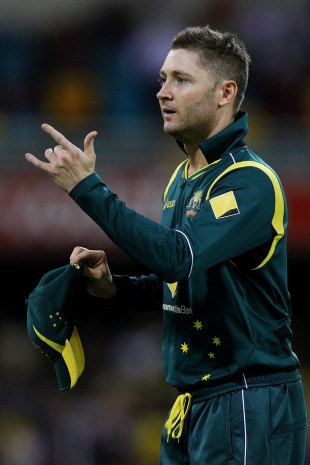
Michael Clarke directs his fielders, Australia v Sri Lanka, Brisbane, CB Series 1st final, March 4, 2012
Be true to your captaincy instincts © Getty Images 
Enlarge
Some coaches have an "unfair" knack
"An assistant coach told a story about how he couldn't get the team to work together at practice sessions, despite giving crystal clear instructions. Some time later he attended a practice led by the brilliant head coach, who began with the same practice drill. The head coach gave his characteristically vague and wobbly advice, and the whole team played together perfectly. It's an unjust world."
Allow room for mavericks
However good you are, some players won't listen - and nor should they. "One of the greatest players in history said he never looked at captains in the field as he couldn't understand what any of them were doing."
****
It's a very good list. But here is a confession. The book, though real, is not about cricket. The words captaincy and coaching are not mentioned at all, not once. The book's real subject is classical music, the title is Inside Conducting and its author is conductor Christopher Seaman. In quoting from the book, each time the term "conductor" appeared, I changed it for the word "captain"/"coach".
First, I want to demonstrate that cricket is not a ghetto, a special case that cannot learn from other disciplines. The art of performance is largely universal. As I found out when I made a series for the BBC comparing the life of a cricketer with that of a classical musician, the differences are dwarfed by the similarities.
Secondly, given the evolved state of professional sport, we need to rethink the outdated assumption that the way to inspire better performances is to threaten, bully, intimidate and scream at players. It's not wrong because it is undignified (though there is that too), it's wrong because it doesn't work. As I've argued before here, instead of seeing sportsmen as a rabble of unmotivated shysters in search of a sergeant-major to whip them into shape, professional athletes have more in common with surgeons and musicians.
Above all, captaincy and coaching are collaborative. No one, no matter how brilliant, can lead without followers. So I'll leave my favourite anecdote from the book in its original form, "untranslated" into cricket-speak:
"A famous conductor was conducting a major work without the score. At one point in the concert his memory failed him, and he gave an enormous downbeat in a silent bar. Nobody played, of course, and he froze in horror. A voice at the back of the violas whispered, 'Aha! He doesn't sound so good on his own, does he?'"

Saturday, 8 November 2014

The rise of unreason


Some 300 years ago the age of reason lifted Europe from darkness, ushering in modern science together with modern scientific attitudes. These soon spread across the world. But now, running hot on its heels is the age of unreason. Reliance upon evidence, patient investigation, and careful logic is giving way to bald assertions, hyperbole, and blind faith.

----For an alternative perspective view
The day the Universe Changed
---
Listen to India’s superstar prime minister, the man who recently enthralled 20,000 of his countrymen in New York City with his promises to change India’s future using science and technology. Inaugurating the Reliance Foundation Hospital in Mumbai two Saturdays ago, he proclaimed that the people of ancient India had known all about cosmetic surgery and reproductive genetics for thousands of years. Here’s his proof:
“We all read about Karna in the Mahabharata. If we think a little more, we realise that the Mahabharata says Karna was not born from his mother’s womb. This means that genetic science was present at that time. That is why Karna could be born outside his mother’s womb.” Referring to the elephant-headed Lord Ganesha, Modi asserted that, “there must have been some plastic surgeon at that time who put an elephant’s head on the body of a human being and began the practice of plastic surgery”.
Whether or not he actually believed his words, Modi knew it would go down well. In 1995, parts of India had gone hysterical after someone found Lord Ganesha would drink the milk if a spoon was held to his trunk. Until the cause was discovered to be straightforward capillary action (the natural tendency of liquids to buck gravity), the rush towards temples was so great that a traffic gridlock resulted in New Delhi and sales of milk jumped up by 30pc.

Once evidence becomes irrelevant, everything becomes possible.


Closer to home: a staggering number of Pakistanis — university science students included — believe that everything from quantum mechanics to black holes and genes were anticipated 1,400 years ago. Darwin’s theory of evolution is roundly rejected even by students and teachers in biology departments. Instead, the common belief is that all of modern science can be extracted by mastering Arabic and interpreting holy texts expertly enough. Forty years ago, when I joined Islamabad University, the chairman of the physics department, a pious man from the Tableeghi Jamaat, had just calculated the speed at which heaven is running away from earth — and found it to be one centimetre per second less than the speed of light. Today TV channels broadcast even more bizarre theories.
Once evidence becomes irrelevant, everything becomes possible. With only preformed notions as guide, outlandish conclusions, offensive to common sense, are frequent. The progress of science may suffer, but society and individuals take the brunt.
Take, for example, the question of whether Ram Janmabhoomi is actually the birthplace of Rama, the seventh avatar of Vishnu. Is this located precisely where Emperor Babar built the now-demolished Babri mosque? No conceivable archaeological evidence can adjudicate the matter. In fact it is impossible to establish on physical grounds the existence of Rama, much less the coordinates of his birthplace. But, the tragic events of Dec 6, 1992, owed to this belief. The scars of that terrible carnage have yet to heal.
Deliberately inflicted psychological scars may be even more unhealable. Terrifying life-after-death experiences are invented to create a passively accepting frame of mind. For decades, one of the most widely read books in Pakistan has been Maut ka manzar — marnay kay baad kya hoga (Scenes of life after death) with horrific episodes created by the author’s fertile imagination. Once considered as creative fiction, such life-after-death works are now becoming part of Pakistan’s mainstream education. Backed by university administrators, teachers and preachers are targeting the youth on campuses across the country.
On Oct 27, the Institute of Business Management in Karachi organised a major event, ‘The last moments — an exclusive insight on the death of a man’. The event’s black-and-white poster seems to be right out of some 1960s’ Hollywood horror movie with hooded, shrouded ghouls slouching across a graveyard. IoBM’s administration sent out official emails asking students to attend. A Saudi-certified professor would answer questions like: “Is life a mere game? Are you prepared for your death? Do you know what it feels at the moment you die? Is Allah pleased with your life?”
Such profound questions are surely best left up to God. A living, breathing, walking, talking professor cannot possibly adduce physical evidence about one’s dying moments. Nor claim to know whether Allah is pleased or angry with an individual. At best he can give his opinion.
I do not know what effect this particular professor had on his audience. But recently a colleague in Islamabad told me that his physics PhD student Mujeeb (not his real name) is behaving very strangely after viewing an after-death movie downloaded from some proselytizing website. Mujeeb now broods incessantly, worries more about death than life, and has almost stopped working.
It is not just South Asia where unreason is on the rise. The United States, the centre of high science, is now struggling with various crackpot anti-science movements. However, determined opposition has kept astrology, creationism, UFOs, magnetic therapy, etc. away from the mainstream.
In India, the battle against Vishwa Hindu Parishad and BJP ideology will be harder. But India has a strong Nehruvian past and Indian rationalists have strongly opposed so-called Vedic mathematics and cosmology, and revamping school curricula. The price has not been small. For example, Dr Narendra Achyut Dabholkar was murdered in Pune almost a year ago. He had helped draft the Anti-Jadu Tona Bill (Anti-Black Magic Bill) which political parties like the BJP and Shiv Sena opposed, claiming it would adversely affect Hindu culture, customs and traditions.
But nowhere in the world has unreason grown faster, and become more dangerous, than in Pakistan and Afghanistan. Polio workers here have shorter lives than soldiers in battle. More importantly, with schools, colleges, and universities actively working to crush young minds rather than enlighten them, this fight against unreason is surely going to be a much tougher one.