Search This Blog

Friday, 3 July 2020

The everyone economy: how to make capitalism work for all

After four decades of rising inequality, the Covid crisis is a chance to change the rules writes Martin Sandbu in The FT


A few weeks into the lockdown, when UK Covid-19 deaths were hitting a thousand a day, I crossed my London street to check on a neighbour. Around 50, she does not fall into a vulnerable category, but she works at a supermarket checkout and has been more exposed to contagion than most. And we had not seen her for a while, which was unusual. 

As it turned out, our neighbour was fine. With a pavement between us, we chatted about how she was not allowed to wear a face mask and gloves at the till. Then she said: “But I have to go to work, otherwise people won’t be able to buy their food, will they?” It was not a complaint, but an expression of pride in her new-found status of essential worker. 

That pride reflected the public appreciation suddenly afforded a group that had previously been treated with neglect. The pandemic and the lockdown brought home how we literally depend for our lives not just on doctors and nurses but also on the humbler jobs of cleaners and care workers, shelf-stackers and bus drivers, delivery couriers and cashiers. The weekly clap for carers, which in March became a national ritual in many European countries, embodied this new recognition. 

Pondering this fleeting moment of moral reordering, I could not help noticing how starkly it clashed with the underlying economic reality. In many rich countries, decades of economic polarisation have left people like my neighbour not just underpaid, but having to accept short-term contracts, erratic shift patterns and unpredictable earnings. This “precariat” faces debilitating insecurity, which lockdown has made worse. As the gilets jaunes protests in France illustrated, many people see the economy as a system to which they do not belong, rigged to benefit others. 

How did it come to this? How did much of the work we count as essential become ill-rewarded and precarious? And what has economic polarisation done to the way our societies and politics function? These are questions that Covid-19 forces us to confront. 

They were becoming hard to ignore long before this crisis. As an economic commentator for the FT, I have spent years trying to understand the causes of economic polarisation in the western world, its effects and what policies might reverse it. Like many others, I have worried that when our societies divide economically, they also fall apart culturally and politically. 

But the pandemic makes these questions more urgent, and adds a new one: will Covid-19 remake society? Is this tragedy also a once-in-a-lifetime opportunity to rebuild better economies? 

It is tempting to think we could be at a 1945-style moment, a year remembered as ushering in a new era. As Branko Milanovic, the economist known for his work on global inequality, writes, it is “utterly wrong to believe that history does not matter and that the social and political changes wrought by the pandemic can be ignored”. The political forces it has set in motion, he suggests, “will fundamentally affect how economies behave in the future”. 

The pandemic also highlights forces that were already at work. Donald Trump, the architects of Brexit and populist movements across Europe all advanced by appealing to groups that felt forgotten by elites and saw the economic system as rigged against them. They have, in effect, been promising to restore the post-1945 era and bring about the sort of moral reordering we glimpsed in the lockdown. 

There is a “rhetoric of how the golden days were better”, says political scientist Catherine De Vries. It is obvious why such nostalgia resonates. By happy accident as well as by policy design, the postwar industrial economy of the west was particularly well-suited for most people to share in economic growth. The three decades the French call les trente glorieuses produced a remarkable convergence in income and wealth levels between rich and poor, between workers of different educational levels, between countryside and city. 

I have a lot of sympathy with this nostalgia, having grown up in Norway in the 1970s and 1980s — a time and place that arguably came as close as any modern society to the ideal of an economy with a place for everyone. Few have ever had lower economic inequality or a shorter social distance between top and bottom, and managed to combine it with high productivity and strong growth. 

When I was living in New York in the 2000s, one mundane activity struck me as embodying the economic difference between the US and Norway: having your car cleaned. On entering a New York car wash, you would be set upon by a group of workers — often immigrants — who proceeded to clean your car by hand. In my childhood in Norway, your choice was between an automated car wash or doing the job yourself. 

It was the difference between an economic model employing low-productivity, low-wage labour and one where wage equality made it commercially necessary to automate to make labour more productive. It was, too, the difference between the precariat and what I think of as an economy of belonging. 

Since the late 1970s, every western economy, albeit some much more than others, has experienced widening economic fractures that have also polarised societies politically and culturally. We moved from an economy of belonging to an economy divided between the successful and the left behind. (Et in Arcadia Ego: the manual car wash has had a renaissance in Norway too, courtesy of underpaid immigrants.) 

This end of economic belonging coincided with the peak in industrial employment across what used to be known as the industrialised world. It is a widespread misunderstanding that the shift from industrial to knowledge-intensive economy involved manufacturing vanishing, or being whisked off to China and other low-cost countries. In fact, most rich economies produce about as much stuff today as they ever have. 

What changed was that factories no longer absorbed the same workforce. Growing productivity through automation and better know-how meant ever fewer hands were needed on assembly lines. New jobs were created in services but many of these were less productive, less well paid and less secure than the ones they replaced, as well as geographically distant from them. (This also meant growth rates slowed down, since manufacturing made up a shrinking share of employment even as its own productivity kept growing.) 

Job-altering technological transformation did not stop with factory work. Roughnecks and dockhands gave way to automated rigs and container cranes. Computing put an end to many clerical jobs. The internet has upended in-person retail. Too often, those who rely on such jobs have had to accept worsening conditions to remain employed. 

These changes are not, on the whole, the fault of globalisation, that scapegoat of the populist insurgency, but of technology-driven changes combined with policies that have reinforced the underlying forces of divergence. For example, western countries shifted tax burdens away from capital and high-wage incomes even as income and wealth inequality rose. Unions, which played a part in reducing income inequality, have declined almost everywhere. 

All this undermined the promise that the postwar economy had largely delivered on: that everyone could expect a secure place in the national economy. In many countries, median wages fell behind labour productivity after tracking it closely for decades. Income inequality and wealth inequality both started rising from around 1980. New jobs were not all created equal: manual and routine work lost out to knowledge work, as pay and job security increasingly depended on workers’ educational background and on where they lived. 

The last effect — regional inequality — is perhaps the most corrosive for our politics. The economic geographer Andrés Rodríguez-Pose calls the support for anti-system populists in peripheral areas “the revenge of the places that don’t matter”. Highly paid jobs and capital (but also low-paid service jobs to serve high earners) have been concentrating in the big metropolitan areas, capital cities above all, while peripheral regions have been drained of capital investment and good job prospects. 

The blow from the pandemic, in other words, landed on economies already made brittle by deep fractures. And not only that; it is making those fractures worse. 

Lockdown causes more pain for those already suffering from low pay and job insecurity, because it preponderantly affects manual jobs that require physical presence. In the UK, one-third of the lowest-paid quintile have lost work, against 15 per cent of the top quintile, according to the Resolution Foundation. In the US, African-Americans have suffered income losses at higher rates than other groups. 

Covid-19’s most important political legacy could be that these pre-existing fractures can no longer be ignored. The moment of moral clarity triggered by the pandemic opens a political opportunity to “rebuild better” so as to make the economy work for everyone, including my neighbour and others like her. 

Acute crises have helped reorient societies in the past. But David Edgerton, the British historian, cautions that 1945 may be the wrong reference. The postwar consensus on the welfare state was less radical than sometimes believed, he says — it was the continuation of a wartime consensus in which “Labour buys into a conservative agenda”. There is also no equivalent to the postwar confrontation with the Soviet Union today, Trump’s talk of a “Chinese virus” notwithstanding. According to Edgerton, “1933 is a better analogue.” Like then, the question today is: “How do you get economies going again?” 

The Great Depression was indeed an economic disaster so great that returning to the status quo ante was politically impossible. It produced radicalism unlike any seen today (yet): in the US, Franklin Roosevelt’s hyperactive New Deal reforms; in Scandinavia, groundbreaking compromises between capital and labour; and in continental Europe, fascism. Could the economic consequences of Covid-19 spur similarly radical change, and if so, how to turn it into a force for good? 

Even before the pandemic, I frequently argued that a Roosevelt-style “centrist radicalism” was necessary to stave off a much greater — and potentially much nastier — disruption, of which signs could already be seen in the rise of authoritarian populism. What would this look like today? It would not give up on globalisation. Instead, to close the economic fractures we have allowed to open in the past 40 years, I think such a programme would need to achieve five goals. 

First, it would jettison business models based on using low-productivity (and therefore low-paid) labour, and harness automation rather than resisting it. That means allowing low-productivity jobs to be competed out of existence by higher-productivity ones. Scandinavia has long shown how this can be done: high wages at the bottom of the distribution encourage employers to automate and boost productivity, while high skill levels and active labour-market policies help workers change jobs frequently and adapt to technological developments. 

Second, the programme would aim to shift more labour-market risk from employees to employers and the welfare system. That means lower tolerance for erratic earnings that make it harder for people to plan, retrain and seek new and better work. And it means avoiding aggressive means-testing of benefits, which, when combined with tax, leaves many lower-middle earners facing effective marginal income-tax rates of around 80 per cent or more. 

Together, these two principles point in the direction of higher minimum wages, a universal basic income (or its less budget-heavy equivalent, a negative income tax), generous government funding for education and labour-market mobility, and strict enforcement of labour standards. 

Third, we can reform taxes to counteract economic divergence instead of intensifying it. That means lowering taxes that penalise hiring. To pay for this, as well as for a negative income tax and policies supporting a well-working labour market, other taxes have to go up. The best candidates are a net wealth tax — which, unlike other capital taxes, favours those who put their capital to the most productive use — and removing the gaping loopholes in multinational taxation, as well as increasing tax revenue from carbon emissions, in line with the climate challenge. A particularly promising proposal is the “carbon tax and dividend”, where revenue from higher emissions taxes would be paid out as a universal basic income. Calculations show that such a policy can leave poorer households significantly better off, even after fuel-price increases are taken into account. 

Fourth, macroeconomic and financial sector policy can be reformed in favour of the left behind. That means sustaining a “high-pressure economy” to keep job creation high, in the knowledge that those on the margins of the job market are fired first in a recession and hired last in a recovery. Governments and central banks must stimulate demand strongly for a long time after the lockdowns end, with debts restructured so they do not hold back investment. 

Fifth, and most challenging, we can work to reverse the divergence between the centre and the periphery. The previous four elements would help with this. But greater policy efforts are needed to give regions, where possible, a critical mass of knowledge jobs so they can connect with the leading economic activity in national centres. 

These are big changes. But, as Milanovic argues, one consequence of the pandemic we can predict with some confidence is a “tendency toward [a] greater state role in many countries”. Some politicians are embracing this with gusto, at least rhetorically: this week, Boris Johnson and his colleagues cast themselves as latter-day Roosevelts, and explicitly compared their levelling-up agenda to FDR’s New Deal. 

Governments everywhere have already gone to extraordinary lengths both to halt the pandemic and to offset the economic consequences of the lockdown. After this experience, as French president Emmanuel Macron has asked in the context of climate change, will publics accept claims that large-scale policy shifts are too hard to achieve? 

Having become accidental radicals, centrist parties may well be tempted to keep making more ambitious offers to voters. “When people are unhappy they go for more extreme choices,” says De Vries. Behind populists’ success, she adds, was “the story of how mainstream parties had become Tweedledee and Tweedledum”, lacking any ideology. Centrist parties “could reinvent themselves by taking clearer positions”. 

With the pandemic causing widespread economic damage to already polarised societies, continued radical policy action cannot be in doubt. What we are going to find out is for what — and for whom — that radicalism will be used.

Inside China’s race to beat poverty

China may be currently unpopular with the rest of the world; but, like the Soviets before them, they claim to have lifted large numbers of people out of poverty writes  and  in The FT


Two A3-sized cards hanging outside the door of Jike Shibu’s house in Atule’er, a village perched on a cliff in the mountains of south-west China, were enough to determine his family’s fate. One was white and divided into four sections: “Having a good house; living a good life; cultivating good habits; creating a good atmosphere.” Each section was scored out of 100, with Jike’s family gaining just 65 points on the issue of housing. 


Next to the white card was a red one, granting them the title of “poverty-stricken household with a card and record”. On it, an official’s handwritten recommendations for how the family could improve their lot. Their “main cause of poverty” was diagnosed as “bad transport infrastructure and lack of money”. Recommended measures included growing higher-profit crops, such as Sichuanese peppercorn, and “changing their customs”. 

By themselves, the cards are not much use to the villagers: very few of those born before the 2000s read Chinese characters fluently. But the writing on them has changed their futures — in Jike’s case, resettling his family in a purpose-built, bustling compound in the nearby market town of Zhaojue. 

Zhaojue is a place in a hurry. The government has set a deadline of the end of this month to end extreme poverty in the surrounding county of Liangshan, one of the most deprived in China. “Win the tough battle to end poverty,” proclaims the central hotel on a red electronic marquee — along with the number of days to the deadline. On the narrow streets outside, farmers rush around with wicker baskets full of produce, and vendors sell shoes and clothes piled high on plastic sheets. 

The roots of this frantic activity go back to 2013, when leader Xi Jinping set a deadline for all of China’s rural counties to eradicate extreme poverty by the end of 2020. In the four decades since market reform began, China has already made huge advances in this area, winning praise from the UN, World Bank and figures from Bill Gates to Bernie Sanders, for raising 850 million people out of extreme poverty. 

For both Xi and the Chinese Communist party, poverty-alleviation goals are more than a policy target. They are also a major source of legitimacy, both inside China and globally. “In my opinion, western politicians act for the next election. [By contrast] China has a ruling party that wants to achieve big goals,” says Hu Angang, a government adviser and head of China Studies at Tsinghua university. “In the history of human development, China achieving this is, if not unique, then at least something worthy of admiration.” 

In the five years of Xi’s first term, an average of 13 million people were lifted out of poverty each year, according to the government. Some 775,000 officials were sent to villages to lead poverty alleviation and the government fund for this purpose increased by more than 20 per cent annually since 2013. State media said in March that central coffers had already handed out Rmb139.6bn (£15.8bn) of an estimated Rmb146bn this year. But the Covid-19 epidemic has led to an economic downturn, with the country’s GDP for the first quarter shrinking for the first time in four decades. Areas that were already deprived have been some of the hardest hit. 

By the end of 2019, there were still 5.5 million individuals in extreme rural poverty around China. Xi’s goal is to bring this figure to zero in time for the centenary of the Communist party in July 2021. Coinciding with this would allow him to declare that China is prosperous and deserves to be a world leader, says Gao Qin, an expert on China’s social welfare at Columbia University. “The government is determined to achieve this goal,” says Gao. “Since March, official publications have reaffirmed that it must happen by the end of the year.” 

In a bid to do this, the fronts for Xi’s “tough battle” on poverty are shifting. “Some villages are in extreme poverty that is difficult to alleviate, because of natural conditions and of the lack of transport infrastructure. In these places, very few villagers can become migrant workers and they rely on subsistence agriculture,” says Wang Xiangyang, assistant professor of public affairs at Southwest Jiaotong University. These include remote mountain communities such as the one in which Jike lives. 


Atule’er — or Cliff Village as it is now widely known in China — sits atop a 1,400m mountain. Like many of the Yi ethnic minority areas of Liangshan, it is infrequently visited by tourists and difficult to reach, and may well have stayed that way had it not come to national prominence in 2016. That year, a local media feature showed children clinging to an old, crumbling vine ladder on their two-hour descent to the nearest school. Soon, more journalists arrived, and the local government pledged a new 800m steel ladder. 

“Liangshan became the forefront of poverty alleviation — a lab within the country,” says Jan Karlach, research fellow at the Czech Academy of Sciences, whose research has focused on Liangshan and the Nuosu-Yi for the past 10 years. In 2017, at the annual meeting of China’s parliament, Xi dropped by the Sichuan province delegation to ask about progress alleviating poverty among the Yi people. “When I saw a report about the Liangshan cliff village on television . . . I felt anxious,” he said. 

Over the past few months, the local government has resettled 84 households, or half the village, in Zhaojue, giving them apartments at the heavily subsidised price of Rmb10,000 (£1,130) per apartment. The “resettlement homes” are located a two-hour drive away from the base of Atule’er’s mountain, with a red banner across the entrance welcoming new residents. 

The villagers allocated these flats are happy to have them. On the mountaintop, their earthen houses are exposed to the rain, as well as fatal rock slides. There, the only industry is subsistence farming. There is no medical care or formal education. 

While some Yi academics question the changing of local (non-Han Chinese) customs for those moved from Cliff Village, the Communist party’s efforts have been largely welcomed. “Even my traditionalist friend — who said he couldn’t live in a house without a Yi fireplace — ditched the idea within a year,” says Karlach. His friend now lives in a town apartment with a picture of Xi on the wall: a poster handed out by local officials to remind poor households who to thank. 

But others are not yet sure how to adapt to life in the town, where they will have to transform their mountain-dwelling culture to fit the 100 sq m apartments. “My mother isn’t keen to come down from the mountaintop,” says the 24-year-old Jike. “Elderly people don’t like the town, they say there’s no land and nothing to eat there. I say, ‘What others eat, you’ll eat.’ The elderly can’t stay up there on their own.” 

Recently, Jike has been carrying heavy loads of bedding and clothes on his trips down the mountain, getting ready for his move. He has also acquired a following on social media. Hopping between slippery footholds, his giant plastic pack on his back, he holds his smartphone out on a selfie stick and chats cheerfully to fans on Douyin, China’s domestic version of TikTok. Jike can earn Rmb3,000 per month from live-streaming: a fortune compared with the Rmb700 average for rural locals. 

He has agreed to take us up to his village in part because he believes the residents who remain there need a better platform to air their views. In some regions, China’s strategy of development through urbanisation has led to forced demolitions, and farmers stripped of the land their families had tended for generations. But Cliff Village faces the opposite problem: there are many more people who want to move than the government has relocated. 

 Over the two days that we spend there, more people approach us, wanting to show us the insides of their houses and tell us how the local government has overlooked them. In Zhaojue, the threshold for being extremely poor is living on less than Rmb4,200 per year (£475) and, in Cliff Village, such officially “poverty-stricken” households receive a basic income guarantee, the right to buy cut-price new apartments — and even 30 chickens. 

But there are also those unlucky enough to be officially logged as poor, either through neglect, miscalculation or mere bureaucracy. They do not receive the same benefits, although they are entitled to some payments, such as the minimum livelihood guarantee. They also do not count towards the government’s poverty-eradication target. In some cases, the government has solved meeting its poverty targets administratively: certain areas have stopped logging residents as “impoverished” since the start of the year. “It’s all been counted, the system no longer takes new impoverished households,” says Azi Aniu, a local county-level party secretary. (He later vacillated on this point, telling us that they were able to log new impoverished households but chose not to.) 

While the rapid rate of alleviation is real, the true level of poverty may be impossible to gauge in a system not designed to admit mistakes. According to official policy, if the minimum-livelihood guarantee was being implemented properly, such impoverished households would not exist. The current database will be overhauled for the next step of China’s development plan, which will move on to “precarious” or “borderline” households. 

According to Li Shi, professor of economics at Beijing Normal University, surveys from 2014 suggested some 60 per cent of those who should qualify for “poverty-stricken” status based on their low incomes did not get the designation. In the years that followed, “some adjustments were made, and there should be some improvement,” Li wrote. 

But many of those still in Atule’er feel left behind. “You’re not going to write one of those ‘Goodbye to Cliff Village’ articles, are you?” asks Jike Quri, a man who had waited all day at the top of the steel ladder for us to arrive. “There is no goodbye: half of us are still here.” 


Within an hour of us checking in, local authorities arrived at our hotel door, indicating the sensitivities around this story. State media had come the week before to report on one of the most high-profile battlegrounds in China’s anti-poverty push, and had written stories about happy villagers moving into their flats. 

In one local media spread, the family of Mou’se Xiongti, a 25-year-old man, were photographed in their new flat, the bed decked with blankets. When we visited Mou’se’s flat, it was empty except for the government-provided furniture: a set of cabinets, sofa, chairs, tables and bed. Many items were stamped with “People’s Government of Sichuan Provincial Committee of the Communist Party of China”. 

The nervousness of local politicians is largely due to the fact that Cliff Village is now renowned for its role as part of a high-level target: Xi has personally embraced poverty alleviation, boosting his populist image as a “peasant emperor” with sympathies for ordinary Chinese people — a persona not dissimilar to that cultivated by Mao Zedong. State propaganda often depicts Xi chatting with farmers about the harvest, sitting cross-legged in village homes or laughing with pensioners. In his first five-year presidential term from 2012, he visited 180 poor regions across 20 provinces. He visited Liangshan in 2018. 

The red and white cards that ultimately gave Jike Shibu’s family a flat are part of a policy which required creating a database of households and checking their progress. This campaign came with a boost in government funding for rural social welfare projects, a powerful committee to guide policy and the establishment of a national database of poor households. By the end of this year, that system must be cleared of households like Jike’s.  
But the villagers still left in Atule’er say they have not received such targeted attention from the local officials, who, they allege, don’t bother to visit their mountaintop homes that often. (The local official Azi counters that he has trekked up the mountain so many times he has damaged his legs.) As a result, they complain there is no meaningful distinction between “poverty-stricken” households and others, and those in need of help are not getting it. 

Some households face the problem of getting lumped together into one record. This happens when adults with their own children are still marked on the record of their parents, meaning they are only assigned one house. Often, officials reject their requests to register new households. 

Others suffer Kafkaesque bureaucratic processes. Jizu Wuluo, a 37-year-old widow and mother to four children, two of whom she had to give up for adoption, is determined to give her youngest a good education and rents a flat near the school at the bottom of the cliff. Jizu ticks many of the boxes of an “impoverished” household: she lives in one of the fragile houses on Cliff Village, heads a single-earner family and also “suffers hardship for education”. 

However, although she has tried to get “impoverished” status on several occasions, each time officials told her to wait. In October last year she and her two sons were finally each given a minimum livelihood guarantee of Rmb2,940 per year, part of the government’s package of anti-poverty measures that it uses when all else fails. About 43 million people receive it nationwide. In Zhaojue county, the maximum paid per rural recipient per year is Rmb4,200. 

“I know Xi Jinping said to help those poor and suffering ordinary folk, but when it comes to grassroots officials like you, you only help those people who already have standing in society,” she says in a meeting with Azi, who listened patiently to a string of complaints. 

After we left, Azi quickly followed up on Jizu’s case. The explanation for why she had not been prioritised for an apartment raised more questions than it answered. Jizu had been missed out of the first survey of impoverished households in 2013. Later, she was recorded as “an impoverished household without an official record”. Azi says they could not create an official “impoverished household” record for her after her husband died in 2018. Instead, they added more labels to her case. Azi couldn’t say when the list of impoverished households stopped being amended but, he says, Jizu will be moved into town by the end of the year. 

“The relocation apartments are beautiful, they are better than other properties in town, so some villagers get a bit jealous,” says Azi. “I’m being very straightforward with you.” 


Moving into town may be one step towards ensuring a secure livelihood, but the most important is finding work. Local officials encourage the younger generation to seek jobs in cities, particularly those along the industrialised south-east coast. For decades, rural-urban migration has been the standard way of improving livelihoods: some 236 million people in China are migrant workers, according to government statistics. 

Of the locals we spoke to in their late teens and twenties, many had gone out to work for a few months at a time. Most did unskilled labour in construction and went in groups arranged by friends or relatives. Like migrants from around China, Liangshan’s workers live as second-class citizens when they arrive in major cities, where it is almost impossible to access healthcare or education for their children. During the coronavirus epidemic, these workers — who often had to continue delivering groceries and cleaning hospitals — were highly vulnerable. 

The work that Liangshan locals can do is also limited by their education. Most of our interviewees were semi-literate at best, and some did not speak Mandarin. The internet is changing that. Social media, ecommerce and live-streaming have created greater opportunity for reading and writing outside of the world of formal education. Jike, who received just two years of schooling, says he learnt a lot about reading, writing and speaking Chinese from live-streaming. Every now and then, as viewers’ comments flash in real time across his screen, he addresses the commenter by saying, “Sister, I can’t read that.” 

Education is another way of leaving the village. While some families prefer to let their children work, others are keen to send them to school. Mou’se Lazuo, the 17-year-old sister of Xiongti, hopes to break the trend in her village by going to university. She is the oldest girl in Cliff Village still at school; the older ones have gone to work or got married. She is one of 72 students in her class. 

While she speaks Yi at home, Mou’se studies in Mandarin, with the exception of an hour and a half of Yi language classes per week. “I think it’s fine for Han culture to come here, so long as Han culture and Yi exist side by side,” she says. “We can’t leave parts of our traditional culture, like our legends and our language.” 


The Yi didn’t come to China: China came to the Yi. Yi people have lived in the mountains of Liangshan for centuries, not far from Sichuan’s borders with Tibet and Myanmar. After teetering on the edge of the Chinese empire for over a millennium, Liangshan was brought under Communist rule in 1957 with the help of the People’s Liberation Army. The Yi were categorised as such by anthropologists sent by the Beijing-based national government in the 1950s, who determined the roster of 55 officially recognised ethnic minorities. 

“It’s a civilising project,” says Karlach, the researcher who has lived in Liangshan, describing the government’s attitude towards poverty alleviation with ethnic minorities. “In Liangshan, in many places, they’re not offered to indigenise or develop their own modernity: they are given the modernity from the outside. They want to be Chinese and are proud to be Chinese, but also want to be Yi.” 

For the government, teaching the Mandarin language and Han customs not only makes ethnic minorities easier to govern, but also helps them fit into a Han-dominated economy. Also, rapid urbanisation has changed all traditional cultures in China, subsuming them into the monoculture of the city and of earning money. 

In Zhaojue, most shops employ at least some locals, although the newer ones are largely run by Han Chinese migrants from richer parts of China. “Generally, local workers don’t stay for long,” says Mao Dongtian, an entrepreneur from the coastal city of Wenzhou. He has opened a local chain of cafés and karaoke bars. His staff earn between Rmb1,000 and Rmb3,000 — a decent amount for the area — but don’t like the discipline and loss of freedom that come with a full-time job, he says. 

“Their ways are more backwards than the Han people, and we are trying to teach them our ways,” continues Mao, describing how he encouraged his staff to seek medical help for ailments rather than rely on folk treatments. Such beliefs are typical of the majority ethnic group’s attitudes towards China’s minorities. Though some of these attitudes are rooted in stereotypes, others reflect a way of life shaped by subsistence agriculture. 


When I ask Jike what he will most miss about Cliff Village, he says “the view”. He plans to make the trip up now and again to enjoy it. After sunset, there are innumerable stars and the night is black and quiet. Zhaojue, on the other hand, is lit with streetlamps and has the bustle of people and cars. 

After June 30, the government will move on to the next stage of China’s development plan: “the strategy to revitalise villages”. Although China’s development plans have focused on the rural poor, the urban poor are of increasing concern. They are more likely to slip between the bureaucratic cracks, as they are often not registered in the places where they live and work. Cities are loath to accept such migrants: two years ago, Beijing “cleaned out” residents referred to by politicians as the “low-end population”. Some economists estimate that about 50 million migrant workers became unemployed at the start of the epidemic. 

This month, Premier Li Keqiang sparked a public outcry over Xi’s claims of success on poverty alleviation, after announcing that the bottom two-fifths of the population made on average an income of less than Rmb1,000 a month. Those 600 million people constitute a significant proportion of city dwellers as well as the rural poor. 

“Somehow or other, this [poverty] target will be declared to have been achieved and will form a part of the big celebrations next year. And then the goalposts will shift, I suspect towards issues of equality and equity,” said Kerry Brown, a scholar of Chinese politics at King’s College London. “That’s really where the key battleground will be, because inequality in China is a serious problem and it’s not getting better.”

Thursday, 2 July 2020

The £ Sterling’s faded illusion of sovereignty

Philip Stephens in The FT

Margaret Thatcher once told me that she would never allow “the Belgians” to decide the value of the British pound. At the time, the then prime minister was battling her chancellor Nigel Lawson’s plan to fix the value of sterling in the European exchange rate mechanism. For some reason she had identified me as one of the chancellor’s confidants. “The Belgians”, equally inexplicably, was her shorthand for the EU.  


The fight cost the chancellor his job, but a year or so later Thatcher was obliged to relent. Two years after it joined the ERM, sterling crashed out of the system amid a tsunami of speculative selling. 

Thatcher by then had gone, replaced by John Major. Even so, the pound became an inviolable emblem of national sovereignty in the Conservative party’s long war with Brussels. Before too long, another Tory leader, William Hague, was promising to “save” sterling from the euro. Black Wednesday, you could say, mapped the Tory route to the Brexit vote in 2016.

I was reminded of the Thatcher encounter by a report published the other day by analysts at Bank of America. Since the Brexit referendum, the pound has rather lost its lustre as a store of value. It no longer bears comparison, the analysts said, with traditional peers such as the dollar, yen, swiss franc or euro. Instead, sterling may more closely resemble an emerging market currency, such as the Mexican peso. Sterling’s effective exchange rate has fallen by about 14 per cent since 2016, but twin budget and current account deficits promise further trouble.  

In truth, Thatcher’s elevation of the pound into an essential pillar of nationhood belied its postwar role in Britain’s fortunes. For decades, an ever-present threat of devaluation was a ball-and-chain around the ankles of successive prime ministers. In 1945, about half the world’s trade was still transacted in sterling. From then on, it was all downhill.  

The failed effort to defend Britain’s global prestige through preservation of the so-called sterling balances held by overseas central banks and financial institutions left governments at the mercy of international investors and speculators. 

It also produced a series of politically costly devaluations. In 1950, one pound bought about 12 Deutsche Marks. In the absence of the euro, the comparable figure today would be a little above two. 

In effect, pressure on the pound measured the gap between Britain’s determination to hold on to its status as a world power, and the capacity of a stuttering domestic economy to generate sufficient resources to match its overseas ambitions and commitments. The price of propping up the pound was a ruinous stop-go approach to domestic economic management. 

It was no coincidence that the devaluation that was forced on Harold Wilson’s government in 1967 sounded the final retreat from imperial pretensions with the subsequent withdrawal of British forces from east of Suez. 

In the circumstances, one might think that sterling would have lost its talismanic status long ago. The sovereignty so preciously guarded by the Brexiters is an illusion. The truth Thatcher could never admit was that the appearance of national control does not change the facts of foreign exchange markets. The pound’s exchange rate, fixed or otherwise, ultimately depends on the confidence, or otherwise, of foreign investors in the nation’s political stability and economic performance — and, yes, that includes the Belgians. 

Mark Carney, the former governor of the Bank of England, has also remarked on how sterling has “decoupled” from its usual peers. Bank of America’s grim prognosis, however, is not universally shared among financial institutions. 

Some think the pound’s present exchange rate anticipates more economic disruption after the expiry of the Brexit transitional arrangements. In the short term, the conclusion of even a fairly thin trade deal with the EU27 could see a temporary appreciation. 

That said, trade deal or no deal, and even assuming a relatively robust recovery from the coronavirus-induced recession, Brexit will throw up new barriers to trade with Britain’s most important market. This promises in turn lower-than-otherwise economic growth, and a widening of the current account deficit. It is hard to find reasons for a positive view of the pound over the medium to long-term. 

The government, of course, could treat sterling’s move to the sidelines as something of a liberation. For now, it has little problem financing its burgeoning government deficit. Devaluation would also provide at least a temporary route to improved competitiveness. It could even pretend, as Wilson did, that a weak currency does not cut living standards. 

I am not sure this would sit alongside Boris Johnson’s expansive pledge to turn Brexit into the platform for the relaunch of “Global Britain”. The prime minister, I am told, is emotionally sympathetic to grand talk about carving out a new role in the Gulf and beyond. 

But no one knows where the money would come from. 

One way or another, sterling holds up a mirror to the world’s view of Britain. The signals are not encouraging. In the 1970s, the UK earned the sobriquet of “the sick man of Europe”. The danger now is it will become the invalid on Europe’s edge.

What's wrong with WhatsApp

As social media has become more inhospitable, the appeal of private online groups has grown. But they hold their own dangers – to those both inside and out. By William Davies in The Guardian


In the spring, as the virus swept across the world and billions of people were compelled to stay at home, the popularity of one social media app rose more sharply than any other. By late March, usage of WhatsApp around the world had grown by 40%. In Spain, where the lockdown was particularly strict, it rose by 76%. In those early months, WhatsApp – which hovers neatly between the space of email, Facebook and SMS, allowing text messages, links and photos to be shared between groups – was a prime conduit through which waves of news, memes and mass anxiety travelled.

At first, many of the new uses were heartening. Mutual aid groups sprung up to help the vulnerable. Families and friends used the app to stay close, sharing their fears and concerns in real time. Yet by mid-April, the role that WhatsApp was playing in the pandemic looked somewhat darker. A conspiracy theory about the rollout of 5G, which originated long before Covid-19 had appeared, now claimed that mobile phone masts were responsible for the disease. Across the UK, people began setting fire to 5G masts, with 20 arson attacks over the Easter weekend alone.

WhatsApp, along with Facebook and YouTube, was a key channel through which the conspiracy theory proliferated. Some feared that the very same community groups created during March were now accelerating the spread of the 5G conspiracy theory. Meanwhile, the app was also enabling the spread of fake audio clips, such as a widely shared recording in which someone who claimed to work for the NHS reported that ambulances would no longer be sent to assist people with breathing difficulties.

This was not the first time that WhatsApp has been embroiled in controversy. While the “fake news” scandals surrounding the 2016 electoral upsets in the UK and US were more focused upon Facebook – which owns WhatsApp – subsequent electoral victories for Jair Bolsonaro in Brazil and Narendra Modi in India were aided by incendiary WhatsApp messaging, exploiting the vast reach of the app in these countries. In India, there have also been reports of riots and at least 30 deaths linked to rumours circulating on WhatsApp. India’s Ministry of Information and Broadcasting has sought ways of regulating WhatsApp content, though this has led to new controversies about government infringement on civil liberties.


Brazil’s president Jair Bolsonaro with a printout of an opponent’s WhatsApp message about him. Photograph: Ueslei Marcelino/Reuters

As ever, there is a risk of pinning too much blame for complex political crises on an inert technology. WhatsApp has also taken some steps to limit its use as a vehicle for misinformation. In March, a WhatsApp spokesperson told the Washington Post that the company had “engaged health ministries around the world to provide simple ways for citizens to receive accurate information about the virus”. But even away from such visible disruptions, WhatsApp does seem to be an unusually effective vehicle for sowing distrust in public institutions and processes.

A WhatsApp group can exist without anyone outside the group knowing of its existence, who its members are or what is being shared, while end-to-end encryption makes it immune to surveillance. Back in Britain’s pre-Covid-19 days, when Brexit and Jeremy Corbyn were the issues that provoked the most feverish political discussions, speculation and paranoia swirled around such groups. Media commentators who defended Corbyn were often accused of belonging to a WhatsApp group of “outriders”, co-ordinated by Corbyn’s office, which supposedly told them what line to take. Meanwhile, the Conservative party’s pro-Brexit European Research Group was said to be chiefly sustained in the form of a WhatsApp group, whose membership was never public. Secretive coordination – both real and imagined – does not strengthen confidence in democracy.

WhatsApp groups can not only breed suspicion among the public, but also manufacture a mood of suspicion among their own participants. As also demonstrated by closed Facebook groups, discontents – not always well-founded – accumulate in private before boiling over in public. The capacity to circulate misinformation and allegations is becoming greater than the capacity to resolve them.

The political threat of WhatsApp is the flipside of its psychological appeal. Unlike so many other social media platforms, WhatsApp is built to secure privacy. On the plus side, this means intimacy with those we care about and an ability to speak freely; on the negative side, it injects an ethos of secrecy and suspicion into the public sphere. As Facebook, Twitter and Instagram become increasingly theatrical – every gesture geared to impress an audience or deflect criticism – WhatsApp has become a sanctuary from a confusing and untrustworthy world, where users can speak more frankly. As trust in groups grows, so it is withdrawn from public institutions and officials. A new common sense develops, founded on instinctive suspicion towards the world beyond the group.

The ongoing rise of WhatsApp, and its challenge to both legacy institutions and open social media, poses a profound political question: how do public institutions and discussions retain legitimacy and trust once people are organised into closed and invisible communities? The risk is that a vicious circle ensues, in which private groups circulate ever more information and disinformation to discredit public officials and public information, and our alienation from democracy escalates.

When WhatsApp was bought by Facebook in 2014 for $19bn, it was the most valuable tech acquisition in history. At the time, WhatsApp brought 450 million users with it. In February this year, it hit 2 billion users worldwide – and that is even before its lockdown surge – making it by far the most widely used messenger app, and the second most commonly used app after Facebook itself. In many countries, it is now the default means of digital communication and social coordination, especially among younger people.

The features that would later allow WhatsApp to become a conduit for conspiracy theory and political conflict were ones never integral to SMS, and have more in common with email: the creation of groups and the ability to forward messages. The ability to forward messages from one group to another – recently limited in response to Covid-19-related misinformation – makes for a potent informational weapon. Groups were initially limited in size to 100 people, but this was later increased to 256. That’s small enough to feel exclusive, but if 256 people forward a message on to another 256 people, 65,536 will have received it.

Groups originate for all sorts of purposes – a party, organising amateur sport, a shared interest – but then take on a life of their own. There can be an anarchic playfulness about this, as a group takes on its own set of in-jokes and traditions. In a New York Magazine piece last year, under the headline “Group chats are making the internet fun again”, the technology critic Max Read argued that groups have become “an outright replacement for the defining mode of social organization of the past decade: the platform-centric, feed-based social network.”

It’s understandable that in order to relax, users need to know they’re not being overheard – though there is a less playful side to this. If groups are perceived as a place to say what you really think, away from the constraints of public judgement or “political correctness”, then it follows that they are also where people turn to share prejudices or more hateful expressions, that are unacceptable (or even illegal) elsewhere. Santiago Abascal, the leader of the Spanish far-right party Vox, has defined his party as one willing to “defend what Spaniards say on WhatsApp”.

 
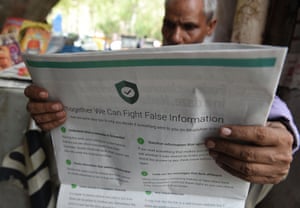
A WhatsApp newspaper ad in India warning about fake information on its service. Photograph: Prakash Singh/AFP/Getty Images

A different type of group emerges where its members are all users of the same service, such as a school, a housing block or a training programme. A potential problem here is one of negative solidarity, in which feelings of community are deepened by turning against the service in question. Groups of this sort typically start from a desire to pool information – students staying in touch about deadlines, say – but can swiftly become a means of discrediting the institution they cluster around. Initial murmurs of dissatisfaction can escalate rapidly, until the group has forged an identity around a spirit of resentment and alienation, which can then be impossible to dislodge with countervailing evidence.

Faced with the rise of new technologies, one option for formal organisations and associations is to follow people to their preferred platform. In March, the government introduced a WhatsApp-based information service about Covid-19, with an automated chatbot. But groups themselves can be an unreliable means of getting crucial information to people. Anecdotal evidence from local political organisers and trade union reps suggests that, despite the initial efficiency of WhatsApp groups, their workload often increases because of the escalating number of sub-communities, each of which needs to be contacted separately. Schools desperately seek to get information out to parents, only to discover that unless it appears in precisely the right WhatsApp group, it doesn’t register. The age of the message board, be it physical or digital, where information can be posted once for anyone who needs it, is over.

WhatsApp’s ‘broadcast list’ function, which allows messages to be sent to multiple recipients who are invisible to one another (like email’s ‘bcc’ line), alleviates some of the problems of groups taking on a life of their own. But even then, lists can only include people who are already mutual contacts of the list-owner. The problem, from the point of view of institutions, is that WhatsApp use seems fuelled by a preference for informal, private communication as such. University lecturers are frequently baffled by the discovery that many students and applicants don’t read email. If email is going into decline, WhatsApp does not seem to be a viable alternative when it comes to sharing verified information as widely and inclusively as possible.

Groups are great for brief bursts of humour or frustration, but, by their very nature, far less useful for supporting the circulation of public information. To understand why this is the case, we have to think about the way in which individuals can become swayed and influenced once they belong to a group.

The internet has brought with it its own litany of social pathologies and threats. Trolling, flaming, doxing, cancelling and pile-ons are all risks that go with socialising within a vast open architecture. “Open” platforms such as Twitter are reminders that much social activity tends to be aimed at a small and select community, but can be rendered comical or shameful when exposed to a different community altogether.

As any frequent user of WhatsApp or a closed Facebook group will recognise, the moral anxiety associated with groups is rather different. If the worry in an open network is of being judged by some outside observer, be it one’s boss or an extended family member, in a closed group it is of saying something that goes against the codes that anchor the group’s identity. Groups can rapidly become dominated by a certain tone or worldview that is uncomfortable to challenge and nigh-impossible to dislodge. WhatsApp is a machine for generating feelings of faux pas, as comments linger in a group’s feed, waiting for a response.

This means that while groups can generate high levels of solidarity, which can in principle be put to powerful political effect, it also becomes harder to express disagreement within the group. If, for example, an outspoken and popular member of a neighbourhood WhatsApp group begins to circulate misinformation about health risks, the general urge to maintain solidarity means that their messages are likely to be met with approval and thanks. When a claim or piece of content shows up in a group, there may be many members who view it as dubious; the question is whether they have the confidence to say as much. Meanwhile, the less sceptical can simply forward it on. It’s not hard, then, to understand why WhatsApp is a powerful distributor of “fake news” and conspiracy theories.

As on open social platforms, one of the chief ways of building solidarity on WhatsApp is to posit some injustice or enemy that threatens the group and its members. In the most acute examples, conspiracy theories are unleashed against political opponents, to the effect that they are paedophiles or secret affiliates of foreign powers. Such plausibly deniable practices swirled around the fringes of the successful election campaigns of Modi, Bolsonaro and Donald Trump, and across multiple platforms.


FacebookTwitterPinterest A security message on WhatsApp. Photograph: Thomas White/Reuters
But what makes WhatsApp potentially more dangerous than public social media are the higher levels of trust and honesty that are often present in private groups. It is a truism that nobody is as happy as they appear on Facebook, as attractive as they appear on Instagram or as angry as they appear on Twitter, which spawns a growing weariness with such endless performance. By contrast, closed groups are where people take off their public masks and let their critical guard down. Neither anonymity (a precondition of most trolling) nor celebrity are on offer. The speed with which rumours circulate on WhatsApp is partly a reflection of how altruistic and uncritical people can be in groups. Most of the time, people seem to share false theories about Covid-19 not with the intention of doing harm, but precisely out of concern for other group members. Anti-vaxx, anti-5G or anti-Hillary rumours combine an identification of an enemy with a strong internal sense of solidarity. Nevertheless, they add to the sense that the world is hostile and dangerous.

There is one particular pattern of a group chat that can manufacture threats and injustices out of thin air. It tends to start with one participant speculating that they are being let down or targeted by some institution or rival group – be it a public service, business or cultural community – whereupon a second participant agrees. By this stage, it becomes risky for anyone else to defend the institution or group in question, and immediately a new enemy and a new resentment is born. Instantly, the warnings and denunciations emanating from within the group take on a level of authenticity that cannot be matched by the entity that is now the object of derision.

But what if the first contributor has misunderstood or misread something, or had a very stressful day and needs to let off steam? And what if the second is merely agreeing so as to make the first one feel better? And what if the other members are either too distracted, too inhibited or too exhausted to say anything to oppose this fresh indignation? This needn’t snowball into the forms of conspiracy theory that produce riots or arson attacks. But even in milder forms, it makes the job of communicating official information – occasionally life-saving information – far more troublesome than it was just a decade ago. Information about public services and health risks is increasingly having to penetrate a thicket of overlapping groups, many of which may have developed an instinctive scepticism to anything emanating from the “mainstream”.

Part of the challenge for institutions is that there is often a strange emotional comfort in the shared feeling of alienation and passivity. “We were never informed about that”, “nobody consulted us”, “we are being ignored”. These are dominant expressions of our political zeitgeist. As WhatsApp has become an increasingly common way of encountering information and news, a vicious circle can ensue: the public world seems ever more distant, impersonal and fake, and the private group becomes a space of sympathy and authenticity.

This is a new twist in the evolution of the social internet. Since the 90s, the internet has held out a promise of connectivity, openness and inclusion, only to then confront inevitable threats to privacy, security and identity. By contrast, groups make people feel secure and anchored, but also help to fragment civil society into separate cliques, unknown to one another. This is the outcome of more than 20 years of ideological battles over what sort of social space the internet should be.

For a few years at the dawn of the millennium, the O’Reilly Emerging Technology Conferences (or ETech), were a crucible in which a new digital world was imagined and debated. Launched by the west coast media entrepreneur Tim O’Reilly and hosted annually around California, the conferences attracted a mixture of geeks, gurus, designers and entrepreneurs, brought together more in a spirit of curiosity than of commerce. In 2005, O’Reilly coined the term “web 2.0” to describe a new wave of websites that connected users with each other, rather than with existing offline institutions. Later that year, the domain name facebook.com was purchased by a 21-year-old Harvard student, and the age of the giant social media platforms was born.

Within this short window of time, we can see competing ideas of what a desirable online community might look like. The more idealistic tech gurus who attended ETech insisted that the internet should remain an open public space, albeit one in which select communities could cluster for their own particular purposes, such as creating open-source software projects or Wikipedia entries. The untapped potential of the internet, they believed, was for greater democracy. But for companies such as Facebook, the internet presented an opportunity to collect data about users en masse. The internet’s potential was for greater surveillance. The rise of the giant platforms from 2005 onwards suggested the latter view had won out. And yet, in a strange twist, we are now witnessing a revival of anarchic, self-organising digital groups – only now, in the hands of Facebook as well. The two competing visions have collided.

 
Mark Zuckerberg talking about privacy at a Facebook conference in 2019. Photograph: Amy Osborne/AFP/Getty Images

To see how this story unfolded, it’s worth going back to 2003. At the ETech conference that year, a keynote speech was given by the web enthusiast and writer Clay Shirky, now an academic at New York University, which surprised its audience by declaring that the task of designing successful online communities had little to do with technology at all. The talk looked back at one of the most fertile periods in the history of social psychology, and was entitled “A group is its own worst enemy”.

Shirky drew on the work of the British psychoanalyst and psychologist Wilfred Bion, who, together with Kurt Lewin, was one of the pioneers of the study of “group dynamics” in the 40s. The central proposition of this school was that groups possess psychological properties that exist independently of their individual members. In groups, people find themselves behaving in ways that they never would if left to their own devices.

Like Stanley Milgram’s notorious series of experiments to test obedience in the early 60s – in which some participants were persuaded to administer apparently painful electric shocks to others – the mid-20th century concern with group dynamics grew in the shadow of the political horrors of the 30s and 40s, which had posed grave questions about how individuals come to abandon their ordinary sense of morality. Lewin and Bion posited that groups possess distinctive personalities, which emerge organically through the interaction of their members, independently of what rules they might have been given, or what individuals might rationally do alone.

With the dawn of the 60s, and its more individualistic political hopes, psychologists’ interest in groups started to wane. The assumption that individuals are governed by conformity fell by the wayside. When Shirky introduced Bion’s work at the O’Reilly conference in 2003, he was going out on a limb. What he correctly saw was that, in the absence of any explicit structures or rules, online communities were battling against many of the disruptive dynamics that fascinated the psychologists of the 40s.

Shirky highlighted one area of Bion’s work in particular: how groups can spontaneously sabotage their own stipulated purpose. The beauty of early online communities, such as listservs, message boards and wikis, was their spirit of egalitarianism, humour and informality. But these same properties often worked against them when it came to actually getting anything constructive done, and could sometimes snowball into something obstructive or angry. Once the mood of a group was diverted towards jokes, disruption or hostility towards another group, it became very difficult to wrest it back.

Bion’s concerns originated in fear of humanity’s darker impulses, but the vision Shirky was putting to his audience that day was a more optimistic one. If the designers of online spaces could preempt disruptive “group dynamics”, he argued, then it might be possible to support cohesive, productive online communities that remained open and useful at the same time. Like a well designed park or street, a well-designed online space might nurture healthy sociability without the need for policing, surveillance or closure to outsiders. Between one extreme of anarchic chaos (constant trolling), and another of strict moderation and regulation of discussion (acceding to an authority figure), thinking in terms of group dynamics held out the promise of a social web that was still largely self-organising, but also relatively orderly.

But there was another solution to this same problem waiting in the wings, which would turn out to be world-changing in its consequences: forget group dynamics, and focus on reputation dynamics instead. If someone online has a certain set of offline attributes, such as a job title, an album of tagged photos, a list of friends and an email address, they will behave themselves in ways that are appropriate to all of these fixed public identifiers. Add more and more surveillance into the mix, both by one’s peers and by corporations, and the problem of spontaneous group dynamics disappears. It is easier to hold on to your self-control and your conscience if you are publicly visible, including to friends, extended family and colleagues.

For many of the Californian pioneers of cyberculture, who cherished online communities as an escape from the values and constraints of capitalist society, Zuckerberg’s triumph represents an unmitigated defeat. Corporations were never meant to seize control of this space. As late as 2005, the hope was that the social web would be built around democratic principles and bottom-up communities. Facebook abandoned all of that, by simply turning the internet into a multimedia telephone directory.

The last ETech was held in 2009. Within a decade, Facebook was being accused of pushing liberal democracy to the brink and even destroying truth itself. But as the demands of social media have become more onerous, with each of us curating a profile and projecting an identity, the lure of the autonomous group has resurfaced once again. In some respects, Shirky’s optimistic concern has now become today’s pessimistic one. Partly thanks to WhatsApp, the unmoderated, self-governing, amoral collective – larger than a conversation, smaller than a public – has become a dominant and disruptive political force in our society, much as figures such as Bion and Lewin feared.

Conspiracy theories and paranoid group dynamics were features of political life long before WhatsApp arrived. It makes no sense to blame the app for their existence, any more than it makes sense to blame Facebook for Brexit. But by considering the types of behaviour and social structures that technologies enable and enhance, we get a better sense of some of society’s characteristics and ailments. What are the general tendencies that WhatsApp helps to accelerate?

First of all, there is the problem of conspiracies in general. WhatsApp is certainly an unbeatable conduit for circulating conspiracy theories, but we must also admit that it seems to be an excellent tool for facilitating genuinely conspiratorial behaviour. One of the great difficulties when considering conspiracy theories in today’s world is that, regardless of WhatsApp, some conspiracies turn out to be true: consider Libor-fixing, phone-hacking, or efforts by Labour party officials to thwart Jeremy Corbyn’s electoral prospects. These all happened, but one would have sounded like a conspiracy theorist to suggest them until they were later confirmed by evidence.

A communication medium that connects groups of up to 256 people, without any public visibility, operating via the phones in their pockets, is by its very nature, well-suited to supporting secrecy. Obviously not every group chat counts as a “conspiracy”. But it makes the question of how society coheres, who is associated with whom, into a matter of speculation – something that involves a trace of conspiracy theory. In that sense, WhatsApp is not just a channel for the circulation of conspiracy theories, but offers content for them as well. The medium is the message.

The full political potential of WhatsApp has not been witnessed in the UK. To date, it has not served as an effective political campaigning tool, partly because users seem reluctant to join large groups with people they don’t know. However, the influence – imagined or real – of WhatsApp groups within Westminster and the media undoubtedly contributes to the deepening sense that public life is a sham, behind which lurk invisible networks through which power is coordinated. WhatsApp has become a kind of “backstage” of public life, where it is assumed people articulate what they really think and believe in secret. This is a sensibility that has long fuelled conspiracy theories, especially antisemitic ones. Invisible WhatsApp groups now offer a modern update to the type of “explanation” that once revolved around Masonic lodges or the Rothschilds.

Away from the world of party politics and news media, there is the prospect of a society organised as a tapestry of overlapping cliques, each with their own internal norms. Groups are less likely to encourage heterodoxy or risk-taking, and more likely to inculcate conformity, albeit often to a set of norms hostile to those of the “mainstream”, whether that be the media, politics or professional public servants simply doing their jobs. In the safety of the group, it becomes possible to have one’s cake and eat it, to be simultaneously radical and orthodox, hyper-sceptical and yet unreflective.

For all the benefits that WhatsApp offers in helping people feel close to others, its rapid ascendency is one further sign of how a common public world – based upon verified facts and recognised procedures – is disintegrating. WhatsApp is well equipped to support communications on the margins of institutions and public discussion: backbenchers plotting coups, parents gossipping about teachers, friends sharing edgy memes, journalists circulating rumours, family members forwarding on unofficial medical advice. A society that only speaks honestly on the margins like this will find it harder to sustain the legitimacy of experts, officials and representatives who, by definition, operate in the spotlight. Meanwhile, distrust, alienation and conspiracy theories become the norm, chipping away at the institutions that might hold us together.

Sunday, 28 June 2020

Don’t tear down statues

Pervez Hoodbhoy in The Dawn

WINSTON Churchill was a terrible man. He authorised use of chemical weapons against Afghans and Kurds, called China “a barbaric nation”, spoke of the “great hordes of Islam” and wrote of Indians as “a beastly people with a beastly religion”. When informed of mass deaths in the 1943 Bengal famine, he simply asked: “So is Gandhi dead yet?” Those nostalgic for the Raj love him, as do white supremacists. Zionists adore him for what he told the Palestine Royal Commission in 1937:

“I do not agree that the dog in a manger has the final right to the manger even though he may have lain there for a very long time. I do not admit for instance, that a great wrong has been done to the Red Indians of America or the black people of Australia. I do not admit that a wrong has been done to these people by the fact that a stronger race, a higher-grade race, a more worldly wise race to put it that way, has come in and taken their place.”

Unsurprisingly, Churchill’s statue is iconic for leftists and progressives around the world. Galvanised by the killing of George Floyd, they want not just this statue gone but all historical monuments associated with oppression, slavery, and bigotry to be eliminated from public view. Thoroughly decent people are roaring: pull them down!

But stop! This is terribly dangerous. Step back and reflect upon the consequences.

I’ve dwelt on Churchill here because he is a metaphor for countless racist, supremacist leaders who led wars of conquest and plundered treasures. From Alexander the Great to Chandragupta Maurya, and Mohammed bin Qasim to Napoleon Bonaparte, ambitious conquerors subjugated weaker peoples on various pretexts. So shouldn’t we eliminate hurtful memories?

Let’s begin by bulldozing the pyramids of ancient Egypt. They are symbols of extreme oppression and the word ‘pharaoh’ is synonymous with cruelty. Thousands of slaves toiling in the scorching desert sun built tombs for the pharaoh king. When he died his retainers were obliged to collectively commit suicide and be buried in the same pyramid, ready to serve when he awakes in the after-life. Morally, the pyramids ought to be levelled.

And what to make of Babri mosque? For Hindu zealots it was the symbol of cultural oppression by Muslim invaders. In 1992 with bare hands and pick-axes a maddened crowd tore apart a five-centuries-old structure built by Emperor Babar, allegedly on the very site where Lord Ram was born. India has never recovered from that.

More Muslim heritage lies in the cross hairs. ‘Babar ki auladain’ (sons of Babur) is the pejorative name given to about two dozen or so Indian cities. In time Ahmadabad, Karimnagar, Jamalpur, Faridpur, Hajipur, Moradabad, and Secunderabad might disappear from the map of India and emerge reincarnated with Hindu names.

Where will the madness stop? Should the Taj Mahal also be torn down because it marks the extraordinary success of invaders? Of course, the Taj is a horrific example of the abuse of man by man much as the magnificent cathedrals of Europe are. Resources to build monuments were forcibly extracted from toiling peasants. The Taj is just the whim of a ruthless monarch mourning his favourite wife.

But look at the Taj in the moonlight and you see something even more enchanting than an architectural jewel. One can almost feel the soft emanations from the side-by-side graves of two star-crossed lovers. Life is surely complex, filled with nuances. My vote: preserve and protect the Taj.

Pakistan’s cultural vandalism exceeds India’s. Hindu heritage sites in Pakistan have all but vanished, and Buddhist statues and artifacts wilfully plundered and destroyed. Hardly a tear was shed in Pakistan when the Taliban blew up the 2,000-year old Buddhas in Afghanistan’s Bamiyan province.

Deemed as corrupting Hindu influences, the celebration of cultural events such as Baisakhi and Basant, as well as kite flying, have been gradually forbidden or abandoned in recent decades. Even ‘Hindu trees’ like banyan, neem, and pipal have been punished — far fewer can be seen today in comparison to earlier times. I cannot forget the smouldering remains of a 200-year-old graceful banyan in the posh E-7 area of Islamabad, destroyed by students from a nearby madressah as a Hindu symbol.

I urge my iconoclastic liberal/left friends in the West to learn from Pakistan-India. In seeking purification by removing distasteful symbols of the past they risk cultural and aesthetic desertification. Pictures of pre-Partition Karachi and Lahore tell us how visually rich and architecturally beautiful they once were — and how cultural purification reduced them to boring blandness.

Eliminating symbols does nothing of substance. There was mass euphoria when crowds of Iraqis, helped by US marines with a 50-ton armoured vehicle, toppled a massive Saddam Hussein statue located exactly where the ousted tyrant had destroyed an older monument. But this was no new dawn for the people of Iraq. On the contrary, a decade of bitter Shia-Sunni sectarian warfare ensued.

Those who seek to efface history’s markers are merely self-righteous. Those seeking a pure, authentic past untainted by sin are chasing a phantom — it doesn’t exist. In my last Dawn op-ed (‘Dangerous delusions’) I wrote of the psychedelic substance being dished out to Pakistan’s masses every evening in the form of Ertugrul Ghazi and of the dangerous hallucinations it is inducing.

Spaceship Earth hurtles towards an uncertain future with a crew that’s terribly sick, more mentally and psychologically than physically. The doctors on board must record the history of various quarrelling groups professionally and clinically, all without emotion or embellishment. The naïve notion of heroes and villains must be dumped; history has actors only.

Let Churchill stay. That fat, cigar-smoking, racist Englishman cannot hurt anyone now that worms have eaten away his flesh. Instead, let’s get serious. The starting point must be the realisation that widow burning, slavery, and genocide are as much part of the human condition as are great acts of generosity and compassion. Every civilisation is the legacy of wars, conquests, and brutality. Even the cleverest surgery cannot cut out these bitter legacies without killing the patient.

Saturday, 27 June 2020

Waking up to the realities of racism in the UK

Gary Younge in The FT 

Every now and then much of Britain discovers racism in much the same way that teenagers discover sex. The general awareness that it is out there collides with the urgent desire to find out where. People talk about it endlessly and carelessly, unsure of what to say or think or whether they are doing it right. They have lots of questions but, even if they did know whom to ask, they would be too crippled by embarrassment to reveal their ignorance. Everyone has an opinion but only a few have any experience. The interest never goes away, though its intensity wanes as they explore other things. 


The trouble is not everyone gets to move on. Black people, and other minorities, do not have the luxury of a passing interest in racism. It is their lived reality. A YouGov poll of black, Asian and minority ethnic Britons surveyed over the past two weeks reveals the extent to which prejudice and discrimination is embedded in society. 

It found that two-thirds of black Britons have had a racial slur directly used against them or had people make assumptions about their behaviour based on their race. Three-quarters have been asked where they’re “really from”. (When I once told a man I was born in Hitchin, he asked, “Well where were you from before then?”). 

More than half say their career development has been affected because of their race, or that they have had people make assumptions about their skills based on their race; 70 per cent believe the Metropolitan police is institutionally racist; and the proportion of black people who have been racially abused in the workplace (half) is almost the same proportion as those who have been abused in the street. 

Little wonder then that two-thirds of black people polled think there is still a “great deal” of racism nowadays. This is not a substantial difference from the three-quarters who say they think there was a great deal around 30 years ago.  

As the public gaze shifts from the Black Lives Matter protests, these experiences will endure. They may be tempered by greater sensitivity; but heightened consciousness alone will not fix what ails us. The roots are too deep, the institutions too inflexible, the opportunism too prevalent and the cynicism too ingrained to trust the changes we need to goodwill and greater understanding alone. 

I applaud the proliferation of reading lists around issues of race and the spike in sales for the work of black authors — people could and should be better informed. But we did not read our way into this and we won’t read our way out. The racism we are dealing with isn’t a question of a few bad apples but a contaminated barrel. It’s a systemic problem and will require a systemic solution. 

This is a crucial moment. The nature of the protests thus far has been primarily symbolic — targeting statues and embassies, taking a knee and raising a fist. That ought not to be dismissed. Symbols should not be disregarded as insubstantial. They denote social value and signify intent. But they should not be mistaken for substance either, lest this moment descend into a noxious cocktail of posturing and piety.  

Concrete demands do exist. All Black Lives UK, for example, has called for the scrapping of section 60, which gives the police the right to stop and search, and the abolition of the Met police’s gangs’ matrix, an intelligence tool that targets suspected gang members. It also wants measures to address health disparities, particularly relating to black women and mental health, and the implementation of reviews that already exist, including the Lammy Review (on racial disparities in the criminal justice system), the Timpson Review (on school exclusions), and the McGregor-Smith review (race in the workplace). 

But the only demand that has cut through has been the push for the education system to more accurately reflect our colonial past and diversity. The poll finds this has the support of 81 per cent of black people — the same percentage that approved of removing a statue of the slave trader Edward Colston in Bristol. (Far from wishing to “photo shop” our cultural landscape, as the prime minister claims, they want their kids to learn more about it. They just don’t want the villains put on a pedestal.) 

This is great, as far as it goes but, given the size of the constituency that has been galvanised in the past few weeks and the awareness that’s been raised, it doesn’t go nearly far enough.  

 The solemn declarations of intent and solidarity that flooded from corporations and governments will leave us drowned in a sea of racial-sensitivity training unless they are followed up by the kind of thoroughgoing change and investment that seeks to genuinely tackle inequalities in everything from housing and education to recruitment, retention and promotion. That costs money and takes guts; it means challenging power and redistributing resources; it requires reckoning with the past and taking on vested interests. 

“When people call for diversity and link it to justice and equality, that's fine,” the black radical Angela Davis once told me. “But there’s a model of diversity as the difference that makes no difference, the change that brings about no change.” 

The governing body of Oxford university’s Oriel College did not resolve to take down its statue of Cecil Rhodes because they suddenly realised that he was a colonial bigot. They did so because it had become more of a liability to keep it up than to take it down. Similarly, it was not new information about police killings that prompted the National Football League in America to change its position on taking a knee. They did that because the pressure was too great to resist. We have to keep that pressure up, albeit in different ways. 

 “If there is no struggle there is no progress,” argued the American abolitionist, Frederick Douglass. “Power concedes nothing without a demand. It never did and it never will.”  

Friday, 26 June 2020

Economics for Non Economists 1: What is a free market economy?


by Girish Menon


Suma, you have asked a really fundamental question and I will try to answer it in two parts viz;

-         What is a market economy?
And
-         What does free mean in the context of free market economy?

So let’s start with the first aspect – What is a market economy?

The activity of buying or selling a good is called a market transaction or a market activity. Thus a market is a set of arrangements where goods are exchanged for money.

Today most countries in the world adopt the market model for the production and consumption of goods and services. They believe in the Adam Smith quote, ‘It is not from the benevolence of the butcher, the brewer, or the baker that we expect our dinner, but from their regard to their own interest.’

Google Dictionary defines self interest (own interest) as ‘one's personal interest or advantage, especially when pursued without regard for others.’ Some economics texts assume that the self interest of a goods producer is to earn profits whereas the self interest of a consumer is to maximise her happiness by paying for goods she requires.

Adam Smith’s theory expects citizens in an economy to be both producers and consumers of goods. As a producer you are expected to generate a profit from your toils. You, as a consumer, are expected to use the profits to buy other goods to live your life.

Based on the above logic, market theory predicts that if all the citizens of an economy are left to pursue their self interest then it will result in the automatic production of all goods and services that citizens require in order to be happy.

Though Adam Smith preferred the word ‘invisible hand’, I have used the term automatic. Google dictionary defines automatic as ‘working by itself with little or no direct human control’. In other words producers make and sell goods which they think will be demanded and hope to profit from it. There is no authority other than their anticipation of consumer needs that guide their decision to produce and sell goods. Similarly, consumers pay for a good because they think it will make them happier and there is nobody telling them what to buy and consume.

Thus, a market economy would be an economy where the production and consumption of all/most goods and services is determined by the self interest of its producers and consumers. This system is also known as capitalism.

 ----

So, what is a free market economy?

These days it’s not only the UK, USA etc. but many other countries who call themselves free market economies. But are they truly free market economies where the production and consumption of all goods are determined automatically with its citizens unabashedly following their self interest?

I notice that you seem to be shaking your head. Especially in this Covid climate you will have noticed the role that the UK government has played in your life and the way it has affected your pursuit of self interest and happiness. So what I will now do is list the conditions necessary for Adam Smith’s theory of the invisible hand to work:

  1. There are many buyers for a good in the market and no buyer is large enough to get a discount on the price.
  2. There are many small sellers of a good in the market and no seller is large enough to set its own price.
  3. The goods produced and consumed are identical or homogeneous. In other words a consumer cannot recognise the producer of the good.
  4. There must be freedom of entry to the market – or no barriers that prevent a potential producer from entering the market.
  5. There must be freedom of exit from a market – if a producer wishes to quit a market then s/he should be able to do so freely and without any sunk costs.
  6. There must be perfect knowledge. Producers must have full knowledge of the technologies used by its rivals and consumer preferences. Consumers must be aware of the short and long term benefits and costs from consuming a good.
  7. The factors of production must be mobile. It means that the land, workers, machines used for producing a good should be easily redeployed to producing any other good when demand changes,
  8. There must be no transport costs.
  9. There must be independence in decision making. No external forces affect the decision making ability of producers and sellers.
  10. No externalities. The act of production and consumption based on self interest should not result in benefits or costs to third parties.

I am sure that after you have read the above conditions you will agree that neither the UK economy nor for that matter the Indian economy is anywhere close to being a free market economy. I don't think there is a single economy in the whole world that satisfies most of the conditions of a free market.

I will now let Ha Joon Chang have the final word on free markets:

“The free market (economy) does not exist. Every market has some rules and boundaries (by governments) that restrict freedom of choice. A market looks free only because we so unconditionally accept its underlying restrictions that we fail to see them. How ‘free’ a market is cannot be objectively defined. It is a political definition. The usual claim by free market economists that they are trying to defend the market from politically motivated interference by the government is false. Government is always involved and those free-marketeers are as politically motivated as anyone. Overcoming the myth that there is such a thing as an objectively defined ‘free market’ is the first step towards understanding capitalism.’


@@@@@


  • When I presented this article to Suma she said, 'Girish, you have not understood my question. I meant where can I find the free goods that should by definition be there in a free market?'