Trader turned neuroscientist John Coates in The FT on why economic crises are also medical ones.
As coronavirus infection rates peak in many countries, the markets rally. There is a nagging worry that a second wave of infections might occur once lockdowns are lifted or summer passes. But for anyone immersed in the financial markets there should be a further concern. Volatility created by the pandemic could itself cause a second wave of health problems. Volatility can make you sick, just as a virus can.
To get an inkling of what this other second wave might look like, it helps to recall what happened after the credit crisis. That event was both a financial and medical disaster. Various epidemiological studies suggest it may be responsible for 260,000 cancer deaths in OECD countries; a 17.8 per cent increase in the Greek mortality rate between 2010-16; and a spike in cardiovascular disease in London for the years 2008-09, with an additional 2,000 deaths due to heart attacks. The current economic crisis may be far worse than 2008-09, so the medical fallout could be as well.
Why do financial and medical crises go hand in hand? Many of the above studies focused on unemployment and reduced access to healthcare as causes of the adverse health outcomes. But research my colleagues and I have conducted on trading floors for the past 12 years suggest to me that uncertainty itself, regardless of outcome, can have independent and profound effects on physiology and health.
Our studies were designed initially to test a hunch I had while running a trading desk for Deutsche Bank, that the rollercoaster of physical sensations a person experiences while immersed in the markets alters their risk-taking. After retraining in neuroscience and physiology at Cambridge University, I set up shop on various hedge fund and asset manager trading floors, along with colleagues, mostly medical researchers. Using wearable tech and sampling biochemistry, we tracked the traders’ cardiovascular, endocrine and immune systems.
My goal was to demonstrate how these physiological changes altered trader performance. Increasingly, though, I came to see that a trading floor provides an elegant model for studying occupational health.
One remarkable thing we found was that traders’ bodies calibrated sensitively to market volatility. For humans, apparently, information is physical. You do not process information dispassionately, as a computer does; rather your brain quietly figures out what movement might ensue from the information, and prepares your body, altering heart rate, adrenaline levels, immune activation and so on.
Your brain did not evolve to support Platonic thought; it evolved to process movement. Our larger brain controls a more sophisticated set of muscles, giving us an ability to learn new movements unmatched by any other animal — or robot — on the planet. If you want to understand yourself, fellow humans, even the markets, put movement at the very core of what we are.
Essential to our exquisite motor control is an equally advanced system of fuel injection, one that has been misleadingly termed “the stress response”. Stress connotes something nasty but the stress response is nothing more sinister than a metabolic preparation for movement. Cortisol, the main stress molecule, inhibits bodily systems not needed during movement, such as digestion and reproduction, and marshals glucose and free fatty acids as fuel for our cells.
The stress response evolved to be short lived, acutely activated for only a few hours or days. Yet during a crisis such as the current one, you can activate the stress response for weeks and months at a time. Then an acute stress response morphs into a chronic one. Your digestive system is inhibited so you become susceptible to gastrointestinal disorders; blood pressure increases so you are prone to hypertension; fatty acids and glucose circulate in your blood but are not used, because you are stuck at home, so your risks increase for cardiovascular disease. Finally, by inhibiting parts of the immune system, stress impairs your ability to recover from diseases such as cancer, and Covid-19.
So why the connection with uncertainty? The stress response is largely predictive rather than reactive. Just as we try to predict the future location of a tennis ball, so too we predict our metabolic needs. When we encounter situations of novelty and uncertainty, we do not know what to expect, so we marshal a preparatory stress response. The stress response is comparable to revving your engine at a yellow light. Situations of novelty can be described, following Claude Shannon, inventor of information theory, as “information rich”. Conveniently, informational load in the financial markets can be measured by the level of volatility: the more Shannon information flowing into the markets, the higher the volatility.
In two of our studies we found that traders’ cortisol levels did in fact track bond volatility almost tick for tick. It did not even matter if the traders were making or losing money; just put a human in the presence of information and their metabolism calibrates to it. Take a moment to contemplate that curious result — there are molecules in your blood that track the amount of information you process.
Today, with historically elevated volatility, there is a good chance cortisol levels are trending higher. Immune systems could also be affected. When your body is attacked by a pathogen, your immune system coordinates a suite of changes known as “sickness behaviour”. You develop a fever, lose your appetite and withdraw socially. You also experience increased risk aversion.
Central to the immune response is inflammation, the process of eliminating pathogens and initiating tissue repair. However, inflammation can also occur in stressful situations, because cytokines, the molecules triggering inflammation, assist in the recruitment of metabolic reserves. If inflammation becomes systemic and chronic, it contributes to a wide range of health problems. We found that interleukin-1-beta, the first responder of inflammation, tracked volatility as closely as cortisol.
Recently we have focused on the cardiovascular system. Working with a large and sophisticated fund manager, we have used cutting-edge wearable tech that permits portfolio managers to track their cardiovascular data, physical activity and sleep. The cardiovascular system similarly tracks volatility and risk appetite.
In short, here we may have a mechanism connecting financial and health crises. On the one hand, fluctuating levels of stress and inflammation affect risk-taking. In a lab-based study, we found that chronically elevated cortisol caused a large decrease in risk appetite. Shifting risk presents tricky problems for risk management — and for central banks. Physiology-induced risk aversion can feed a bear market, morphing it into a crash so dangerous that the state has to step in with asset purchases. On the other hand, chronically elevated stress and inflammation are known to contribute to a wide range of health problems.
We are not accustomed to combining financial and medical data in this way. But corporate and state health programs should start.
The markets today are living through a period of volatility the likes of which I have never encountered. March was, to put it mildly, information rich. As a result, there is now the very real possibility of a second wave of disease. Viruses can make you sick, but so too can information.
Friday, 10 April 2020
Bank of England to directly finance UK government’s extra spending
Chris Giles and Philip Georgiadis in The FT
The UK has become the first country to embrace the monetary financing of government to fund the immediate cost of fighting coronavirus, with the Bank of England agreeing to a Treasury demand to directly finance the state’s spending needs on a temporary basis.
The move allows the government to bypass the bond market until the Covid-19 pandemic subsides, financing unexpected costs such as the job retention scheme where bills will fall due at the end of April.
Although BoE governor Andrew Bailey opposed monetary financing earlier this week, Treasury officials felt it was best to have the insurance of the central bank willing to finance its operations in the short term.
It highlights the extraordinary demands on cash the government has experienced in recent weeks, which it feels it cannot finance immediately in the gilts market.
In a statement to financial markets on Thursday, the government announced it would extend the size of the government’s bank account at the central bank, known historically as the “Ways and Means Facility”, which normally stands at just £370m.
This will rise to an effectively unlimited amount, allowing ministers to spend more in the short term without having to tap the gilts market. In 2008, a similar move saw the facility rise briefly to £20bn.
The scale is likely to be large. The government has already tripled the amount of debt it wanted to raise in financial markets in April from £15bn announced in the March 11 Budget to £45bn by the start of this month.
Although the gilts market showed severe stress in the middle of March as the coronavirus crisis deepened, the government has so far had little difficulty raising finance, especially as the BoE had already committed to printing £200bn to pump into the government bond market to ensure there was sufficient demand for gilts and improve market functioning.
This direct monetary financing of government would be “temporary and short-term”, the Treasury said in its statement.
“As well as temporarily smoothing government cash flows, the W & M Facility supports market function by minimising the immediate impact of raising additional funding in gilt and sterling money markets,” it added.
It said any drawings on this facility would be repaid as soon as possible before the end of the year.
Market reaction was muted. Sterling was trading 0.1 per cent higher against the US dollar at just below $1.24 shortly after the announcement, while the yield on the benchmark 10-year UK gilt was flat at 0.37 per cent.
But many economists saw the Treasury’s demand to be financed directly as a big step.
Tony Yates, senior adviser at Fathom Consulting and a former BoE official, said the move was “an indication of the extraordinary pressures on government”. He added, however, that UK monetary financing of government deficits was unlikely to turn Britain into Zimbabwe because, once the crisis was over, the UK’s capacity to raise taxes again remained intact.
But just as the quantitative easing the BoE has introduced since 2009 has never been repaid, Richard Barwell, head of macro research at BNP Asset Management and also a former BoE official, said temporary moves such as this often became more permanent as time passed.
“Persistent monetary financing feels inevitable. Central banks just need to figure out a plan for how to best get into it and how they might eventually want to get out of it,” he said.
The Ways and Means Facility had long been used as a financing means of government for day-to-day spending before the BoE would sell government bonds to the market, but by 2006 it had become an emergency fund with the financing of government undertaken by the Debt Management Office on a scheduled basis.
Less than a month ago, the BoE said there was little chance there would be any need to use the facility, demonstrating just how much stress government finances have come under in the past few weeks.
In a call with journalists on March 18, Mr Bailey said the facility was just a “historical feature”.
“I don’t think at the moment we’re facing an inability of the government to fund itself, so, yes, it’s there, but it’s not a frontline tool,” Mr Bailey said at the time.
In an opinion column in the Financial Times earlier this week, the BoE governor pledged not to slip into permanent monetary financing of the government. He said the central bank would not engage in permanent monetary financing, but did not rule out temporary operations that he said would not be inflationary.
“Short-term operations play an important role in stabilising market conditions and counteracting any immediate tightening of monetary conditions,” Mr Bailey wrote.
Fran Boait, executive director of Positive Money, an advocacy group, said: “This use of direct monetary financing demonstrates once and for all that the government does not depend on the market to finance its spending. Hopefully now we can have an honest debate about how our collective resources should be allocated.”
The UK has become the first country to embrace the monetary financing of government to fund the immediate cost of fighting coronavirus, with the Bank of England agreeing to a Treasury demand to directly finance the state’s spending needs on a temporary basis.
The move allows the government to bypass the bond market until the Covid-19 pandemic subsides, financing unexpected costs such as the job retention scheme where bills will fall due at the end of April.
Although BoE governor Andrew Bailey opposed monetary financing earlier this week, Treasury officials felt it was best to have the insurance of the central bank willing to finance its operations in the short term.
It highlights the extraordinary demands on cash the government has experienced in recent weeks, which it feels it cannot finance immediately in the gilts market.
In a statement to financial markets on Thursday, the government announced it would extend the size of the government’s bank account at the central bank, known historically as the “Ways and Means Facility”, which normally stands at just £370m.
This will rise to an effectively unlimited amount, allowing ministers to spend more in the short term without having to tap the gilts market. In 2008, a similar move saw the facility rise briefly to £20bn.
The scale is likely to be large. The government has already tripled the amount of debt it wanted to raise in financial markets in April from £15bn announced in the March 11 Budget to £45bn by the start of this month.
Although the gilts market showed severe stress in the middle of March as the coronavirus crisis deepened, the government has so far had little difficulty raising finance, especially as the BoE had already committed to printing £200bn to pump into the government bond market to ensure there was sufficient demand for gilts and improve market functioning.
This direct monetary financing of government would be “temporary and short-term”, the Treasury said in its statement.
“As well as temporarily smoothing government cash flows, the W & M Facility supports market function by minimising the immediate impact of raising additional funding in gilt and sterling money markets,” it added.
It said any drawings on this facility would be repaid as soon as possible before the end of the year.
Market reaction was muted. Sterling was trading 0.1 per cent higher against the US dollar at just below $1.24 shortly after the announcement, while the yield on the benchmark 10-year UK gilt was flat at 0.37 per cent.
But many economists saw the Treasury’s demand to be financed directly as a big step.
Tony Yates, senior adviser at Fathom Consulting and a former BoE official, said the move was “an indication of the extraordinary pressures on government”. He added, however, that UK monetary financing of government deficits was unlikely to turn Britain into Zimbabwe because, once the crisis was over, the UK’s capacity to raise taxes again remained intact.
But just as the quantitative easing the BoE has introduced since 2009 has never been repaid, Richard Barwell, head of macro research at BNP Asset Management and also a former BoE official, said temporary moves such as this often became more permanent as time passed.
“Persistent monetary financing feels inevitable. Central banks just need to figure out a plan for how to best get into it and how they might eventually want to get out of it,” he said.
The Ways and Means Facility had long been used as a financing means of government for day-to-day spending before the BoE would sell government bonds to the market, but by 2006 it had become an emergency fund with the financing of government undertaken by the Debt Management Office on a scheduled basis.
Less than a month ago, the BoE said there was little chance there would be any need to use the facility, demonstrating just how much stress government finances have come under in the past few weeks.
In a call with journalists on March 18, Mr Bailey said the facility was just a “historical feature”.
“I don’t think at the moment we’re facing an inability of the government to fund itself, so, yes, it’s there, but it’s not a frontline tool,” Mr Bailey said at the time.
In an opinion column in the Financial Times earlier this week, the BoE governor pledged not to slip into permanent monetary financing of the government. He said the central bank would not engage in permanent monetary financing, but did not rule out temporary operations that he said would not be inflationary.
“Short-term operations play an important role in stabilising market conditions and counteracting any immediate tightening of monetary conditions,” Mr Bailey wrote.
Fran Boait, executive director of Positive Money, an advocacy group, said: “This use of direct monetary financing demonstrates once and for all that the government does not depend on the market to finance its spending. Hopefully now we can have an honest debate about how our collective resources should be allocated.”
Thursday, 9 April 2020
Who to let die and who to keep alive - On the Nice guidelines
The coronavirus pandemic response is normalising the notion that some lives are disposable writes Frances Ryan in The Guardian
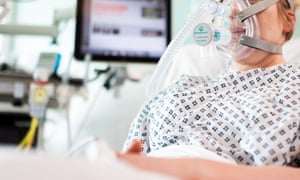
‘In a health crisis, it is not only the virus that risks infecting society but our prejudices.’ Photograph: James Tye/University College London (UCL)/AFP via Getty Images
In a pandemic, triage starts long before some of us get sick. A new document issued by the British Medical Association (BMA) has set out guidance to ration treatment if the NHS becomes overwhelmed with coronavirus cases.
The BMA suggests that in cases where ventilators are scarce, those facing poor prognosis could have the life-saving equipment taken away from them – even if their condition is improving – with younger and healthier patients given priority instead.
We are already seeing this play out. Last week, one man tweeted that his brother, who lives in a care home with limited mobility and a cognitive disability, went to hospital with a chest infection but didn’t make “the pandemic-led prioritisation cut”. He died a week later.
Meanwhile, it has been reported that a GP practice in Wales issued “do not resuscitate” (DNR) forms to a small number of patients, ensuring that emergency services would not be called should they contract coronavirus and their symptoms worsen. One adult social care provider has said that three of their services have been contacted by GPs to say that they have deemed the people they support should all be DNR. One woman who has received the form so far is in her 20s.
These stories of disabled and older people being denied care have been emerging for weeks as the virus has struck hospitals around the world, but have generally failed to find attention outside the disability community until now.
The National Institute for Health and Care Excellence (Nice) was forced to make a U-turn last week on their advice for the NHS to deny disabled people treatment, but only after disability groups threatened legal action. Nice had told doctors they should assess patients with conditions such as learning disabilities and autism as scoring high for “frailty” - thereby meeting criteria to be refused treatment - based on the fact they need support with personal care in their day-to-day life.
In a health crisis, it is not only the virus that risks infecting society, but our prejudices. It’s a slippery slope of ethical compromises in a culture and medical system that already struggles to support people with disabilities. Research shows that an estimated 1,200 people with a learning disability die avoidably every year due to poor care, while the terms “learning disabilities” or “Down’s syndrome” have been given as the reason for “Do not resuscitate” orders.
In the coronavirus pandemic, doctors are having to make difficult clinical judgments: would a medical intervention help a patient or does their underlying health condition prevent them from benefiting? Is it better to facilitate a peaceful death rather than administer a futile and distressing treatment?
However, judgments based on the efficacy of treatment are not the same as judgments based on the quality of a disabled person’s life. That might be falsely equating support needs with “frailty”, or adopting a blanket policy that withdraws treatment from a whole group of people rather than basing decisions on each individual’s needs and choices. That isn’t healthcare, it’s discrimination.
These are complex issues and we are in deeply difficult times; medics are risking their own lives for the NHS and will face impossible choices as even oxygen and face pumps run low. But that should not mean abandoning debates around key decisions. Indeed, in an emergency it is more important than ever to question our attitudes and responses.
It is worth considering why the default position is to deny life-saving treatment to some disabled people rather than to ask why a wealthy nation that had months to prepare doesn’t have enough resources in the first place. It is worth considering whether talk of “limited resources” is excusing and normalising the long-held idea that disabled lives are disposable.
In recent days, I have seen disabled people take to social media to list their achievements, as if trying to make the case that they are worth saving. A disabled person who has their ventilator removed during this crisis may have gone on to cure cancer. But then, they may have just been loved. A mum with heart disease who always burns her daughter’s birthday cakes. An accountant born with muscular dystrophy who watches Dr Who every Sunday. Disabled people, like all minorities, are only fully human when we are permitted to be as wonderfully average as anyone else.
Utilitarian calculations over the value of certain people’s lives may appear pragmatic right now, but they cost us a part of ourselves. In the coming days, it is inevitable Britain will lose more lives. We need not lose our humanity too.
In a pandemic, triage starts long before some of us get sick. A new document issued by the British Medical Association (BMA) has set out guidance to ration treatment if the NHS becomes overwhelmed with coronavirus cases.
The BMA suggests that in cases where ventilators are scarce, those facing poor prognosis could have the life-saving equipment taken away from them – even if their condition is improving – with younger and healthier patients given priority instead.
We are already seeing this play out. Last week, one man tweeted that his brother, who lives in a care home with limited mobility and a cognitive disability, went to hospital with a chest infection but didn’t make “the pandemic-led prioritisation cut”. He died a week later.
Meanwhile, it has been reported that a GP practice in Wales issued “do not resuscitate” (DNR) forms to a small number of patients, ensuring that emergency services would not be called should they contract coronavirus and their symptoms worsen. One adult social care provider has said that three of their services have been contacted by GPs to say that they have deemed the people they support should all be DNR. One woman who has received the form so far is in her 20s.
These stories of disabled and older people being denied care have been emerging for weeks as the virus has struck hospitals around the world, but have generally failed to find attention outside the disability community until now.
The National Institute for Health and Care Excellence (Nice) was forced to make a U-turn last week on their advice for the NHS to deny disabled people treatment, but only after disability groups threatened legal action. Nice had told doctors they should assess patients with conditions such as learning disabilities and autism as scoring high for “frailty” - thereby meeting criteria to be refused treatment - based on the fact they need support with personal care in their day-to-day life.
In a health crisis, it is not only the virus that risks infecting society, but our prejudices. It’s a slippery slope of ethical compromises in a culture and medical system that already struggles to support people with disabilities. Research shows that an estimated 1,200 people with a learning disability die avoidably every year due to poor care, while the terms “learning disabilities” or “Down’s syndrome” have been given as the reason for “Do not resuscitate” orders.
In the coronavirus pandemic, doctors are having to make difficult clinical judgments: would a medical intervention help a patient or does their underlying health condition prevent them from benefiting? Is it better to facilitate a peaceful death rather than administer a futile and distressing treatment?
However, judgments based on the efficacy of treatment are not the same as judgments based on the quality of a disabled person’s life. That might be falsely equating support needs with “frailty”, or adopting a blanket policy that withdraws treatment from a whole group of people rather than basing decisions on each individual’s needs and choices. That isn’t healthcare, it’s discrimination.
These are complex issues and we are in deeply difficult times; medics are risking their own lives for the NHS and will face impossible choices as even oxygen and face pumps run low. But that should not mean abandoning debates around key decisions. Indeed, in an emergency it is more important than ever to question our attitudes and responses.
It is worth considering why the default position is to deny life-saving treatment to some disabled people rather than to ask why a wealthy nation that had months to prepare doesn’t have enough resources in the first place. It is worth considering whether talk of “limited resources” is excusing and normalising the long-held idea that disabled lives are disposable.
In recent days, I have seen disabled people take to social media to list their achievements, as if trying to make the case that they are worth saving. A disabled person who has their ventilator removed during this crisis may have gone on to cure cancer. But then, they may have just been loved. A mum with heart disease who always burns her daughter’s birthday cakes. An accountant born with muscular dystrophy who watches Dr Who every Sunday. Disabled people, like all minorities, are only fully human when we are permitted to be as wonderfully average as anyone else.
Utilitarian calculations over the value of certain people’s lives may appear pragmatic right now, but they cost us a part of ourselves. In the coming days, it is inevitable Britain will lose more lives. We need not lose our humanity too.
Wednesday, 8 April 2020
Defining productivity in a pandemic may teach us a lesson
How should we measure the contribution of a teacher or a health worker during this crisis asks DIANE COYLE in The FT
One “P” word has been dominating economic policy discussions for some time now: not “pandemic”, but “productivity”. Now that coronavirus has dealt an unprecedented blow to economies everywhere, policymakers are asking how it will affect productivity at a national level.
The long-term effects of Covid-19 are unknown — they depend on the length of time for which economic activity will have to be suspended. The longer lockdowns last, the greater the hit to output growth and increasing unemployment.
Productivity — the output the economy gains for the resources and effort it expends — matters because it is what drives improvements in living standards: better health; longer lives; greater comfort. Investment, innovation and skills are the key ingredients, though the recipe is still a mystery.
In the UK, the pandemic will certainly cause a short-term fall in private-sector productivity. This is not only because many people are unwell or struggling to work at home around children and pets, but also because of a sharp decline in output. Employment is falling too, but many businesses are keeping workers on their books so labour input will not decline by as much. In general, productivity falls when output falls.
In the public sector, measuring productivity is hard. For services such as health and education, the Office for National Statistics looks at both activity and quality — such as the number of pupils and their exam grades, or the number of operations and health outcomes. But, at the best of times, these measures depend on other factors.
How should we think of the productivity of a teacher preparing lessons for online delivery, with all the challenges that involves, and what will be the effect on pupils’ attainment? It is easy to think of new measures, such as the number of online lessons delivered, but hard to imagine pupil outcomes not suffering.
As for medical staff, who would argue their productivity has not rocketed in recent weeks? But for many patients the outcomes that are measured will sadly be tragic. The biggest “productivity” boost may come from a new vaccine.
Public investment in infrastructure or green technologies will ultimately help productivity, but financial pain may force businesses to retrench. Business investment in the UK has been sluggish anyway, falling in 2018 and rising just 0.6 per cent in 2019. It is hard to foresee anything other than a big fall from the £50m-or-so-a-quarter last year.
Will supply chains unravel? The division of labour and specialisation that comes with outsourcing has driven gains in manufacturing productivity since the 1980s, but it depends on frictionless logistics and freight. Keeping that system going through lockdowns will take significant international co-ordination, which seems unlikely.
Some recent work suggests that even quite small shocks can cause networks to fall apart. This one will reverberate as waves of contagion hit countries at varying times. One response would be for importing companies to diversify supply chains. A less benign one — in productivity terms — would be a shift to reshoring production at home.
The pandemic and its aftermath will raise profound questions. Productivity involves a more-for-less (or, at least, more-for-the-same) mindset — hence the just-in-time systems and tight logistics operations. Companies may rethink the need for buffers as economic insurance. Inventories could rise, increasing business costs. Suppliers closer to home could be found, again at higher cost.
Perhaps the definition of economic wellbeing will also change. Conventional economic output matters, as people now losing their incomes know all too well. But so do social support networks and fair access to services. Without them, everyone is more vulnerable. Prosperity is more than productivity.
One “P” word has been dominating economic policy discussions for some time now: not “pandemic”, but “productivity”. Now that coronavirus has dealt an unprecedented blow to economies everywhere, policymakers are asking how it will affect productivity at a national level.
The long-term effects of Covid-19 are unknown — they depend on the length of time for which economic activity will have to be suspended. The longer lockdowns last, the greater the hit to output growth and increasing unemployment.
Productivity — the output the economy gains for the resources and effort it expends — matters because it is what drives improvements in living standards: better health; longer lives; greater comfort. Investment, innovation and skills are the key ingredients, though the recipe is still a mystery.
In the UK, the pandemic will certainly cause a short-term fall in private-sector productivity. This is not only because many people are unwell or struggling to work at home around children and pets, but also because of a sharp decline in output. Employment is falling too, but many businesses are keeping workers on their books so labour input will not decline by as much. In general, productivity falls when output falls.
In the public sector, measuring productivity is hard. For services such as health and education, the Office for National Statistics looks at both activity and quality — such as the number of pupils and their exam grades, or the number of operations and health outcomes. But, at the best of times, these measures depend on other factors.
How should we think of the productivity of a teacher preparing lessons for online delivery, with all the challenges that involves, and what will be the effect on pupils’ attainment? It is easy to think of new measures, such as the number of online lessons delivered, but hard to imagine pupil outcomes not suffering.
As for medical staff, who would argue their productivity has not rocketed in recent weeks? But for many patients the outcomes that are measured will sadly be tragic. The biggest “productivity” boost may come from a new vaccine.
Public investment in infrastructure or green technologies will ultimately help productivity, but financial pain may force businesses to retrench. Business investment in the UK has been sluggish anyway, falling in 2018 and rising just 0.6 per cent in 2019. It is hard to foresee anything other than a big fall from the £50m-or-so-a-quarter last year.
Will supply chains unravel? The division of labour and specialisation that comes with outsourcing has driven gains in manufacturing productivity since the 1980s, but it depends on frictionless logistics and freight. Keeping that system going through lockdowns will take significant international co-ordination, which seems unlikely.
Some recent work suggests that even quite small shocks can cause networks to fall apart. This one will reverberate as waves of contagion hit countries at varying times. One response would be for importing companies to diversify supply chains. A less benign one — in productivity terms — would be a shift to reshoring production at home.
The pandemic and its aftermath will raise profound questions. Productivity involves a more-for-less (or, at least, more-for-the-same) mindset — hence the just-in-time systems and tight logistics operations. Companies may rethink the need for buffers as economic insurance. Inventories could rise, increasing business costs. Suppliers closer to home could be found, again at higher cost.
Perhaps the definition of economic wellbeing will also change. Conventional economic output matters, as people now losing their incomes know all too well. But so do social support networks and fair access to services. Without them, everyone is more vulnerable. Prosperity is more than productivity.
Tuesday, 7 April 2020
We say we value key workers, but their low pay is systematic, not accidental
If those who care for us are to be first, not last, we have to look at the conditions that drive wage stagnation and insecurity writes Zoe Williams in The Guardian
This crisis is forcing an urgent re-evaluation of that, along with all those other jobs that were previously classed as low-value yet now turn out to be the most important in the country. Words are not enough, and nor is clapping; you can praise care workers to the skies, but if you’re paying them the minimum amount in 15-minute segments, without security of hours or of employment, without sick or holiday pay, then the praise is hollow.
You can wax sentimental about the holy vocation of nursing, but you cannot then bring second-year students on to the frontline to fight coronavirus and still expect them to pay their tuition fees. You cannot claim, as the health secretary, Matt Hancock, told Andrew Marr on Sunday, that this isn’t the right time to talk about pay rises; it is the best and only time to talk about pay rises, when we have finally realised, with a jolt, just how much we rely on people who put their jobs ahead of their own safety.
Yet this is about more than money: Keir Starmer accepted the Labour leadership on Saturday with the rousing Old Testament statement about all key workers, cleaners, paramedics, carers, porters: “For too long they’ve been taken for granted and poorly paid. They were last and now they should be first.” But what would it actually mean to put these jobs first? Money is some of the answer, but we also have to look at the conditions and assumptions that drive wage stagnation and the steady erosion of security.
There is nothing radical in the observation that jobs are often described as low-skill, when actually they are just poorly paid. More radical, yet still accurate, is the assertion that they are characterised as “low-skill” deliberately. Caring is a job of tremendous skill, hard as well as soft. And while there is a huge amount of bolt-on expertise that employers require, from administering medicines to dealing with dementia, this is not reflected in any career progression. It is not unusual for a carer in her 40s to be on the same hourly rate, adjusted for inflation, that she was on at 18.
This has been systematic, not accidental. Without progression, the wage bill can remain reliably static, which is the only way the financial architecture of the sector makes sense.
There is often better progression in public sector work, but the combination of the austerity-years pay freeze and a new normal (extending even to the police) of people at the start of their career being expected to work voluntarily, which itself erodes starting salaries, has had a striking effect on these jobs.
Ironically, Theresa May was right when she famously said that a nurse might use a food bank for “complicated reasons”. Of course there’s a very simple reason – that nurse is not being paid enough. But the feedback loop between the private and public sectors – low pay, insecurity and poor conditions legitimised in one sector and migrating to another – is actually quite complicated.
And there’s an overarching fallacy, that a job many people could do must be inherently low in value. By these lights, huge numbers of people – cleaners, drivers, shop assistants – are without prospects, being so replaceable. The times are testing this assumption to destruction – when you’re looking for the people whose courage we need in order for civilisation to survive, you don’t have to look much further than the postal worker or the hospital porter.
In the immediate term, putting key workers first means personal protective equipment; it means collective and determined effort to strip as much risk as possible out of essential jobs that simply wouldn’t get done if everyone looked out for themselves. But there will be an era after coronavirus; and one thing to carry into it will be a determination never again to think, talk about or treat people as though logic demands they should be screwed down to their lowest possible price.
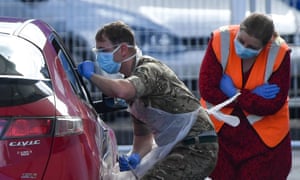
Military personnel help administer Covid-19 tests for NHS workers at Edgbaston cricket ground in Birmingham. Photograph: Jacob King/PA
This weekend brought the news that two workers at London’s Pentonville prison, Bovil Peter and Patrick Beckford, had died with symptoms of Covid-19. “Symptoms” is nowadays a euphemism for “they weren’t tested”, and a grim reminder of the hundreds of thousands of key workers we are asking the world of, but whose selflessness is not being reciprocated.
These are tragedies laced with guilt for all of us: plainly, the most dangerous place to be during this epidemic is in a densely populated care environment, whether a hospital, school or prison. People work in them because they have a passion, but also because there is no alternative, and they do so on all our behalves.
Prison officers have always been the unsung heroes of public duty: never quite macho enough for the people who glorify the armed forces; always a bit too authoritarian for those who valorise nurses. They are some of the most inventive and diligent people working anywhere in the business of caring for others, but they have generally done so without much credit.
This weekend brought the news that two workers at London’s Pentonville prison, Bovil Peter and Patrick Beckford, had died with symptoms of Covid-19. “Symptoms” is nowadays a euphemism for “they weren’t tested”, and a grim reminder of the hundreds of thousands of key workers we are asking the world of, but whose selflessness is not being reciprocated.
These are tragedies laced with guilt for all of us: plainly, the most dangerous place to be during this epidemic is in a densely populated care environment, whether a hospital, school or prison. People work in them because they have a passion, but also because there is no alternative, and they do so on all our behalves.
Prison officers have always been the unsung heroes of public duty: never quite macho enough for the people who glorify the armed forces; always a bit too authoritarian for those who valorise nurses. They are some of the most inventive and diligent people working anywhere in the business of caring for others, but they have generally done so without much credit.
This crisis is forcing an urgent re-evaluation of that, along with all those other jobs that were previously classed as low-value yet now turn out to be the most important in the country. Words are not enough, and nor is clapping; you can praise care workers to the skies, but if you’re paying them the minimum amount in 15-minute segments, without security of hours or of employment, without sick or holiday pay, then the praise is hollow.
You can wax sentimental about the holy vocation of nursing, but you cannot then bring second-year students on to the frontline to fight coronavirus and still expect them to pay their tuition fees. You cannot claim, as the health secretary, Matt Hancock, told Andrew Marr on Sunday, that this isn’t the right time to talk about pay rises; it is the best and only time to talk about pay rises, when we have finally realised, with a jolt, just how much we rely on people who put their jobs ahead of their own safety.
Yet this is about more than money: Keir Starmer accepted the Labour leadership on Saturday with the rousing Old Testament statement about all key workers, cleaners, paramedics, carers, porters: “For too long they’ve been taken for granted and poorly paid. They were last and now they should be first.” But what would it actually mean to put these jobs first? Money is some of the answer, but we also have to look at the conditions and assumptions that drive wage stagnation and the steady erosion of security.
There is nothing radical in the observation that jobs are often described as low-skill, when actually they are just poorly paid. More radical, yet still accurate, is the assertion that they are characterised as “low-skill” deliberately. Caring is a job of tremendous skill, hard as well as soft. And while there is a huge amount of bolt-on expertise that employers require, from administering medicines to dealing with dementia, this is not reflected in any career progression. It is not unusual for a carer in her 40s to be on the same hourly rate, adjusted for inflation, that she was on at 18.
This has been systematic, not accidental. Without progression, the wage bill can remain reliably static, which is the only way the financial architecture of the sector makes sense.
There is often better progression in public sector work, but the combination of the austerity-years pay freeze and a new normal (extending even to the police) of people at the start of their career being expected to work voluntarily, which itself erodes starting salaries, has had a striking effect on these jobs.
Ironically, Theresa May was right when she famously said that a nurse might use a food bank for “complicated reasons”. Of course there’s a very simple reason – that nurse is not being paid enough. But the feedback loop between the private and public sectors – low pay, insecurity and poor conditions legitimised in one sector and migrating to another – is actually quite complicated.
And there’s an overarching fallacy, that a job many people could do must be inherently low in value. By these lights, huge numbers of people – cleaners, drivers, shop assistants – are without prospects, being so replaceable. The times are testing this assumption to destruction – when you’re looking for the people whose courage we need in order for civilisation to survive, you don’t have to look much further than the postal worker or the hospital porter.
In the immediate term, putting key workers first means personal protective equipment; it means collective and determined effort to strip as much risk as possible out of essential jobs that simply wouldn’t get done if everyone looked out for themselves. But there will be an era after coronavirus; and one thing to carry into it will be a determination never again to think, talk about or treat people as though logic demands they should be screwed down to their lowest possible price.
Monday, 6 April 2020
Coronavirus: Is Europe losing Italy?
Furious at their plight being ignored and over resistance to coronabonds, Italians’ sense of betrayal deepens writes Miles Johnson, Sam Fleming and Guy Chazan in The FT
A year ago Carlo Calenda ran in European parliamentary elections in Italy under the slogan “We are Europeans”, a rallying cry to defend his country’s place in the EU at a time of rising nationalism.
Now even Mr Calenda, a 46-year-old former minister and Italian permanent representative to the EU, is experiencing a crisis of faith in an idea he has spent a lifetime fighting for.
“This is an existential threat, I am not sure if we are going to make it,” he says. “You have to consider my party is one of the most pro-European parties in Italy and I now have members writing to me saying: ‘Why do we want to stay in the EU? It is useless.’”
As Italy faces its most severe crisis since the second world war, with more than 15,000 deaths from coronavirus and its economy on course to suffer the deepest recession in its modern history, there is a rising feeling among even its pro-European elite that the country is being abandoned by its neighbours.
A massive, massive shift is happening in Italy. You have thousands of pro-Europeans moving to this position,” says Mr Calenda, who leads the recently formed liberal Action party.
Last month Sergio Mattarella, Italy’s softly-spoken 78-year-old president, and the man its establishment has relied on to safeguard its constitution and international alliances, warned the future of Europe was at stake if its institutions did not show solidarity with their country.
“I hope that everyone fully understands, before it is too late, the seriousness of the threat to Europe,” he said in an evening television address beamed into the homes of millions of Italians.
Many in Rome now feel that unless bold action is taken by northern European countries, they risk Italy turning its back on the European project forever.
There are already signs that Italian faith in the EU has been damaged. In a survey conducted last month by Tecnè, 67 per cent of respondents said they believed being part of the union was a disadvantage for their country, up from 47 per cent in November 2018.
Donald Tusk, the former European Council president, told the FT the situation today was much more worrying than during the euro crisis — both politically and economically.
Southern European expectations of a rapid demonstration of solidarity from the rest of the EU early in the pandemic were not met, even if the bloc has subsequently ramped up its assistance including financial aid and equipment.
“I hope everything can be fixed, but the loss of reputation is huge,” says Mr Tusk, who is now president of the European People’s party, the centre-right political alliance. “We must save Italy, Spain and the whole of Europe and not be afraid of extraordinary measures. This is a state of emergency.”
Mr Tusk says the EU’s assistance for Italy and other hard-hit countries is vastly more substantial than that from China and Russia, but he warns that “in politics perception can be more important than fact”.
In 2018 Italy became the first founding member to elect a government hostile to the EU, with Matteo Salvini, the anti-immigration League leader and then deputy prime minister of the coalition government, raging against “the Brussels bunker”.
The following year that government fell, and Mr Salvini was banished to opposition, giving pro-Europeans hope that the nationalist threat had faded. But many believe bitterness felt from events over the past month could permanently alter the country’s politics in Mr Salvini’s favour.
“There was a feeling before that the political system had marginalised the anti-EU forces,” says Lorenzo Pregliasco, a pollster at YouTrend. “Now if pro-European party activists and politicians are no longer so sure how they feel, imagine what the voters think.”
At the core of the argument is a bitter divide over the extent to which euro area countries should be pursuing a far more unified economic response to the crisis. Finance ministers will meet on Tuesday to attempt to agree a package of measures aimed at marshalling greater Europe-wide fiscal firepower.
Italy is among the member states that are pushing for the euro area to be far more ambitious by collectively selling bonds to help fund the massive economic rebuilding efforts that lie ahead.
The discussions mark just the latest iteration of a longstanding dispute over collective fiscal action that economists call debt mutualisation — and which many see as the biggest missing element of the single currency.
The EU does have a rescue fund called the European Stability Mechanism which countries can use. But despite assurances to the contrary from the ESM’s managing director, Klaus Regling, many Italians still fear lending from the institution would come with tough conditions attached and would stigmatise the country. It would feel to many that their country was being punished for a disaster that was outside of its control.
Roberto Gualtieri, Italy’s finance minister, has said that Italian gross domestic product is likely to fall by 6 per cent this year. Other economists believe this may be a conservative estimate. With the country entering the crisis with a debt-to-GDP ratio already at 136 per cent, there is a real threat that Italy’s debt reaches a level that brings into question its sustainability.
In March, with the virus already ripping through southern Europe, nine euro members led by France, Italy and Spain signed a joint letter pushing for so-called coronabonds — jointly issued debt backed by all euro countries including deep-pocketed Germany — to help pay for the recovery effort.
The depth of divisions over the topic was exposed at a tough EU leaders’ video conference call in late March in which the Italian prime minister Giuseppe Conte and his allies pushed hard for the door to be opened to coronabonds.
Mr Conte said the euro area’s bailout instruments had been developed for the last crisis and were ill-suited to the current symmetric shock hitting the entire continent. “What will we tell our citizens if Europe does not prove capable of a united, strong and cohesive reaction in the face of a symmetrical, unpredictable shock of this historical magnitude?” he asked.
Leaders eventually struck a compromise and issued a statement using vague language that effectively kicked deliberations in to Tuesday’s eurogroup meeting of finance ministers.
But the truce did not last long. Ursula von der Leyen, the European Commission president and a former German defence minister, appeared to use dismissive language in an interview, describing coronabonds as a slogan and appearing to express sympathy with Germany’s concerns about the idea.
The language provoked immediate rebukes from Mr Conte and Mr Gualtieri, forcing the commission to issue a late-night statement that vowed to leave open all options that are compatible with the EU treaty.
Ms Von der Leyen’s shifting positions reflected in part sharp divisions among her commissioners as well as the EU as a whole over the idea of coronabonds.
While the discussion over which financial instruments can be used to help Italy is technical, the tone of the debate has become emotionally charged in both southern Europe and in the north, where the Netherlands has sided with Germany in opposing coronabonds.
Mr Calenda last week took out a full-page advert in the German daily Frankfurter Allgemeine Zeitung, signed by himself and a number of leftwing mayors and governors from the regions worst-hit by the outbreak.
In it they attacked the Dutch position as “an example of a lack of ethics and solidarity”, called the country a tax haven and compared German reluctance to support joint European debt with the partial cancellation of Nazi war debts by European countries including Italy after the second world war.
“Germany could never have paid it,” the letter said. “Your place is with the Europe of institutions, of values of freedom and solidarity. Not following small national egoisms.”
“They shouldn’t be using such emotional arguments,” says Eckhardt Rehberg, a German MP in Chancellor Angela Merkel’s Christian Democratic Union. “Every country should ask itself whether it bears some responsibility for the situation it is in. Look at Italy’s health system. You cannot blame all your difficulties on Europe and Germany. As a German politician, I find that unfair.”
The current German-Italian tensions are part of a much longer dispute, stretching back to the eurozone sovereign debt crisis of 2010-12.
Even back then, many in southern Europe saw eurobonds as a potential solution. But Ms Merkel was always opposed, saying in 2012 that there would be no such instruments “as long as I live”. For the chancellor and her CDU party, the EU treaties were sacrosanct: and they expressly forbade the mutualisation of debt. The rule was clear: states cannot finance each other.
Yet in the eurozone more broadly, her reputation suffered. Southerners increasingly saw her as Europe’s great disciplinarian. Posters appeared in Greece showing her with a Hitler moustache. She was depicted as a witch, a dominatrix or a wicked stepmother, and accused of trying to subjugate the whole continent.
In Italy the hostility to her was fanned by the media empire of then prime minister Silvio Berlusconi. Records of bugged phone calls emerged in which he referred to the chancellor in extremely disparaging terms. In August 2012 the newspaper Il Giornale, owned by Mr Berlusconi’s brother, had a front-page picture of Ms Merkel raising her hand in a vaguely fascist salute, accompanied by an article claiming Italy was “no longer in Europe, it is in the Fourth Reich”.
The crisis has emboldened politicians on Italy’s right who sense the mood in the country is shifting against Brussels, as well as becoming more anti-German.
“The EU has gone from doing absolutely nothing to some trying to profit from the difficulties we are facing,” says Giorgia Meloni, leader of the far-right Brothers of Italy, which has made significant gains in opinion polls to become the second most popular rightwing party after Mr Salvini’s League.
“There are people who are trying to use the virus to speculate. There is a game to weaken Italy and buy its strategic assets,” she told the FT. “While we are counting our dead, they are counting the risk of losing interest on their bonds.”
Claudio Borghi, a League MP who has led a ferocious campaign against Italy accepting money from the ESM — arguing it would be tantamount to a surrender of sovereignty — this week posted an Italian Fascist era poster with a smiling German soldier extending his hand. The text reads “Germany is truly your friend”. Mr Borghi wrote: “Time goes on, but the tactics are always the same.”
Franziska Brantner, a German Green MP, says the Italians she has spoken to see themselves as “a laboratory for corona”, adding: “[They feel] Germany is just watching them and trying to learn from their experience. There is real bitterness among my pro-European friends in Italy. They’re saying what have we done to the Germans to make them treat us like this?”
Italy’s pro-Europeans are hoping that the mounting shock from the Covid-19 crisis will jolt recalcitrant northern European countries into making a large enough gesture of solidarity to repair the damage that has been done.
In recent days opponents of collective fiscal action have been on the defensive as the sheer scale of the economic slump has become clearer. In the Netherlands, the government of prime minister Mark Rutte last Wednesday proposed a solidarity fund worth €20bn, with cash transfers set to go straight to the coffers of Rome and Madrid to fund emergency medical spending.
His finance minister Wopke Hoekstra had been criticised in the south after he called on Brussels to investigate why some economies did not have fiscal buffers to see them through a crisis. Portugal’s prime minister António Costa called the remarks “repulsive”.
Mr Rutte’s proposal would only fill a small part of the gap given the vertiginous public finance challenges facing Italy and Spain, but the very fact that a country that has traditionally been a vociferous opponent of any fiscal transfers between euro area members should make such a suggestion is indicative of the changing public mood.
Bruno Le Maire, France’s finance minister, on Thursday laid out plans for an “exceptional and temporary” joint fund that would help countries kick-start their recoveries. This would issue bonds with the joint guarantee of all EU member states and be operated by the European Commission.
“Solidarity means to be able to pull together our resources to cope with the aftermath of the crisis,” he said. “Let’s avoid any ideological debates on eurobonds or coronabonds. There is one single political question: shall we stand together or not?”
For Mr Tusk there is now little time left for the EU’s richest nations to come forward with bold and positive initiatives and avoid instilling any sense of humiliation in countries that needed help. “People are suffering now — it is not a political game,” he says. “People have to feel that we are a real community and a real family in such a time.”
A year ago Carlo Calenda ran in European parliamentary elections in Italy under the slogan “We are Europeans”, a rallying cry to defend his country’s place in the EU at a time of rising nationalism.
Now even Mr Calenda, a 46-year-old former minister and Italian permanent representative to the EU, is experiencing a crisis of faith in an idea he has spent a lifetime fighting for.
“This is an existential threat, I am not sure if we are going to make it,” he says. “You have to consider my party is one of the most pro-European parties in Italy and I now have members writing to me saying: ‘Why do we want to stay in the EU? It is useless.’”
As Italy faces its most severe crisis since the second world war, with more than 15,000 deaths from coronavirus and its economy on course to suffer the deepest recession in its modern history, there is a rising feeling among even its pro-European elite that the country is being abandoned by its neighbours.
A massive, massive shift is happening in Italy. You have thousands of pro-Europeans moving to this position,” says Mr Calenda, who leads the recently formed liberal Action party.
Last month Sergio Mattarella, Italy’s softly-spoken 78-year-old president, and the man its establishment has relied on to safeguard its constitution and international alliances, warned the future of Europe was at stake if its institutions did not show solidarity with their country.
“I hope that everyone fully understands, before it is too late, the seriousness of the threat to Europe,” he said in an evening television address beamed into the homes of millions of Italians.
Many in Rome now feel that unless bold action is taken by northern European countries, they risk Italy turning its back on the European project forever.
There are already signs that Italian faith in the EU has been damaged. In a survey conducted last month by Tecnè, 67 per cent of respondents said they believed being part of the union was a disadvantage for their country, up from 47 per cent in November 2018.
Donald Tusk, the former European Council president, told the FT the situation today was much more worrying than during the euro crisis — both politically and economically.
Southern European expectations of a rapid demonstration of solidarity from the rest of the EU early in the pandemic were not met, even if the bloc has subsequently ramped up its assistance including financial aid and equipment.
“I hope everything can be fixed, but the loss of reputation is huge,” says Mr Tusk, who is now president of the European People’s party, the centre-right political alliance. “We must save Italy, Spain and the whole of Europe and not be afraid of extraordinary measures. This is a state of emergency.”
Mr Tusk says the EU’s assistance for Italy and other hard-hit countries is vastly more substantial than that from China and Russia, but he warns that “in politics perception can be more important than fact”.
In 2018 Italy became the first founding member to elect a government hostile to the EU, with Matteo Salvini, the anti-immigration League leader and then deputy prime minister of the coalition government, raging against “the Brussels bunker”.
The following year that government fell, and Mr Salvini was banished to opposition, giving pro-Europeans hope that the nationalist threat had faded. But many believe bitterness felt from events over the past month could permanently alter the country’s politics in Mr Salvini’s favour.
“There was a feeling before that the political system had marginalised the anti-EU forces,” says Lorenzo Pregliasco, a pollster at YouTrend. “Now if pro-European party activists and politicians are no longer so sure how they feel, imagine what the voters think.”
At the core of the argument is a bitter divide over the extent to which euro area countries should be pursuing a far more unified economic response to the crisis. Finance ministers will meet on Tuesday to attempt to agree a package of measures aimed at marshalling greater Europe-wide fiscal firepower.
Italy is among the member states that are pushing for the euro area to be far more ambitious by collectively selling bonds to help fund the massive economic rebuilding efforts that lie ahead.
The discussions mark just the latest iteration of a longstanding dispute over collective fiscal action that economists call debt mutualisation — and which many see as the biggest missing element of the single currency.
The EU does have a rescue fund called the European Stability Mechanism which countries can use. But despite assurances to the contrary from the ESM’s managing director, Klaus Regling, many Italians still fear lending from the institution would come with tough conditions attached and would stigmatise the country. It would feel to many that their country was being punished for a disaster that was outside of its control.
Roberto Gualtieri, Italy’s finance minister, has said that Italian gross domestic product is likely to fall by 6 per cent this year. Other economists believe this may be a conservative estimate. With the country entering the crisis with a debt-to-GDP ratio already at 136 per cent, there is a real threat that Italy’s debt reaches a level that brings into question its sustainability.
In March, with the virus already ripping through southern Europe, nine euro members led by France, Italy and Spain signed a joint letter pushing for so-called coronabonds — jointly issued debt backed by all euro countries including deep-pocketed Germany — to help pay for the recovery effort.
The depth of divisions over the topic was exposed at a tough EU leaders’ video conference call in late March in which the Italian prime minister Giuseppe Conte and his allies pushed hard for the door to be opened to coronabonds.
Mr Conte said the euro area’s bailout instruments had been developed for the last crisis and were ill-suited to the current symmetric shock hitting the entire continent. “What will we tell our citizens if Europe does not prove capable of a united, strong and cohesive reaction in the face of a symmetrical, unpredictable shock of this historical magnitude?” he asked.
Leaders eventually struck a compromise and issued a statement using vague language that effectively kicked deliberations in to Tuesday’s eurogroup meeting of finance ministers.
But the truce did not last long. Ursula von der Leyen, the European Commission president and a former German defence minister, appeared to use dismissive language in an interview, describing coronabonds as a slogan and appearing to express sympathy with Germany’s concerns about the idea.
The language provoked immediate rebukes from Mr Conte and Mr Gualtieri, forcing the commission to issue a late-night statement that vowed to leave open all options that are compatible with the EU treaty.
Ms Von der Leyen’s shifting positions reflected in part sharp divisions among her commissioners as well as the EU as a whole over the idea of coronabonds.
While the discussion over which financial instruments can be used to help Italy is technical, the tone of the debate has become emotionally charged in both southern Europe and in the north, where the Netherlands has sided with Germany in opposing coronabonds.
Mr Calenda last week took out a full-page advert in the German daily Frankfurter Allgemeine Zeitung, signed by himself and a number of leftwing mayors and governors from the regions worst-hit by the outbreak.
In it they attacked the Dutch position as “an example of a lack of ethics and solidarity”, called the country a tax haven and compared German reluctance to support joint European debt with the partial cancellation of Nazi war debts by European countries including Italy after the second world war.
“Germany could never have paid it,” the letter said. “Your place is with the Europe of institutions, of values of freedom and solidarity. Not following small national egoisms.”
“They shouldn’t be using such emotional arguments,” says Eckhardt Rehberg, a German MP in Chancellor Angela Merkel’s Christian Democratic Union. “Every country should ask itself whether it bears some responsibility for the situation it is in. Look at Italy’s health system. You cannot blame all your difficulties on Europe and Germany. As a German politician, I find that unfair.”
The current German-Italian tensions are part of a much longer dispute, stretching back to the eurozone sovereign debt crisis of 2010-12.
Even back then, many in southern Europe saw eurobonds as a potential solution. But Ms Merkel was always opposed, saying in 2012 that there would be no such instruments “as long as I live”. For the chancellor and her CDU party, the EU treaties were sacrosanct: and they expressly forbade the mutualisation of debt. The rule was clear: states cannot finance each other.
Yet in the eurozone more broadly, her reputation suffered. Southerners increasingly saw her as Europe’s great disciplinarian. Posters appeared in Greece showing her with a Hitler moustache. She was depicted as a witch, a dominatrix or a wicked stepmother, and accused of trying to subjugate the whole continent.
In Italy the hostility to her was fanned by the media empire of then prime minister Silvio Berlusconi. Records of bugged phone calls emerged in which he referred to the chancellor in extremely disparaging terms. In August 2012 the newspaper Il Giornale, owned by Mr Berlusconi’s brother, had a front-page picture of Ms Merkel raising her hand in a vaguely fascist salute, accompanied by an article claiming Italy was “no longer in Europe, it is in the Fourth Reich”.
The crisis has emboldened politicians on Italy’s right who sense the mood in the country is shifting against Brussels, as well as becoming more anti-German.
“The EU has gone from doing absolutely nothing to some trying to profit from the difficulties we are facing,” says Giorgia Meloni, leader of the far-right Brothers of Italy, which has made significant gains in opinion polls to become the second most popular rightwing party after Mr Salvini’s League.
“There are people who are trying to use the virus to speculate. There is a game to weaken Italy and buy its strategic assets,” she told the FT. “While we are counting our dead, they are counting the risk of losing interest on their bonds.”
Claudio Borghi, a League MP who has led a ferocious campaign against Italy accepting money from the ESM — arguing it would be tantamount to a surrender of sovereignty — this week posted an Italian Fascist era poster with a smiling German soldier extending his hand. The text reads “Germany is truly your friend”. Mr Borghi wrote: “Time goes on, but the tactics are always the same.”
Franziska Brantner, a German Green MP, says the Italians she has spoken to see themselves as “a laboratory for corona”, adding: “[They feel] Germany is just watching them and trying to learn from their experience. There is real bitterness among my pro-European friends in Italy. They’re saying what have we done to the Germans to make them treat us like this?”
Italy’s pro-Europeans are hoping that the mounting shock from the Covid-19 crisis will jolt recalcitrant northern European countries into making a large enough gesture of solidarity to repair the damage that has been done.
In recent days opponents of collective fiscal action have been on the defensive as the sheer scale of the economic slump has become clearer. In the Netherlands, the government of prime minister Mark Rutte last Wednesday proposed a solidarity fund worth €20bn, with cash transfers set to go straight to the coffers of Rome and Madrid to fund emergency medical spending.
His finance minister Wopke Hoekstra had been criticised in the south after he called on Brussels to investigate why some economies did not have fiscal buffers to see them through a crisis. Portugal’s prime minister António Costa called the remarks “repulsive”.
Mr Rutte’s proposal would only fill a small part of the gap given the vertiginous public finance challenges facing Italy and Spain, but the very fact that a country that has traditionally been a vociferous opponent of any fiscal transfers between euro area members should make such a suggestion is indicative of the changing public mood.
Bruno Le Maire, France’s finance minister, on Thursday laid out plans for an “exceptional and temporary” joint fund that would help countries kick-start their recoveries. This would issue bonds with the joint guarantee of all EU member states and be operated by the European Commission.
“Solidarity means to be able to pull together our resources to cope with the aftermath of the crisis,” he said. “Let’s avoid any ideological debates on eurobonds or coronabonds. There is one single political question: shall we stand together or not?”
For Mr Tusk there is now little time left for the EU’s richest nations to come forward with bold and positive initiatives and avoid instilling any sense of humiliation in countries that needed help. “People are suffering now — it is not a political game,” he says. “People have to feel that we are a real community and a real family in such a time.”
Subscribe to:
Posts (Atom)