Search This Blog

Tuesday, 13 November 2018

Why Sabarimala is surprising even Kerala, and why it is an opportunity

With all the claims of literacy, good healthcare system and the resultant general progressiveness of Kerala, it largely seemed like a reasonable expectation that women would just start going to the Sabarimala temple writes N P Ashley in The Indian Express

I find surprised, and even flabbergasted, Malayalis and non-Malayalis around me on the Sabarimala issue.

Even though a lot of people had reservations about the Supreme Court verdict which lifted the ban on women of menstrual ages from entering the Sabarimala temple, it was largely expected that, like the famous declaration of the Temple Entry Proclamation which allowed the lower caste groups temple entry in Kerala in 1936, women would just start going to the temple by and by. With all the claims of literacy, good healthcare system and the resultant general progressiveness of Kerala, it largely seemed like a reasonable expectation.

But events unfurled in quite a different way: the televised break down of law and order in the area, the rule of fear and insecurity that hovers around the state on this issue and the unending high-voltage discussions on mass and social media gave a sense of a state at siege. Though all parties are oath-bound and duty-bound to endorse the Constitution of India, and even when most parties at the national level have taken the official national position that there should be no ban on women only because of they are of the menstruating age (this includes the RSS and the Congress), their state leadership got so scared of the sentiments of their supporters and decided to resist the implementation of the court order through campaigns or even physically. The attempts have been so successful that not a single woman of the age between 10 and 50 have entered the inner sanctum of the temple to this day.
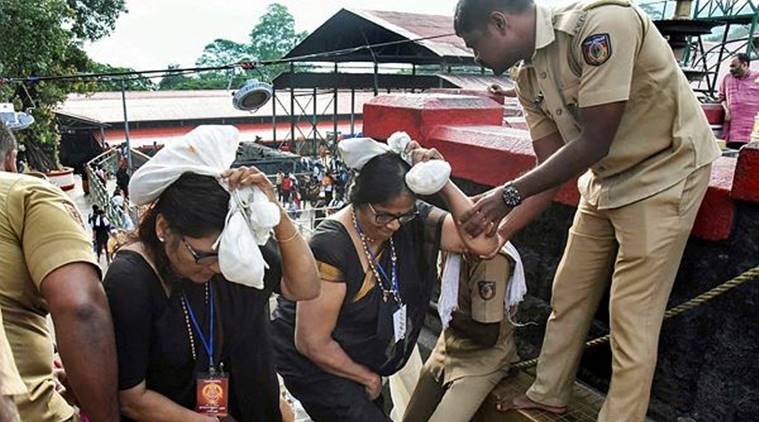
 
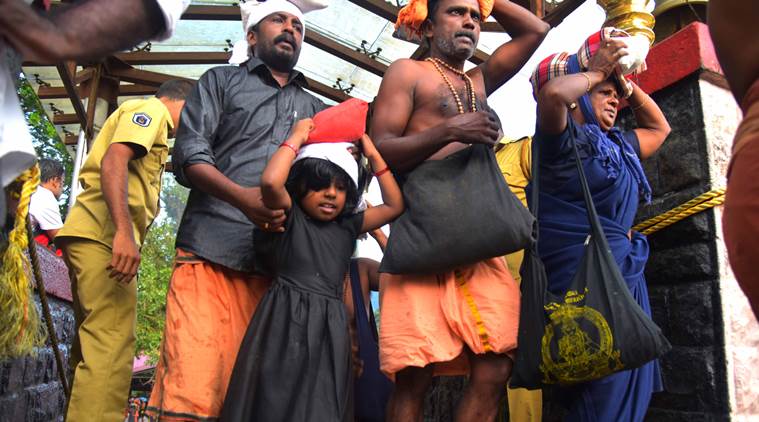
Women devotees at Sabarimala.
The typicality of Sabarimala

Three aspects of Kerala society throw light on the typicality of the developments: one, Kerala is a hyper consumerist, middle class society in which party supporters behave like consumers with a sense of entitlement. Politicians are only capable of giving what these supporters like and want. This should explain how the state committees of national parties have decided to take a position contradicting their national leadership. Two, though Kerala somersaulted into a global economy in 1970s itself, its values are completely feudal: a huge house, marrying off a daughter in all pomp and glory, and strict allegiance to family, community or party are still cherished.

The cocktail of feudal values and capitalist life-conditions provides the third aspect of the Kerala society: misogyny. Sabarimala is only one of the spaces in Kerala where women have no entry. Public spaces are largely inaccessible to unaccompanied women after nightfall, places of worship, festival venues and grounds are male homosocial havens, mass media and entertainment industries revolve around a handful of male icons, in many households women continue to belong to the kitchen and drawing rooms are still men’s, and lastly and most importantly, political and cultural discussions are held by men, of men and for men (even feminism is just another discussion topic for men!). In short, Kerala’s public sphere is saturated with male bodies and their understanding of the world.

This is not to belittle the amazing movements of the women in the last 30 years for the rights to body, property, work, dignity and presence. But the subcultural space of male bonding has defined itself against all such naming them to be feminist. The all too existing possibility that “feminist” in itself can be used as an allegation, like “terrorist” or “Maoist” in today’s Kerala should tell us something about contemporary Kerala. This becomes all the more revealing when compared with the moral ground that North Indian feminists have won against patriarchy on the ground, creating a new common sense, making it impossible even for the majoritarian right to oppose the Supreme Court verdicts on decriminalising homosexuality and lifting the ban on women to enter Sabarimala.

This is nothing new: though women’s rights were a crucial concern for the social justice project on caste reformation and economic restructuring called Kerala Renaissance (beginning in the early 20th century), men limited their participation to the level of ideas without extending it to bodies and spaces. Women continued to be in-charge of households, preparing children for a male chauvinist society and men continued to talk about things political and social. These women and their domestic spaces were addressed only by two entities: the religious organisations and by television serials (both were designed and developed by men again). Other than making fun of them and treating these as innocuous, men never had interrogations about the exclusivity of the spaces they held. Family WhatsApp groups seem to mould these sensibilities into community stories of victimhood and fear mongering. This blackhole of the Kerala public sphere must be acknowledged in the contemporary developments.


Kerala Renaissance: Archaic, Aestheticised or Unfinished?

Sabarimala women’s temple entry issue largely has four categories of people involved: Violent Ritualists (mostly male) who oppose women’s temple entry and believe that women who dare should be stopped using violence and terror, Anti-Violence Ritualists who oppose women’s temple entry but believe that use of violence and abuse by vigilante groups is unacceptable, Constitutionalists who believe that the verdict is, to borrow Gandhi’s words on the Temple Entry proclamation for the lower caste groups, one written in golden letters upholding constitutional morality and must be implemented by getting rid of the violent men at any cost, and Institutionalists who believe that though the judgment could have as well not come at all, now that it has, there is a need to respect the judgment and implement it, slowly and strategically.

All these groups seem equally lost about something or the other: Ritualists don’t know till how long they can hold the fort (every party has people who make contradictory statements is a good sign of it), Constitutionalists have not come up with any practical solution to the law and order troubles that might come up with what has now been construed as the “event of that single woman’s temple entry” (One of the questions they should consider answering is how did this “social vacuum” around Constitutional values come about!) and Institutionalists seem to be rather half-hearted about any actual step by any woman to enter the temple.

Among the four, the first, the Violent Ritualists, given how anti-social their acts have been merit no discussions. They need to be removed from the space and booked, along with their political patrons in the media and elsewhere, for their acts. The Anti-Violence Ritualists, Constitutionalists and Institutionalists can, and I believe they need to, hold conversations.

What would be the reference point of such conversations? Many are resorting to idealisation of the Kerala Renaissance which I find problematic in a discussion about women’s bodies for its very exclusive history on that front. Post 1970s Kerala has been such a different space that much of this rhetoric ring no bell with the life-realities of Malayalis now- as future cannot be in some past and nostalgia for it, it is unlikely to take anybody forward. Reviving any kind of golden past in itself is a regressive position.

Secondly, Kerala Renaissance has been made into an empty symbol to such a point that all sides are actually using the same images. The constitutionalists and institutionalists are constantly reminding people of the dark ages before the Kerala Renaissance while the Ritualists have used the photos of the Renaissance leaders on their “rath yathra” vehicle, and thus making them null entities politically.

The only useful and viable option is to see Kerala Renaissance as an unfinished project: one that talked of social justice for the backward castes like ezhavas while abandoning dalits and adivasis, one that spoke of women but never let them speak and one that believed in freedom from feudalism but without ever being able to come out of feudal values. Kerala Renaissance surely has, in it, a moment and a spirit that is ethical, inclusive and brave that can be captured but it cannot be a destination.

For this act of completion, let women sit together and come up with ethical, practical and effective solutions which are capable of redefining the very social values of the Malayali society. For once, men need to listen and just listen for the saturation they have caused is itself a huge part of the problem.

The underbelly of the state has come out right in the open, while the symptoms have always been there. Now this is an opportunity: let there be new thoughts, new imagery, new set of bodies from the receiving end changing the very paradigm towards a more egalitarian and more inclusive tomorrow. Kerala needs more and Malayalis deserve better!

Sunday, 11 November 2018

Is there an Indian road to Equality

Ramachandra Guha

Surely it is not the politicians’ fault is it?


A dream fable from a strangely familiar land where people blame their politicians for their own failures writes Tabish Khair in The Hindu

I dreamt that I woke up in a foreign country with many languages, cultures and religions. It was also a country with a working democratic system and a Parliament full of different parties.

The people of this country, despite wide swathes of illiteracy, mostly participated in the political process, and often held strong views. But they tended to complain endlessly about their representatives. Some of them would aggressively — even violently — endorse one party against the other, but they would also castigate politicians in general.

“If only we had good politicians,” one of them lamented to me. “Yes,” added his friend, who actually supported a party in the Opposition. “All these politicians just play us against each other in order to win. They never think of the people and the country first. Sheer opportunists, all of them. With no moral, no character, nothing but a hunger for power.”

In my dream, I listened to them, and it sounded familiar. I had heard similar sentiments while awake too. But I was curious. I asked them to explain.

Two cults

“Well, you see,” one of them said. “We have various religions, but the major one is known as the cult of stone and the second biggest one is known as the cult of air.”

Ah, I said. That sounded familiar too. “And what do these, er, cultists look like?” I inquired.

“Look like?” he answered. “They look human, like me and him, of course!” He pointed to his friend, who — to my foreign eyes — looked almost like his twin. “My friend belongs to the cult of air: we call them Aerialists. I belong to the cult of stone: they call us Lithicists.”

Ok, I rejoined. “I don’t see any problem yet — let alone a problem your politicians can take advantage of.”

“No, you won’t, you don’t know the place,” the Aerialist responded. “But you see, we had this church in which we worshipped our god who cannot be seen, and the People’s Party of Aerialists claimed that it had been built on the spot where one of their visible gods had been born...”

“Not that you lot were actually using that Aerialist church,” the Lithicist rejoined with a laugh.

“Facts, my friend, facts. You are talking belief; we are talking facts. Your lot broke down our church by sheer force. You broke the law in the process,” the Aerialist responded.

The two friends paused at this point of disagreement and then agreed that, in any case, they did not care this way or that, and the matter would be decided in court before the next election.

“I still do not see how politicians can...,” I began to say, but I was interrupted by the two.

“That’s not the only issue the courts will decide before the next election,” the Lithicist interposed. “You see, the Aerialist Church has its own personal laws.”

“So do other churches here,” the Aerialist broke in.

“But my friend,” the Lithicist continued. “You will agree that your personal laws are a bit harsh on your women: the husbands obviously get more rights than the wives. Why, they even get more wives!”

The Aerialist looked a bit uncomfortable and waved away the issue. “I say, let the courts decide,” he replied. “They will, they will,” his friend laughed.

I was still quite confused in my dream. “Look here, gentlemen,” I objected. “It is not that I am unfamiliar with such controversies, but what I still do not understand is why you seem to be blaming all this on your politicians?”

Both of them replied together: “Because our politicians take advantage of such situations!”

“But how can they?” I asked, bewildered. “You have said that the courts will decide, and you have told me that you have a constitutional democracy and functioning courts in your country. If so, surely, the courts will decide against the conservative Lithicist position in the case of the demolished church and against the conservative Aerialist position in the case of the personal laws. I mean, you have already indicated that, in terms of law and justice, it was wrong to demolish the Aerialist church and that it is wrong of Aerialists to discriminate against women in their personal laws. So, problem solved: your courts will take the right decision before the elections and no politician will be able to use these issues again!”

Accepting court orders

Both the friends laughed incredulously at me.

“That is what you think, do you?” they scoffed. “Well, let me tell you, Mr. Foreigner (or maybe they said Mr. Dreamer), many Lithicists won’t accept a court order in favour of the Aerialist position on the matter of the demolished church, and many Aerialists will not accept a court order against their personal laws. So, do you know what will happen before the election if the courts take the correct decisions in both the cases? Mobs of Lithicists and Aerialists will be out in the streets protesting and smashing windows for different reasons, preventing reasonable voters from voting… The election will be totally polarised. Politicians!”

“Surely it is not the politicians’ fault if so many of you refuse to accept the correct...,” I started objecting, but that is when I woke up.

Saturday, 10 November 2018

Should the rich pay more for the same services – and higher fines too?

Patrick Collinson in The Guardian

The government is considering a sliding scale of probate fees, an idea that could apply elsewhere


In Finland, speeding fines are based on the offender’s income. Photograph: Danny Lawson/PA

There was outrage this week when the government said it was pressing ahead with a new approach to charging for its role in probate (the legal process for settling your financial affairs on death). Instead of the current £155 flat fee for the paperwork, the government is considering a sliding scale of probate fees based on the value of the estate, from zero to £6,000 – even though the cost of the paperwork is virtually the same.

The Law Society – representing the solicitors who do probate work – says it’s unfair. “The cost to the courts for providing a grant of probate does not change whether the size of the estate is £10,000 or £1m.” It argues that this is no longer a fee but a “stealth” increase in inheritance tax.

Much steeper inheritance taxes are perfectly fine, but this back-door attempt to raise IHT will strike even soak-the-rich types as a bit odd. What next? Should a homebuyer pay a higher fee for local authority searches depending on the sale price of the property? Should your TV licence be based on your income? Should you pay a bigger fine for not having a TV licence, if you have an above-average income?

Actually, on the last one, plenty of countries do go down that path. In Finland – to which we must now genuflect on all things progressive – there is a system called “day fines”. If you commit a misdemeanour that may result in a fine issued by a public authority – such as a speeding ticket – then the size of the penalty is based on the person’s income.

In 2015, a millionaire in Finland was hit with a €54,000 (£4,700) fine for speeding, while in 2002 a Nokia executive received a €116,000 fine for speeding on his Harley Davidson motorcycle, and in 2001 a driver was punished with a €35,300 fine for going through a red light.

Behind the idea of bigger fines for the rich is the fear that they can “purchase” the right to commit offences, because the relative cost to them is immaterial. Anybody who speeds, or evades their TV licence, or who goes through a red light, is equally blameworthy, but the richer person is less deterred from repeating the offence because the fine is relatively meaningless.

Of course, this is all about misdemeanours. Surely there’s no read-across to pure government services? But there is: your family might produce the same amount of rubbish as a similar family on the other side of town, but you are already effectively paying a much higher price (through your council tax) for it to be collected if you live in a pricier house.

There may be more merit in a sliding scale for probate fees than first thought – and a very good case for making speeding and other fines payable according to income.

What the Working Class Is Still Trying to Tell Us

David Brooks in The New York Times


Republican supporters waited to enter a rally in Indiana where President Trump was campaigning days before the midterm elections. Credit Leah Klafczynski for The New York Times


I was ready for massive Democratic turnout for the election on Tuesday. But I was surprised how massive the Republican turnout was in response.

The Republicans who flooded to the polls weren’t college-educated suburbanites. Those people voted for Democrats this year.

They weren’t tax-cut fanatics. Half of the Republican members of the House Ways and Means Committee either left Congress, ran for other offices or were defeated.

They weren’t even small-government Republicans. The same red states that elected conservatives to office also — in Nebraska, Idaho and Utah — approved ballot initiatives to expand Medicaid. The same red states that elected conservatives also approved initiatives — in Arkansas and Missouri — to raise the minimum wage.

These were high-school-educated, working-class Republicans.

A lot of us pundits said Donald Trump should run a positive campaign bragging about all the economic growth. But Trump ran another American carnage campaign. That’s because American life still feels like carnage to many.

This is still a country in which nearly 20 percent of prime-age American men are not working full time. This is still a country in which only 37 percent of adults expect children to be better off financially than they are. This is still a country in which millions of new jobs are through “alternative work arrangements” like contracting or consulting — meaning no steady salary, no predictable hours and no security.

Working-class voters tried to send a message in 2016, and they are still trying to send it. The crucial question is whether America’s leaders will listen and respond.

One way to start doing that is to read Oren Cass’s absolutely brilliant new book, “The Once and Future Worker.” The first part of the book is about how we in the educated class have screwed up labor markets in ways that devalued work and made it harder for people in the working class to find a satisfying job.

Part of the problem is misplaced priorities. For the last several decades, American economic policy has been pinioned on one goal: expanding G.D.P. We measure G.D.P. We talk incessantly about economic growth. Between 1975 and 2015, American G.D.P. increased threefold. But what good is that growth if it means that a thick slice of America is discarded for efficiency reasons? 

Similarly, for the last several decades American, welfare policy has focused on consumption — giving money to the poor so they can consume more. Yet we have not successfully helped poor people produce more so that they can take control of their own lives. We now spend more than $20,000 a year in means-tested government spending per person in poverty. And yet the average poverty rate for 2000 to 2015 was higher than it was for 1970 to 1985.

“What if people’s ability to produce matters more than how much they can consume?” Cass asks.

The bulk of his book is a series of ideas for how we can reform labor markets.

For example, Cass supports academic tracking. Right now, we have a one-size-fits-all education system. Everybody should go to college. The problem is that roughly one-fifth of our students fail to graduate high school in four years; roughly one-fifth take no further schooling after high school; roughly one-fifth drop out of college; roughly one-fifth get a job that doesn’t require the degree they just earned; and roughly one-fifth actually navigate the path the system is built around — from school to career.

We build a broken system and then ask people to try to fit into the system instead of tailoring a system around people’s actual needs.

Cass suggests that we instead do what nearly every other affluent nation does: Let students, starting in high school, decide whether they want to be on an apprenticeship track or an academic track. Vocational and technical schools are ubiquitous across the developed world, and yet that model is mostly rejected here.

Cass also supports worker co-ops. Today, we have an old, adversarial labor union model that is inappropriate for the gig economy and uninteresting to most private-sector workers. But co-ops, drawing on more successful models used in several European nations, could represent workers in negotiations, train and retrain workers as they moved from firm to firm and build a safety net for periods of unemployment. Shopping for a worker co-op would be more like buying a gym membership. Each co-op would be a community and service provider to address a range of each worker’s needs.

Cass has many other proposals — wage subsidies, immigration reforms. But he’s really trying to put work, and the dignity of work, at the center of our culture and concern. In the 1970s and 1980s, he points out, the Emmy Award-winning TV shows were about blue-collar families: “All in the Family,” “Taxi,” “Cheers,” “The Wonder Years.” Now the Emmy-winning shows are mostly about white-collar adults working in Los Angeles, Seattle, Boston, New York and Washington. 

We in the college-educated sliver have built a culture, an economy and a political system that are all about ourselves. It’s time to pass labor market reforms that will make life decent for everybody.

Thursday, 8 November 2018

Congress - The party of Hinduism?


Liberals hoping that Rahul Gandhi’s Congress would rescue them from Hindutva may be in for a rude awakening writes G Sampath in The Hindu


The stage is all set for Assembly elections in five States — Madhya Pradesh, Rajasthan, Chhattisgarh, Mizoram and Telangana. Described as a ‘semi-final’ for the 2019 Lok Sabha polls, they offer a foretaste of the electoral strategies likely to be on view next year. Though State and national elections often have their own specific dynamic, some useful inferences may be drawn from the campaigns of the national parties, especially the Congress.

An important conundrum is whether the Congress can emerge as a meaningful alternative to the Bharatiya Janata Party (BJP) and its Hindu majoritarian politics. On the evidence of its campaign so far, especially in Madhya Pradesh and Rajasthan, the party appears to have chosen the path of least resistance. Given that these two States also happen to be among those where the BJP’s Hindutva dimension is in full bloom, they presented the Congress with a good opportunity to test its political counter to the divisive agenda of its adversary. The combination of high anti-incumbency and a two-way contest with the BJP meant that the Congress could have taken the ideological battle to the Sangh Parivar.

Wooing the upper castes

But the Congress did nothing of the sort. It steered clear of the BJP’s majoritarian depredations, and opted to woo the same upper castes that constitute the BJP’s core vote base. It has embraced what has come to be known as ‘soft Hindutva’. In Madhya Pradesh, for instance, the Congress has promised to build cow shelters in every village if voted to power — this in a State where desperate farmers were fired upon by the administration. In Kerala, its State unit has played along with so-called religious sentiment, opposing the entry of women (between the ages of 10-50) in Sabarimala instead of standing by the constitutional principle of equality.

In Rajasthan, too, the Congress’s game plan is to retrieve the upper caste vote from the BJP. Hindutva politics has queered the pitch in such a way that today no party can specifically woo the savarna voter without pandering to communal sentiment. In effect, this means not confronting the infusion of religion into the heart of democratic politics. Conversely, challenging it would require two things from a party: certain ideological non-negotiables, among which, in the case of the Congress, would be the Nehruvian legacy of secularism and a politics of caste rooted in the principle of social justice.

Given the cynicism that has become commonplace in public discourse, it is fashionable to scoff at any expectation of principles in politics. But it is delusional to imagine that the very realpolitik that unleashed the genie of communal hatred on national politics will also be able — now that its disruptions are coming home to roost — to put that genie back into the constitutional bottle. In fact, the most troubling takeaway from the Congress’s approach to these Assembly polls is that even an outright victory for a Congress-led alliance in 2019, however improbable it may seem at present, may not really signify a defeat of communal forces.

The clearest indication yet that the Congress cannot be expected to counter the normalisation of Hindu majoritarianism came during party president Rahul Gandhi’s campaign tour in Madhya Pradesh, where he stated that the “Congress was a party of Hinduism”. He prefaced it by saying that it was “not a party of Hindutva” but the fact that he felt compelled to paint the Congress in Hindu colours marks a clear shift in the party’s overt political line.

For some time now, there has been a debate on the Congress’s use of ‘soft Hindutva’ as a counter to the BJP’s presumably ‘hard’ Hindutva. Mr. Gandhi’s supporters have argued that what has been labelled as ‘soft Hindutva’ is nothing but a free and open expression of his personal faith as a devout Hindu. Even if this were true, his temple visits, which rarely seem to take place without a photo-op, the recent emergence of vermilion on his forehead, his pilgrimage to Kailash Mansarovar, and his coming out as a Shiv bhakt, are all gestures saturated with political significance.

Smart politics?

They could either be read as a smart political response to the widespread ‘Hinduisation’ of the socio-political sphere, or as an admission of defeat to Hindutva forces, for this is exactly what they seek — an India where Hindu identity would be the starting point of any mobilisation for political power.

Last month, a Rajasthan Minister was booked for violating the Representation of the People Act after he gave a speech asking all Hindus to vote for the BJP. Mr. Gandhi has never verbalised such a plea with regard to his own party. But can we truly characterise his description of the Congress as a “party of Hinduism”, or his embodiment of Hindu symbolism on the campaign trail, as actions in keeping with either the spirit of the Representation of the People Act or the secularism the Constitution speaks of?

There are other aspects of this symbolism-driven ‘soft Hindutva’ that are as troubling: an overriding anxiety not to be seen as sympathetic to Muslims; and a low key yet consistent messaging that underscores Mr. Gandhi’s position at the apex of the caste hierarchy as a “janeu-wearing Hindu”. The phrase, used by a Congress spokesperson after Mr. Gandhi’s visit to the Somnath temple last year, was invoked by a BJP leader recently in the context of yet another temple visit by Mr. Gandhi, when he asked, “What kind of janeu-dhari are you? What is your gotra?” The focus on Mr. Gandhi’s caste pedigree once again reveals how temple politics is never without its attendant caste politics.

Put simply, it gives the lie to Mr. Gandhi’s self-serving distinction between Hindutva and Hinduism, a distinction that is also becoming increasingly popular among an influential section of Indian liberals who, much like Mr. Gandhi, seem to have suddenly woken up to their Hindu identity in the last four years. For these ‘proud Hindus’, one of whom has recently penned a bestselling book on why he is one, the classical secularist position that one’s religion is a private matter and not an instrument to garner social or political capital is, of course, past its sell-by date.

The distinction between Hinduism and Hindutva — which only matters because of the political uses of religion —rests on two premises. First, that Hinduism is inclusive and progressive, while Hindutva is exclusionary and regressive; second, that Hinduism is individualistic and preaches tolerance, whereas Hindutva is a supremacist ideology that deploys angry mobs to subjugate other religious communities.

On Sangh Parivar’s page

While this is, no doubt, an interesting distinction, it is even more interesting that no Hindutva ideologue has ever expressed any discomfort with this definition of Hinduism that categorically rejects Hindutva. If anything, representatives of the Sangh Parivar have been pleased with the transformation of the Congress president into a tilak-wearing, temple-hopping ‘Hindu politician’.

The Congress becoming more ‘Hindu’ is but another sign of savarna consolidation, a movement of which Hindutva is the flag-bearer. Mr. Gandhi’s version of non-threatening Hinduism and the Parivar’s aggressive Hindutva are in complete agreement on one issue: caste. They both want to be the party of choice for the upper castes, and so long as this remains the case, the Congress cannot be expected to operationalise in its politics the principle of equality. In other words, liberals and other good-hearted people hoping that Mr. Gandhi and the Congress would rescue them from Hindutva may be in for a rude awakening. As is well known, god doesn’t help those who don’t help themselves.

The making of an opioid epidemic

When high doses of painkillers led to widespread addiction, it was called one of the biggest mistakes in modern medicine. But this was no accident. By Chris McGreal in The Guardian 

Jane Ballantyne was, at one time, a true believer. The British-born doctor, who trained as an anaesthetist on the NHS before her appointment to head the pain department at Harvard and its associated hospital, drank up the promise of opioid painkillers – drugs such as morphine and methadone – in the late 1990s. Ballantyne listened to the evangelists among her colleagues who painted the drugs as magic bullets against the scourge of chronic pain blighting millions of American lives. Doctors such as Russell Portenoy at the Memorial Sloan Kettering Cancer Center in New York saw how effective morphine was in easing the pain of dying cancer patients thanks to the hospice movement that came out of the UK in the 1970s.

Why, the new thinking went, could the same opioids not be made to work for people grappling with the physical and mental toll of debilitating pain from arthritis, wrecked knees and bodies worn out by physically demanding jobs? As Portenoy saw it, opiates were effective painkillers through most of recorded history and it was only outdated fears about addiction that prevented the drugs still playing that role.

Opioids were languishing from the legacy of an earlier epidemic that prompted President Theodore Roosevelt to appoint the US’s first opium commissioner, Dr Hamilton Wright, in 1908. Portenoy wanted to liberate them from this taint. Wright described Americans as “the greatest drug fiends in the world”, and opium and morphine as a “national curse”. After that the medical profession treated opioid pain relief with what Portenoy and his colleagues regarded as unwarranted fear, stigmatising a valuable medicine.

These new evangelists painted a picture of a nation awash in chronic pain that could be relieved if only the medical profession would overcome its prejudices. They constructed a web of claims they said were rooted in science to back their case, including an assertion that the risk of addiction from narcotic painkillers was “less than 1%” and that dosages could be increased without limit until the pain was overcome. But the evidence was, at best, thin and in time would not stand up to detailed scrutiny. One theory, promoted by Dr David Haddox, was that patients genuinely experiencing pain could not become addicted to opioids because the pain neutralised the euphoria caused by the narcotic. He said that what looked to prescribing doctors like a patient hooked on the drug was “pseudo-addiction”.
Portenoy toured the country, describing opioids as a gift from nature and promoting access to narcotics as a moral argument. Being pain-free was a human right, he said. In 1993, he told the New York Times of a “growing literature showing that these drugs can be used for a long time, with few side-effects, and that addiction and abuse are not a problem”.

Long after the epidemic took hold, and the death toll rose into the hundreds of thousands in the US, Portenoy admitted that there was little basis for this claim and that he had been more interested in changing attitudes to opioids among doctors than in scientific rigour.

“In essence, this was education to destigmatise and because the primary goal was to destigmatise, we often left evidence behind,” he admitted years later as the scale of the epidemic unfolded.

Likewise, Haddox’s theory of pseudo-addiction was based on the study of a single cancer patient. At the time, though, the new thinking was a liberation for primary care doctors frustrated at the limited help they could offer patients begging to get a few hours’ sleep. Ballantyne was as enthusiastic as anyone and began teaching the gospel of pain relief at Harvard, and embracing opioids to treat her patients.

“Our message was a message of hope,” she said. “We were teaching that we shouldn’t withhold opiates from people suffering from chronic pain and that the risks of addiction were pretty low because that was the teaching we’d received.”

But then Ballantyne began to see signs in her patients that experience wasn’t matching theory. Doctors were told they could repeatedly ratchet up the dosage of narcotics and switch to a new and powerful drug, OxyContin, without endangering the patient, because the pain, in effect, cancelled out the risk of addiction. To her dismay, Ballantyne saw that many of her patients were not better off when taking the drugs and were showing signs of dependence.

Among those patients on high doses over months and years, Ballantyne heard from one after another that the more drugs they took, the worse their pain became. But if they tried to stop or cut back on the pills, their pain also worsened. They were trapped.

“You had never seen people in such agony as these people on high doses of opiates,” she told me. “And we thought it’s not just because of the underlying pain; it’s to do with the medication.”

As Ballantyne listened to relatives of her patients talk about how much the drugs had changed their loved ones, her misgivings grew. Husbands spoke of wives as if a part of them were lost. Mothers complained that children had become sullen and distant, their judgment gone, their personality warped, their character altered. None of this should have been happening. Pain relief was supposed to free the patients, not imprison them. It was all very far from the promise of a magic bullet.

As the evidence that opioids were not delivering as promised piled up, the Harvard specialist began to record her findings. By then, though, there were other powerful forces with a big financial stake in the wider prescribing of painkilling drugs. Pharmaceutical companies are not slow to spot an opportunity and the push for wider prescribing of opioids had not gone unnoticed by the drug-makers, including the manufacturer of OxyContin, Purdue Pharma, which rapidly came to play a central role in the epidemic.

As the influence of the opioid evangelists grew, and restraints on prescribing loosened, the pharmaceutical industry moved to the fore with a push to make opioids the default treatment for pain, and to take advantage of the huge profits to be made from mass prescribing of a drug that was cheap to produce.

 
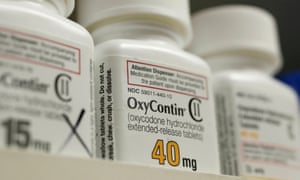
Bottles of painkiller OxyContin, made by Purdue Pharma. Photograph: Reuters

The American Pain Society, a body partially funded by pharmaceutical companies, was pushing the concept of pain as the “fifth vital sign”, alongside other measures of health such as heart rate and blood pressure. “Vital signs are taken seriously,” said its president, James Campbell, in a 1996 speech to the society. “If pain were assessed with the same zeal as other vital signs are, it would have a much better chance of being treated properly. We need to train doctors and nurses to treat pain as a vital sign.”

The APS wanted the practice of checking pain as a vital sign as a matter of routine adopted in American hospitals. The key was to win over the Joint Commission for Accreditation of Healthcare Organizations, which certifies about 20,000 hospitals and clinics in the US. Its stamp of approval is the gateway for medical facilities to tap into the huge pot of federal money paying for healthcare for older, disabled and poor people. Hospitals are careful not to get on the wrong side of the joint commission’s “best practices” or to fail its regular performance reviews.

In response to what it called “the national outcry about the widespread problem of under-treatment” – an outcry in good part generated by drug manufacturers – the commission issued new standards for pain care in 2001. Hospital administrators picked over the document to ensure they understood exactly what was required.

Every patient was to be asked about their pain levels, no matter what the reason they were seeing a doctor. Hospitals adopted a system of colour-coded smiley faces, to represent a rising scale of pain from 0-10. The commission ruled that anybody identifying as a five – a yellow neutral face described as “very distressing” – or above was to be was to be referred for a pain consultation.

The commission told hospitals they would be expected to meet the new standards for pain management at their next accreditation survey. Purdue Pharma was ready. The company offered to distribute materials to educate doctors in pain management for free. This amounted to exclusive rights to indoctrinate medical staff. A training video asserted that there is “no evidence that addiction is a significant issue when persons are given opioids for pain control”, and claimed that some clinicians had “inaccurate and exaggerated concerns about addiction, tolerance and risk of death”. Neither claim was true.

Some doctors questioned the value of patient self-assessment, but the commission’s regulations soon came to be viewed as a rigid standard. In time, pain as the fifth vital sign worked its way into hospital culture. New generations of nurses, steeped in the opioid orthodoxy, sometimes came to see pain as more important than other health indicators.

Dr Roger Chou, a pain specialist at Oregon Health and Science University who has made long-term studies of the effectiveness of opioid painkillers and helped shape the Centers for Disease Control and Prevention’s policy on the epidemic, said the focus on pain caused patients to give it greater weight than made sense.

“When you start asking people: ‘How much pain are you having?’ every time they come into the hospital, then people start thinking: ‘Well, maybe I shouldn’t be having this little ache I’ve been having. Maybe there’s something wrong.’ You’re medicalising what’s a normal part of life,” he said.

One consequence was that people with relatively minor pain were increasingly directed toward medicinal treatment while consideration of safer or more effective alternatives, such as physiotherapy, were marginalised. Another, said Chou, was the increased expectation that pain can be eliminated. Chasing the lowest score on the pain chart often came at the expense of quality of life as opioid doses increased. “It’s better to have a little bit of pain and be functional than to have no pain and be completely unfunctional,” said Chou.

Health insurance companies piled yet more pressure on doctors to follow the path of least resistance. This meant cutting consultation times and payments for more costly forms of pain treatment in favour of the direct approach: drugs.

The joint commission needed a way to judge whether its 2001 edict on pain was being adhered to and latched on to patient satisfaction surveys. It took a determined doctor to resist the pressure to prescribe. Physicians could spend half an hour pressing a person to take more responsibility for their own health – eat better, exercise more, drink less, find ways to deal with stress – only to watch an unhappy patient make their views known on the satisfaction survey and face a dressing down from hospital management. Or they could quickly do what the patient came in for: give them a pill and get full marks.

In Detroit, Dr Charles Lucas’s three decades of experience as a surgeon told him it was possible to what was easy and sign the prescription, or to do what was hard. Lucas grew up in the city and had been instrumental in establishing Detroit’s publicly owned hospital as the highest-level trauma centre in Michigan and one of the first top-tier centres in the country.

 
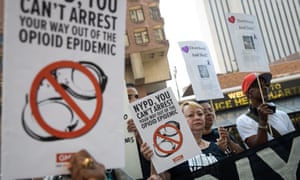
Activists in New York, during a protest denouncing the city’s ‘inadequate and wrongheaded response’ to the opioid overdose crisis. Photograph: Getty
Emergency departments became beacons for the opioid dependent, who quickly learned to game the system to get drugs on top of their prescriptions. They turned up feigning pain, knowing harassed medical staff under pressure of time and the commission’s standards were likely to prescribe narcotics and move on without too many questions.

“Some of the old-time nurses, they have that jaundiced look in their eye and say ‘So-and-so’s complaining of pain’. You can tell by the look in their eye that they don’t think it’s justified that they get any more medicine,” said Lucas. “The younger nurses, they say we have to treat this pain – because they’ve been indoctrinated – they’ve got to get rid of the pain. God forbid you don’t get rid of the pain. That would be like a mortal sin.”

But there was a price for resisting the pressure to prescribe ever higher doses of pain relief.

Lucas was knocked back in surprise, and then infuriated, to be summoned to appear before his hospital’s ethics committee after a nurse reported him for failing to provide adequate pain treatment.

The surgeon’s longstanding patients included Gail Purton, the wife of a well-known Michigan radio personality. Lucas operated on Purton a few times, and she was back for surgery after her ovarian cancer spread. “It was a big operation. Cut off all sorts of cancer.” The next day, a nurse asked Purton if she was in pain. Purton said she was. The nurse reported Lucas for failing to properly address a patient’s pain. “I got reported because I wasn’t giving her enough pain medicine. She had a big cut from here to here,” Lucas said, running his finger across the front of his shirt and scoffing at the idea that she could be pain-free after an operation like that.

The surgeon responded with a five-page letter to the ethics committee chairman, whom he happened to have trained, challenging the questioning of his professional judgment. Purton wrote her own letter, praising Lucas’s care and saying that she never expected not to have pain after a major operation.

The case was dropped, but it was not an isolated incident. Lucas has worked closely with another surgeon, Anna Ledgerwood, since 1972. She too was hauled before the ethics committee on more than one occasion, on the same charge. It cleared Ledgerwood, but Lucas said more junior surgeons buckled to the pressure to administer opioids just to stay out of trouble.

Lucas regarded the new pain orthodoxy as a growing tyranny. He also thought it was killing patients. He began to collect his own data.

As the joint commission was pushing out its new standards for pain treatment in the early 2000s, the industry was driving a parallel effort to influence the prescribing habits of doctors in small clinics and private practices across the country. Many were still hesitant to prescribe narcotics, in part because of fear of legal liability for overdose or addiction.

The American Pain Society and Haddox, who was by then working for Purdue Pharma, were instrumental in writing a policy document reassuring doctors they would not face disciplinary action for prescribing narcotics, even in large quantities. The industry latched on to the Federation of State Medical Boards because of its influence over health policy individual US states which regulate how doctors practise medicine.

In 2001, Purdue Pharma funded the distribution of new pain treatment guidelines drawn up by the FSMB that sounded many of the same themes as the standards written by the joint commission.

The document picked up on Haddox’s pseudo-addiction theory. “Physicians should recognise that tolerance and physical dependence are normal consequences of sustained use of opioid analgesics and are not synonymous with addiction,” it said.

The FSMB pressed state medical boards to adopt the guidelines and to reassure doctors that adhering to them would diminish the likelihood of disciplinary action.

Over the following decade, the FSMB took close to $2m (£1.52m) from the drug industry, which mostly went to promote the guidelines and to finance a book, Responsible Opioid Prescribing, written with the oversight and advice of a clutch of doctors who were strong advocates of wider use of prescription narcotics. The book was sold to state medical boards and health departments for distribution to physicians, clinics and hospitals. The drug industry paid for the publication but the FSMB kept the $270,000 profits from sales.

Within a few years, the model guidelines were adopted in full or in part by 35 states, and the floodgates were open to mass prescribing of what Drug Enforcement Administration agents came to call “heroin in a pill”. Opioids were soon the default treatment even for relatively minor pain. Dentists gave them to teenagers after pulling their wisdom teeth. Not just one or two days’ worth of pills, but a fortnight or a month’s worth, which, if they did not draw the intended recipient in, frequently sat in the medicine cabinet waiting to be discovered by someone else in the family. The lack of caution in prescribing left an impression among the users that the drugs were harmless, and some people shared them with others as easily as they might an aspirin. Prescribing escalated year on year. So did profits. OxyContin sales passed $1bn a year in 2000. Three years later they were twice that. Other opioid makers were pulling in huge profits too.

By the time the FSMB guidelines were landing in doctors’ inboxes in the early 2000s, Ballantyne had reached her own conclusions about the impact of escalating opioid prescribing. In 2003, she co-authored an article in the New England Journal of Medicine highlighting the dearth of comprehensive trials and saying that two important questions remained unanswered even as mass prescribing of opioids took off. Do they work long term? Are higher doses safe to take year after year? The drug industry and opioid evangelists said yes, but where was the evidence for it?

Ballantyne wrote that there was evidence that putting some patients on serial prescriptions of strong opioids has the opposite of the intended effect. High doses not only build up a tolerance to the drug, but cause increased sensitivity to pain. The drugs were defeating themselves.

Her assessment seemed to warn that if there was an epidemic of pain, it was partly driven by the cure. On top of that, there was evidence that the drugs were toxic. Then came the conclusion that stuck a dagger into the heart of the campaign for wider opioid prescribing. “Whereas it was previously thought that unlimited dose escalation was at least safe, evidence now suggests that prolonged, high-dose opioid therapy may be neither safe nor effective,” she wrote.

Ballantyne was also increasingly aware that the claim that pain neutralised the risk of addiction was false. Quantifying addiction, and who may be vulnerable, is notoriously difficult. Ballantyne, like a lot of doctors, estimated that between 10 and 15% of the population is vulnerable, but that it depends on the substance and circumstances. What she was certain of was that Purdue’s high-strength pill, OxyContin, had been a game changer. “The long-acting opiates suddenly put much higher doses into people’s hands and much more of it, and taking it around the clock made them dependent on it.”

From her research, Ballantyne concluded that OxyContin supercharged what was already widespread dependence on weaker opioid pills by drawing a new group of people into the category at risk of addiction and death. The danger was compounded by OxyContin’s failure to live up to its promise of holding pain at bay for 12 hours. For some patients, it wore off after eight, causing them to take three pills a day instead of two, greatly increasing their overall dose of narcotic and with it the risk of addiction.

Ballantyne thought the article would at least cause her profession and the drug industry to take stock of the impact of mass prescribing. By the time the article appeared, the documented death toll from prescription opioids was running at around 8,000 a year.

“When the 2003 New England journal article came out, I thought it was going to make the medical community sit up and say: ‘Wow. These drugs that we’ve been thinking are helping people are not. We have a real problem.’ But the medical community didn’t at all say: ‘Wow,’” Ballantyne said with half a laugh, 15 years later.

“People in my field who had been, like me, taught we have to do this – people who’d been lobbying to try and increase opiate use, like the palliative care physicians – said: ‘What are you doing? We worked so hard to get to this point, and now you’re going to turn it all around. They become so rattled when you suggest you shouldn’t give the opiates – it’s partly people in the pain field and especially people in pharma – because it’s big business.”

Lucas and Ledgerwood had their own study on the impact of opioids in the works. They came to believe the tyranny of the colour-coded smiley faces was costing lives. Years of surgery have given Lucas a healthy respect for pain as a tool for recovery. To suppress it was dangerous. But as large doses of opioids became the norm, the surgeon noted an increasing number of incidents of patients struggling to breathe after routine operations and being moved to intensive care.

Lucas and Ledgerwood visited trauma centres to collect data on deaths before and after the joint commission standards on pain treatment. In 2007, the two doctors published their findings. Before the commission’s dictum, 0.7% of trauma centre patients died from “excess administration of pain medicines”. The death toll rose to 3.6% after the commission’s policies kicked in.

“In each case, administration of sedation led to a change in vital signs or a deterioration in the respiratory status requiring some type of intervention which, in turn, led to a cascade of events resulting in death,” the paper said. Those were only the deaths in which there was little doubt opioids were responsible, and the real toll was almost certainly higher. “Overmedication with sedatives/narcotics … clearly contributed to deaths,” the study concluded.

A memorial in Washington DC, consisting of 22,000 engraved white pills representing the face of someone lost to a prescription opioid overdose in 2015. Photograph: Mark Wilson/Getty

“I’m convinced that because of the pressures brought to bear by the joint commission, we are killing people,” Lucas told me. The study said the medical staff lived in fear of the joint commission standards which created “great psychological pressure on caregivers” to use narcotics.

In a damning critique, the paper said that the commission’s reliance on pain scales to guide treatment had created an “excessive emphasis on undermedication at the same time ignoring overmedication”. The obsession with ensuring people were not in pain came at the expense of ignoring the dangers of giving large amounts of opioids to people recovering from surgery or serious injury. The drugs may kill the pain but they also risked killing the patient.

The two doctors made no secret of who they blamed for “this preventable cause of death and disability”. “It’s about money. Money has influence, and it influenced the joint commission,” said Lucas.

The surgeon presented the paper to a meeting of the Central Surgical Association and saw it published by the Journal of the American College of Surgeons under the headline “Kindness Kills: The Negative Impact of Pain as the Fifth Vital Sign.”

Afterwards, Lucas got a stream of letters and emails from doctors who recognised the problem. But, unlike Ballantyne, he wasn’t surprised when the policy remained the same. “Did I expect a change? No. It is too ingrained into the medical profession. It’s become financial just like the drug industry is financial. It’s nothing to do with right or wrong. It’s about how the money flows,” he said. “When you write a paper you want there to be unemotional data out there. You want that unemotional data to be analysed and interpreted in one way or the other, but you don’t expect the Renaissance.”

In 2012, nine years after Ballantyne’s cautioning against the mass prescribing of opioids as a quick fix for pain was published in the New England Journal of Medicine, a renowned British pain specialist, Cathy Stannard, called the doctor’s paper “a distant warning bell”, challenging the opening of the floodgates to strong opioids.

Ballantyne continued to collect data and publish ever more detailed insights into the impact of painkillers. A less rapacious drug industry might have paused in its headlong charge to sell opioids, and less blinkered and compliant regulators might have determined that this was the moment to weigh the claims made in favour of permitting such widespread prescribing.

Instead the pharmaceutical companies took the warnings as a challenge to their business interests. Through the 2000s, industry poured money into a political strategy to keep the drugs flowing. It funded front groups and studies to claim that there was indeed an epidemic – but it was of untreated pain. The millions coping with chronic pain were the real victims, the industry said, not the “abusers” hooked on opioids they often bought on the black market or obtained from crooked doctors. That one frequently became the other was conveniently overlooked.

Pharma’s lobbyists worked to persuade Congress and the regulators that to curb opioid prescribing would be to punish the real victims because of the sins of the “abusers”, and it worked. As a result, the devastation ran unchecked for another decade and more. By 2010, doctors in the US were writing more than 200m opioid prescriptions a year. As the prescribing rose, so did the death toll. Last year, more than 72,000 Americans died of drug overdoses, the vast majority from opioids, nearly 10 times the number at the time Ballantyne published her warning.

The head of the FDA at the time OxyContin was approved for distribution two decades ago, Dr David Kessler, later described the opioid crisis as an “epidemic we failed to foresee”. “It has proved to be one of the biggest mistakes in modern medicine,” he said.

Kessler was wrong. It wasn’t a mistake. It was a betrayal.