Search This Blog

Monday, 28 July 2014

When it comes to our welfare system, we’ve lost the plot


As Britain follows the US in tearing up its safety net, the story of social security needs to be retold from the very beginning

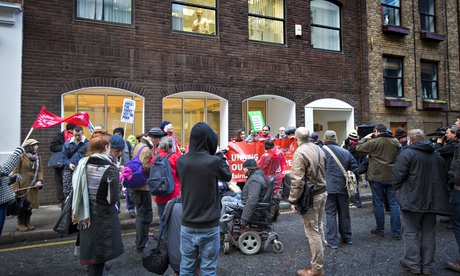
protest benefits street
A protest outside the London offices of Love Productions, which made the TV programme Benefits Street. Photograph: Graham Turner for the Guardian

The rip-roaringly successful 4’s Benefits Street, on Channel 4, is being followed up by Immigrant Street. This a year after the same station’s Benefits Britain 1949 – to middle England’s delight – subjected contemporary welfare claimants to the social security rules of the ration-book years, as applied by real-life bullying bureaucrats with real jobcentre experience. Meanwhile, Channel 5 has developed its own pauper-baiting programme,On Benefits & Proud, and its cousin, Gypsies On Benefits & Proud.
The boom in poverty porn suggests that the left is getting thrashed on social security, and the polling confirms this. There is still support for the general principle of a safety net and a ladder of opportunity, but turn to the practicalities of particular benefits and suspicions about freeloaders rise as jealousies break out in every direction. Listening to voices from across Britain for my book Hard Times, I found not only workers complaining about the unemployed getting an easy ride, but also jobless people grumbling that the low-paid got more help than them nowadays, not to mention striking mutual antipathy between recipients of different benefits.
To see where this debate could lead, glance across the Atlantic. Four decades after Ronald Reagan invoked the “welfare queen”, the nearest thing America had to income support is long abolished. There is charity, and sometimes state and local relief, but many a chronic health condition goes untreated, and penury abounds. The right, however, still refuses to relent. Paul Ryan, the Republican pick for vice-president in 2012, said about Medicaid and food stamps that year: “We don’t want to turn the safety net into a hammock that lulls able-bodied people into lives of dependency and complacency.” It is remarkable that such language is not being used about cash payments that could be misspent but about programmes to provide food and medicine to poor people in the world’s richest economy.
As the coalition freezes, cuts and applies punitive “sanctions”, we’re heading the same way faster than anyone would have thought possible a few years ago. The only chance of arresting the drift is somehow resetting the whole discussion from first principles.
Benefits are paid out on many different bases around the world. In France, there is still a meaningful connection between earnings, social contributions paid in, and benefit paid out. In parts of northern Europe, unions retain a hand in collecting premiums and administering payments, forging a link between benefits and a concrete institution less remote and alien than “the welfare state”. In New Zealand, a flat-rate pension – available to all seniors, on the strength of residency alone – represents an entirely different way of thinking about benefits, more related to universal rights.
No real-world system ever fits any theory perfectly. Even the fondly remembered Beveridge settlement of the 1940s was riddled with compromise. A stern Victorian, William Beveridge himself was serious about social insurance, properly funded by contributions that built up over time. But Attlee was rightly concerned about the pressing needs of the already elderly, who had never had a chance to pay in, so it was operated as pay-as-you-go from the off. There was also – as there almost always has to be – a means-tested safety net to catch those who would otherwise sink, something that compromised the ideal of “earned” benefits.
Underlying the unloved mosaic of contemporary British benefits lurks a mishmash of half-forgotten principles. In the field of disability alone, there are income top-ups that embody poverty relief, allowances based on contribution records, and other benefits contingent on nothing but health, which reflect ideas about economic rights – even if it does not feel that way as the coalition hacks them back. But through the muddle, there are some definite trends. The proportion of non-pensioner benefits linked to contributions in the UK has dropped by around two-thirds since the 1970s, with means-testing filling the gap, turning welfare payment into the sort of residual function Richard Titmuss was thinking of when he warned that services for the poor would become poor services.
There will, then, always be fixes and workarounds. The important thing is that citizens should be able tell a rough story about how the system works. That sense of a story is what we have lost, and must now restore. But how?
The Institute of Public Policy’s Condition of Britain report suggests replacing some ill-understood cash benefits with public services, particularly in childcare, where – it says – state nurseries would not only be more loved, but also more efficient than under today’s morass of subsidies. Building social houses instead of writing cheques to landlords for owning scarce private homes likewise has commonsensical appeal. The IPPR also proposes refreshing the contributory link by turning the national insurance fund into the sort of independent body Beveridge envisaged, while also increasing jobseeker’s allowance for unemployed workers who have previously paid in.
There would need to be adjustments to “credit in” parents and carers who can’t work and also, arguably, the increasing band whose temporary, part-time or zero-hours jobs make for patchy careers. This leads some radical voices, such as left-leaning Compass, to call for a citizen’s income, paid to all and clawed back through taxes from those who don’t need it. A payment for everybody could hardly be painted as the preserve of the scrounger, and the proposal would deal – at root – with the financial anxiety of our times.
I’ve got my doubts about affordability, and also the pitch to voters often none too keen on rights. But what I admire here is Compass’s willingness to pose the big questions. You might prefer the story about rights to social security, or you might prefer a yarn about the duty to contribute to social insurance. Either, I’d say, is preferable to today’s tragic tale of welfare’s decline.
How we misunderstand risk in sport

Aggression, defence, success, failure, innovation - they are all about our willingness to take risks and how we judge them
Ed Smith in Cricinfo 
July 28, 2014

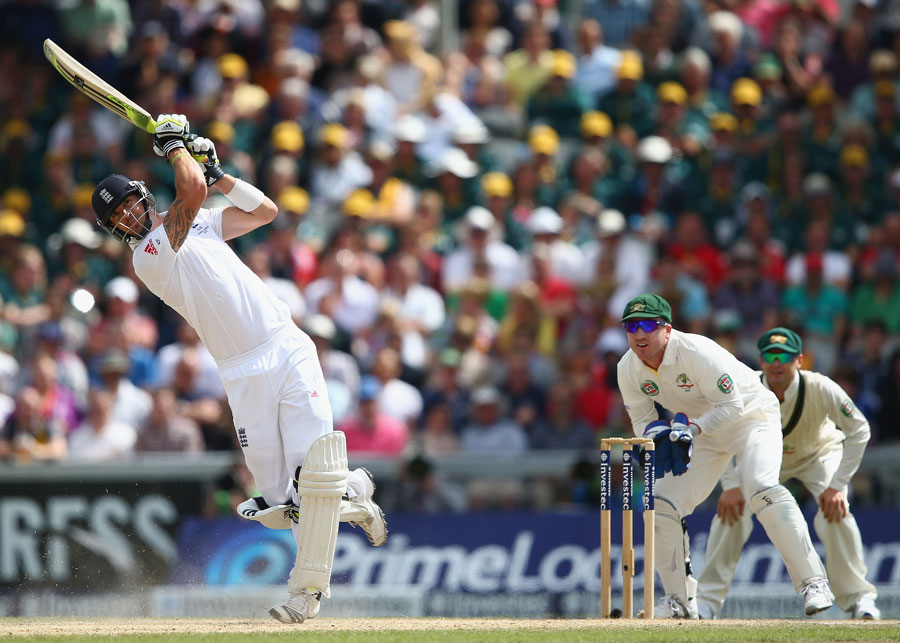
Same risk, different outcome: when a batsman goes after a bowler, he could end up being dismissed or hitting a six © Getty Images

The World Bank recently asked me to give a speech at a forum in London called "Understanding Risk". Initiall, I was unsure how I could approach the subject. How could I, an ex-sportsman turned writer, address financial experts on the question of risk?
On reflection, I realised there is another profession, followed around the world and relentlessly scrutinised, that relies almost entirely on the assessment of risk. Without risk, there can be no reward. Without risk, there are no triumphs. Without risk, there can be no progress.
And yet this entire profession, this whole sphere of human endeavour, doesn't really understand risk at all. It uses the term sloppily, even incorrectly. It criticises good risks and celebrates bad risks. It cannot distinguish between probabilities and outcomes.
It has changed its approach to risk, swapping one flawed approach for the opposite mistake. In the old amateur days, when it was run and managed like an old boys' club, there was little or no calculation of risk - merely unscientific anecdotes and old wives' tales. But the brave new dawn of social science didn't prove any better. In fact, it might be even worse. People put too much faith in maths, metrics and quantification. It has lurched from old boy's network to a pseudo-science - without pausing en route where it ought permanently to reside: with the acknowledgment that risk requires subjective but expert judgement. There is no perfect formula. If there was, everyone with a brain would succeed.
The sphere I describe, of course, is not finance or banking but professional sport. Sporting strategy - sometimes analytical and planned, sometimes instant and intuitive - always revolves around the assessment of risk. Taking risks is what sportsmen do for a living. And yet the analysis of risk does not match this practical reality. We usually talk in clichés not truths, often criticising good risks and praising bad risk-taking.
Here are four ways the sports world often misinterprets risk.

Risk is everywhere

In cricket, every attacking shot played by a batsman carries an element of risk, no matter how small. Stop playing shots and you cannot score runs. "You miss 100% of the shots you don't take," as Wayne Gretzky, the greatest ice hockey player of all time, put it.
And it is amazing when you stop playing attacking shots how much better bowlers bowl. Effective risk-taking has an intimidatory effect. Total risk-aversion the opposite: it emboldens your opponent, making him feel safe and relaxed.
In football, when a midfield player advances up the pitch, he is trying to orchestrate a goal while also reducing his own team's defensive protection. In risking creating a goal, he increases the risk of conceding one. Defenders, too, constantly weigh risks. Pressing the opposition, trying to get the ball back from them, is a risk. In moving up the pitch without possession, you create space behind you - if they are good enough to keep the ball and get past you.
But the alternative - safety-first defending - brings risks of another kind. If you never press, and always retreat into the safety of deep defensive organisation, then you rarely regain the ball. You dig your own trench, unable to threaten or frighten the opposition, merely sitting there waiting for the next wave of attack.
Tennis is all about risk. With your groundstrokes, if you are determined never to lose a point by hitting the ball long, not even once, then sadly you won't play with enough depth to make life difficult for your opponent. You will make zero errors and still lose.
And when it's your turn to return, if you never run round your backhand in the hope of hitting a forehand winner, then you will allow your opponent to settle into a comfortable serving rhythm. In the pursuit of good returning, you have to risk getting aced. You have to risk failure in the short term to give yourself a chance in the long term. You have to dare to be great.

Being right is not the same thing as events turning out well

You can be right and fail. You can be wrong and succeed.
Sport is about problem-solving. And the best way to discover new, better methods is to allow people to experiment through trial and error. Don't see what everyone else is doing and copy it. Find a better way
Sport rarely allows for this. We say that winning "justified the decision", a classic failure to distinguish between ex ante and ex poste thinking. Instead, the real question should be: would I do the same thing again, given the information I had at the time? Coaches and captains often make the right calls and lose. And they often make the wrong calls and win. It is stupid to judge a man's judgement on a sample size of one event.
The same point applies to risks taken by players. An unthinking tribal fan will shout "hero" when a risk-taking batsman hits a six, then scream "idiot" when the same shot ends up in a fielder's hands.
What a champion to take on the bowler! What a fool to take such a risk! The inconsistency here is not the batsman's, it is the spectator's. Coward/hero, fool/champion, disgrace/legend. The same risk can lead to either assessment.

Many crucial risks are invisible 

There are risks that no one sees that still have to be taken. Critics delude themselves that the only form of bravery in sport is guts and determination. At least as important is nerve, or, put differently, the capacity to endure risk imperceptibly.
When I was commentating with Sourav Ganguly at Lord's last week, he told me that Virender Sehwag used to shout, "He missed a four!" while he was in the dressing room watching team-mates batting. Ganguly quite rightly added that missing an opportunity to do something good is just as much of a mistake as making a visible error.
Many teams imperceptibly yield an advantage through timidity, fearfulness, and anxiety about standing out for the wrong reasons - an advantage they never subsequently reverse.
During the last Ashes series, I used this column to develop the metaphor of looking at sport as an old-fashioned battlefield. As the front lines engage and each army tries to advance, the direction of travel will be determined by tiny acts of skill and bravery - and equally imperceptible acts of risk aversion.
Somewhere on the front line, an infantryman inches a foot closer to his ally, hiding his own shield slightly behind his friend's. Hence one man becomes fractionally safer - but if the action is repeated a thousand times, the front line becomes significantly narrower and weaker as a whole. No one individual can be singled out as a hopeless failure. But the group suffers a collective diminution.
So it is in sport. When a batsman fails to hit a half-volley for four because he is too cautious, an opportunity is wasted to exploit an advantage offered to his team.
We talk a great deal about momentum, but not enough about how momentum is created. Once the whole army is retreating, even the bravest soldiers can fail to hold the line. We talk of courage when the tide has already turned. So in place of the usual clichés, "out-fought", "out-toughed", "out-hungered", I have a simpler word: outplayed. Or, even better, "quietly, perhaps indiscernibly, defeated by superior risk-taking".

The essential risk of being prepared to look silly

This is how sport moves forward. In 1968, a professional athlete had a crazy idea. Madder still, he had this idea just before the tournament event of his life. He wanted to rip up the coaching manual and do it all his own way. His coaches told him to forget about it, to stick with the old way of doing things, not to rock the boat.
He ignored them. He was a high-jumper, and he instinctively wanted to go over the bar head first, back down - not, as everyone else did, leg first, face down. At the 1968 Mexico Olympics, despite everyone telling him he was mad, he went ahead with his revolutionary technique. And how did it work out? He won a gold medal and set a new world record. He was called Dick Fosbury and he'd just invented the Fosbury Flop.
Sport is about problem-solving. A challenge is set: kick the ball into the net; hit the ball over the boundary; jump over the bar. From then on, solutions evolve, sometimes deliberately, sometimes by accident. And the best way to discover new, better methods is to allow people to experiment through trial and error. Don't see what everyone else is doing and copy it. Find a better way.
The left-field question is the one to ask. Why shouldn't I jump over the high-jump bar head first? Why shouldn't I aim my sweep shot towards off side where there aren't any fielders (the reverse sweep, the switch hit)?
Sport moves forward when it is irreverent, resistant to authority. The greatest cricketer of all time, Don Bradman, used a technique that no one has dared to try out a second time. His bat swing started way out to the side, rather than as a straight pendulum line from behind him.
Let me repeat. The method that made Bradman one and a half times better than the second-best player was consigned to the rubbish bin of sporting ideas. Bradman was prepared to look stupid by risking a unique rather than textbook technique. Others have been unwilling or unable to follow.
Bradman, however, benefited from one huge slice of luck. He escaped the greatest risk that can befall any genius: formal education. He learnt to bat on his own, using the empirical method, without a coaching manual. As a child he would repeatedly hit a golf ball against the curved brick base of his family's water tank.
Here is a startling thought. How many Bradmans were persuaded to try the usual technique? How many Fosburys were talked out of taking a chance?
In the course of trying to be different and better, you have to bear the risk of being different and worse.

Sunday, 27 July 2014

One of my favourite Mallu films - Arabikkatha


Israel-Gaza conflict: Secret report helps Israelis to hide facts

Patrick Cockburn in The Independent.

Israeli spokesmen have their work cut out explaining how they have killed more than 1,000 Palestinians in Gaza, most of them civilians, compared with just three civilians killed in Israel by Hamas rocket and mortar fire. But on television and radio and in newspapers, Israeli government spokesmen such as Mark Regev appear slicker and less aggressive than their predecessors, who were often visibly indifferent to how many Palestinians were killed.
There is a reason for this enhancement of the PR skills of Israeli spokesmen. Going by what they say, the playbook they are using is a professional, well-researched and confidential study on how to influence the media and public opinion in America and Europe. Written by the expert Republican pollster and political strategist Dr Frank Luntz, the study was commissioned five years ago by a group called The Israel Project, with offices in the US and Israel, for use by those "who are on the front lines of fighting the media war for Israel".
Every one of the 112 pages in the booklet is marked "not for distribution or publication" and it is easy to see why. The Luntz report, officially entitled "The Israel project's 2009 Global Language Dictionary, was leaked almost immediately to Newsweek Online, but its true importance has seldom been appreciated. It should be required reading for everybody, especially journalists, interested in any aspect of Israeli policy because of its "dos and don'ts" for Israeli spokesmen.
These are highly illuminating about the gap between what Israeli officials and politicians really believe, and what they say, the latter shaped in minute detail by polling to determine what Americans want to hear. Certainly, no journalist interviewing an Israeli spokesman should do so without reading this preview of many of the themes and phrases employed by Mr Regev and his colleagues.
Mark RegevMark Regev


The booklet is full of meaty advice about how they should shape their answers for different audiences. For example, the study says that "Americans agree that Israel 'has a right to defensible borders'. But it does you no good to define exactly what those borders should be. Avoid talking about borders in terms of pre- or post-1967, because it only serves to remind Americans of Israel's military history. Particularly on the left this does you harm. For instance, support for Israel's right to defensible borders drops from a heady 89 per cent to under 60 per cent when you talk about it in terms of 1967."
How about the right of return for Palestinian refugees who were expelled or fled in 1948 and in the following years, and who are not allowed to go back to their homes? Here Dr Luntz has subtle advice for spokesmen, saying that "the right of return is a tough issue for Israelis to communicate effectively because much of Israeli language sounds like the 'separate but equal' words of the 1950s segregationists and the 1980s advocates of Apartheid. The fact is, Americans don't like, don't believe and don't accept the concept of 'separate but equal'."
So how should spokesmen deal with what the booklet admits is a tough question? They should call it a "demand", on the grounds that Americans don't like people who make demands. "Then say 'Palestinians aren't content with their own state. Now they're demanding territory inside Israel'." Other suggestions for an effective Israeli response include saying that the right of return might become part of a final settlement "at some point in the future".
Dr Luntz notes that Americans as a whole are fearful of mass immigration into the US, so mention of "mass Palestinian immigration" into Israel will not go down well with them. If nothing else works, say that the return of Palestinians would "derail the effort to achieve peace".
The Luntz report was written in the aftermath of Operation Cast Lead in December 2008 and January 2009, when 1,387 Palestinians and nine Israelis were killed.
There is a whole chapter on "isolating Iran-backed Hamas as an obstacle to peace". Unfortunately, come the current Operation Protective Edge, which began on 6 July, there was a problem for Israeli propagandists because Hamas had quarrelled with Iran over the war in Syria and had no contact with Tehran. Friendly relations have been resumed only in the past few days – thanks to the Israeli invasion.
Frank LuntzFrank Luntz


Much of Dr Luntz's advice is about the tone and presentation of the Israeli case. He says it is absolutely crucial to exude empathy for Palestinians: "Persuadables [sic] won't care how much you know until they know how much you care. Show Empathy for BOTH sides!" This may explain why a number of Israeli spokesman are almost lachrymose about the plight of Palestinians being pounded by Israeli bombs and shells.
In a sentence in bold type, underlined and with capitalisation, Dr Luntz says that Israeli spokesmen or political leaders must never, ever justify "the deliberate slaughter of innocent women and children" and they must aggressively challenge those who accuse Israel of such a crime. Israeli spokesmen struggled to be true to this prescription when 16 Palestinians were killed in a UN shelter in Gaza last Thursday.
There is a list of words and phrases to be used and a list of those to be avoided. Schmaltz is at a premium: "The best way, the only way, to achieve lasting peace is to achieve mutual respect." Above all, Israel's desire for peace with the Palestinians should be emphasised at all times because this what Americans overwhelmingly want to happen. But any pressure on Israel to actually make peace can be reduced by saying "one step at a time, one day at a time", which will be accepted as "a commonsense approach to the land-for-peace equation".
Dr Luntz cites as an example of an "effective Israeli sound bite" one which reads: "I particularly want to reach out to Palestinian mothers who have lost their children. No parent should have to bury their child."
The study admits that the Israeli government does not really want a two-state solution, but says this should be masked because 78 per cent of Americans do. Hopes for the economic betterment of Palestinians should be emphasised.
Prime Minister Benjamin Netanyahu is quoted with approval for saying that it is "time for someone to ask Hamas: what exactly are YOU doing to bring prosperity to your people". The hypocrisy of this beggars belief: it is the seven-year-old Israeli economic siege that has reduced the Gaza to poverty and misery.
On every occasion, the presentation of events by Israeli spokesmen is geared to giving Americans and Europeans the impression that Israel wants peace with the Palestinians and is prepared to compromise to achieve this, when all the evidence is that it does not. Though it was not intended as such, few more revealing studies have been written about modern Israel in times of war and peace.

The length of my beard


Untitled-1

“What’s the point of wearing a headscarf, if she’s going to roam around campus wearing tight jeans like that?” remarked a not so conservative friend, while referring to his former crush, after she turned him down. Pakistani society is visibly in flux when it comes to understanding the role religion should play in society. This fluidity will naturally translate into individuals that struggle to define the role religion should play in their lives. Most of these people can be spotted from a distance; they stand on the edge of external markers of religiosity. The edge is where all the action takes place: a young man from an ultramodern family goes to university clean shaven and returns home four years later, wearing a thick black beard and a white Saudi style thobe with a turban. The edge is where one young woman – from a family full of women donning the hijab – chooses to take her hijab off and is ostracized by her own mother.

Their story is Pakistan’s story.

I still remember the whispers of hypocrite that followed a girl in university who chose to take her head scarf off. “Why did she wear a scarf in the first place, if she wasn’t sure about her ability to follow through?” was a common comment on the campus grapevine. Same was the case with young men who chose to vary the length of their beards. Labeled ‘confused’ at best and ‘hypocrites’ at worst, these men and women are physical manifestations of a nation on the edge – we hang onto religion as our last hope for salvation or self-destruction, whichever comes first.

Beards and hijabs may serve as visible proxies of an individual’s religiosity but Pakistani society has taken this to an extreme by transforming these external markers into a religious stock market, where your shares trade up or down based on the length of your beard on a particular day.  This outside in approach to religion hasn’t just turned people off religion, as some secular folks like to argue. It has also corrupted the understanding of religion for those genuinely trying to be religious. Pakistanis have used their signature ingenuity to crack a short cut to understanding religion. So what if you can’t become a good human being overnight? You can develop the intention to grow a beard or start wearing a headscarf overnight.

We blame ‘foreigners’ and ‘conspiracies’ for the horrible things done in the name of our religion but which foreigner or conspiracy forces us to ostracize a family member for her decision to take the Hijab off or take it for the first time? Our actions and taunts suffocate those who want to genuinely discover their faith, at their own pace. In fact, for all their striking differences, there’s one belief religious and non-religious Pakistanis share; both have a low tolerance for individuals struggling to figure out religion, with interpretations different from their own.

We need to challenge ourselves to be better Muslims and human beings – to respect each other’s right to evolve our religious identity, without being quick to pass judgment. The purpose of this column isn’t to condemn everyone with the same broad brush but to highlight that collectively as a society, we tend to gravitate towards judging those who don’t look like us or our worldview. This has to stop.

Take a look at the beating religion has taken because of our judgmental behavior: an extraordinary emphasis on external behaviors has incentivized a one dimensional view of religion that quietly replaces spirituality with showing off. This behavior is now visible in society with kitty party aunties trying to top each other by hosting the most elaborate ‘dars’ at their DHA Mc-mansions. Or infamous rich tycoons strutting out sacrificial animals, imported all the way from Australia for Eid-ul-Adha, to draw record crowds appreciating the beauty and fat content of their prey. And then there are middle aged men playing mine is bigger than yours with their beards, while forgetting that religion also requires us to pay our taxes, not park in the middle of the road at Juma and be honest in business dealings.
jugaru nation will find shortcuts to anything, which includes understanding religion. The least we can do is spare those refusing to take a short cut – those living on the edges, who try to reflect on religion from the inside out rather than the outside in. 

Wednesday, 16 July 2014

Ten dating mistakes that men always make

Eighteen months ago, I was a long-term singleton. I’d decided that my taste in men had become a little too stringent and restrictive (i.e. I always dated the same sort of guy and was left feeling bemused when they kept showing themselves to be scoundrels). So, I was set a challenge by my friends, in hope of changing the status quo – I was to join a dating site and I HAD TO accept every date I was asked on over the next six weeks.
A month and a half later I’d been on nearly 60 first dates (and can confirm that it is truly exhausting having to represent only the most palatable aspects of your personality over a prolonged period, I don’t know how the Duchess of Cambridge does it). I dated every type of man you could possibly think of, from every possible profession and background, ranging from 23 to 65 years old. I learned quite a lot about humanity, I like to think.
Natasha Devon in The Telegraph

I also noticed a few common dating faux pas nearly all men make. That’s not to say that aren’t totally understandable……But they’re also massive turn-offs (hence why the sixty first dates only resulted in one second date). So, here they are, my gift to you, single men of Britain:
1. Not having a plan. 
 It doesn’t matter how feminist and independent you believe your date to be, we love a man who is good at decision making. Please do not arrange to meet us at the Tube station and then say, “so, where do you fancy going?” This question fills us with dread. We spent three hours getting ready for this thing. We’ve done our bit. We just want to be taken somewhere nice, please.
Bonus points if you say something like “I was thinking about going here as I’ve heard it’s great, unless you had somewhere in mind you’d prefer?” This shows you are decisive AND flatters our feminist sensibilities. We will swoon.
2. Saying “so why is a beautiful girl like you single?”
This is a stupid question on a couple of levels. First of all it makes us think you’re the sort of bloke who believes the dating game is just one long queue of girls, all of whom are DESPERATE for a boyfriend and are standing in order of physical attractiveness, waiting for the next man to walk past. Life is not the television show Take Me Out and we don’t want to go out with a man who thinks it is. Secondly, it immediately makes us wonder why YOU’RE single, before concluding that you’re probably either a serial killer, one of those guys that has a house full of "love dolls" or secretly married.
We know you’re trying to pay us a compliment and that’s lovely, but just telling us we look nice is fine.
3. Admitting you’re nervous.
This is the sort of admission that should only ever happen in retrospect. If it’s five years hence, you’re married and you’re having all your other married friends over for dinner one evening then by all means say “you know the first time I took Sarah out I was SO nervous I had to dash to the toilet seven times in the half hour I was waiting for her to arrive”*. This will seem sweet when we know and love you. Before that, however, it’s just a bit weird.
*This example assumes that your partner is called Sarah. Toilet-based anecdotes about girls you dated who aren’t your present girlfriend/wife are almost never acceptable.
4. Acting like you don’t care.
Having said the above, behaving as though we are utterly disposable and as though this is the sort of thing you do every night isn’t very attractive either. Even if you DO go on dates with different women every night, making us feel special, unique and cherished is the cornerstone of every healthy relationship and also, more short term, the non-negotiable key to getting into our knickers. Things that will make us think you aren’t giving the date sufficient gravitas include yawning, playing with your phone* and turning up in any sort of sportswear.
5. *Playing with your phone
Put. The. Phone. Away. PLEASE.
6. Asking a question then looking really disinterested as soon as the answer comes.
Sounds really obvious, but you’d be surprised how many guys do this. It’s as though they’re actually there purely to soak up the ambience of the pub and their date’s company has been requested solely so they don’t look like a Billy No Mates. Do not ask us something, then glance lazily around (especially not at other girls in the vicinity) as soon as we open our mouths to respond. This is not how a conversation is supposed to go and however subtle you think you’re being, we always notice.
Call us demanding, but in addition to expressing a verbal interest in our lives, we expect you to stick around in the conversation long enough to hear our response.
7. Saying ‘tell me something about you no one else knows’.
Right, first of all, we are women and by our nature confessional – there’s virtually nothing that, between them, our Mum, best friend and most trusted work colleague don’t know about us. Secondly, even if there was, we’re hardly likely to share this scintillating fact with someone who was, 14 minutes ago, a complete stranger. Thirdly, this then puts us on the spot to recall something really unusual and ‘zany’ about ourselves, at which point every zany and unusual thing we have ever thought or done will immediately evaporate from our memory and there will be a cavernous, awkward silence during which we will both wish we were dead.
8. Doing the ‘mid-point date assessment’.
If there is one sentence guaranteed to kill any sort of spark it’s “so, how do you think it’s going?”. We do not wish to analyse this date halfway through it, with you, thank you. We wish to analyse it with our best girlfriends – initially via the medium of text whilst you are in the loo and then further the next evening over several glasses of Pinot Grigio.
9. Bad-mouthing other dates you have been on.
This is the dating equivalent of being the office gossip who spend their days spreading spurious personal information from desk-to-desk and then wonders why they aren’t invited to the pub at six o'clock. Your dating horror stories are fascinating and we will be enthusiastic because we really, really want to hear them. But we’ll also then immediately be on our guard, wondering if this date is a future anecdote for another date you might go on.
If you’re interested in watching in horror as someone second-guesses each word that comes out of their face in case it’s used to incriminate them at a further juncture, may I suggest instead watching Question Time.
10. Talking about your ex/Asking about her ex
Ah, the holy grail. We all know we shouldn’t do it. Every magazine article, dating manual and wise older person has warned us against this particular pitfall for as long as we can remember. Yet for some reason I was asked about my ex on approximately 80% of the dates I went on and, as a direct consequence, I actually ended up missing my ex a little bit.
To be avoided. At all costs.
And here’s some "dos":
- SMILE! - It doesn’t cost anything and it makes you look sexy.
- Insist on paying - A controversial one, this. We’re always happy to go halves or even to pay for the whole thing BUT if you absolutely insist we’ll assume you’re having deeply loving feelings towards us.
- Walk us to the station/put us in a cab/in some way show that you are bothered about what might befall us during our journey home.
- Text immediately you get in to say what a lovely night you had - Even if it’s a lie. It’s just British good manners.
Et voila. Happy dating, fellas!

Debunking the Myers-Briggs personality test


By Anthony Zurcher Editor, Echo Chambers 

The popular Myers-Briggs personality test is a joke, writes Vox's Joseph Stromberg. While it might be a fun way to pass the time, he says, it has about as much insight and validity as a Buzzfeed quiz.
The test, taken by an estimated 2 million people each year, has been around since the 1940s and is based on the observations of psychologist Carl Jung. Through a battery of 93 questions, it classifies test-takers into one of 16 personality types based on four sets of binary characteristics: introvert/extrovert, intuitive/sensory, feeling/thinking and judging/perceiving.
"Several analyses have shown the test is totally ineffective at predicting people's success in various jobs, and that about half of the people who take it twice get different results each time," Stromberg writes.
Stromberg says one of the key flaws to the test is that it relies on "limited binaries". Most humans, he says, fall along a spectrum and are not easily classified into opposite choices. People aren't exclusively extroverts or introverts - and where they fall on the spectrum can fluctuate widely based on how they are feeling at the moment.
Most psychologists have long since abandoned Myers-Briggs, if they ever gave it any credence at all, Stromberg continues.
Instead, he says, Myers-Briggs lives on as a revenue generator for CPP, the company that owns the rights to the test. It makes an estimated $20m (£11.6m) a year by charging people $15 to $40 to take the survey and certifying test administrators for $1,700.
Stromberg explains why people are willing to pay such a steep fee to get the official Myers-Briggs imprimatur:
"Once you have that title, you can sell your services as a career coach to both people looking for work and the thousands of major companies - such as McKinsey & Co., General Motors, and a reported 89 of the Fortune 100 - that use the test to separate employees and potential hires into 'types' and assign them appropriate training programs and responsibilities."
Even the US government, including the state department and the Central Intelligence Agency, uses Myers-Briggs - a waste of taxpayer money, Stromberg says.
He concludes:
"It's 2014. Thousands of professional psychologists have evaluated the century-old Myers-Briggs, found it to be inaccurate and arbitrary, and devised better systems for evaluating personality. Let's stop using this outdated measure - which has about as much scientific validity as your astrological sign - and move on to something else."
In a statement provided to the BBC, CPP president Jeffrey Hayes defends the test's validity.
"It's the world's most popular personality assessment largely because people find it useful and empowering, and much criticism of it stems from misunderstanding regarding its purpose and design," he says. "It is not, and was never intended to be predictive, and should never be used for hiring, screening or to dictate life decisions."
He says that organisations rely on the test "for its practical benefits in career development, conflict-handling, team building and leadership development".