Search This Blog

Thursday, 12 June 2014

Lies, damn lies, and Fleet Street stories about Kevin Pietersen


News-International-office-007

For months now, most of the mainstream cricket press have patronised and belittled England supporters who’ve dared to question their line on Kevin Pietersen.

We’ve said that too many hacks are:

(a) Prejudiced against Pietersen.
(b) In hock to the ECB.
(c) Far too ready to accept the ECB’s anti-KP spin as gospel truth.
(d) Instead of asking proper questions, have just believed any old rubbish Paul Downton has told them off the record.

They’ve not liked it one little bit. “Keyboard ranters” is how Derek Pringle describes the likes of us bloggers and Tweeters. The fourth estate see us impudent, paranoid, deluded, and in the grip of conspiracy theories.

They say we should shut up and be grateful for their privileged insight into the real workings of English cricket. In their minds, we must accept that KP is a bad man because…because they say so. They know the inside track, goes the claim – although they couldn’t possibly divulge the details.

Unfortunately for Her Majesty’s Press, the whole charade has today blown up in their face. The edifice has collapsed.

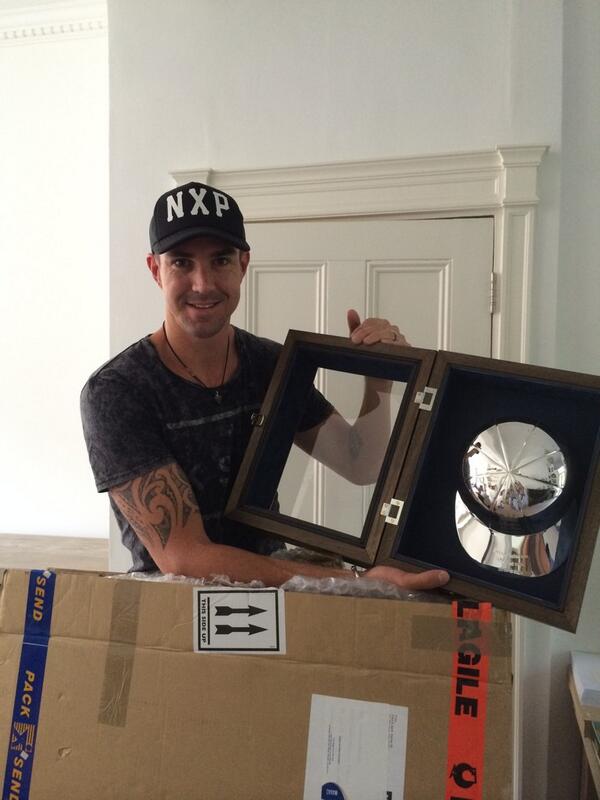
Yesterday, Sun cricket correspondent John Etheridge boasted this exclusive:


But there was a tiny problem: it was complete bollocks. As KP himself quickly made clear, by producing a photo of himself with the very presents he had supposedly forsaken. 

LIES from this morning! Who briefs you, John? Care 2 check ur facts instead of misleading the public?

Cricket - There's more grey to chucking than we might think

Osman Samiuddin in Cricinfo

A decade ago cricket's ancient and embedded hyper-morality crashed into the modern world's burgeoning thirst for reality television. The focus for this communion was Muttiah Muralitharan, and more specifically his action. Two TV networks, ESPN (in India) and the UK's Channel 4, broadcast what were paraded at the time as definitive acquittals of Muralitharan's action, which had till then been called periodically, sanctioned occasionally, and the subject of hysterical debate permanently.
------ALSO READ
------
Muralitharan went through his repertoire of deliveries with a steel-embedded plaster brace around his right arm, from bicep to wrist, and with admirable good nature. He looked a little uneasy in the ESPN show, a little too much like the guinea pig just becoming aware of his centrality to bigger, buffeting winds. But he went about it like a man who felt he needed to.
He bowled to Michael Slater in that one, to recreate match conditions. There was a doctor present too, explaining the unique physical quirks of Muralitharan's wrist, arm and shoulder, though he felt a little like Dr Nick Riviera, whose only residency of note has been on The Simpsons. Ravi Shastri, for ESPN, was quadruply burdened, as host, judge, jury and, eventually, the benefactor who cleared Murali. Shastri did so in the manner with which we are all familiar, effectively hype-mastering a science documentary. For Channel 4, Mark Nicholas managed a sombre posture, considered and inquiring but above all providing a kind of bipartisan seal on matters.
The issue by then had become so divided along racial lines that a non-Asian clearing of Murali felt necessary. That was the ultimate takeaway, of course, that Murali did not chuck. He could not with that steel brace on. Even Slats, an Aussie, said so.
In hindsight it is not so much the details of Murali's case that were important as was the fact that cricket felt the need for this public trial by TV in the first place. Even today, viewing it produces the kind of cringe only a certain kind of reality show does; especially the eagerness with which Muralitharan is cleared, as if he was guilty of some crime.
Though he looks uncomfortable in the ESPN version, Murali looked cheery and eager for Channel 4. He was probably a willing participant, perhaps even an instigator in doing the shows, but that is hardly the point. He was compelled into it by cricket, feeling no other recourse was available to prove that he was not some evil, cheating villain who would leave cricket forever corrupted. That is precisely what umpires such as Ross Emerson and Darrell Hair seemed to think he was, no-balling him with such ugly fervour that it was impossible to avoid feeling a vicarious humiliation at what Murali underwent. Men are prone to delusions when invested with the tiniest bit of authority in any case, but when furnished with a haloed moral authority they become monsters, or cricket umpires.
Hair and Emerson were after all only maintaining professional tradition. In every purge of suspect actions, umpires have led the hounding, right at the front of bloodthirsty crowds. Chuckers (and even the word is so phonetically derisive) have never been just men with kinks in their actions, or have seemed to bowl thus as a natural outcome of the overarm bowling action, which basically predetermines some degree of straightening (as an ICC survey discovered back in 2004). Cricket has treated chuckers as lepers because cricket doesn't have a reliable sense of a scale of bad: it can summon about the same amount of moral outrage for slow over rates as it can for Mankading, intimidatory bowling and match-fixing. It has a spirit nobody can define but one everybody screeches about when it is - regularly and easily - breached. So Murali and Saeed Ajmal walk around with an asterisk floating above them. To their detractors they are asylum seekers who exist only because of the weak-kneed liberalism of a governing body.
Maybe now the urge to purge is suppressed a little but the moralising over suspect actions remains; in the smugness of Australia and England that their offspinners do not bowl doosras, or feel the need to wear long sleeves (Shane Warne, one failed drug test plus one corruption scandal to the good, sniggering at Ajmal's long sleeves in the World T20 is a classic example of cricket's wonky moral scale); in Michael Vaughan tweeting and Stuart Broad responding to a photo of Ajmal in action and, metaphorically, nodding and winking. That yanks into black-and-white territory what is an inherently grey matter.
Suspect actions can be deliberate but they can also be functions of the mechanics of human bodies we do not understand. Could anyone have imagined that a study would find 99% of bowlers in cricket straighten their arm to some degree? What effects do injuries have, as a fairly serious accident did on Ajmal's right forearm when he was younger? How to explain the squirmy spectacle of Shoaib Akhtar being able to bend his elbow in ways that normally ought not to have been possible?
Where, in any case, is the study that sheds light on the exact nature of the advantages gained from greater elbow straightening? It is said that bowling the doosra is impossible without breaking the acceptable degrees of flex, but how to explain Saqlain Mushtaq, the pioneer, who did it with almost no visible bend at all? He even bowled it under the eyes of Hair and Emerson and elicited not a squeak, so he must have been fine, right? Even if we make the crazy assumption that post-Murali, Hair might have been chastened?
 
 
Where is the study that sheds light on the exact nature of the advantages gained from greater elbow straightening?
 
****
Cricket cannot continue being blind to the grey of this issue because soon we might be in greyer territory. Last week the ICC's cricket committee expressed its concerns about the identifying, reporting and testing of suspect actions. The processes, they said, need to change.
The primary reason appears to be discontent with the testing labs at the University of Western Australia in Perth, where bowling actions have hitherto undergone testing. The time and cost of sending a bowler that far has always been problematic but now more issues have emerged. One official familiar with the meeting last week says that there was concern about discrepancies in the findings of the Perth labs and others around the world. Apparently the Perth lab has not been following the exact protocols for testing actions that the ICC has laid down, disagreeing with the nature of those protocols.
So the ICC wants to accredit other labs around the world, in England, South Africa and India initially, and ultimately standardise testing protocols and results. The utopian aim is to have testing centres in every Full Member country, so that bowlers can be observed, tested and corrected at domestic level before they get further.
More significantly, they are also testing body sensors that could capture real-time analysis of a bowler's action during a game. These were tested by under-19 players at the recent World Cup but only in net practice, and much more work needs to be done before it goes further. The calibration of the sensors on the arm is a particular issue, especially after players dive in the field.
In time, that will be the least of the problems, because trickier questions will arise. Who will wear sensors in a game? Those who have already undergone testing once? Others we suspect have a kink in their action? Nobody, as the ICC says, is cleared permanently, so everyone is under the scanner theoretically. Singling out someone who may have a kink but has not been tested officially places an undue burden on the bowler and recreates, in a way, the TV trial Murali underwent. How real is real-time? Will we be able to see the results after each ball, after each over, after each session, after each day?
Mike Hesson has already asked how those with suspect actions will be policed: what happens, he said, if a wicket falls off a ball delivered by an action in breach of the laws? Will a TV umpire review it immediately? Umpiring technology hardly needs further complication. As it stands, these discussions haven't begun but these are difficult and complicated questions. It is, after all, a difficult and complicated issue, even if it feels sometimes that cricket has still not grasped this.

Wednesday, 11 June 2014

Difficulties of being Rich

Extracted from The Soul of Money by Lynne Twist

Extracted by Girish Menon

This was a shocking idea to me. Of course the rich were human and had their woes, but I never thought of them as needy.I could begin to see it now. Their money had brought them material comforts and some level of protection from the inconveniences and impositions of more ordinary everyday life. But their money and the lifestyle of privilege also cut them off from the richness of ordinary everyday life, the more normal and healthy give and take of relationships and useful work, the best of the human experience. Often their wealth distorted their relationship with money and only widened the gap between their soulful life and their interactions around money. Sexual abuse, psychological abuse, addictions, alcoholism, abandonment and brutality are part of the dysfunctional world that hides behind walled communities, mansions and darkened car windows. Hurtful rejections, custody suits, legal battles for the purpose of attaining more and more money harden family members and shut them down from each other. The access to money and power at high levels can amplify these situations and make them even more lethal and unbearably cruel.
----

The Toxic Myths of Scarcity

Myths and superstitions have power over us only to the extent that we believe them., but when we believe, we live completely under their spell and in that fiction. Scarcity is a lie, but it has been passed down as truth and with a powerful mythology that insists on itself, demands compliance and discourages doubt or questioning.

Toxic Myth # 1: There's Not Enough

There's not enough becomes the reason we do work that brings us down or the reason we do things to each other that we're not proud of. There's not enough generates a fear that drives us to make sure that we're not the the person, or our loved ones aren't the people, who get crushed, marginalised or left out

Once we define our world as deficient, the total of our life energy, everything we think, everything we say and everything we do - particularly with money - becomes an expression of an effort to overcome this sense of lack and the fear of losing to others or being left out. It becomes noble and responsible to make sure we take care of our own, whoever we deem them to be. If there's not enough for everyone, then taking care of yourself and your own, even at the others' expense, seems unfortunate but unavoidable and somehow valid. It's like the game of musical chairs. With one seat short of the number of people playing, your focus is on not losing and not being the one who ends up at the end of the scramble without a seat. We don't want to be the poor suckers without, so we compete to get more than the other guy, determined to stay ahead of some impending doom.

...As members of the global community, our fear based responses lead us at times - in the demand for foreign oil, for instance - to put our own material desires above the health, safety and well being of other people and other nations. In our own communities, we respond to the fear that there's not enough by creating systems that favor us or exclude others from access to basic resources such as clean water, good schools, adequate health care or safe housing. And in our families, there's not enough drives us to buy more than we need or even want of some things to value, favour or curry favour with people on the basis of their value to us in relation to money, rather than qualities of character.

Toxic Myth # 2: More is Better

More of anything is better than what we have. It's the logical response if you fear there's not enough,  but more is better drives a competitive culture of accumulation, acquisition and greed that only heightens fears and quickens the pace of the race. And none of it makes life more valuable. In truth, the rush for more distances us from  experiencing the deeper value of what we acquire or already have. When we eat too fast or too much, we cannot savour any single bite of food. When we are focussed constantly on the next thing - the next dress, the next car, the next job, the next vacation, the next home improvement - we hardly experience the gifts of that which we have now. In our relationship with money, more is better distances us from living more mindfully and richly with what we have.

More is better is a chase with no end and a race without winners. It's like a hamster wheel that we hop onto, get going, and then forget how to stop. Eventually, the chase for more becomes an addictive exercise, and as with any addiction, it's almost impossible to stop the process when you're in its grip. But no matter how far you go, or how fast, or how many other people you pass up, you can't win. In the mind-set of scarcity, even too much is not enough.

It doesn't make sense to someone who makes forty thousand dollars a year that someone who makes five million dollars a year would be arguing over their golden parachute package and need at least fifteen million dollars more. Some of the people with fortunes enough to last three lifetimes spend their days and nights worrying about losing money on the stock market, about being ripped off or conned or not having enough for their retirement. Any genuine fulfilment in their life of financial privilege can be completely eclipsed by these money fears and stresses. How could people who have millions of dollars think they need more? They think they need more because that is the prevailing myth. We all think that, so they think that too. Even those who have plenty cannot quit the chase. The chase of more is better no matter what our money circumstances demands our attention, saps our energy and erodes our opportunities for fulfilment. When we buy into the premise that more is better we can never arrive. People who follow that credo, consciously or unconsciously, which is all of us to some degree - are doomed to a life that is never fulfilled; we lose the capacity to reach a destination. So even those who have plenty, in this scarcity culture, cannot quit the chase.

More is better misguides us in a deeper way. It leads us to define ourselves by financial success and external achievements. We judge others based on what they have and how much they have, and miss the immeasurable inner gifts they bring to life. all the great spiritual teachings tell us to look inside to find the wholeness we crave, but the scarcity chase allows no time or psychic space for that kind of introspection. In the pursuit of more we overlook the fullness and completeness that are already within us waiting to be discovered. Our drive to enlarge our net worth turns us away from discovering and deepening our self worth.

The belief that we need to possess, and possess more than the other person or company or nation, is the driving force for much of the violence and war, corruption and exploitation on earth. In the condition of scarcity, we believe we must have more - more oil, more land, more military might, more market share, more profits....more money. In the campaign to gain, we often pursue our goals at all costs, even at the risk of destroying whole cultures and peoples.

.... Do we need or even really want all the clothing, cars, groceries and gadgets we bring home from our shopping trips; or are we acting on impulse, responding to the call of the consumer culture and the steady, calculated seduction by fashion, food and consumer product advertising?...

Toxic Myth #3: That's Just The Way It Is

The third toxic myth is that that's just the way it is, and there's no way out. There's not enough to go around, more is definitely better, and the people who have more are always people who are other than us. It's not fair, but we'd better play the game because that's just the way it is and it's a hopeless, helpless, unequal, unfair world where you can never get out of this trap.

That's just the way it is is just another myth, but it's probably the one with the most grip, because you can always make a case for it. When something has always been a certain way and tradition, assumptions or habits make it resistant to change, then it seems logical, just commonsensical, that the way it is is the way it will stay. This is when and where the blindness, the numbness, the trance and underneath it all the the resignation of scarcity sets in. Resignation makes us feel hopeless, helpless and cynical. Resignation also keeps us in line, even at the end of the line, where a lack of money becomes an excuse for holding back from commitment and contributing what we do have - time, energy and creativity - to making a difference. Resignation keeps us from questioning how much we'll compromise ourselves or exploit others for the money available to us in a job or career, a personal relationship or a business opportunity.

That's just the way it is justifies the greed, prejudice and inaction that scarcity fosters in our relationship with money and the rest of the human race. For generations, it protected the early American slave trade (The Indian caste system) from which the privileged majority built farms, towns, business empires and family fortunes many of which survive today. For more generations it protected and emboldened institutionalised racism, sex discrimination and social and economic discrimination against other ethnic and religious minorities. It has throughout history, and still today, enabled dishonest business and political leaders to exploit others for their own financial gain.

Globally, the myth of that's just the way it is makes it so that those with the most money wield the most power and feel encouraged and entitled to do so. For instance, the United States with 4 % of the world's population produces 25% of the pollution that contributes to global warming......  Meanwhile, developing countries adopting Western economic models are replicating patterns that, even in political democracies, place inordinate power in the hands of the wealthy few, design social institutions and systems that favour them and fail to adequately address the inherent inequities and consequences that undermine health, education and safety for all.

We say we feel bad about these and other inequities in the world, but the problems seem so deeply rooted as to be insurmountable and we resign ourselves to that's just the way it is, declaring ourselves helpless to change things. In that resignation, we abandon our own human potential, and the possibility of contributing to a thriving, equitable and healthy world.

That's just the way it is presents one of the toughest pieces of transforming our relationship with money, because if you can't let go of the chase and shake off the helplessness and cynicism it eventually generates then you're stuck. If you are not willing to question that, then it is hard to dislodge the thinking that got you stuck. We have to be willing to let go of that's just the way it is, even if just for a moment, to consider the possibility that there isn't a way it is or way it isn't. There is the way we choose to act and what we choose to make of circumstances.


Tuesday, 10 June 2014

Life without sex – it's better than you think


After I was diagnosed with a neurological condition, my partner left me and I decided to try celibacy. It has improved my friendships with women no end
Medieval monks took vows of celibacy – but it's rare for anyone to do the same today for non-religio
Medieval monks took vows of celibacy – but it's rare for anyone to do the same today for non-religious reasons. Photograph: Archivo Iconografico, S.A./COR
I am celibate. I am a single, heterosexual, early-middle-aged male. I have all the appendages that nature intended and, although modesty forbids that I class myself as good-looking, attractive women still make me interesting offers of intimate entanglements – and, yes, some of them are even sober at the time. (Of course, being a Guardian reader also helps to make one irresistibly attractive to the opposite sex.)
So why am I celibate? More than a decade ago I was in a relationship when I discovered that I had a neurological condition that is likely, in time (I know not when), to deteriorate. That was the end of the relationship – a decision that my partner made and which, although I took it badly at the time, I now appreciate a lot better. After all, it is one thing to think that illness or death may happen to one or other of you half a century hence, another altogether when it may be only five years down the road.
Despite this, if you met me in the street you probably wouldn't even know that there was anything wrong with me. Certainly nothing off-putting to any potential mate. So why celibacy? At first, after the break-up, I could have gone one of two ways. I could have dived head-first into a flurry of empty, hedonistic sex in a quest for revenge against all women for my ex-partner's abandonment of me. I didn't; although it crossed my mind. Instead, at first, I took some time out to grieve for the loss of a relationship that had meant a lot to me and, to be honest, to feel bloody sorry for myself.
But what to do after that? After I had spent some time in thought, both consciously and sub-consciously, I slowly came to the conclusion that celibacy was the way forward. I know within that I could live a life of permanent isolation like an anchorite, yet I know also that I would not want to. Frankly, I love women. I love their company, the sound of their voices, the way that although they occupy the same physical space as us blokes yet they seem to inhabit it so totally differently. The thought of not sharing their company was, and is, unthinkable to me. I have always preferred sex within a relationship to one-night stands. I am not a puritan, but I prefer the greater intimacy that you can achieve through a shared exploration of each other's body and desires. Yet I could not, in conscience, enter into a relationship bringing the baggage of my illness; it would not be fair to do so. Neither to a partner or, conceivably, any potential children who might inherit my illness. (Before anybody suggests seeking "relief" with a prostitute – I am a Guardian reader, we don't do that sort of thing). Such was my final decision, and it is one that I have stuck to.
Do I miss sex? Yes, but not as much as I thought that I would. Arguably, sex is an addiction. Break the cycle and, over time, the physical and psychological "need" for sex lessens – you can do without it, hard as that may be to believe. Yes, you still think about it, but over time those thoughts lose their power. I have read assiduously about the various techniques employed by monks and other religious adherents of various faiths, and the supposed benefits that they derive from abstinence. I have, however, yet to be convinced that there is any spiritual or physical gain to be had.
However, being celibate has actually improved my relationships with women – at least those that I already know (getting to know new people of the opposite sex is still no easier, although you can be seen as a "challenge" by some, which can be … interesting). Once you remove the potential for sex from the relationship, and both parties are aware of that, it changes the dynamic of the friendship. You can both be relaxed in each other's company in a way that is not possible otherwise. Daft, but seemingly true. Look, for example, at the similarly close relationships that some women have with gay men.
So would I recommend celibacy to my fellow men? I appreciate that my circumstances are not normal – and anybody finding themselves in my position would have to make up their own mind on the matter. However, people consider celibacy for many and varied reasons; so if you are considering it, I would say that it is not something to fear and can indeed be a positive choice (and, let's face it, if you try it and don't like it then you can always change your mind). Even taking a break from sex, or at least taking a break from the obsessional quest for it, can often be incredibly rewarding.

Monday, 9 June 2014

Breaking the wall of secrecy on the sexual abuse of men by women


Our collective difficulty in understanding and addressing this taboo is tied up in our archaic conceptions of sexuality
young dark haired teenage man sitting on the floor
‘How does it happen? Alcohol is implicated in a very large proportion of accounts.’ Photograph: joefoxphoto/Alamy
"You don't feel like a person any more. You feel like a thing. Like you're subhuman. It gets to you, and you stop thinking of yourself as human. You stop thinking you deserve to be happy, or that you deserve to have friends or to be loved.
"Eventually, you stop thinking you deserve to live. Maybe you act on those feelings, maybe you don't. I did. I was hospitalised four times before I finally got help and found a therapist who took me seriously and told me it wasn't my fault."
The first-person accounts posted on Reddit last week by survivors of sexual abuse have many familiar elements. They recount post-traumatic stress and emotional damage, the sexual dysfunction and difficulties forming relationships, and – most commonly – the disbelief and victim-blaming that greet attempts to report or share the details, even with trusted friends. The only difference with the hundreds of stories shared on one remarkable, often heartbreaking thread is that all were from men, recounting their abuse by women. Many told of childhood sexual abuse, others described sexual assaults, all the way up to forced penetrative sex, committed by women on teenage or adult males.
Of course Reddit is not a verified source. Anyone can register under any name, and many of the accounts were posted under so-called throwaway monikers. But before anyone dismisses the anecdotes out of hand, consider that whenever academic researchers have asked the question, they have found astonishingly high incidence of this crime.
In 2010, the largest survey of its type in the world – the US Centre for Disease Control'sNational Intimate Partner and Sexual Violence Survey – found that the rates of men being forced to penetrate women over the previous year were identical to the rates of women reporting being raped: 1.1%. Lifetime prevalence of the crimes were 4.8% for men and 17.8% for women. Meanwhile, men reporting sex through coercion was 1.5% over the past year (6% lifetime) compared with 2% (13% lifetime) for women.
These findings were not wildly out of step with precedent. I collated much of the previous research in a blogpost. A consensus emerged that not only do a significant minority of men report having been forced or coerced into a sexual act in their lifetime, even higher numbers of women admit to having forced or coerced a man to do so. Our collective ignorance of these issues does not arise from lack of data, but from a wilfully constructed wall of secrecy.
How does it happen? Alcohol is implicated in a very large proportion of accounts, men passing out at parties and coming around to find themselves being molested, or being assaulted by a woman. Other accounts include threats, blackmail or even brute force and violence. Not all men are bigger, stronger or more assertive than all women. There is very little understanding that not only is sexual abuse of men by women potentially damaging to the victim, it is also a criminal offence, carrying a maximum sentence of life imprisonment.
Whenever I have written on this topic, I receive a new batch of comments, emails and messages from men saying, yes, this happened to me too. Inevitably, I have received many more offering ridicule, mockery and outright denial. The most powerful response to such attitudes came in a stunning, stomach-twisting monologue by the actor and writer Andrew Bailey, which went viral a couple of months ago. Anyone who has ever reacted to this issue with words such as "lucky bastard, wish that had happened to me" should perhaps get their pocket money stopped until they have sat down and watched this brilliant little film to the end.
Just raising this issue is difficult. By talking about it, I will be accused of undermining attempts to address the rape and sexual assault of women which is, by any measure, the more extensive and harmful social phenomenon and public health crisis. There are indeed poisonous souls who use "yeah, well women are just as bad" as a vapid and vacuous response to complaints about male violence against women, and that is shameful. Such fears, however, cannot justify leaving any victims ignored, maligned and misunderstood. The only correct response to learning about the prevalence of male victims is not to treat female victims as a lower priority, but all victims as a higher priority.
Our collective difficulty in understanding and addressing the sexual abuse of men by women is tied up in our archaic and damaging conceptions of both male and female sexuality. No, boys and men are not always gagging for sex with anyone, under any circumstances. No, women are not invariably coy, chaste flowers awaiting a Romeo to sweep them off their feet. I thoroughly agree with the campaigners who call for better education of our young people on what true sexual consent really looks like. We also need to take on board that such lessons are not only needed by young men.

The French are right: tear up public debt – most of it is illegitimate anyway


Debt audits show that austerity is politically motivated to favour social elites. Is a new working-class internationalism in the air?
Chile artist burns studetn debt
Contracts for Chilean student loans worth $500m go up in flames – the 'imaginative auditing' of the artist Francisco Tapia, commonly known as Papas Fritas (Fried Potatoes). Photograph: David von Blohn/REX
As history has shown, France is capable of the best and the worst, and often in short periods of time.
On the day following Marine Le Pen's Front National victory in the European elections, however, France made a decisive contribution to the reinvention of a radical politics for the 21st century. On that day, the committee for a citizen's audit on the public debt issued a 30-page report on French public debt, its origins and evolution in the past decades. The report was written by a group of experts in public finances under the coordination of Michel Husson, one of France's finest critical economists. Its conclusion is straightforward: 60% of French public debt is illegitimate.
Anyone who has read a newspaper in recent years knows how important debt is to contemporary politics. As David Graeber among others has shown, we live in debtocracies, not democracies. Debt, rather than popular will, is the governing principle of our societies, through the devastating austerity policies implemented in the name of debt reduction. Debt was also a triggering cause of the most innovative social movements in recent years, the Occupy movement.
If it were shown that public debts were somehow illegitimate, that citizens had a right to demand a moratorium – and even the cancellation of part of these debts – the political implications would be huge. It is hard to think of an event that would transform social life as profoundly and rapidly as the emancipation of societies from the constraints of debt. And yet this is precisely what the French report aims to do.
The audit is part of a wider movement of popular debt audits in more than 18 countries.Ecuador and Brazil have had theirs, the former at the initiative of Rafael Correa's government, the latter organised by civil society. European social movements have also put in place debt audits, especially in countries hardly hit by the sovereign debt crisis, such as Greece and Spain. In Tunisia, the post-revolutionary government declared the debt taken out during Ben Ali's dictatorship an "odious" debt: one that served to enrich the clique in power, rather than improving the living conditions of the people.
The report on French debt contains several key findings. Primarily, the rise in the state's debt in the past decades cannot be explained by an increase in public spending. The neoliberal argument in favour of austerity policies claims that debt is due to unreasonable public spending levels; that societies in general, and popular classes in particular, live above their means.
This is plain false. In the past 30 years, from 1978 to 2012 more precisely, French public spending has in fact decreased by two GDP points. What, then, explains the rise in public debt? First, a fall in the tax revenues of the state. Massive tax reductions for the wealthy and big corporations have been carried out since 1980. In line with the neoliberal mantra, the purpose of these reductions was to favour investment and employment. Well, unemployment is at its highest today, whereas tax revenues have decreased by five points of GDP.
The second factor is the increase in interest rates, especially in the 1990s. This increase favoured creditors and speculators, to the detriment of debtors. Instead of borrowing on financial markets at prohibitive interest rates, had the state financed itself by appealing to household savings and banks, and borrowed at historically normal rates, the public debt would be inferior to current levels by 29 GDP points.
Tax reductions for the wealthy and interest rates increases are political decisions. What the audit shows is that public deficits do not just grow naturally out of the normal course of social life. They are deliberately inflicted on society by the dominant classes, to legitimise austerity policies that will allow the transfer of value from the working classes to the wealthy ones.
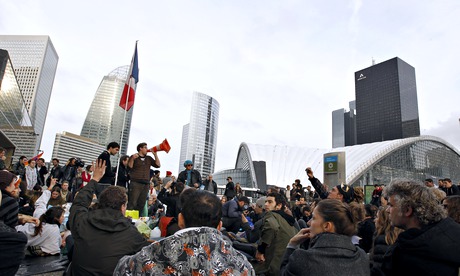
French Indignants A sit-in called by Occupy France at La Défense business district in Paris. Photograph: Afp/AFP/Getty Images

A stunning finding of the report is that no one actually knows who holds the French debt. To finance its debt, the French state, like any other state, issues bonds, which are bought by a set of authorised banks. These banks then sell the bonds on the global financial markets. Who owns these titles is one of the world's best kept secrets. The state pays interests to the holders, so technically it could know who owns them. Yet a legally organised ignorance forbids the disclosure of the identity of the bond holders.
This deliberate organisation of ignorance – agnotology – in neoliberal economies intentionally renders the state powerless, even when it could have the means to know and act. This is what permits tax evasion in its various forms – which last year cost about €50bn to European societies, and €17bn to France alone.
Hence, the audit on the debt concludes, some 60% of the French public debt is illegitimate.
An illegitimate debt is one that grew in the service of private interests, and not the well being of the people. Therefore the French people have a right to demand a moratorium on the payment of the debt, and the cancellation of at least part of it. There is precedent for this: in 2008 Ecuador declared 70% of its debt illegitimate.
The nascent global movement for debt audits may well contain the seeds of a new internationalism – an internationalism for today – in the working classes throughout the world. This is, among other things, a consequence of financialisation. Thus debt audits might provide a fertile ground for renewed forms of international mobilisations and solidarity.
This new internationalism could start with three easy steps.

1) Debt audits in all countries

The crucial point is to demonstrate, as the French audit did, that debt is a political construction, that it doesn't just happen to societies when they supposedly live above their means. This is what justifies calling it illegitimate, and may lead to cancellation procedures. Audits on private debts are also possible, as the Chilean artist Francisco Tapia has recently shown by auditing student loans in an imaginative way.

2) The disclosure of the identity of debt holders

A directory of creditors at national and international levels could be assembled. Not only would such a directory help fight tax evasion, it would also reveal that while the living conditions of the majority are worsening, a small group of individuals and financial institutions has consistently taken advantage of high levels of public indebtedness. Hence, it would reveal the political nature of debt.

3) The socialisation of the banking system

The state should cease to borrow on financial markets, instead financing itself through households and banks at reasonable and controllable interest rates. The banks themselves should be put under the supervision of citizens' committees, hence rendering the audit on the debt permanent. In short, debt should be democratised. This, of course, is the harder part, where elements of socialism are introduced at the very core of the system. Yet, to counter the tyranny of debt on every aspect of our lives, there is no alternative.