Search This Blog

Monday, 19 August 2013

Secret courts: justice conducted behind closed doors is no justice at all


If Britain has suddenly decided that open justice is a luxury we can't afford, then I for one was not invited to the debate

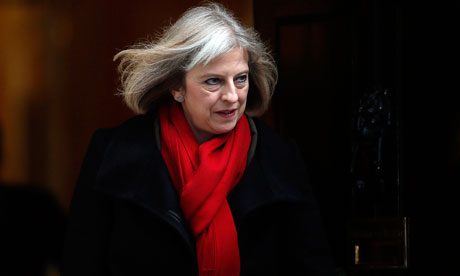
Theresa May
Britain's home secretary, Theresa May, leaves Downing Street in London. Photograph: Stefan Wermuth/Reuters
Last March, I watched from afar as perhaps the most important case in my 30-year legal career was decided in a soundproofed room protected by a security guard. This was the first time in the UK supreme court's history that it had entered closed session for what has been aptly named a "secret court". It is a phrase we should get used to after a judge ruled last week that the home secretary, Theresa May, has the power to "terminate" high court challenges on national security grounds and push more cases away from public view.
This ruling is all the more worrying after my experience. Giving his final judgment on our secret court, Lord Hope described it as an "unwelcome departure from the principle of open justice", calling for a "stern and steadfast resistance to the use of that procedure" in the future. His call is one that every Briton should heed.
Representing Bank Mellat, an Iranian bank caught up in the middle of the sanctions battle between the west and Iran, I was tasked with showing that UK sanctions must be more than an indiscriminate attack on people living under regimes we dislike. My firm argued that the Treasury had no evidence to suggest the bank had somehow helped Iran's nuclear programme. The sanctions were at best irrational and at worst discriminatory. The supreme court agreed – but there was a catch. In a last ditch attempt to win the day, the Treasury claimed that they did have rock solid evidence … they just couldn't show anyone.
The dilemma was etched on Lord Neuberger's face as he announced the decision to enter a secret court. On the one hand, the Treasury insisted that the evidence must be kept secret for national security reasons, but on the other the supreme court risked undermining the whole system of open justice. Imagine being convicted of a crime by evidence you are not allowed to see and without the opportunity to defend yourself – that is the state in which the bank found itself. When the Treasury insisted that the supreme court view evidence obtained from the secret services, the judges obliged in good faith. Ultimately, the court attached little weight to this evidence and decided in Bank Mellat's favour.
The judges' concern, much like my own, is that justice conducted behind closed doors with evidence hidden from view is no kind of justice at all.
The ultimate driving force behind this self-mutilation of a proud justice system was the politics of security. Ironically, it is in our dealings with the alleged opponents of liberty that the dangerous, prejudicial and irrational politics of security push us to our most extreme. Just as the US Prism programme is unravelling the extent to which we have given up our privacy to GCHQ, so too are secret courts forcing us to be "free" in ways we are powerless to stop.
You need only look to the US to see the sacrifices made in the name of national security – a compassionless system fuelled by uncompromising secret surveillance of citizens and allowing the unchecked detention of suspects in Guantánamo Bay. Has the balance in the name of security gone too far? In Bank Mellat's instance, our supreme court may have dismissed the government's tactics, but it would be naive to hope that nine judges will be enough to rein in sustained attacks on British liberty if the rot of politics continues to eat away at our rights. Only days after the supreme court entered closed session in the case I was representing, a broad coalition of Labour, Liberal Democrats and Conservative MPs pushed through the Justice and Security bill, allowing the same secret courts used against foreign companies to apply to anyone living in the UK. This bill has now come into full force. Indeed, as the revelations about GCHQ's snooping make clear, there will be no dearth of information available to help the secret courts convict us.
If the British people have suddenly decided that open justice is a luxury we cannot afford, then I for one was not invited to the debate. It is perfectly reasonable to argue that the threats facing the UK warrant such suspensions of justice, but it is both absurd and dangerous to allow this vital judgment call to be made solely by those politicians who hope to wield the new powers against us. Privileges which we can surely only give up voluntarily have been wrestled from us without our consent.
The revelations of secret courts and Prism show just how little influence we have over our own rights. Indeed as Theresa May can now attest, not even high court judges can keep the government's secret courts at bay. It is time politicians asked for our permission before denying us access to open justice.

How does a polyamorous relationship between four people work?

BBC News 19 Aug 2013
Imagine one house, with four people, but five couples. How does it work, asks Jo Fidgen.
Charlie is talking excitedly about a first date she went on the night before.
Next to her on the sofa is her husband of six years, Tom. And on the other side of him is Sarah, who's been in a relationship with Tom for the last five years. Sarah's fiance, Chris, is in the kitchen making a cup of tea.
The two women are also in a full-blown relationship, while the two men are just good friends. Together, they make a polyamorous family and share a house in Sheffield.
"We're planning to grow old together," says Charlie.
Polyamory is the practice of having simultaneous intimate relationships with more than one person at a time, with the knowledge and consent of all partners. The term entered the Oxford English Dictionary only in 2006, and such relationships are rare enough that Tom finds himself having to account for his personal situation time and time again.
"The number of conversations I've had with peers where I've started to explain it and they've got as far as, 'so, you all cheat on each other' and not been able to get past that. I've said no, everybody's cool with it, everybody knows what's happening, no one's deceiving each other."
If any of the four want to get involved with someone else, they have to run it by the others - all of whom have a veto.
"We can't use a veto for something as silly as, say, personal taste," says Sarah. "If you were dating somebody and I could not understand why you found them attractive, that would not be sufficient reason for me to say, no, you can't see this person."
What counts as infidelity, then?
"Lying," they chorus.
"For example," explains Charlie, "before I went on this first date yesterday, I sat down with each of my three partners and checked with them individually that I was okay to go on this date. Cheating would have been me sneaking off and saying I was meeting Friend X and not say that it was a potential romantic partner."
The rules and boundaries of their relationships are carefully negotiated.
When they had been a couple for just two weeks, Tom suggested to Charlie that they be non-monogamous.
"It was a light bulb moment for me," she says. 'I had been scared of commitment because I had never met anyone I felt I could fall completely and exclusively in love with. The idea of this not being a monogamous relationship allowed me to fall as deeply in love with Tom as I wanted to without fear that I would break his heart by falling in love with somebody else as well."
But how did she feel when, a year into their marriage, Tom fell in love with another woman?
"Well, Sarah's lovely," says Charlie. "I was just so happy that Tom was happy with her."
Sarah's partner, Chris, was less comfortable with the situation at first. They had agreed that they could have other sexual partners, but forming an emotional attachment with someone else was a different matter.
So when Sarah fell for Tom, she agonised over how to tell Chris.
"We sat down and talked about what it meant to be in love with more than one person, and did that mean I loved him less. Well, of course it didn't.
"It's not like there's only so much love I have to give and I have to give all of it to one person. I can love as many people as I can fit in my heart and it turns out that's quite a few."
Chris and Tom bonded over video games and became firm friends. Before long, Chris had fallen in love with Tom's wife, Charlie.
"It had never crossed Chris's mind not to be monogamous - now he says he could never go back," says Sarah.
This quandary over how to manage relationships is something that couples counsellor, Esther Perel, sees people struggling with all the time.
"You can live in a monogamous institution and you can negotiate monotony, or you can live in a non-monogamous choice and negotiate jealousy. Pick your evil.
"If you are opening it up you have to contend with the fact that you're not the only one, and if you are not opening it up then you have to contend with the fact that your partner is the only one."
So how do Charlie, Sarah and Tom handle jealousy?
Not a problem, they insist, and point to a word invented in polyamorous circles to indicate the opposite feeling.
"Compersion," explains Tom, "is the little warm glow that you get when you see somebody you really care about loving somebody else and being loved."
"There's always a small amount of insecurity," reflects Sarah, recalling how she felt when her fiance fell in love with Charlie. "But compare my small amount of discomfort with the huge amount of love that I could see in both of them, and honestly, I'd feel like a really mean person if I said my discomfort was more important than their happiness."
Jealousy has to be handled differently in a polyamorous relationship, adds Charlie.
"In a two-person, monogamous relationship, it's not necessary but it is possible to say, we just need to cut out all of the people who are causing jealousy and then everything will be fine.
"Whereas when you are committed to a multi-partner relationship, you can't just take that shortcut. You have to look at the reasons behind the jealousy."
If an issue does arise, the four may stay up all night talking it over.
"We do so much more talking than sex," laughs Charlie.
But some argue that it is natural for people to bond in pairs.
Our desire for monogamy has deep roots, says Marian O'Connor, a psychosexual therapist at the Tavistock Centre for Couple Relationships in London.
"As children we need someone who loves us best of all in order to thrive. There's normally one main care giver, usually the mother, who will look after the infant.
"The thing about a monogamous relationship, it can give you some sense of certainty and surety, somewhere you can feel safe and at home."
Sarah, Tom and Charlie agree that a safe base is important, but see no reason why only monogamy can provide one.
"I feel safe and secure, with the ability to trust and grow, with Tom, Sarah and Chris," says Charlie. "It is from the base and security of the three of them that I face the world and the challenges the day brings."
"The way I see it, it's only a problem if I feel like one of my partners is spending more time with all their other partners than with me," says Sarah. "It just leads to people feeling hurt."
A shared Google calendar is the answer.
"We mostly use it for keeping track of date nights," says Charlie. "The couple who is on a date gets first pick of what film goes on the TV and it helps keep track of who's in what bedroom."
Sarah chips in. "So, for example, I have a weekly date night with Charlie. It's us snuggling up, us with the TV, us going to bed together and all that kind of business."
Perel sees polyamory as "the next frontier" - a way of avoiding having to choose between monotony and jealousy.
"We have a generation of people coming up who are saying, we also want stability and committed relationships and safety and security, but we also want individual fulfilment. Let us see if we can negotiate monogamy or non-monogamy in a consensual way that prevents a lot of the destructions and pains of infidelity."
But it's not an easy option.
"We get funny looks in the street," says Sarah.
"And every time you out yourself, you risk losing a friend," adds Charlie. "I'm preparing for 30 years of being made fun of."
Tom is cautiously optimistic that polyamory will become "average and everyday".
"Anyone who is expecting some massive social change overnight is terribly mistaken, but it will happen."
In the meantime, the four of them are planning an unofficial ceremony to mark their commitment to each other.
"Sometimes people just write the relationship off as a lazy way of getting more sex than you normally would. There are easier ways," says Tom wryly.
They all agree managing a multi-partner relationship can be exhausting.
"But we don't have a choice. We're in love with each other," they chime.

Kanwal Bharti's Facebook Like - Nothing here to arrest

The Hindu


Mixed signals emanating from the Supreme Court have done little to strengthen efforts to protect free speech online. Last week, the court rightly hauled up the Uttar Pradesh government over its arrest of scholar and writer Kanwal Bharti for his Facebook post criticising the suspension of IAS officer Durga Shakti Nagpal. The same day, however, the SC refused to stay the implementation of the Information Technology (Intermediaries Guidelines) Rules, 2011, which require websites to take down objectionable material posted by third-party users within 36 hours of being notified of the need to do so. Although the two incidents which drew the Court’s attention are separate, they point to a larger, systemic problem: the ultimate arbiter of what constitutes offensive online content is the executive. In practice, that means touchy politicians and trigger-happy policemen. Given that the imposition of penal laws falls within the domain of States, it was ill-advised for the Supreme Court to have left the IT Act’s implementation to them without framing clear guidelines. States have seized on this legal vacuum to use the Indian Penal Code and the IT Act to clamp down on dissent.
Kanwal Bharti’s case highlights this problem. The policemen who arrested him were acting on a criminal complaint filed by a close aide of Samajwadi Party (SP) leader and local MLA Azam Khan. Thanks to a simple Facebook post, Mr. Bharti was charged under Sections 153 and 295A of the IPC — the latter, like Section 66A of the IT Act, is a cognizable offence that requires no warrant — for “wanton provocation with intent to cause riots” and insulting religious sentiments. As if these ludicrous charges were not enough, the SP has egged on Muslim clerics in the area to demand the writer be booked under the National Security Act. The Supreme Court’s intervention comes not a moment too soon — but the judiciary needs to realise that Mr. Bharti’s harassment was made possible thanks to the discretion governments exercise in regulating cyberspace. That the court is inclined to view the IT intermediary rules favourably does not bode well for social media sites, on whom the United Progressive Alliance government has launched an assault for their hosting of politically sensitive content. The unfortunate fact remains that the implementation of penal provisions has not been tweaked to reflect the constitutional rights of “netizens” in India. The Supreme Court has a chance to set this record straight: in its verdict on S. 66A, expected later this year, it should strike down the provision while setting a higher bar for invoking penal provisions in the IPC and other statutes against internet content.

Detaining my partner: a failed attempt at intimidation


The detention of my partner, David Miranda, by UK authorities will have the opposite effect of the one intended
At 6:30 am this morning my time - 5:30 am on the East Coast of the US - I received a telephone call from someone who identified himself as a "security official at Heathrow airport." He told me that my partner, David Miranda, had been "detained" at the London airport "under Schedule 7 of the Terrorism Act of 2000."
David had spent the last week in Berlin, where he stayed with Laura Poitras, the US filmmaker who has worked with me extensively on the NSA stories. A Brazilian citizen, he was returning to our home in Rio de Janeiro this morning on British Airways, flying first to London and then on to Rio. When he arrived in London this morning, he was detained.
At the time the "security official" called me, David had been detained for 3 hours. The security official told me that they had the right to detain him for up to 9 hours in order to question him, at which point they could either arrest and charge him or ask a court to extend the question time. The official - who refused to give his name but would only identify himself by his number: 203654 - said David was not allowed to have a lawyer present, nor would they allow me to talk to him.
I immediately contacted the Guardian, which sent lawyers to the airport, as well various Brazilian officials I know. Within the hour, several senior Brazilian officials were engaged and expressing indignation over what was being done. The Guardian has the full storyhere.
Despite all that, five more hours went by and neither the Guardian's lawyers nor Brazilian officials, including the Ambassador to the UK in London, were able to obtain any information about David. We spent most of that time contemplating the charges he would likely face once the 9-hour period elapsed.
According to a document published by the UK government about Schedule 7 of the Terrorism Act, "fewer than 3 people in every 10,000 are examined as they pass through UK borders" (David was not entering the UK but only transiting through to Rio). Moreover, "most examinations, over 97%, last under an hour." An appendix to that document states that only .06% of all people detained are kept for more than 6 hours.
The stated purpose of this law, as the name suggests, is to question people aboutterrorism. The detention power, claims the UK government, is used "to determine whether that person is or has been involved in the commission, preparation or instigation of acts of terrorism."
But they obviously had zero suspicion that David was associated with a terrorist organization or involved in any terrorist plot. Instead, they spent their time interrogating him about the NSA reporting which Laura Poitras, the Guardian and I are doing, as well the content of the electronic products he was carrying. They completely abused their own terrorism law for reasons having nothing whatsoever to do with terrorism: a potent reminder of how often governments lie when they claim that they need powers to stop "the terrorists", and how dangerous it is to vest unchecked power with political officials in its name.
Worse, they kept David detained right up until the last minute: for the full 9 hours, something they very rarely do. Only at the last minute did they finally release him. We spent all day - as every hour passed - worried that he would be arrested and charged under a terrorism statute. This was obviously designed to send a message of intimidation to those of us working journalistically on reporting on the NSA and its British counterpart, the GCHQ.
Before letting him go, they seized numerous possessions of his, including his laptop, his cellphone, various video game consoles, DVDs, USB sticks, and other materials. They did not say when they would return any of it, or if they would.
This is obviously a rather profound escalation of their attacks on the news-gathering process and journalism. It's bad enough to prosecute and imprison sources. It's worse still to imprison journalists who report the truth. But to start detaining the family members and loved ones of journalists is simply despotic. Even the Mafia had ethical rules against targeting the family members of people they felt threatened by. But the UK puppets and their owners in the US national security state obviously are unconstrained by even those minimal scruples.
If the UK and US governments believe that tactics like this are going to deter or intimidate us in any way from continuing to report aggressively on what these documents reveal, they are beyond deluded. If anything, it will have only the opposite effect: to embolden us even further. Beyond that, every time the US and UK governments show their true character to the world - when they prevent the Bolivian President's plane from flying safely home, when they threaten journalists with prosecution, when they engage in behavior like what they did today - all they do is helpfully underscore why it's so dangerous to allow them to exercise vast, unchecked spying power in the dark.
David was unable to call me because his phone and laptop are now with UK authorities. So I don't yet know what they told him. But the Guardian's lawyer was able to speak with him immediately upon his release, and told me that, while a bit distressed from the ordeal, he was in very good spirits and quite defiant, and he asked the lawyer to convey that defiance to me. I already share it, as I'm certain US and UK authorities will soon see.

Sunday, 18 August 2013

The Need for Roots brought home the modern era's disconnection with the past and the loss of community


Having recently moved to a Himalayan village, I felt Simone Weil's focus on uprootedness spoke directly to me
Ganesh Chaturthi Festival
An idol of the Hindu god Ganesh. ‘A rare European thinker who was as curious about Hindu and Buddhist traditions as about the Cathars, Weil despised colonialism as well as nationalism.’ Photograph: Sanjeev Gupta/EPA
There has rarely been a day since I first read The Need for Roots, nearly two decades ago, that I haven't thought of Simone Weil – one of my earliest heroines along with Hannah Arendt and Rosa Luxemburg. It was the title that initially attracted me more than the contents. Having recently moved to a Himalayan village after a peripatetic life in the plains, I had begun to feel rooted for the first time, connected to a stable community which, living off the land, neither poor nor rich, and low rather than upper caste, was marked above all by dignity – remarkable in a country where villages had become synonymous with destitution. And when Weil asserted that the central event of the modern era was uprootedness – the disconnection from the past and the loss of community – she seemed to speak directly to my experience.
The range of her admirers – from TS Eliot to Albert Camus – attest to the difficulty of describing Weil. She was a bourgeois Jewish intellectual from France who, in a viciously antisemitic climate, rejected both Judaism and Zionism. A youthful Marxist who fought on the Republican side in the Spanish civil war she, after an immersion in the "icy pandemonium of industrial life", came to believe that "it is not religion but revolution which is the opium of the people". A devoted Hellenist, she despised the Roman empire, implicating it with an oppressive tradition of the authoritarian state in Europe that culminated in Nazi Germany.
A rare European thinker who was as curious about Hindu and Buddhist traditions as about the Cathars, Weil despised colonialism as well as nationalism. "When one takes upon oneself, as France did in 1789, the function of thinking on behalf of the world, of defining justice for the world, one may not become an owner of human flesh and blood." She possessed an ironic view of historians – how they buttress the ideological claims of the hyper-power of the day: "If Germany, thanks to Hitler and his successors, were to enslave the European nations and destroy most of the treasures of their past, future historians would certainly pronounce that she had civilised Europe."
Freed of the popular intellectual's obligation to boost national or imperial egos, she could point out something that was obvious to many Asian sufferers of European colonialism: the shocking nature of Nazi racism lay, she wrote, "in the application by Germany to the European continent, and the white race, generally, of colonial methods of conquest and domination".
In The Need for Roots she distilled everything she had learned from her intellectual struggles with the ideologies of socialism and liberalism, her experience of working-class conditions and the plight of the Vietnamese in France.
In different ways, Marx, Nietzsche and Max Weber had described how human relationships had shifted dramatically in societies built around commerce, industrial capitalism and the colonisation of vast tracts of the world. Life had lost its old moorings in a world where technology greatly enhanced the power of large abstract entities, such as the state and nationalism. Weil brought a different intensity to this sober diagnosis of the human condition.
Uprootedness was a sickness of the soul, a spiritual malaise, but with far-reaching political consequences that left no one unaffected. As Weil wrote: "Hitler would be inconceivable without modern technique and the existence of millions of uprooted men."
Material affluence and political stability in recent decades has rendered less toxic the extensive deracination that began in Europe in the 19th century. Today, it is people from countries such as India, Iran and Egypt who will immediately recognise Weil's insight that the modern promise of individual development, which was realised through the destruction of old bonds, can leave people dangerously adrift and vulnerable to demagogues.
As the years passed in my village, I witnessed poorly educated young men leaving to seek the greater comforts and liberations of big cities. I would see them on my visits to Delhi. Working in sweatshops and living in equally degrading conditions, the promise of the modern world had turned sour for them. These were the men whose disaffection had traditionally seeded militant ideologies or random violence against those weaker than them.
Recent history shows that the social turmoil provoked by large-scale uprootings helps authoritarians more than progressives. In any case, revolution was both undesirable and unrealisable, since technology and industry were unstoppable. What, then, could be done?
Weil aimed at the rehumanisation of the workplace and, by extension, the larger society. As she put it somewhat melodramatically, a civilisation that did not recognise the spiritual nature of work was doomed.
This was not all abstract speculation. Policymakers can draw much from The Need for Roots: such clear prescriptions as that employers ought to provide an adequate vocational training for their employees, education should be compulsory and publicly funded, and include technical as well as elementary education.
But her most original move was to abandon the language of rights – the claims of possessive individuals against others that had provided political philosophy with its syntax since Hobbes and Locke. Instead, she talked of needs, duties and obligations as the basis of a good society – something that would be immediately familiar to Buddhist philosophers but remains marginal in the western tradition of political theory.
As she wrote, "If you say to someone who has ears to hear: 'What you are doing to me is not just', you may touch and awaken at its source the spirit of attention and love. But it is not the same with words like 'I have the right' … or 'you have no right to … ' They evoke a latent war and awaken the spirit of contention. To place the notion of rights at the centre of social conflicts is to inhibit any possible impulse of charity on both sides."
As she saw it, the original advocacy of rights had served the expansion of commerce and a contract-based society in western Europe. But a free and rooted society ought to consist of a web of moral obligations. We have the right to ignore them, but we ought to be actually obliged not to let other people starve, or to let them lapse into destitution.
It should be noted that Weil was not a liberal. For her, there can be no such thing as absolute freedom of expression at a time when "journalism becomes indistinguishable from organised lying", and its consumers don't have the time or leisure to sift truth from falsehood. "There ought to be," she wrote, looking ahead to the age of Leveson, special courts to monitor communications network that are "guilty of too frequent a distortion of the truth".
Indeed, what makes The Need for Roots particularly pertinent today is its critique of the ethic of liberalism that had originally emerged to serve the needs of a commercial society – individuals with highly self-regarding conceptions of their rights. As Weil saw, and we recognise very well in 2013, the extension of the marketplace into the realm of values has severely constrained our moral imagination.
It is easy to criticise some Weil's ideas for being too impractical and occasionally draconian. There is something too sanguine about her view of human nature. As a friend scolded her, shortly before she died of self-induced starvation in Kent in 1943 at the age of only 34: "Man is not pure but a 'sinner'. And the sinner must stink a bit, at the least." Perhaps. But you can only marvel, as Orwell did about Gandhi, at how clean a smell she managed to leave behind.

Fleeing the light - Political Parties and The Right to Information Act


    ARUNA ROY
    NIKHIL DEY in THE HINDU
  

Political parties have acted as judge, jury, supplicant and advocate in their move to amend the RTI Act and exempt themselves from its purview. Their rhetoric on transparency is more hollow than ever


A friend called the other day, and said: “I want to congratulate all of you in the RTI community, because you have managed to do what no one, and nothing else has managed to for a long time: bring about unity and unanimity in the political class.” His comment, laced with irony and sarcasm was not far from the truth.

The Central Information Commission (CIC) decision to classify political parties as public authorities and bring them under the RTI Act has kicked up a storm in our democratic polity.
The reaction of the parties to the Central Information Commission order that political parties will be considered public authorities under the RTI has been poor in content and abysmal in form. It is a pity that the opportunity provided for the politician to transform into a statesman is lost in the muddle of apprehension and self-interest. For a country that is unanimous in its opinion that electoral politics and democratic governance are being perverted by the undue influence of money, and vested interests, both the content and the form of reaction are important.

Let us understand the content first. Through the one line amendment, political parties in parliament are seeking to carve out an exclusive space for themselves beyond the reach and purview of the RTI Act. While all other associations or bodies constituted by law, can come under the purview of the RTI Act, an insertion “explains” that by law, this will exclude any association of persons registered under the Representation of Peoples Act.

Here are a set of implications that arise from this quick and potentially decisive amendment: The representatives of the people, have made it clear that they do not want to be answerable to the people. By removing themselves completely from the purview of the transparency law, they are preventing any obligation they might have to directly answer any query from the citizen on any issue.
This amendment dramatically exposes the extent of doublespeak. Many politicians have shared their concern with the growing influence of money, and even political parties have expressed distress that the use of unaccounted money is completely perverting the democratic political system. While parties across the spectrum have publicly reiterated their commitment to full financial transparency, the content of this “consensual” amendment has revealed the truth. By proposing a blanket exemption for themselves from the RTI Act, it is clear that they are not willing to answer questions of the citizen on anything- even financial matters.

Credibility gap

The yawning gap between ‘statements submitted’ and real expenditure during elections is no secret. Recent statements by politicians have exposed dramatically what real election spending to "secure" a seat means. This does not end with party issues but also determines key appointments in government. Is it surprising that the citizen wants to know where the money comes from and where it goes?

This amendment would negate one of the biggest opportunities we have had to identify, and fight the misuse of money in politics. Let us not have any illusions. Fighting corruption, and corporate/commercial influence in politics is only possible with the help of the ordinary citizen. The RTI has evolved into a decentralised process that allows an ordinary person to interface at her own expense and with her constitutional legitimacy as a sovereign citizen. The multiple uses of the Act to improve government functioning are so many that they defy enumeration. Accepting applicability of the RTI is therefore seen as the one stated intent of any structure to lay itself open to scrutiny and accountability. It is the many questions that citizens will pose, in a million places across the country, that will shine the torch, search, probe, expose, audit, and actually help regulatory institutions like the income tax department, and the election commission to eventually bring about real change and political reform.

Legitimate objections

This is not to say that we do not understand the complexities of political activity, and the need to keep some internal discussions out of the public domain. We do not feel that every question that is asked by every citizen needs to be answered under this, or any other law. The technical reading of the Act by the CIC brought political parties under the purview of the RTI Act as public authorities. The technical implication of being classified a ‘public authority’ has led to many legitimate objections from party leaders. Even with the current CIC decision, the concerns could have been “technically” addressed without amending the act – even through some amendments to the rules, perhaps. After all, even the defence establishment keeps strategy and internal matters out of the public domain while subjecting itself to, and benefiting from the purview of the RTI Act.

The nature of the political response has been even more disappointing and unacceptable. When a privileged class closes ranks to impose its decision, it is “technicalities” with the inevitable fallout that will determine the outcomes. Politicians know that substantive constitutional principles override technicalities of law. That is why perhaps in this case alone they were not willing to take the risk of taking the CIC decision to court.

And now the likelihood is that they will pass this amendment in their own court without even allowing the matter to go to the Standing Committee of Parliament. Can any institution be judge, jury, supplicant, and advocate, in a matter in relation to itself? Is this interpretation of privilege constitutional? Is it ethical or logical?

Eventually, none of us want to weaken the political system, or burden it with questions that will not allow it to function. But a blanket exemption can surely not be the means to make a political system strong, transparent, and accountable. This has led to the belief that freedom in internal matters and strategy like candidate selection is only a red herring to take the attention away from the real worry of financial disclosures.

If there had to be an amendment, it was incumbent upon parliamentarians to show that the political class was going to overcome technicalities to improve the scope of the law, not curtail it. People focus on substantive issues- not the technicalities. They want parties to live up to their rhetoric of transparency, and their stated desire to fight corruption in politics. This was in fact a historic opportunity lost to the exigencies of obvious and immediate self- preservation. It could have been used to enforce greater transparency not only amongst the political class, but also to expand direct coverage of the RTI to all institutions and organisations who spend public funds. In finding the substantively correct way of broadening coverage of the RTI, the political class, would not only have created a standard for themselves, but for the whole fabric of Indian society.

That would have been a huge quantum leap towards a healthy and ethical society.