Search This Blog

Thursday, 25 July 2013

Church of England wants to 'compete' Wonga out of existence


Archbishop of Canterbury lays down challenge to payday lender after launching new credit union earlier this month
Justin Welby
The Most Rev Justin Welby, archbishop of Canterbury, says he has had a 'very good conversation' with Wonga's chief executive. Photograph: Dominic Lipinski/PA
The archbishop of Canterbury has told Wonga that the Church of England wants to "compete" it out of existence as part of its plans to expand credit unions as an alternative to payday lenders.
The Most Rev Justin Welby said he had delivered the message to Errol Damelin, chief executive of Wonga, one of Britain's best-known payday lenders, during a "very good conversation".
"I've met the head of Wonga and we had a very good conversation and I said to him quite bluntly 'we're not in the business of trying to legislate you out of existence, we're trying to compete you out of existence'," he told Total Politics magazine.
"He's a businessman, he took that well."
The archbishop's remarks come after he launched a new credit union for clergy and church staff earlier this month at the General Synod in York.
Welby, who has served on the parliamentary Banking Standards Commission, has said he plans to expand the reach of credit unions as part of a long-term campaign to boost competition in the banking sector.
There are also plans to encourage church members with relevant skills to volunteer at credit unions. Small, local lenders could also be invited to use church buildings and other community locations with the help of church members.
The government announced an investment of £38m in credit unions in April to help them offer an alternative option to payday lenders.
The entire pay day lending industry, worth £2bn, was referred last month for a full-blown investigation by the Competition Commission after the trading watchdog uncovered "deep-rooted" problems with the industry.
The Office of Fair Trading said it decided to make the referral because it continues to suspect that features of the market "prevent, restrict or distort competition".
Wonga said in March that it welcomed any attempt to encourage responsible lending and that it has been "instrumental" in helping to raise industry standards.
Damelin, founder of Wonga, said: "The archbishop is clearly an exceptional individual and someone who understands the power of innovation.
"We discussed the future of banking and financial services, as well as our emerging digital society.
"There is mutual respect, some differing opinions and a meeting of minds on many big issues.
"On the competition point, we always welcome fresh approaches that give people a fuller set of alternatives to solve their financial challenges. I'm all for better consumer choice."

Wednesday, 24 July 2013

For Tories, privatisation is still a matter of dogmatic faith

Dogmatic in the face of all the evidence; backing fringe policies embraced by obscure minorities; pushing failed ideas which, if implemented, would be nothing short of disastrous. Here are accusations long thrown at the left by level-headed advocates of such moderate proposals as, say, illegally invading countries prompting hundreds of thousands of deaths, or introducing cuts Mrs Thatcher could only have dreamt of.

So how about this for an extreme, unpopular policy? According to YouGov, the proposed privatisation of the Royal Mail is opposed by over two-thirds of Britons; even Tory voters are more likely to be against than in support. Just 4 per cent strongly support the flogging off of yet another public service, which gives an indication of how few hardcore free-marketeers there are.

The breadth of opposition is hardly surprising. Britons have endured a three-decade-long experiment of selling off our utilities and public services. After a fair run, the cheerleaders of free market extremism must now accept that they have failed to win the support or consent of the British people. A poll in April found that 61 per cent believed major public services such as energy and water were best run by the public sector; only just over a quarter opted for private companies. Every poll going shows that we want the railways back in public ownership. That so few MPs echo these calls in Parliament is a damning indictment indeed of our political elite and the state of British democracy.

The public’s verdict is undoubtedly based on pragmatic experience. The taxpayer is paying around three times more subsidising private railways than when they were run by the state. Ticket prices soar above inflation, pricing out millions of families, and the service is fragmented and chaotic. Energy and water companies are ripping off consumers when workers’ pay packets are facing the biggest squeeze in modern times.

This latest bout of free market extremism comes after a torrid week for the dogma of “private sector good, public sector bad”. Security companies G4S and Serco have both been accused of overcharging the state for the electronic tagging of offenders, including billing government for people who had died or never even been tagged. During the Olympics, G4S failed to deliver enough security guards, leaving the state – who else? – to fill the vacuum. At the time, Tory Cabinet minister Philip Hammond admitted that the episode challenged his “prejudice that we have to look at the way private sector does things to know how we should do things in government”.

The list could go on. Take the likes of A4e, the welfare-to-work company: on top of being investigated for fraud, its former chief executive Emma Harrison stood down after paying herself a £8.6m share dividend at the expense of the state. There are the PFI schemes that exploded under New Labour, leaving the taxpayer saddled with billions of pounds worth of debt. And then, of course, there’s the small matter of the banks that collapsed. It wasn’t free market dogma that rescued them – it was the state.

The case against privatising our Royal Mail is overwhelming, even disregarding other failures. It is a profitable business, making £440m last year. It is a natural monopoly. The right-wing think-tank Bow Group suggests that rural Post Offices could close and the price of stamps could be hiked.

The truth is the free market extremism pushed by the biggest party in Britain – the neo-liberal centre of Blairites, Cameroon Tories and Orange Book Lib Dems – is riddled with hypocrisy. Modern capitalism depends on a big state, on government largesse. Bailed out banks; PFI contracts; tax credits that subsidise bosses paying low wages; housing benefit subsidising landlords because of the mass sell-off of council houses – the list goes on.

Many of the free market extremists have benefited directly from their dogma. Take Patricia Hewitt, who journeyed from left-wing firebrand to Blairite health secretary: she was recently appointed board director at Bupa, a health company that stands to benefit from the privatisation of the NHS. Lord Norman Warner, a “Labour” Lord who supports the Tories’ dismantling of the NHS, is a non-executive chairman of UK Health Gateway and an adviser to technology firm Xansa, all of which government plans have guaranteed a bright future. The revolving door of free-market extremists is profitable indeed.

Evidence that shatters the demonisation of the public sector is routinely ignored by our media and political elite. The Government is planning to reprivatise the East Coast mainline, despite the Office of Rail Regulation finding it to be the “most efficiently run franchise”. None of this means opponents of free market extremism should be defensive, allowing themselves to be painted as conservative opponents of “reform” (a term stolen and redefined as “privatising” and “cutting”). When the post-war Labour government nationalised key sectors of the economy, it created top-down, undemocratic public corporations. Without meaningfully involving users and workers, there was little resistance when Thatcher sold the family silver.

It’s time to argue for a new form of democratic, social ownership. Take the railways. They could easily be taken into public ownership if the political will was there: the state could simply take over each franchise as it expires. But instead of being run by bureaucrats in Whitehall, passengers and workers could be given the right to vote for representatives on the management board. The same argument could be made for, say, the banks, the NHS, or Royal Mail, forcing services to be more responsive to the needs of users, without selling them off to companies who are solely interested in making big bucks – not in delivering a quality service.

As the free market extremists once again ignore the will of the British people, it’s time to go on the offensive. Yet another disastrous sell-off doesn’t mean simply sticking to the status quo. Democracy, not privatisation: that should be our call.

Britain is far more corrupt than we think


Mary Dejevsky in The Independent

Within Britain, there is a widespread view – seriously dented neither by the MPs’ expenses saga nor by the newspaper phone-hacking scandal – that this is not a corrupt country. It might not be quite as squeaky clean as Scandinavia, but it is nothing like – let’s see, who shall we offend? – Italy or Spain. As for Russia or China, well, we can strut the moral high ground – can’t we? – certain of our superiority.

Incorruptibility is part of our national self-image. But we flatter and deceive ourselves. Over the past few weeks, The Independent has exposed private investigators who routinely break the law, digging for dirt on behalf of commercial clients. The techniques – phone hacking and “blagging” – are the same as those for which journalists have been hauled before the courts and pilloried by public opinion.

If there seems to be a slight edge to our reports, how could there not be? On present evidence, law enforcers would appear to take a dimmer view of journalists applying these illegal methods, or buying them in, than it does of business people and lawyers who do the same. That, at least, was the message from the Serious Organised Crime Agency, which initially instructed MPs not to name the companies commissioning such services on the grounds that it could “undermine their financial viability” by “tainting them with… criminality”.  Yesterday, however, there was a change of heart and Soca supplied the Home Affairs Select Committee with a list of a list of 101 names of people and organisations who have hired private investigators. The committee’s chairman, Keith Vaz, is now deciding whether to publish them.

Strictly speaking, blagging – obtaining information by deceit – can succeed without a partner. The offence is all on one side: no money or favour changes hands. But this is not the only way in which information is obtained. As with journalists and the police or others who hold  sensitive information, it is now known that money or favours have changed hands. And in these cases, those who sell are as culpable as those who buy. There has to be a market for the transaction to work.

The sellers might not see themselves as corrupt, merely as individuals exploiting an opportunity, or enjoying a perk of the job. That such practices may not always have been recognised as corrupt does not make them less so. It just means we are more adept than some of our neighbours at not calling things by their proper names. A gift for euphemism is something else that defines our national character.

If journalists and private investigators were the only ones under investigation, and the only commodity changing hands was information, we might just be able to file it away and argue that Britain has a very limited and very specific corruption problem. But this is not true, either.  In banking, we have had the rigging of Libor, the key lending rate, by individual bank employees for personal gain. As corruption goes, this comes close to the top of any list because  greed compromised a major pillar of the financial system – in a global financial centre which was built largely on its word being its bond.

A few steps further down we have claims of corrupt behaviour by British companies abroad. Only last week accusations were made against employees of a British company in China, GlaxoSmithKline. According to the Chinese, other pharmaceutical firms are also in the frame – for allegedly bribing doctors to prescribe their products. It is not, of course, that paying backhanders, or “doing as the natives do”, was unheard of in the operations of UK companies outside Britain. But the Bribery Act of 2010 made it expressly illegal, and it comes to something when it is the Chinese authorities doing the exposing and British companies that find themselves in the dock. The reputational damage flows only one way.

Again, it might be just possible to winkle out a “British” exception and claim that this sort of corruption reflects the malign influence of “foreigners” rather than any home-grown proclivity. But such complacency is challenged by the latest “global corruption barometer” compiled by Transparency International. Published earlier this month, its findings show not only that the perception of corruption in Britain has increased markedly over the past two years – not surprising, giving the prominence of the phone-hacking scandal – but that in the same period one person in 20 claims to have paid a bribe to a public official for services as diverse as health, justice and education.

A first instinct is, naturally, to question these conclusions. A second would be to surmise that those who admitted paying a bribe were at the margins – newcomers, perhaps or illegal migrants. But that would be too easy an escape. As with journalists and police, corruption is a transaction. There must be takers as well as givers. But I find it credible, too, because of a mini-brush of my own. When posted abroad more than 10 years ago, I checked that my husband, if he became non-resident, would have to pay privately for his (expensive) Parkinson’s medicine. The doctor, a locum, said yes, that was so. Then he paused, and – as I read it – implied, no more, that a deal could be struck. I left, but a possibility was there. 

And this is where corruption begins. Not with GSK in China, but with crimes left unpunished, names left unnamed and the prosaic minutiae of daily needs debased. If the Serious Organised Crime Agency is telling MPs – our representatives – what we the public may and may not know for national commercial reasons, the UK is on a slipperly slope indeed.

India's greatest cricket series - Recalling India's collective vow of silence


Akarsh Sharma
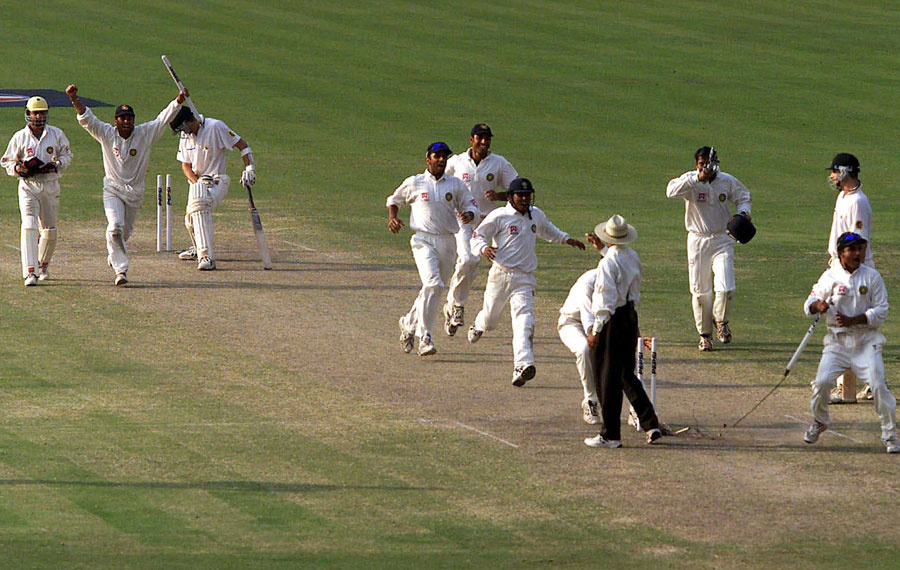
Trigger finger: SK Bansal gives Glenn McGrath out lbw on the last day of the 2001 Kolkata Test  © Getty Images
Enlarge
Dave Richardson, the ICC chief executive, has called for the debate on neutral umpires to be reopened. It is a logical step too, since the nations that produce the best officials are unfairly deprived of the highest standards in officiating.
Umpires, their decisions, the DRS, and general human competence in the face of technology - all have come under the scanner during the ongoing Ashes series.
Ah, the Ashes! The fourth sequel to the greatest series ever - a title that is vehemently contested in India.
The greatest series ever? Neutral umpires? Combine the two and it serves as a natural trigger to take our minds back to 2001, a year before the Elite Panel of ICC umpires was appointed.
It seems a good time then to - if sheepishly rather than fondly, for reasons that will become clear soon - reminisce about the actual greatest series everwhen free men stood against the immortals and, unlike in the Battle of the Hot Gates, miraculously won the combat of the dust bowls.
India isn't so much the land of snake charmers as it is the land of unrivalled cricket fanatics. Fanaticism by definition leads to voluntary blindness and mutism. And from late afternoon onwards on the first day of the famousLaxman-Dravid Test match at Eden Gardens, the symptoms manifested themselves across the nation.
Harbhajan Singh had just become the first Indian to bag a Test match hat-trick, in circumstances so dubious that had Dean Jones been commentating, he'd still be muttering about the injustice in his sleep.
But, fortunately for us, we had the honour of being enthralled by the late Tony Greig, an Englishman whose brand of commentary every Indian could relate to: full of infectious enthusiasm that often came in the way of the facts. Thus, a cricket-mad nation perpetually charged up on adrenaline was further enthused by Tony's awe-inspiring words, and hope of immediate retrospection was lost.
Ricky Ponting was caught plumb in front. Adam Gilchrist smashed a ball that pitched miles (cricket metric) outside leg stump into his pads, but was given out lbw. The swashbuckling wicketkeeper, who had bludgeoned the Indian bowling en route to a match-winning ton at faster than a run a ball in the previous Test, left with a rueful smile.
And finally, Shane Warne was adjudged out caught, though replays were at the very least inconclusive, if not favouring the batsman's claim of a bump ball (though Sadagoppan Ramesh's unbelievable catch alone deserved that wicket, or so we convinced ourselves).
It was probably the most fortuitous hat-trick ever, and we were probably well aware of it at the time. But did we really care? Not a single bit.
An inherent detestation of anything Australian had clouded our senses. The visitors had won a record 16 Tests in a row. They had humiliated India in Mumbai, home of the nation's favourite son. Mark Waugh's paltry spin had made a mockery of batsmen who were born to play spin. Matthew Hayden and Gilchrist's combined onslaught had made a mockery of turning pitches. Ajit Agarkar had made a mockery of himself. Again.
But the tipping point was when Michael Slater - upset at his appeal for a catch being overturned - got in the face of Rahul Dravid, a cricketer for whom Indian mothers would be prepared to go to war, with rolling pins for swords.
And so, there was little remorse about the way India were thrown a lifeline.
The next morning, in offices, in schools, at bus stands, in shared cabs, in autorickshaws, on the footpaths, on news channels, in newspapers, the discussions would revolve around those five minutes of earth-shattering cricket the previous day.
Those who did dare point out India's extremely good fortune were shushed and banished. The implied embargo was added alongside the traditional laws of our cricket culture, which include: No remark can be accepted against the actions of Sachin Tendulkar, even if he unnecessarily paddle-sweeps his way back to the pavilion. And a Pakistani cricketer's communication skills ought to be laughed at irrespective of their educational backgrounds, and independent of how mediocre our own players' English-speaking skills are.
You were to muse over the Test match only in a 2:98 ratio, where 2% of the time is to be spent acknowledging the timing of the hat-trick and 98% of it admiring the lengthy batting partnership that followed two days later. If you were to watch the feat again, it ought to be done in 30 seconds and without replays. You were tacitly prohibited from indulging yourself in the finer details.
Six on-field umpires were used in the three Test matches. The three neutral umpires were experienced ones: David Shepherd, Peter Willey and Rudi Koertzen. All three were selected to be on the Elite Panel a year later, though Willey chose not to take up the option.
The three home umpires are worth looking at. S Venkataraghavan, who was later chosen as the only Indian umpire on the Elite Panel, stood in his 43rd Test in Mumbai. Unsurprisingly, the match went without a glitch.
SK Bansal, who stood in only his sixth Test (and incidentally his last) in Kolkata, and AV Jayaprakash, who stood in his ninth in Chennai, were the other two home umpires. Bansal, in particular, presided over a host of controversial decisions, which included the series-changing hat-trick calls and some key rulings that triggered Australia's second-innings collapse.
The speed at which his decisions were made - as Glenn McGrath found out when batting bravely to save the match in the final hour - suggested they were more impulsive than considered. He was an Indian after all, and only the most hard-hearted of professionals wouldn't have been affected by the screams of 100,000 people.
Such key moments, when the series was completely turned on its head, had more than just divine intervention about them. They also had a very human helping hand - or rather, finger. But a nation awash with patriotism and a renewed sense of pride chose to overlook factors that could possibly dampen their most famous victory.
The greatest series ever? Maybe. One of the greatest endorsements of the need for neutral and qualified umpires? Definitely.

Australian Cricket: hubris, despair, panic


Clarke and Co find themselves where England were in the 1990s. But how did the two nations fall into such a state?
Ed Smith
July 24, 2013


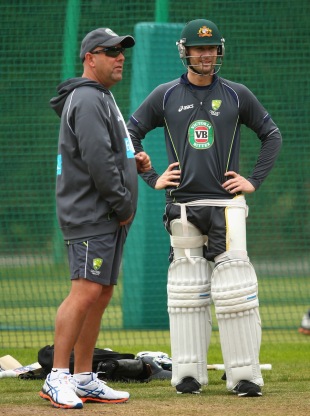
Darren Lehmann and Michael Clarke chat while training, Worcester, July 1, 2013
Sport suffers from the delusion that great leaders can change everything about their circumstances. They cannot © Getty Images 
Enlarge
Related Links
Players/Officials: Michael Clarke | Darren Lehmann
Teams: Australia | England
I have been watching Michael Clarke, but the shadows I see following him around - to my eyes, anyway - resemble the ghosts of old English nightmares.
When Clarke stood at slip on the third day at Lord's, with the match over as a contest but unmercifully drawn out as a spectacle, he experienced what every captain dreads. He could move the deckchairs, but the boat was sinking. He could change the bowling, but it would be determined by a sense of fairness and sharing the burden rather than to swing the match; he could set new fields, but more to protect pride rather than ensnare opponents; and, worst of all, he had to weigh up how fully to engage in captaining the fielding effort, and how much emotional energy to preserve for when his turn to bat came around. Captaining the team, captaining your own mood, managing defeat, managing the draining away of hope.
I bumped into Mike Brearley during the long afternoon slaughter and we agreed: no captain, so far behind in the match and still awaiting a slim chance to save the match with his own bat, can captain flat out in the field all day. He inevitably dips in and out of full engagement, the long spells of routine steadiness in which he preserves emotional energy interspersed with shorter bursts of activity and invention designed partly just to keep up his own sense of interest and alertness. And what emotional outlook should you adopt? Is it easier to retain optimism and be perpetually let down? Or better to accept the inevitable, release the burden of pretence, and just wait to bat with coolly detached precision?
And that is why the shadows looked so English to my eyes. I thought of Michael Atherton and Nasser Hussain, hurling their considerable competitiveness and intelligence at the effort to win the Ashes - pick any moment you like, really, between 1993 and 2002-03 - and ending up exhausted, holding a losing hand of cards, looking within once again, wondering how much more they still had left to give when called upon to bat.
Clarke, when the series is over, will doubtless seek honest conversations with men who have experienced similar suffering. Ironically, the opposition coach, Andy Flower, knows more than most about how to retain exceptional standards while playing for an inferior team.
All of which leads me to the central point: if you are interested in leadership (and I have never met a sports fan without strong opinions about captains, managers and selectors) then you have the obligation to be equally interested in context. Sport, like political analysis, suffers from the recurrent delusion that great leaders can change everything about their circumstances, that they can engineer a new reality out of will power and charisma alone. They cannot.
Just think how beside the point the analysis of Darren Lehmann's character and personality now sounds. It is the same Lehmann - with the same sense of fun and enjoyment, the same sharp cricketing brain, the same mischievous enthusiasm. All of which is being applied to the same tendency of Shane Watson to get lbw, the same Phillip Hughes weakness against spin, the same holes at the top of the order, the same shortage of new cabs on the rank. No coach can solve all those problems in a few weeks. So it is largely irrelevant to analyse the strengths and weaknesses of the man currently trying to do so. Mickey Arthur is suing Cricket Australia for damage to his reputation. Perhaps he should be sending them a cheque and a letter of thanks for preserving it.
So let us leave behind the soap opera, the tidbits of gossip and intrigue. No causal truths reside there. What David Warner's brother thinks of Shane Watson did not lose Australia the Test match, nor did the sacking of Arthur, nor homework-gate, nor an incident in a nightclub, nor even an alleged rift in the team. There was, in fact, no news from Lord's. Old failings, long present, were simply exposed in a clearer light.
Players, they are the problem; performance, that is the flaw; culture, that is the cause.
Before the 2010-11 Ashes, I suggested that the pillars of Australian excellence - club cricket, state cricket, and a hard-bitten unified cricketing culture that ran through their game at all levels - had crumbled. One firm push and the citadel might fall. I first put my theory to a distinguished former England captain. He didn't quite ridicule me, but he smirked at the idea that an enemy that had inflicted so much pain on him might now suffer structural decline. I deferred to his greater experience, cut short my conversational theorising, and steeled myself for print instead.
This is what I wrote in the Spectator on 20th November 2010:
The idea will not leave me alone. A sneaking question keeps coming into my head: are Australia losing their cricketing edge? And I don't just mean the Ashes. I mean the whole legend of the Aussie battler that has been constructed over decades of flinty toughness…
[Once] self-reliance was as central as toughness. Rod Marsh's coaching advice was simple: "Sort it out for yourself." That spirit ran through the great tradition. Bradman taught himself to bat by hitting a golf ball against a wall with a stick. Learning to bat was another form of looking after yourself, like pitching a tent in the outback. That resilience was compounded by the sense that Australians had a point to prove, that the world too often underestimated them. Cricket was a means of getting even…
I was brought up on the received wisdom that it was the Australian system that made them so tough - the strong club cricket, the fierce inter-state rivalries. Each has now declined, at least to some extent. It may be a very long time indeed - a full turn of the dynastic wheel - before Australia will again be able to boast such a record of dominance.
 
 
let us leave behind the soap opera, the tidbits of gossip and intrigue. No causal truths reside there. What David Warner's brother thinks of Shane Watson did not lose Australia the Test match, nor did the sacking of Arthur, nor homework-gate, nor an incident in a nightclub
 
Since then, Australia have lost five Ashes Tests, several disastrously, and won just one.
It has become a truism that Australia now find themselves where England were in the 1990s. Less explored is the question of how the two nations fell into such a state.
Here is my abbreviated history of England's decline. First, phase one: "Cricket is our game; we run it. We have the oldest, richest and most fully professional game in the world. We know best and won't take any lectures from New World upstarts."
Well, that didn't work too well. After decades of being overtaken by leaner, hungrier cricketing nations, the original decline was compounded by the following over-reaction. Let's call it phase two: "England must now copy Australia, who are the best team in the world. We must reshape our character as well as our institutions to follow a new model."
Hubris, in other words, gave way to despair, confusion and panic. Sound familiar?
Yes, that is now the lot of Australia. First, phase one of decline: "We win because Aussies are tougher, braver, better mates and grew up getting bounced and abused in club matches tougher than war zones. We are cut from different cloth, born of a different gene pool. The rest of the cricketing world is effete and soft. Leopards don't change their spots. Seen one Pom, seen them all…"
At Lord's, Australia entered phase two: despair and confusion. History tells us to expect all manner of wrong turns and pseudo solutions, sackings and scapegoats, false dawns and bad logic. Most of it will be aimed at the wrong targets.
The English should be wary of gloating. After all, it took decades of quick fixes and attempted root-and-branch reform before England eventually emerged from the darkness. That was through luck as well as planning. Sporting success is increasingly determined by wealth and England can invest in success because it has deeper pockets, thanks to the bounty television rights, than any nation except India.
Conclusion: the best guard against hubris is continuing to recognise the role of fortune. Just ask Australia.

Tuesday, 23 July 2013

What Hindus can and should be proud of


RAMACHANDRA GUHA in the hindu
  

Those who care for the future of the religion should valorise the work of reformers who rid an ancient, ossified faith of its divisions, prejudices, and closed-mindedness


bhadralok friend of mine is of the view that the Government of India should celebrate every December 16 as Vijay Diwas, Victory Day, to mark the surrender in 1971 of the Pakistani forces in Dhaka to the advancing Indian Army. My friend argues that such a celebration would take Indians in general, and Hindus in particular, out of the pacifist, defeatist mindset that he claims has so crippled them. The triumph in Dhaka represents for him the finest moment in a millenia otherwise characterised by Indian (and more specifically Hindu) humiliation at the hands of foreigners.

I was reminded of my friend’s fond fantasy when reading about the posters in Mumbai recently put up by members of the Bharatiya Janata Party. These carry portraits of a prominent BJP leader, with two accompanying slogans: ‘I AM A HINDU NATIONALIST,’ in English, and ‘Garv sé Kaho Ham Hindu Hain’, in Hindi. The latter slogan needs perhaps to be translated for south Indian readers, and set in context for younger ones. ‘Proudly Proclaim Our Hindu-Ness’, would be a faithful rendition. The slogan originates in the Ram Janmabhoomi campaign of the 1980s and 1990s, when it was used by the VHP, RSS, BJP, and Bajrang Dal cadres to mobilise men and materials in the drive to demolish a 16th century mosque in Ayodhya believed by many to be sited on the birthplace of the (mythical) God Ram.

Victory in Dhaka

Should Hindus be proud of the Indian Army’s victory in Dhaka in 1971? Perhaps as Indians, but not specifically as Hindus. The war had its basis in the savage repression of Bengalis in East Pakistan by the West Pakistan Army. The refugees who came to India were both Hindus and Muslims. The help rendered to them by the Government of India did not discriminate according to their faith. As for the Indian military campaign, the chief commander in the field was a Jew, his immediate superior a Sikh. A Parsi served as Chief of Army Staff. His own superior, the Prime Minister of India, had notoriously been disallowed from entering the Jagannath temple in Puri because she had not married a Hindu.

To be sure, many soldiers and officers in the Indian Army were of Hindu origin. Yet they never saw themselves in narrowly communal terms. In our armed forces, then and now, Hindu and Muslim, Christian and Sikh, Parsi and Jew, lived, laboured and struggled together.

Hindu in intent and content

Unlike the military campaign in East Pakistan in 1971, the campaign to build a temple in Ayodha was unquestionably Hindu in intent and content. No Muslims or Sikhs or Parsis or Jews or Christians participated in it. But should Hindus have been proud of it? I rather think not. In a society where so many are without access to adequate education, health care and housing, where malnutrition is rife and where safety and environmental standards are violated every minute, to invest so much political energy and human capital in the demolition of a mosque and its replacement with a brand-new temple seemed wildly foolish, if not downright Machiavellian. As it turned out, the Ram Janmabhoomi campaign led to two decades of strife across northern and western India, with thousands of people losing their lives and hundreds of thousands their homes and livelihoods.
The war of 1971 was not a Hindu war, and the destruction of the Babri Masjid was not something that could fill Hindus with pride. What then, should Hindus be proud of? The answer is that rather than seek for one defining moment, one heroic triumph, Hindus who care for the fate and future of Hinduism should instead valorise the quiet, persistent work of reformers down the centuries to rid an ancient, ossified faith of its divisions, its prejudices, and its closed-mindedness.

The story of Hindu pride that I wish to tell also begins with Bengal, not with the surrender of the Pakistani Army in 1971, but with the work in the early 19th century of Rammohun Roy, who was unarguably the first great Indian modernist. Rammohun campaigned for the abolition of sati, for greater rights for women more generally, for the embrace of modern scientific education and for a liberal spirit of free enquiry and intellectual debate. His example was carried forward by other Bengali reformers, among them Ishwar Chandra Vidyasagar and Swami Vivekananda, who focussed on, among other things, education for women and the abolition of caste distinctions.

Epicentre of radical thinking

The torch first lit in Bengal was taken over, and made even brighter, in Maharashtra, which in the late 19th and early 20th centuries was the epicentre of reformist and radical thinking in India. The pernicious practice of ‘untouchability’ was attacked from below by Jotirau Phule and from above by Gopal Krishna Gokhale. Maharashtra also gave birth to India’s first home-grown feminists, such as Tarabai Shinde and Pandita Ramabai, who wrote searing tracts against patriarchal practices and motivated young girls to emancipate themselves through modern education.

In 1915, Mohandas K. Gandhi came back to India after two decades in the diaspora. Living in South Africa, he had been seized of the need to build harmonious, mutually beneficial, relations between Hindus and Muslims. This commitment to religious pluralism he now renewed and reaffirmed.  Meanwhile, he progressively became more critical of caste discrimination. To begin with, he attacked ‘untouchability’ while upholding the ancient ideal of varnashramadharma. Then he began advocating inter-mixing and inter-dining, and eventually, inter-marriage itself.

Gandhi was pushed to take more radical positions by B.R. Ambedkar, the outstanding lawyer-scholar who was of ‘Untouchable’ origins himself. A modernist and rationalist, Dr. Ambedkar believed that for Dalits to escape from oppression, they had to not look for favours from guilt-ridden reformers but themselves ‘educate, agitate and organise’ their way to emancipation. He remains an inspirational figure, whose work and legacy remain relevant for Dalit and Suvarna alike.

When India became independent in 1947, a central question the new nation faced was the relation of faith to state. There was a strong movement to create India as a ‘Hindu Rashtra’, a mirror-image of the Islamic nation that was Pakistan. The person who stood most firmly against this idea was the first Prime Minister, Jawaharlal Nehru. In a letter written to Chief Ministers on October 15, 1947, he reminded them that “we have a Muslim minority who are so large in numbers that they cannot, even if they want to, go anywhere else. They have got to live in India. This is a basic fact about which there can be no argument. Whatever the provocation from Pakistan and whatever the indignities and horrors inflicted on non-Muslims there, we have got to deal with this minority in a civilised manner. We must give them security and the rights of citizens in a democratic State.”

Gandhi was a heterodox Hindu, who was detested by the priestly orthodoxy; so much so that the Sankaracharyas once even organised a signature campaign that asked the British to declare Gandhi a non-Hindu. Nehru was a lapsed Hindu, who never entered a temple in adult life. He too was intensely disliked by the sants and shakha heads who arrogate to themselves the right to speak for Hindus. Ambedkar was a renegade Hindu, who was born into the faith yet decided in the end to leave it, through a dramatic conversion ceremony weeks before his death.

For all their lapses and departures from orthodoxy — or perhaps because of them — Gandhi, Ambedkar, and Nehru were the three 20th century figures who did most to rid Hinduism of its ills and excesses, who worked most heroically to nurture the spirit of equal citizenship that the Laws of Manu so explicitly deny. The work that they, and the equally remarkable reformers who preceded them, did, are what Hindus should be most proud of.

Entrenched prejudices

That said, Hindus still have much to be ashamed about. As the recent spate of attacks on Dalits and women shows, deep-rooted caste and patriarchal prejudices remain entrenched in many parts of India. Meanwhile, in countries that neighbour ours, Islamic fundamentalism is on the rise, giving ammunition to parties in India who represent the most sectarian and exclusive aspects of Hinduism themselves. The battles inaugurated by the likes of Rammohun Roy and Jotirau Phule, and carried forward by Ambedkar and Nehru and company, have now to be fought afresh. The abolition of caste prejudices; the elimination of gender hierarchies; the promotion of religious pluralism — these remain the elusive ideals of those who wish (proudly or otherwise) to call themselves Hindu and Indian.

Monday, 22 July 2013

Students need to make time for love, as well as for sex


The University of Pennsylvania
The University of Pennsylvania, scene of much 'hooking up'. (Photo: Alamy)
From Monday's Daily Telegraph:
We are nervously awaiting the 18-year-old’s A-level results. Not as nervously, however, as if he had chosen, as many of his friends have done, to try for an American university. The latest news from elite campuses across the Atlantic struck fear in our hearts: everyone is “hooking up” over there, and that’s bad.
Hook-up culture is about sexual encounters that are rushed, unemotional and brief. It sounds depressingly familiar – “wham, bam, thank you ma’am”, we called it when I was an undergraduate – but what makes hook-up culture different is its raison d’être: students today are too busy for relationships. And, unlike the no-strings sex of yesteryear, women as well as men are choosing a hook-up over proper dating.
The bleak new thinking was exposed in a New York Times investigation last week. A journalist interviewed 60 girls at the top-drawer University of Pennsylvania – and their revelations shocked middle-class moms and dads across the country. Their children feel immense pressure to get A grades and fill their CVs with extra-curricular activities, such as running the university magazine, starring in the debating society, spending the summer volunteering as an intern on Capitol Hill. There is a shortage of good jobs out there, so competition is huge on campus. No one’s got time for romance.
Instead, they text (probably after a drink or two) hook-up buddies with whom they can engage in a decompression session of sexual activity. I won’t say “sexual pleasure” as the couple spends very little time on anything but the most perfunctory of chats: think commuters on the Tube rather than Romeo and Juliet. They invest so little in one another, one interviewee confessed she always went to her hook-up’s rooms, so she wouldn’t have to bother changing the sheets.
What a difference a recession makes. In my salad days, during the boom years of the 1980s, we could afford to be far more casual about job-seeking. University, I was taught, was not a means to an end but an end in itself: a place where I could finally learn everything I wanted to know about Bismarck, the Risorgimento and the Dreyfus Affair. Grants, scholarships and no-fee tuition meant that undergraduates, even from modest backgrounds, felt that for three years, money really was immaterial. I remember being shocked that friends were going to London for job interviews in the run-up to finals: surely the BBC and the Rothschild bank could wait?
The time of plenty meant that splurging felt acceptable – emotionally as well as with government grants. University was about romance as well as books; among the more precious undergraduates, in fact, the latter served to fuel the former. We bought scented candles, agonised over which LP to set the mood (Dire Straits’ Sultans of Swing was reckoned to be the most aphrodisiac song in my first year), and even considered sprinkling rose petals on pillows… we may have been naive, and naff, but at least we thought coupling meant exchanging ideas, memories and compliments, not merely bodily fluids.

Studies show that the average number of hook-ups in the US last year worked out to two per student. That’s cheered up a lot of my male friends, on both sides of the Atlantic: apart from their children having heartless sex,
the biggest fear fathers have is that their children are having much more sex than they did.
My worry, though, is for the young men and women who graduate from hooking up only to discover that they lack the necessary skills for a proper relationship. Hook-ups teach that love is a distraction; for most of us, though, it’s the main event. Even in a recession, kids.